


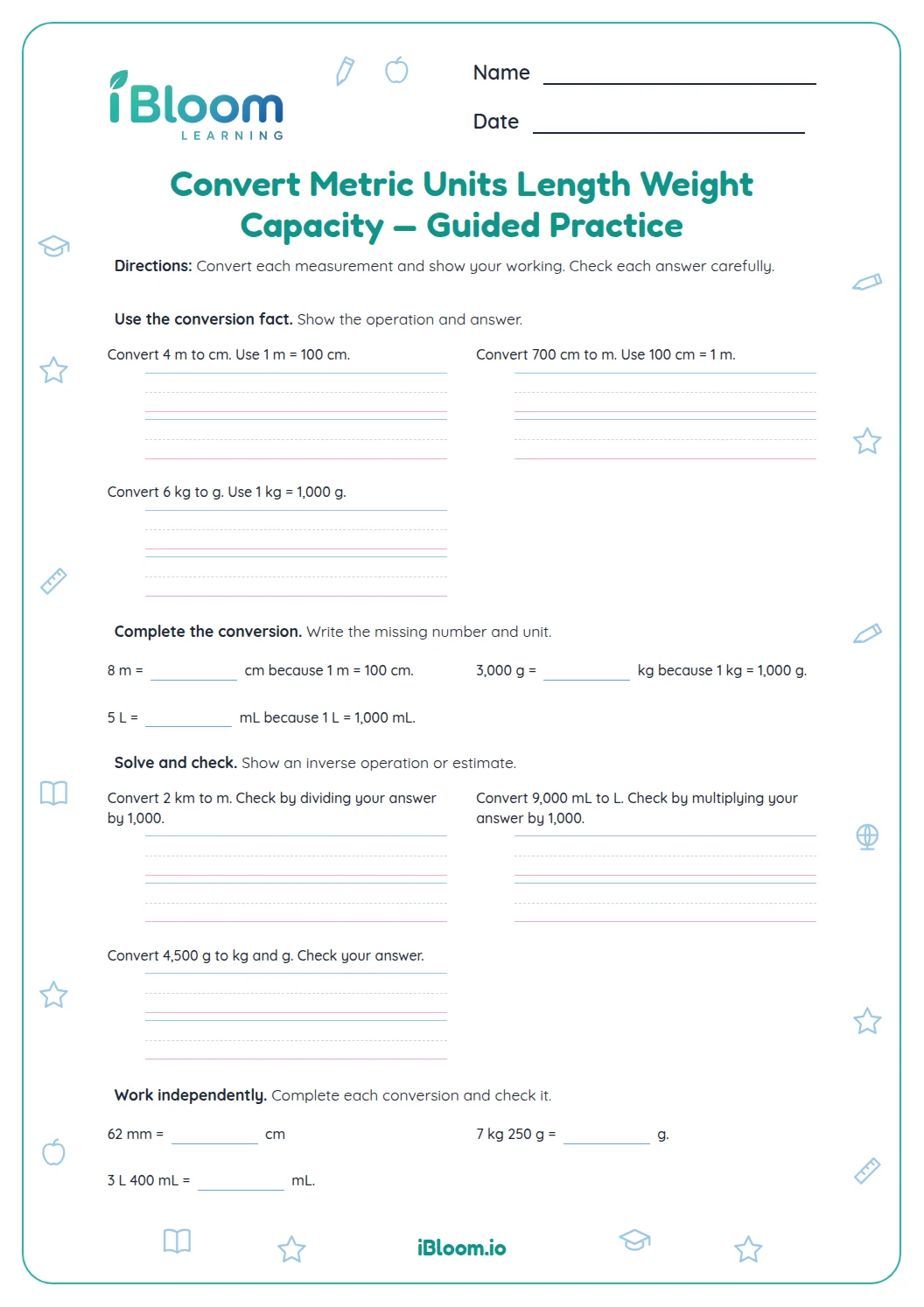
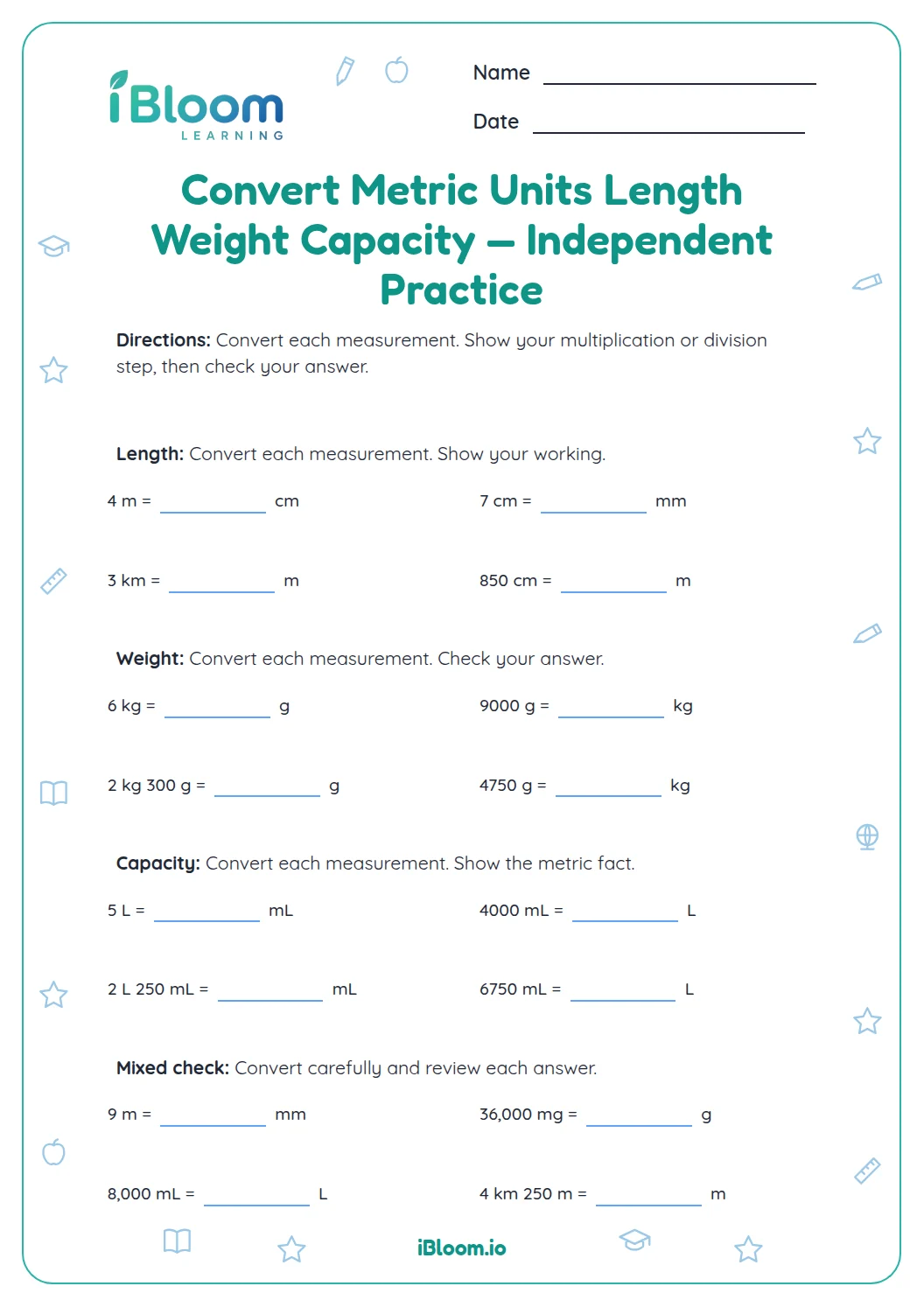
About this worksheet
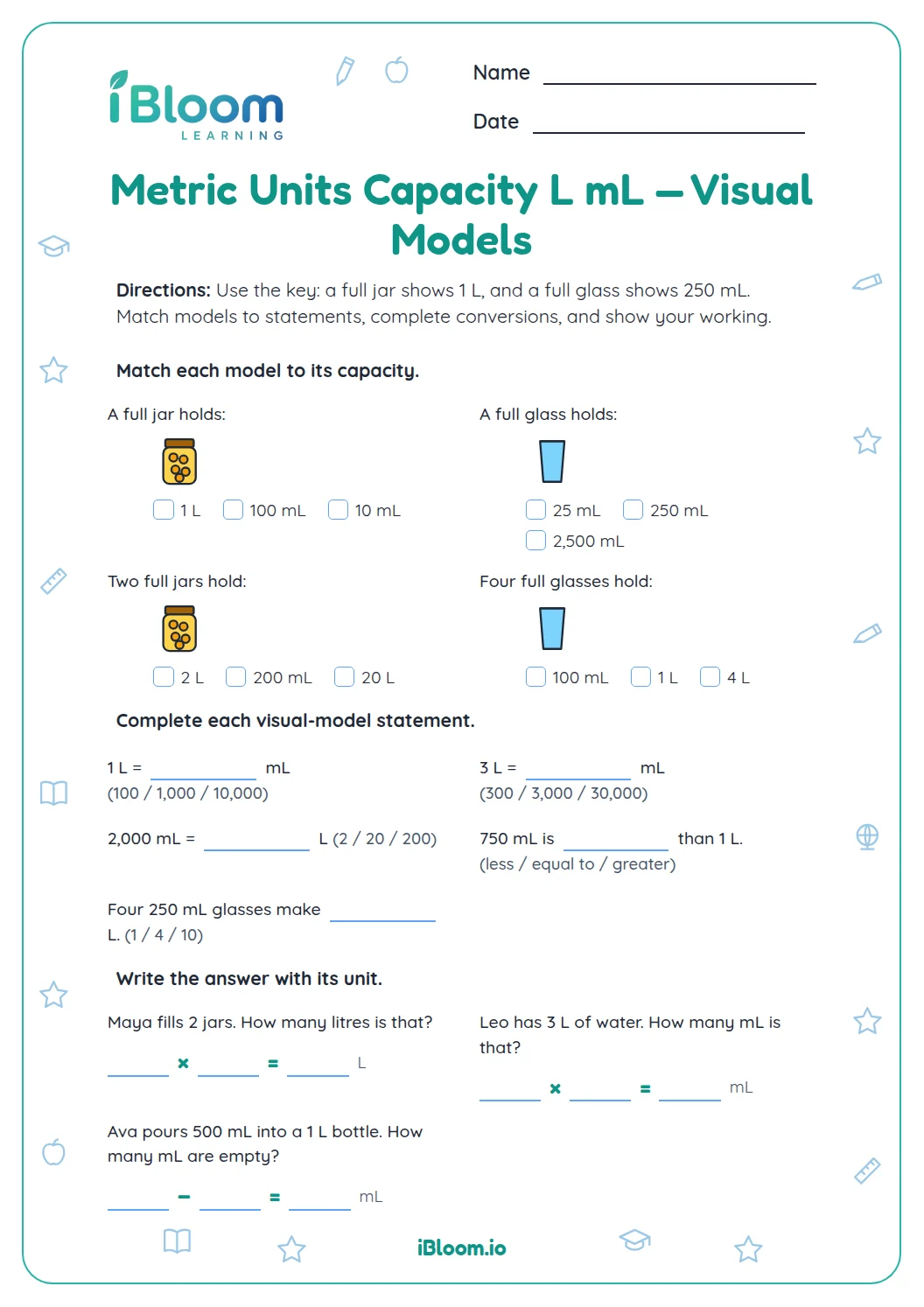
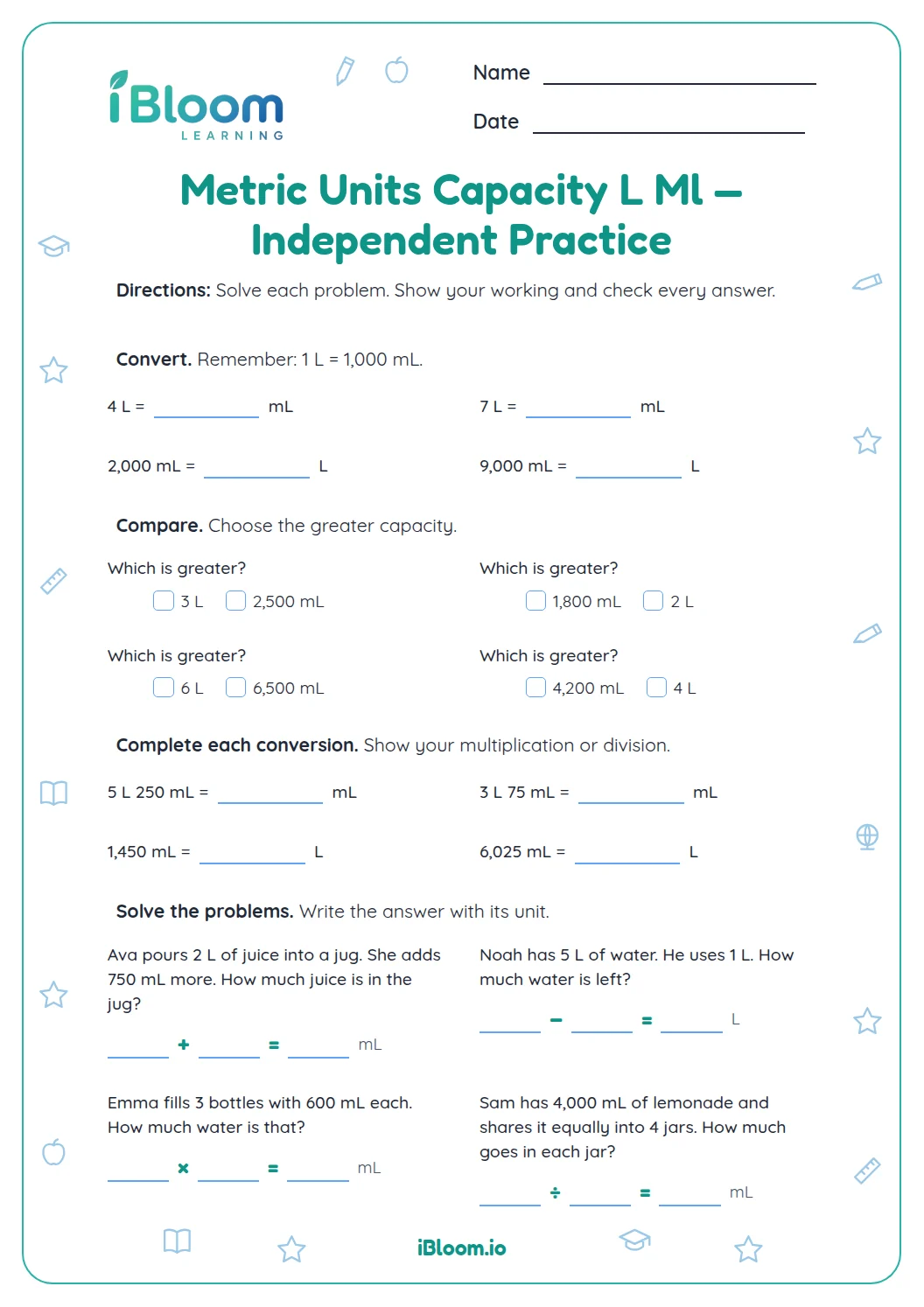
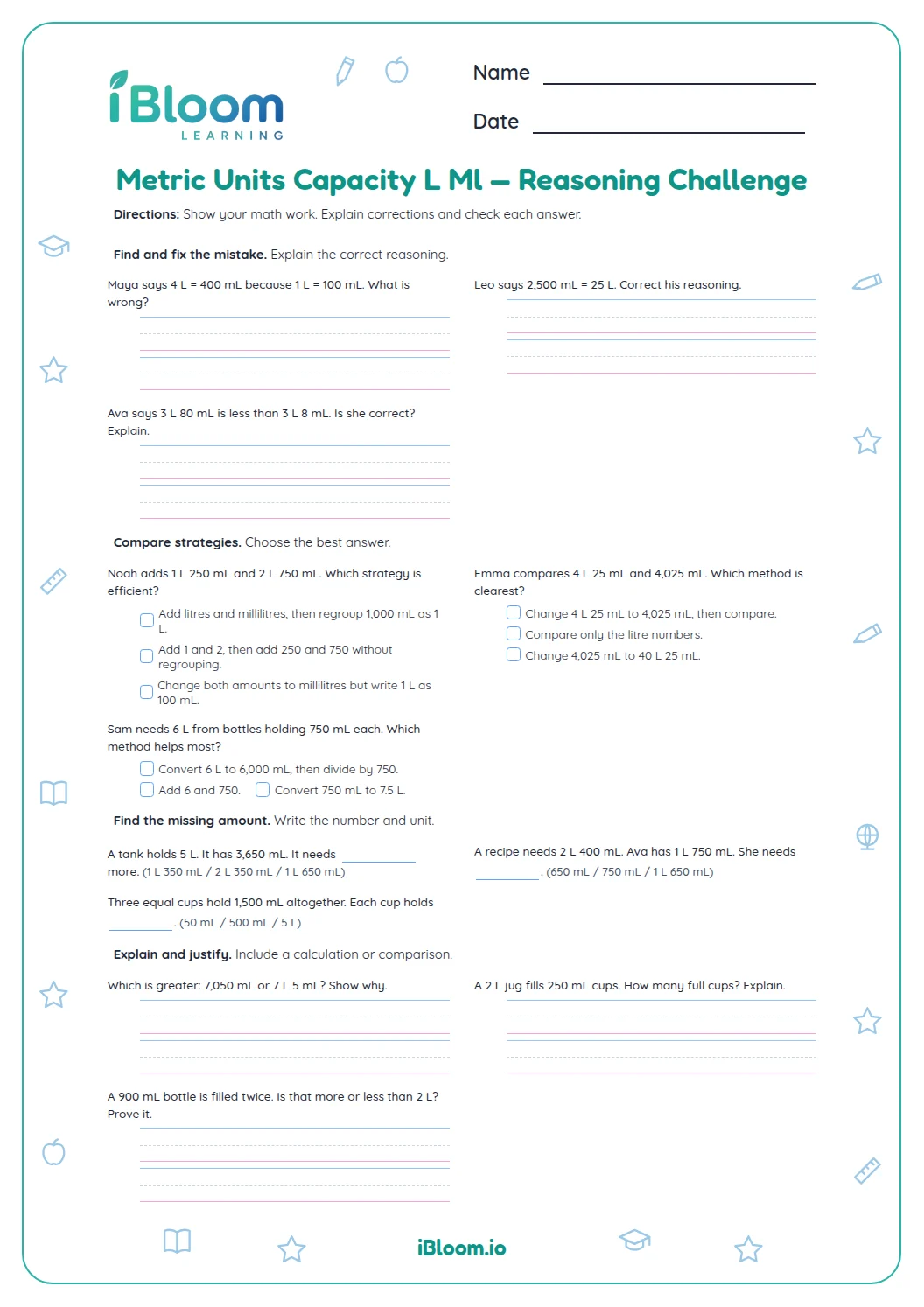
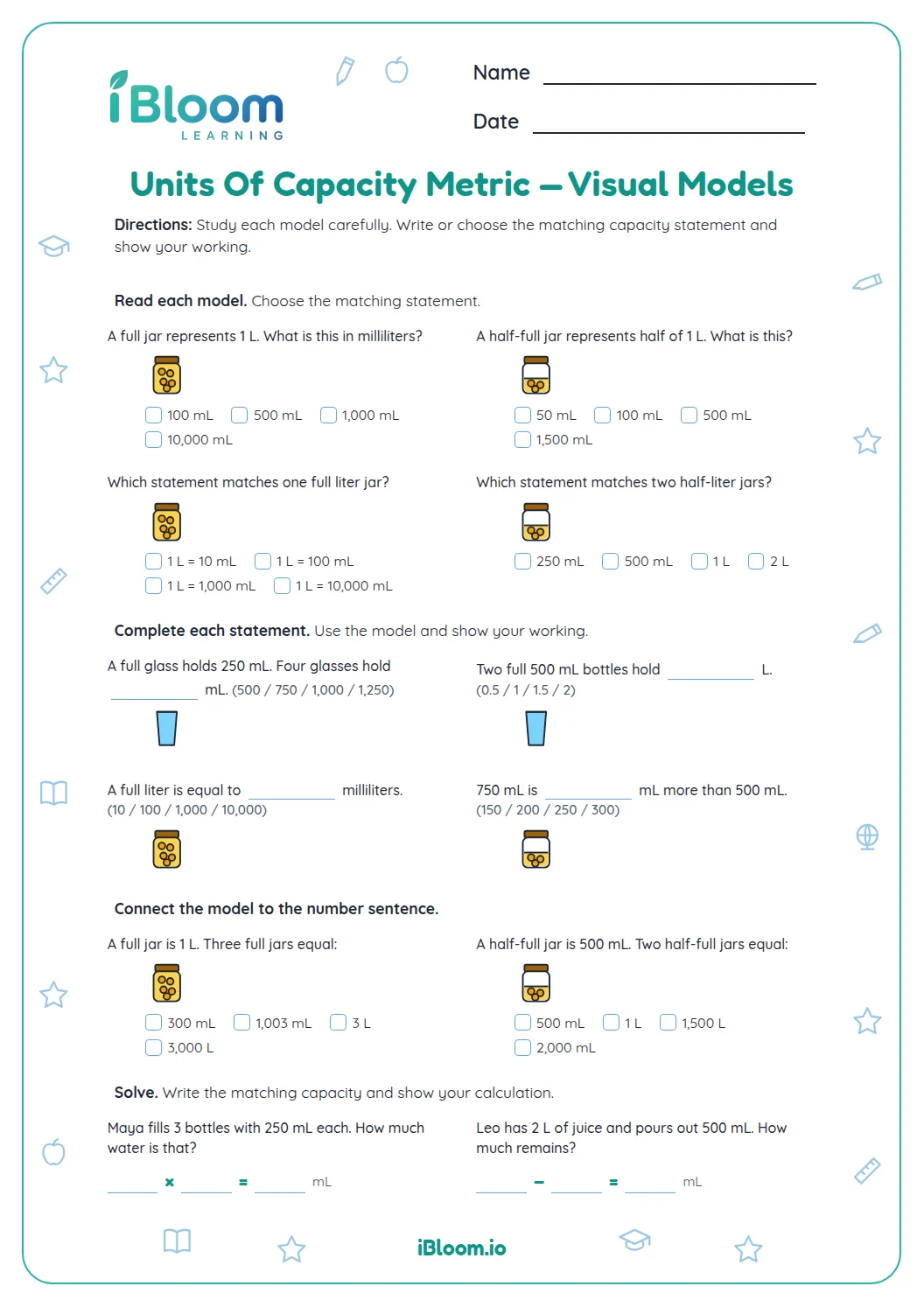
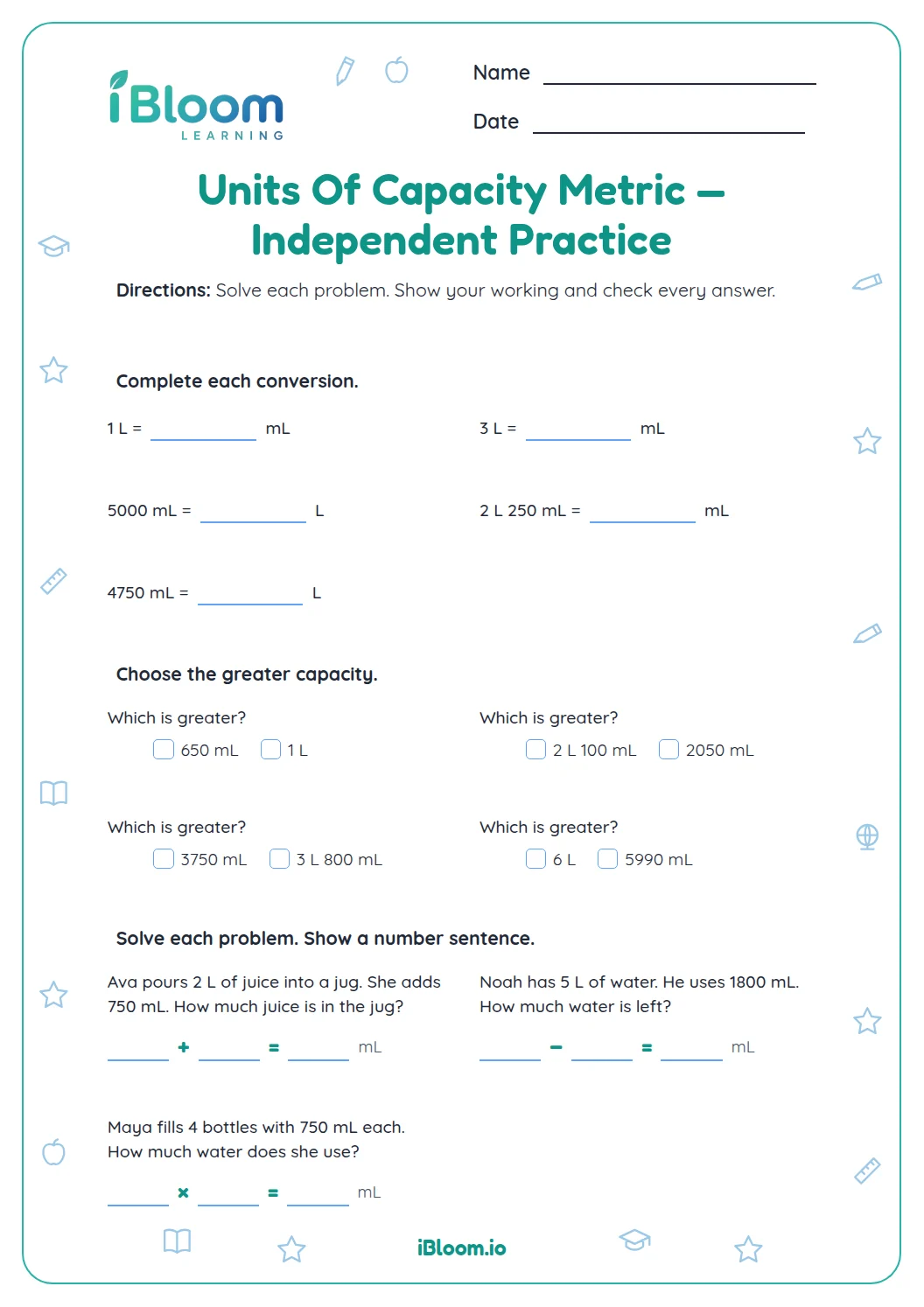
This Grade 4 worksheet uses everyday capacity situations to practice liters and milliliters. Students convert between units, combine amounts, find what remains or what will fit, and solve a few multiplication problems. Each of the 15 questions gives room to show an equation and requires a unit in the answer. The answer key lists the calculations and units. The work aligns with CCSS 4.MD.A.1.
Aligned to 4.MD.A.1
How do liters and milliliters relate?
One liter equals 1,000 milliliters. Converting a larger unit to milliliters gives a common unit for combining amounts. Convert milliliters to liters by grouping thousands.
- 13 L = 3 × 1,000 mL = 3,000 mL.
When should you convert before calculating?
If a story combines liters and milliliters, rewrite both amounts in the same unit first. Then add or subtract and include that unit in the answer.
- 11 L + 750 mL = 1,000 mL + 750 mL = 1,750 mL.
How can you check a capacity answer?
Check that the answer is sensible compared with the starting amount. For example, removing 1,250 mL from 4 L should leave a little less than 3 L, which is 2,750 mL.
How to use this worksheet
- 1Underline the amount and the unit in the question.
- 2Convert liters to milliliters when the amounts use different units.
- 3Choose addition, subtraction, or multiplication to match the story.
- 4Write an equation before calculating.
- 5Include the requested capacity unit and estimate to check.
Common mistakes and quick fixes
The mistake
Adding liters directly to milliliters.
The fix
Convert liters to milliliters first, or convert milliliters to liters.
The mistake
Subtracting in the wrong order for “how much remains.”
The fix
Start with the amount available and subtract the amount used.
The mistake
Leaving off the unit.
The fix
Write L or mL to show what the numerical answer measures.
Common Core alignment
These problems use metric capacity units and record equivalent measures.
Express larger metric capacity units in smaller units and use equivalents in problems.
On this sheet: Students convert between L and mL and use those equivalent measures in capacity problems.
Show the official wordingHide the official wording
Know relative sizes of measurement units within one system of units including km, m, cm; kg, g; lb, oz.; l, ml; hr, min, sec. Within a single system of measurement, express measurements in a larger unit in terms of a smaller unit. Record measurement equivalents in a two-column table. For example, know that 1 ft is 12 times as long as 1 in. Express the length of a 4 ft snake as 48 in. Generate a conversion table for feet and inches listing the number pairs (1, 12), (2, 24), (3, 36), …
What to practice next
Make more practice
Further reading
Questions parents and teachers ask
How many milliliters are in 1 liter?
One liter equals 1,000 milliliters. To convert liters to milliliters, multiply the number of liters by 1,000; to convert an amount in milliliters to liters, group the milliliters into thousands. The first part asks students to use this relationship in direct conversions and short stories.
How many problems are on the worksheet?
There are 15 capacity problems in three parts. They include direct conversions, addition and subtraction in everyday situations, and multi-step capacity questions. Each item provides space for an equation, and the answer key includes the unit so students can check both the calculation and what the number measures.
Why convert to one unit before adding?
Liters and milliliters describe different-sized units. Convert one amount so both quantities use the same unit, then add or subtract. For example, 1 L + 750 mL becomes 1,000 mL + 750 mL, or 1,750 mL. Keeping the unit beside each amount helps prevent mixing unlike units.
Should answers include units?
Yes. Include the unit named in the question, such as L or mL, because the number alone does not say what capacity it measures. The worksheet directions ask for a labeled answer, and the key shows units for every result so students can check the calculation and its meaning.
How can students check a subtraction answer?
Check that the amount left is smaller than the starting amount by exactly the amount used. For example, 4 L is 4,000 mL, and 4,000 − 1,250 = 2,750 mL. Adding 2,750 mL and 1,250 mL should return the original 4,000 mL.