

About this worksheet
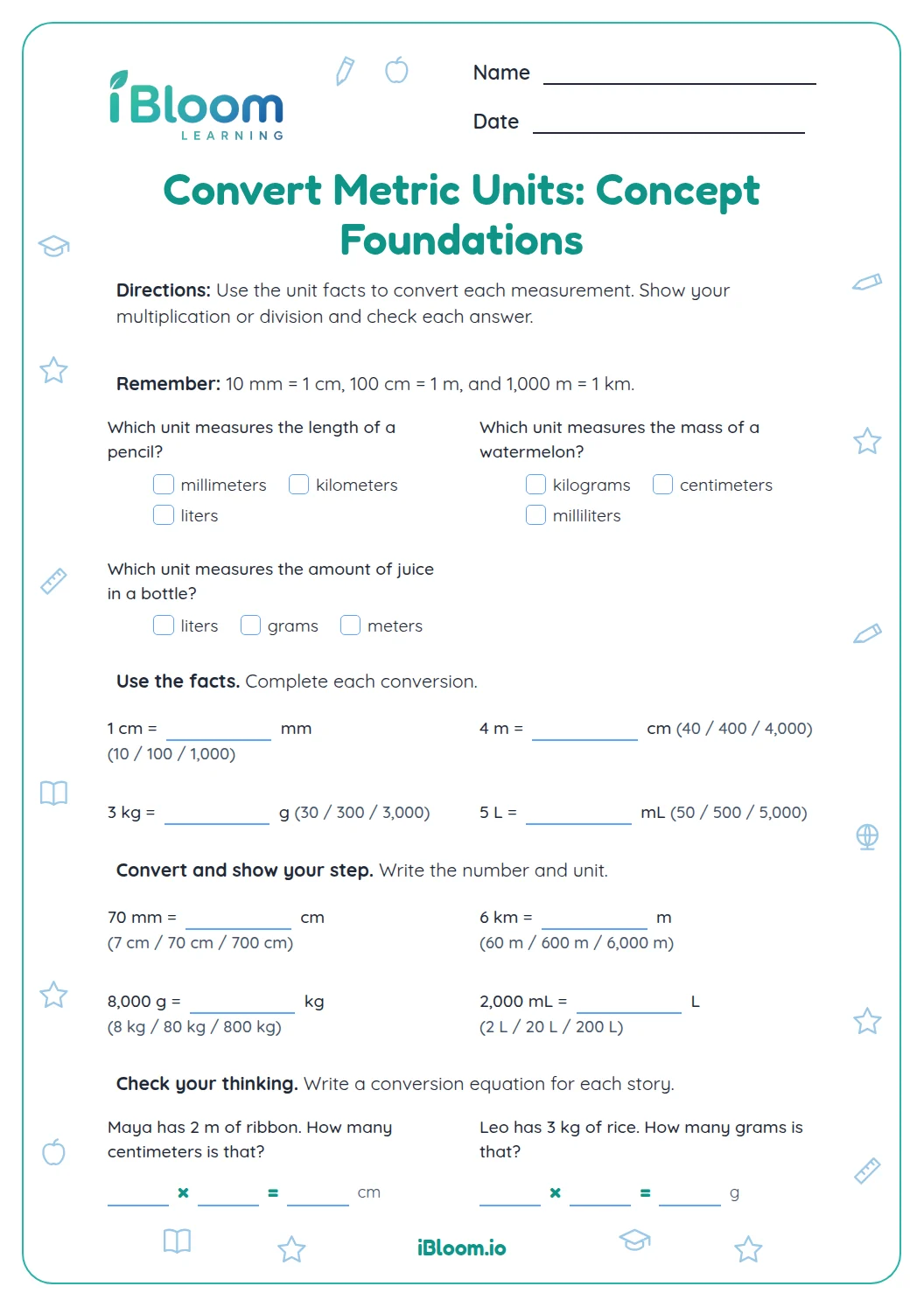
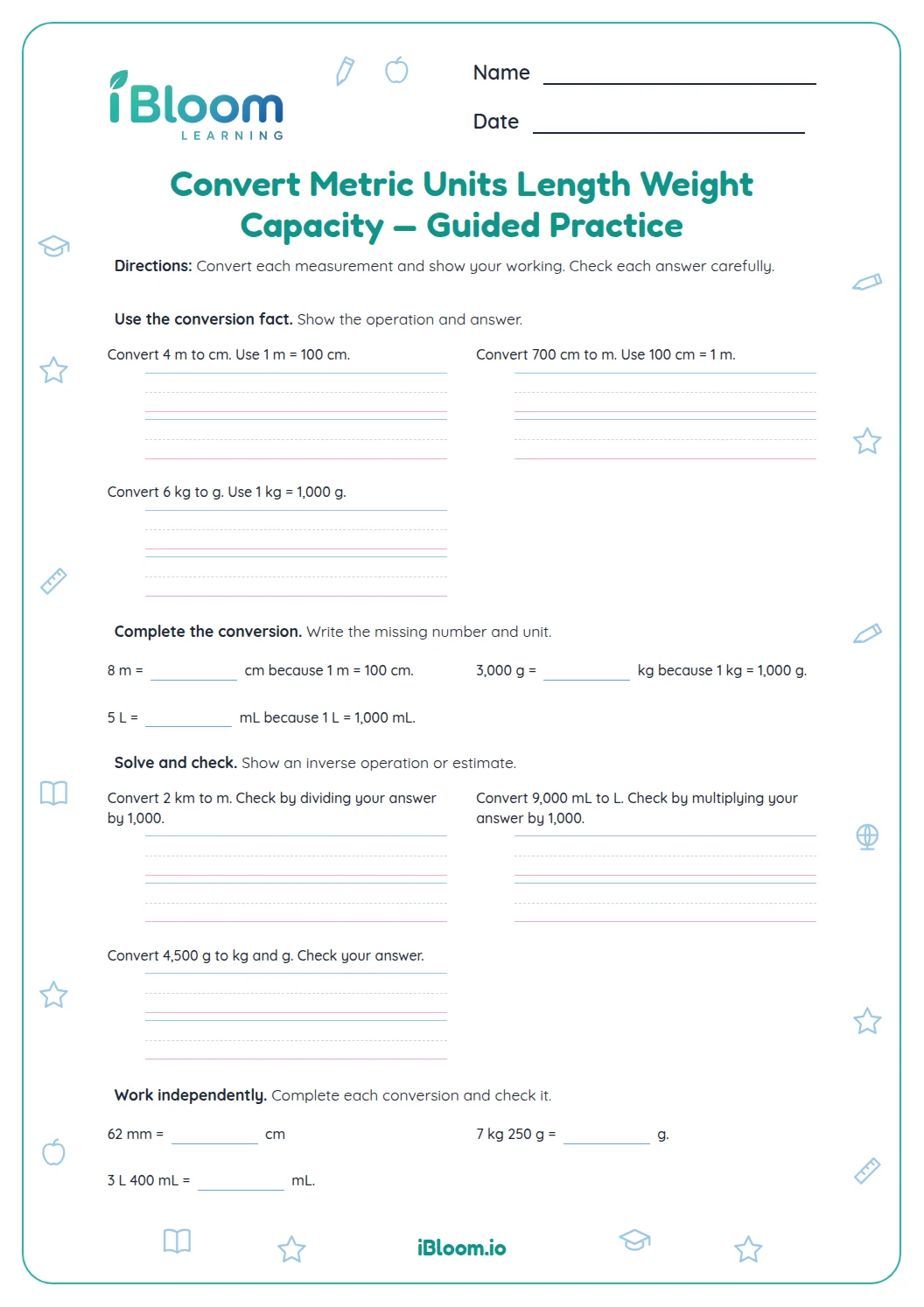
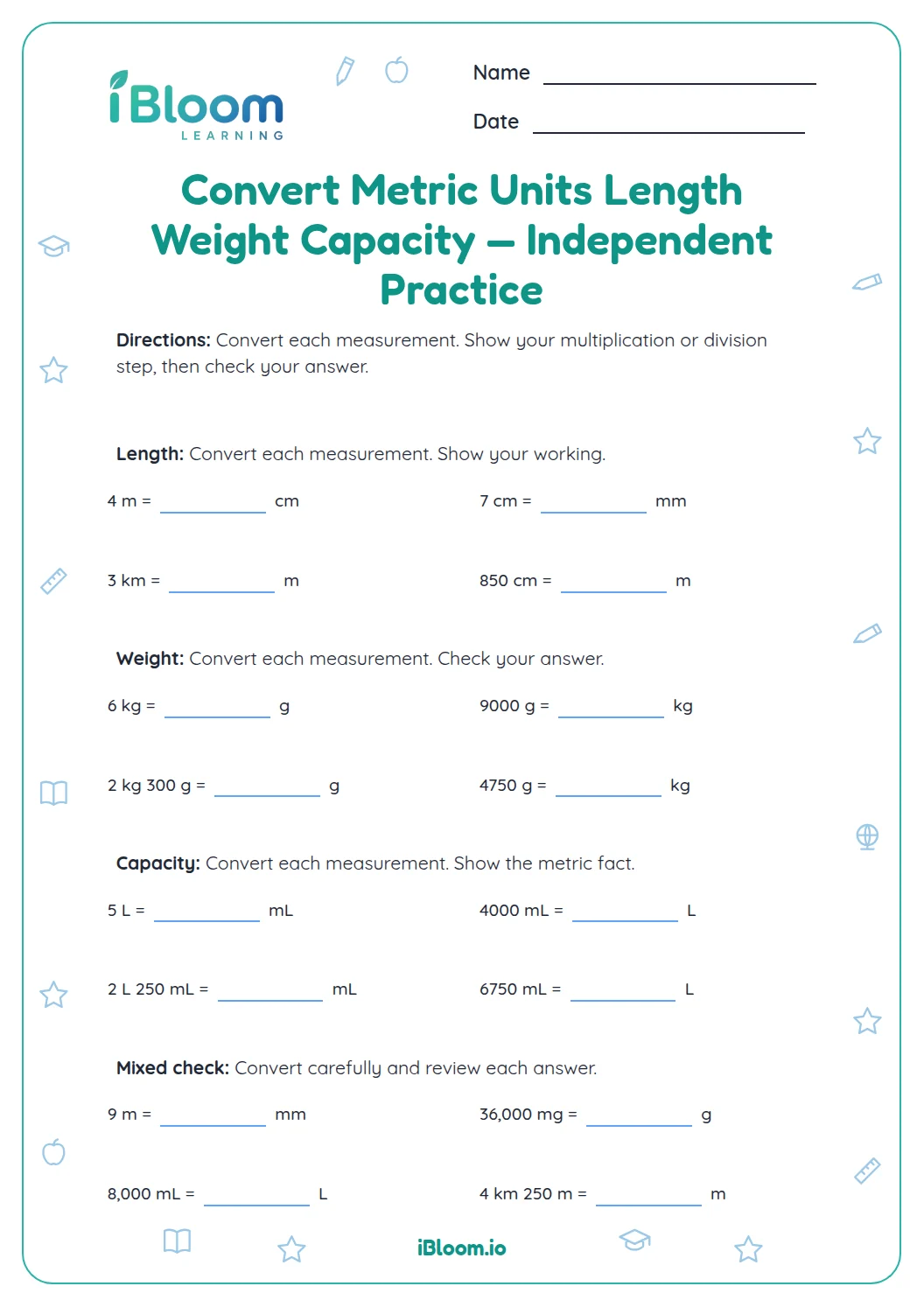
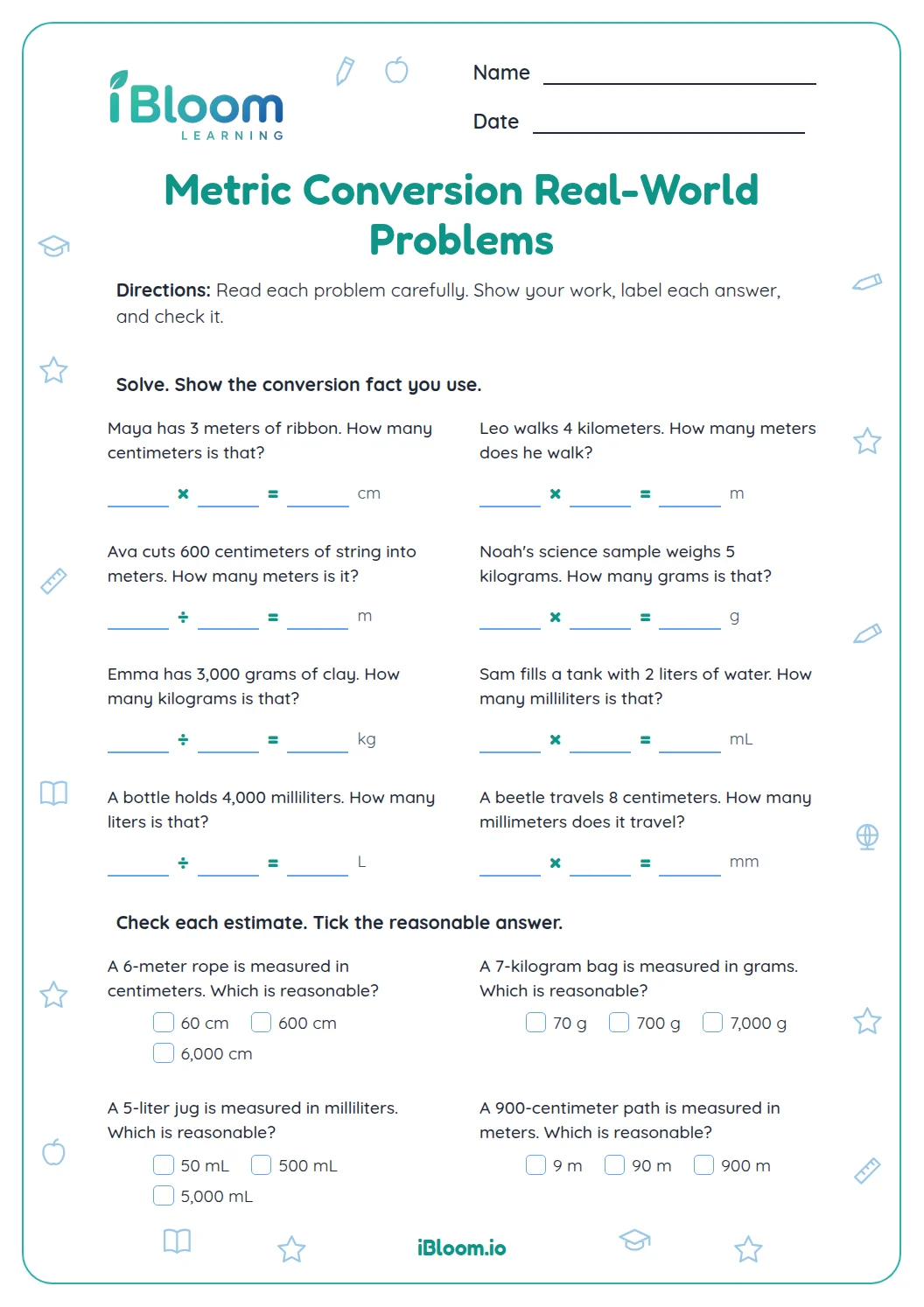
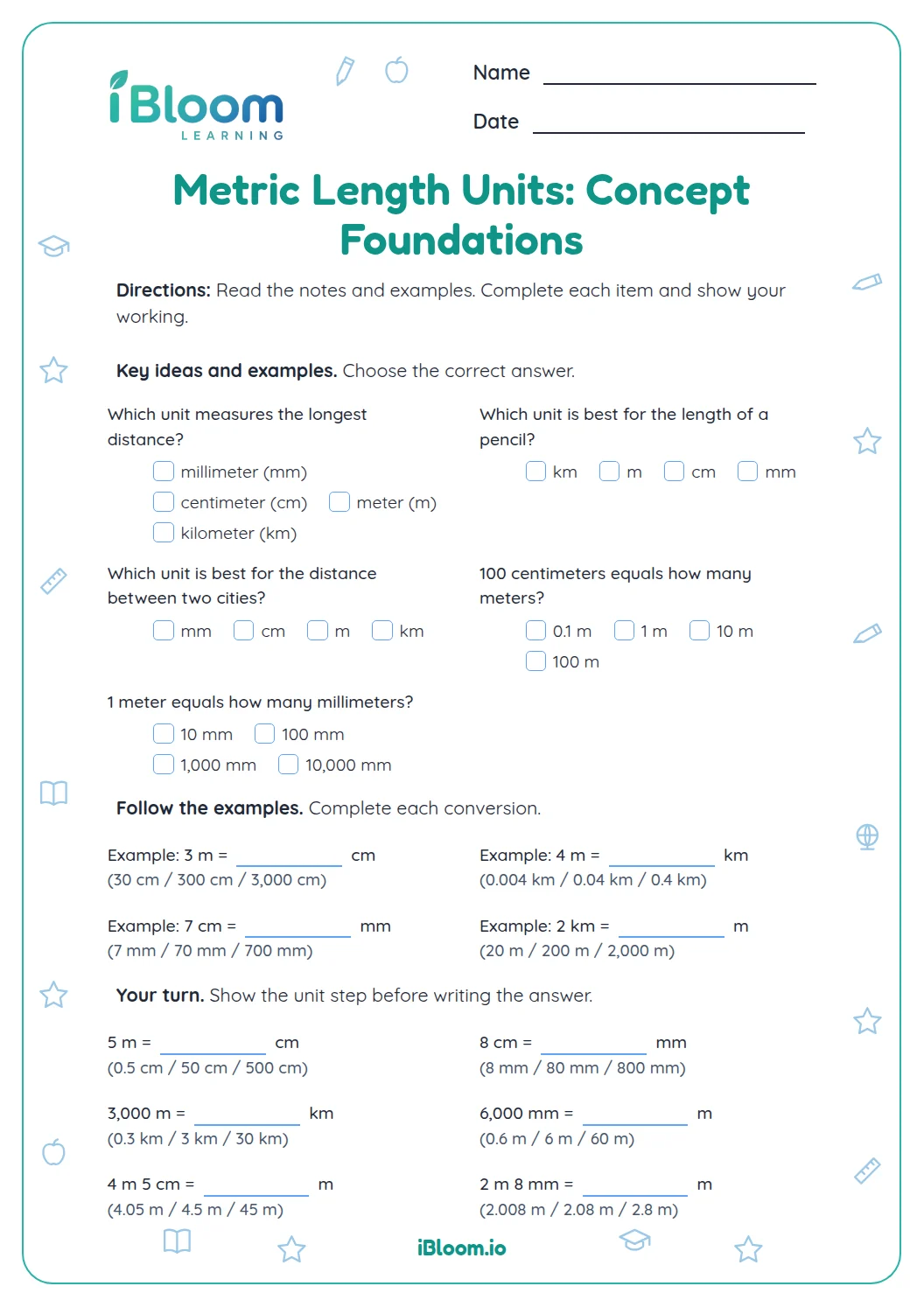
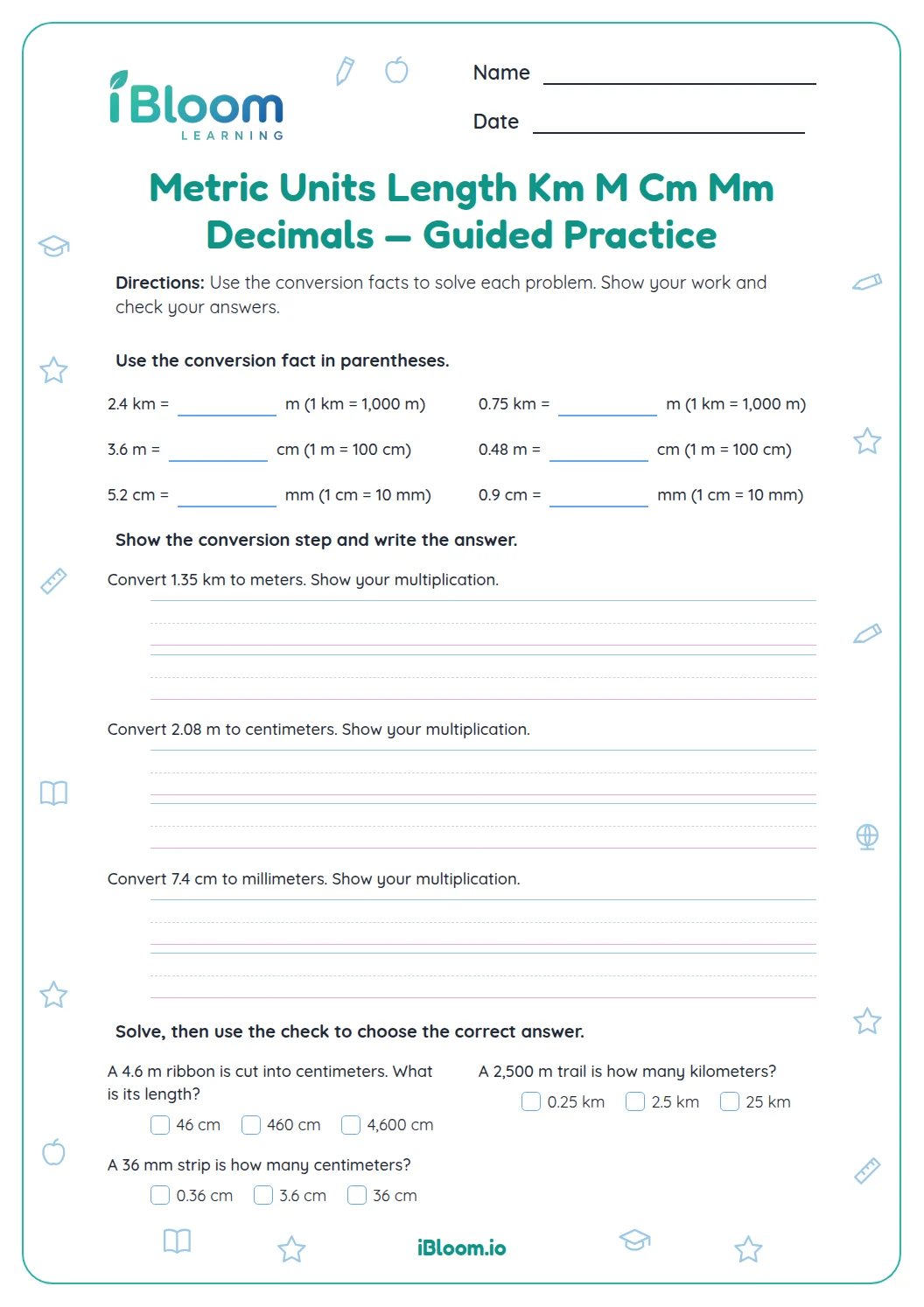
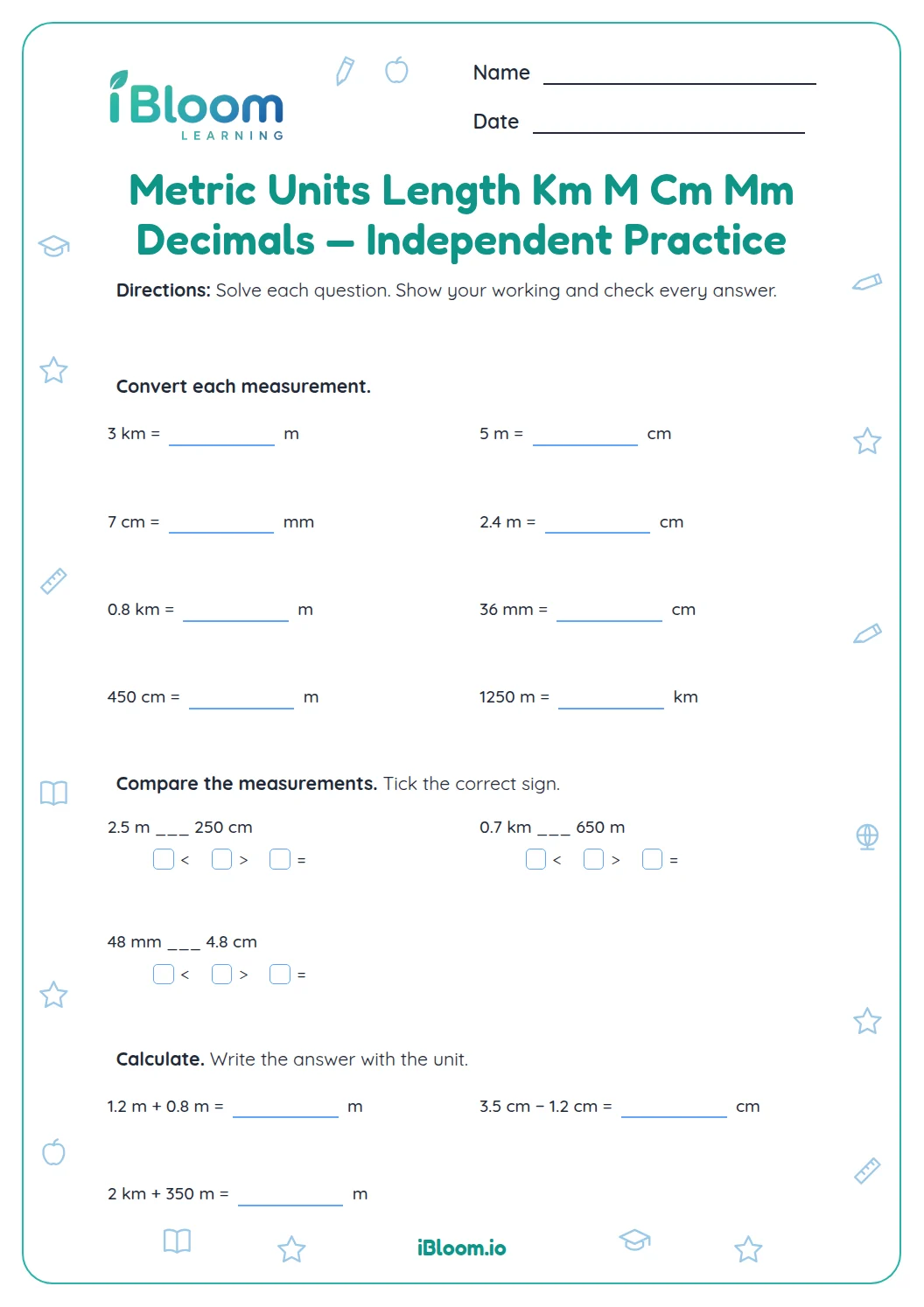
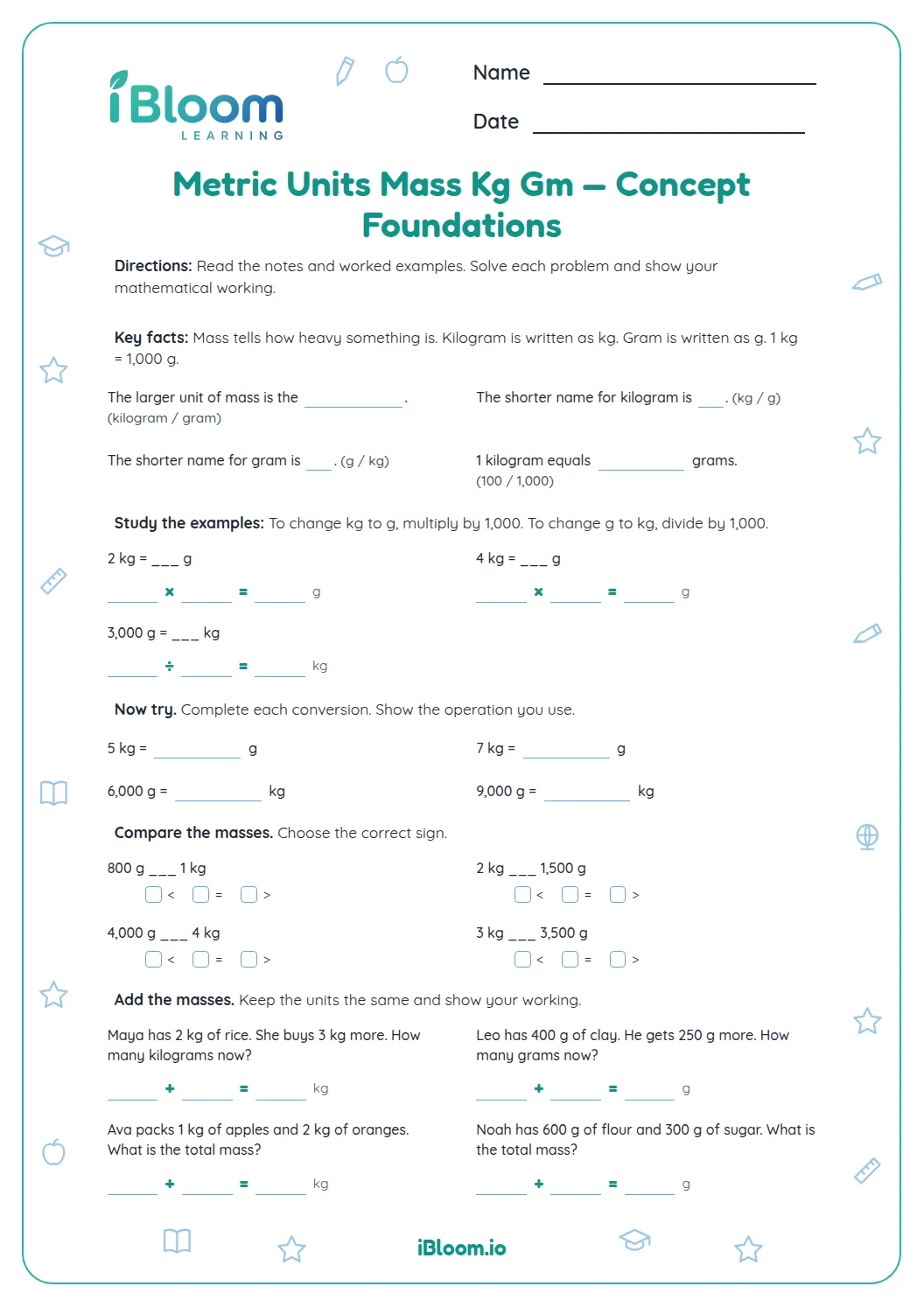
This free Grade 4 printable practices converting metric units of length, mass, and capacity within each measurement system. Students complete a kilometer-to-meter table, convert among metric units, and solve four measurement situations. The 17 questions are organized in three parts over two worksheet pages, with a separate two-page answer key. The work connects to Common Core 4.MD.A.1, including recording equivalent measurements in a table.
Aligned to 4.MD.A.1
What is on the metric conversion sheet?
The 17 questions use three parts: a kilometers-to-meters table, direct conversions across length, mass, and capacity, and four applied problems. The units stay within their own families: meters with kilometers, grams with kilograms, and milliliters with liters.
How does the table show a metric relationship?
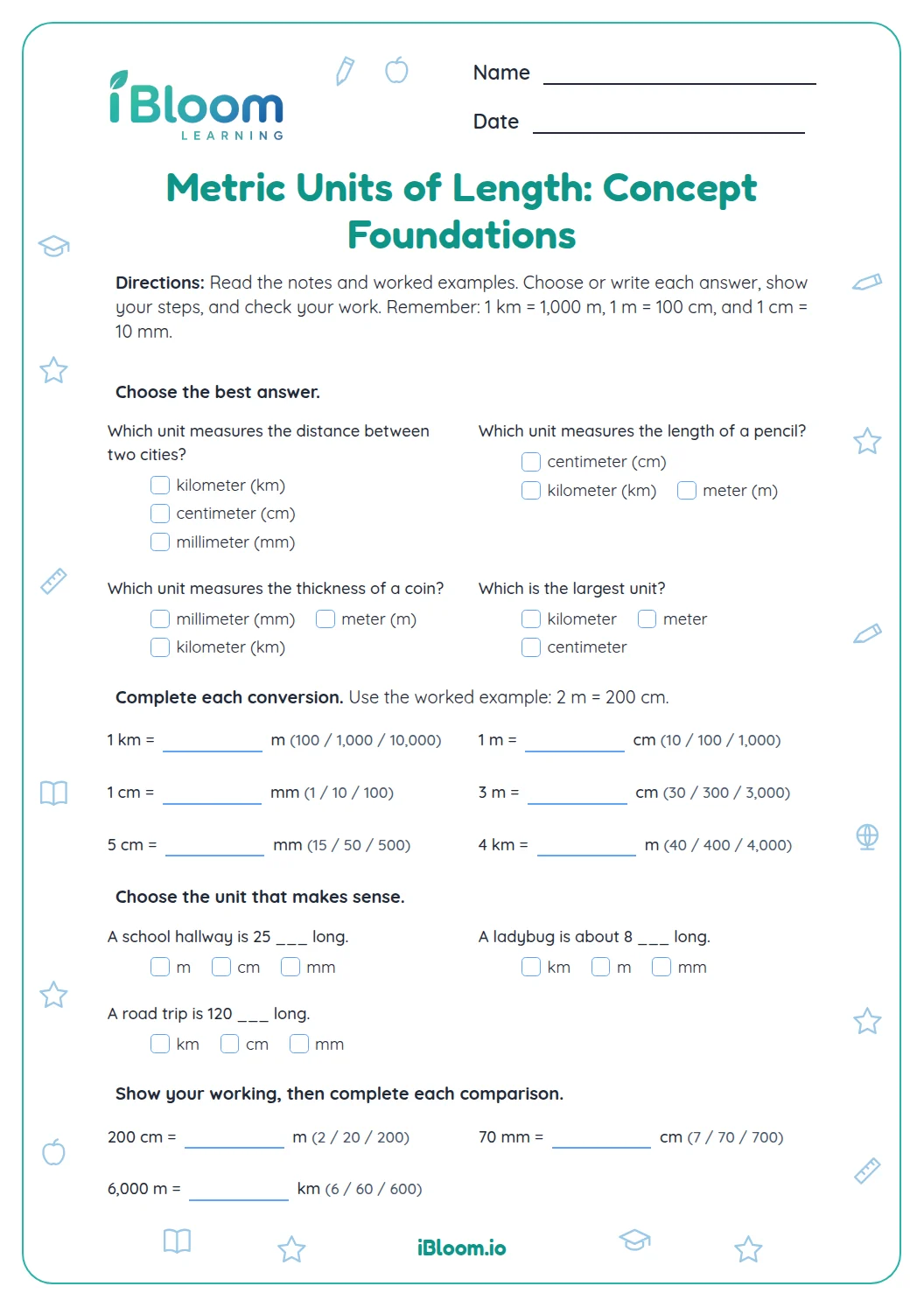
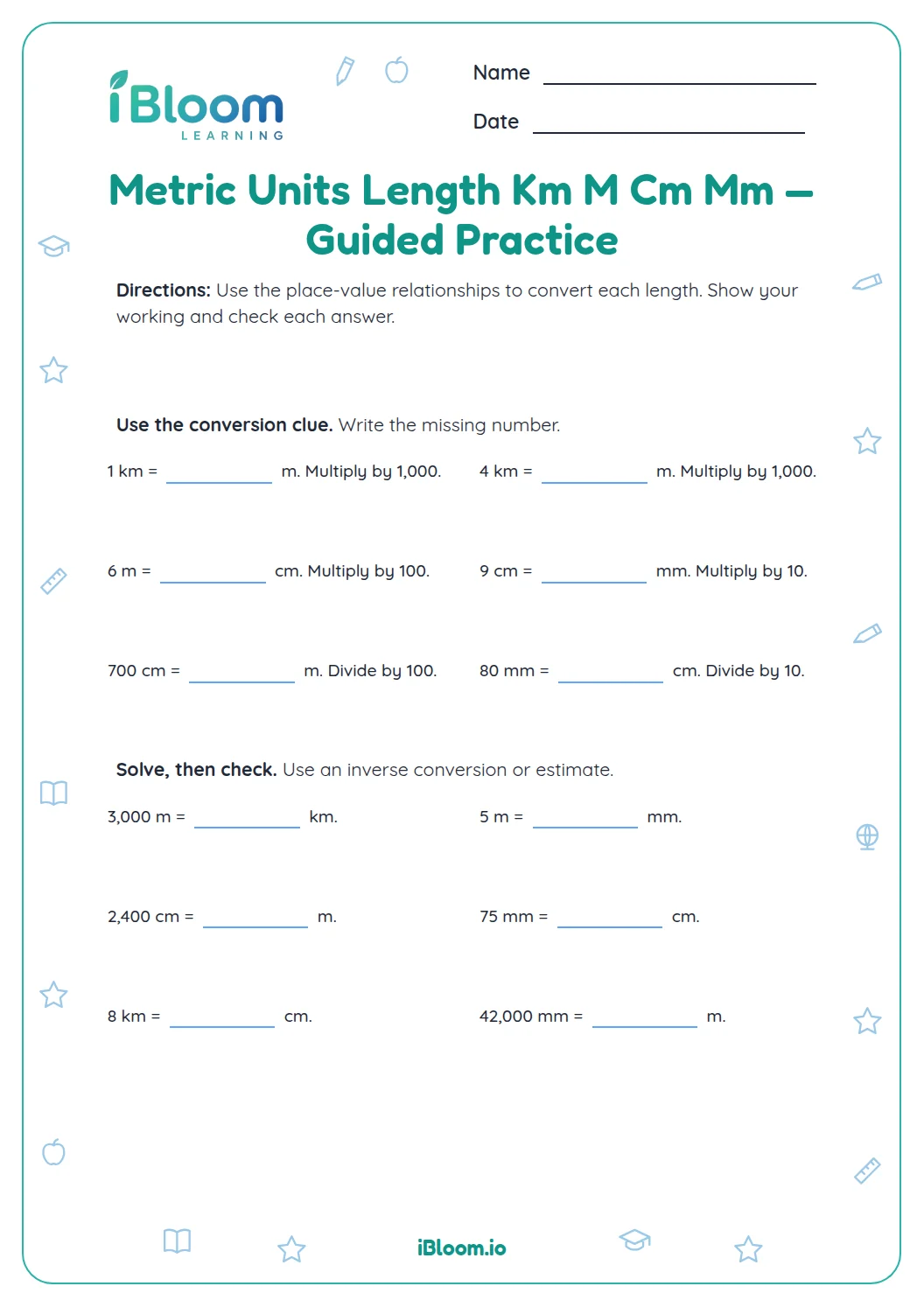
The first table pairs kilometers with meters. Each kilometer equals 1,000 meters, so 3 kilometers equal 3,000 meters. The missing entry can be found by multiplying 3 by 1,000.
- 13 km = 3 × 1,000 m
- 23 km = 3,000 m
- 3The missing table entry is 3,000.
How do you choose multiply or divide?
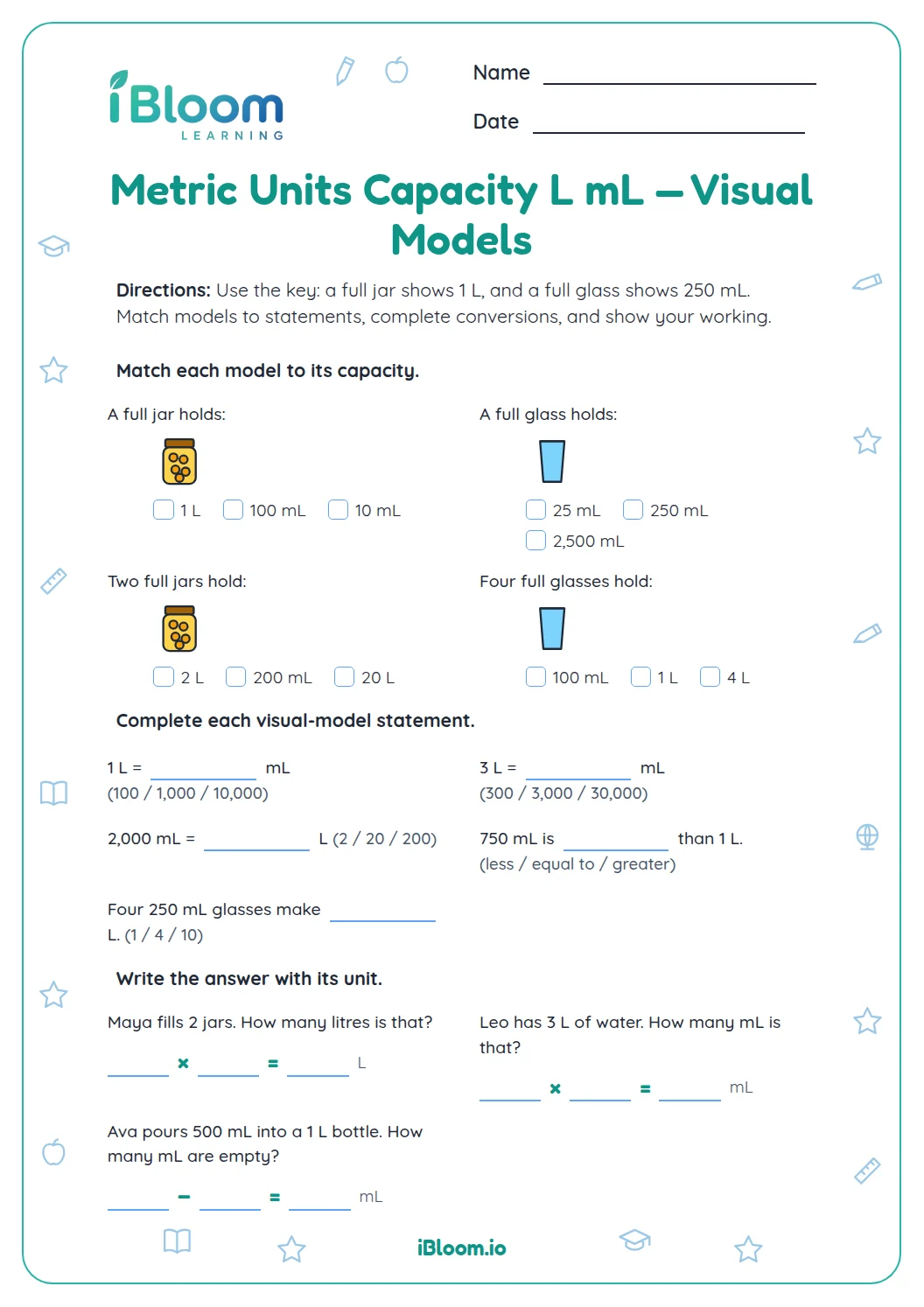
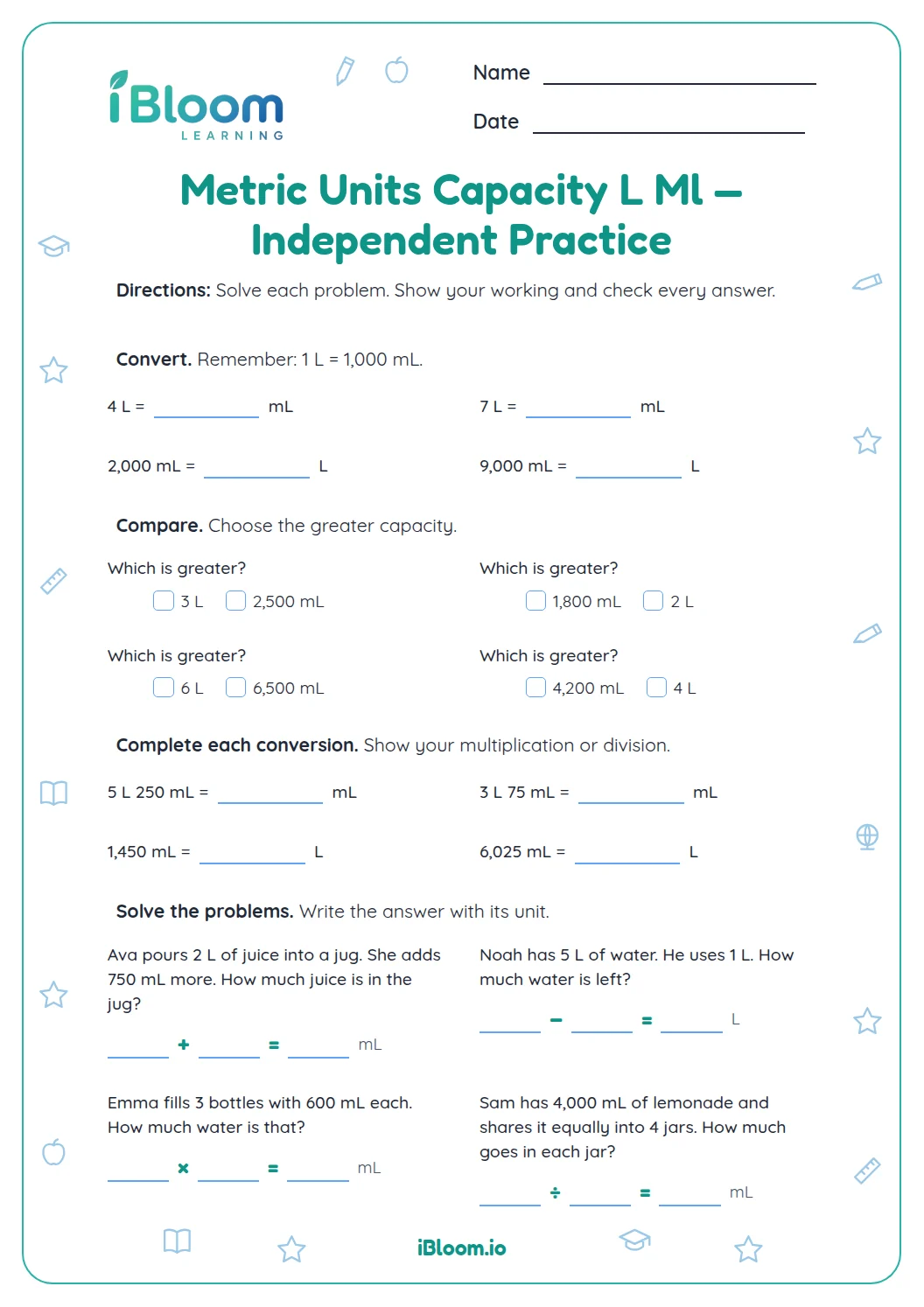
When changing to a smaller unit, the number of units increases: 4 meters equal 400 centimeters. When changing to a larger unit, the number decreases: 3,500 meters equal 3.5 kilometers. Check that the unit named in the prompt appears in the answer.
How do mixed-unit situations work?
Convert the larger unit into the smaller unit, then combine. For 2 kilometers 350 meters, change 2 kilometers to 2,000 meters and add 350 to get 2,350 meters. The last problem also uses repeated groups of 750 milliliters.
How to use this worksheet
- 1Identify the unit you start with and the unit requested.
- 2Recall how many smaller units make one larger unit.
- 3Multiply when converting to a smaller unit; divide to a larger unit.
- 4For mixed units, convert first and then add.
- 5Label each result and estimate to check its size.
Common mistakes and quick fixes
The mistake
Multiplying when converting to a larger unit.
The fix
A larger unit takes fewer units, so divide.
The mistake
Using a length conversion for mass or capacity.
The fix
Keep the unit family together: meters, grams, or liters.
The mistake
Changing the number but not writing the target unit.
The fix
Copy the requested unit beside every result.
Common Core alignment
These Common Core standards describe the central skills practiced on this page.
Express metric measurements in a smaller unit and record equivalents.
On this sheet: The table and calculations convert between metric length, mass, and capacity units.
Show the official wordingHide the official wording
Know relative sizes of measurement units within one system of units including km, m, cm; kg, g; lb, oz.; l, ml; hr, min, sec. Within a single system of measurement, express measurements in a larger unit in terms of a smaller unit. Record measurement equivalents in a two-column table. For example, know that 1 ft is 12 times as long as 1 in. Express the length of a 4 ft snake as 48 in. Generate a conversion table for feet and inches listing the number pairs (1, 12), (2, 24), (3, 36), ...
What to practice next
Make more practice
Further reading
Questions parents and teachers ask
How many metric conversion questions are there?
There are 17 questions in three parts over two worksheet pages. They include a conversion table, direct conversions, and four word problems. A separate answer key takes two pages. A size estimate is a useful final check before the answer is marked.
Why is 3 kilometers equal to 3,000 meters?
One kilometer equals 1,000 meters. Multiply 3 by 1,000 to get 3,000 meters. Question 1 uses this relationship to fill the missing table entry, and question 2 applies it in a conversion equation. A size estimate is a useful final check before the answer is marked.
When should students multiply or divide?
Converting to a smaller unit gives more units, so multiply: 2 kilograms become 2,000 grams. Converting to a larger unit gives fewer units, so divide: 5,000 grams become 5 kilograms. A size estimate is a useful final check before the answer is marked.
How do you convert 3 kilograms 250 grams to grams?
Change 3 kilograms to 3,000 grams, then add the extra 250 grams. The total is 3,250 grams. Keeping both amounts in grams before adding prevents mixing unlike units. A size estimate is a useful final check before the answer is marked.
What does the final bottle problem ask?
It asks for the total amount when a 750-milliliter bottle is filled four times. Multiply 750 by 4 to get 3,000 milliliters, which is 3 liters. The answer key gives the result in liters. A size estimate is a useful final check before the answer is marked.
What can students practice after this sheet?
The linked focused worksheets offer more practice with metric capacity, length, and mass conversions. A single-unit page can help students strengthen one conversion family before returning to mixed practice. A size estimate is a useful final check before the answer is marked.