



About this worksheet
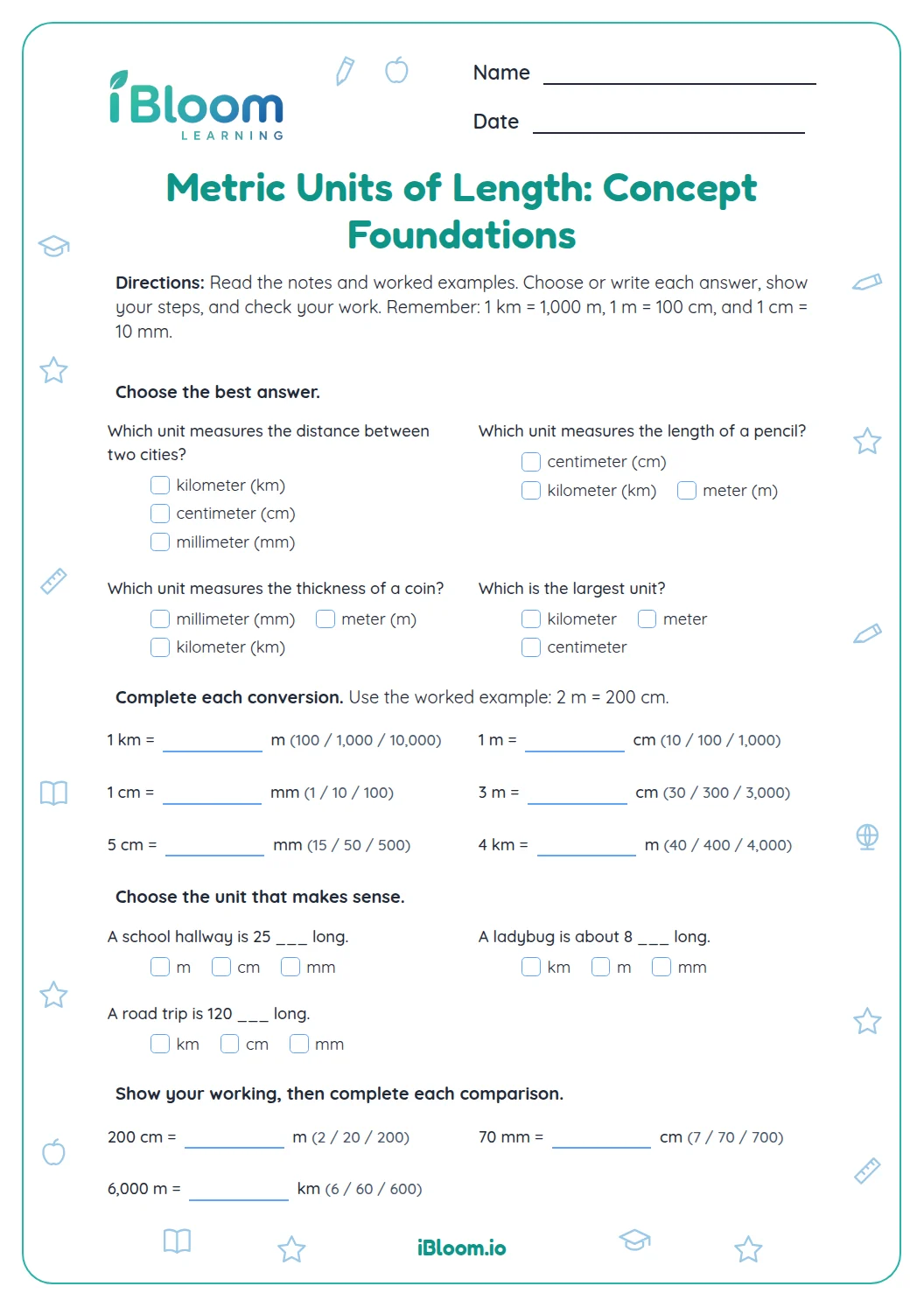
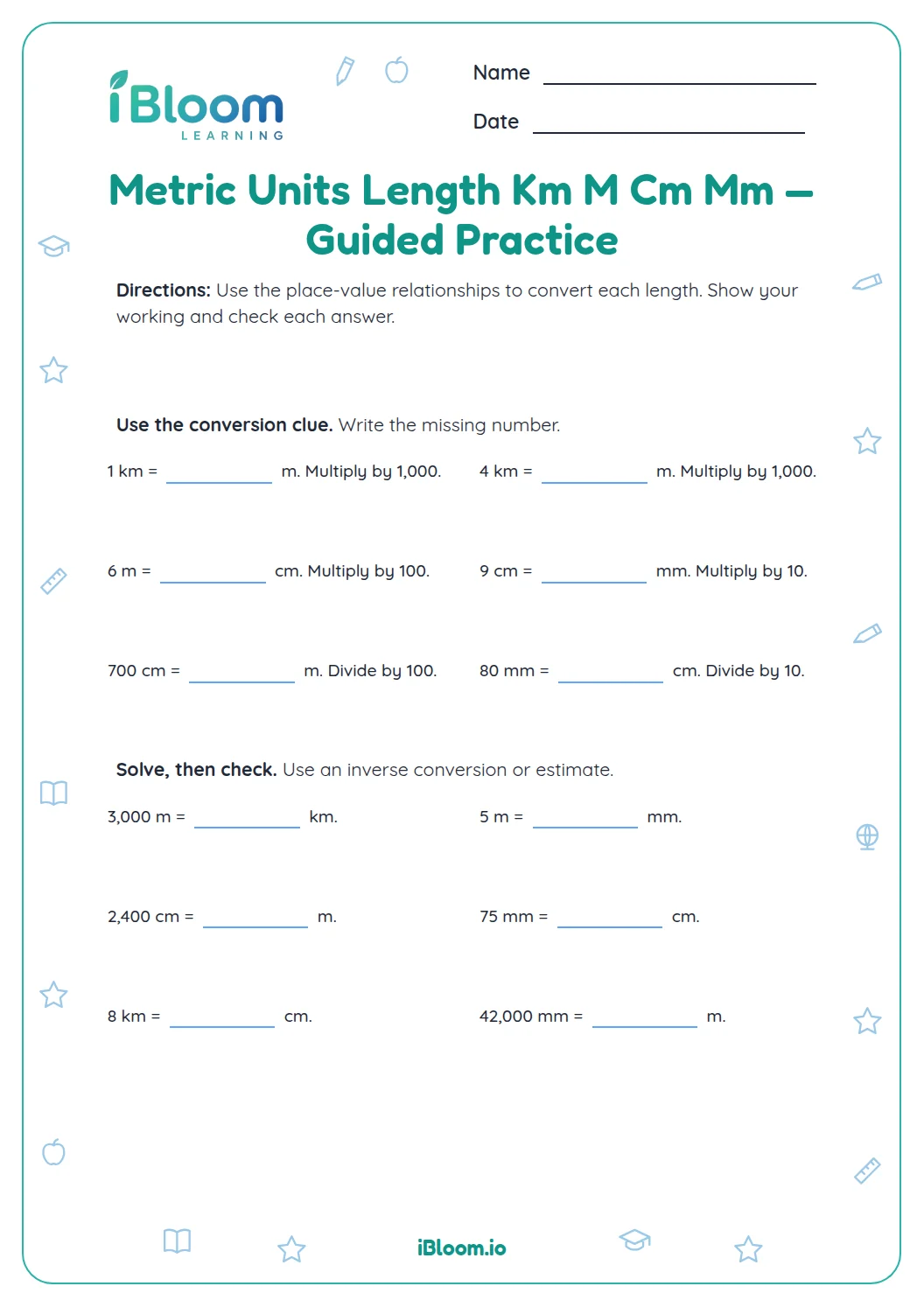
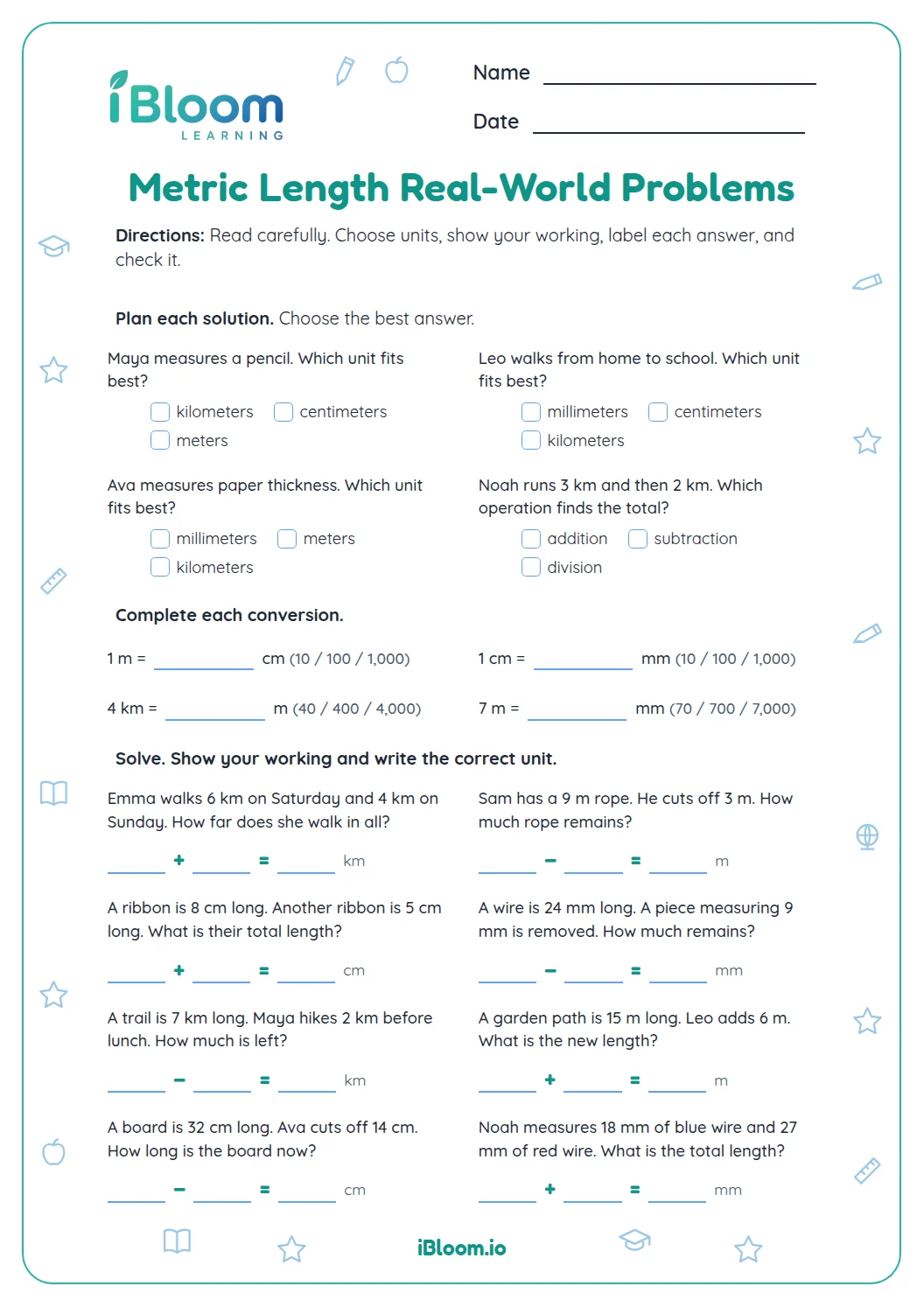
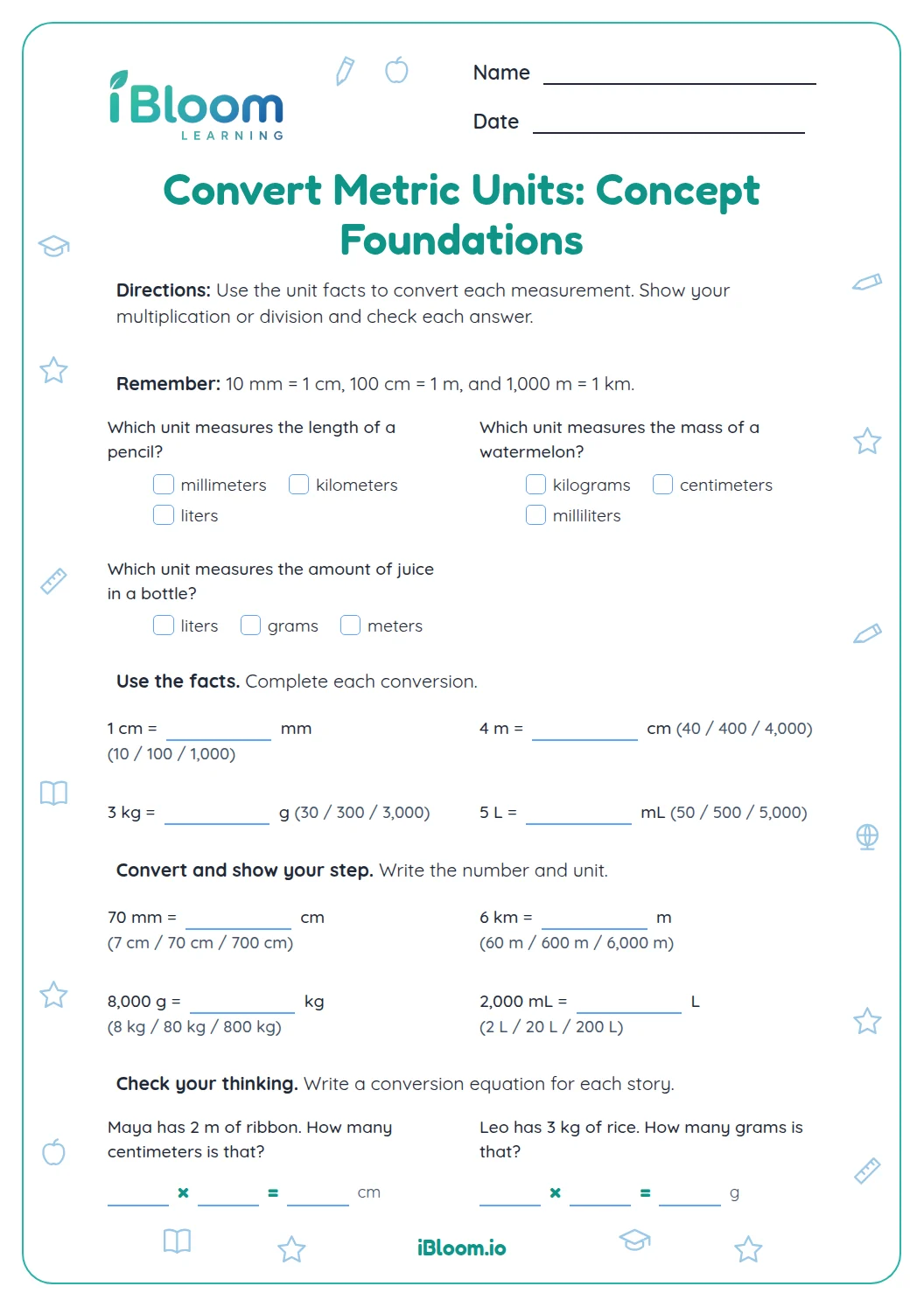
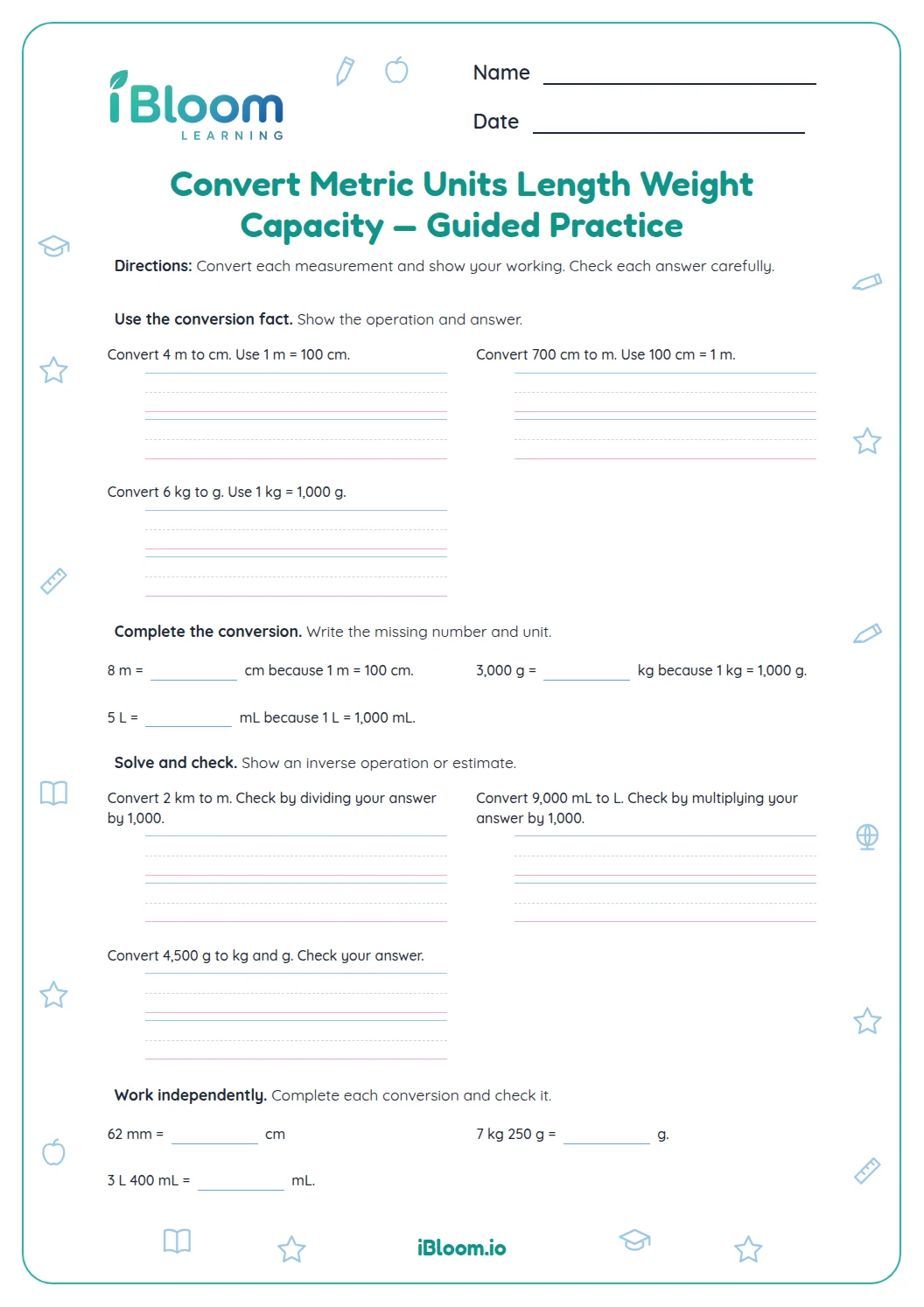
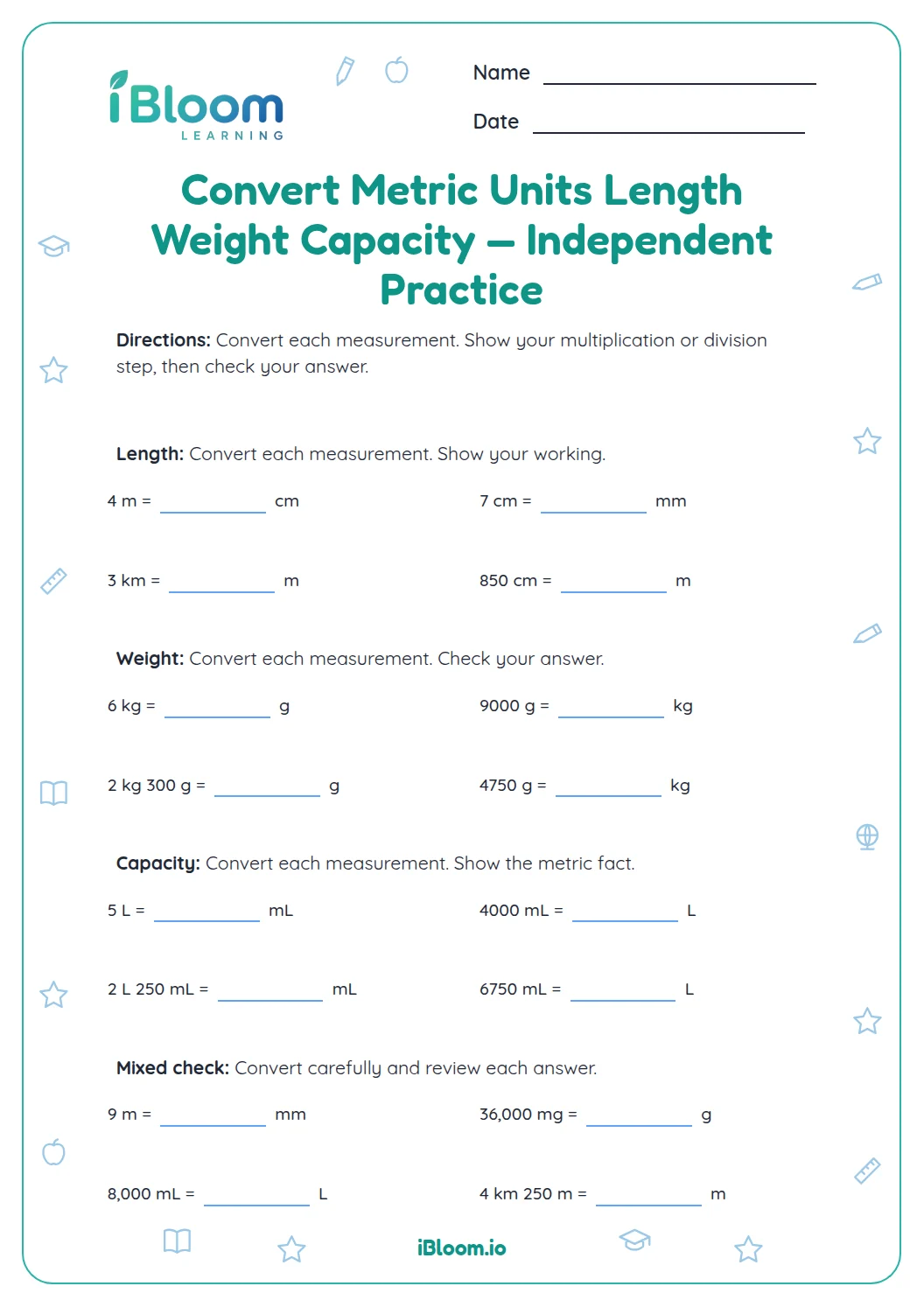
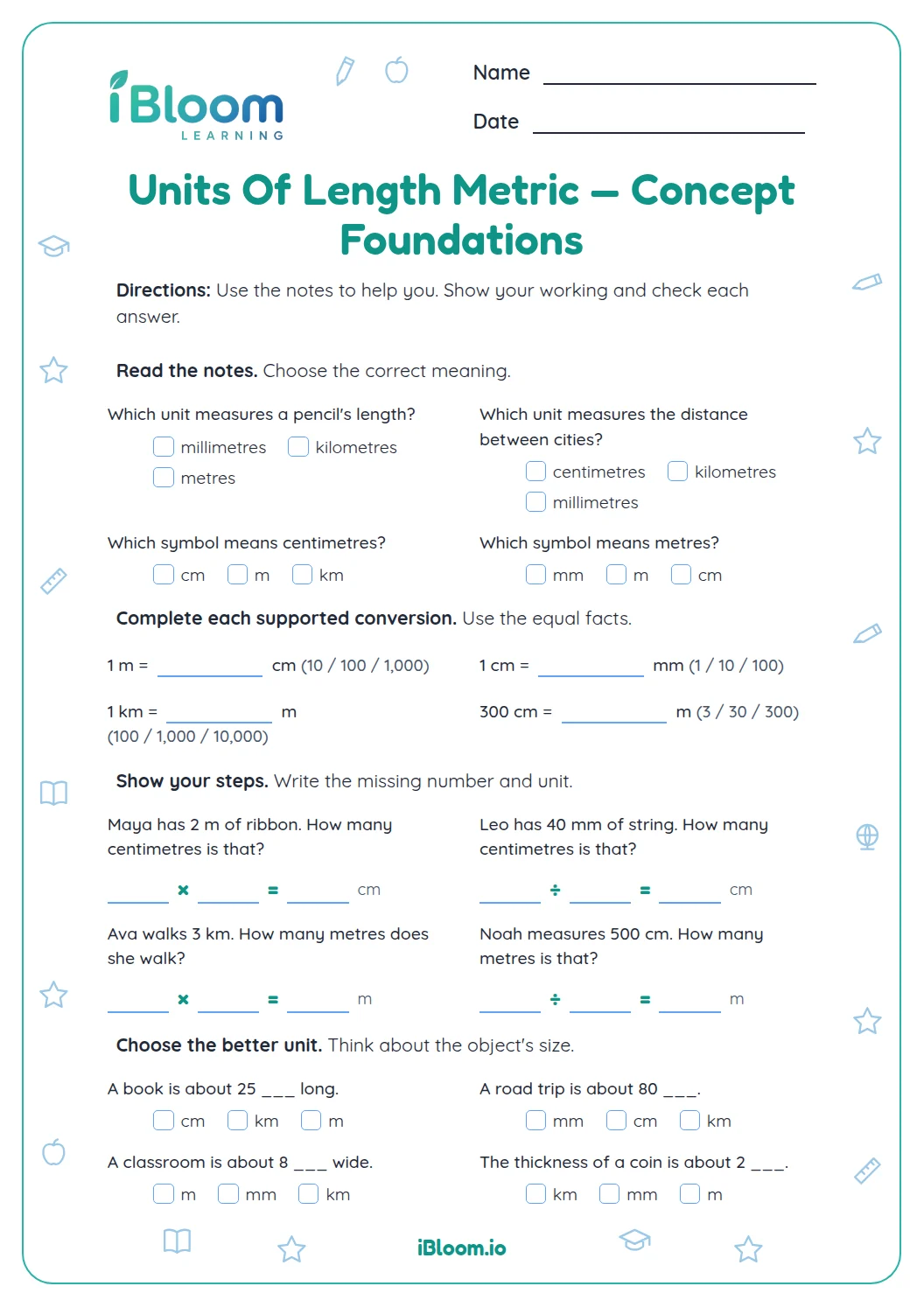
This free Grade 4 worksheet practices metric length conversions among kilometers, meters, centimeters, and millimeters. Four questions include equivalent-length tables, two put conversions into trail and cord contexts, and the remaining questions ask students to convert or combine lengths. Across 14 questions, students use the relative sizes of units and record equivalent measures. A separate key gives the answers. The page aligns with CCSS 4.MD.A.1.
Aligned to 4.MD.A.1
How do the table models help?
A table places a starting length beside a blank in the requested unit. For example, 2 m equals 200 cm, so the missing entry is 200. Keep the unit shown in the heading in mind.
- 12 m → 200 cm. There are 100 centimeters in each meter, so 2 × 100 = 200.
What should you do before combining lengths?
Convert both lengths to the same unit. For 6 cm + 4 mm, convert 6 cm to 60 mm, then add 4 mm to get 64 mm.
- 16 cm + 4 mm = 60 mm + 4 mm = 64 mm.
How can you check a conversion?
Use the unit relationship in reverse or estimate the size. A length expressed in millimeters has a larger number than the same length expressed in centimeters. The physical length stays equal.
How to work through this page
- 1Read the starting and requested units carefully.
- 2Use the table headings when an item includes a model.
- 3Convert mixed lengths to one unit before adding.
- 4Check whether the number should grow or shrink after conversion.
- 5Compare each result with the answer key.
Common mistakes and quick checks
The mistake
Using the conversion factor in the wrong direction.
The fix
A smaller unit needs a larger number for the same length.
The mistake
Adding meters directly to centimeters.
The fix
Convert both measures to the requested unit first.
The mistake
Leaving off the requested unit.
The fix
Include the unit in context answers; use the table heading for table entries.
Common Core alignment
This worksheet practices the following Common Core skill.
Convert metric lengths within one system and record equivalent measures.
On this sheet: Questions convert among kilometers, meters, centimeters, and millimeters.
Show the official wordingHide the official wording
Know relative sizes of measurement units within one system of units including km, m, cm; kg, g; lb, oz.; l, ml; hr, min, sec. Within a single system of measurement, express measurements in a larger unit in terms of a smaller unit. Record measurement equivalents in a two-column table. For example, know that 1 ft is 12 times as long as 1 in. Express the length of a 4 ft snake as 48 in. Generate a conversion table for feet and inches listing the number pairs (1, 12), (2, 24), …
What to practice next
Make more practice
Further reading
Questions parents and teachers ask
Which metric units appear here?
The questions use kilometers, meters, centimeters, and millimeters. Students complete eight equivalent-length tables, then solve six conversion or combination problems. Always check the requested unit, because the same length uses different numbers in different units. The key shows the completed equivalents for every item.
How many centimeters are in a meter?
One meter is 100 centimeters, so 2 meters equal 200 centimeters. In a table, use the column heading to see which unit belongs in the blank. The answer key gives the corresponding values for all four table models. This relationship is used in several of the table entries.
How do I combine centimeters and millimeters?
First express both lengths in the same unit. For 6 cm + 4 mm, convert 6 centimeters to 60 millimeters, then add 4 millimeters for 64 millimeters. The requested unit at the end of the number sentence tells you which conversion to use.
Why can the number change when a length is converted?
The physical length stays the same, but smaller units require more units to measure it. For example, 1 meter is 100 centimeters. So the value grows when you convert meters to centimeters, and gets smaller when you convert centimeters to meters.
What is a good next measurement skill?
After practicing metric length, students can compare lengths or continue with other metric units. The related pages below offer those next steps. Have your child name the unit relationship before calculating so the conversion factor is clear. Those links are selected from this page’s related Grade 4 measurement skills.