





About this worksheet
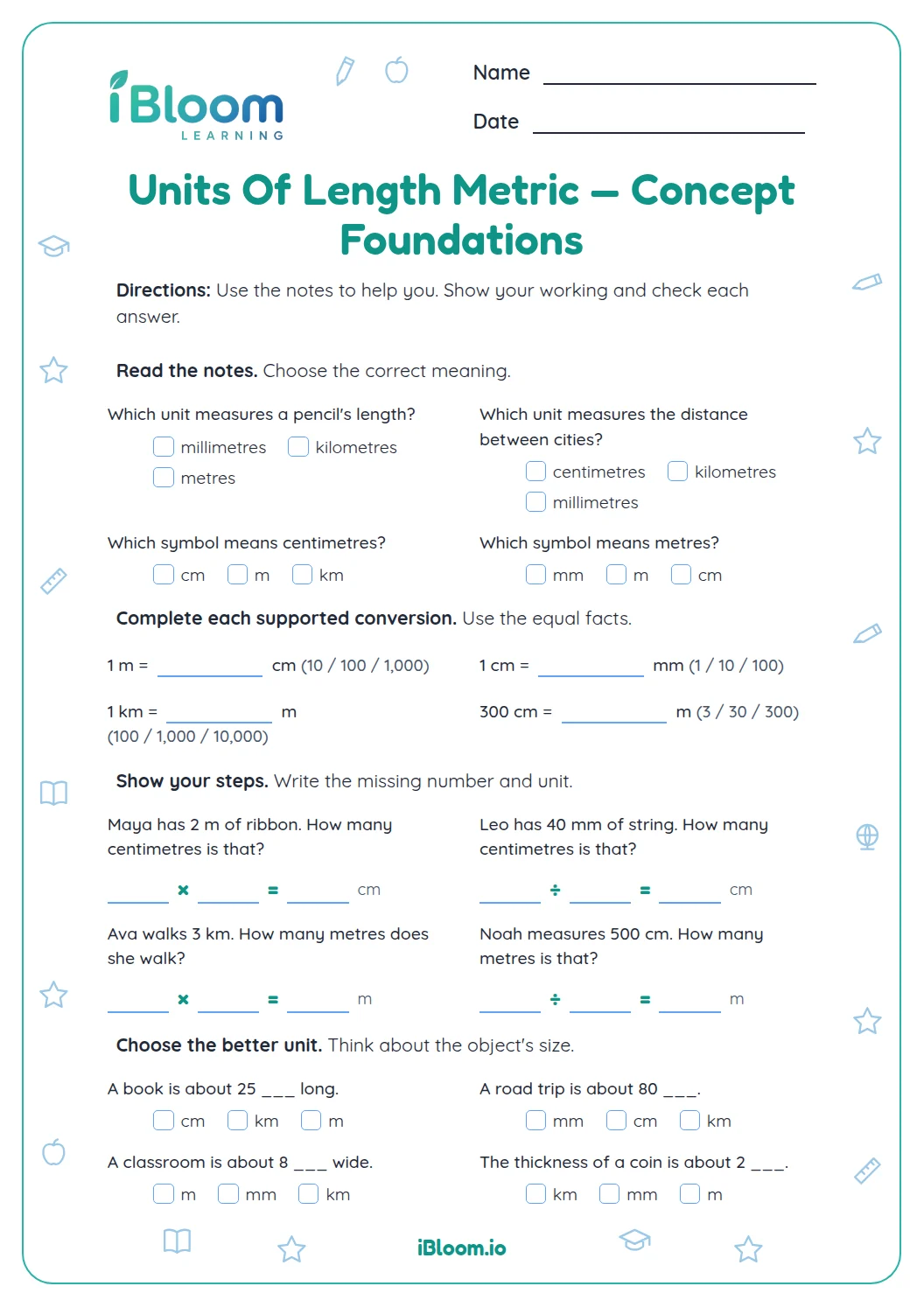
This Grade 4 printable helps students work with metric units of length. It begins with direct conversions, then asks students to complete meters-to-centimeters and kilometers-to-meters tables. A ruler drawing supports the smaller-unit relationship, and the last part applies conversions in short distance and cutting problems. The answer key includes units for the word problems.
Aligned to 4.MD.A.1
What will students practice?
Fifteen questions practice meter-to-centimeter and kilometer-to-meter conversions, conversion tables, centimeter-to-millimeter ruler readings, and length problems.
The final question asks students to explain why converting meters to centimeters uses multiplication.
How does one problem work?
For q2, each meter is 100 centimeters, so 3 meters is 3 × 100 = 300 centimeters.
- 1q2: 3 m × 100 = 300 cm.
How can students check their work?
Check the unit direction before choosing an operation: a larger unit count becomes a larger number when expressed in a smaller unit. Include units in the word-problem answers.
How to use this worksheet
- 1Name the unit you start with and the unit you need.
- 2Recall that 1 km = 1,000 m and 1 m = 100 cm.
- 3Multiply when changing to a smaller unit; divide when changing to a larger unit.
- 4Write the unit with every word-problem answer.
- 5Check by reversing the conversion.
Common slips and quick fixes
The mistake
Using 100 to convert kilometers to meters.
The fix
Use 1,000 meters in one kilometer.
The mistake
Dividing when changing meters to centimeters.
The fix
A smaller unit takes more units to cover the same length, so multiply by 100.
The mistake
Leaving off a unit in a story answer.
The fix
Write m, cm or km to show what the number measures.
Common Core alignment
Students use relationships among metric length units and record equivalent measurements.
Use metric unit relationships to express one length in a smaller unit.
On this sheet: Students convert among km, m, cm and mm and complete metric conversion tables.
Show the official wordingHide the official wording
Know relative sizes of measurement units within one system of units including km, m, cm; kg, g; lb, oz.; l, ml; hr, min, sec. Within a single system of measurement, express measurements in a larger unit in terms of a smaller unit. Record measurement equivalents in a two-column table. For example, know that 1 ft is 12 times as long as 1 in. Express the length of a 4 ft snake as 48 in. Generate a conversion table for feet and inches listing the number pairs (1, 12), (2, 24), (3, 36), ...
What to practice next
Make more practice
Further reading
Questions parents and teachers ask
What metric units does this worksheet use?
The 15 questions convert meters, centimeters, kilometers, and millimeters, complete two conversion tables, read two centimeter rulers, and solve length problems. The first part practices basic relationships; later questions use those relationships in context. Answers in the final problems include units.
What is the key fact for meters and centimeters?
One meter equals 100 centimeters. To express meters in centimeters, multiply by 100; to express centimeters in meters, divide by 100. When the target unit is smaller, the count increases; when it is larger, the count decreases. Use the known unit relationship to choose the operation.
How do the tables help?
The two tables show matching lengths in meters and centimeters or kilometers and meters. Students use the known entries to find the missing equivalent and see the conversion pattern. Read the unit labels in each column before filling a value. A correct number placed under the wrong unit does not name the same measurement.
Why does the ruler drawing show centimeters?
The ruler gives a familiar picture for a length in centimeters. Students use the stated measurement and the unit relationship to express the same length in a smaller unit. The drawing is a familiar length reference. The conversion question then asks students to rename that measurement using a smaller metric unit.
Should word-problem answers include units?
Yes. The answer key includes meters, centimeters or a mixed-unit length where appropriate. Writing the unit helps distinguish a length from a bare number. Mixed-unit answers can be checked by converting both parts to one unit and comparing the total with the starting length.
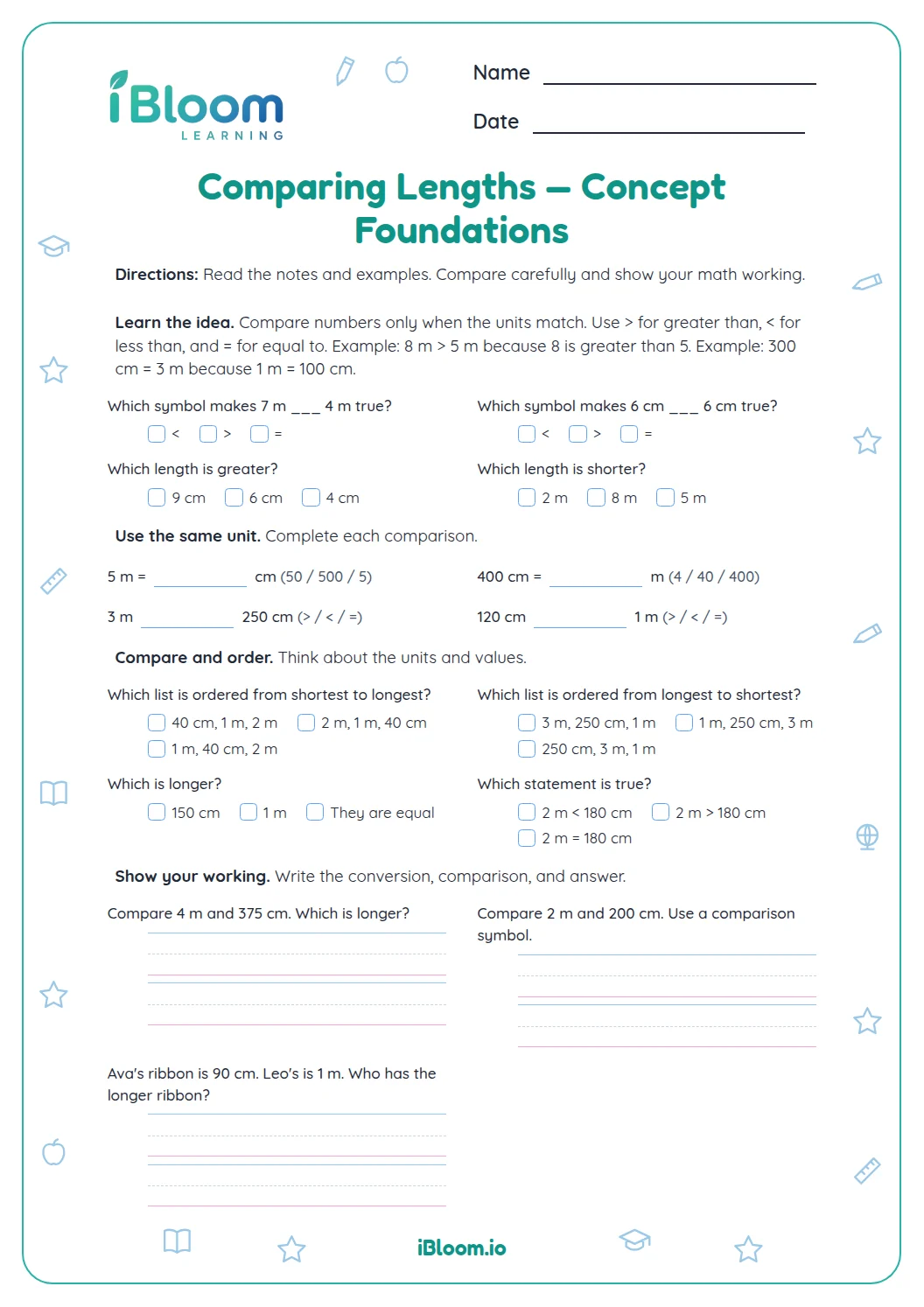
What comes next after metric length conversions?
Try comparing lengths or solving measurement word problems that combine distance and operations. Those tasks build on choosing a unit relationship accurately. After practicing metric conversions, comparing lengths gives students a chance to reason about which measurement is greater.