


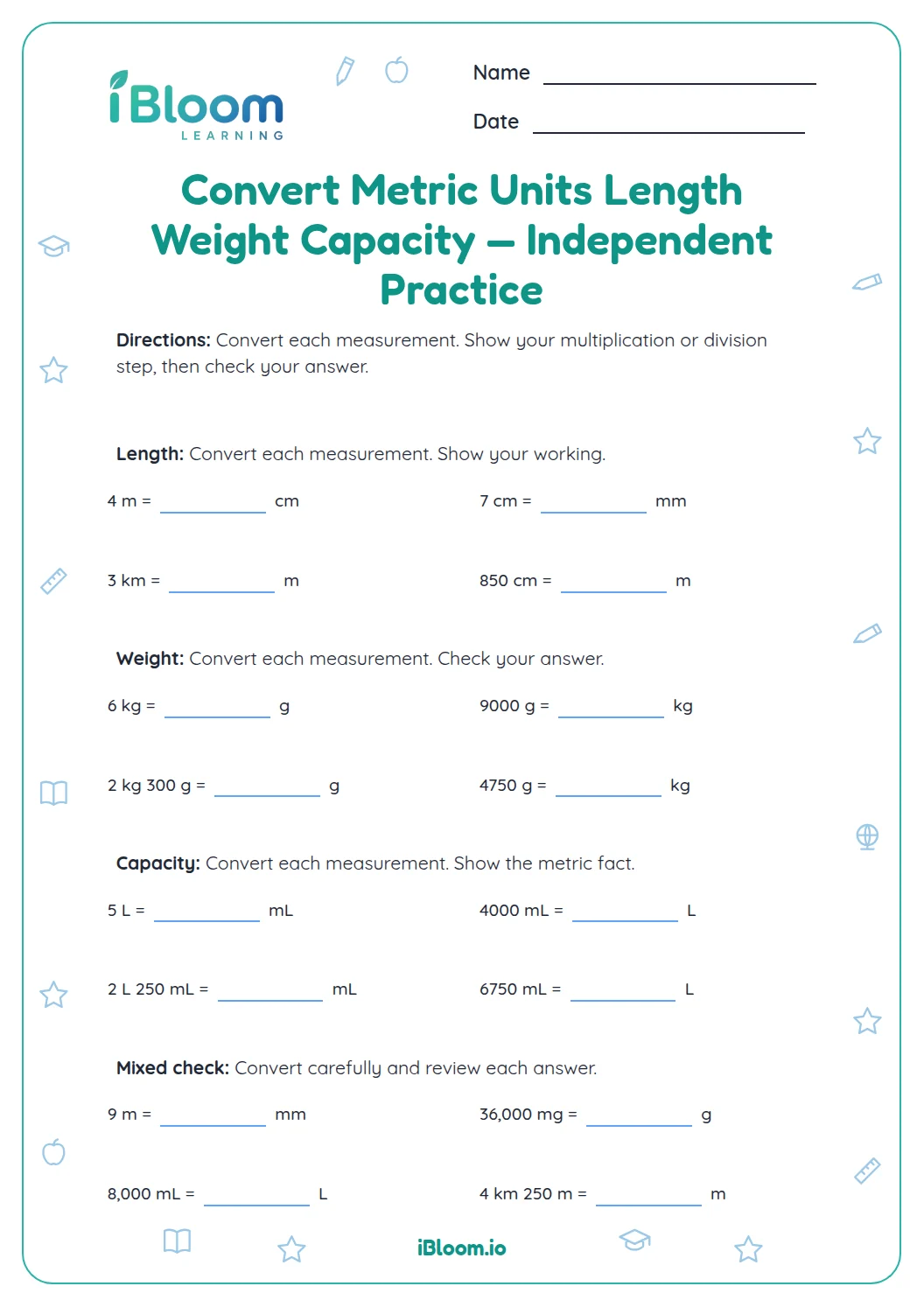
About this worksheet
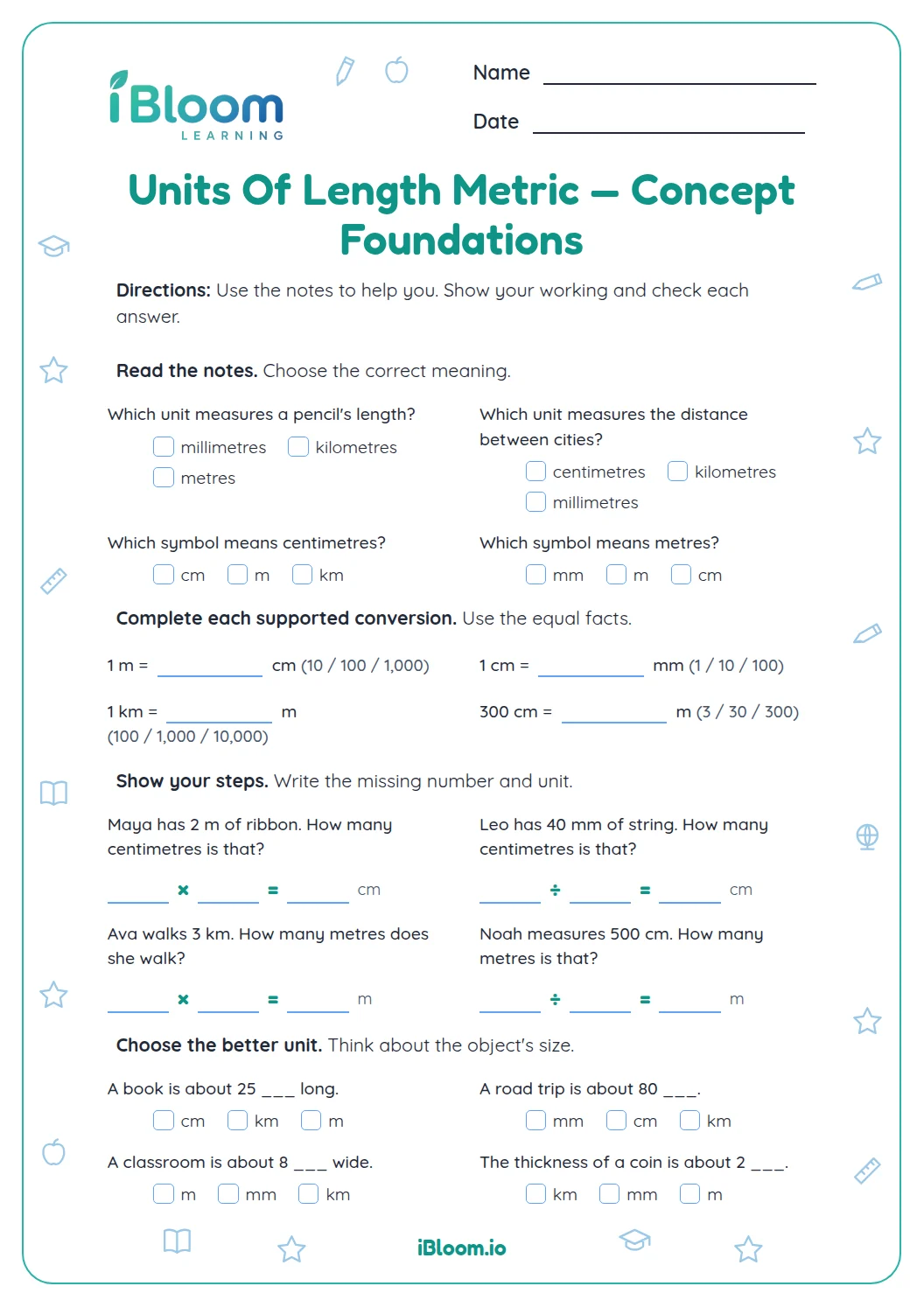
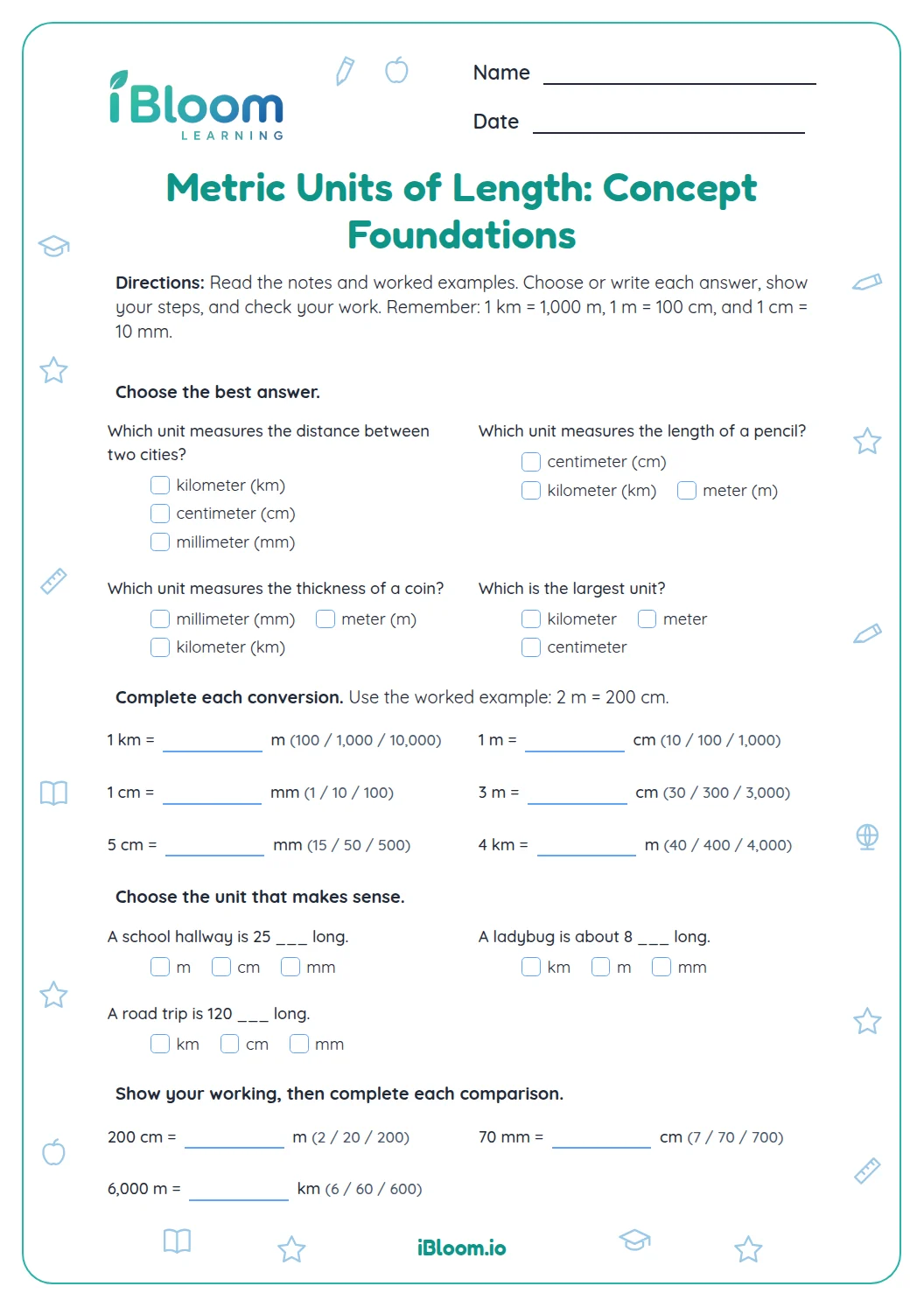
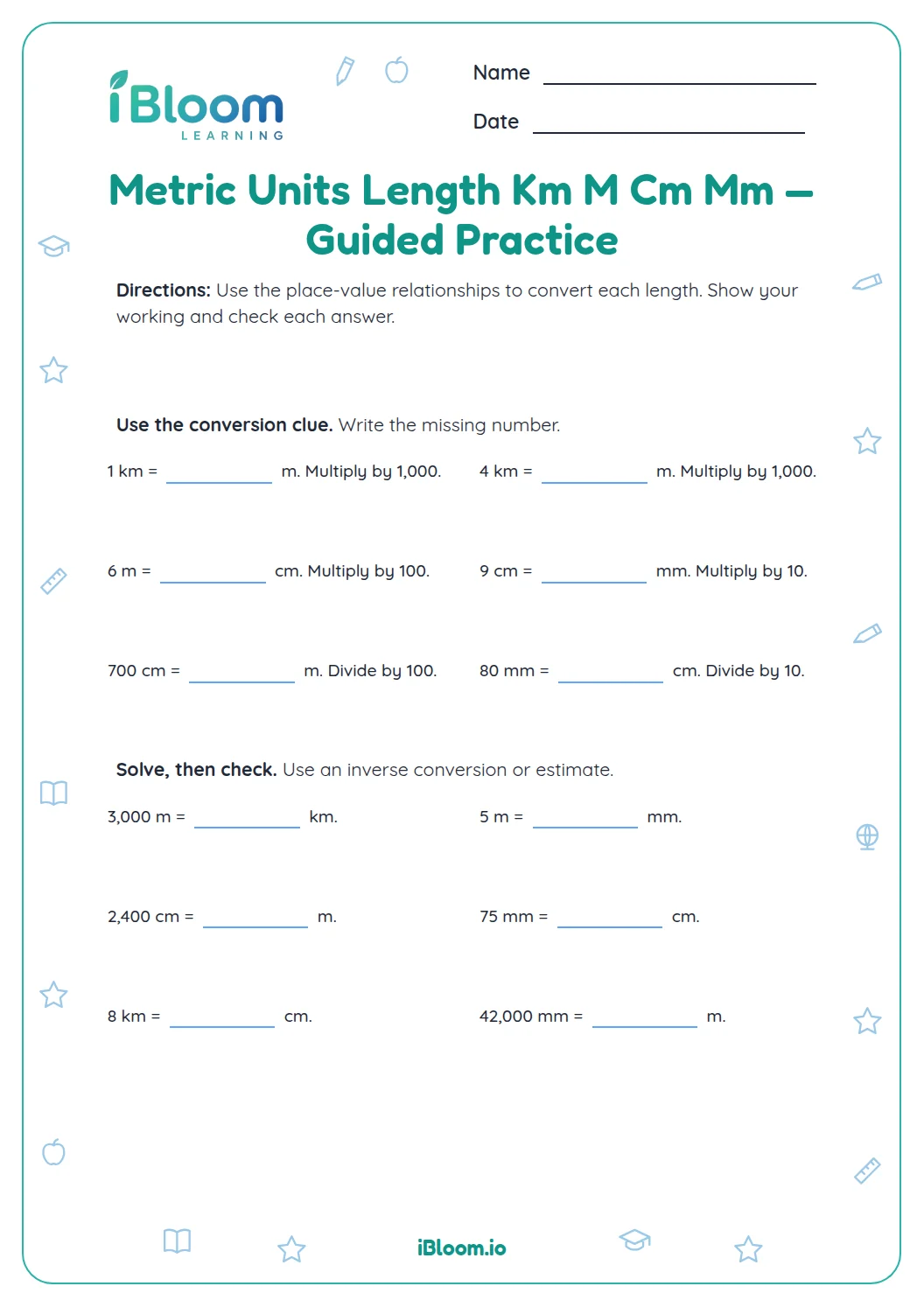
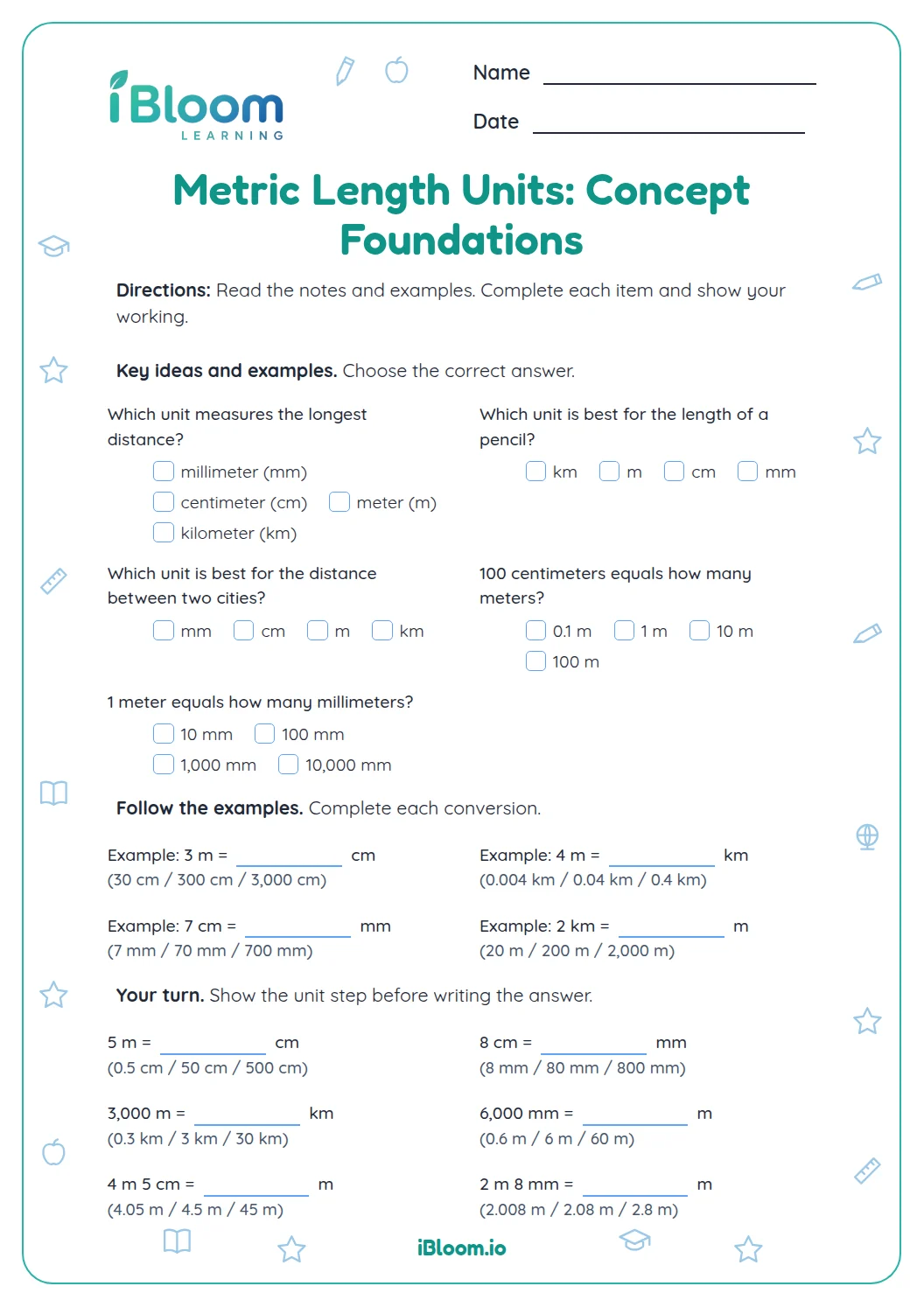
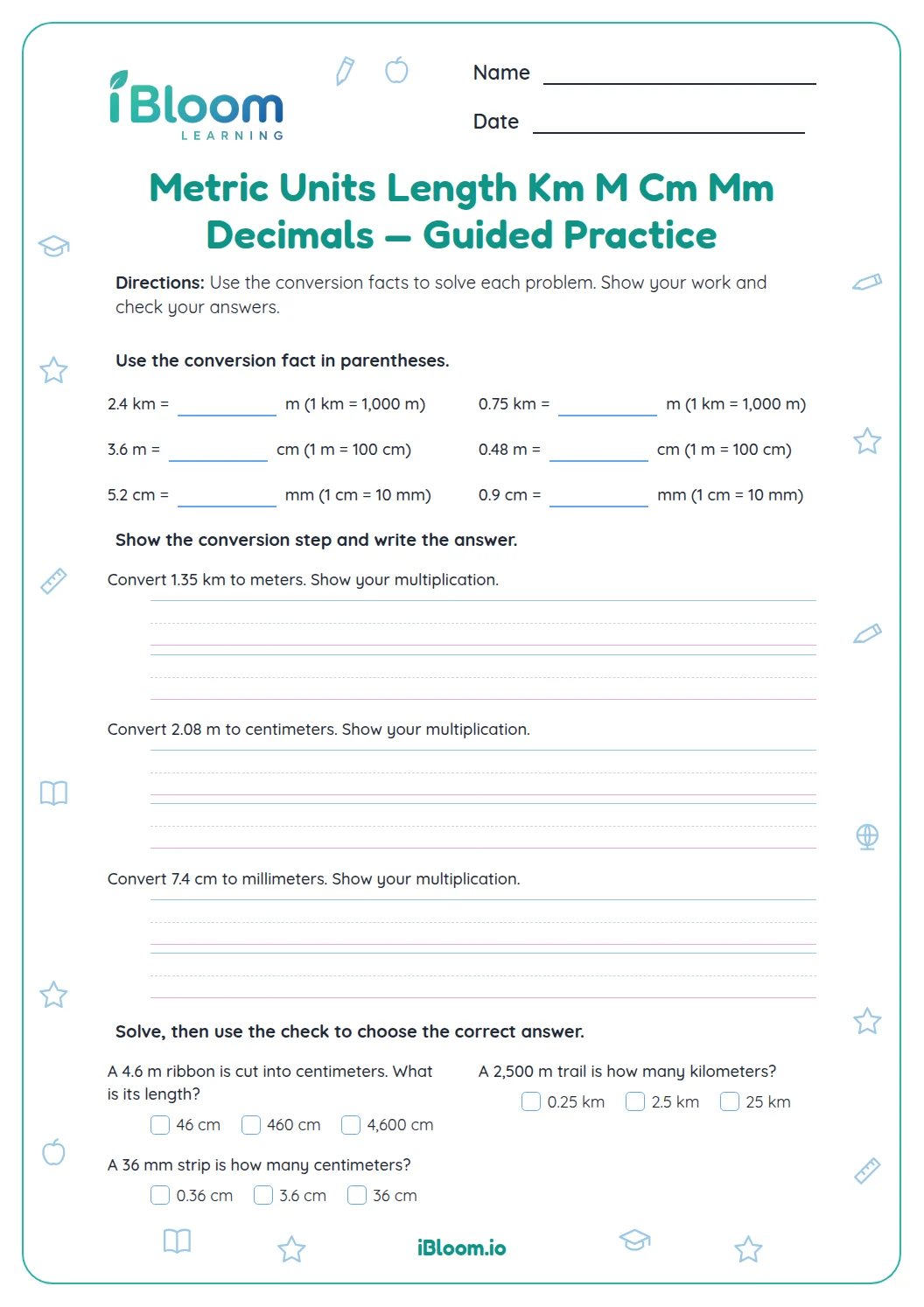
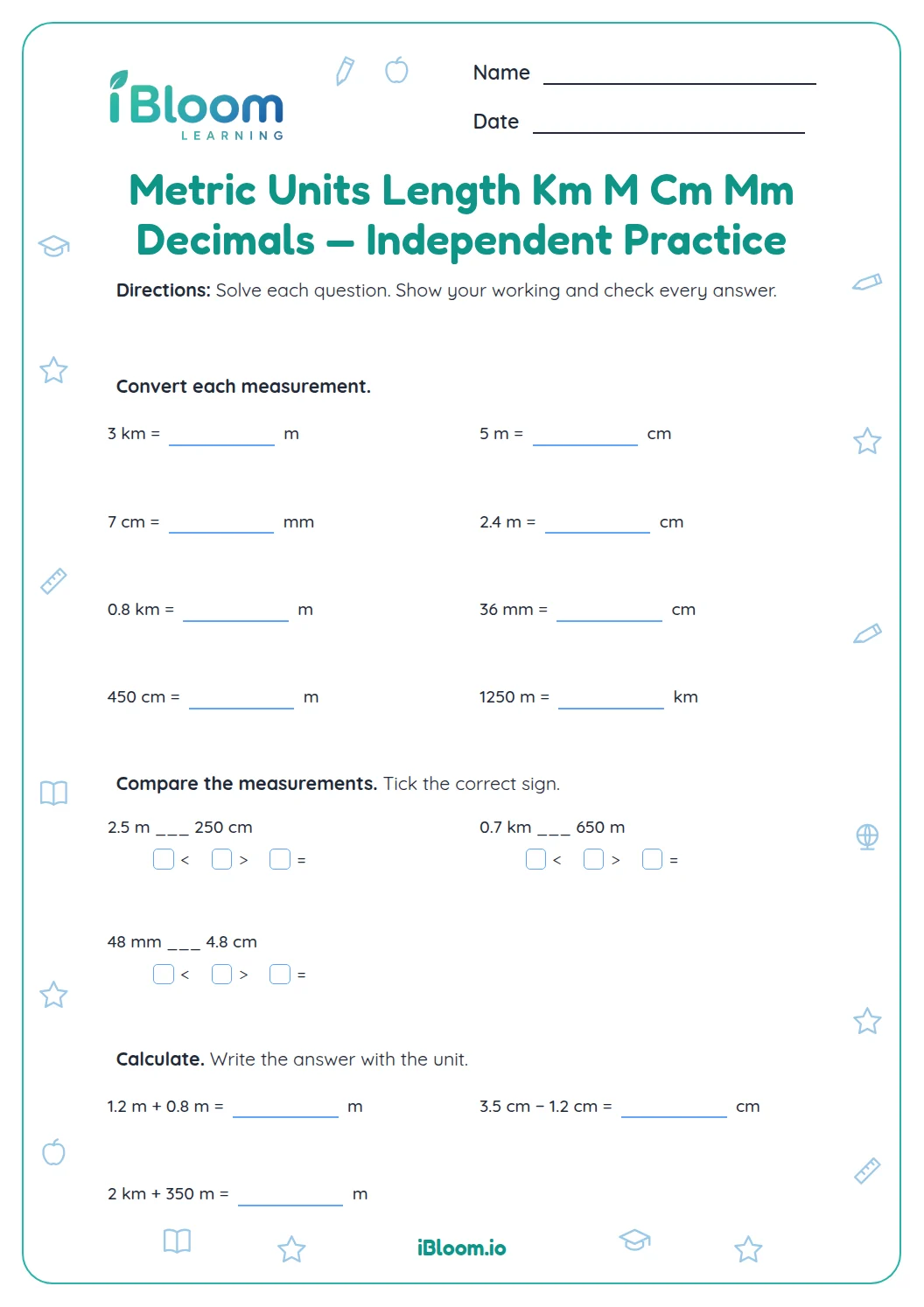
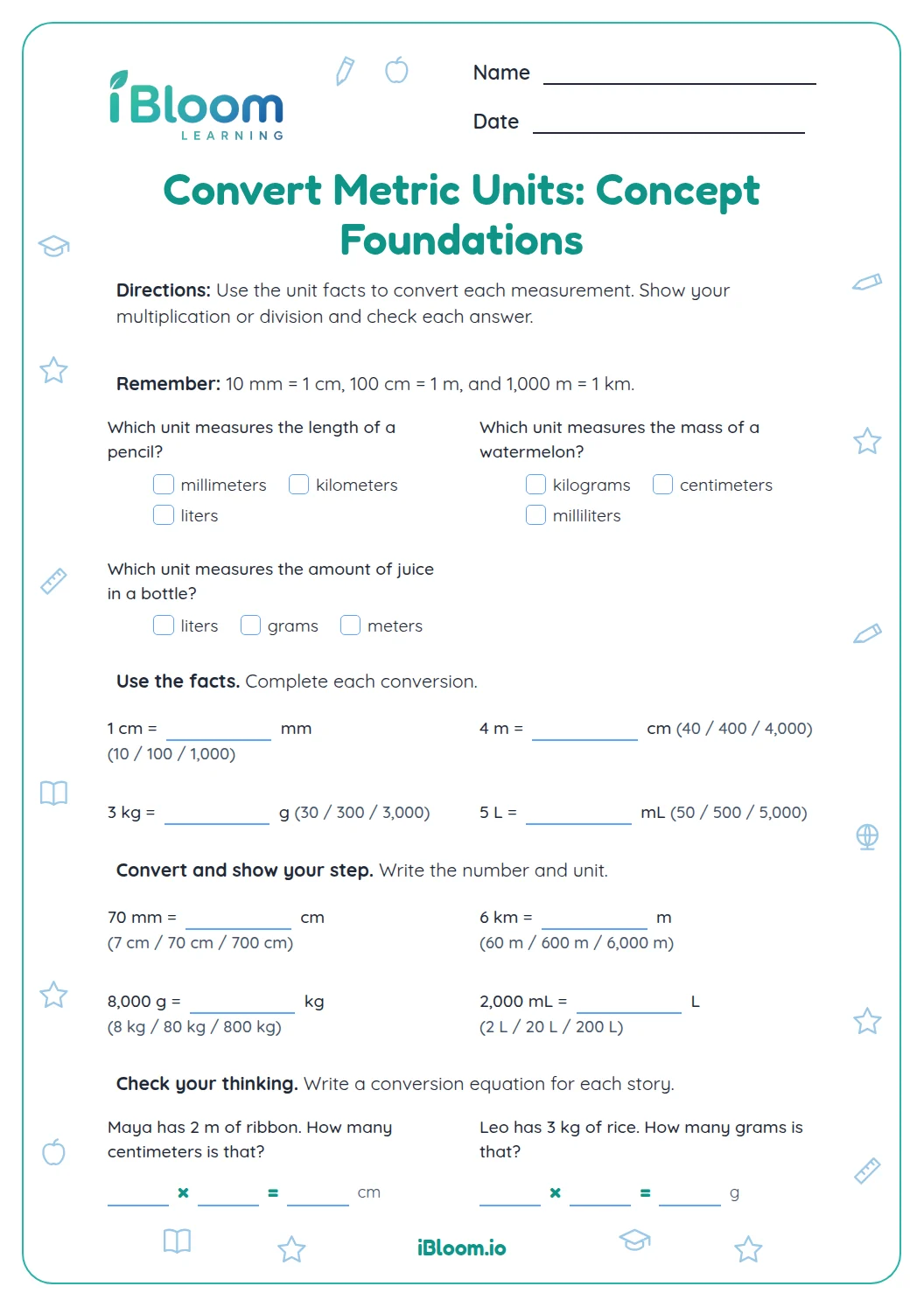
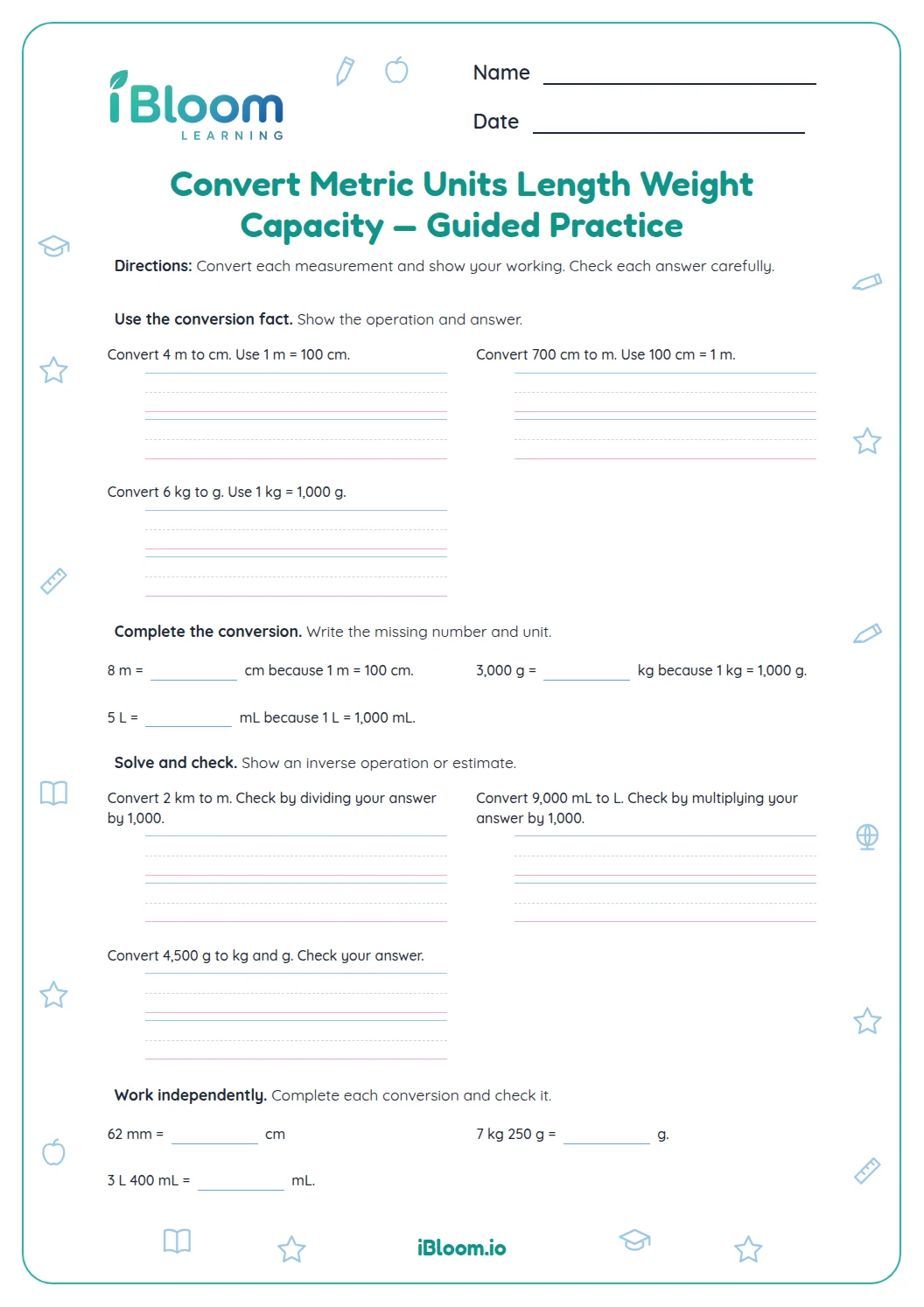
This Grade 4 printable offers 16 metric length questions. Learners convert among kilometers, meters, centimeters, and millimeters, compare measurements in different units, and combine lengths after converting to a shared unit. A separate answer key is included. The sheet aligns with CCSS 4.MD.A.1.
Aligned to 4.MD.A.1
Why convert before comparing?
To compare 2 m and 180 cm, express both lengths in centimeters. Since 2 m = 200 cm and 200 cm > 180 cm, the correct comparison is 2 m > 180 cm.
How do you compare different units?
Convert both lengths to the same unit first. To compare 2 m and 180 cm, write 2 m as 200 cm; 200 cm is longer.
How do conversions help solve length problems?
Put quantities in one unit before adding or subtracting. A 2 m board is 200 cm; after cutting 75 cm, 125 cm remain.
How to use this worksheet
- 1Identify the units in the measurement.
- 2Recall the conversion relationship.
- 3Convert to the unit needed for the question.
- 4For comparisons and word problems, use one common unit.
- 5Check whether the result is a sensible size.
Common mistakes and quick fixes
The mistake
Multiplying by 10 for meters to centimeters.
The fix
Meters to centimeters is two steps: multiply by 100.
The mistake
Comparing 2 m directly with 180 cm.
The fix
Rewrite both measures in centimeters or meters first.
The mistake
Subtracting mixed units as written.
The fix
Convert both lengths to the same unit before subtracting.
Common Core alignment
This sheet practices metric length conversions, comparisons, and multistep length problems.
Convert metric lengths among kilometers, meters, centimeters, and millimeters.
On this sheet:
Show the official wordingHide the official wording
Know relative sizes of measurement units within one system of units including km, m, cm; kg, g; lb, oz.; l, ml; hr, min, sec. Within a single system of measurement, express measurements in a larger unit in terms of a smaller unit. Record measurement equivalents in a two-column table.
What to practice next
Make more practice
Further reading
Questions parents and teachers ask
Which metric units appear?
The questions use kilometers, meters, centimeters, and millimeters. Learners convert between neighboring and larger units, compare lengths written in different units, and order three lengths from shortest to longest. The questions use whole numbers and one decimal length.
How should a child compare 2 m and 180 cm?
First express both measurements in the same unit. Since 2 m equals 200 cm, compare 200 cm with 180 cm. That shows that 2 m is longer. Converting first avoids comparing unlike units directly. The shared unit makes the comparison clear.
Does the worksheet include word problems?
It includes reasoning questions as well as direct conversions and comparisons. Learners use metric relationships to order measurements and solve a length subtraction situation, including finding how much remains after a cut. Learners can write the equivalent measurement before calculating.
How many pages are included?
The worksheet is two pages long, and the answer key is separate. There are 16 questions across conversions, comparisons, ordering, and length reasoning. The key can be used after learners have completed both pages. These 16 items are spread across both worksheet pages.
Which standard does this practice address?
The page aligns with CCSS 4.MD.A.1, which asks learners to know relative sizes of units within a measurement system and express measurements in equivalent units. The conversions and comparisons on the sheet practice that metric length relationship. A conversion table can help organize the relationships.