



About this worksheet
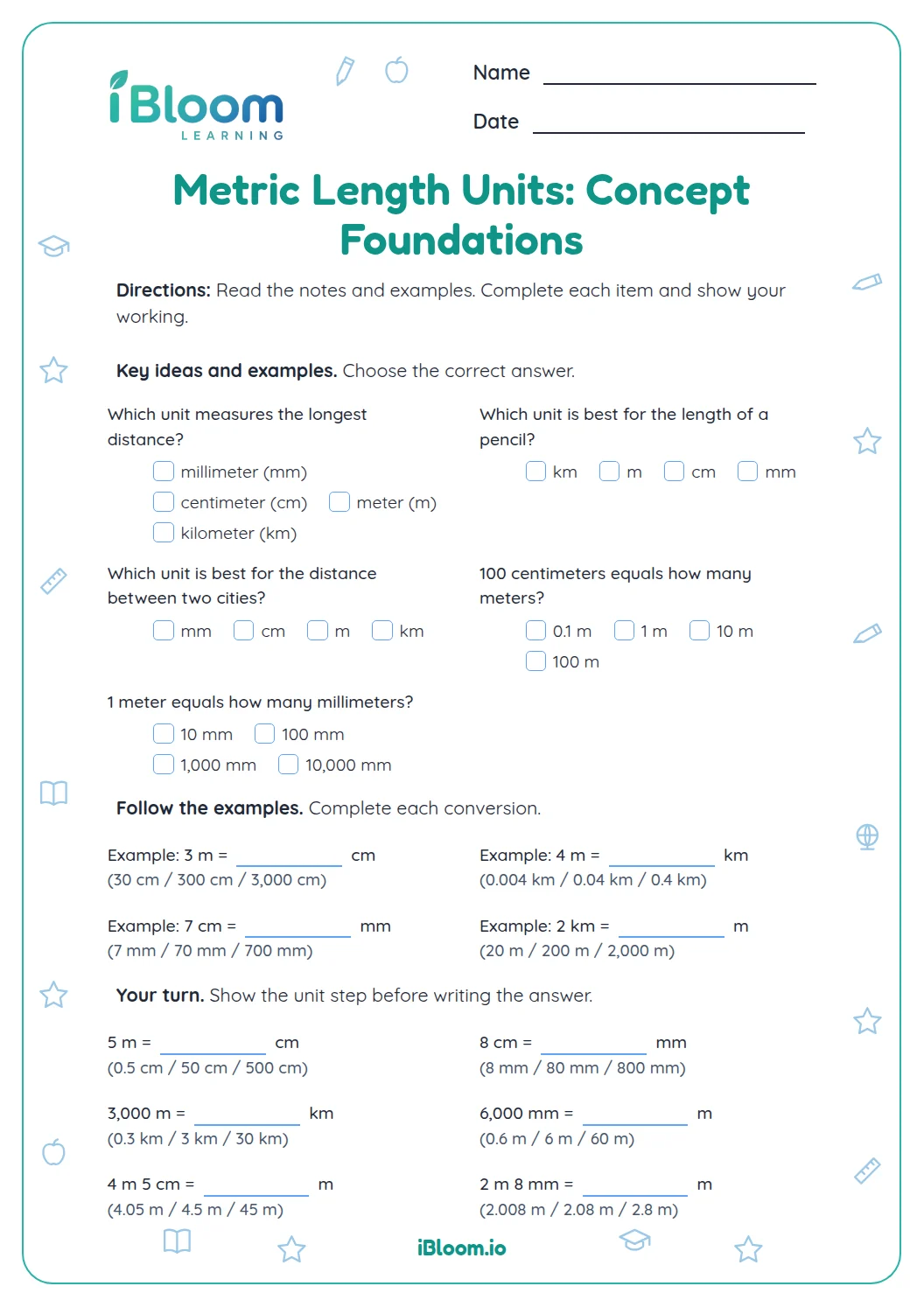
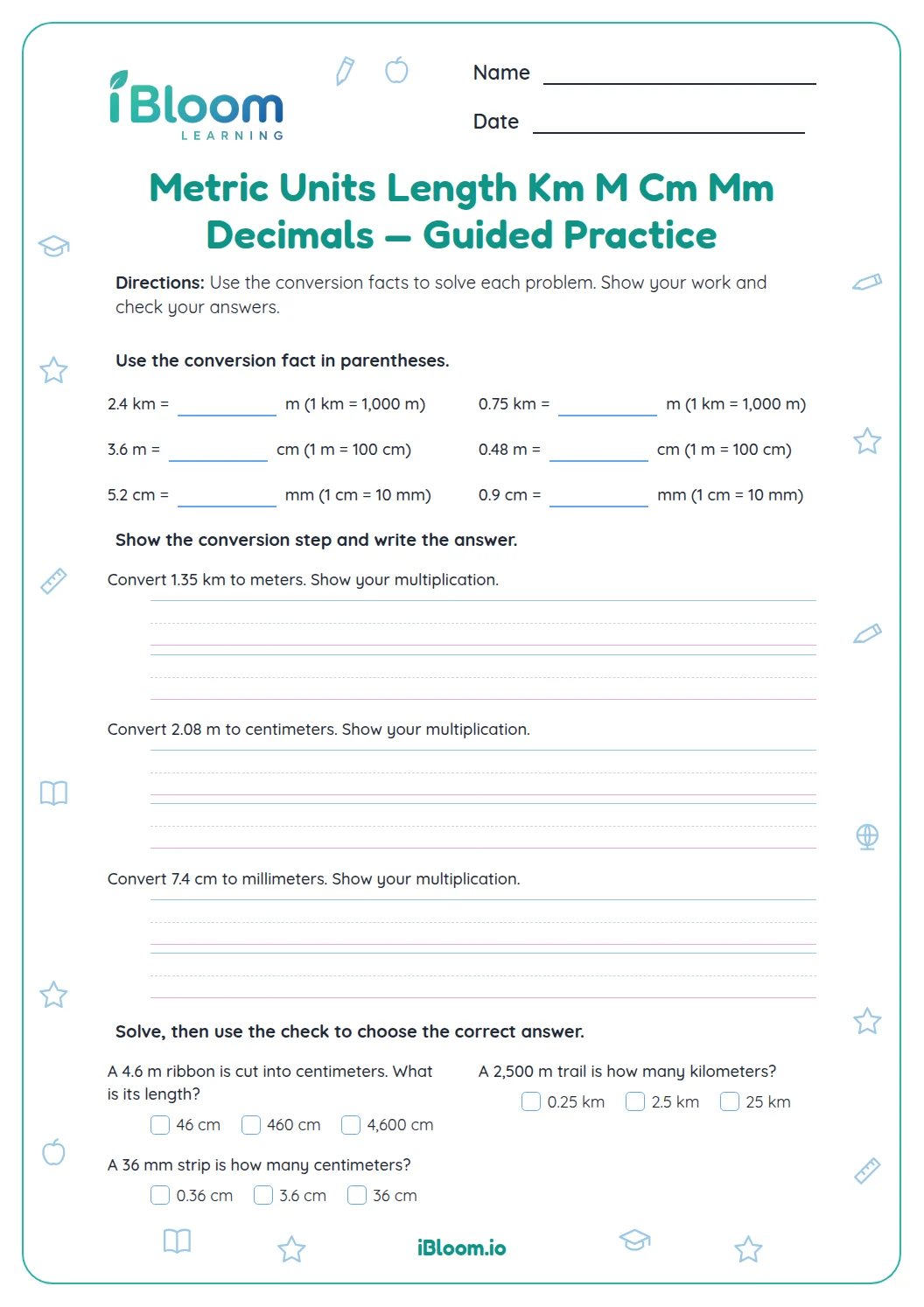
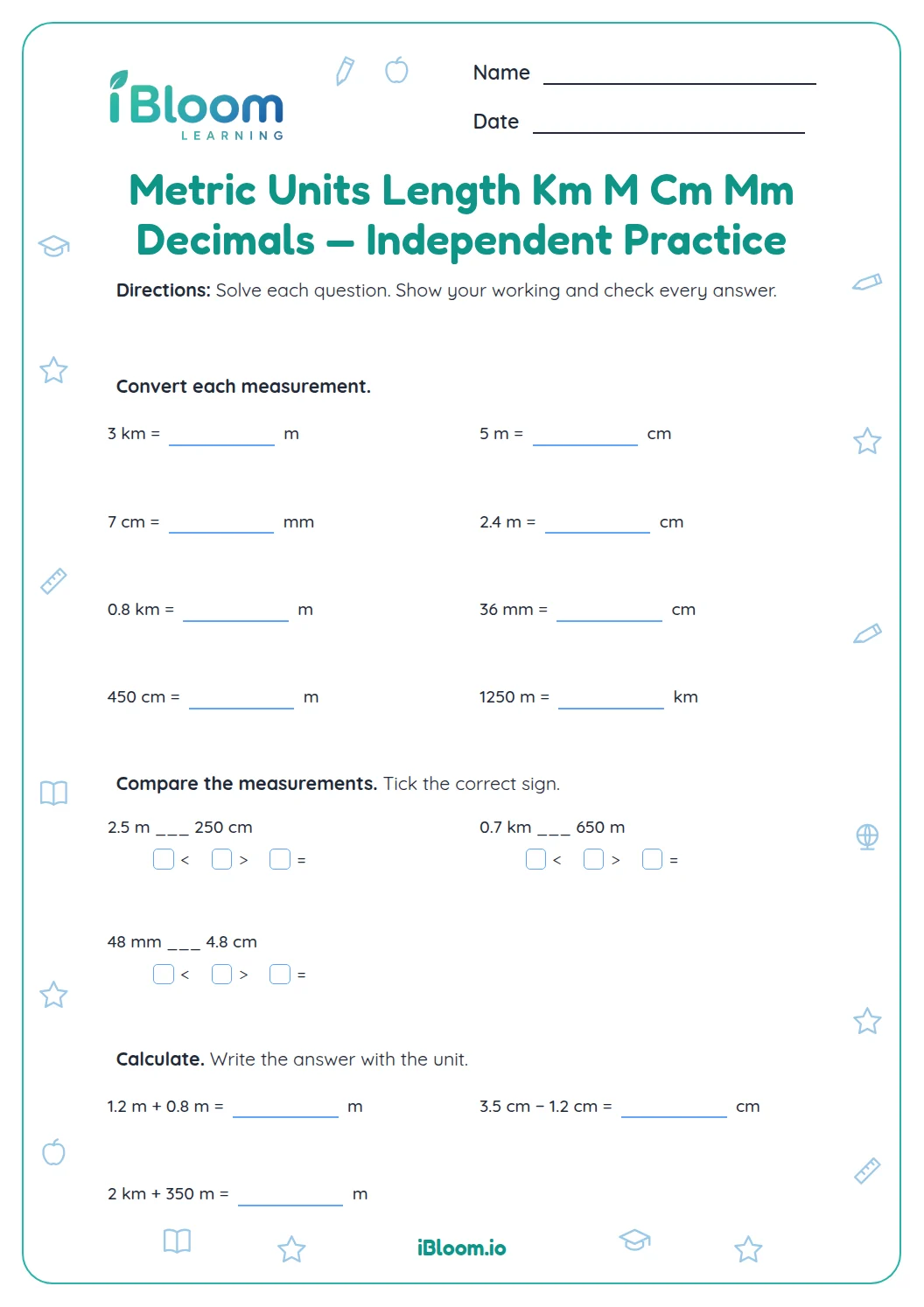
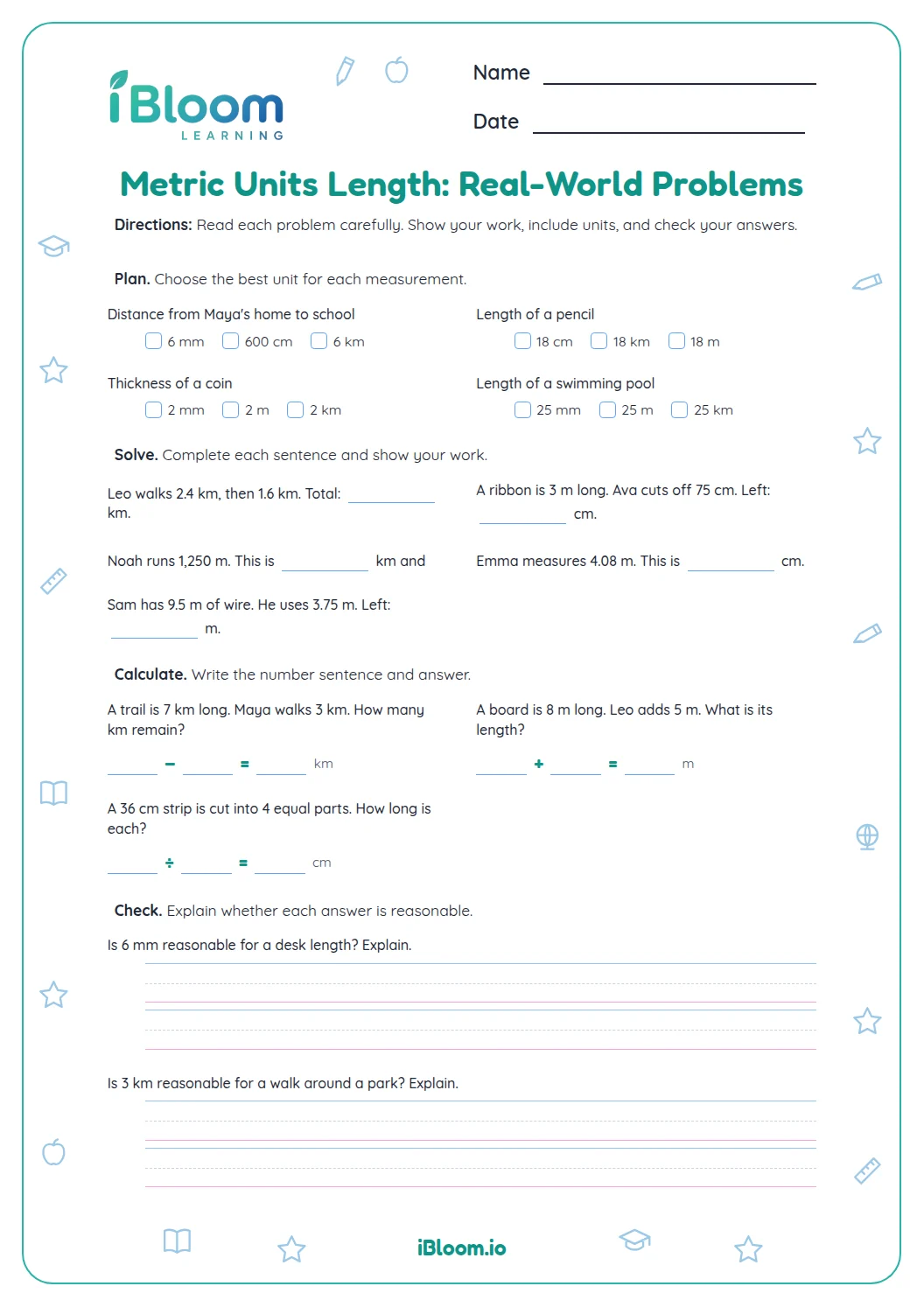
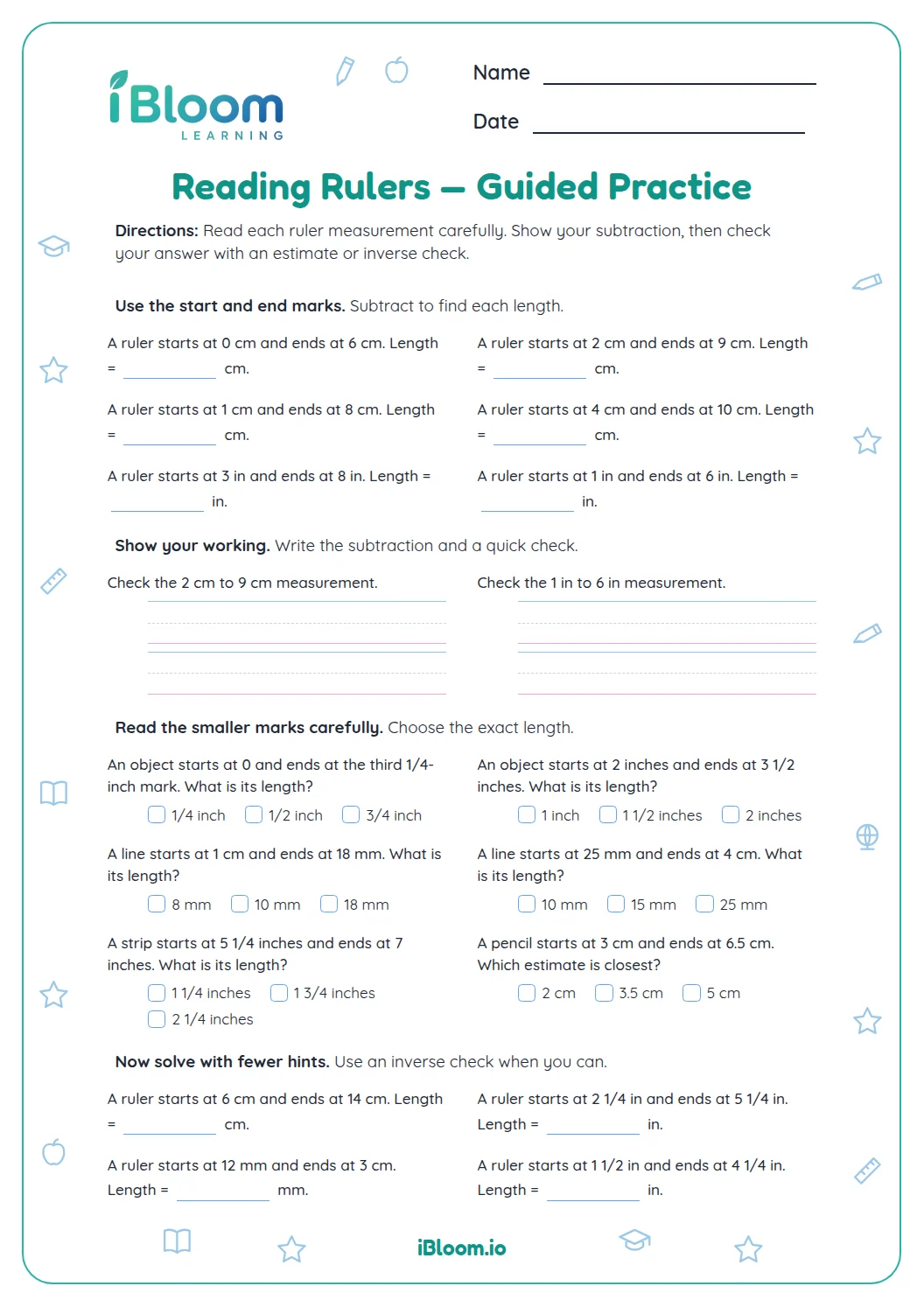
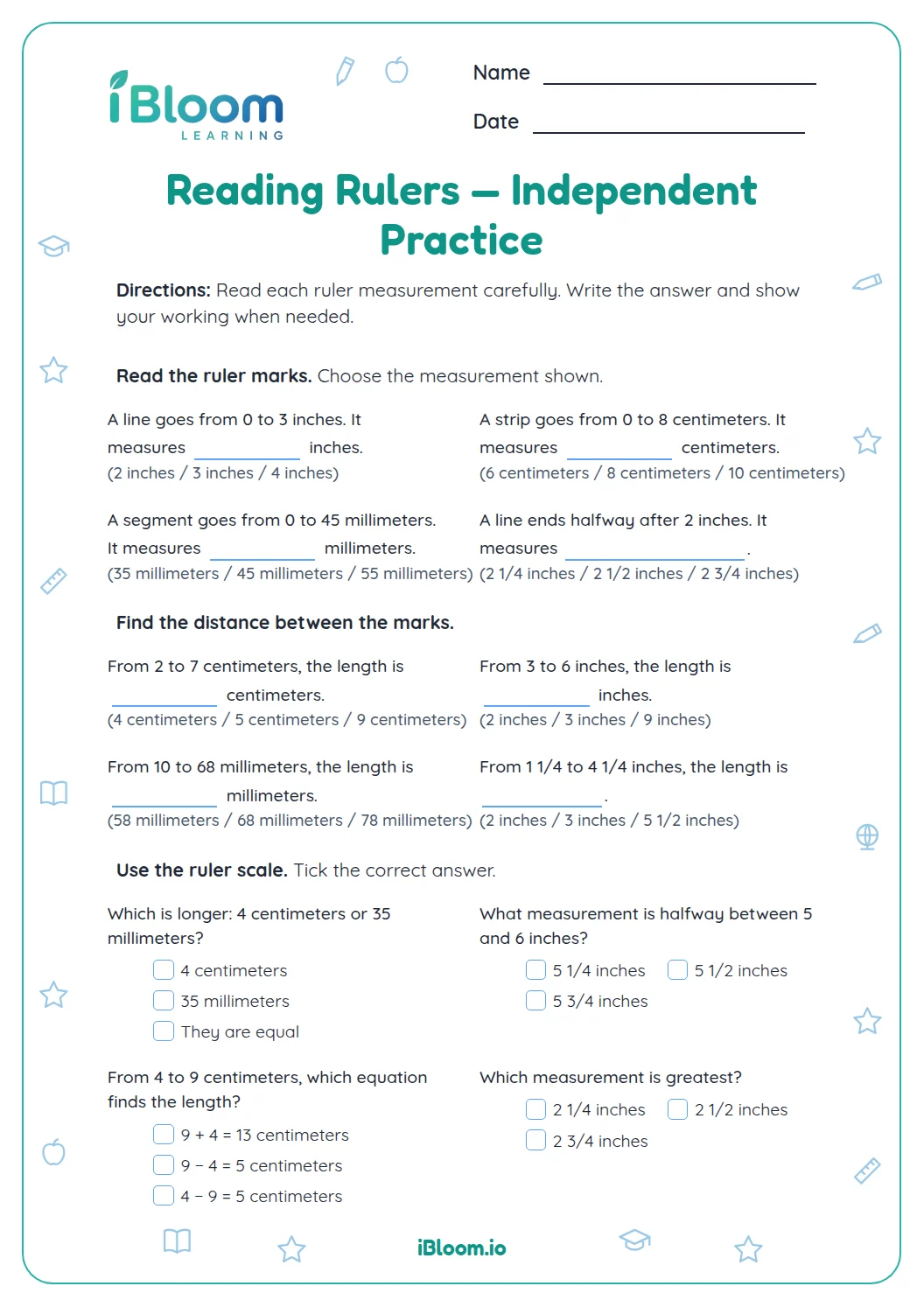
This Grade 4 worksheet practices metric length through visual models and calculations. Students read tenths and hundredths of a meter, locate decimal lengths on number lines, complete a kilometer-to-meter table, and convert among kilometers, meters, centimeters, and millimeters. They then use those relationships in three length problems and compare decimal measurements. The separate answer key shows the model readings and calculations. The work supports CCSS 4.MD.A.1 by using relative unit sizes and recording equivalent measurements.
Aligned to 4.MD.A.1
What metric models appear on the worksheet?
Part A uses a tenths strip and a kilometer-to-meter table. Students also use decimal clues to choose equivalent lengths. A number line later helps compare two decimal measurements.
For question 2, 0.56 m means 56 hundredths of a meter. Since each hundredth of a meter is 1 centimeter, 0.56 m equals 56 cm.
- 10 tenths make 1 meter
- 100 hundredths of a meter make 100 centimeters
- 1 kilometer equals 1,000 meters
How can a decimal length be converted?
Keep the unit relationship beside the number. In question 9, 4.08 m is converted to centimeters by multiplying by 100. The result, 408 cm, is a little more than 400 cm, which matches a length a little over 4 meters.
- 14.08 m = ___ cm
- 21 m = 100 cm, so multiply by 100.
- 34.08 × 100 = 408
- 4Answer: 408 cm.
How do the final problems use metric lengths?
Part C applies conversions in a strip, a ribbon, and a path problem, then compares 0.75 m and 0.8 m. For question 11, change 5 m to 500 cm before subtracting 75 cm. The strip has 425 cm left.
For question 14, write 0.8 as 0.80. Since 0.80 is greater than 0.75, point B is farther right.
How to read and solve the metric models
- 1Read the unit named in each model or problem.
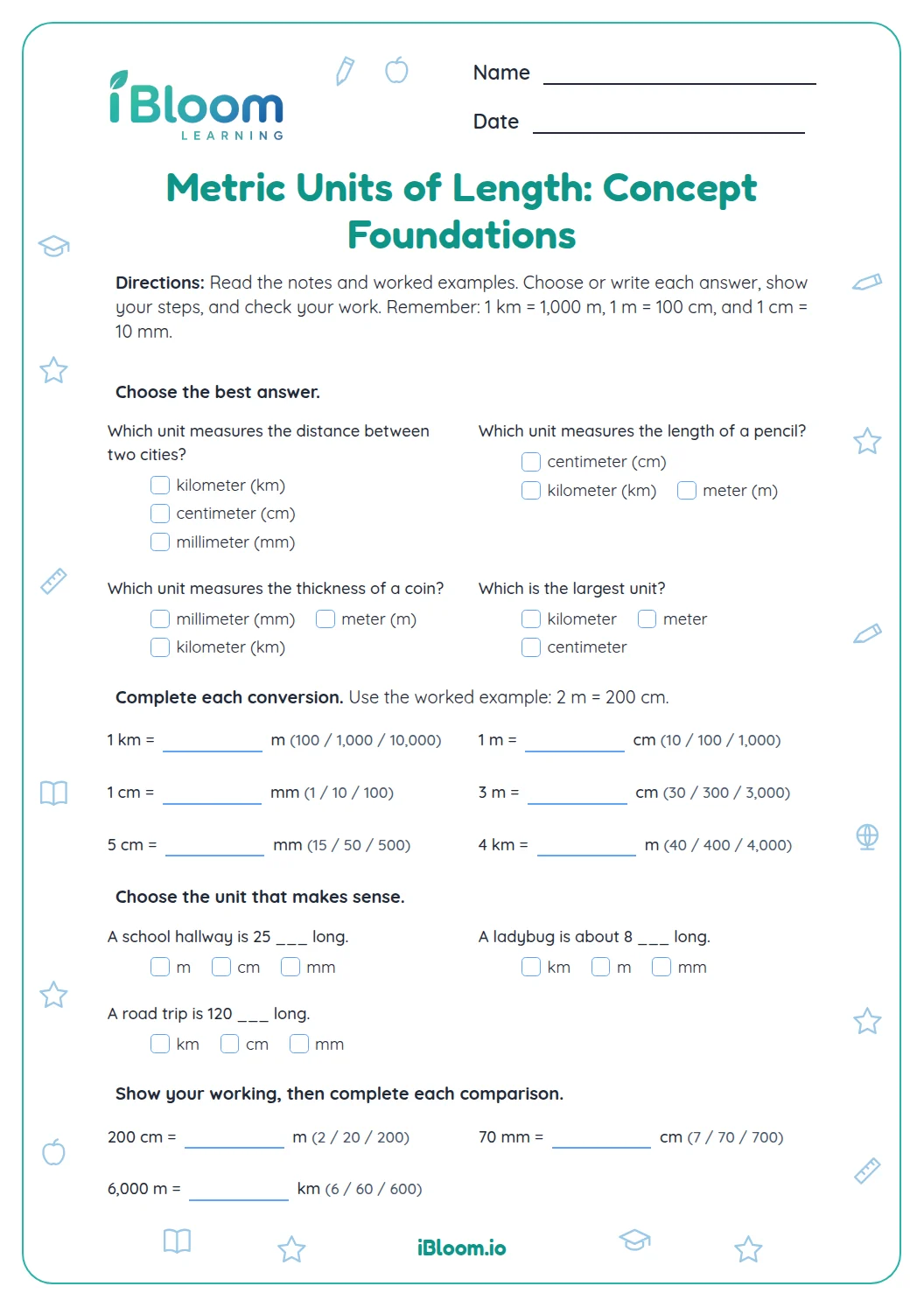
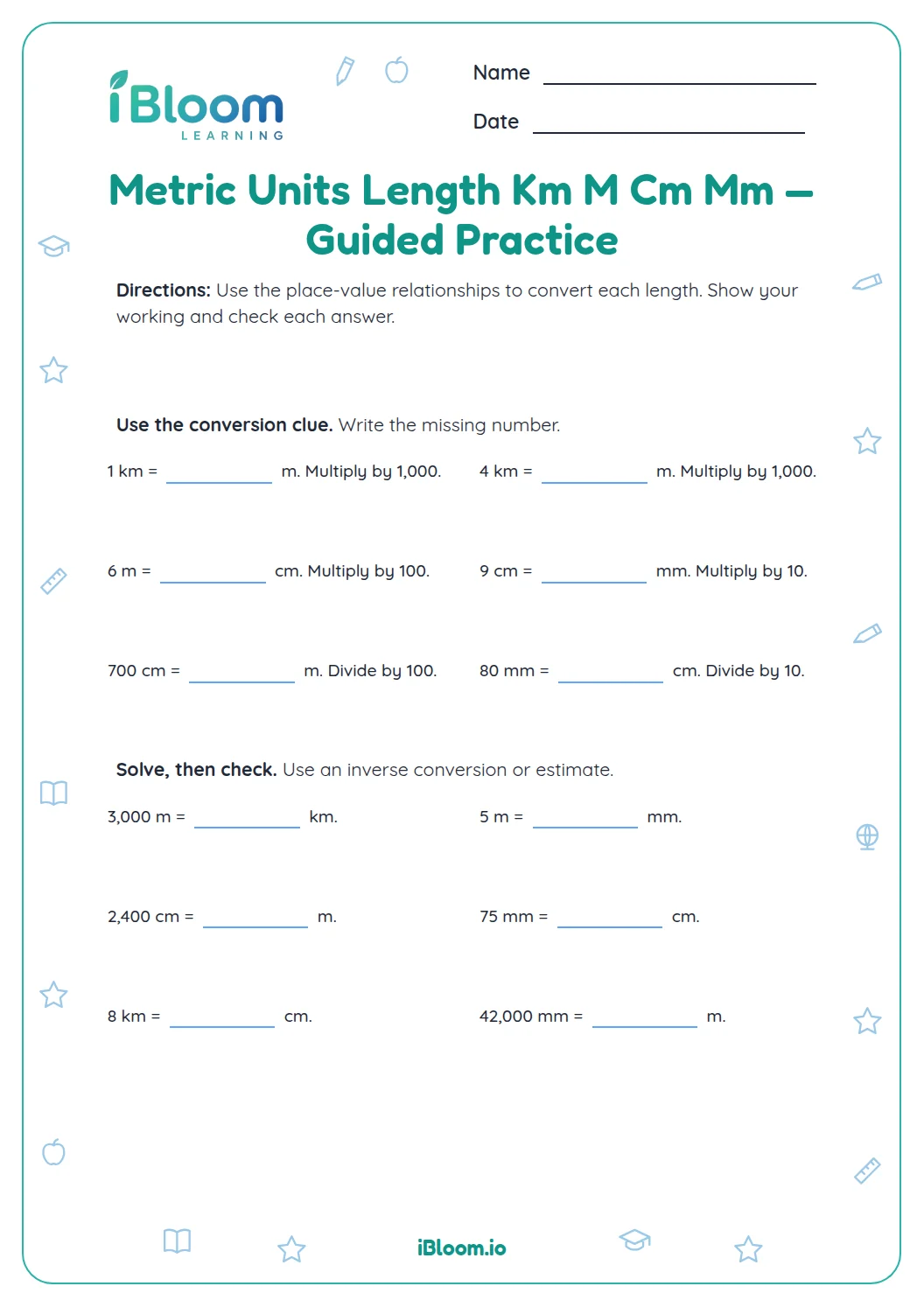
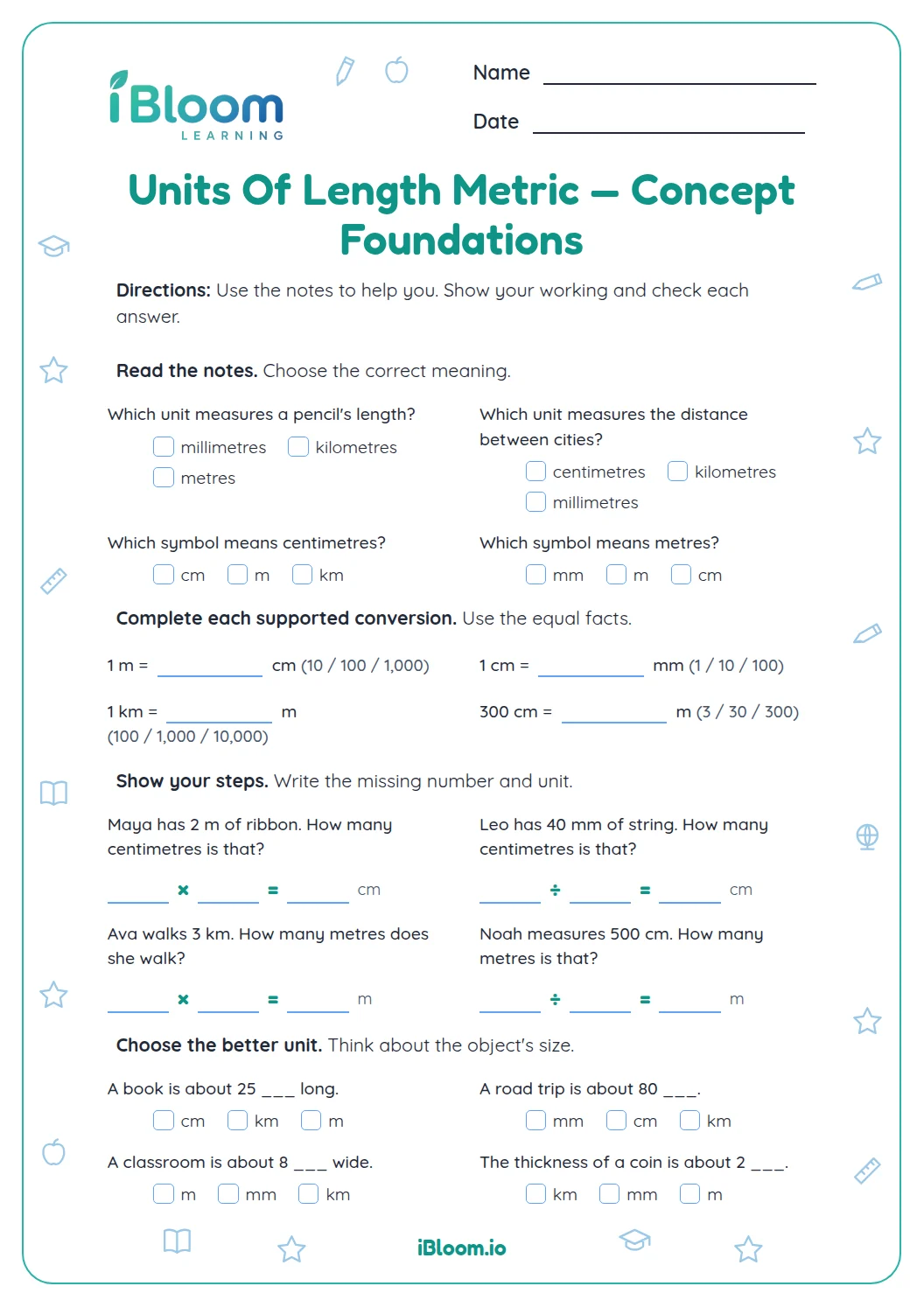
- 2Use 1 km = 1,000 m, 1 m = 100 cm, and 1 cm = 10 mm.
- 3For a tenths or hundredths model, count equal parts of the whole meter.
- 4Convert both lengths to the same unit before comparing or subtracting.
- 5Check that the answer is the right size and includes its unit.
Common metric conversion slips
The mistake
Reading 0.56 m as 5.6 cm.
The fix
Since 1 m = 100 cm, multiply 0.56 by 100: 0.56 m = 56 cm.
The mistake
Changing 7 mm to 0.07 cm.
The fix
Ten millimeters make 1 centimeter, so divide by 10: 7 mm = 0.7 cm.
The mistake
Subtracting 75 cm from 5 without changing meters to centimeters.
The fix
First write 5 m as 500 cm, then calculate 500 − 75 = 425 cm.
Curriculum alignment
Convert metric lengths and record equivalent measurements.
On this sheet: Questions convert and compare kilometers, meters, centimeters, and millimeters.
Show the official wordingHide the official wording
Know relative sizes of measurement units within one system of units including km, m, cm; kg, g; lb, oz.; l, ml; hr, min, sec. Within a single system of measurement, express measurements in a larger unit in terms of a smaller unit. Record measurement equivalents in a two-column table. For example, know that 1 ft is 12 times as long as 1 in. Express the length of a 4 ft snake as 48 in. Generate a conversion table for feet and inches listing the number pairs (1, 12), (2, 24), (3, 36), …
What to practice next
Make more practice
Further reading
Questions parents and teachers ask
What visual models are included?
The worksheet uses a tenths strip, a kilometer-to-meter table, and a decimal number line. Students read or compare values with these models, then connect the pictures and labels to metric units. Other questions ask them to apply the same relationships in conversions and length problems.
How many questions are on this metric worksheet?
There are 14 questions: five model and table questions, five direct conversions, three length problems, and one decimal comparison. The practice uses kilometers, meters, centimeters, and millimeters. A separate answer key shows equivalent lengths and problem answers for both worksheet pages, with units where the prompt asks for them.
How many centimeters are in a meter?
There are 100 centimeters in 1 meter. Multiply a meter measurement by 100 to express it in centimeters. For example, question 9 changes 4.08 m to 408 cm. The hundredths grid also shows why each hundredth of a meter equals one centimeter.
How can a child convert millimeters to centimeters?
Since 10 millimeters equal 1 centimeter, divide a millimeter measurement by 10. For question 8, 125 mm becomes 12.5 cm. For question 4, 7 mm is 0.7 cm. Keeping the unit names visible helps distinguish this relationship from meters to centimeters.
Does the worksheet include an answer key?
Yes. A separate answer key covers both worksheet pages. It gives the model readings, completed metric relationships, and answers to the strip, ribbon, path, and comparison problems. An adult can use it to check the result and revisit the conversion relationship if needed.