


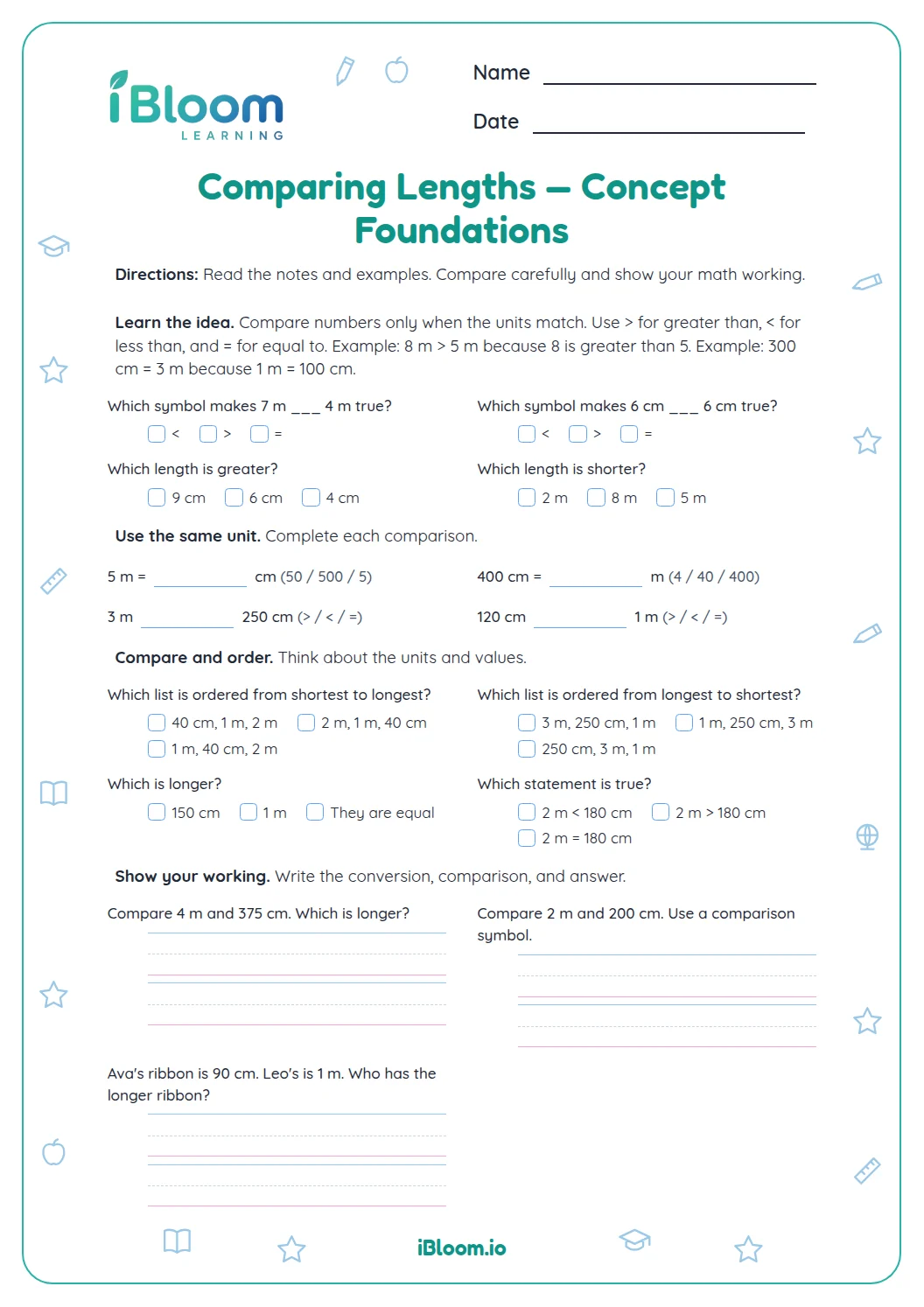
About this worksheet
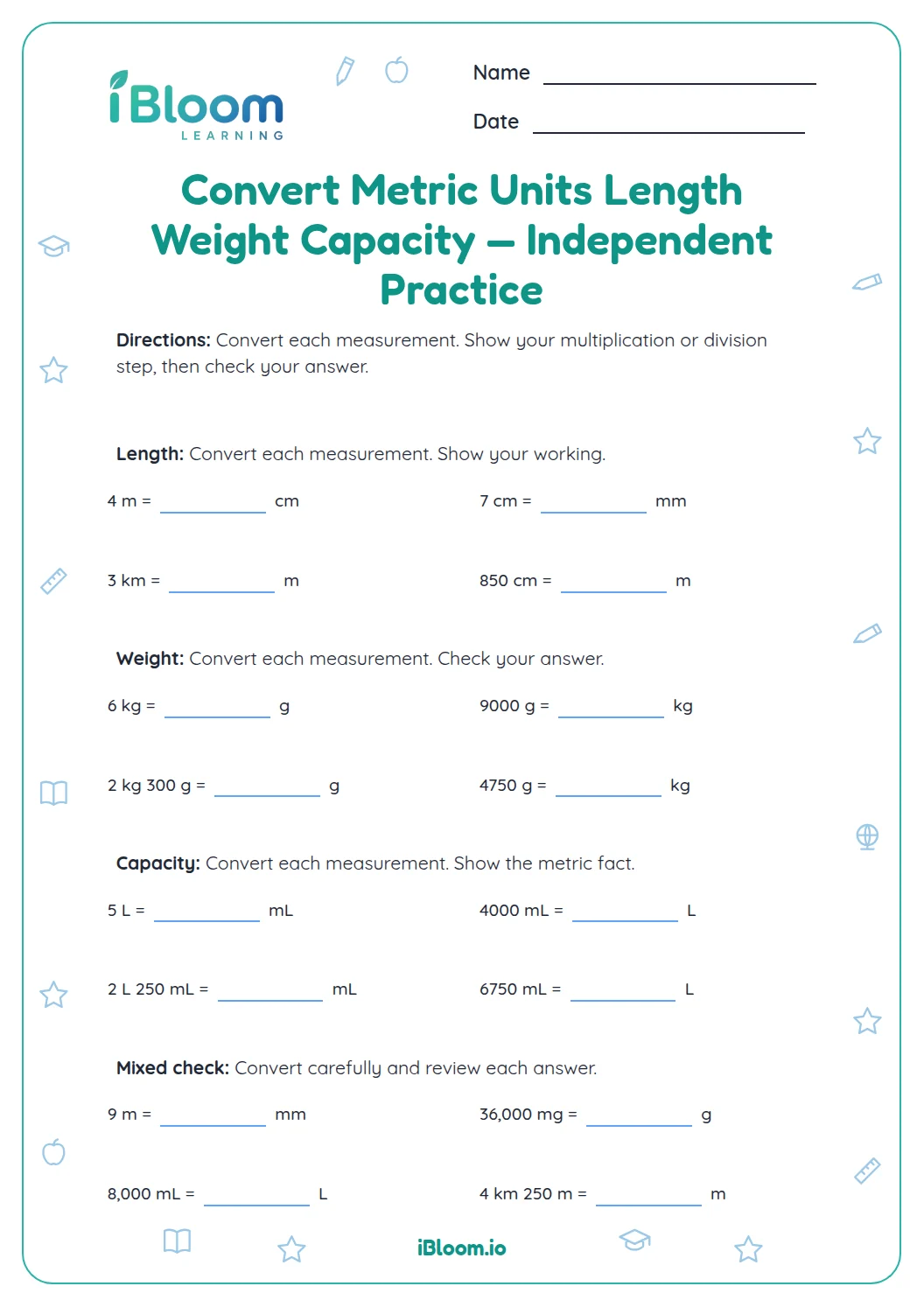
This Grade 4 math printable gives independent practice with metric units of length. Students convert kilometers, meters, centimeters and millimeters in ten number sentences, then solve six word problems involving equivalent units, addition, subtraction and comparison. The problems use whole numbers and a decimal conversion to connect unit size with computation. A separate key lists the converted lengths and word-problem answers. The page practices CCSS 4.MD.A.1 by expressing larger metric units in smaller units.
Aligned to 4.MD.A.1
How do the metric units relate?
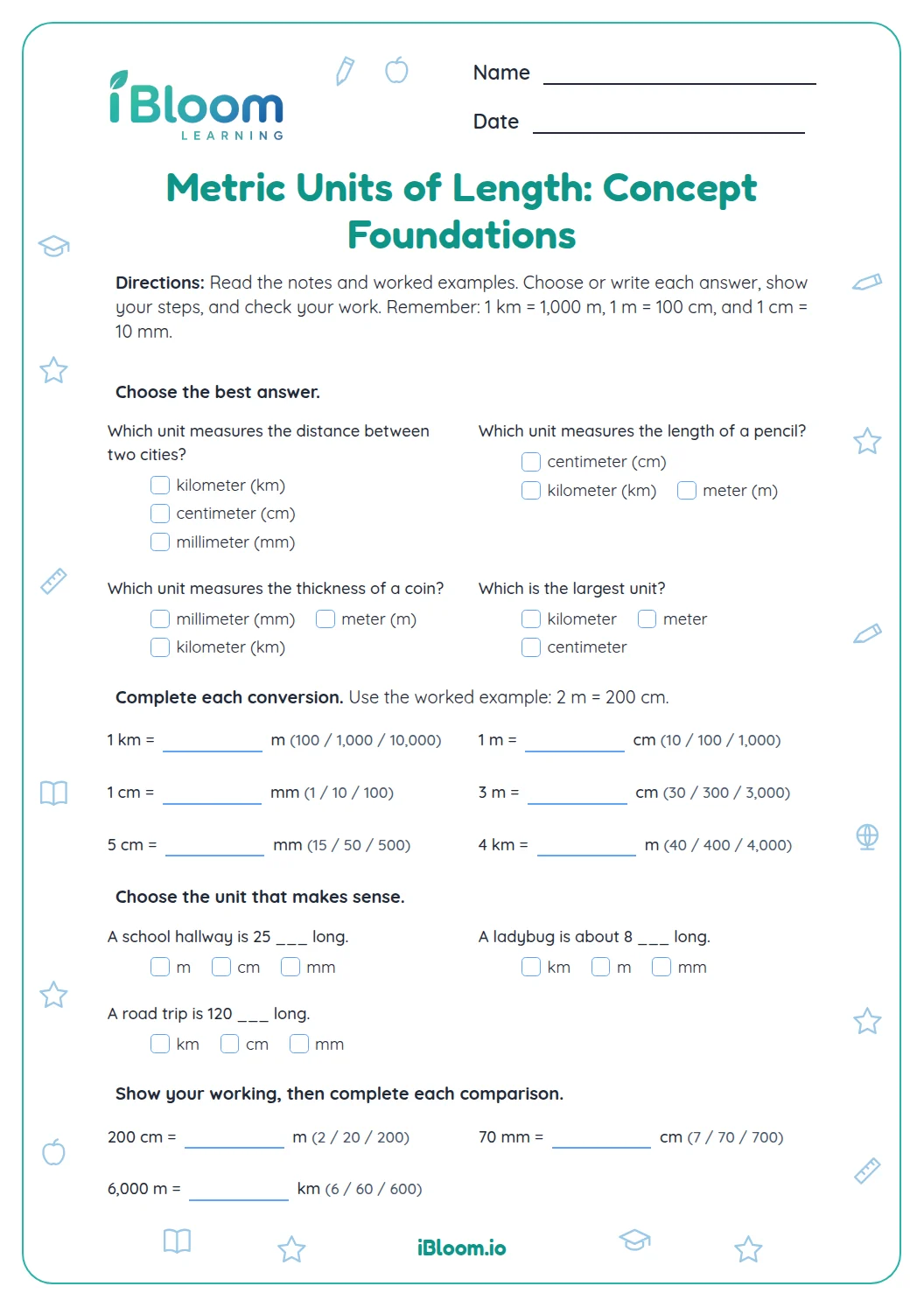
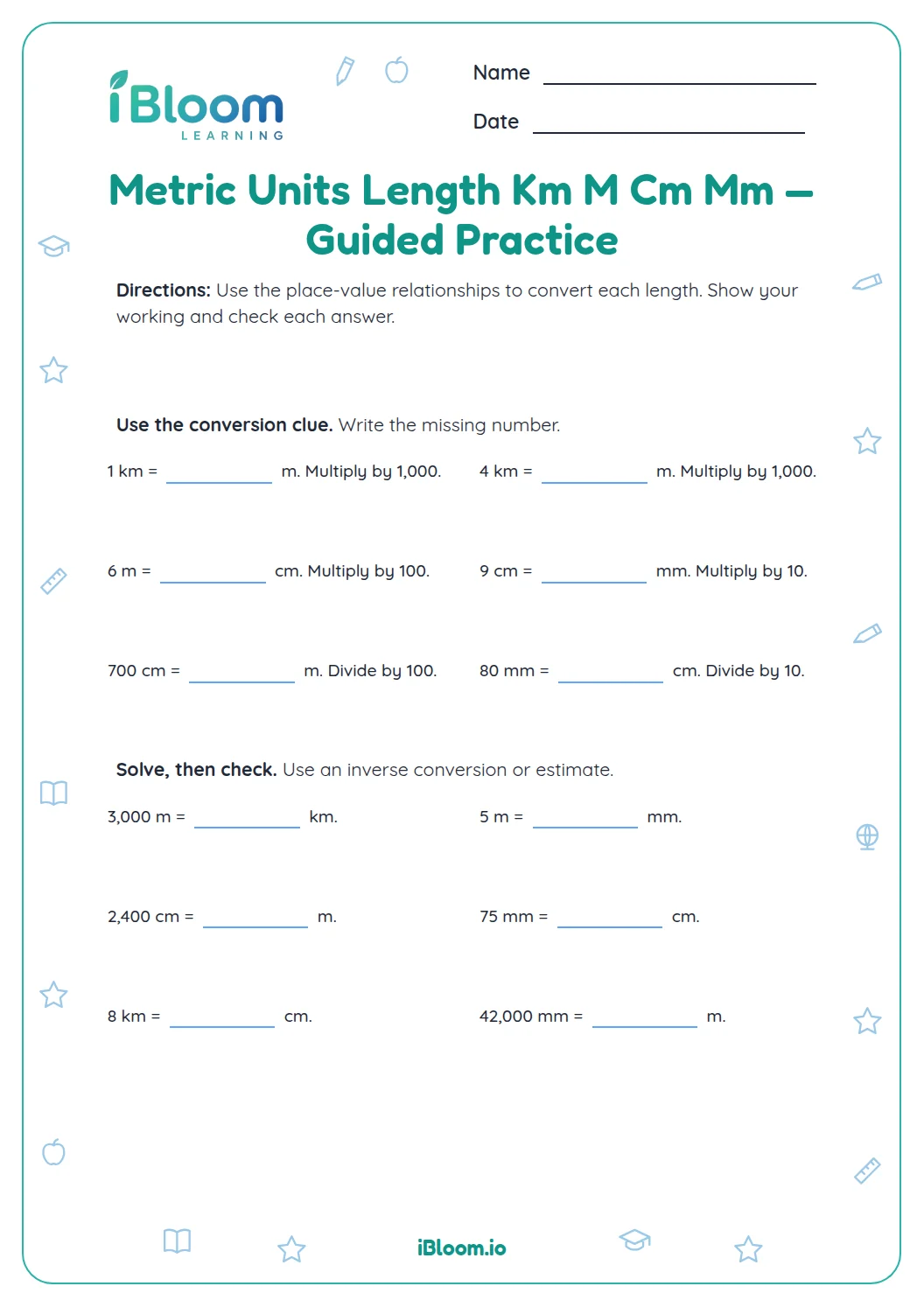
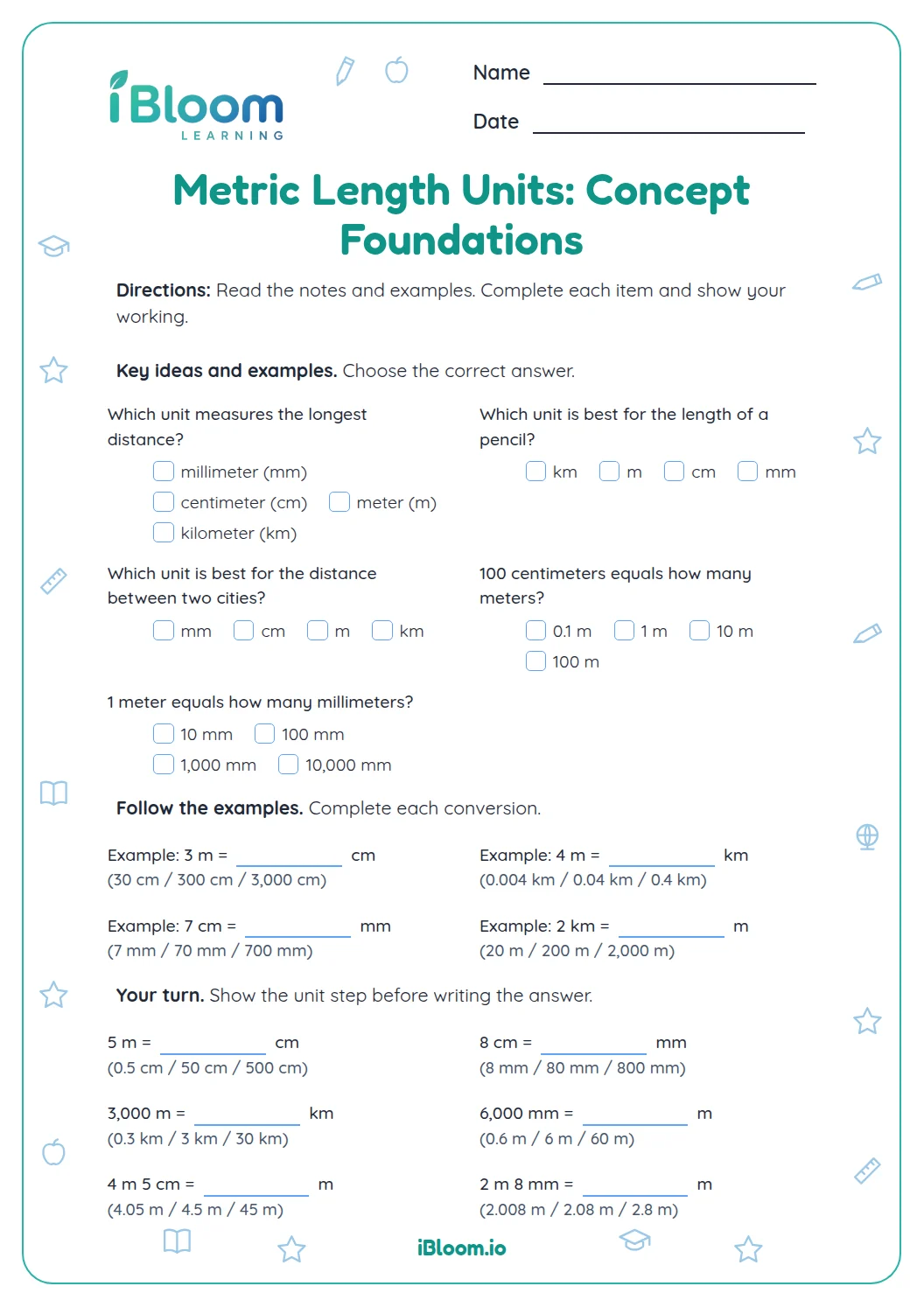
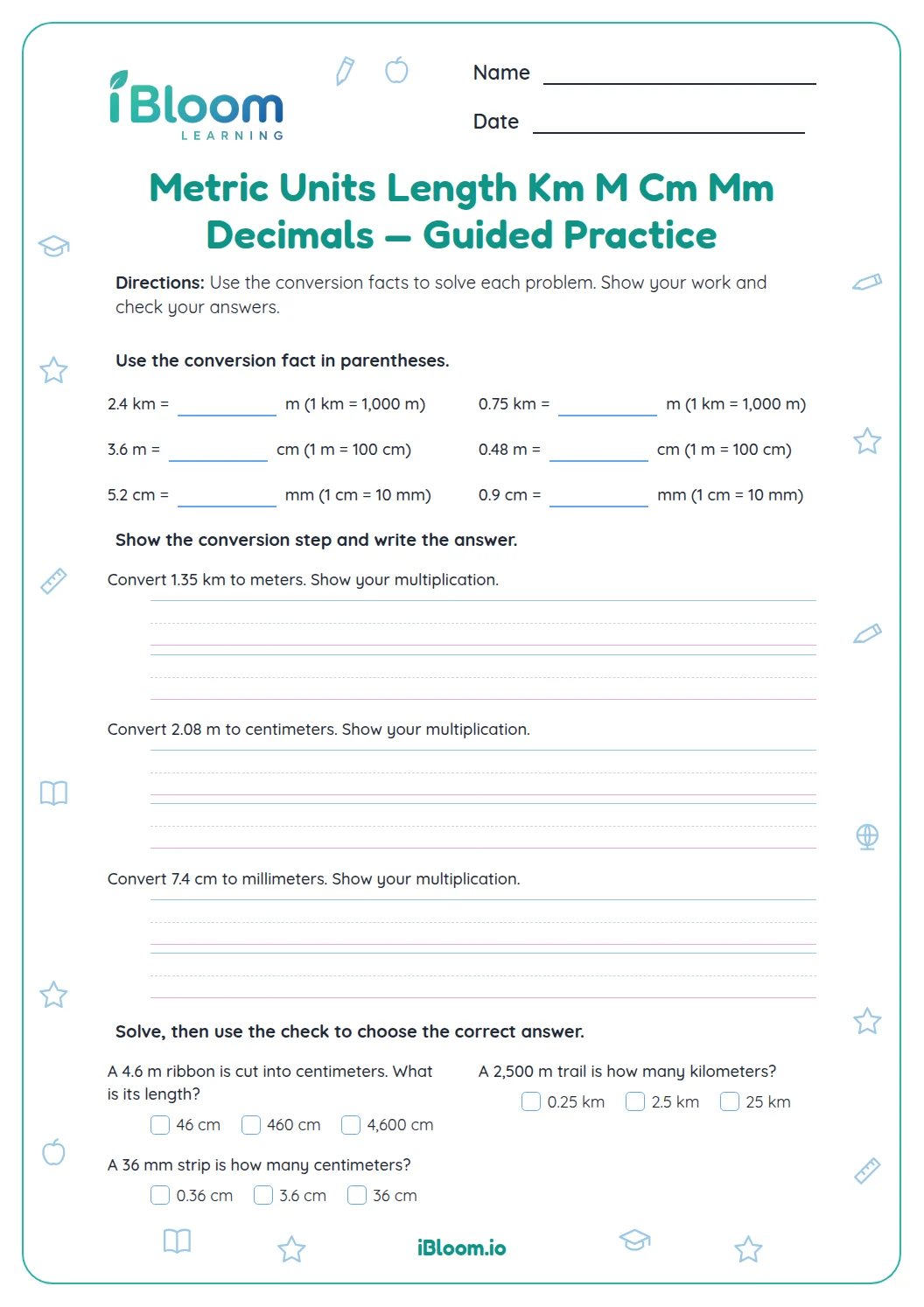
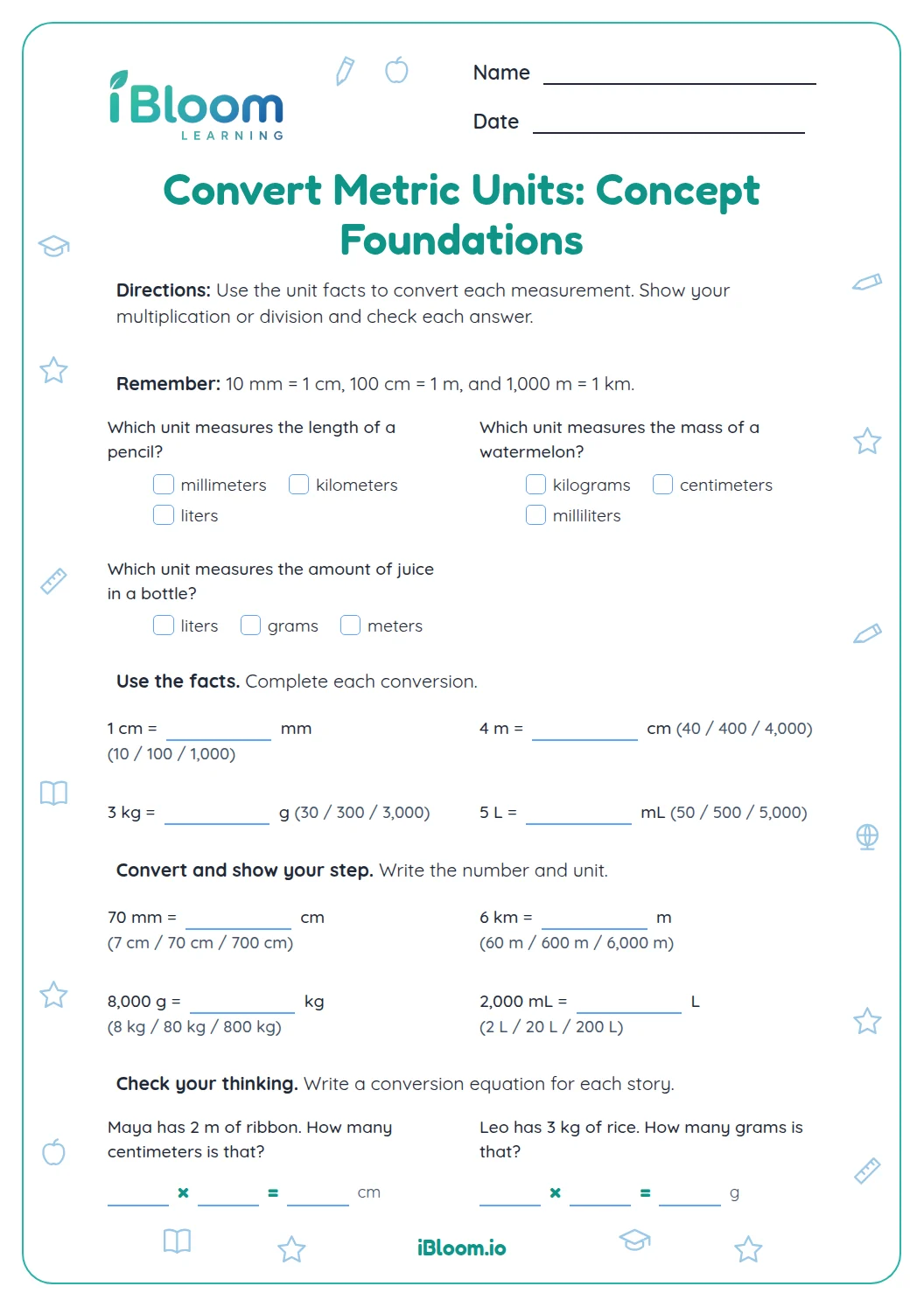
Part A asks students to convert among kilometers, meters, centimeters and millimeters. One meter equals 100 centimeters, one centimeter equals 10 millimeters, and one kilometer equals 1,000 meters.
Track each conversion one relationship at a time. For example, 2 km = 2,000 m, and 2,000 m = 200,000 cm.
- 1Question 7: 2 km = ___ cm
- 22 km = 2,000 m and 2,000 m = 200,000 cm.
Why convert before solving a length problem?
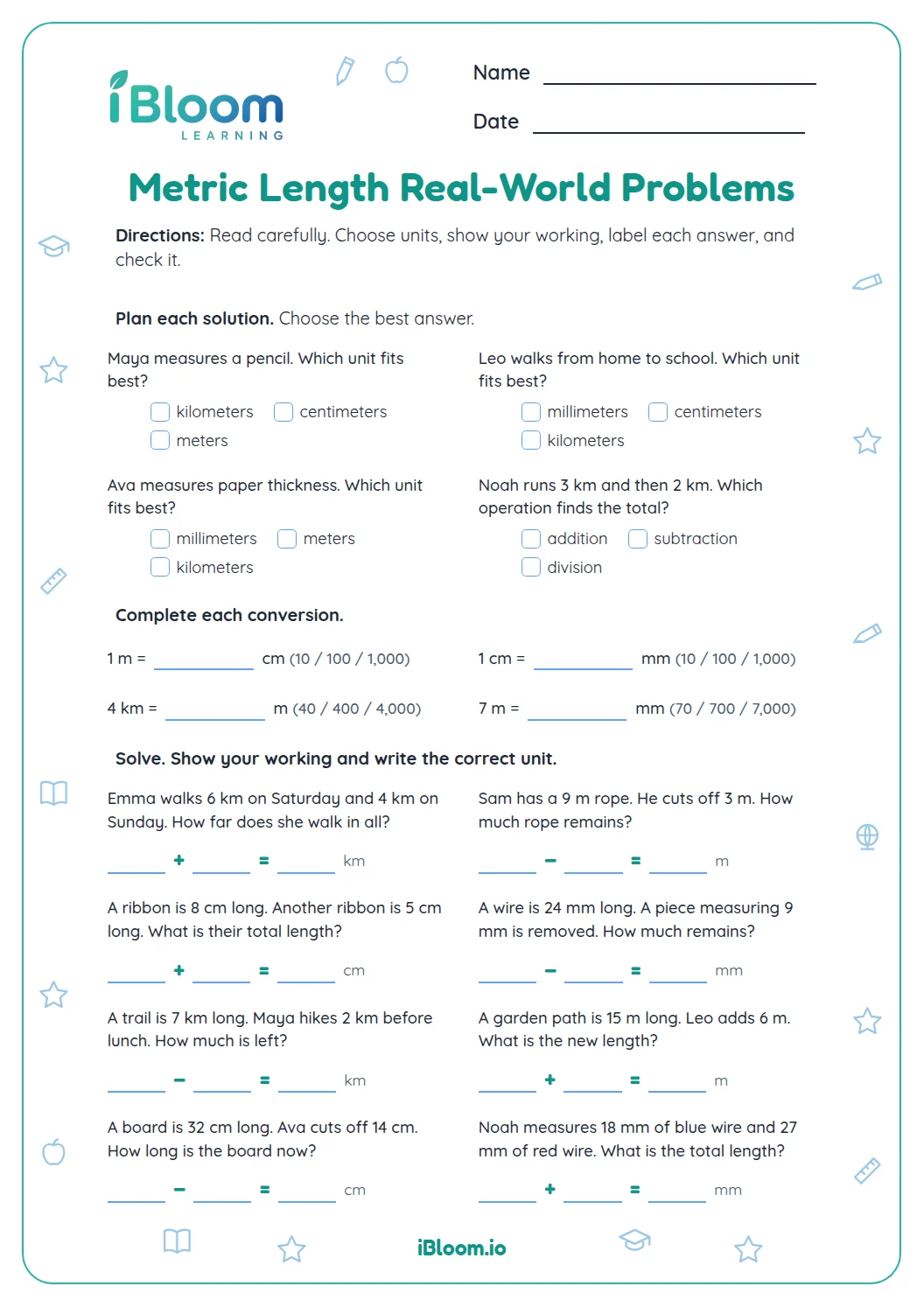
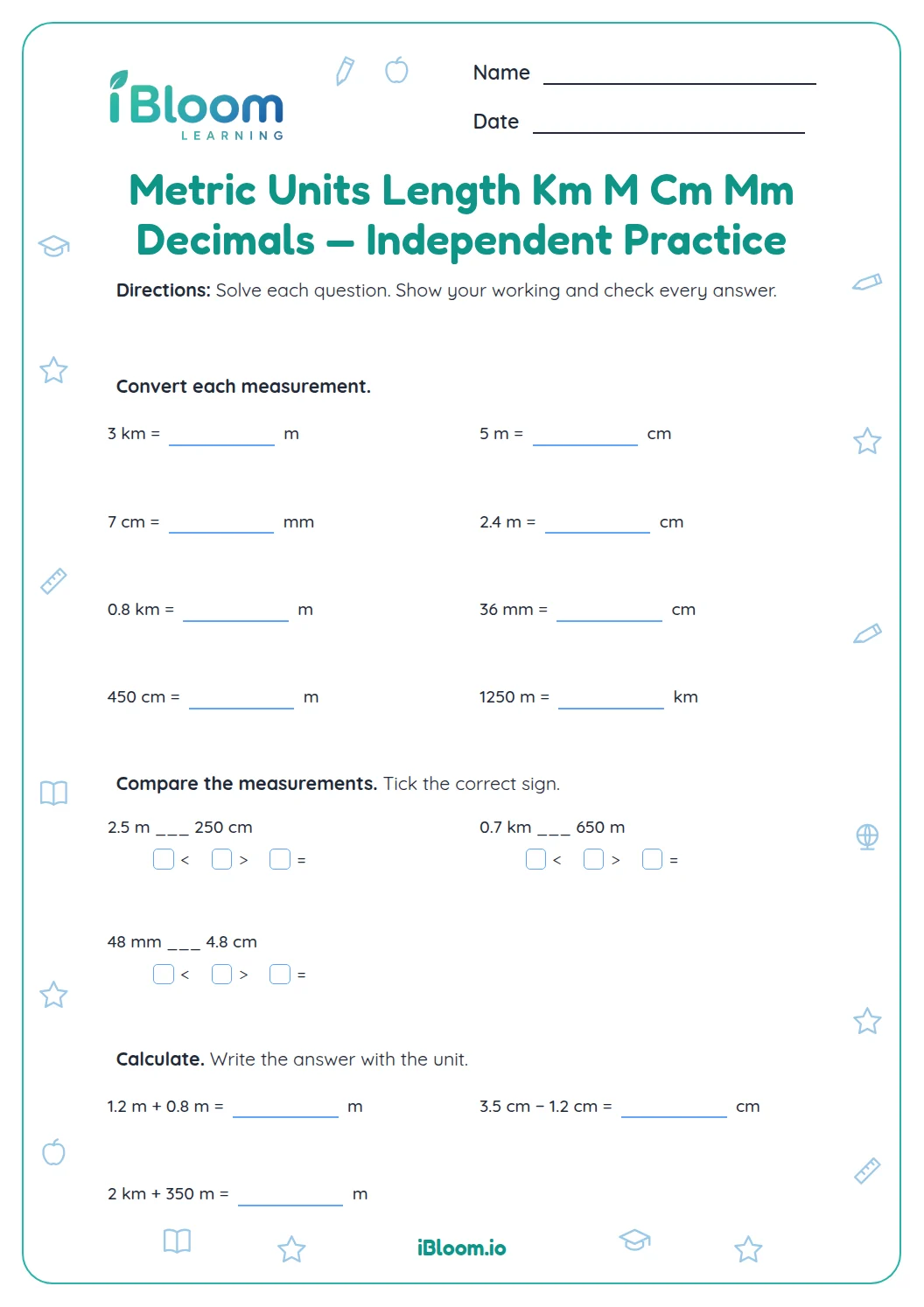
Part B combines unit conversion with addition, subtraction and comparison. Rewrite both measurements in the same unit before calculating; the answer then keeps a clear unit.
For the hiking problem, 7 km is 7,000 m. Subtract the 2,500 m already walked to find the remaining distance: 4,500 m.
How can students check a conversion?
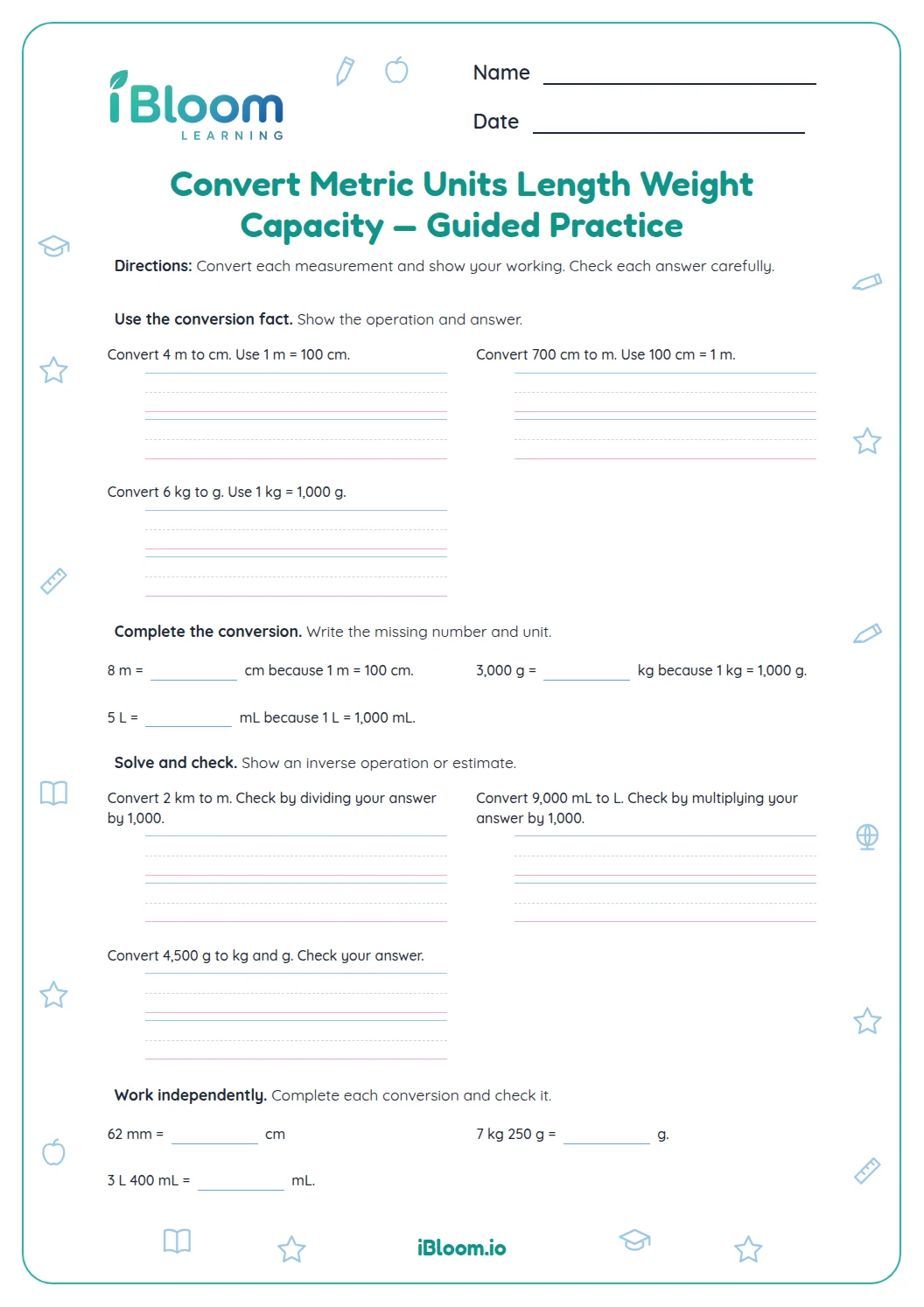
Estimate whether the number should grow or shrink. A length in millimeters should have a larger numeral than the same length in meters. Then reverse the conversion to see whether the original measure returns.
Check calculations separately from conversions. This helps catch a correct unit change followed by an addition or subtraction slip.
How to use this worksheet
- 1Read the unit named after the blank or question.
- 2Write the relationship between the two units.
- 3Multiply when changing a larger unit to a smaller one.
- 4Convert both measures to the same unit before adding, subtracting or comparing.
- 5Check that the answer includes a suitable unit.
Mistakes to watch for
The mistake
Multiplying when changing to a larger unit.
The fix
A larger unit needs fewer units for the same length, so divide.
The mistake
Comparing 2 m directly with 2,050 mm.
The fix
Convert both lengths to millimeters or meters before comparing.
The mistake
Leaving off the unit in a word problem.
The fix
Write m, cm or mm after the result so the measurement is clear.
Common Core alignment
These standards describe the reading, writing or math skills practiced on this page.
Convert metric lengths between kilometers, meters, centimeters and millimeters.
On this sheet: Questions convert lengths across km, m, cm and mm and compare equivalent measures.
Show the official wordingHide the official wording
Know relative sizes of measurement units within one system of units including km, m, cm; kg, g; lb, oz.; l, ml; hr, min, sec. Within a single system of measurement, express measurements in a larger unit in terms of a smaller unit. Record measurement equivalents in a two-column table. For example, know that 1 ft is 12 times as long as 1 in. Express the length of a 4 ft snake as 48 in. Generate a conversion table for feet and inches listing the number pairs (1, 12), (2, 24), (3, 36), ...
What to practice next
Make more practice
Further reading
Questions parents and teachers ask
Which metric units appear?
The questions use kilometers, meters, centimeters and millimeters. Students convert among these units in ten number sentences and apply conversions in six length situations. The answer key lists the equivalent measures and the results of the word problems. Work includes unit labels.
How many questions are included?
There are 16 questions: ten conversion number sentences and six word problems. The sheet spans two worksheet pages and includes a separate answer key. Students can show conversion steps before writing the final unit or result for each applied problem.
Should students convert before adding two lengths?
Yes. Convert both lengths to the same unit first, then add. In the total-path question, 1 km 300 m becomes 1,300 m, which can be added to 900 m for 2,200 m. The answer key records the total in meters.
How can a student tell if a conversion is reasonable?
The number of units increases when the same length is expressed in a smaller unit, such as meters to centimeters. It decreases when expressed in a larger unit, such as millimeters to meters. Students can estimate the direction before calculating.
Does the worksheet include decimals?
Two conversion items use decimal results: 3,500 millimeters equals 3.5 meters, and 2.4 meters equals 240 centimeters. The other conversions and six word problems use whole-number measurements. The key shows the expected value and unit for every problem. Students can compare decimal place values.
What standard does this worksheet practice?
It practices CCSS 4.MD.A.1, which includes knowing metric unit sizes and expressing a measurement in a smaller unit. Several questions apply equivalent measures to addition, subtraction or comparison of lengths. The answer key helps check both the conversion and the calculation.