

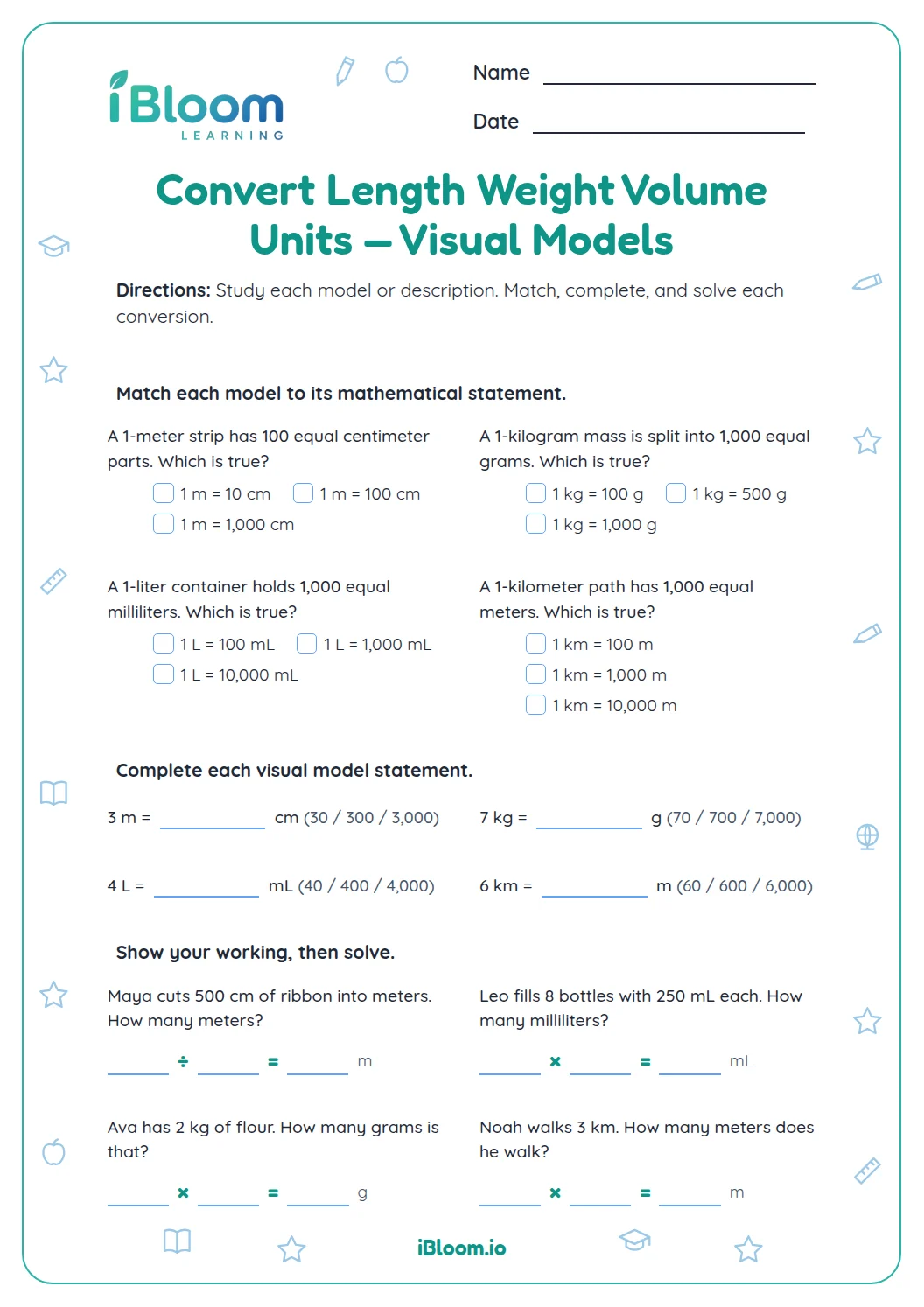

About this worksheet
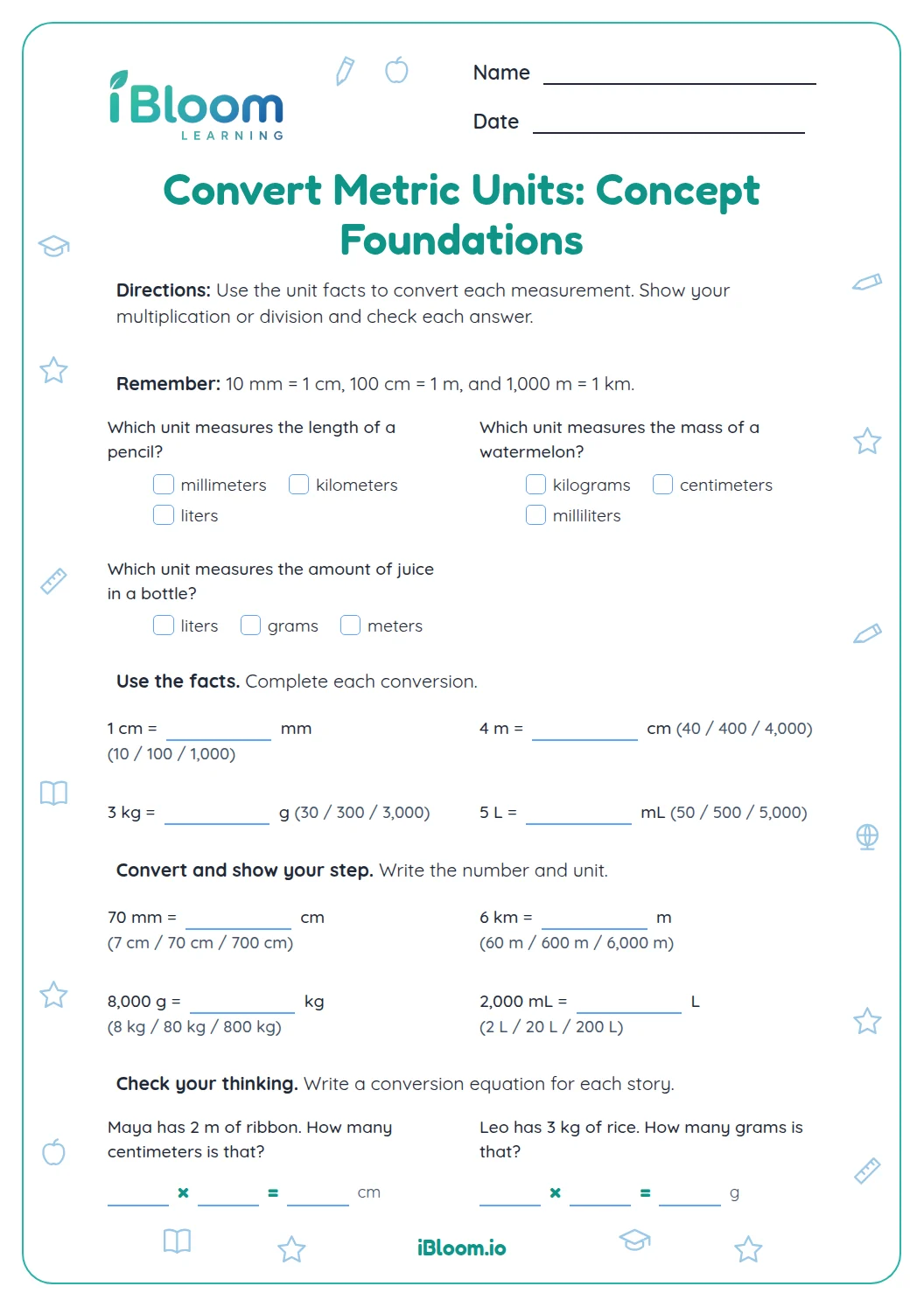
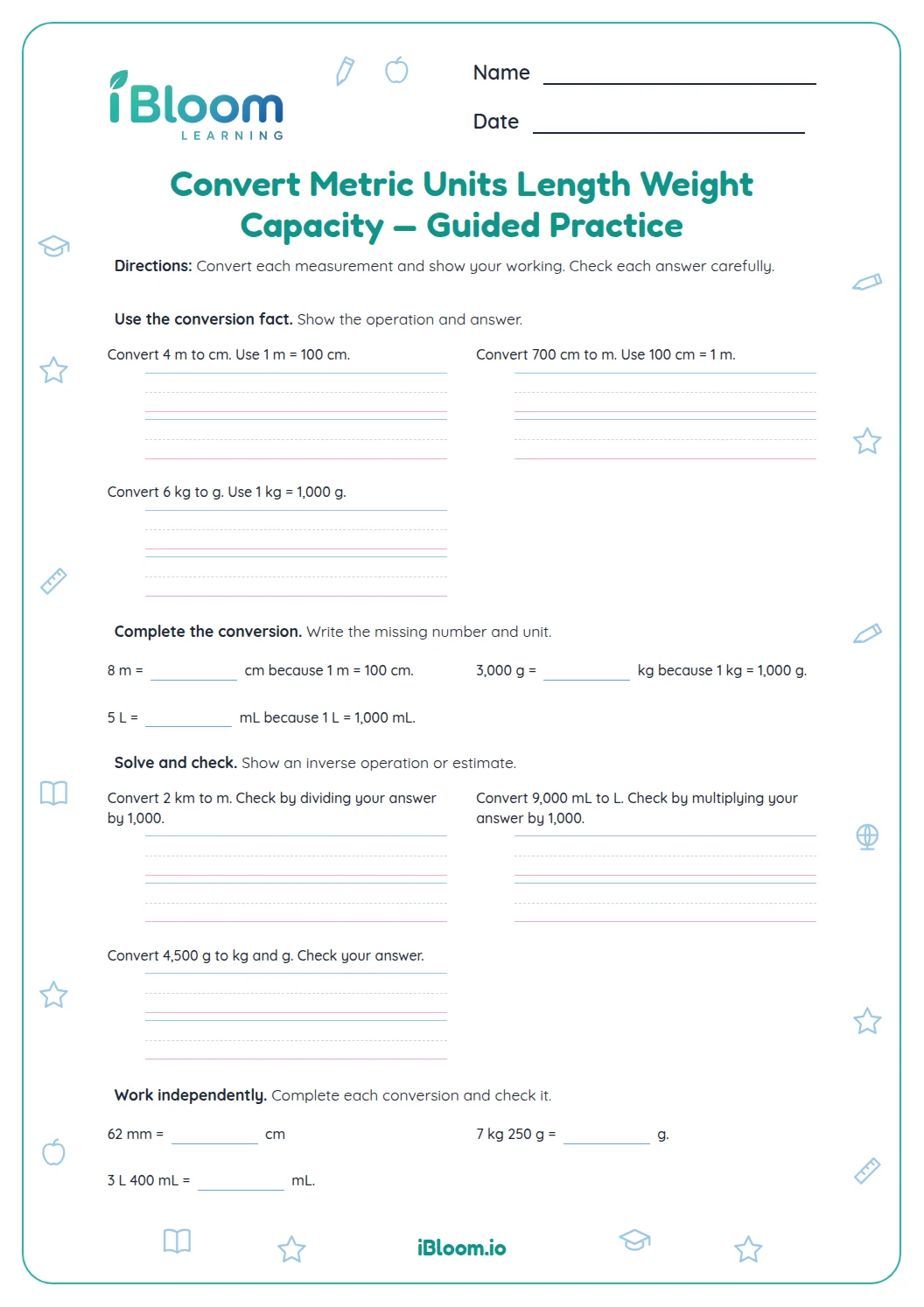
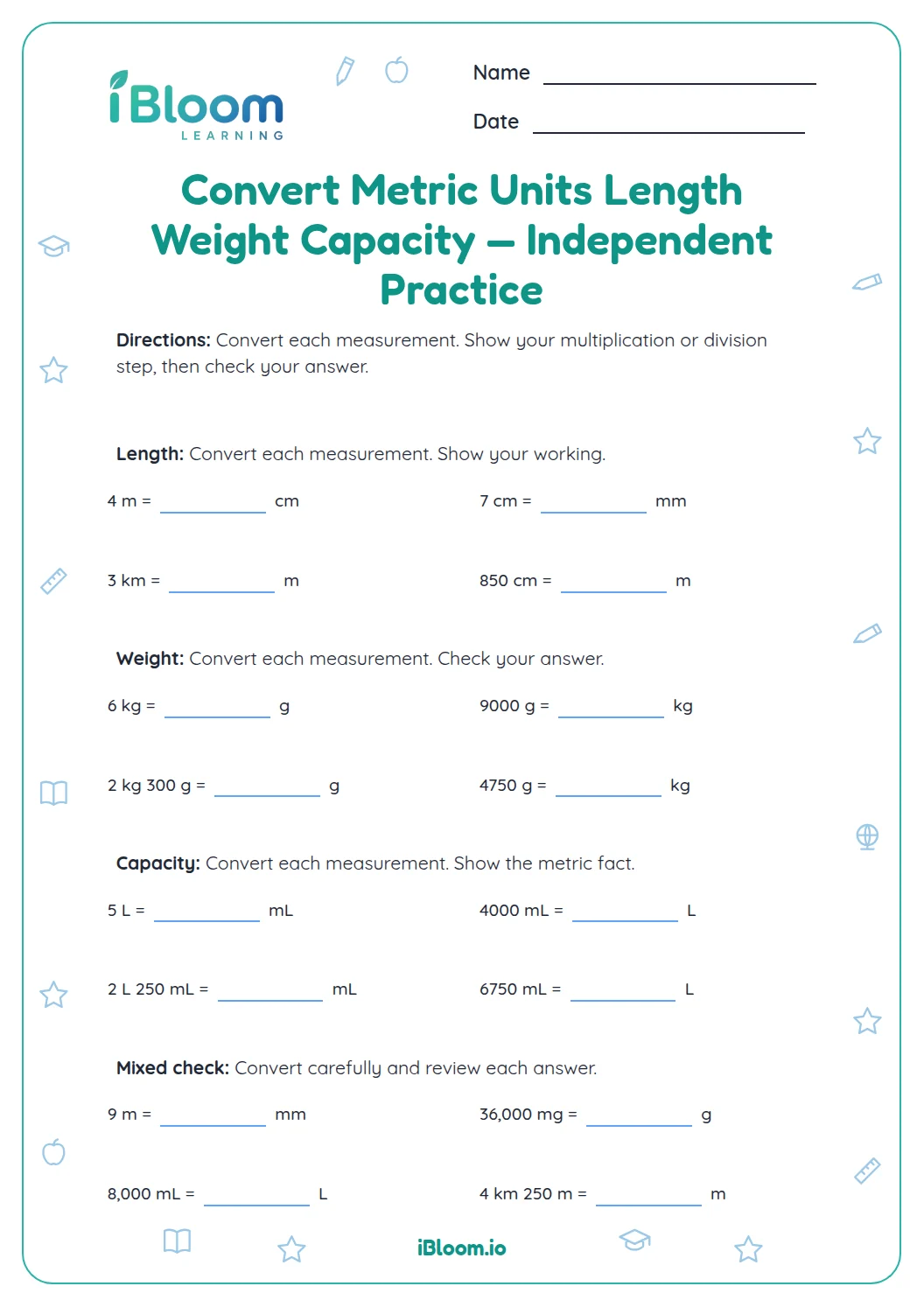
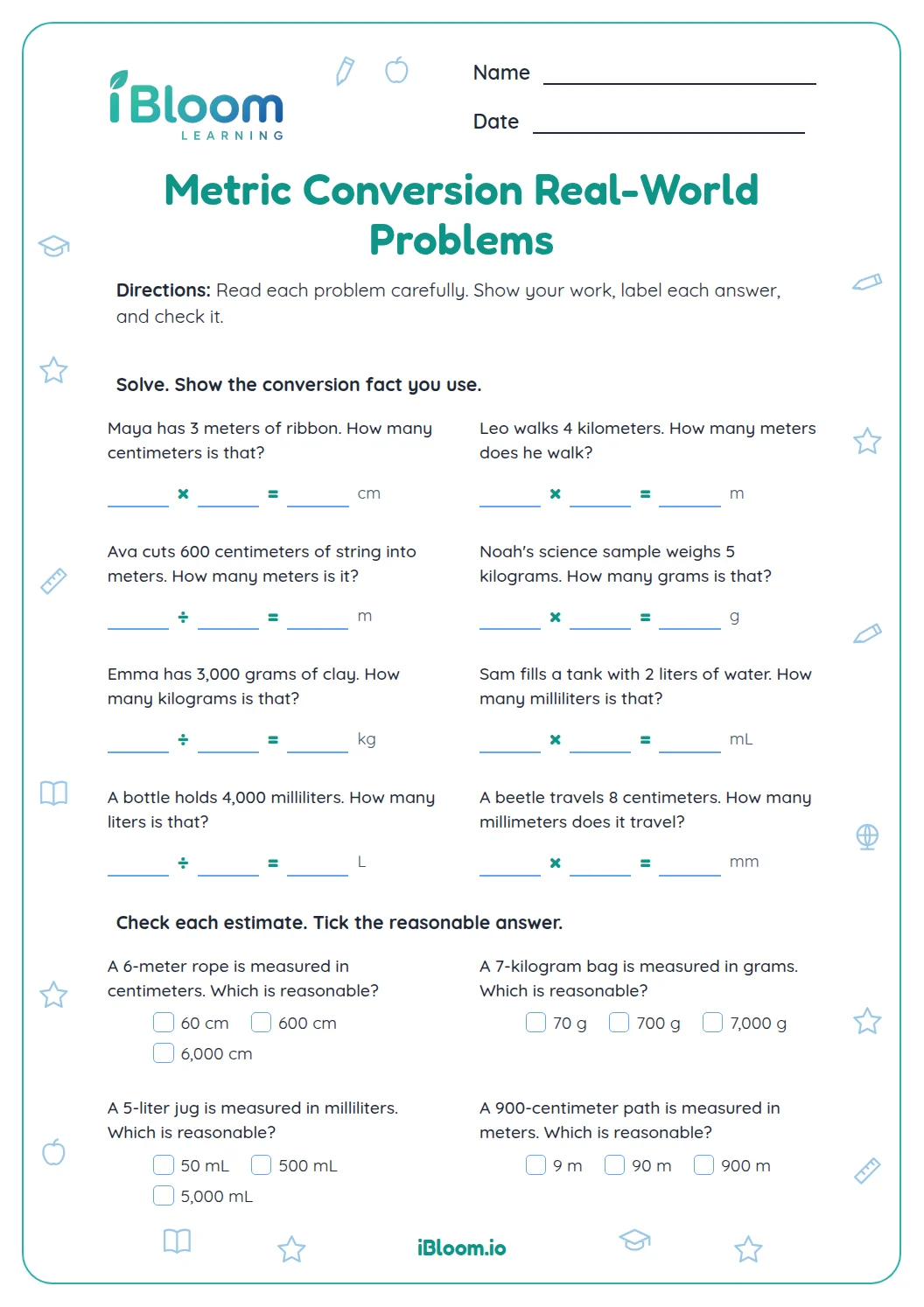
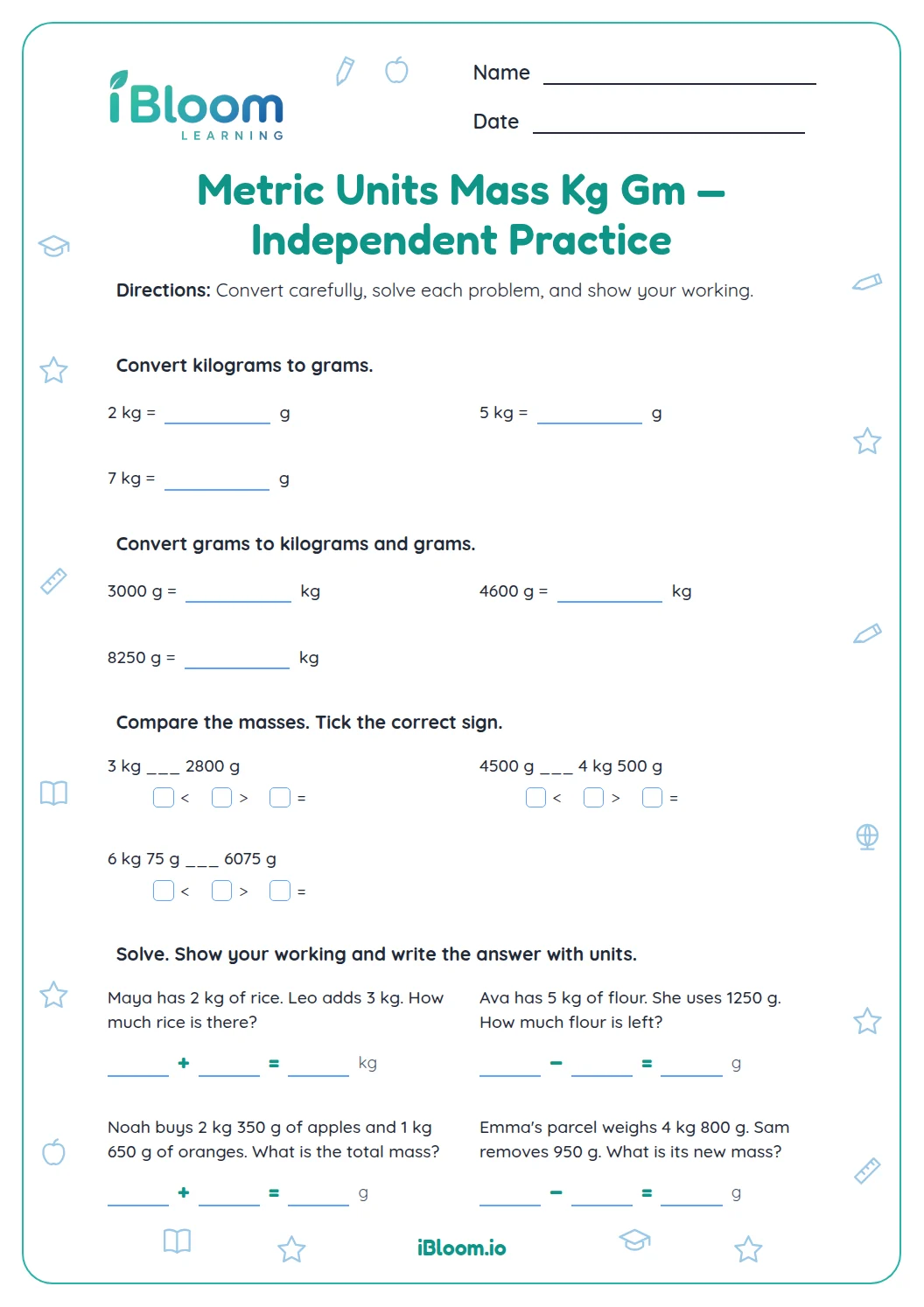
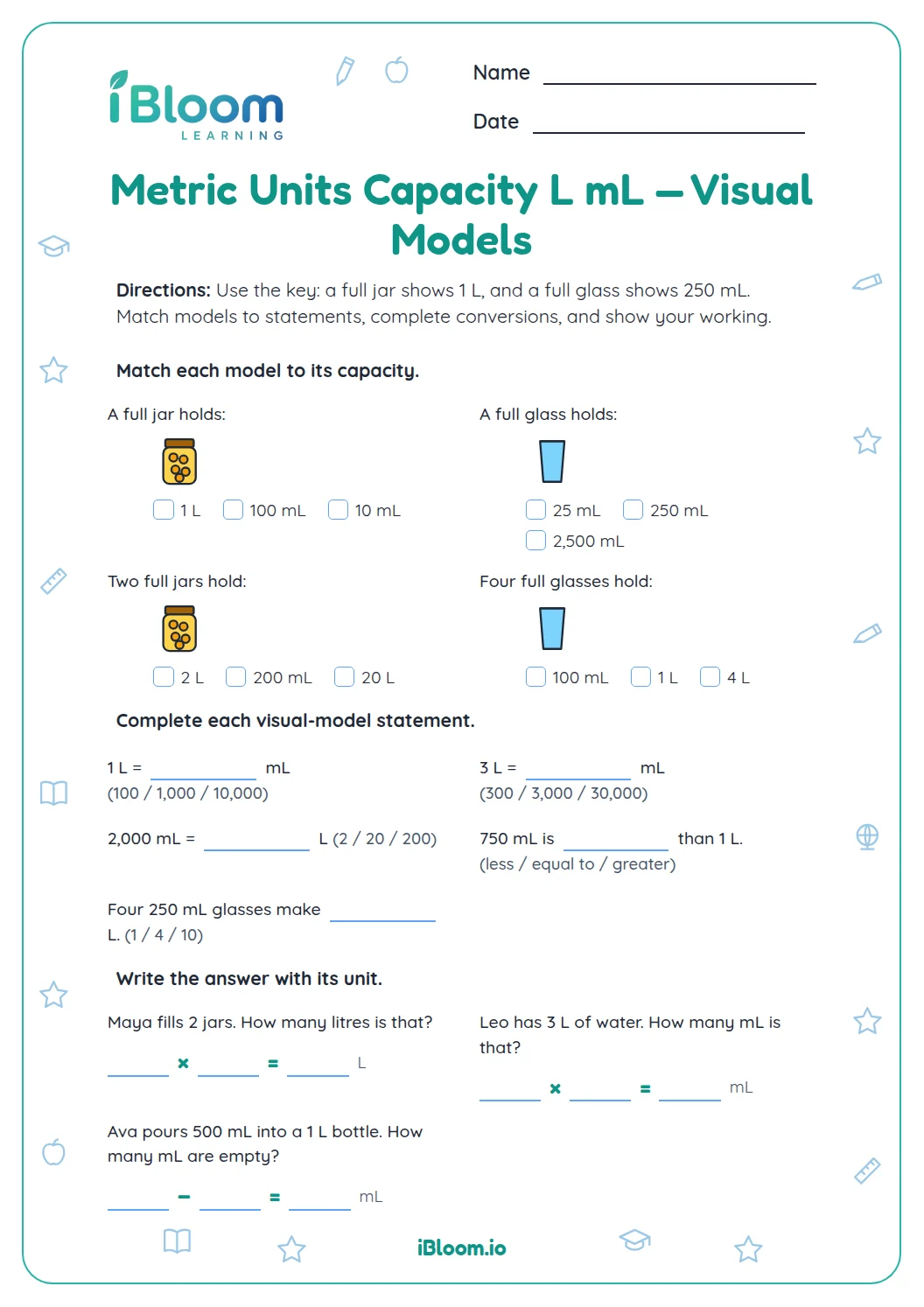
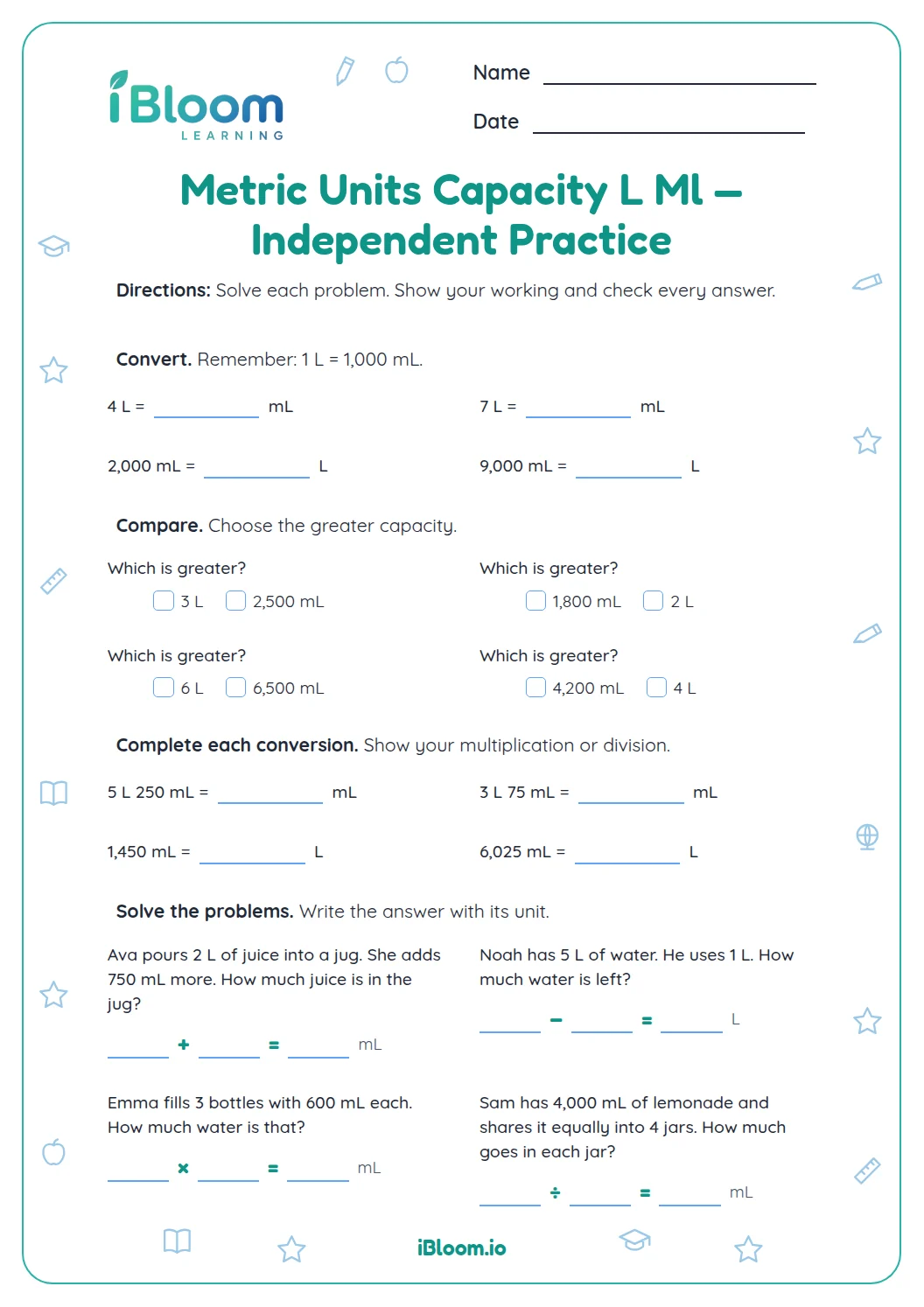
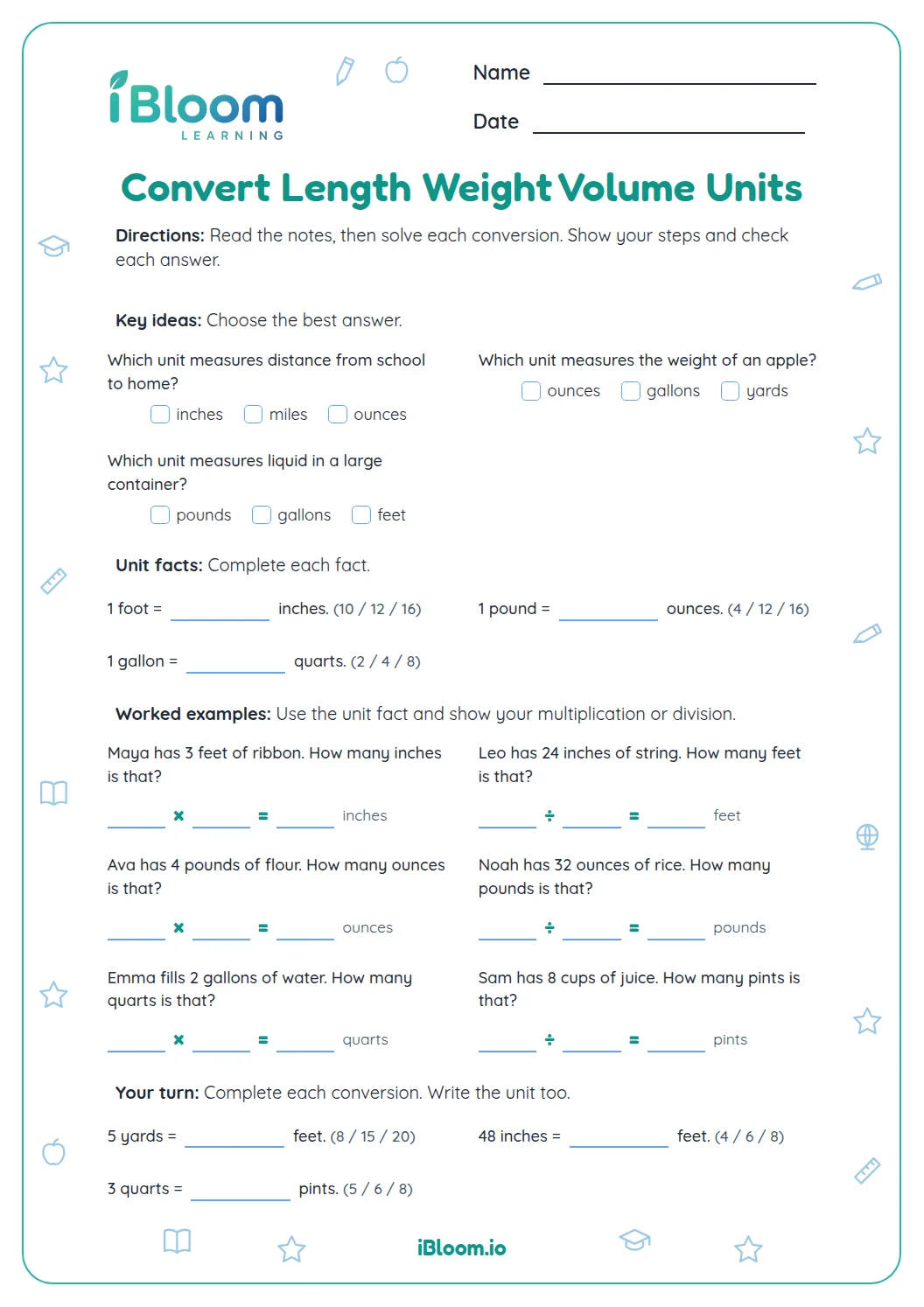
This free Grade 4 printable practices metric unit relationships for length, mass, and capacity. Students convert between kilometers, meters, centimeters, kilograms, grams, liters, and milliliters, then compare equivalent measures and solve multistep problems. The final section combines conversions with addition, subtraction, division, and equal groups. A separate answer key is included.
Aligned to 4.MD.A.1
What metric relationships help with conversions?
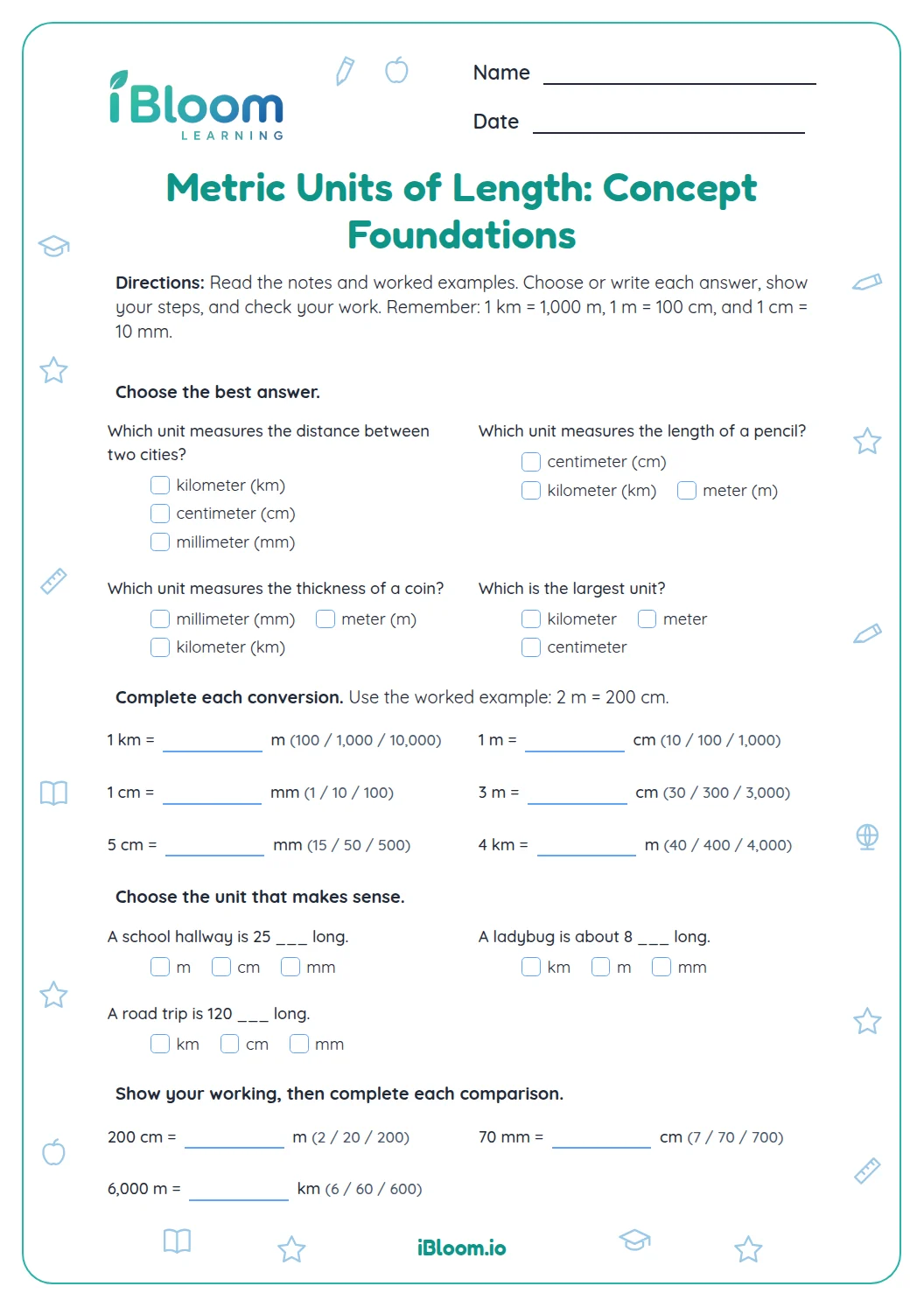
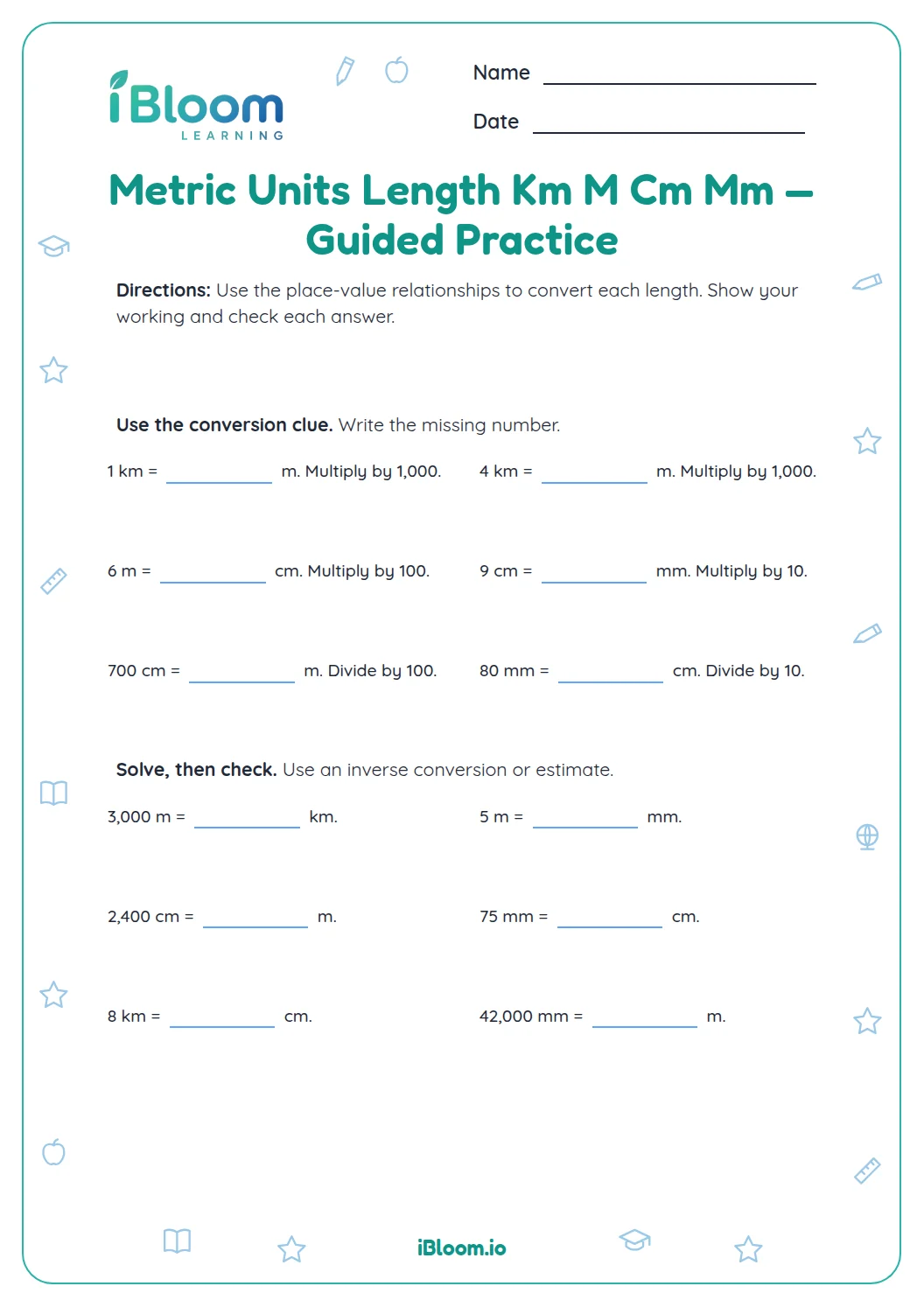
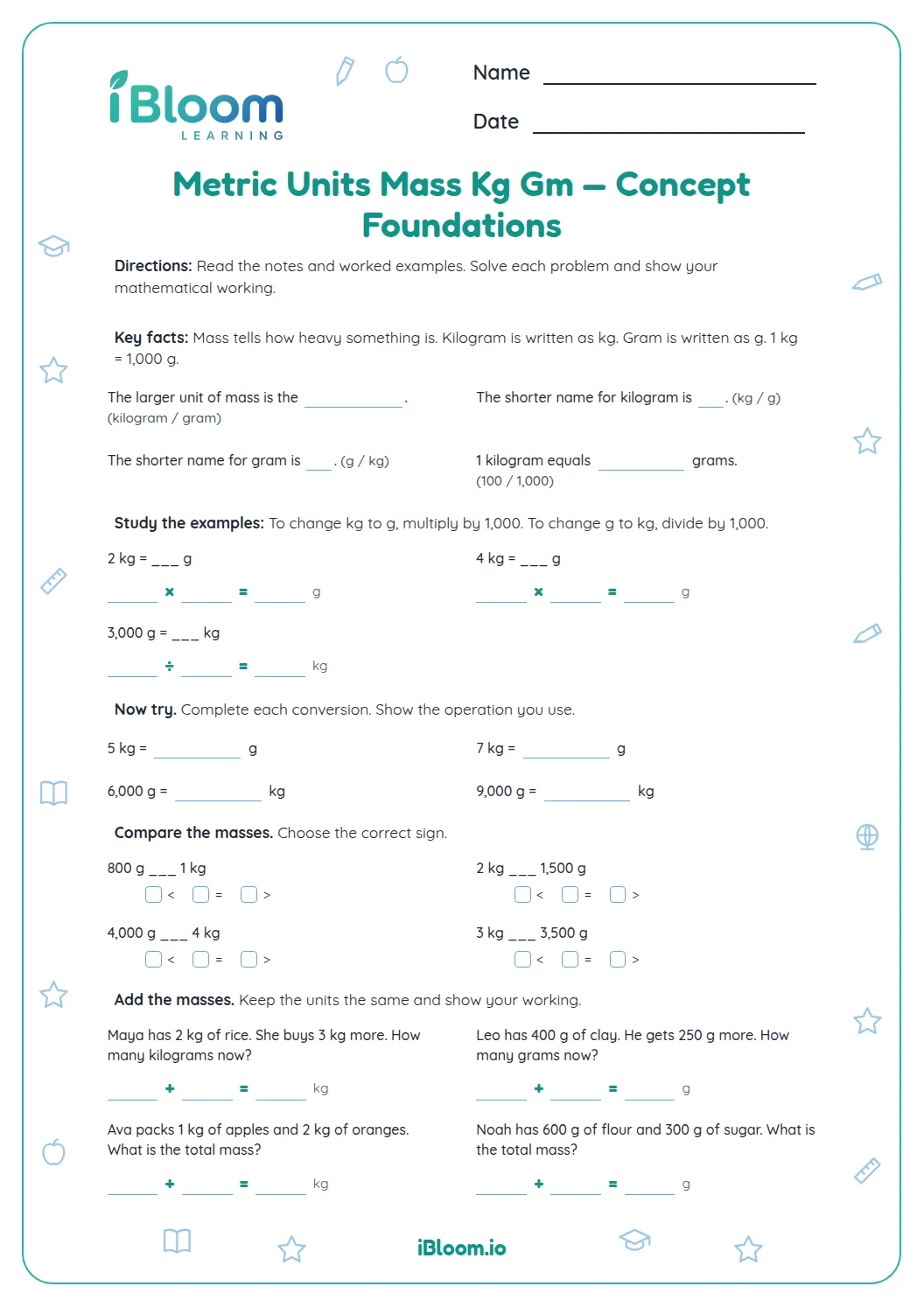
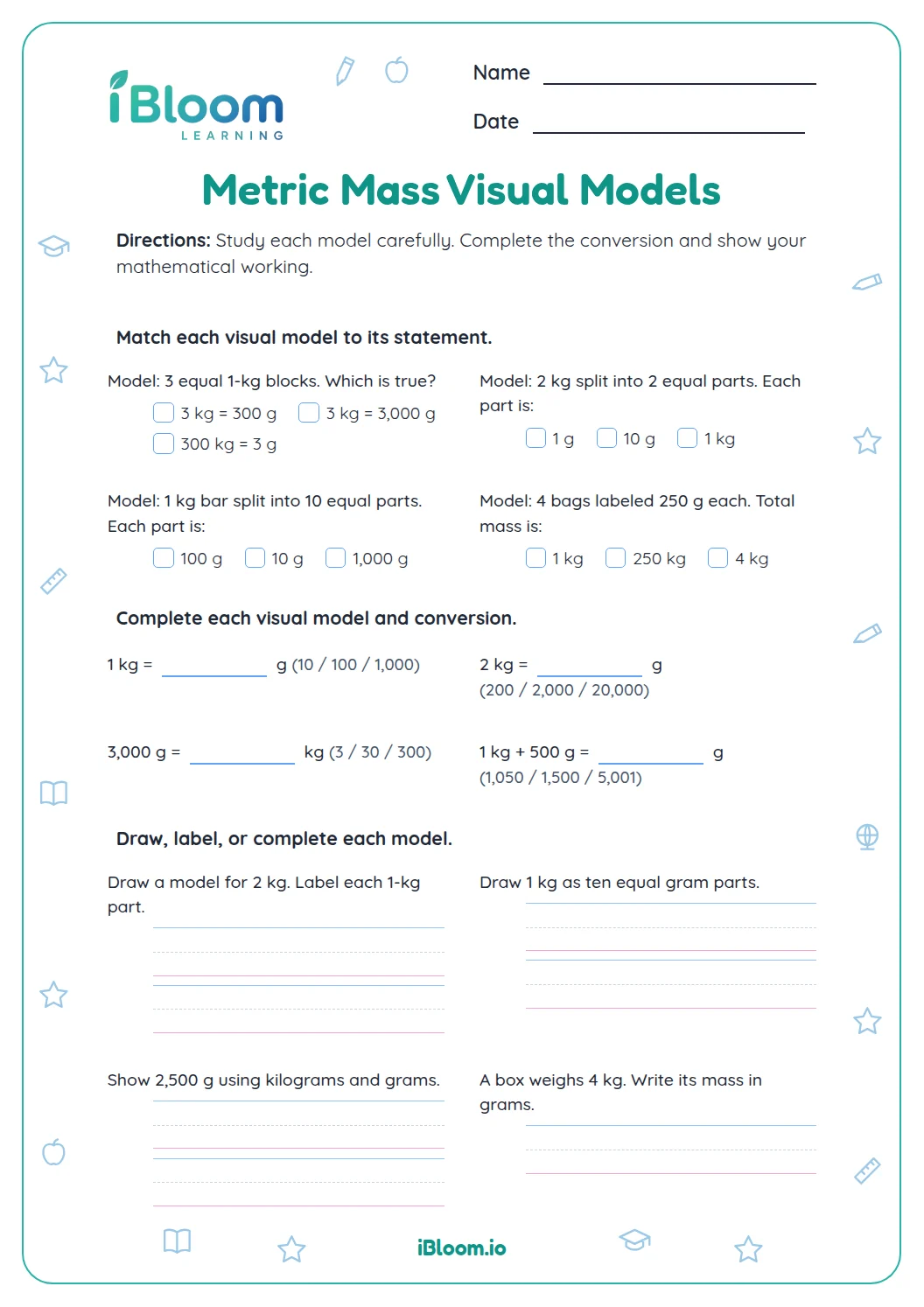
Use 1 km = 1,000 m, 1 m = 100 cm, 1 kg = 1,000 g, and 1 L = 1,000 mL. Moving from a larger unit to a smaller unit makes the numerical value larger.
For example, 6.5 m is 6.5 × 100 = 650 cm.
How do equivalent measures help you compare?
Write both quantities in one unit before comparing. Since 3 km equals 3,000 m, it is greater than 2,500 m. Likewise, 1 kg 80 g equals 1,080 g.
What is a reliable plan for a multistep problem?
Convert first, calculate second, and include the requested unit. For 8 equal pieces from 6 m, convert to 600 cm and divide by 8 to get 75 cm per piece.
How to use this worksheet
- 1Underline the units in each quantity.
- 2Write the metric relationship you need.
- 3Convert one or both quantities to a useful unit.
- 4Do the required arithmetic after converting.
- 5Keep units beside each intermediate value.
- 6Check that the size of the answer makes sense.
Common mistakes and quick fixes
The mistake
Multiplying when converting to a smaller unit but using the wrong factor.
The fix
Name the relationship first: 1 m = 100 cm, 1 kg = 1,000 g, and 1 L = 1,000 mL.
The mistake
Comparing a number of meters directly with a number of kilometers.
The fix
Rewrite both quantities in the same unit, then compare the numbers.
The mistake
Forgetting leftover units in a mixed measure such as 3 kg 250 g.
The fix
Separate the full larger units from the remainder, or convert the entire amount to grams.
Common Core alignment
These problems compare unit sizes and express larger units with smaller units.
Use metric unit relationships to express equivalent lengths, masses, and capacities.
On this sheet: All three parts rely on metric unit relationships to convert, compare and solve multistep measurement problems.
Show the official wordingHide the official wording
Know relative sizes of measurement units within one system of units including km, m, cm; kg, g; lb, oz.; l, ml; hr, min, sec. Within a single system of measurement, express measurements in a larger unit in terms of a smaller unit. Record measurement equivalents in a two-column table. For example, know that 1 ft is 12 times as long as 1 in. Express the length of a 4 ft snake as 48 in. Generate a conversion table for feet and inches listing the number pairs (1, 12), (2, 24), (3, 36), …
What to practice next
Further reading
Questions parents and teachers ask
Which metric units does this worksheet use?
The 18 questions use kilometers, meters, centimeters, kilograms, grams, liters, and milliliters. Students practice relationships such as 1 m = 100 cm, 1 kg = 1,000 g, and 1 L = 1,000 mL before using equivalent amounts in comparisons and problems.
How should students compare two measures?
Convert both measures to the same unit first. In question 7, 3 km is 3,000 m, which is greater than 2,500 m. In question 8, 1 kg 80 g is 1,080 g, which is less than 1,800 g. The comparison is clear once the units match.
What is an example of a multistep problem?
Question 16 asks for the length of each of 8 equal pieces cut from 6 m. Convert 6 m to 600 cm, then divide 600 by 8. Each piece is 75 cm long. Writing the conversion before division helps keep the units consistent.
Does the answer key include units?
The key supplies numerical conversions and the comparison choice. Students should keep the requested unit from each prompt when recording an answer, such as centimeters for the ribbon problem or grams for the mass problem. The units in the prompt show what each response should represent.
How can students check a conversion?
Use the size of the units to predict whether the number should grow or shrink. Converting 7 kilometers to meters multiplies by 1,000, giving 7,000 meters. Converting smaller units into a larger unit makes the numerical value smaller. A quick estimate can catch misplaced zeros.