


About this worksheet
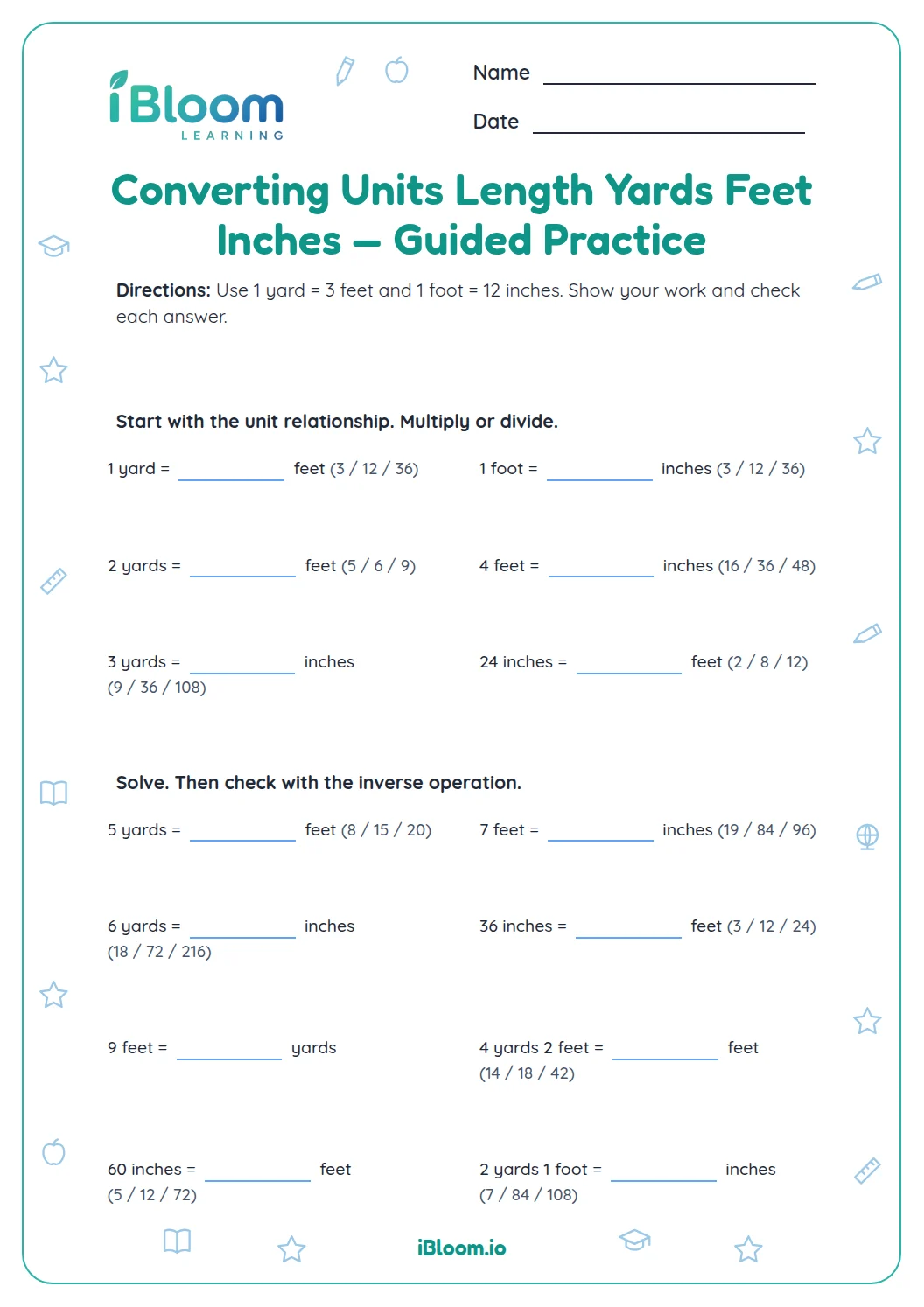
This free printable worksheet gives Grade 4 students sixteen questions on converting whole-number lengths among miles, yards, and feet. The three conversion facts are printed in the directions. Part A converts to smaller units, Part B converts to larger units, and Part C applies the facts in four short problems. The final problem combines miles and yards into one total in yards. The sheet practices unit relationships and equivalent lengths in Common Core 4.MD.A.1. A separate answer key includes units for the word-problem answers.
Aligned to 4.MD.A.1
Which conversion facts do students need?
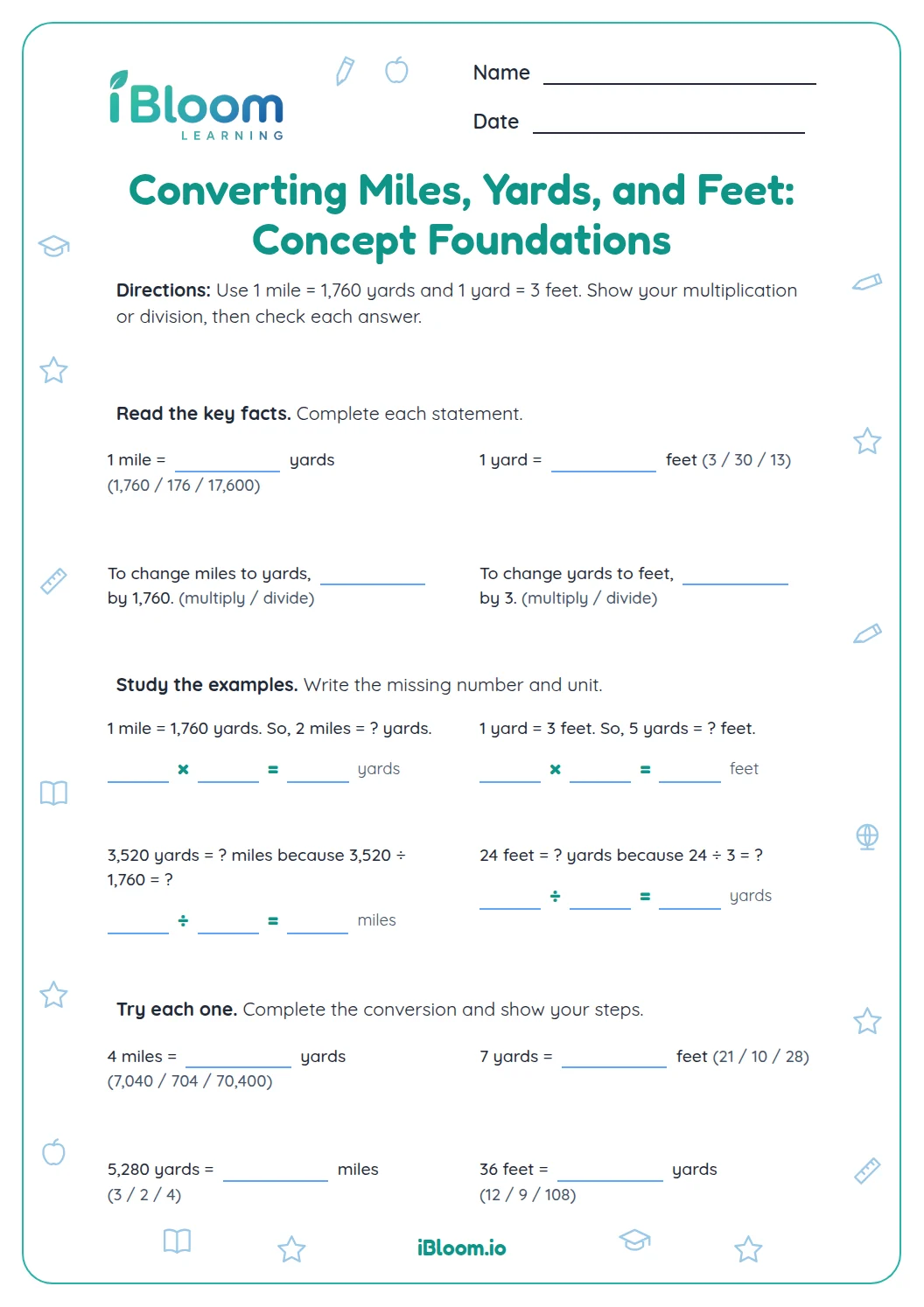
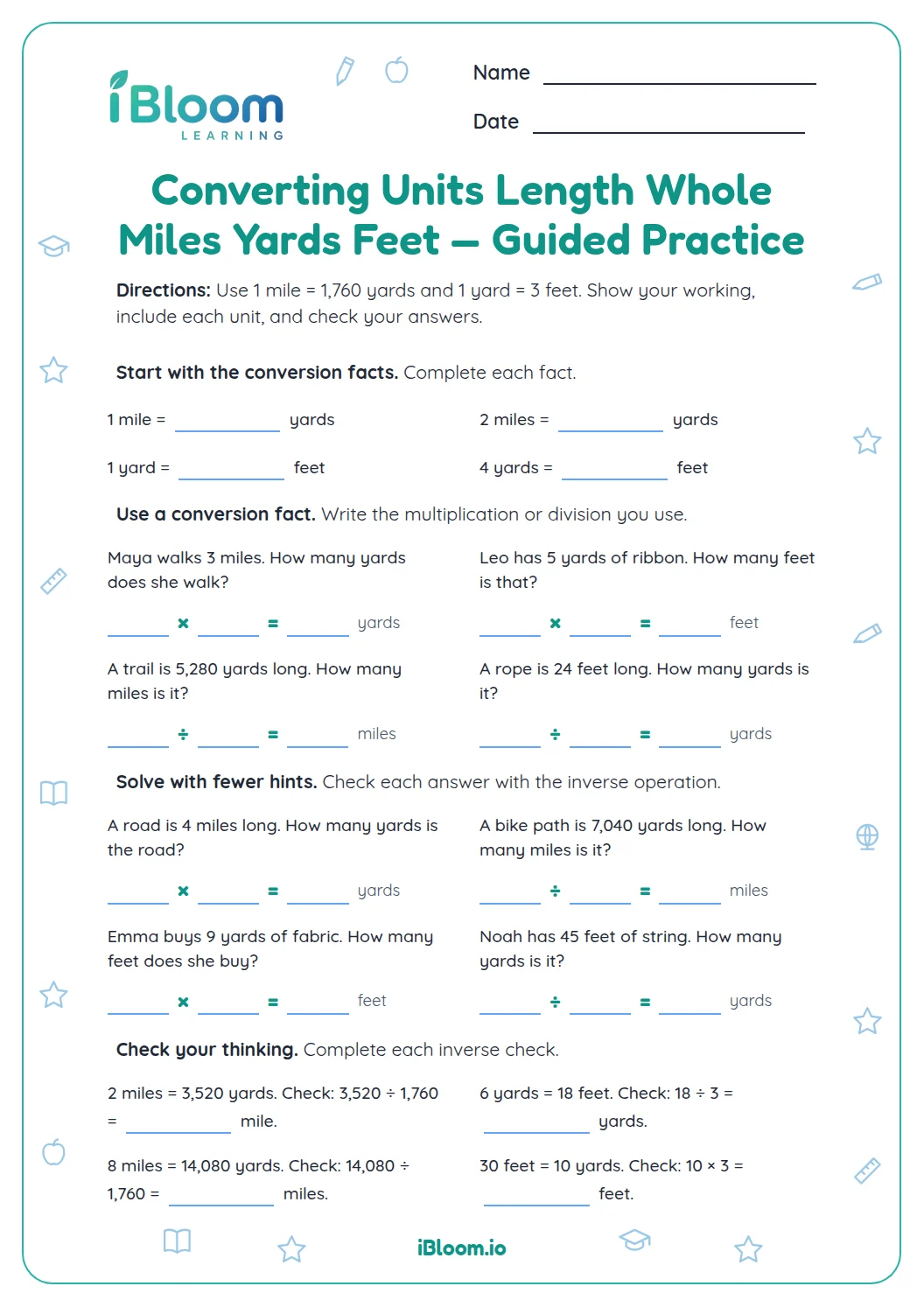
The directions give all three relationships: one yard is three feet, one mile is 1,760 yards, and one mile is 5,280 feet. Students choose the fact that connects the starting unit to the requested unit.
Questions 9 and 11 use different starting units. For 5,280 yards, divide by 1,760 to get three miles. For 10,560 feet, divide by 5,280 to get two miles. Read the unit before choosing the conversion fact.
When should students multiply or divide?
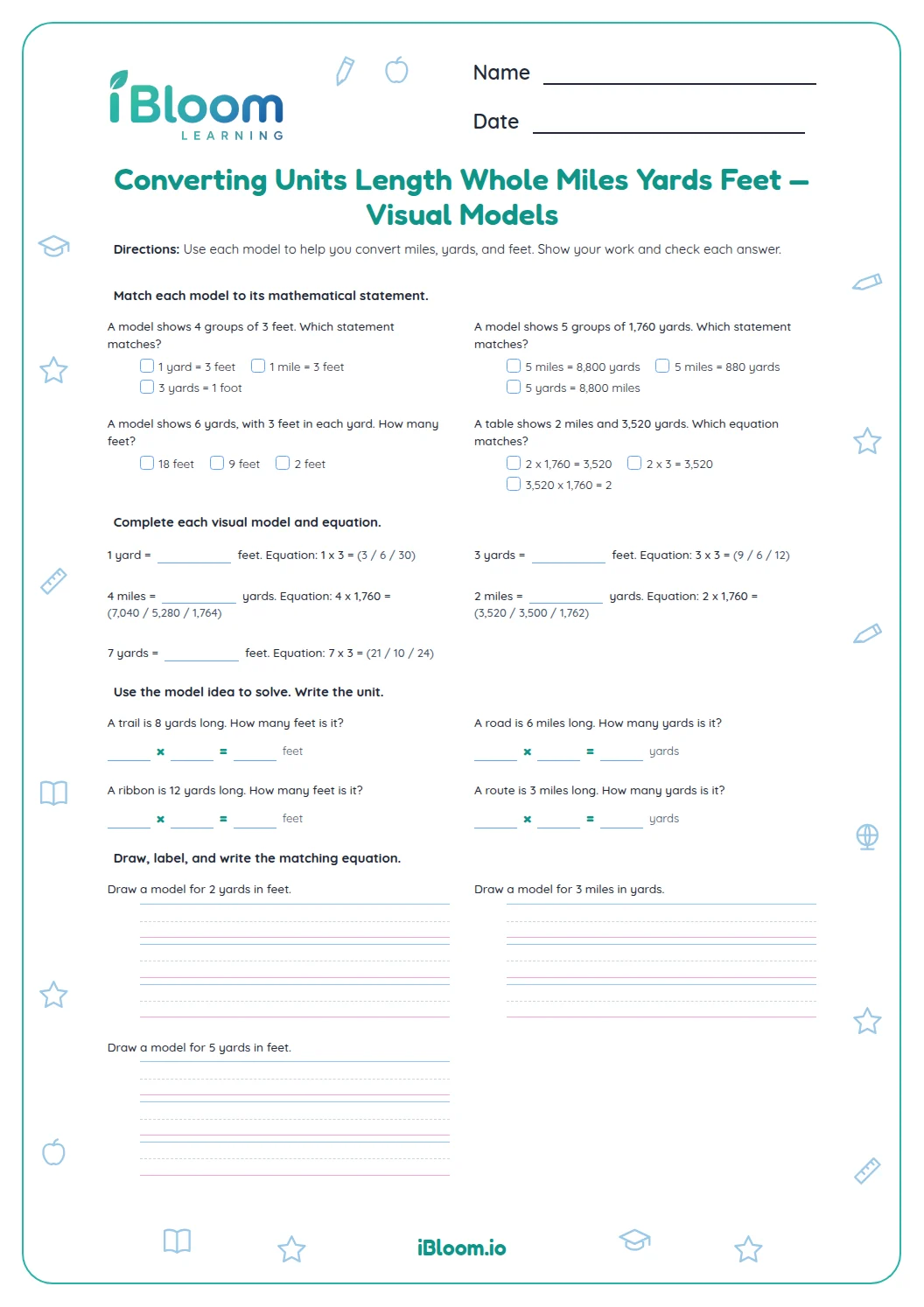
A smaller unit requires more units to cover the same length. Converting miles to yards or feet therefore makes the number larger. Converting feet to yards or miles finds the number of complete groups and makes the number smaller.
- 13 mi = ___ ft
- 21 mi = 5,280 ft
- 33 × 5,280 = 15,840
- 43 mi = 15,840 ft
How do you add lengths written in different units?
Convert both lengths to the unit requested before adding. In question 16, the answer must be in yards, so convert two miles to 3,520 yards. Then add the remaining 880 yards to get 4,400 yards.
For an independent practice session, let students choose the operation themselves. During review, ask them to explain why their answer became numerically larger or smaller when the unit changed.
How to use this worksheet
- 1Read the three conversion facts at the top and identify the largest and smallest unit.
- 2For each Part A question, choose the matching fact and multiply.
- 3For each Part B question, count equal groups using division.
- 4Write an equation for each word problem before doing the arithmetic.
- 5In question 16, convert the miles to yards before adding the two lengths.
- 6Check each result by reversing the conversion and include units on the word-problem answers.
Mistakes to discuss
The mistake
Using 5,280 for a miles-to-yards conversion.
The fix
Match both units to the fact: miles to yards uses 1,760.
The mistake
Multiplying when converting feet to yards.
The fix
Group the feet in threes; a yard is larger, so fewer yards describe the same length.
The mistake
Adding 2 and 880 directly in the last problem.
The fix
First change the two miles to 3,520 yards, then add the 880 yards.
Common Core alignment
Use the sizes of miles, yards, and feet to express equivalent lengths.
On this sheet: Children convert whole-number lengths among miles, yards, and feet, then apply the equivalents in problems.
Show the official wordingHide the official wording
Know relative sizes of measurement units within one system of units including km, m, cm; kg, g; lb, oz.; l, ml; hr, min, sec. Within a single system of measurement, express measurements in a larger unit in terms of a smaller unit. Record measurement equivalents in a two-column table.
What to practice next
Make more practice
Further reading
Questions parents and teachers ask
Are the conversion facts printed on the worksheet?
Yes, the directions give one yard as three feet, one mile as 1,760 yards, and one mile as 5,280 feet. Students can refer to these facts throughout the practice. The task is to choose the matching relationship and use it correctly for the units in each question.
Does the sheet convert in both directions?
Yes, Part A has six conversions to smaller units and Part B has six conversions to larger units. The four word problems apply these relationships in short contexts. Every result is a whole number, so students can focus on choosing the operation and keeping track of the unit.
Why do 5,280 yards and 5,280 feet give different answers?
They describe different lengths because a yard is three times as long as a foot. In question 9, divide 5,280 yards by 1,760 yards per mile to get three miles. The same numeral in feet would describe one mile. Always read the unit beside the number.
How should the last word problem be solved?
Convert the two miles to yards first, then add the extra 880 yards. Two times 1,760 is 3,520, and 3,520 plus 880 is 4,400. The answer is 4,400 yards. Adding the original numerals directly would mix two different units and would not represent the total length.
How can students check a conversion independently?
Reverse the operation using the same unit relationship. After converting seven yards to twenty-one feet, divide twenty-one by three to recover seven yards. Also check the direction: describing a fixed length with a smaller unit should produce a larger number, while a larger unit produces a smaller number.