

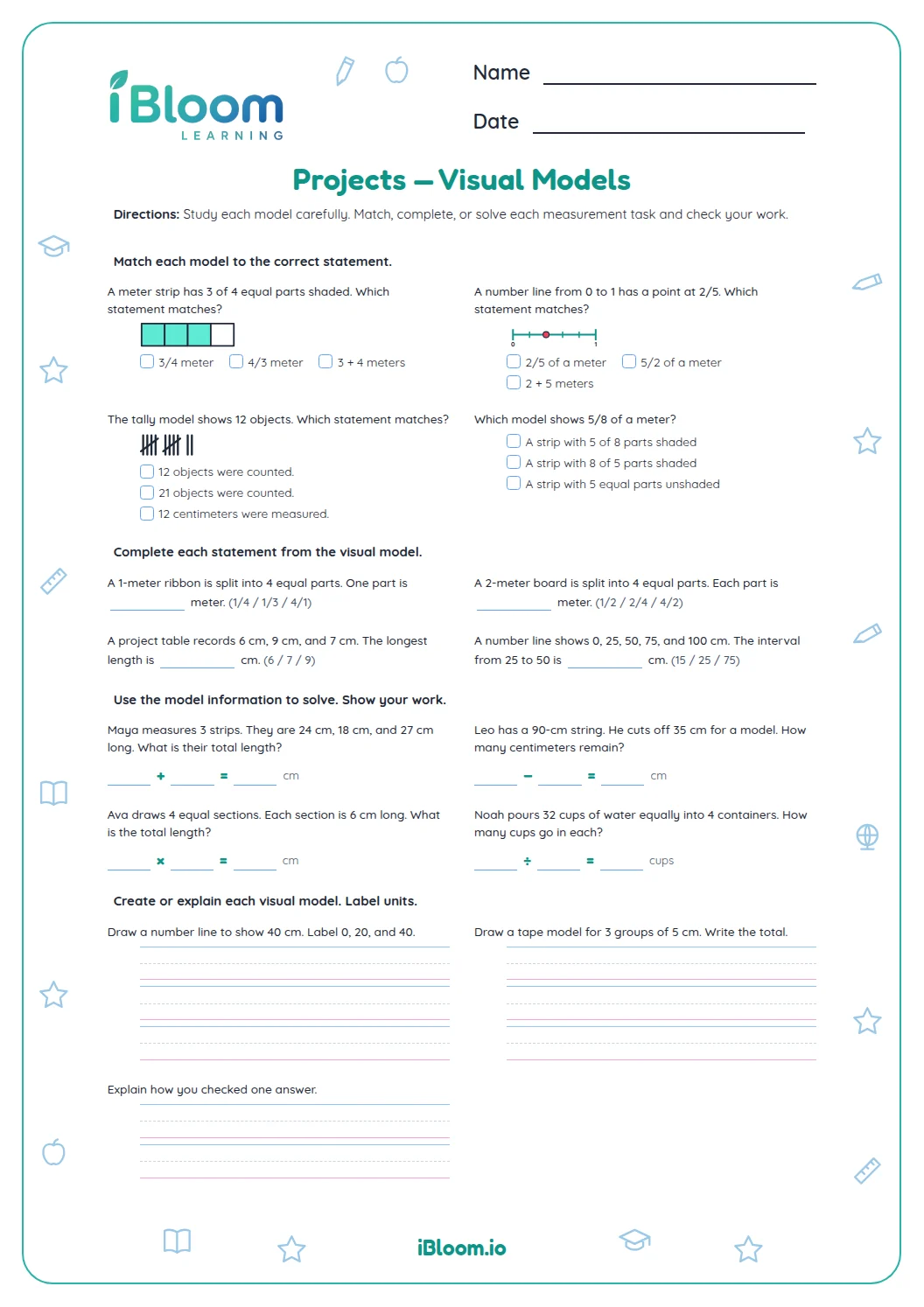
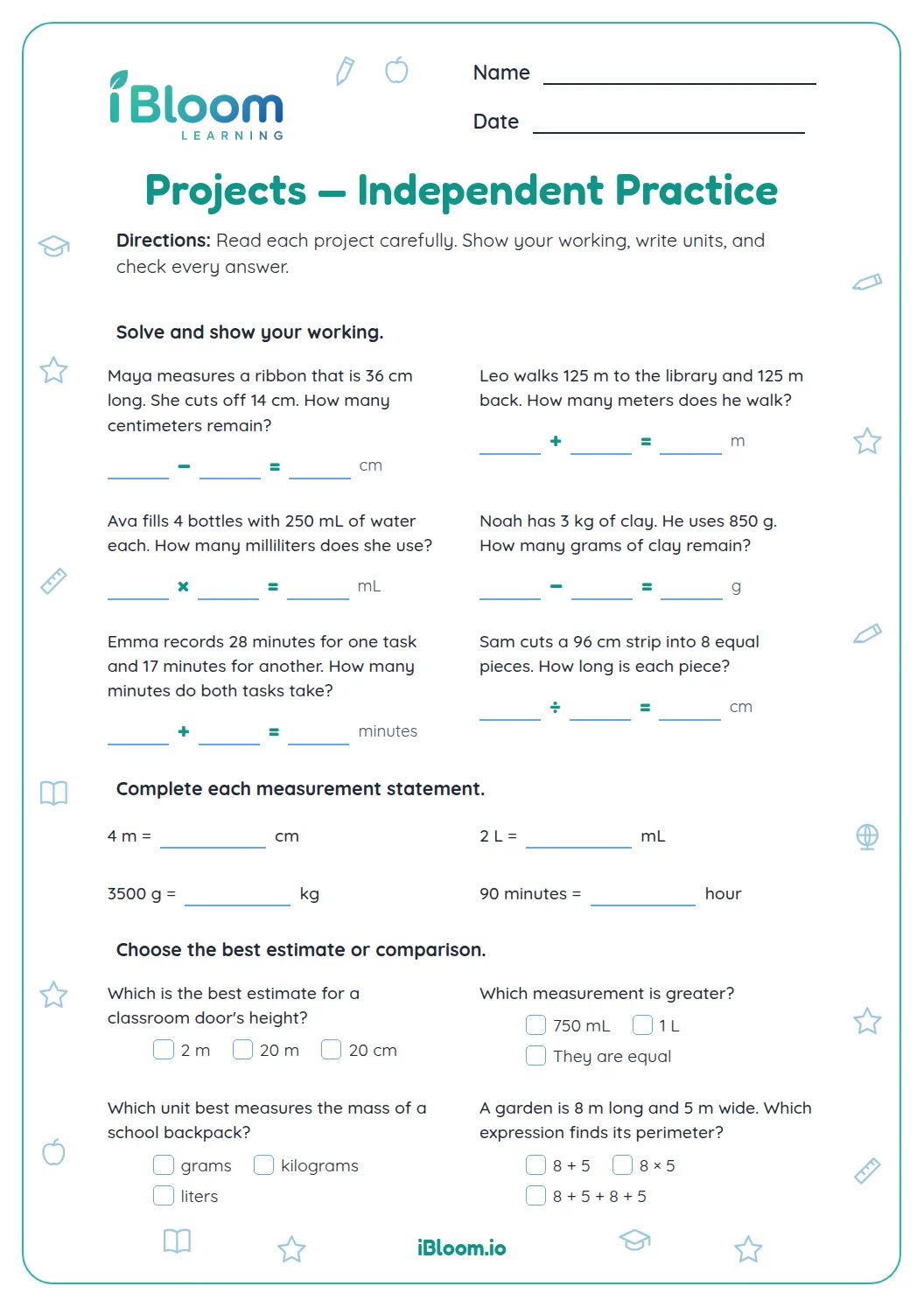
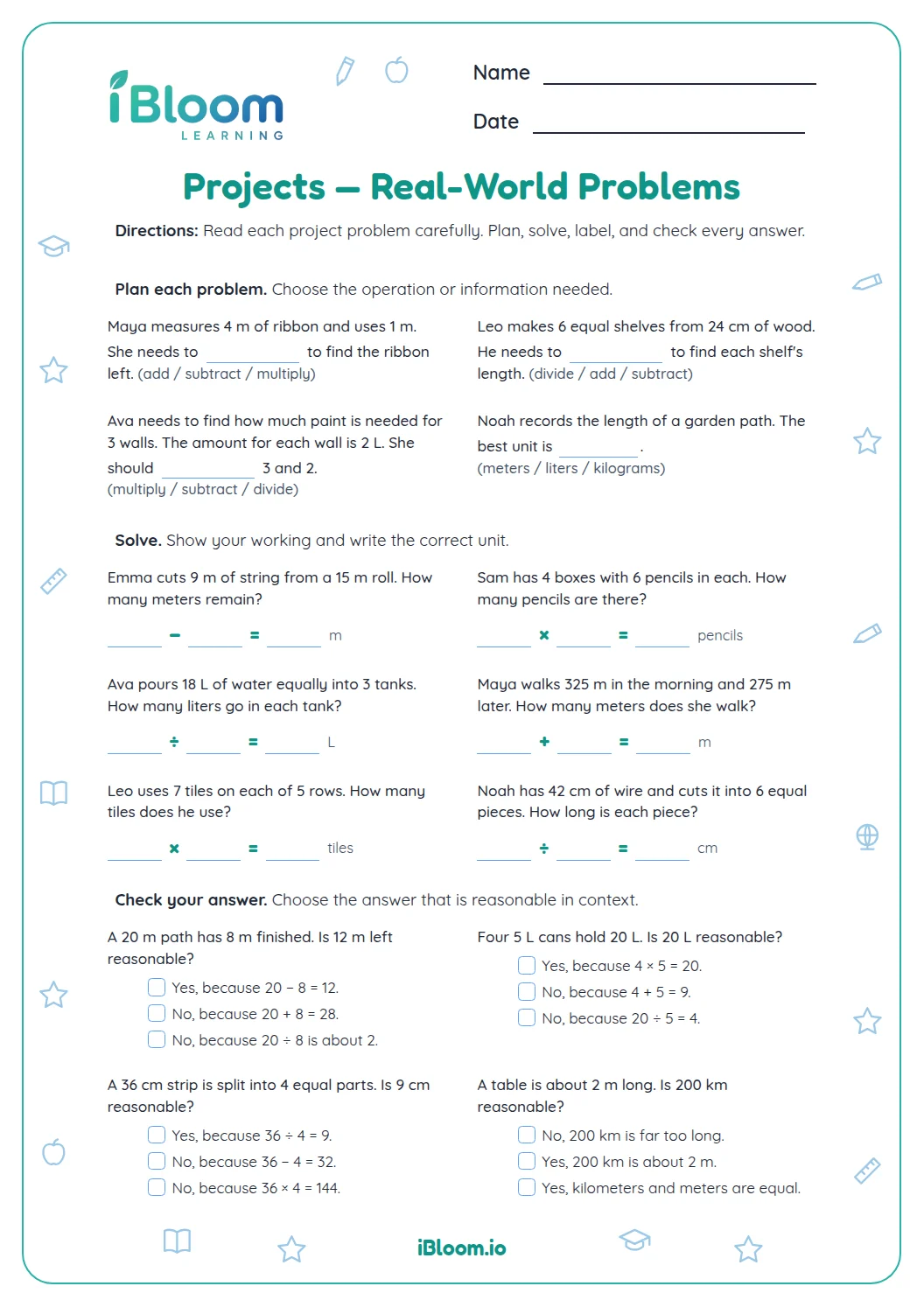
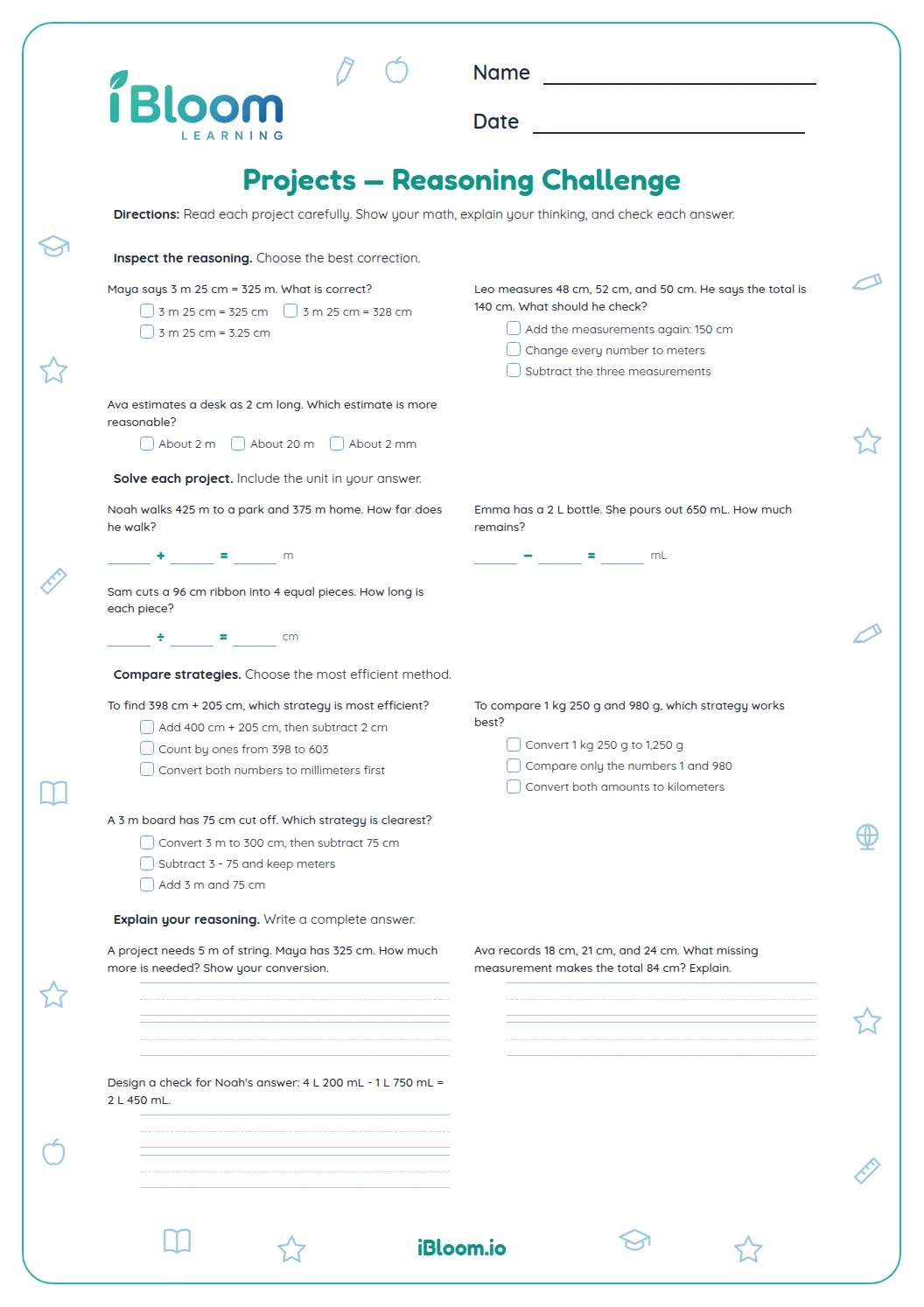
About this worksheet
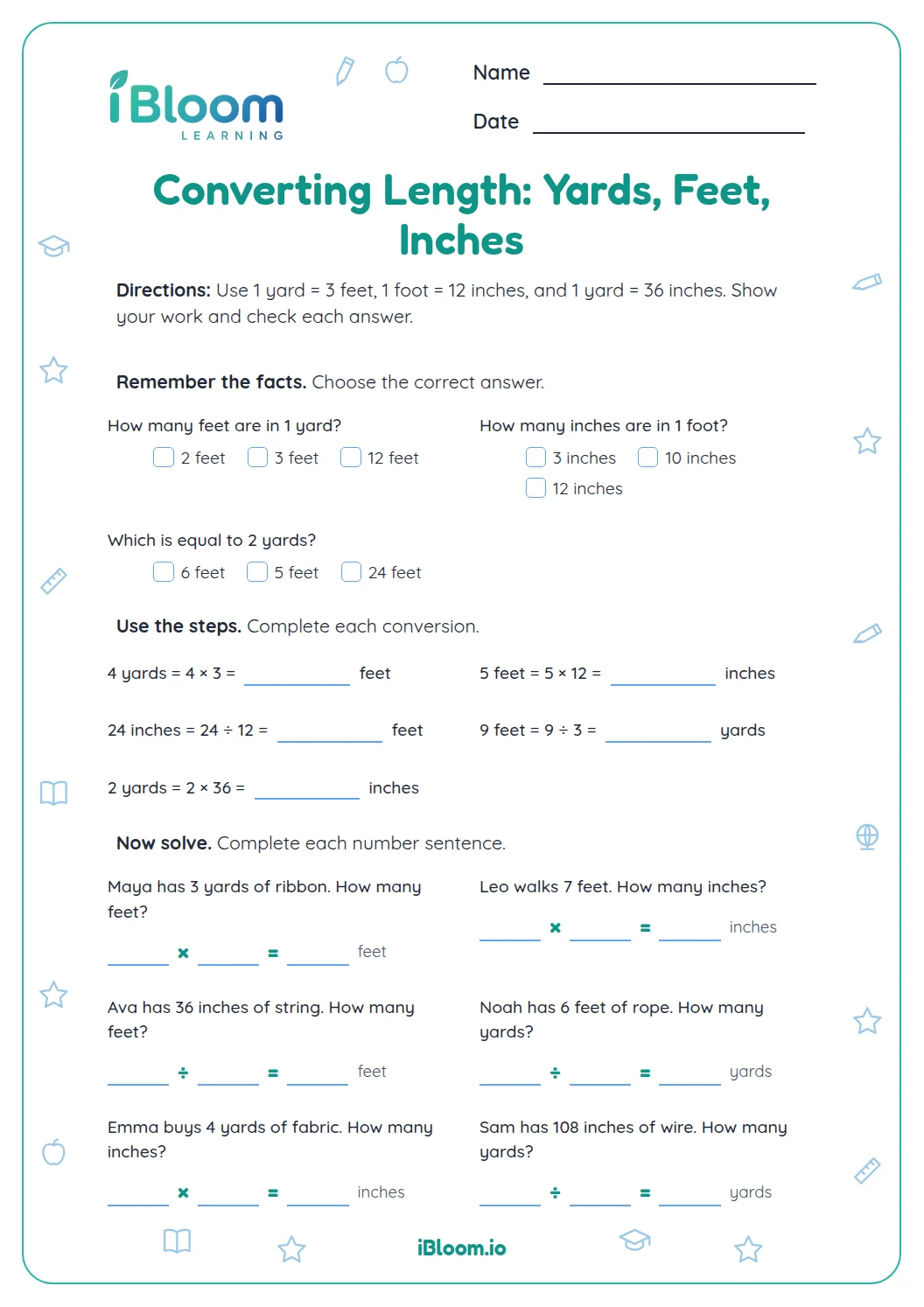
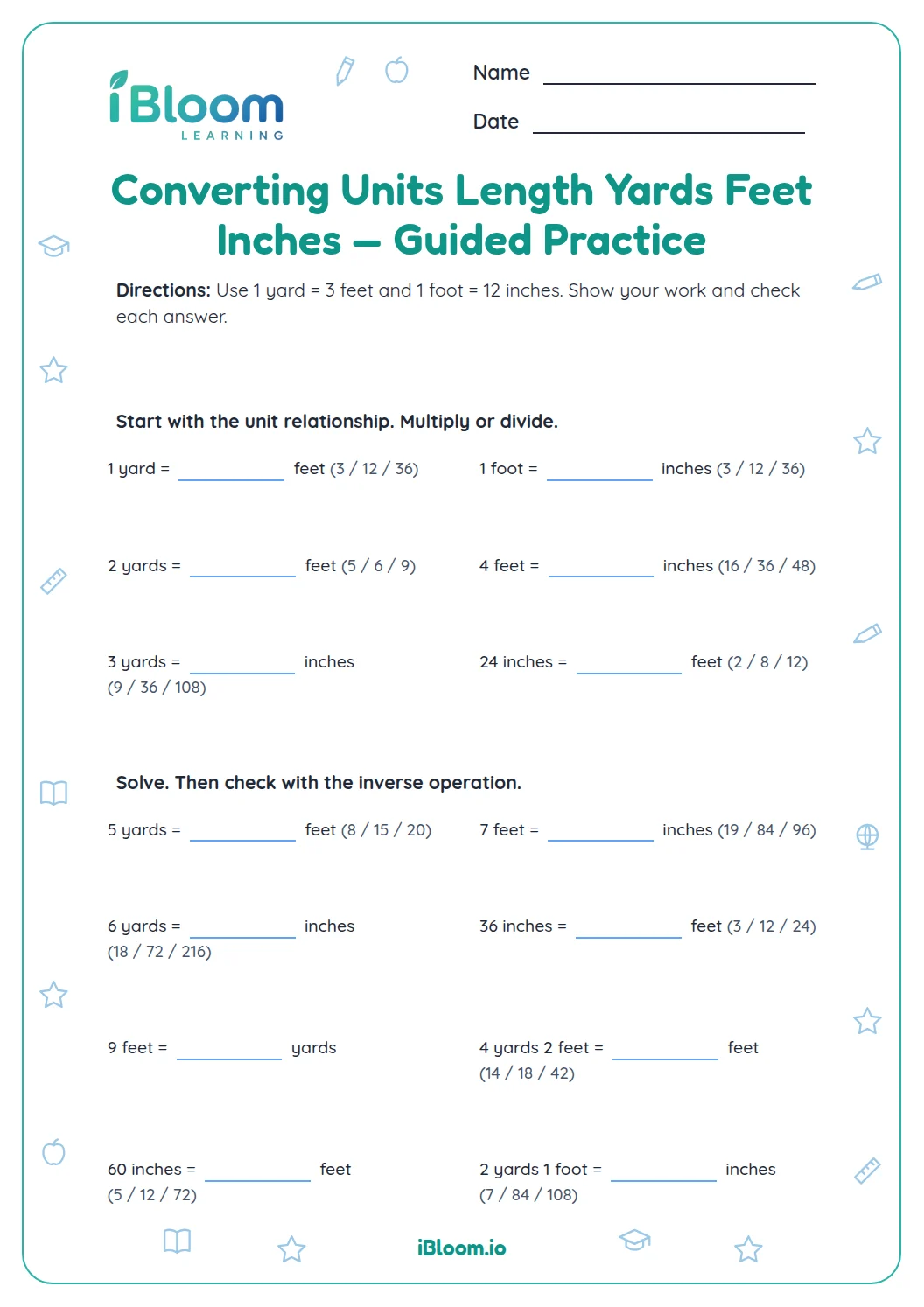
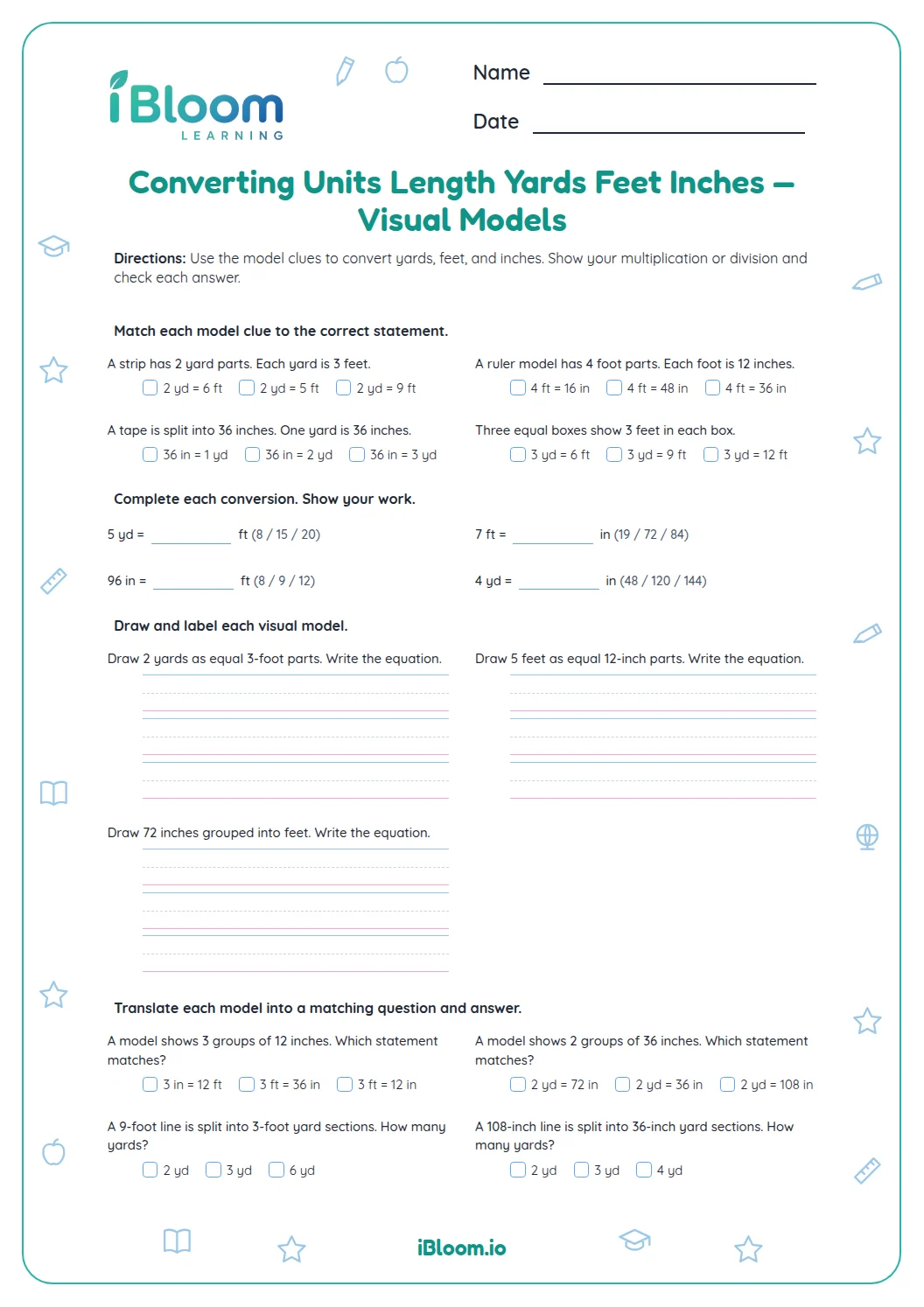
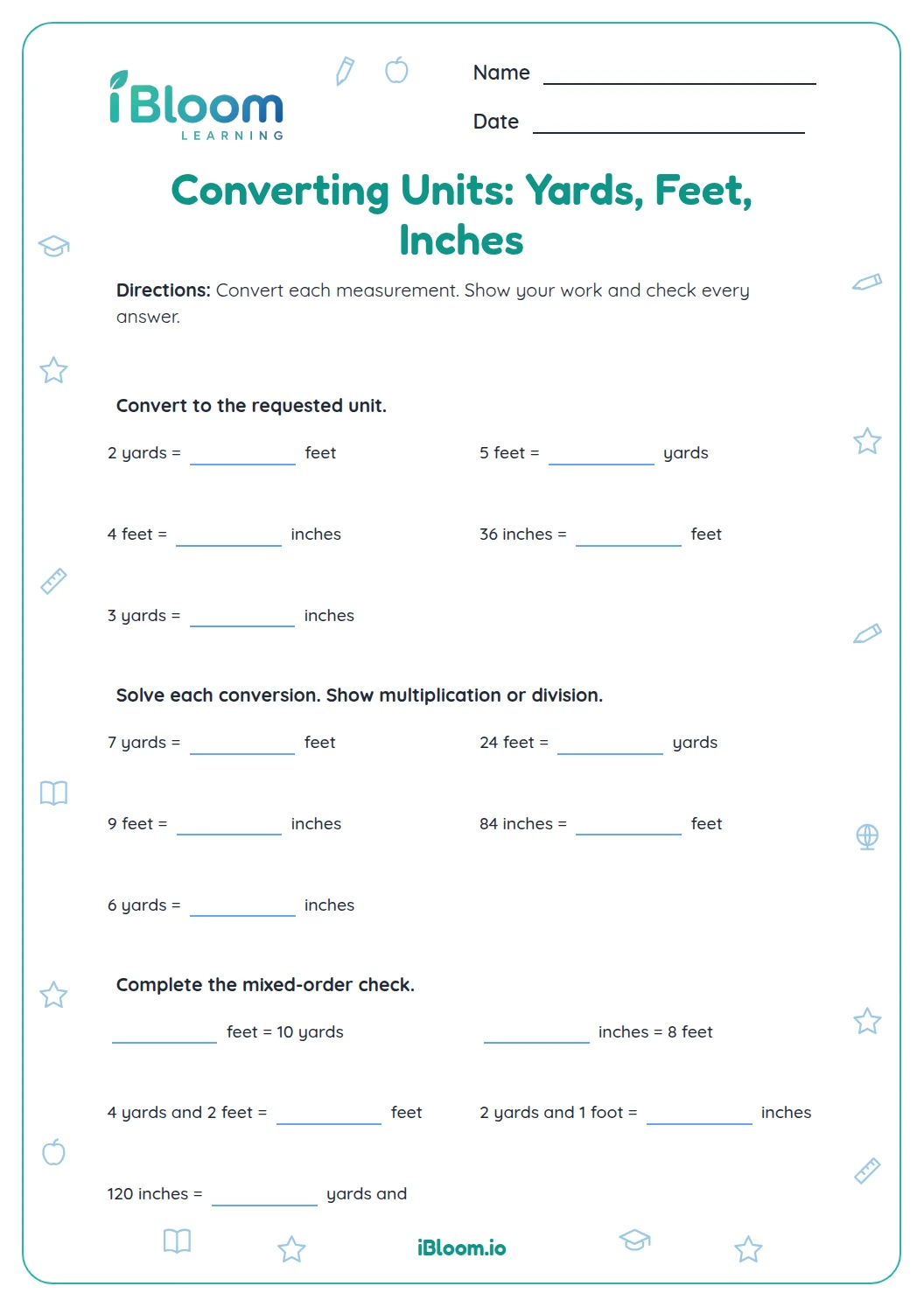
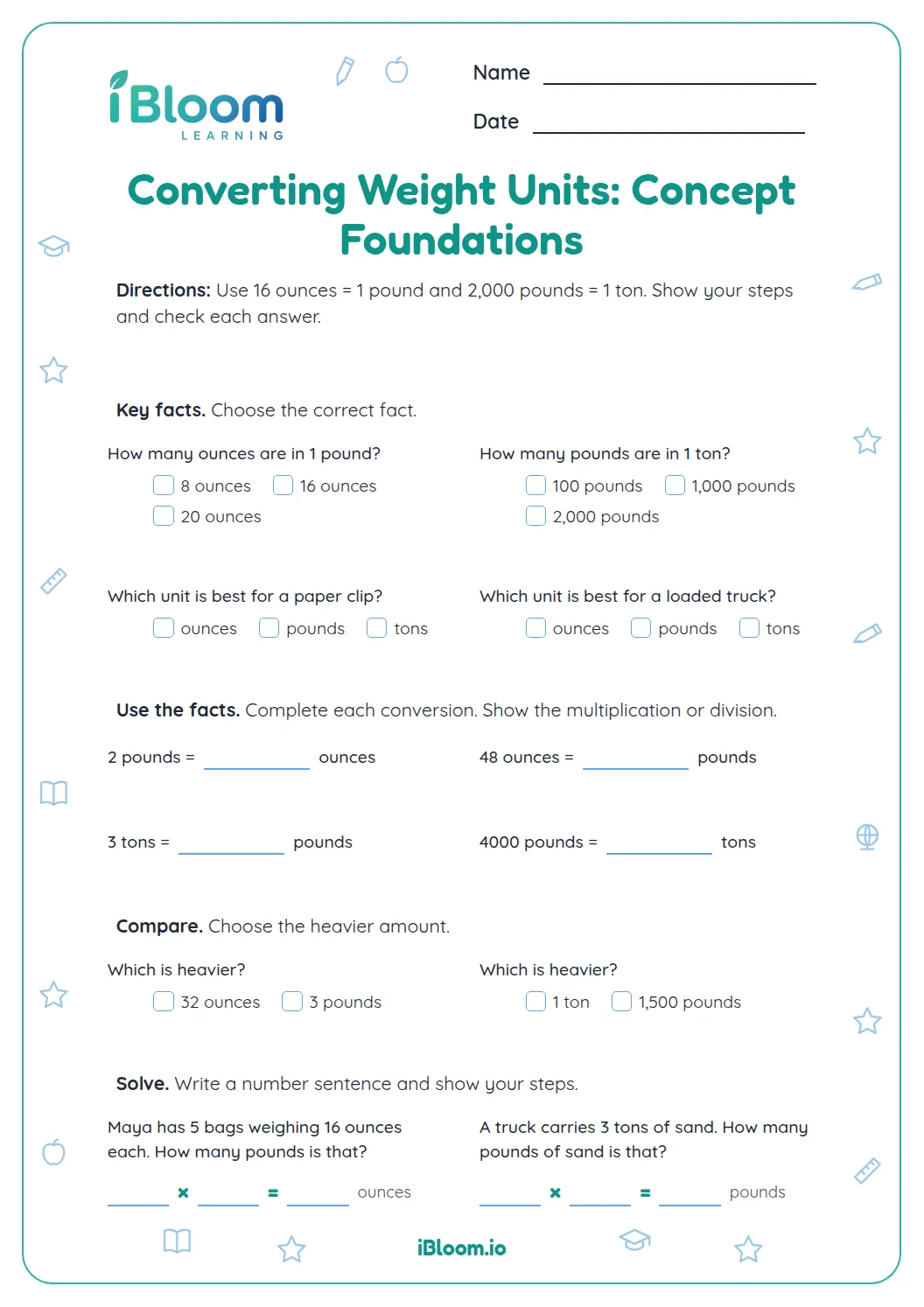
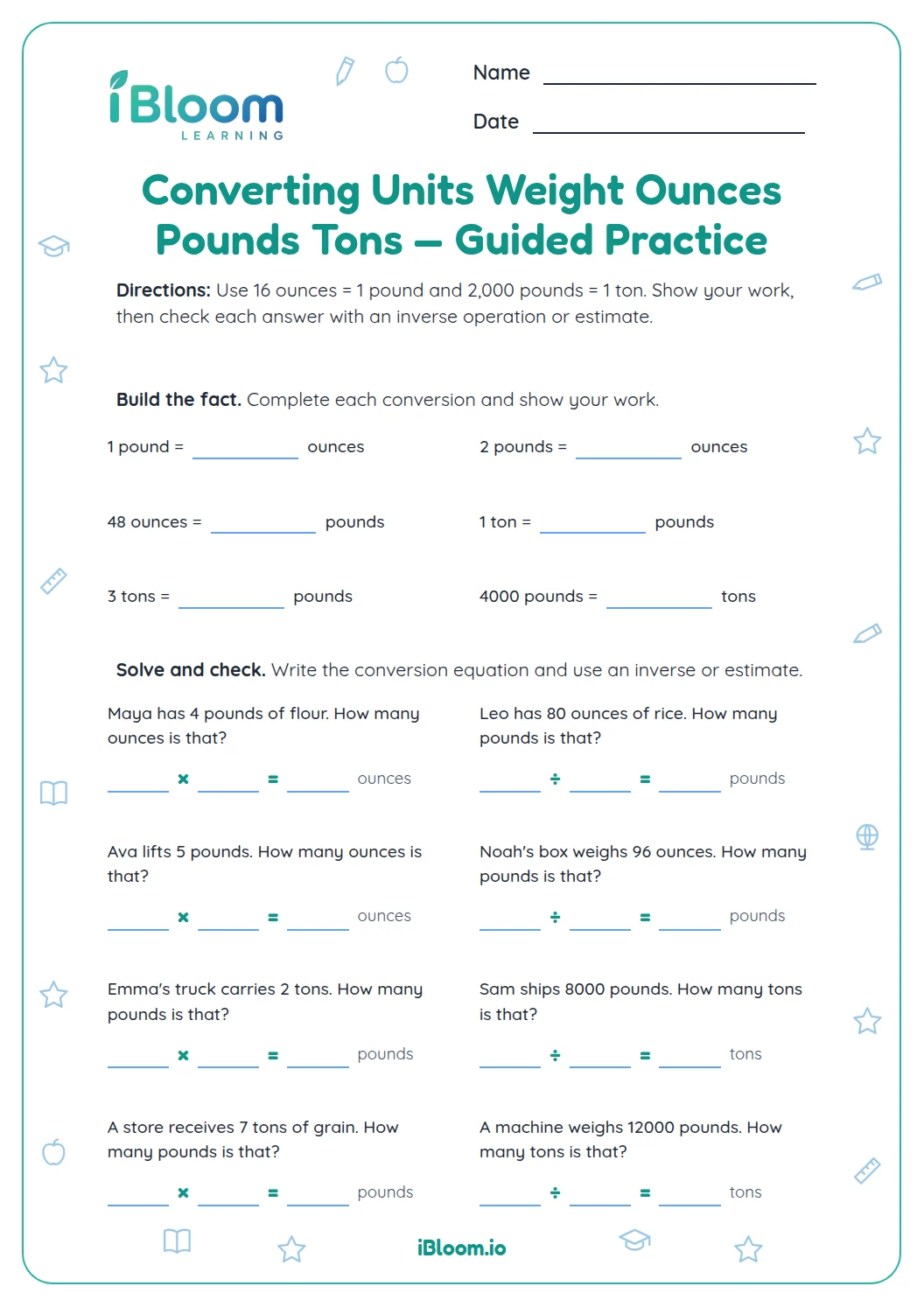
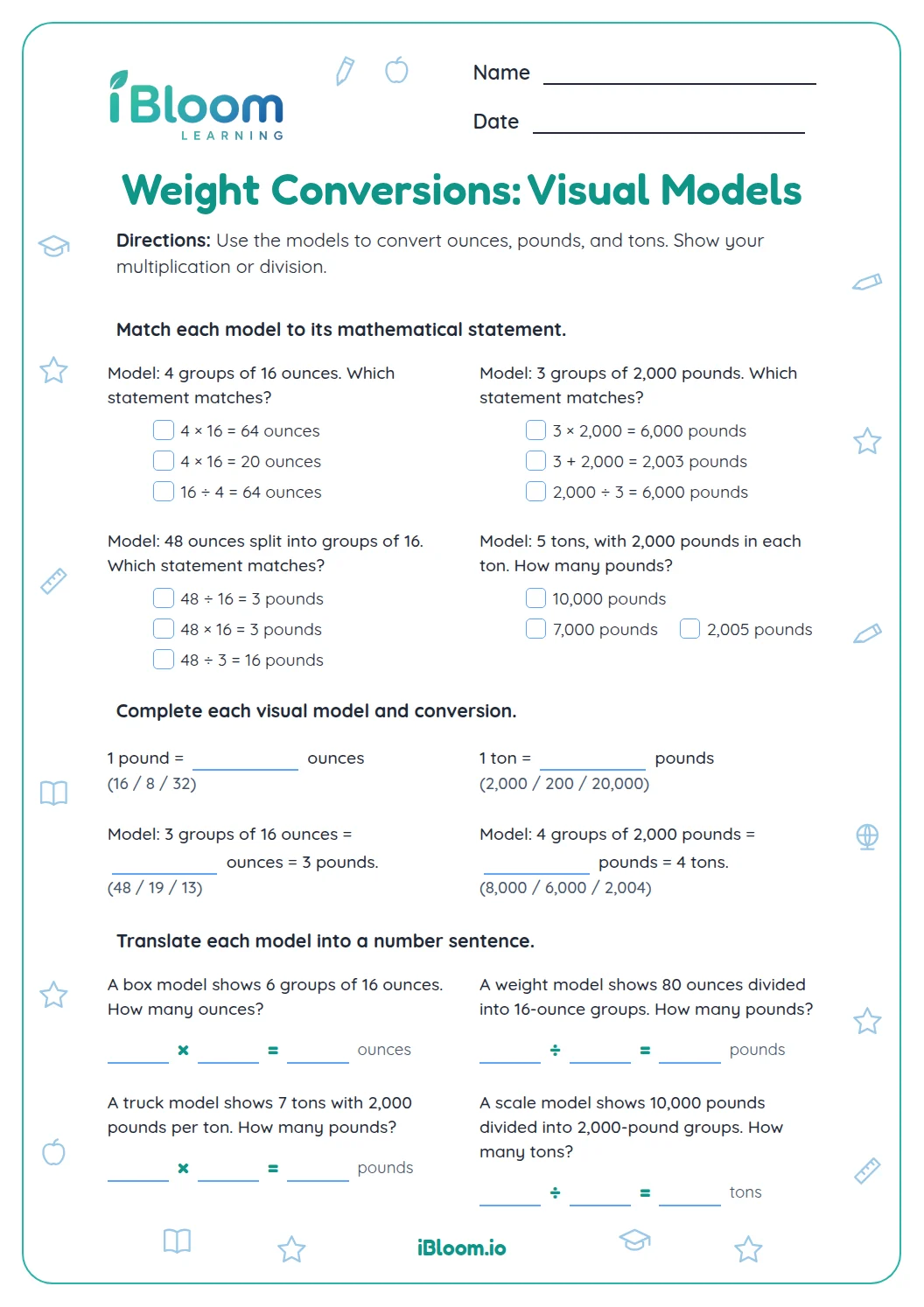
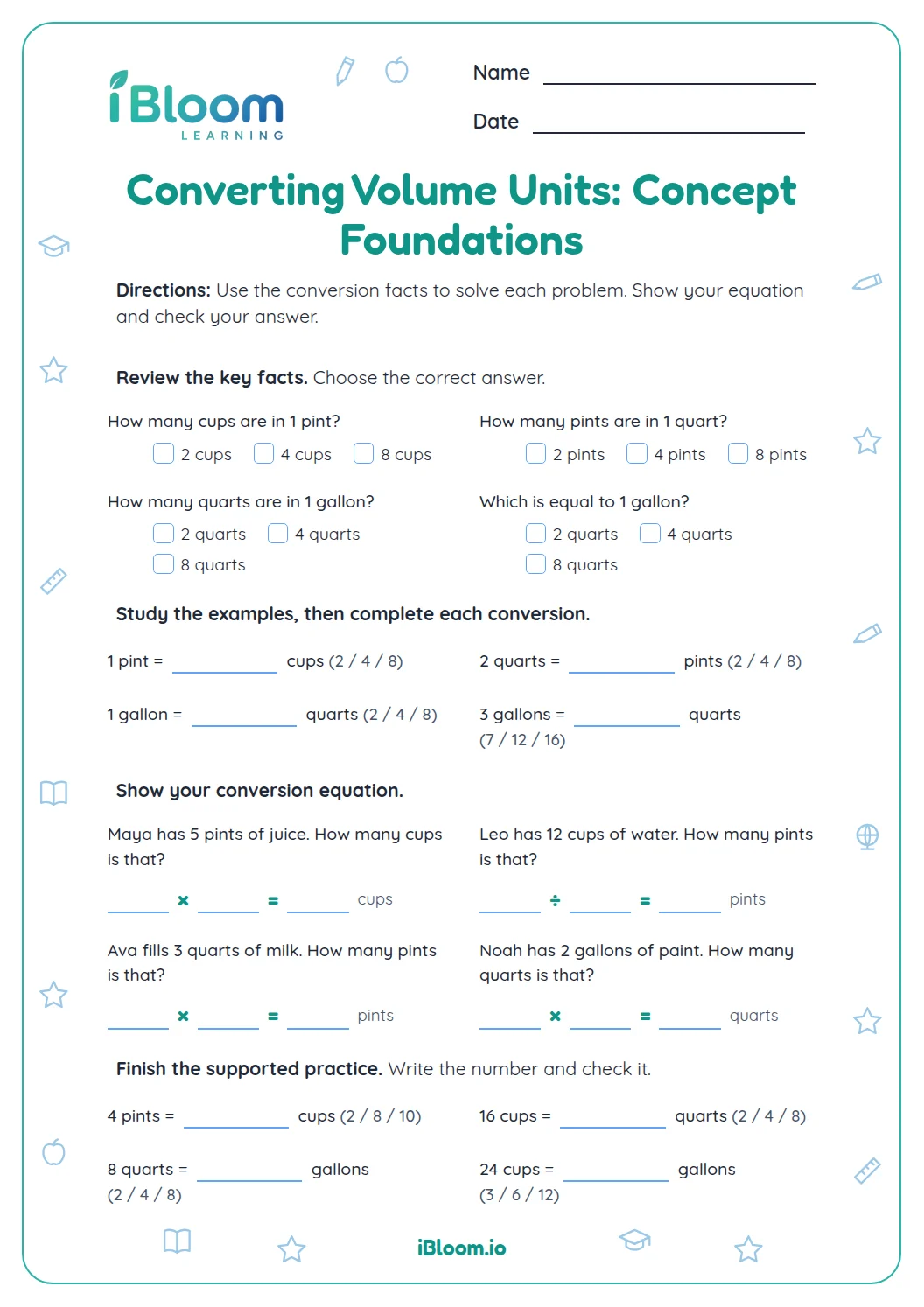
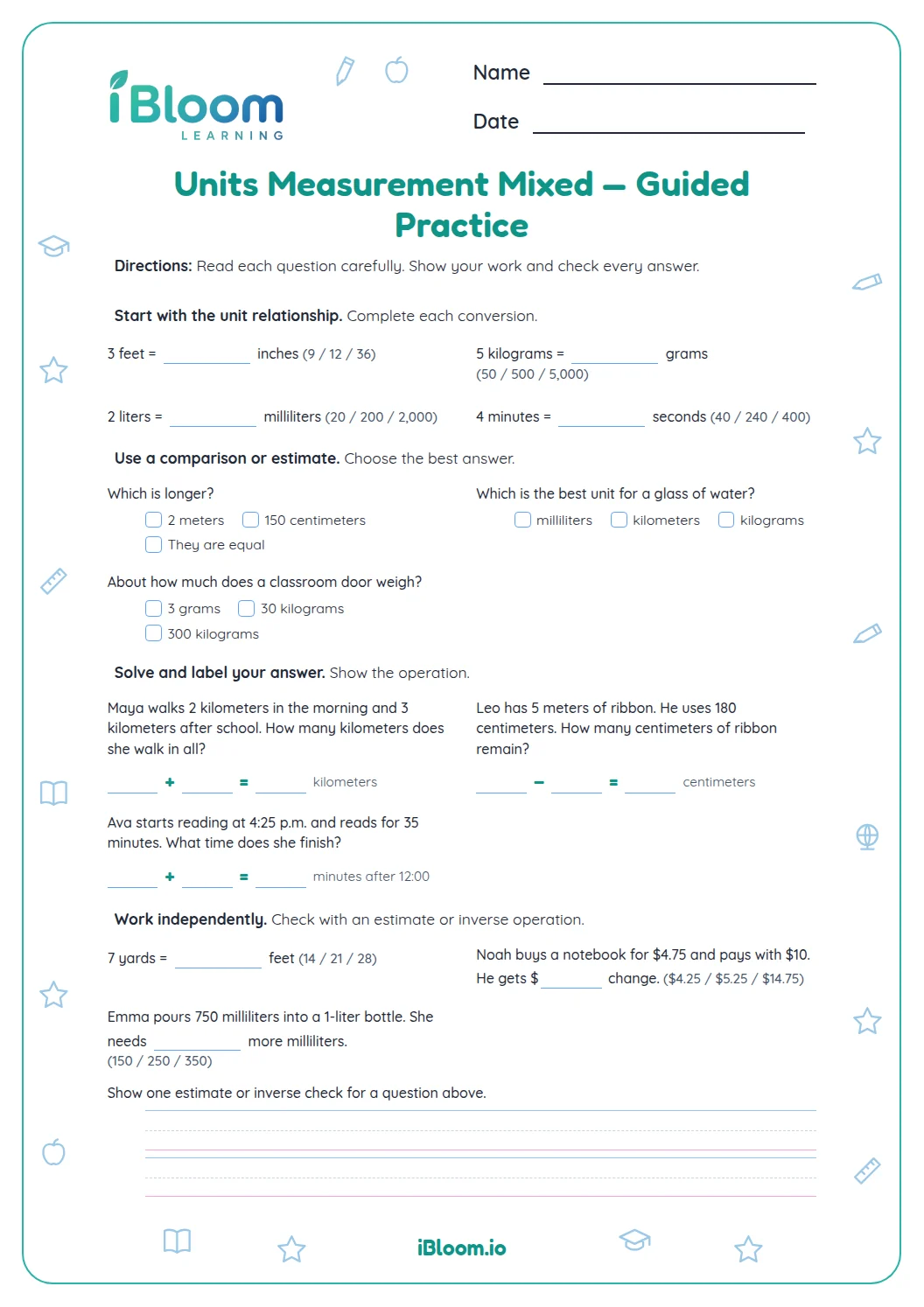
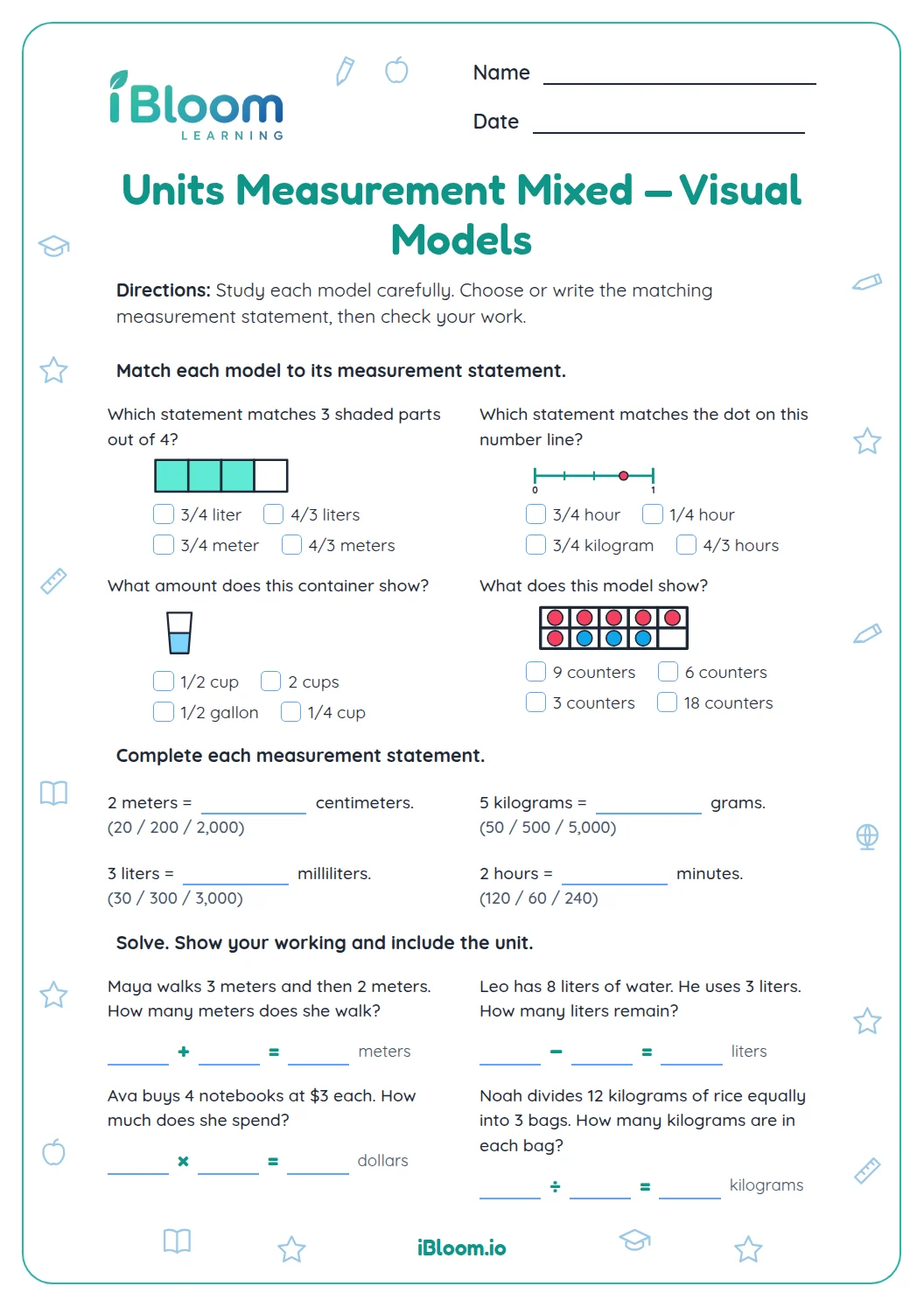
This Grade 4 guided practice page uses short project situations to build measurement conversion and problem-solving skills. Students convert feet and inches, liters and milliliters, kilometers and meters, pounds and ounces, and hours and minutes. Later questions combine measurements, divide quantities equally, estimate, and explain a check. The work aligns with CCSS 4.MD.A.1 and 4.MD.A.2, which address unit relationships and measurement word problems. An answer key is included.
Aligned to 4.MD.A.1 and 4.MD.A.2
What is in the guided practice?
The questions use projects such as ribbons, walks, juice, boards, and event planning. Students first convert measurements, then apply conversions to addition, subtraction, division, and capacity situations.
- Part A reviews unit conversions.
- Part B applies measurements in project contexts.
- Part C asks students to explain or estimate.
- The answer key shows answers with units.
How do you convert a larger unit to a smaller unit?
Find how many smaller units make one larger unit, then multiply. For question 1, there are 12 inches in each foot, so 3 feet is 3 × 12 = 36 inches. Keep the unit with the answer.
- 13 feet × 12 inches per foot
- 23 × 12 = 36
- 3Answer: 36 inches
How do you solve a measurement project problem?
Read what the question asks for and make the units match before calculating. In question 11, change 5 feet to 60 inches, then subtract the 28-inch piece. The remaining board is 32 inches.
How can estimation help check an answer?
Round measurements to friendly amounts and see whether the result is reasonable. For 425 + 275, 400 + 300 is about 700, supporting an exact total of 700. Estimation checks scale; an inverse operation can check the exact calculation.
How to solve each measurement question
- 1Underline the unit and the quantity asked for.
- 2Write the conversion relationship, such as 1 foot = 12 inches.
- 3Convert to matching units before adding or subtracting.
- 4Choose the operation that fits the situation and calculate carefully.
- 5Include the unit and check the answer with an estimate or inverse operation.
Measurement mistakes to watch for
The mistake
Multiplying by 10 to convert feet to inches.
The fix
Use the relationship 1 foot = 12 inches.
The mistake
Adding meters directly to kilometers without converting.
The fix
Express both amounts in meters before finding a total.
The mistake
Giving a number without a unit.
The fix
Name the final unit requested, such as milliliters or minutes.
Common Core alignment
The questions use unit relationships and operations to solve everyday measurement problems.
Use measurement unit relationships and record equivalent quantities.
On this sheet: Students use relationships among customary and metric units and fill equivalent quantities.
Show the official wordingHide the official wording
Know relative sizes of measurement units within one system of units including km, m, cm; kg, g; lb, oz.; l, ml; hr, min, sec. Within a single system of measurement, express measurements in a larger unit in terms of a smaller unit. Record measurement equivalents in a two-column table. For example, know that 1 ft is 12 times as long as 1 in. Express the length of a 4 ft snake as 48 in. Generate a conversion table for feet and inches listing the number pairs (1, 12), (2, 24), (3, 36), …
Solve word problems using measurement conversions and the four operations.
On this sheet: Students convert and calculate with distances, time, liquid volume, and mass in contextual problems.
Show the official wordingHide the official wording
Use the four operations to solve word problems involving distances, intervals of time, liquid volumes, masses of objects, and money, including problems involving simple fractions or decimals, and problems that require expressing measurements given in a larger unit in terms of a smaller unit. Represent measurement quantities using diagrams such as number line diagrams that feature a measurement scale.
What to practice next
Make more practice
Further reading
Questions parents and teachers ask
Which units are included?
The page includes customary and metric examples: feet and inches, pounds and ounces, kilometers and meters, liters and milliliters, kilograms and grams, and hours and minutes. Students use the conversion facts in practical problems and include a unit with each answer.
How many questions are included?
There are 14 questions in two parts. Students begin with unit conversions, then apply them to project situations involving addition, subtraction, division, and estimation. The separate answer key shows the correct value and unit for every question, making it easy to review each conversion.
What conversion should students know for feet and inches?
One foot equals 12 inches. Multiply the number of feet by 12 to find inches; for example, 3 feet equals 36 inches. To subtract a piece from a board, convert the board length to inches first so both measurements use the same unit.
Why should answers include units?
The number alone does not tell what was measured. A result of 36 could mean inches, feet, or another unit. Writing “36 inches” communicates the quantity clearly and makes it easier to check whether the conversion and operation answered the question.
How can students check a conversion problem?
Use an estimate or reverse the operation. For 3 feet converted to 36 inches, divide 36 by 12 to return to 3 feet. For an addition question, estimate with rounded amounts, then check the exact total with subtraction. This also confirms the units and size of the result.