






About this worksheet
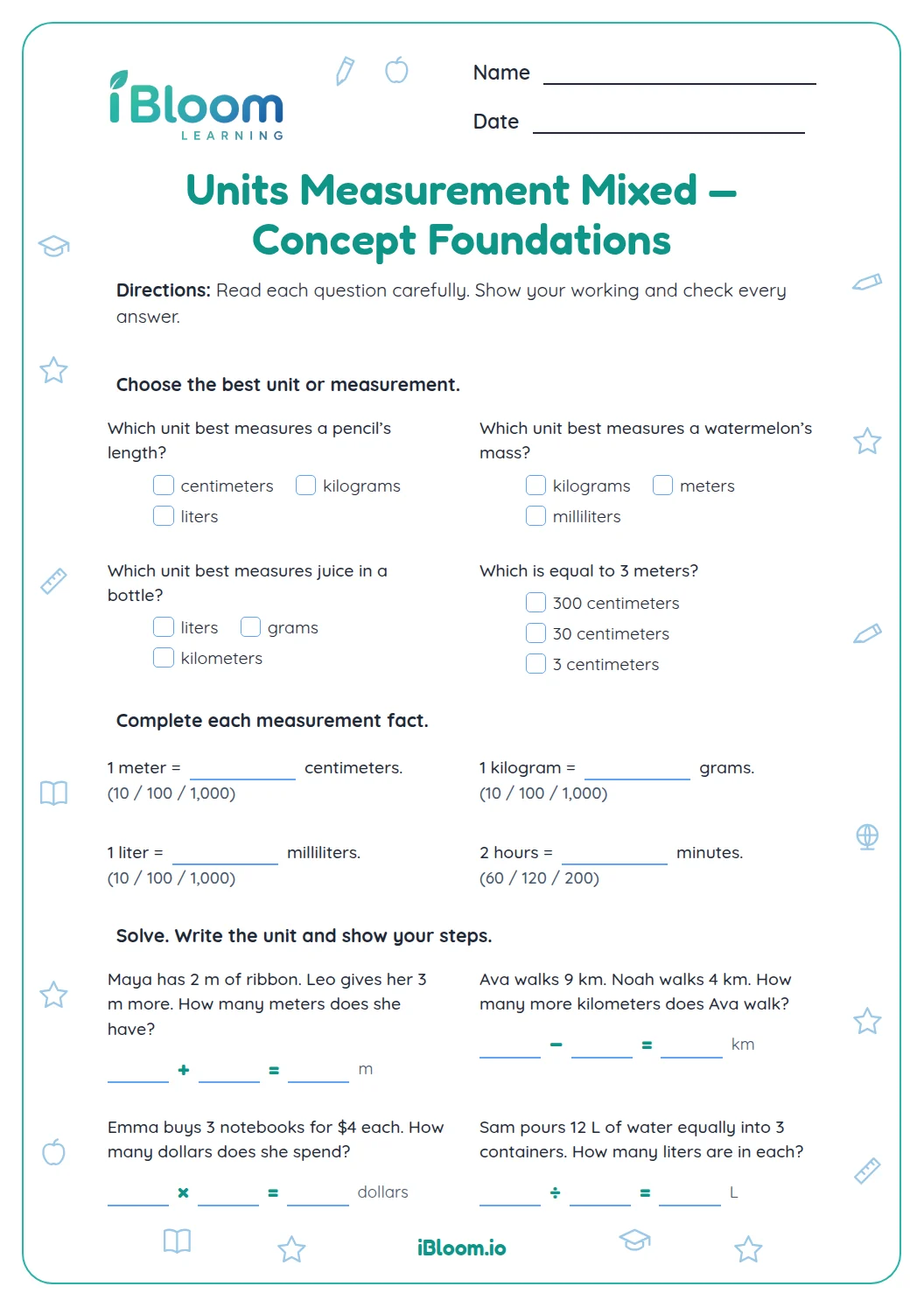
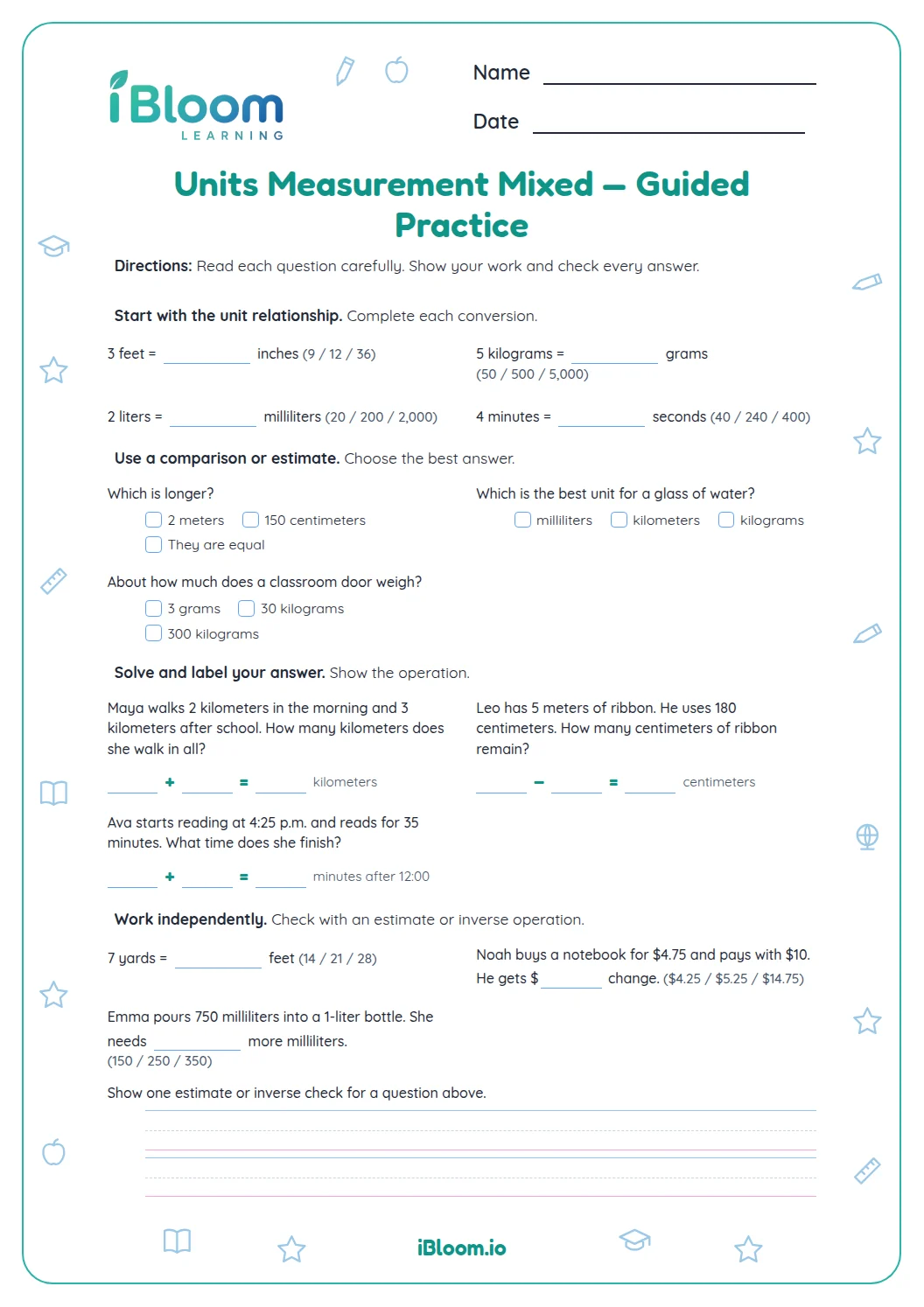
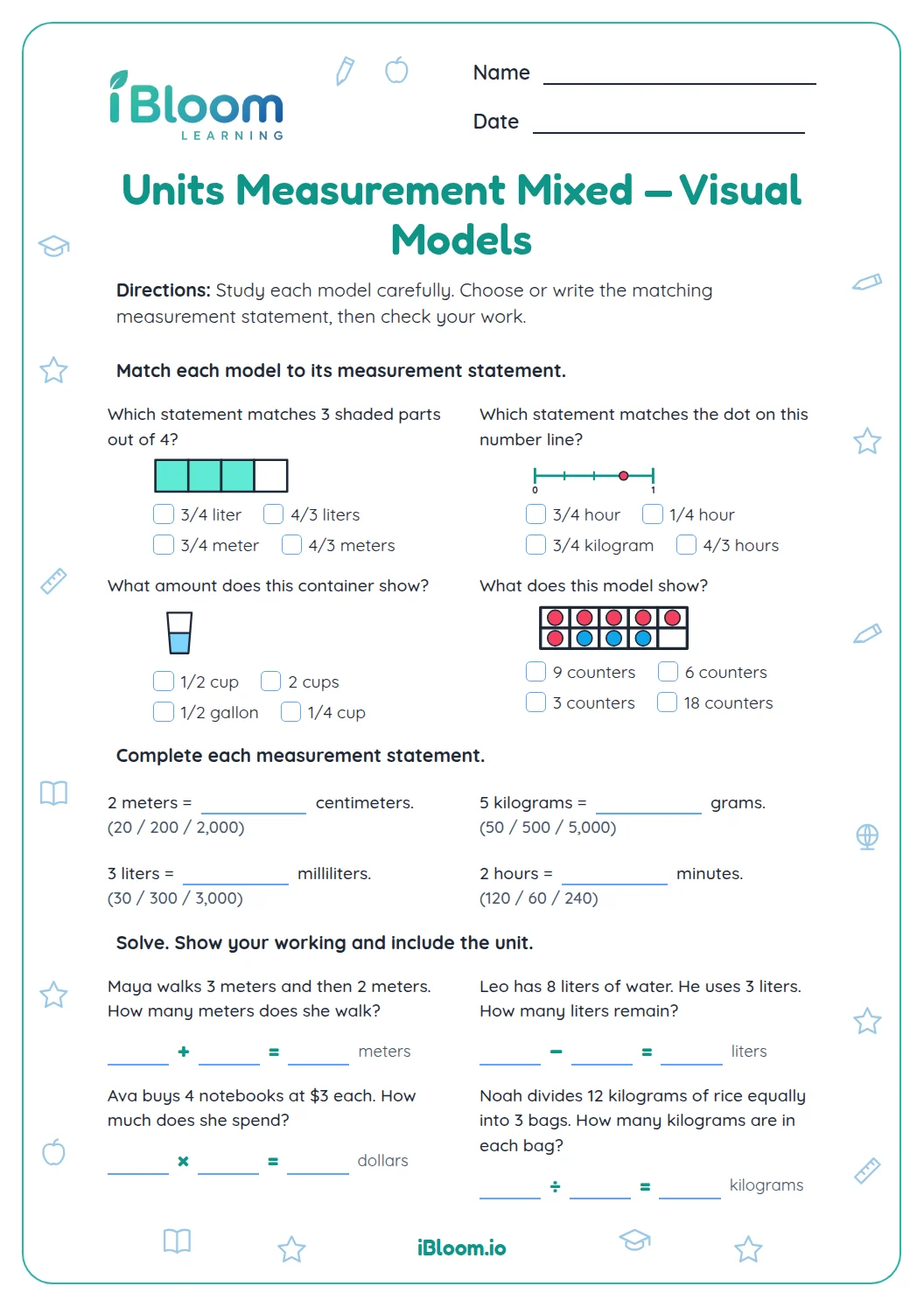
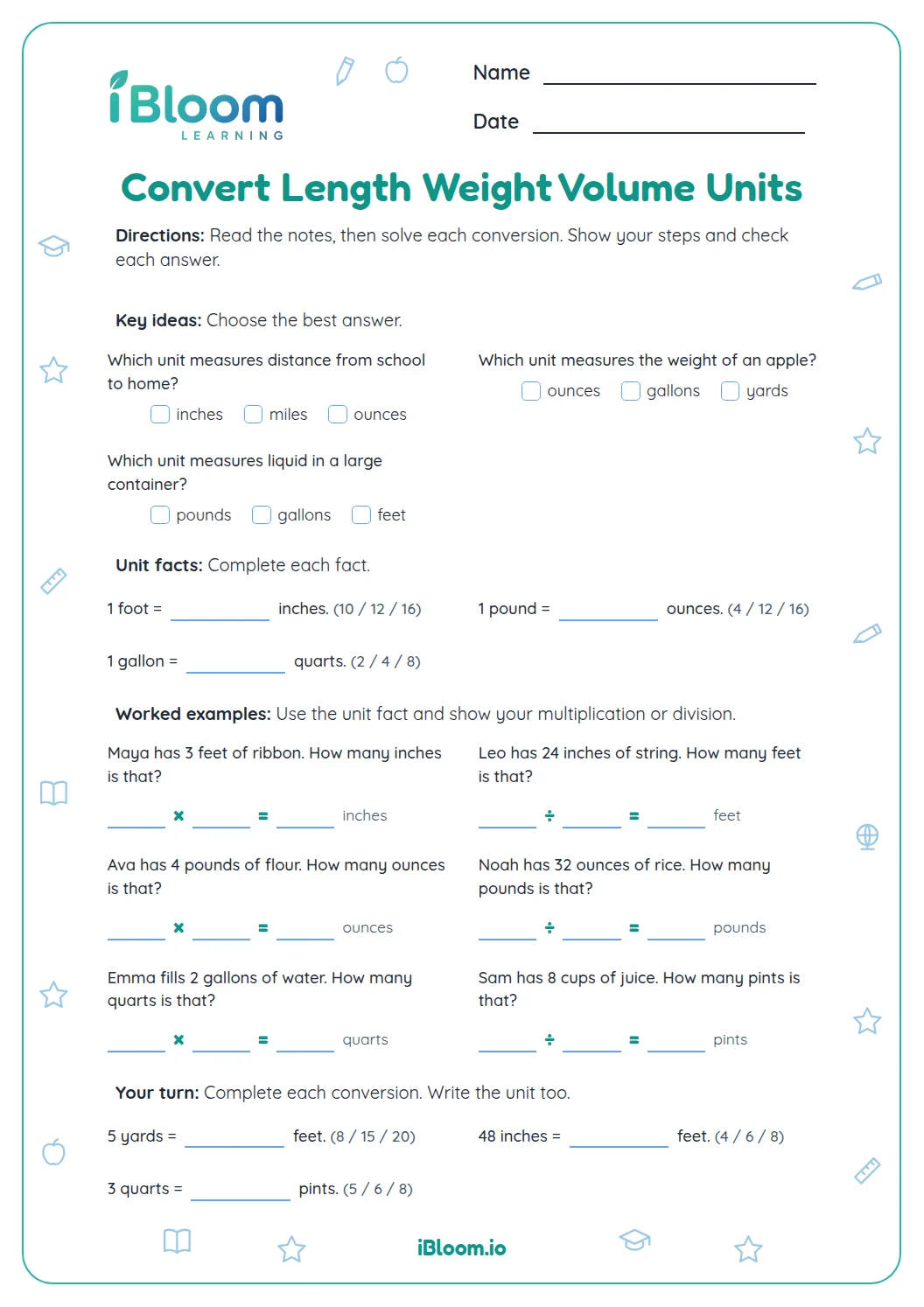
This free Grade 4 worksheet reviews customary and metric conversions, elapsed time, and measurement word problems. Students convert feet, yards, pounds, quarts, meters, and liters, then apply measurement reasoning to distance, time, mass, liquid volume, and money. Eight story problems ask students to find a measurement in context. The worksheet includes 14 questions and a separate answer key. It practices CCSS 4.MD.A.1 and 4.MD.A.2 through unit equivalents and real-world measurement problems.
Aligned to 4.MD.A.1 and 4.MD.A.2
How do you convert a measurement to a smaller unit?
Use the relationship between the two units. One foot is 12 inches, so 3 feet is 3 groups of 12 inches. Keep the unit in the answer; a correct number with the wrong unit changes what the measurement means.
- 13 ft = ___
- 2There are 12 inches in 1 foot.
- 33 × 12 = 36, so 3 ft = 36 in.
How do you find an elapsed time?
Count forward from the start time to the end time, keeping track of the minutes. In question 7, count 45 minutes from 2:15 p.m. to 3:00 p.m., then 5 more minutes to 3:05 p.m. The movie lasts 50 minutes.
How do units help solve a measurement story?
Read what is being combined, removed, or divided and make the units agree. For question 10, change 3 kg to 3,000 g before subtracting 750 g. The rice remaining is 2,250 g. The later questions use this same habit with liquid amounts, money, and lengths.
How to use this worksheet
- 1Write the unit asked for before calculating.
- 2Recall the equivalent units in the same system.
- 3For elapsed time, count forward in manageable steps.
- 4For a story, convert units first if the amounts use different units.
- 5Show the calculation in the space provided.
- 6Check that the answer and unit fit the question.
Checks for this skill
The mistake
Multiplying by 10 when converting feet to inches.
The fix
Use 12 inches per foot, so multiply the number of feet by 12.
The mistake
Subtracting grams from kilograms without converting.
The fix
Rewrite kilograms as grams before subtracting.
The mistake
Counting only to the next hour in a time problem.
The fix
Continue from the hour mark to the stated end time.
Common Core alignment
This page practices the Common Core skill named below.
Convert units within one measurement system and record equivalent measures.
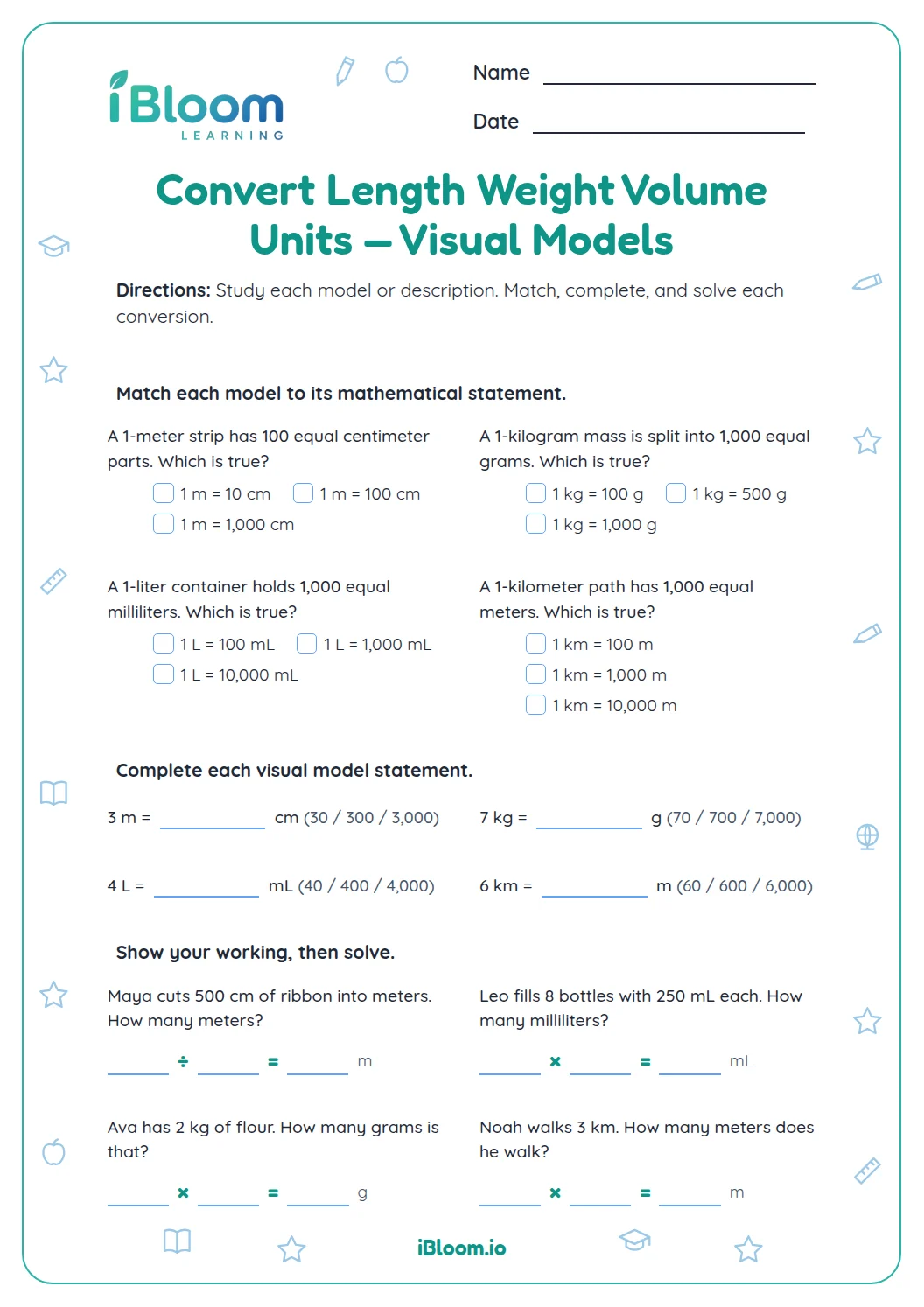
On this sheet: Questions 1–6 convert customary and metric measurements within a unit system.
Show the official wordingHide the official wording
Know relative sizes of measurement units within one system of units including km, m, cm; kg, g; lb, oz.; l, ml; hr, min, sec. Within a single system of measurement, express measurements in a larger unit in terms of a smaller unit. Record measurement equivalents in a two-column table. For example, know that 1 ft is 12 times as long as 1 in. Express the length of a 4 ft snake as 48 in. Generate a conversion table for feet and inches listing the number pairs (1, 12), (2, 24), (3, 36), ...
Solve measurement stories about distance, elapsed time, volume, mass, and money.
On this sheet: Questions 7–14 apply operations to measurement stories involving distance, time, liquid volume, mass, and money.
Show the official wordingHide the official wording
Use the four operations to solve word problems involving distances, intervals of time, liquid volumes, masses of objects, and money, including problems involving simple fractions or decimals, and problems that require expressing measurements given in a larger unit in terms of a smaller unit. Represent measurement quantities using diagrams such as number line diagrams that feature a measurement scale.
What to practice next
Make more practice
Further reading
Questions parents and teachers ask
Which measurement units does the worksheet use?
The conversion section uses feet and inches, yards and feet, pounds and ounces, quarts and pints, meters and centimeters, and liters and milliliters. The stories also use minutes, grams, dollars, and cups, so students practice keeping the unit attached to each result.
Does the worksheet include elapsed time?
Yes. Two questions give a start and end time and ask how long an event lasts. Students can count forward to the next hour, then on to the end time, and record the total minutes. Both times are p.m. on the same day, so no date change is involved.
Do students need to show their work?
The story problems ask students to use the quantities and units in context. A conversion or calculation helps prevent a unit mismatch, such as subtracting 750 grams from 3 kilograms before changing kilograms to grams. The key lists each final measure in its matching unit.
What standards does this practice?
The page practices CCSS 4.MD.A.1 through measurement-unit equivalents and CCSS 4.MD.A.2 through real-world questions involving distance, time, liquid volume, mass, and money. The separate key gives the expected value and unit for every item. Students can check the conversion separately from the operation used in a story.
Is there an answer key?
Yes. The answer key lists the equivalent measurement for each conversion and the result for every story problem. For questions with working space, students can compare both the final amount and its unit with the key. The conversion items also show the target unit in the question.