



About this worksheet
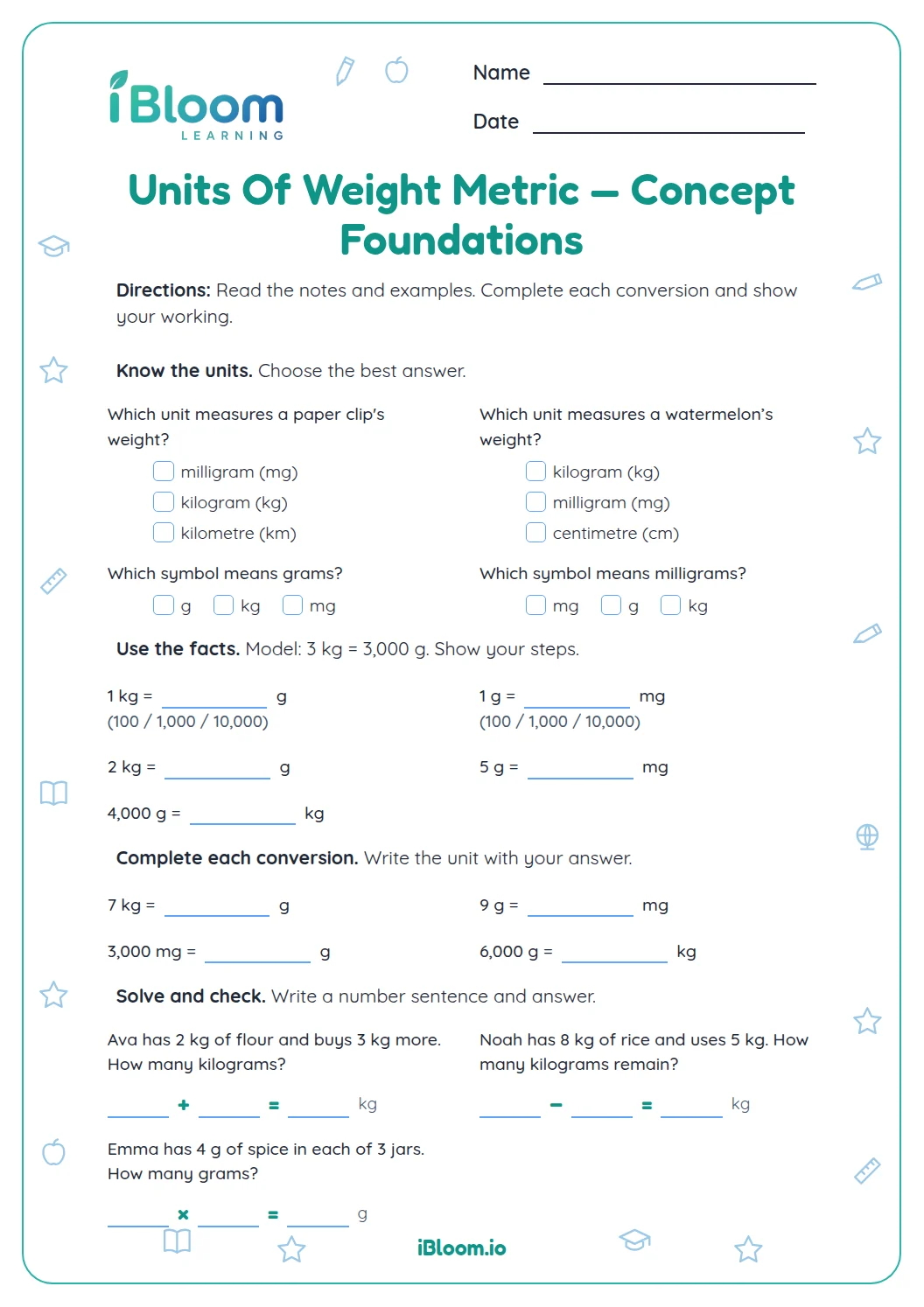
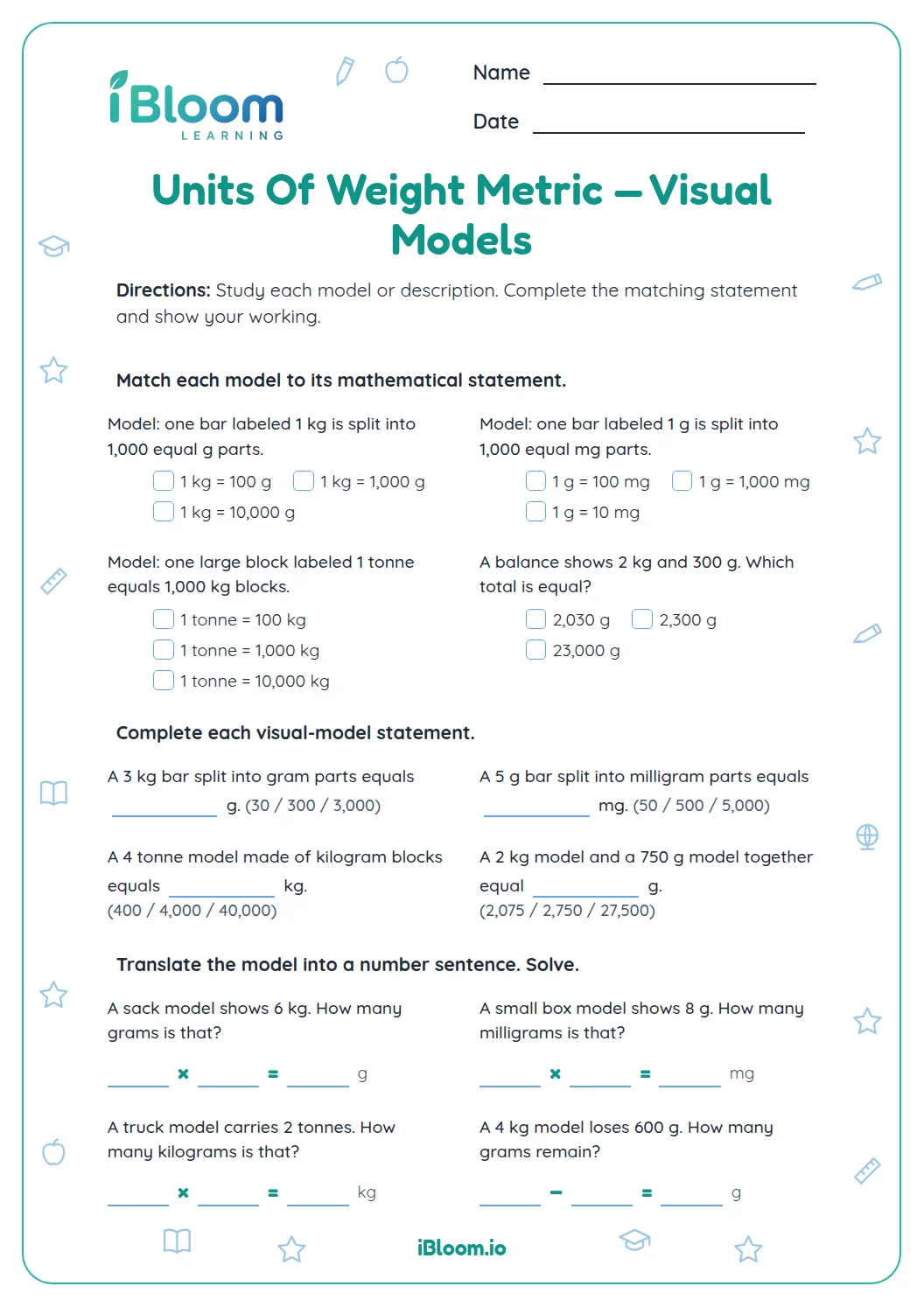
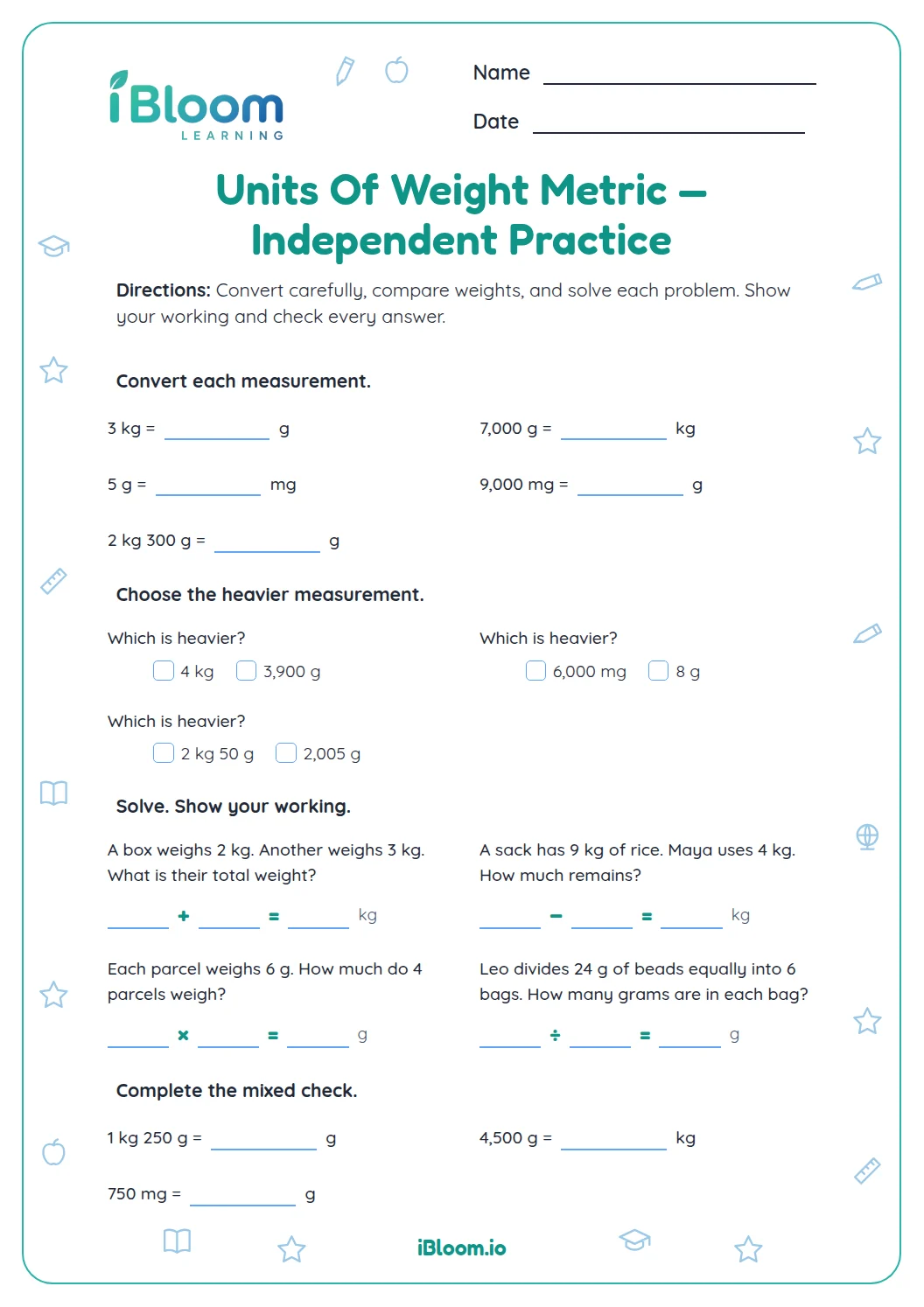
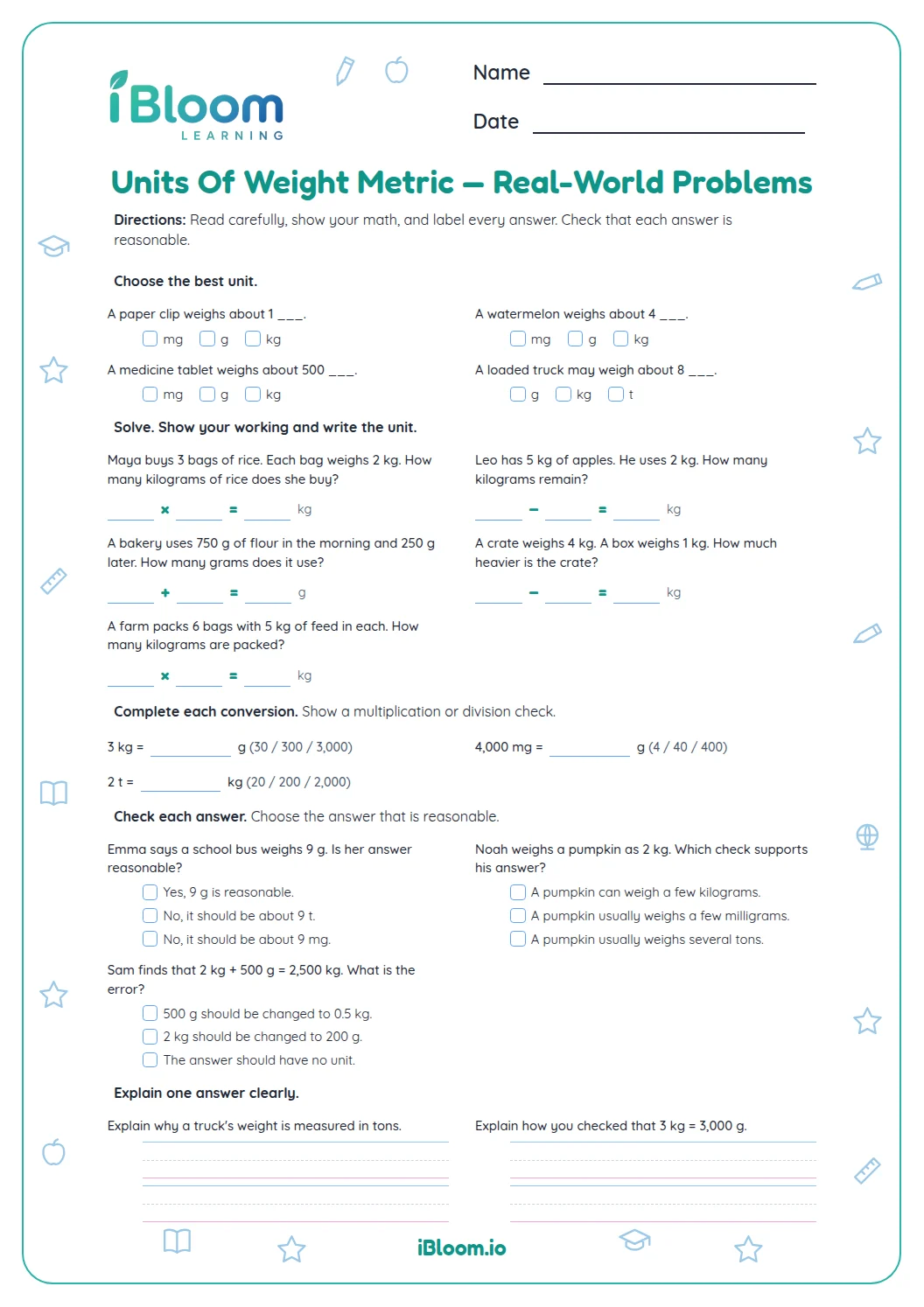
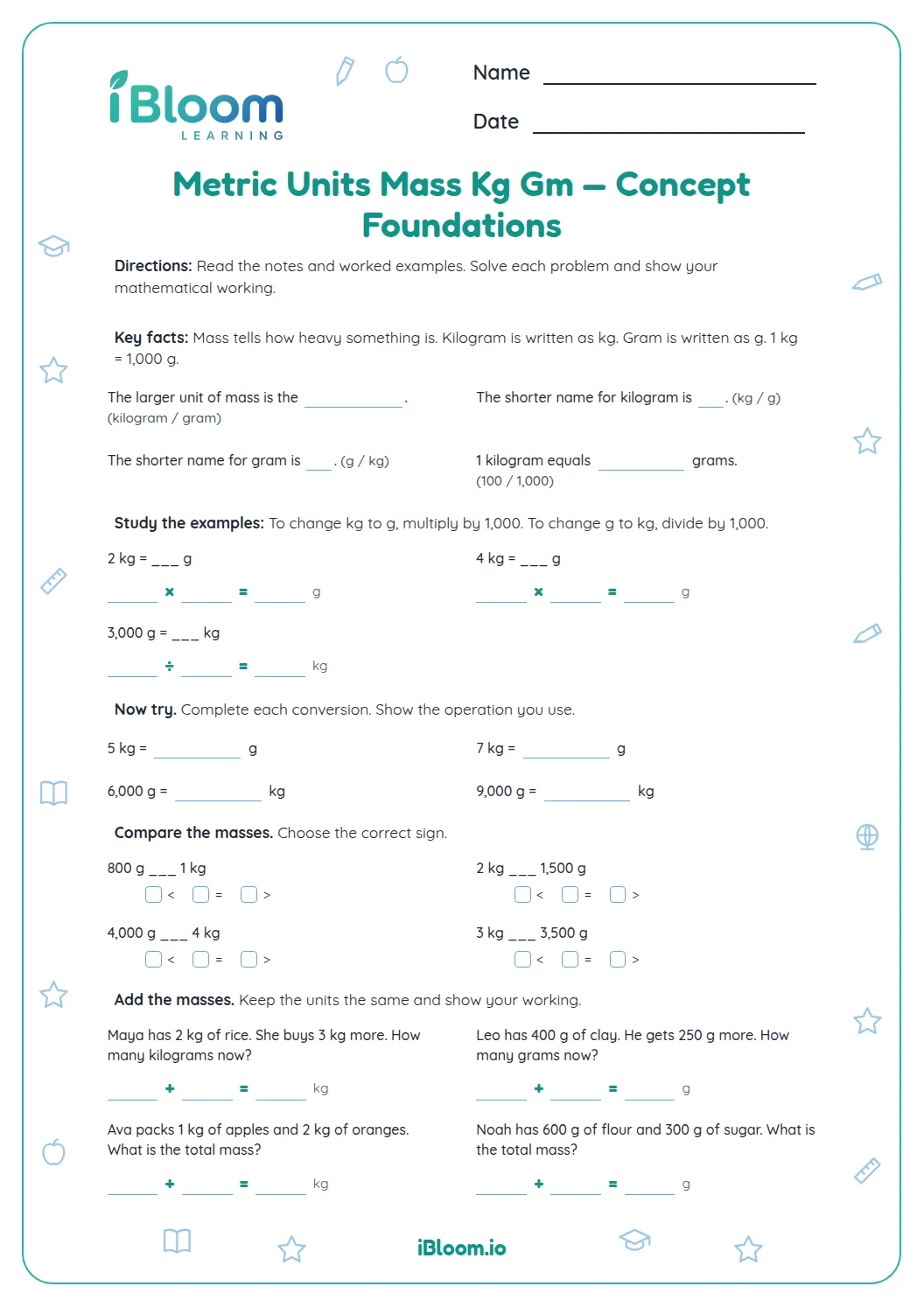
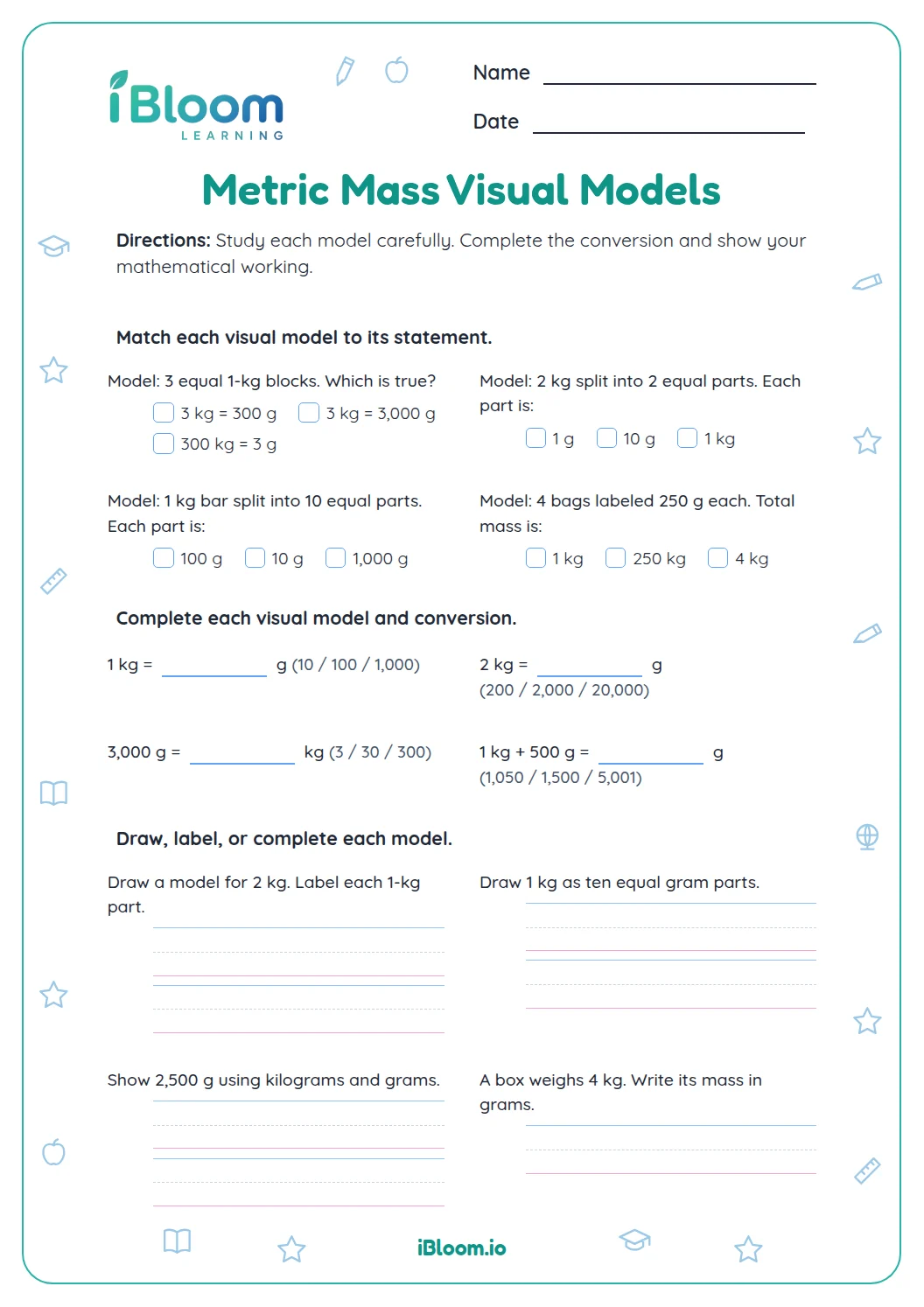
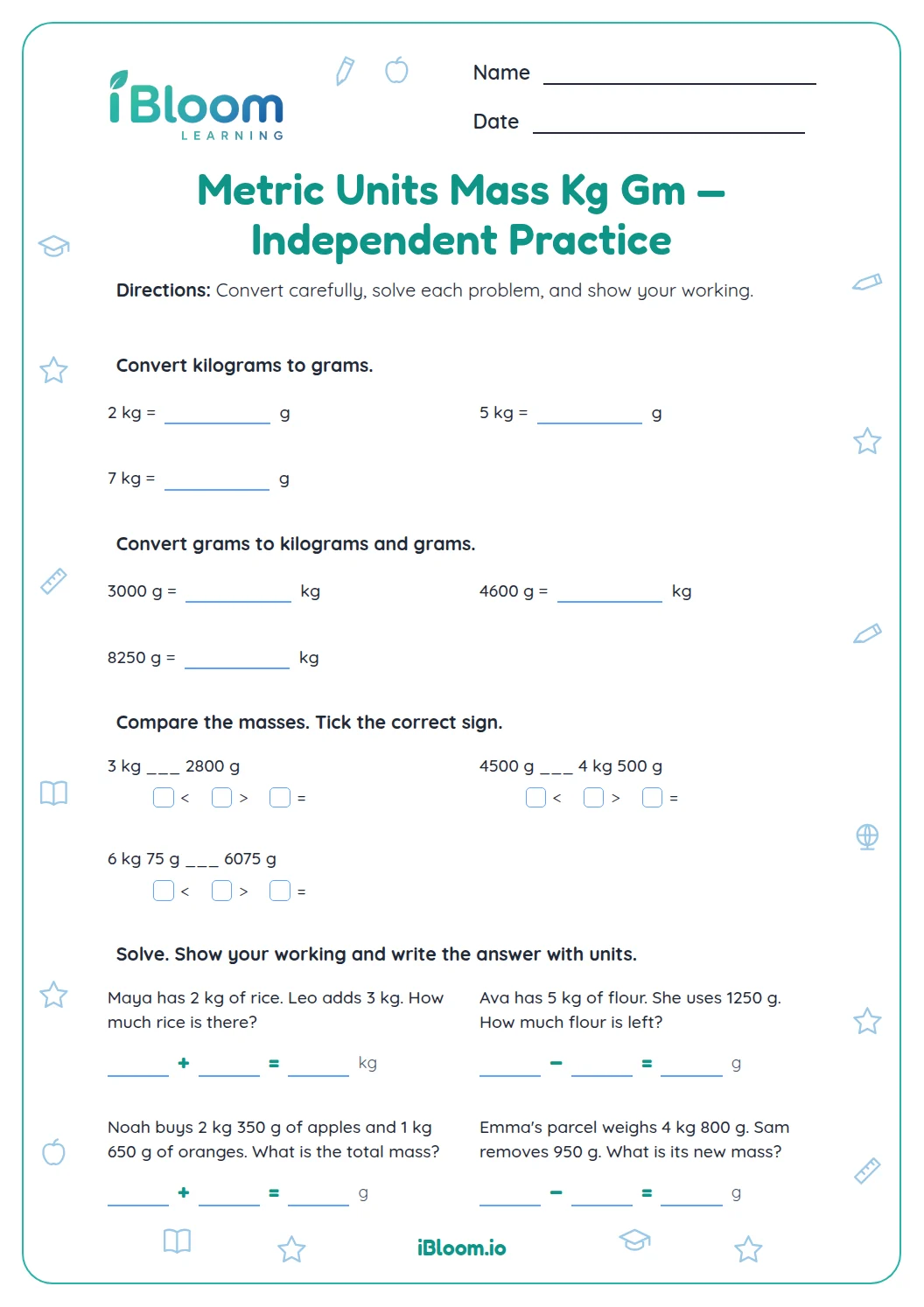
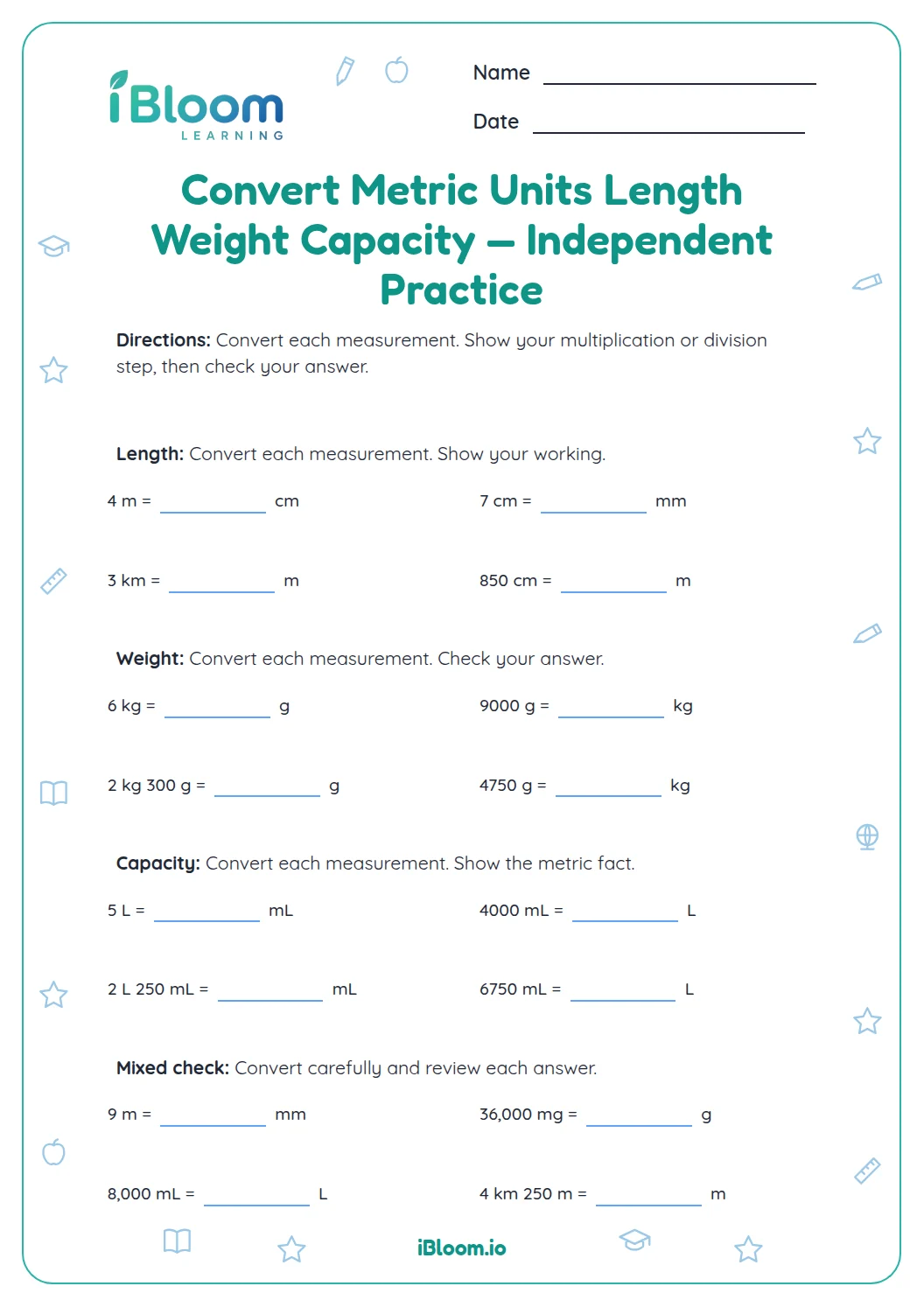
This Grade 4 printable builds reasoning with metric mass through 14 questions about kilograms and grams. Learners convert between units, compare equivalent masses, choose sensible units, and solve addition and subtraction problems, including a two-step scale limit. Several items ask students to explain or show how they converted. The key relationship is 1 kilogram = 1,000 grams, and the answer key includes worked values for the reasoning questions.
Aligned to 4.MD.A.1
What kinds of mass problems are included?
Part A checks conversion and comparison. Parts B and C use mass in everyday contexts: adding parcels, finding what remains, and calculating capacity under a limit. Part D asks for explanations and a final comparison.
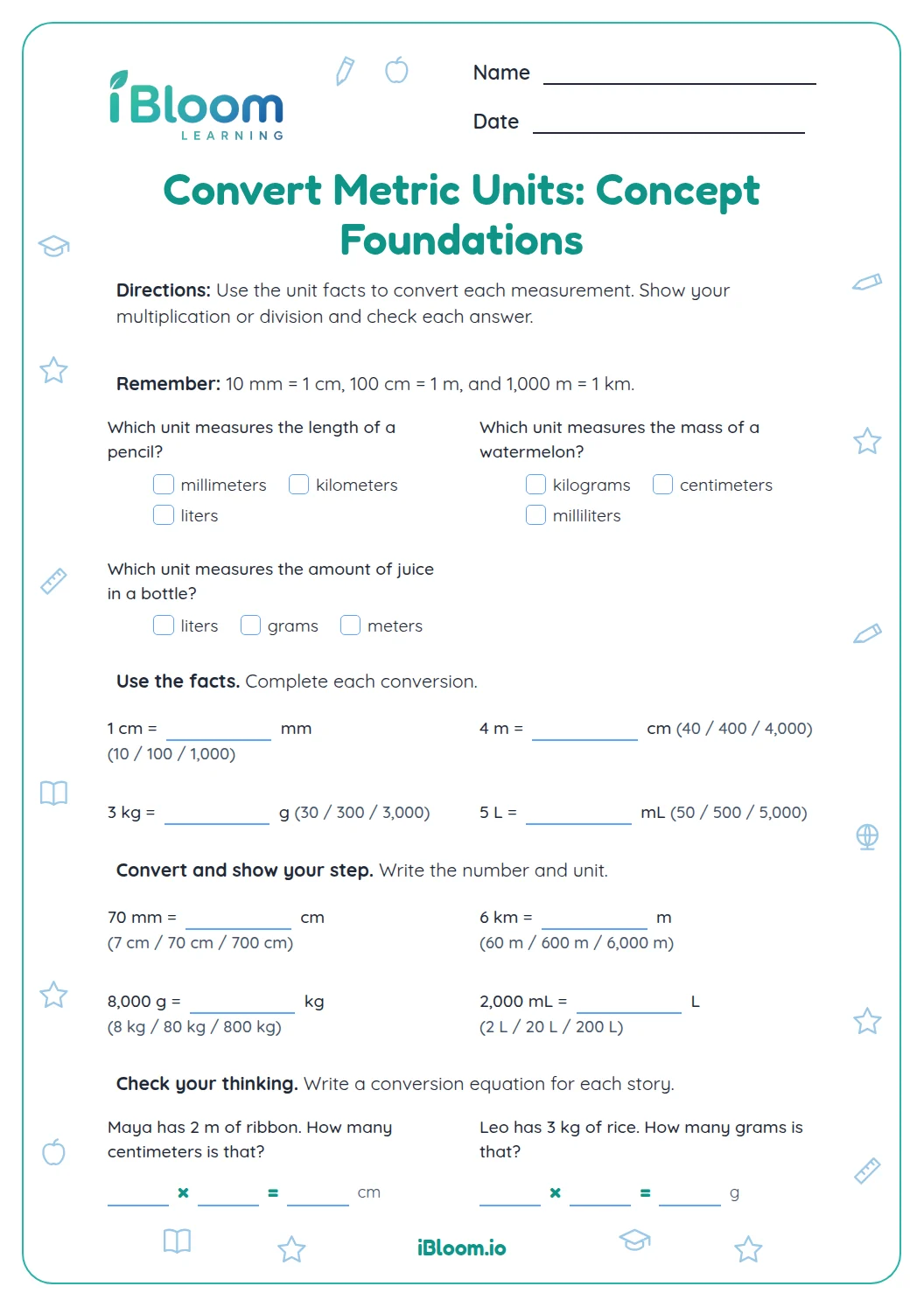
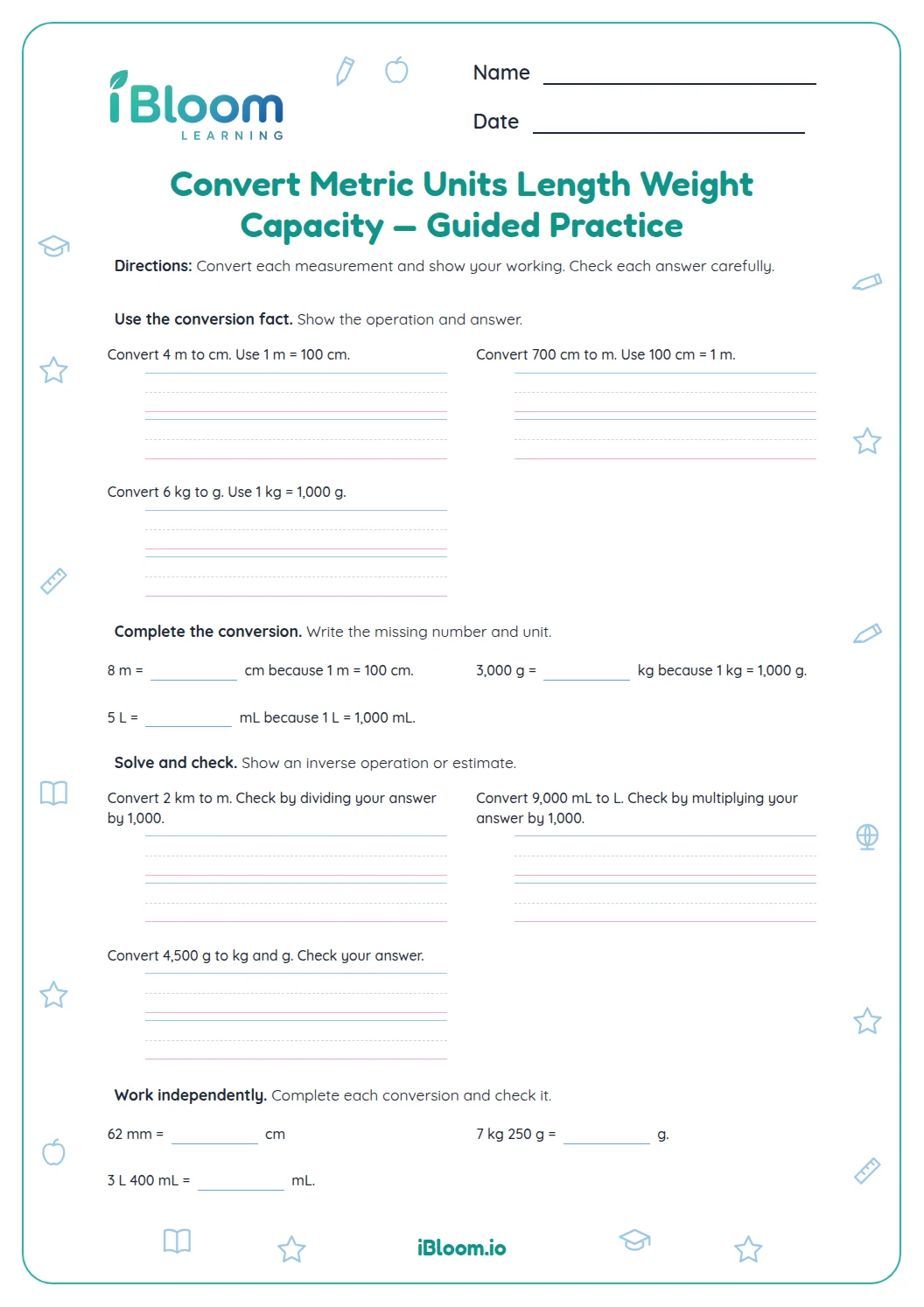
Every conversion depends on the same fact: 1 kg = 1,000 g. For mixed units, write the kilograms as grams before adding or subtracting.
- Convert kilograms and grams
- Compare equivalent measurements
- Solve addition and subtraction problems
- Explain a unit conversion
How do you compare a mixed mass and grams?
Convert the mixed mass to grams. Three kilograms is 3,000 grams, so 3 kg 40 g is 3,040 g. Then compare 3,040 g with 3,400 g.
- 13 kg 40 g = 3,040 g
- 23,400 g − 3,040 g = 360 g
- 3So 3,400 g is heavier by 360 g.
Why convert before a multistep calculation?
Keeping a calculation in one unit helps avoid adding kilograms to grams as if they were the same-sized units. Convert to grams, calculate, then regroup each 1,000 grams as 1 kilogram if the answer asks for mixed units.
How to work through the sheet
- 1Write 1 kg = 1,000 g at the top of the page.
- 2Complete conversions before comparing any two masses.
- 3For a story problem, underline the known masses and identify whether to add or subtract.
- 4Convert all quantities to grams for multistep work.
- 5Regroup each 1,000 g as 1 kg when a mixed-unit answer is useful.
- 6Check whether the answer is reasonable for the context.
Common mistakes and quick fixes
The mistake
Writing 2,500 g as 2 kg 5 g.
The fix
Separate thousands and leftover grams: 2,500 g = 2 kg 500 g.
The mistake
Comparing 3 kg and 2,900 g by looking only at 3 and 2,900.
The fix
Convert 3 kg to 3,000 g, then compare 3,000 with 2,900.
The mistake
Adding 2 kg 750 g and 1 kg 900 g to get 3 kg 1,650 g.
The fix
Regroup 1,000 of the grams as 1 kg: 4 kg 650 g.
Common Core alignment
Use relative sizes of metric units to convert and solve measurement problems.
On this sheet:
Show the official wordingHide the official wording
Know relative sizes of measurement units within one system of units including km, m, cm; kg, g; lb, oz; l, ml; hr, min, sec. Within a single system of measurement, express measurements in a larger unit in terms of a smaller unit. Record measurement equivalents in a two-column table.
What to practice next
Make more practice
Further reading
Questions parents and teachers ask
What is the relationship between kilograms and grams?
One kilogram equals 1,000 grams. To change kilograms to grams, multiply by 1,000; to rewrite grams as kilograms and leftover grams, group the thousands first. For example, 2,500 g is 2 kg 500 g. The conversion is useful for both comparisons and calculations.
How do I compare 3 kg with 2,900 g?
Use the same unit for both measurements. Change 3 kg to 3,000 g, then compare 3,000 g and 2,900 g. The 3 kg mass is heavier by 100 g, since it has one more group of 100 grams.
How can I subtract grams from kilograms?
Convert the kilograms to grams, subtract, and then convert back if the answer should use mixed units. For example, 8 kg is 8,000 g; removing 2,750 g leaves 5,250 g, or 5 kg 250 g. Students can refer to the worked examples and answer key to check each step.
Does the worksheet include multistep problems?
Yes. Several questions ask students to add or subtract more than one mass, such as checking how much remains under a 5 kg limit. Converting everything to grams first makes the calculation easier to organize and check. Students can refer to the worked examples and answer key to check each step.
Should answers include units?
Yes. Include g or kg when the prompt asks for a mass. For a question that asks only how many equal packs, the answer is a count, so no mass unit is needed. Students can refer to the worked examples and answer key to check each step.
Is an answer key included?
Yes. A separate key lists all 14 answers, including mixed-unit conversions and sample reasoning. Students can check the number and the unit, then revisit any step where the converted masses were not in the same unit. Students can refer to the worked examples and answer key to check each step.