






About this worksheet
This Grade 4 worksheet builds mental multiplication with whole hundreds through familiar quantities such as flyers, books, seats, and flowers. Students solve 14 questions in three parts, beginning with one product and progressing to stories that combine groups. They write equations, use place value, and check the size of their answers. A complete answer key accompanies the worksheet.
Aligned to 4.NBT.B.5
How can you multiply whole hundreds mentally?
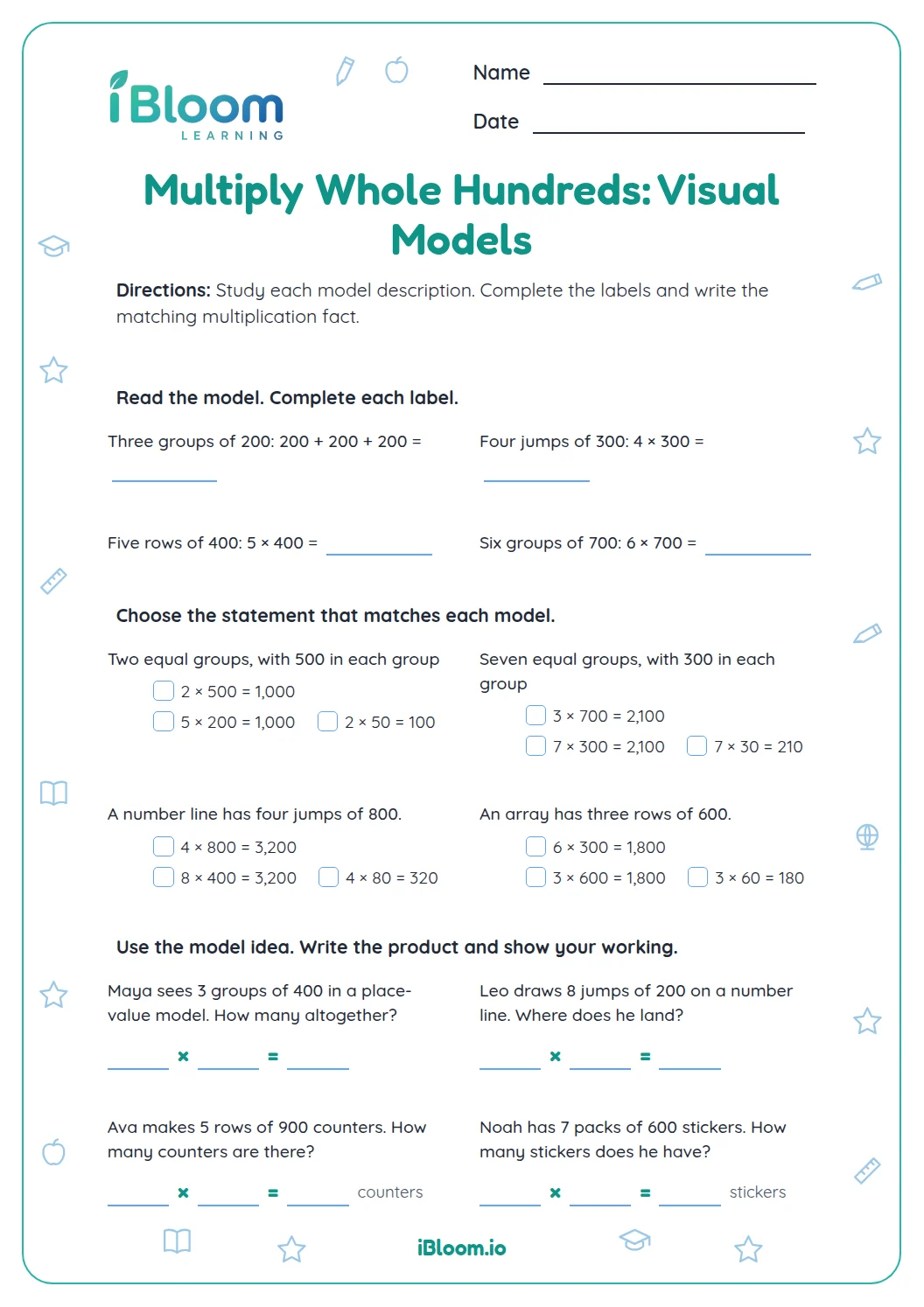
Think of 700 as 7 × 100. Then 6 × 700 is 6 × 7 groups of 100, or 42 hundreds: 4,200. Multiply the nonzero digits first, then attach the two place-value zeros.
- 14 × 300
- 24 × 3 = 12
- 312 hundreds = 1,200 flyers
How do you handle more than one group?
For two kinds of groups, multiply each quantity separately and add the partial totals. In the flower problem, 9 × 300 = 2,700 tulips and 4 × 200 = 800 daffodils. Then 2,700 + 800 = 3,500 flowers. Keep the units with the answer.
What kinds of problems are included?
The first part asks for one product, while the next part combines two or more groups of hundreds. The final choices check whether students can identify a multiplication expression, use place value, and select a reasonable total.
How can you use this worksheet?
- 1Underline how many groups and how many items are in each group.
- 2Write a multiplication equation for each group.
- 3Multiply the nonzero digits, then check the hundreds place.
- 4For a multi-step story, add the group totals and include the unit.
- 5Estimate the size of the answer before checking it with the key.
Common mistakes and quick fixes
The mistake
Multiplying the digits but forgetting the hundreds.
The fix
Say “42 hundreds” before writing 4,200.
The mistake
Adding the number of groups to the amount in each group.
The fix
Look for equal groups; use multiplication to find their total.
The mistake
Combining two groups before finding each product.
The fix
Write a separate product for each group, then add the partial totals.
Common Core alignment
The questions use place value to multiply one-digit factors by whole hundreds.
Multiply whole hundreds by one-digit numbers using place-value strategies.
On this sheet: Students multiply one-digit factors by whole hundreds and represent the products with equations.
Show the official wordingHide the official wording
Multiply a whole number of up to four digits by a one-digit whole number, and multiply two two-digit numbers, using strategies based on place value and the properties of operations. Illustrate and explain the calculation by using equations, rectangular arrays, and/or area models.
What to practice next
Make more practice
Further reading
Questions parents and teachers ask
How do you multiply a number by a whole hundred?
Multiply the nonzero digits, then account for the hundreds. For question 1, 4 × 300 means 4 × 3 hundreds, or 12 hundreds. That equals 1,200 flyers. Writing the hundreds as groups can help keep the place value clear.
Why does 6 × 700 equal 4,200?
Seven hundred is seven groups of 100. Six groups of 700 contain 6 × 7 = 42 hundreds, and 42 hundreds equal 4,200. Multiplying 6 × 7 first makes the place-value zeros easier to track. A quick estimate confirms the answer is in the thousands.
How do students solve the two-group stories?
Break a whole hundred into hundreds and multiply the nonzero digits first. For example, 6 × 700 is 6 × 7 hundreds, or 42 hundreds, which is 4,200. Check that the product has the expected number of hundreds.
What does “reasonable answer” mean here?
A reasonable answer has the right size and matches the story. If 8 groups each contain 400 seats, the total must be several thousands; 320 would be too small because it treats 400 as 40. Multiplying 8 × 4 hundreds gives 32 hundreds, or 3,200.
Should students write an equation?
Yes. A short equation shows what the quantities represent and helps catch a wrong operation. For a single group problem, write groups × amount in each group; for combined groups, show each product and the addition. Label the answer with the story’s unit.
Does the worksheet include only one-step multiplication?
No. The first six problems are single products, and later story problems combine groups of hundreds. Children practice multiplying each group and adding the results, with an answer key for all 14 questions. The sections move from a single product to combined groups and checking.