





About this worksheet
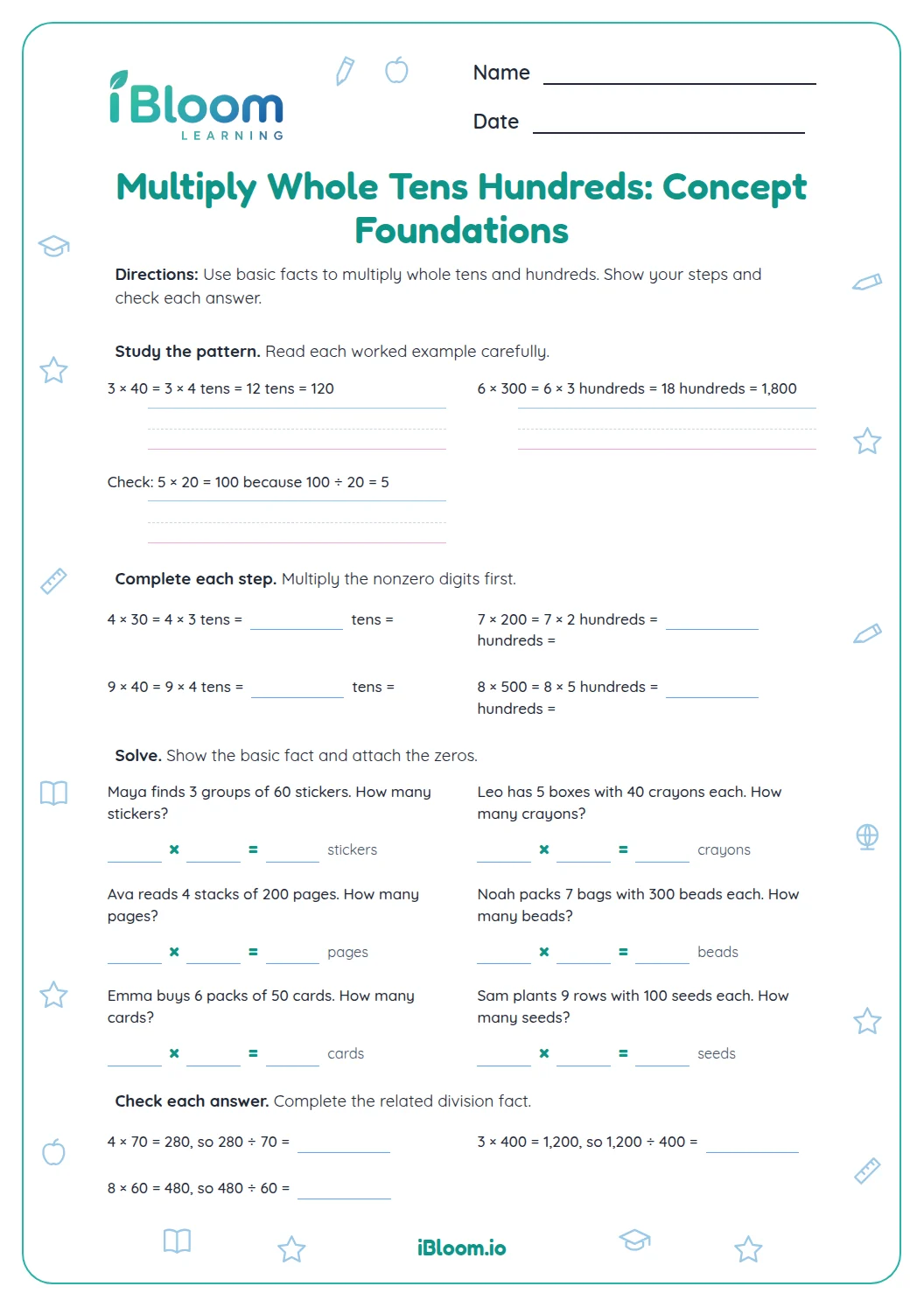
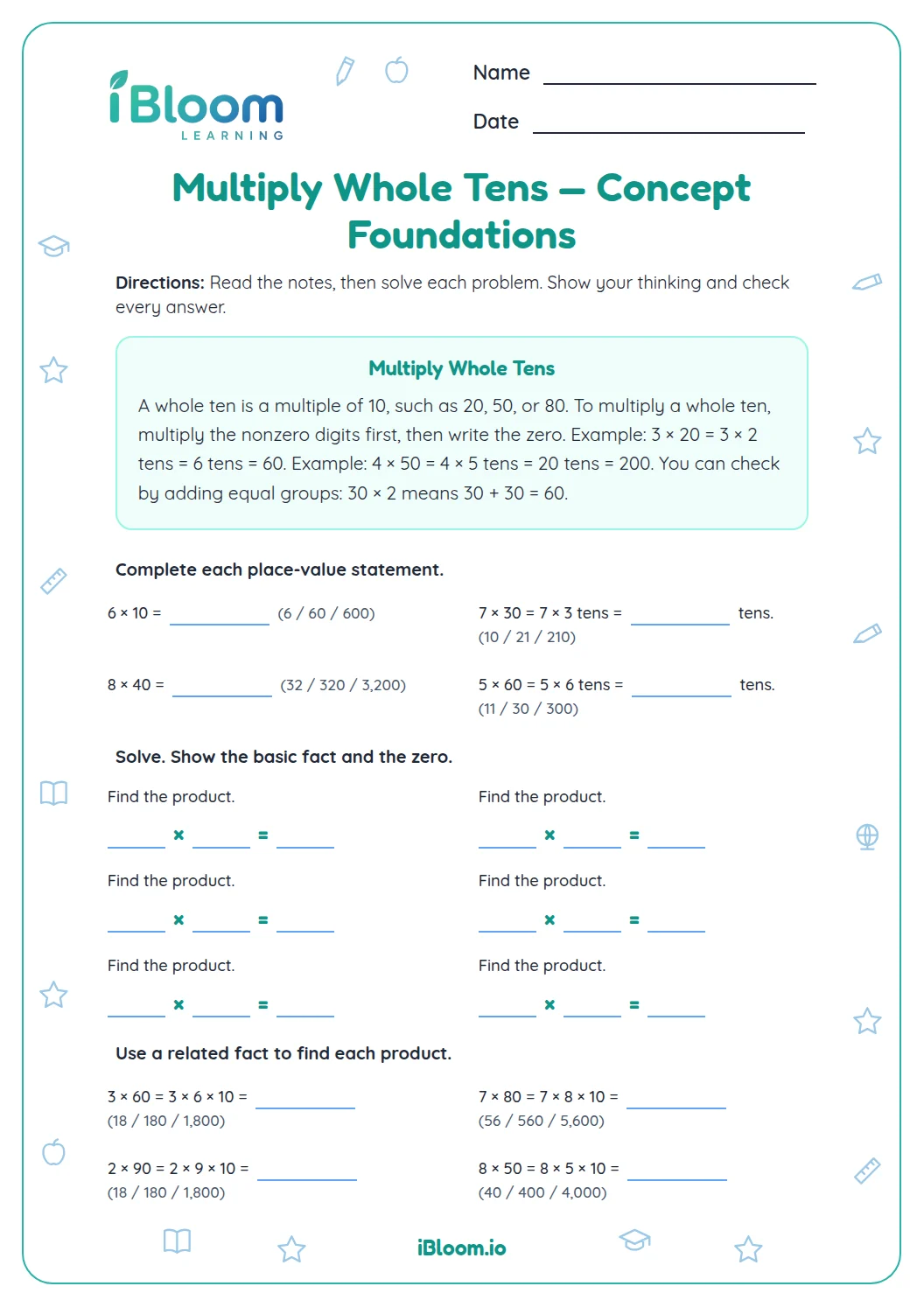
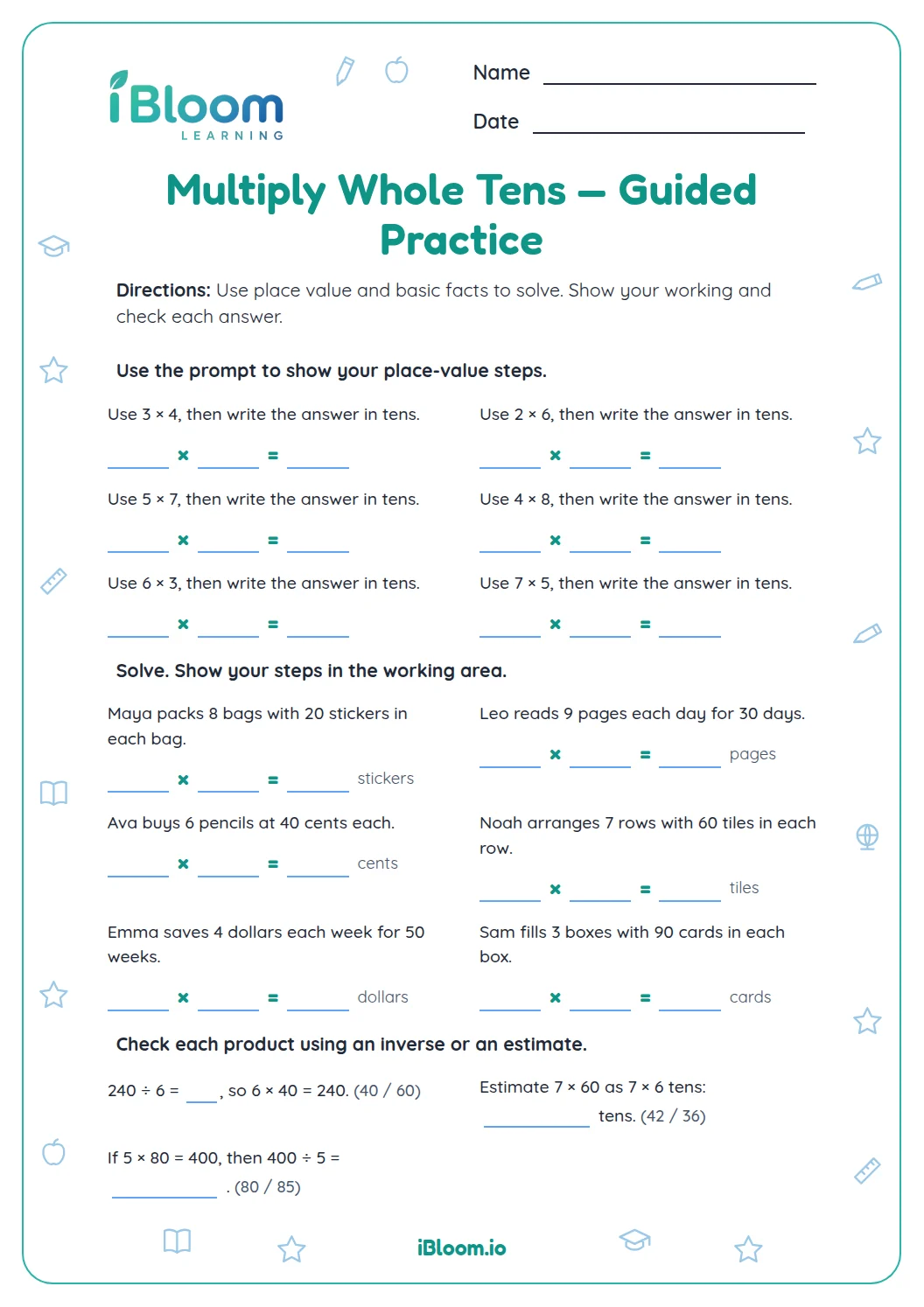
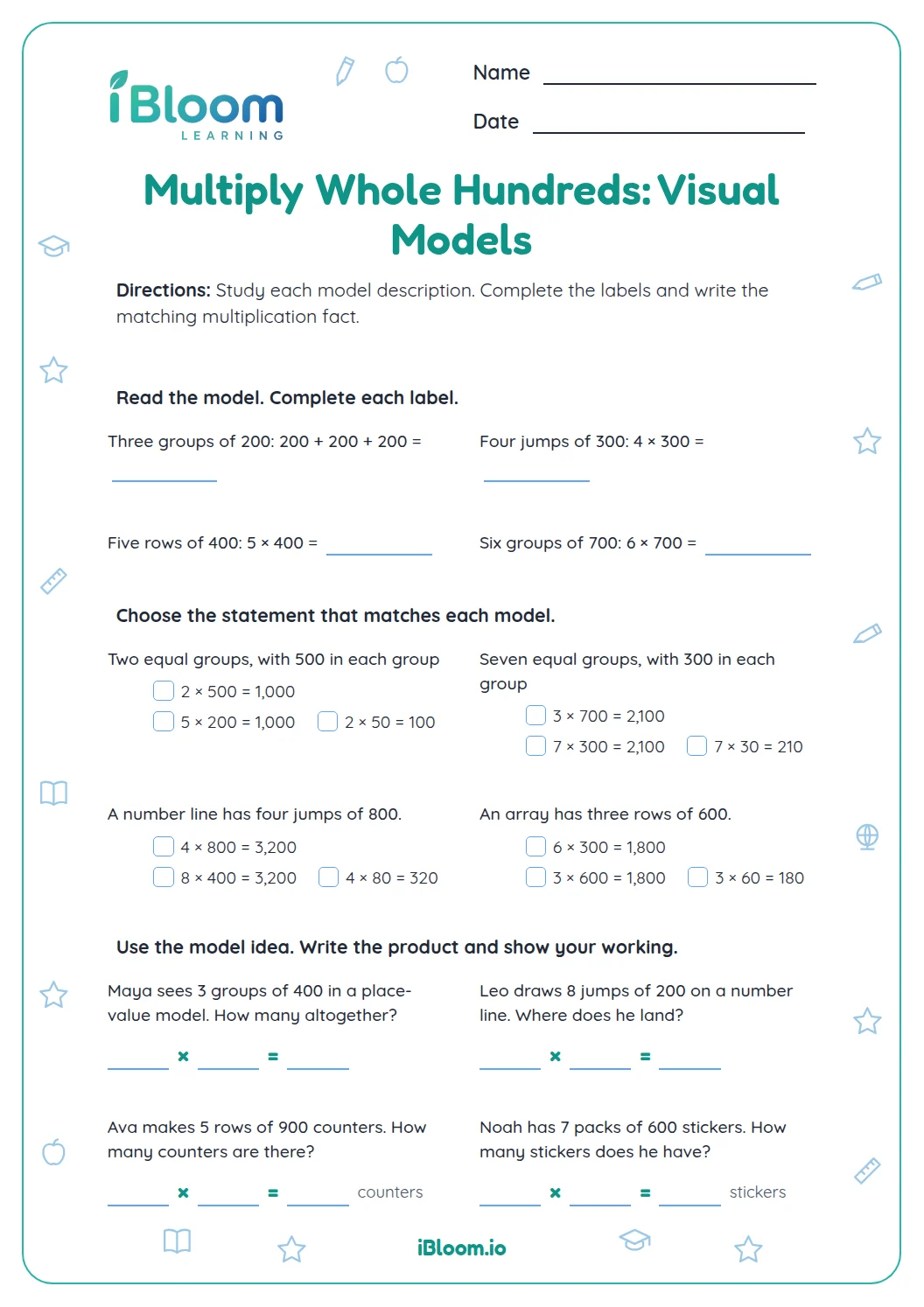
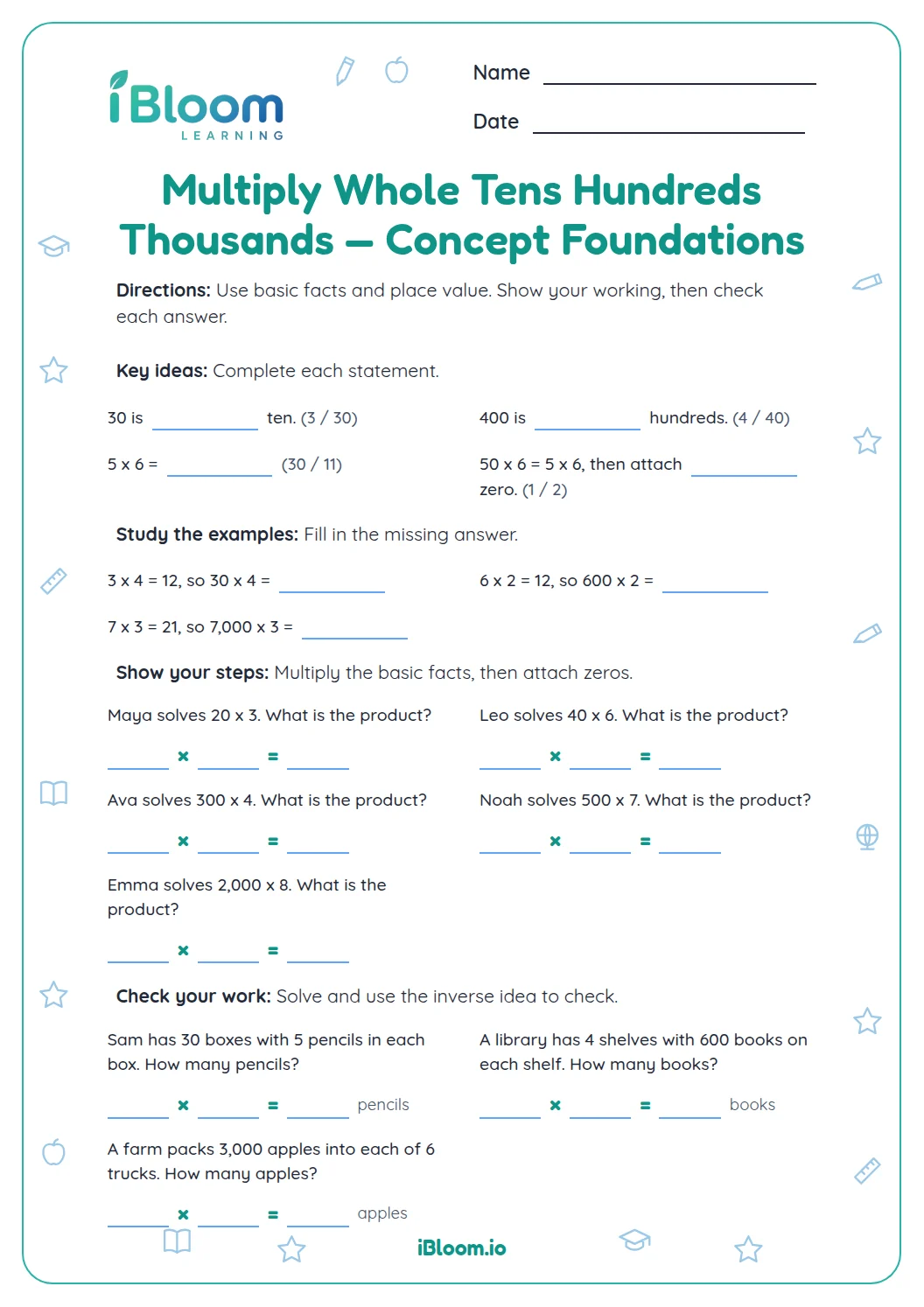
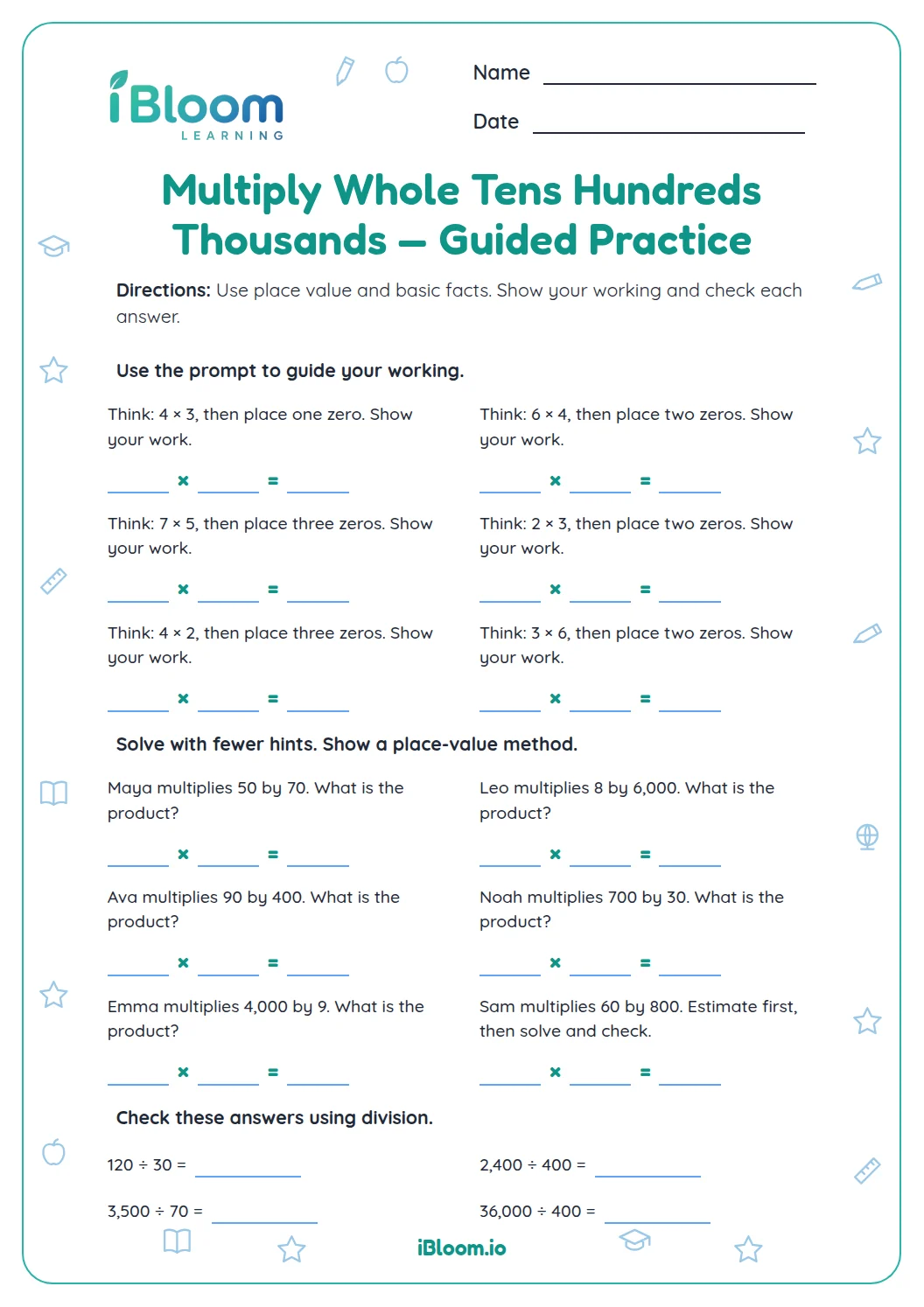
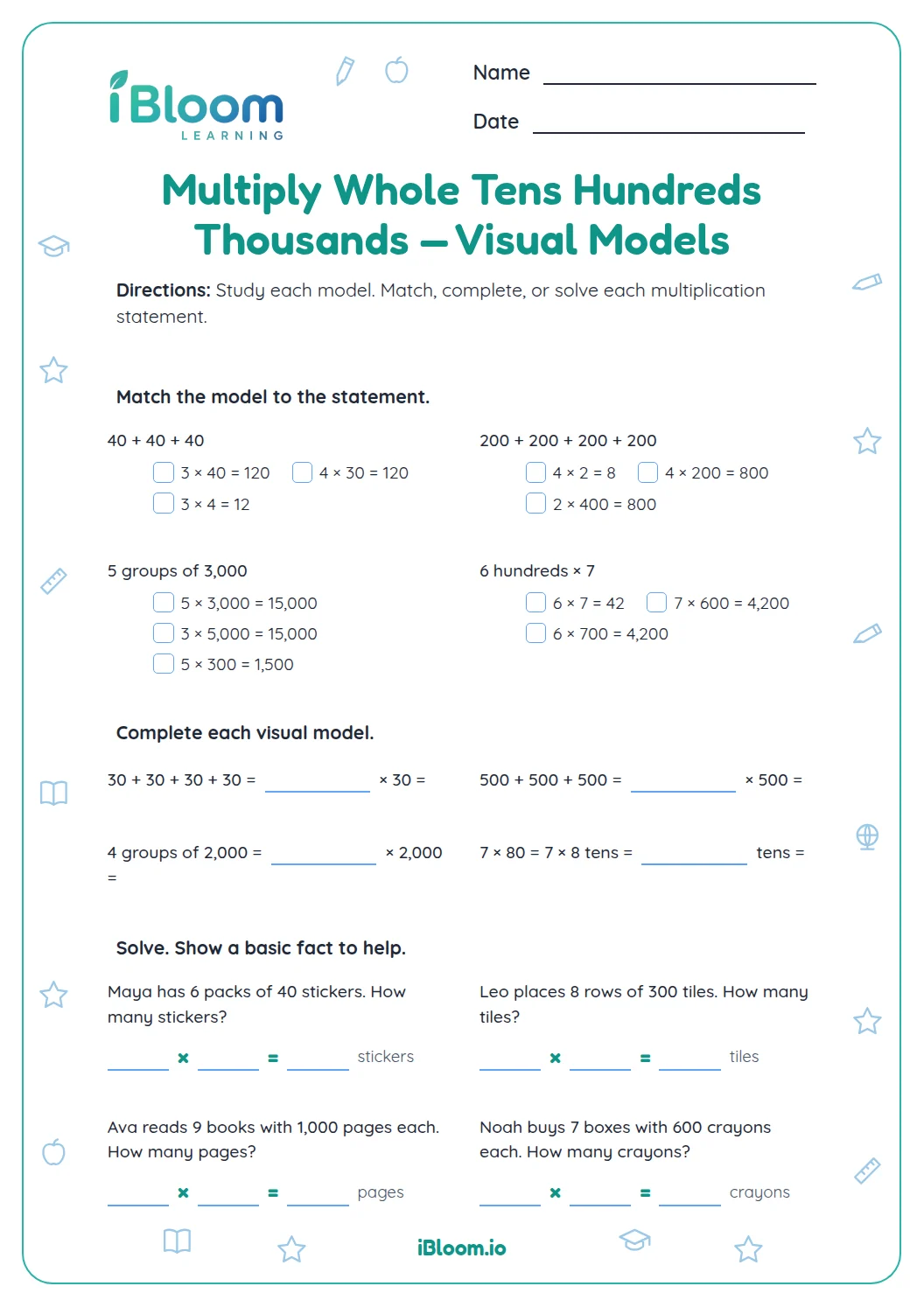
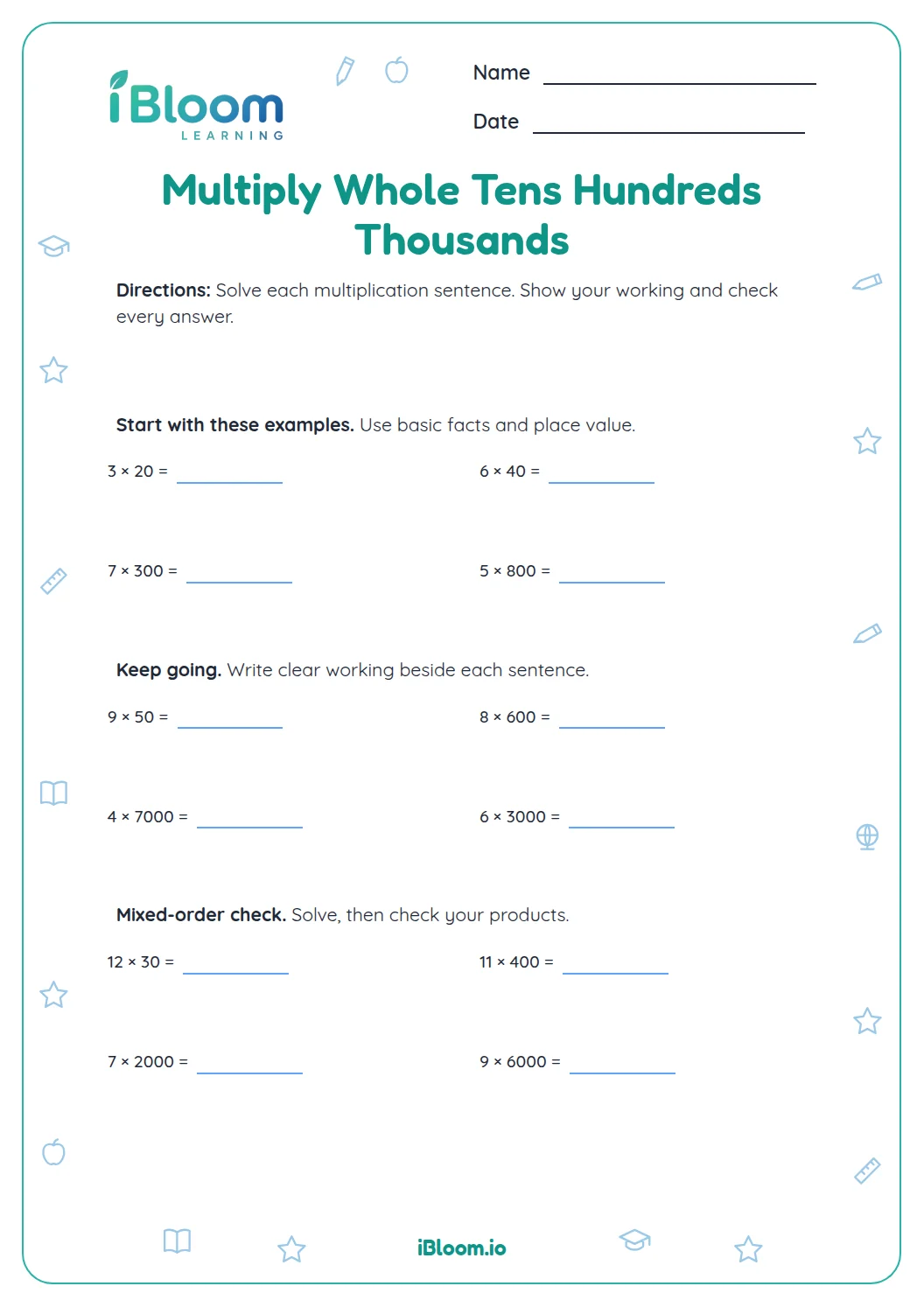
This free printable Grade 4 worksheet gives students independent practice multiplying one-digit numbers by whole tens and hundreds. The 18 questions move from products with tens, to products with hundreds, then missing factors and mixed practice. Students can use place value: for 6 × 70, find 6 × 7 tens, or 42 tens, which is 420. The work supports CCSS 4.NBT.B.5, which asks students to use place-value understanding and operation properties for multi-digit multiplication. A separate answer key is included.
Aligned to 4.NBT.B.5
How do you multiply by a whole ten?
Treat the tens digit as groups of ten. In 6 × 70, first calculate 6 × 7 = 42, then recognize that the 7 represents 7 tens: 42 tens is 420. This keeps the fact manageable while preserving the factor’s place value.
The first six problems practice products with multiples of ten. Keep the zero in the tens factor in mind as you write the product.
- 16 × 70
- 26 × 7 tens = 42 tens
- 342 tens = 420
What changes when the factor is a whole hundred?
The same idea works with hundreds. For 4 × 300, calculate 4 × 3 = 12, then read 300 as 3 hundreds: 12 hundreds equals 1,200. The six hundred problems include products beyond 1,000.
How can you find a missing factor?
Undo the multiplication to find the missing factor. In question 13, ___ × 50 = 350. Since 350 is 35 tens, and 50 is 5 tens, ask how many groups of 5 tens make 35 tens: the missing factor is 7. The final part mixes missing factors and product questions.
How to use this worksheet
- 1Review that 10 is one ten and 100 is one hundred.
- 2For each product, multiply the nonzero digits first.
- 3Say the result in tens or hundreds before writing the numeral.
- 4For a missing factor, divide the product by the known factor.
- 5Check by multiplying your answer by the given factor.
Common mistakes and quick fixes
The mistake
Writing 42 for 6 × 70.
The fix
Read 42 as 42 tens, then write 420.
The mistake
Writing 12 for 4 × 300.
The fix
The 3 stands for 3 hundreds, so 12 hundreds is 1,200.
The mistake
Adding a zero to the basic fact without checking the place value.
The fix
Name the groups: 6 × 7 tens is 42 tens.
The questions build multiplication strategies from place value and operation properties.
Students multiply one-digit numbers by multiples of ten and hundred using place value.
On this sheet:
Show the official wordingHide the official wording
Multiply a whole number of up to four digits by a one-digit whole number, and multiply two two-digit numbers, using strategies based on place value and the properties of operations. Illustrate and explain the calculation by using equations, rectangular arrays, and/or area models.
What to practice next
Make more practice
Further reading
Questions parents and teachers ask
How many questions are on the worksheet?
There are 18 questions in three parts. Students find products with whole tens, find products with whole hundreds, and finish with missing factors and mixed multiplication. The answer key is a separate page, so a parent or teacher can check each response without marking the worksheet itself.
Does this worksheet include multiplication by thousands?
No. The practice stays with whole tens and hundreds, as named in the worksheet title. Products range from 120 to 4,000, and students use place value to keep track of whether a factor represents tens or hundreds. The focused range lets them practice the same mental strategy in several ways.
What is one strategy for 7 × 200?
Think of 200 as 2 hundreds. Multiply 7 × 2 to get 14, then name the result as 14 hundreds, or 1,400. To check, divide 1,400 by 200; the quotient is 7, so seven groups of 200 make 1,400.
How should students solve a missing-factor question?
Use the inverse relationship between multiplication and division. For ___ × 50 = 350, divide 350 by 50 to find 7, then multiply 7 × 50 to check that it equals 350. The missing number is a factor, and the check returns to the original product.
Is an answer key included?
Yes. The printable includes a separate answer-key page with answers for all 18 questions. Students can complete the worksheet first, then use the key with an adult to check products and missing factors. The key can help pinpoint a place-value error so the student can review that step.