





About this worksheet
This Grade 4 printable connects an equal-groups array and base-ten blocks to mental multiplication by whole tens and hundreds. Students read models, rename products as tens or hundreds, and solve two short word problems with equations. The practice supports CCSS 4.NBT.B.5. A separate answer key shows each product and the units in the place-value statements.
Aligned to 4.NBT.B.5
Think in groups of tens
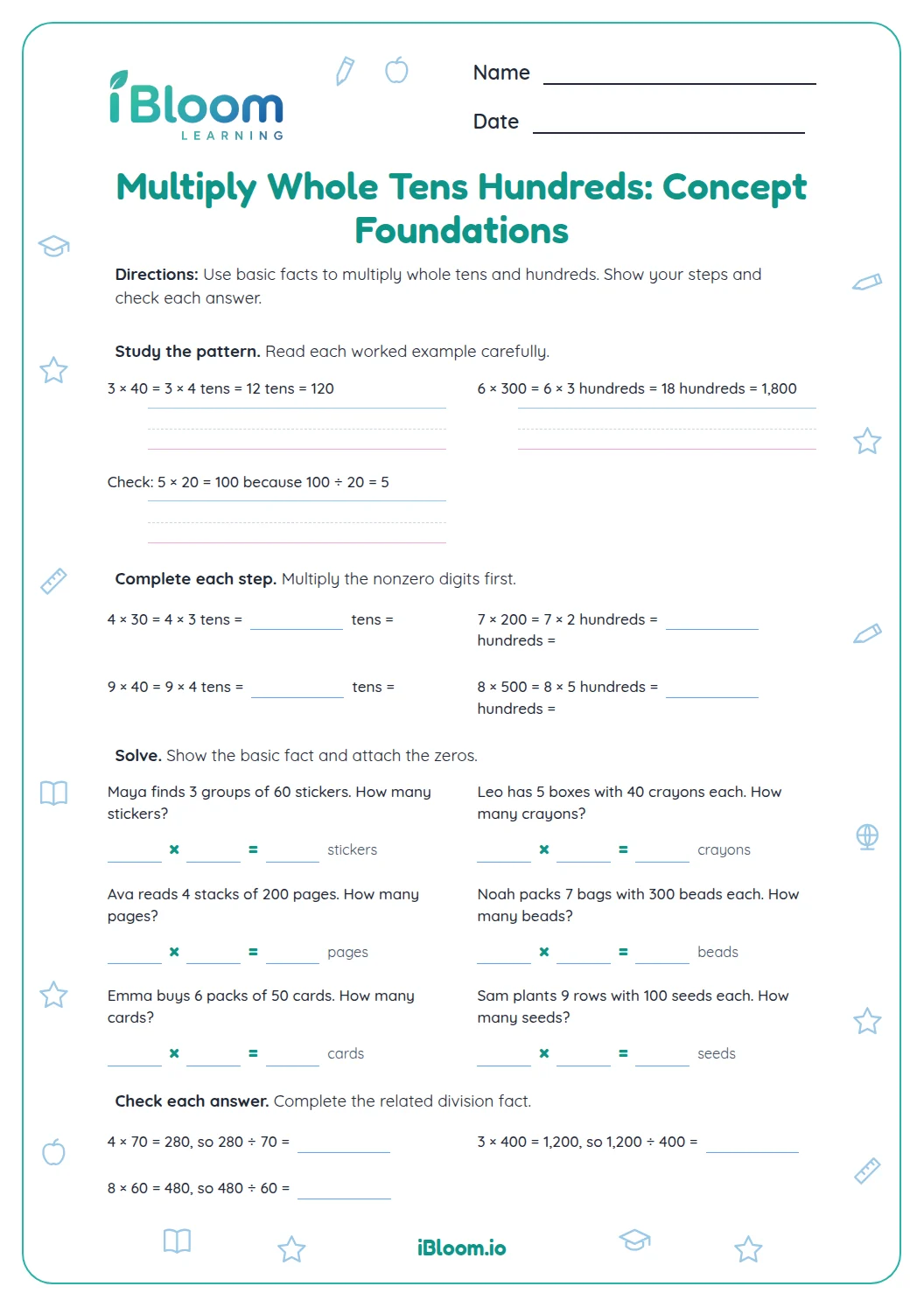
A whole ten is a group of 10. For 6 × 40, think of 6 groups of 4 tens: 24 tens. Since 24 tens equals 240, the product is 240. The same idea works with hundreds.
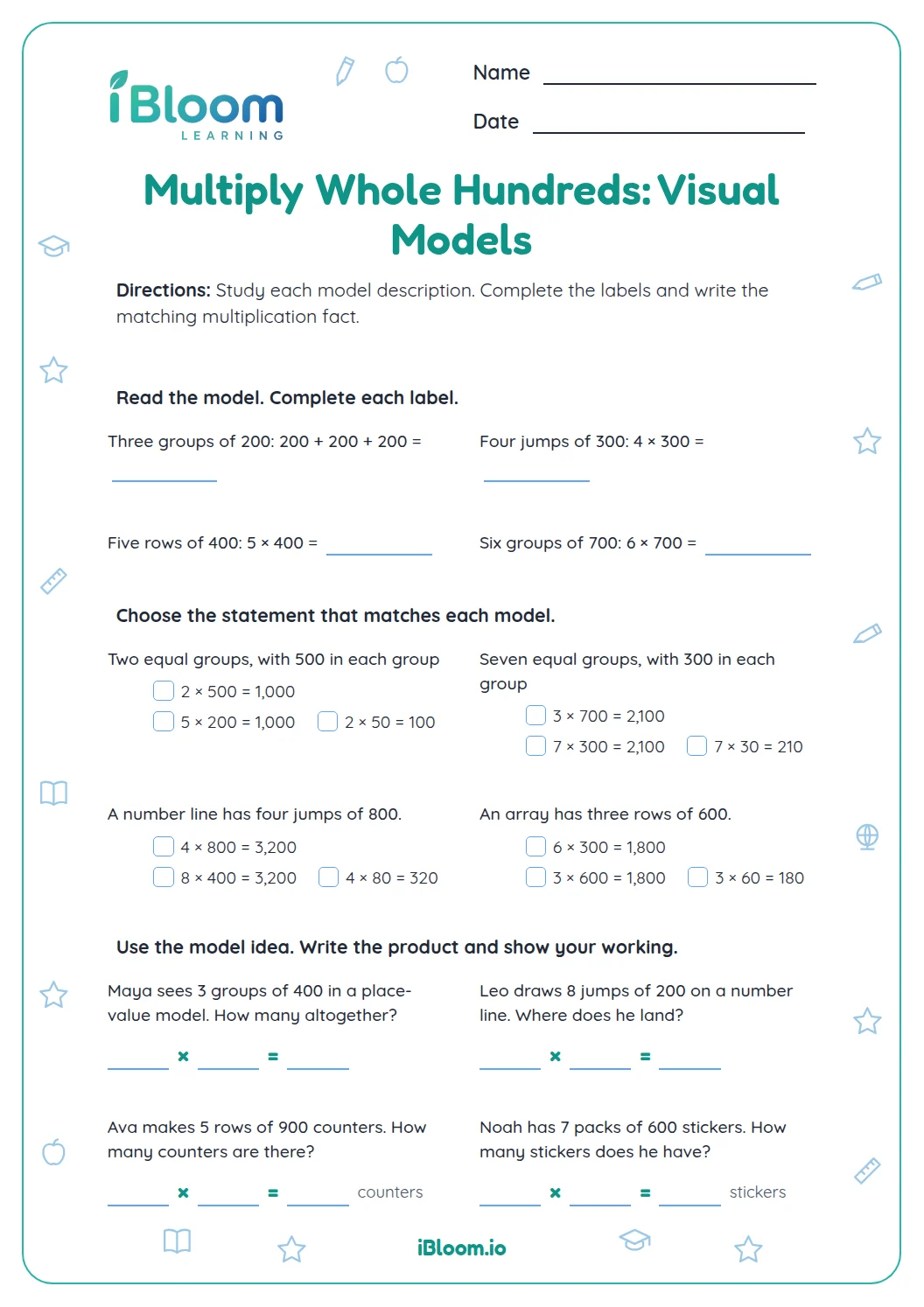
- 13 × 200 means 3 groups of 2 hundreds, or 6 hundreds = 600.
Rewrite the tens or hundreds as a place-value unit.
- 1Multiply the one-digit numbers.
- 2Rename the groups as a product, such as 21 tens = 210.
Check these common slips
The mistake
Writing 6 × 40 as 24 instead of 240 because the tens unit was dropped.
The fix
The mistake
Counting the number of blocks without noticing whether they stand for tens or hundreds.
The fix
Common Core alignment
Students use arrays and place-value units to multiply one-digit factors by whole tens and hundreds.
Multiply whole numbers using place-value strategies.
On this sheet: Students use arrays and place-value groups to multiply by whole tens and hundreds.
Show the official wordingHide the official wording
Multiply a whole number of up to four digits by a one-digit whole number, and multiply two two-digit numbers, using strategies based on place value and the properties of operations. Illustrate and explain the calculation by using equations, rectangular arrays, and/or area models.
What to practice next
Make more practice
Further reading
Questions parents and teachers ask
What does 4 × 30 mean?
It means four groups of three tens. Four times three is twelve, so the product is twelve tens, or 120. The worksheet asks students to name the tens unit before writing the full product, which helps keep the place value clear.
Why does the array use small numbers?
The array shows equal groups in a compact model. Students count its 12 dots, then use the same equal-groups idea with tens and hundreds, where each group has a place value greater than one. This connects the model to the multiplication strategy.
Should students show an algorithm?
The two word problems ask for a multiplication equation and a product. The other items focus on mental place-value reasoning, such as renaming 7 × 30 as 7 × 3 tens, or 21 tens, which is 210. Students can use any clear equation in those two answers.
How do base-ten blocks help?
A hundred block represents 100 and a ten rod represents 10. The base-ten model in the first section shows 2 hundreds and 3 tens, which is 230. Students read the value of each block rather than counting each block as one.
How many problems are included?
There are 14 questions across two worksheet pages: two model-reading questions, ten multiplication questions, and two word problems. The answer key has two pages, with each answer placed alongside its question number. Students can use both key pages to check all 14 responses.