

About this worksheet
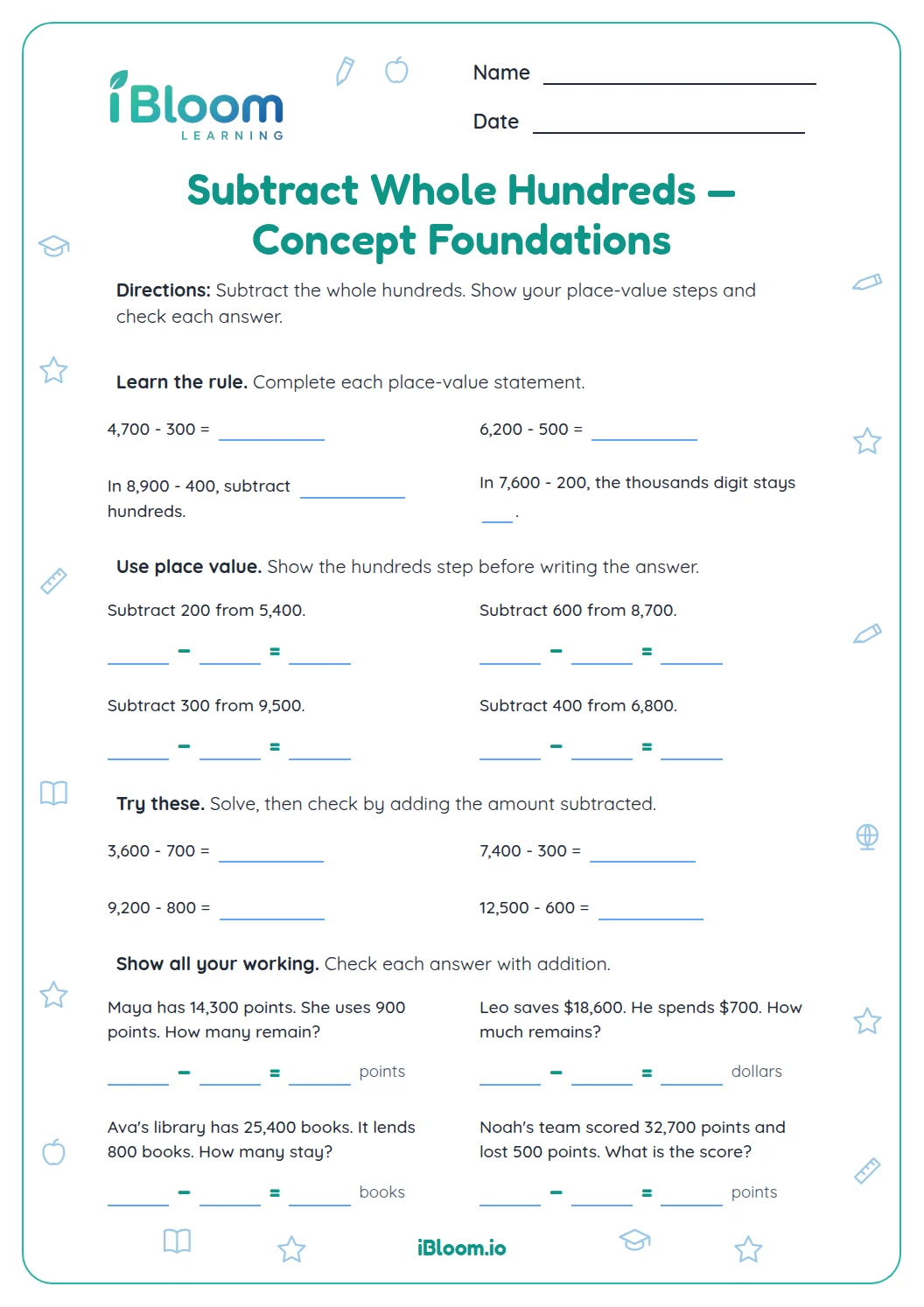
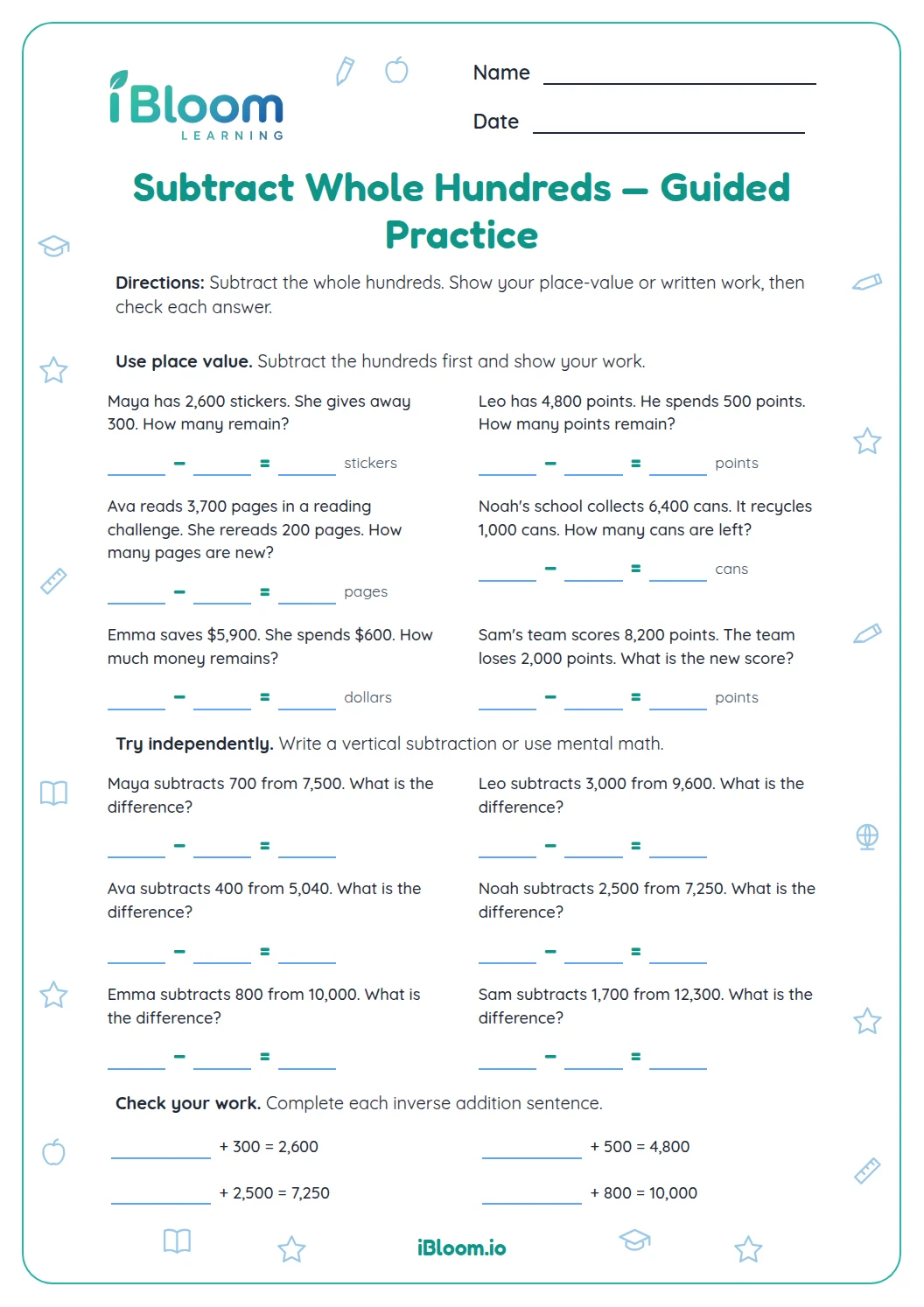
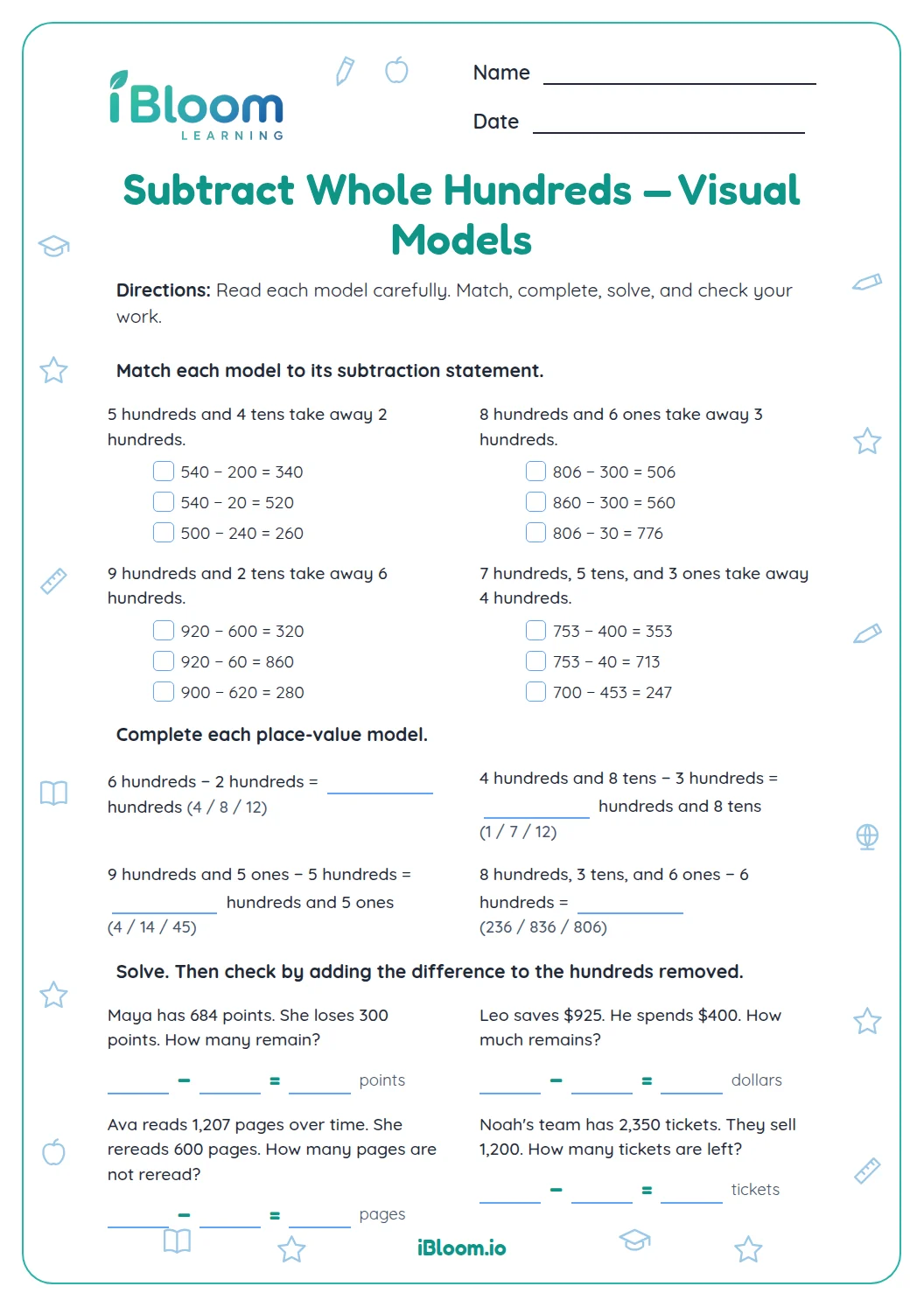
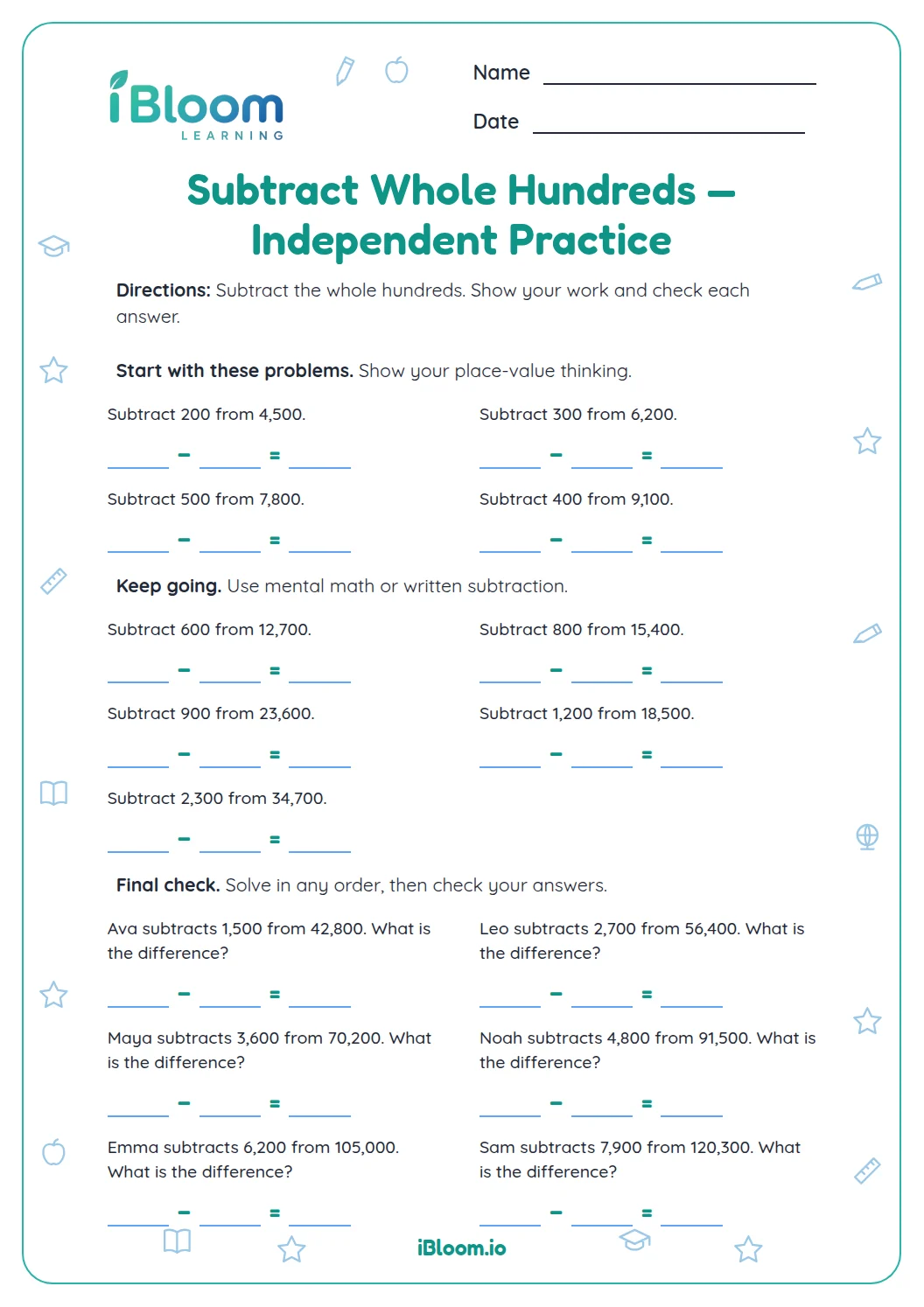
Students subtract whole hundreds in situations involving books, tickets, supplies, and distances. Each item asks for a sensible quantity and unit, so learners practice translating a story into subtraction and checking that the result is smaller than the starting amount.
Aligned to 4.NBT.B.4
Turn the story into subtraction
Find the starting amount, then identify how many are taken away or how many more are needed. Subtract the hundreds and keep the unit from the story.
For example, 2,450 visitors with 600 fewer in July means 2,450 − 600 = 1,850 visitors. Estimate first: the answer should be near 1,800 and smaller than 2,450.
What is on the worksheet?
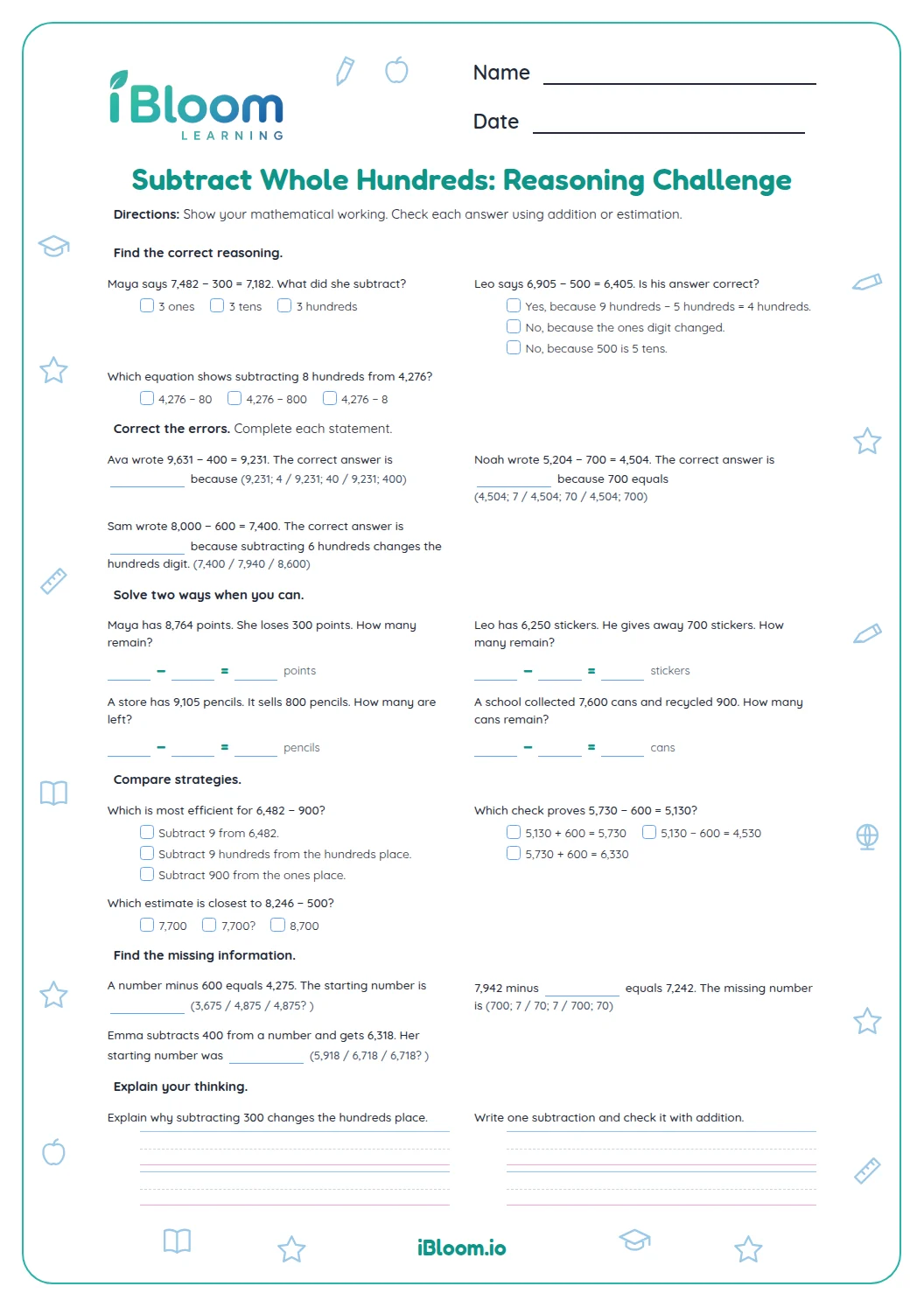
Sixteen short situations use whole hundreds with quantities from the thousands into the ten-thousands. The contexts vary so students must read for the operation instead of repeating a single sentence pattern.
- Part A starts with books, visitors, and food-bank supplies.
- Part B continues with remaining amounts, empty seats, and amounts still needed.
- The separate key gives the number and unit for every response.
How can a student check subtraction?
For q2, 2,450 − 600 = 1,850 visitors. The answer is less than the June count, and adding 600 back gives 2,450.
Add the difference to the amount taken away. The sum should equal the starting amount. For example, if 4,600 meters minus 800 meters leaves 3,800 meters, adding 800 and 3,800 returns 4,600. Keep the unit in both the calculation and the answer.
Common Core alignment
This page applies Grade 4 whole-number subtraction to practical situations.
Fluently add and subtract multi-digit whole numbers using the standard algorithm.
On this sheet: Students subtract whole hundreds from multi-digit quantities in word problems.
Show the official wordingHide the official wording
Fluently add and subtract multi-digit whole numbers using the standard algorithm.
What to practice next
Make more practice
Questions parents and teachers ask
How should a student begin a subtraction story?
Find the starting amount and the amount that is taken away, or identify how much more is needed. Write those quantities in a subtraction equation before calculating. Then put the correct unit in the answer and check by adding the difference back to the amount taken away.
How can a student check a subtraction answer?
Add the difference to the amount taken away. The sum should equal the starting amount from the story. For example, if 600 books were sent away and 1,850 remained, 1,850 + 600 returns to 2,450 books. This check can reveal a missed zero or place-value error.
Why does this worksheet use whole hundreds?
Whole hundreds make it possible to focus on interpreting the situation and subtracting accurately by place value. The stories include quantities in the thousands and ten-thousands, so students still need to attend to each digit and keep the correct unit with the result.
Does the answer key include units?
Yes. The key includes the measured item or unit in each response, such as books, feet, dollars, or cans. Matching the unit to the story helps students explain what the difference represents, instead of leaving a number without context in the final response.
How can a student check subtraction?
Add the difference to the amount taken away. The sum should equal the starting amount. For example, if 4,600 meters minus 800 meters leaves 3,800 meters, adding 800 and 3,800 returns 4,600. Keep the unit in both the calculation and the answer.