

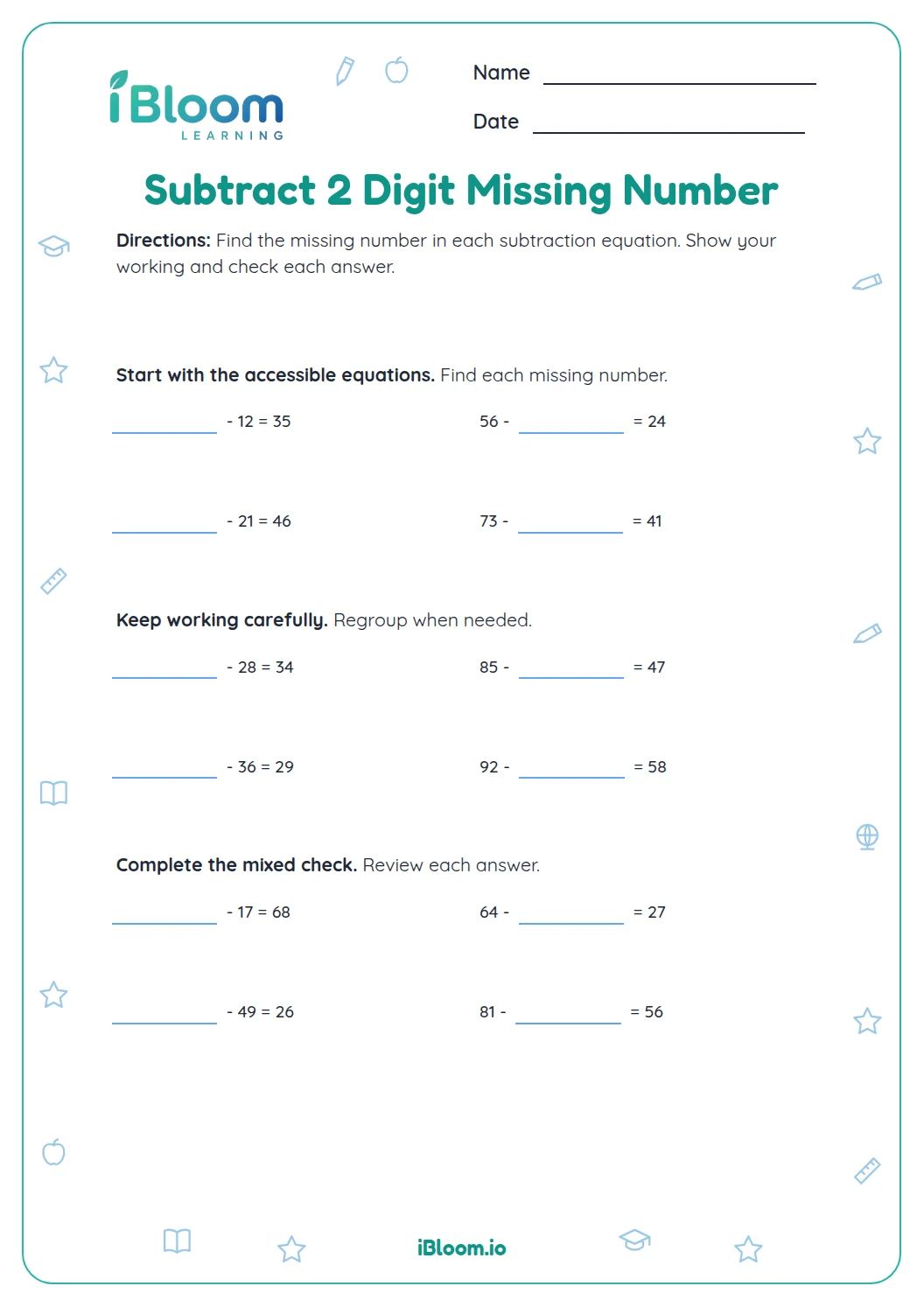
About this worksheet
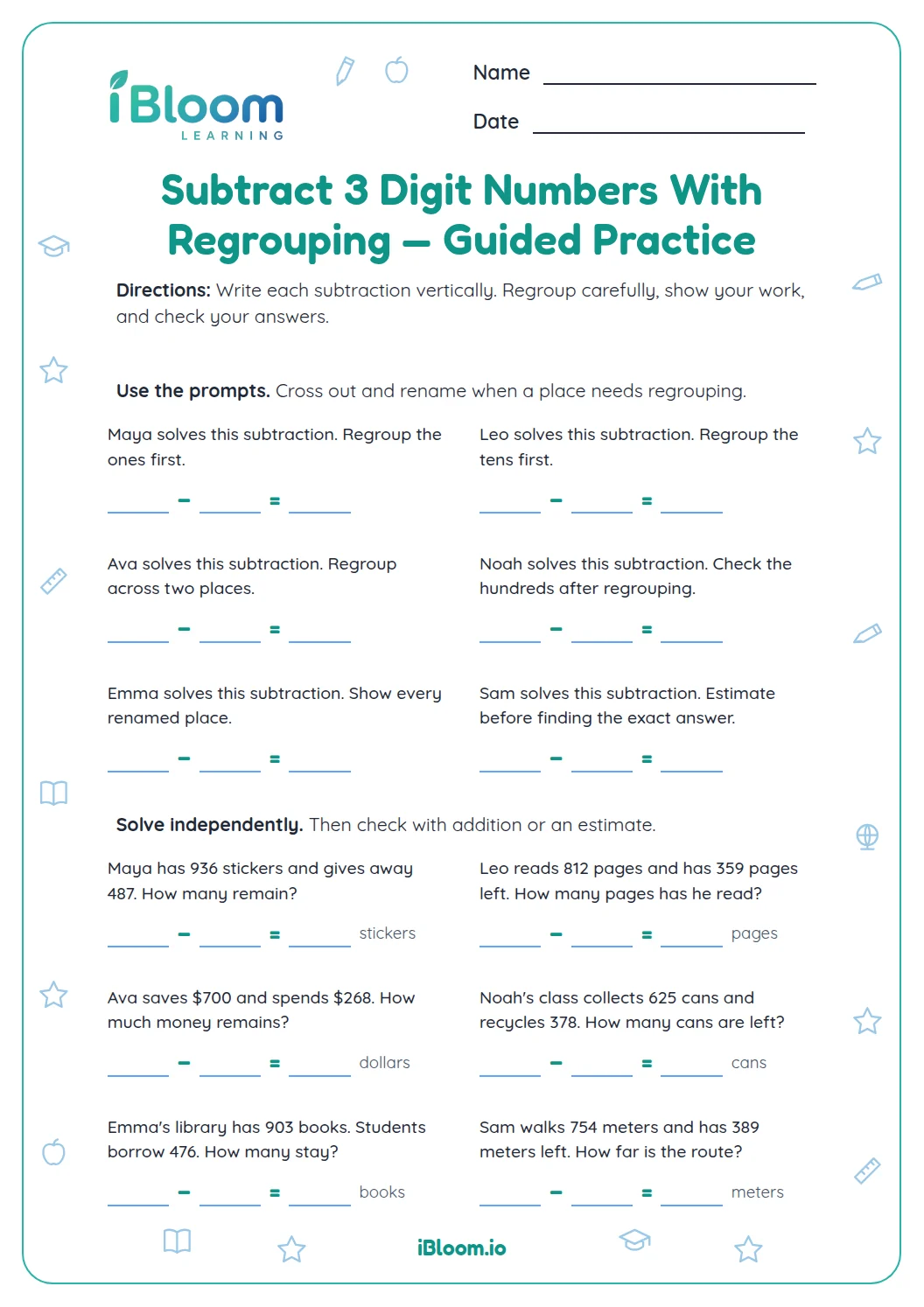
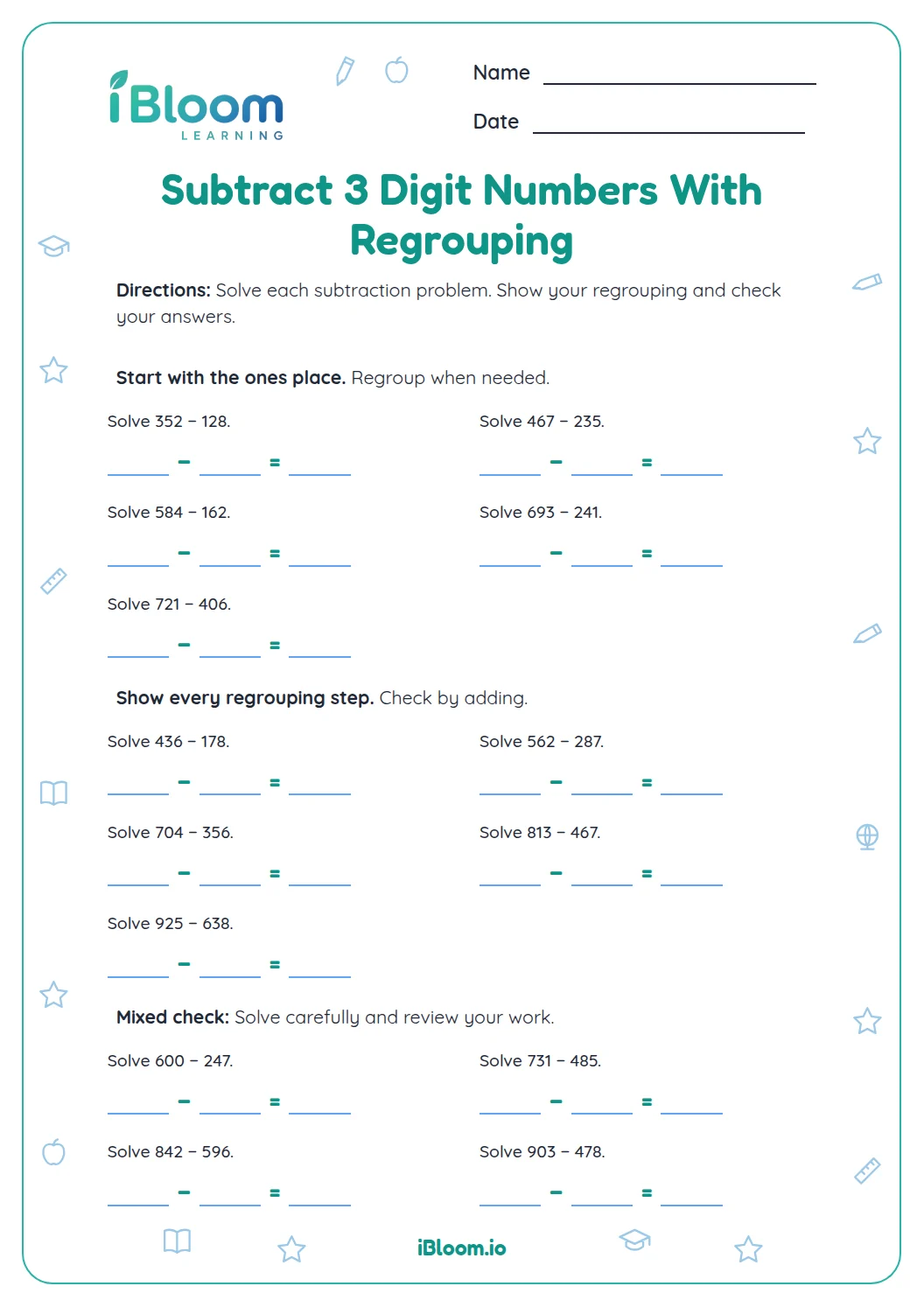
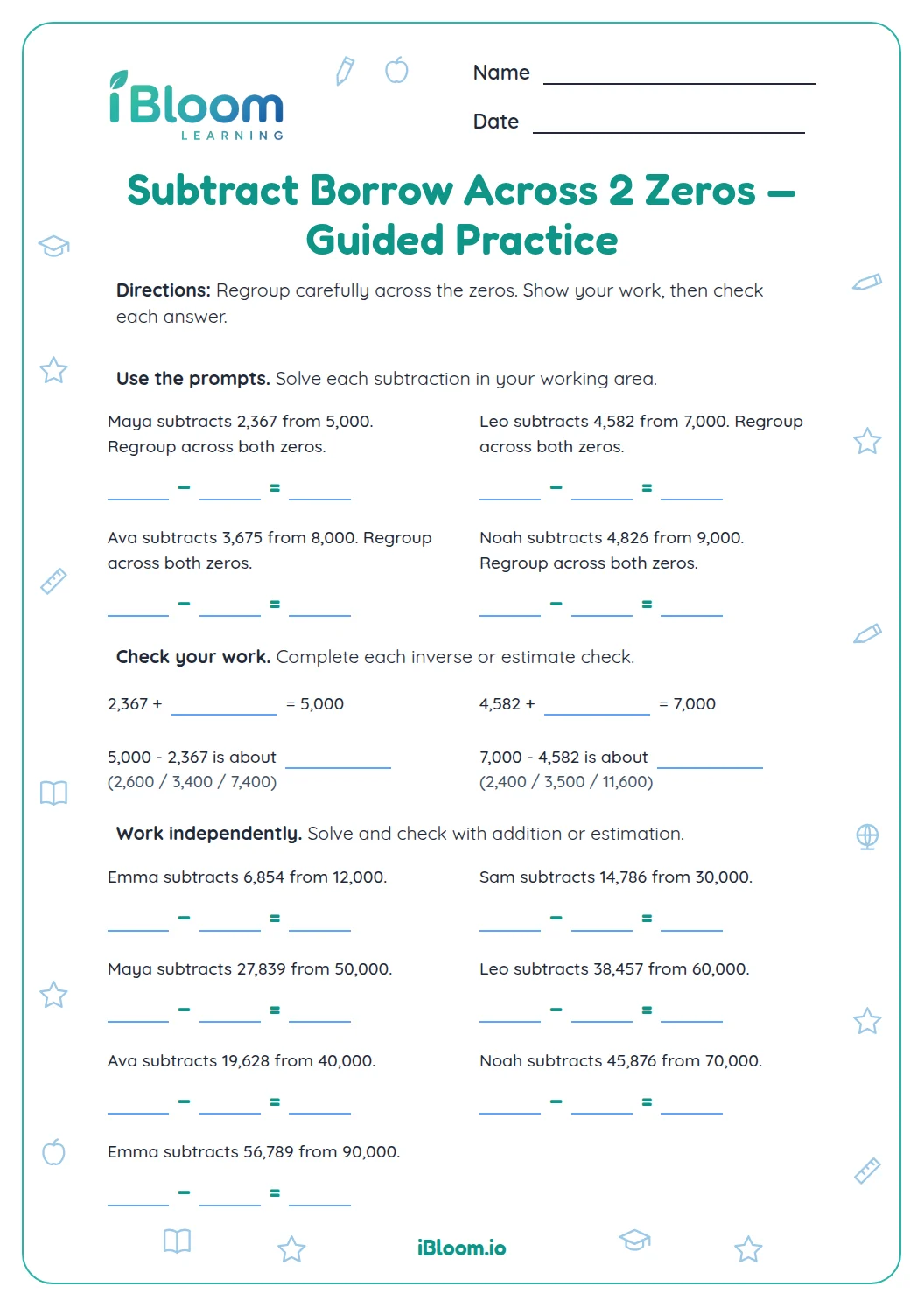
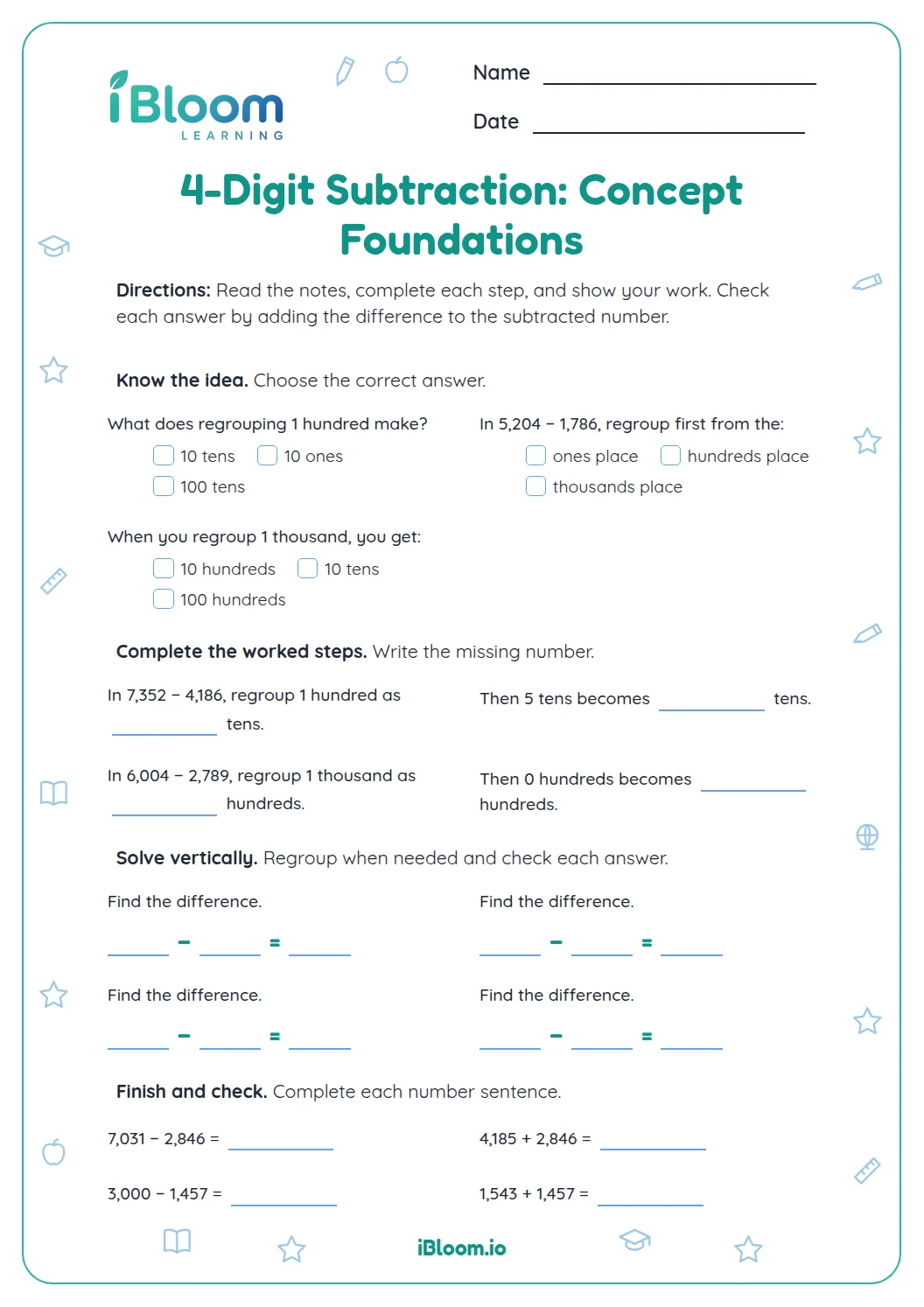
This free printable worksheet is for Grade 4 learners practicing subtracting from 1,000. It builds the named skill with focused questions, a short worked example, and a separate answer key. Children read each direction, try the item, and use the key to review their thinking. The worksheet aligns with 4.NBT.B.4: Fluently add and subtract multi-digit whole numbers using the standard algorithm.
Aligned to 4.NBT.B.4
How do you subtract from 1,000?
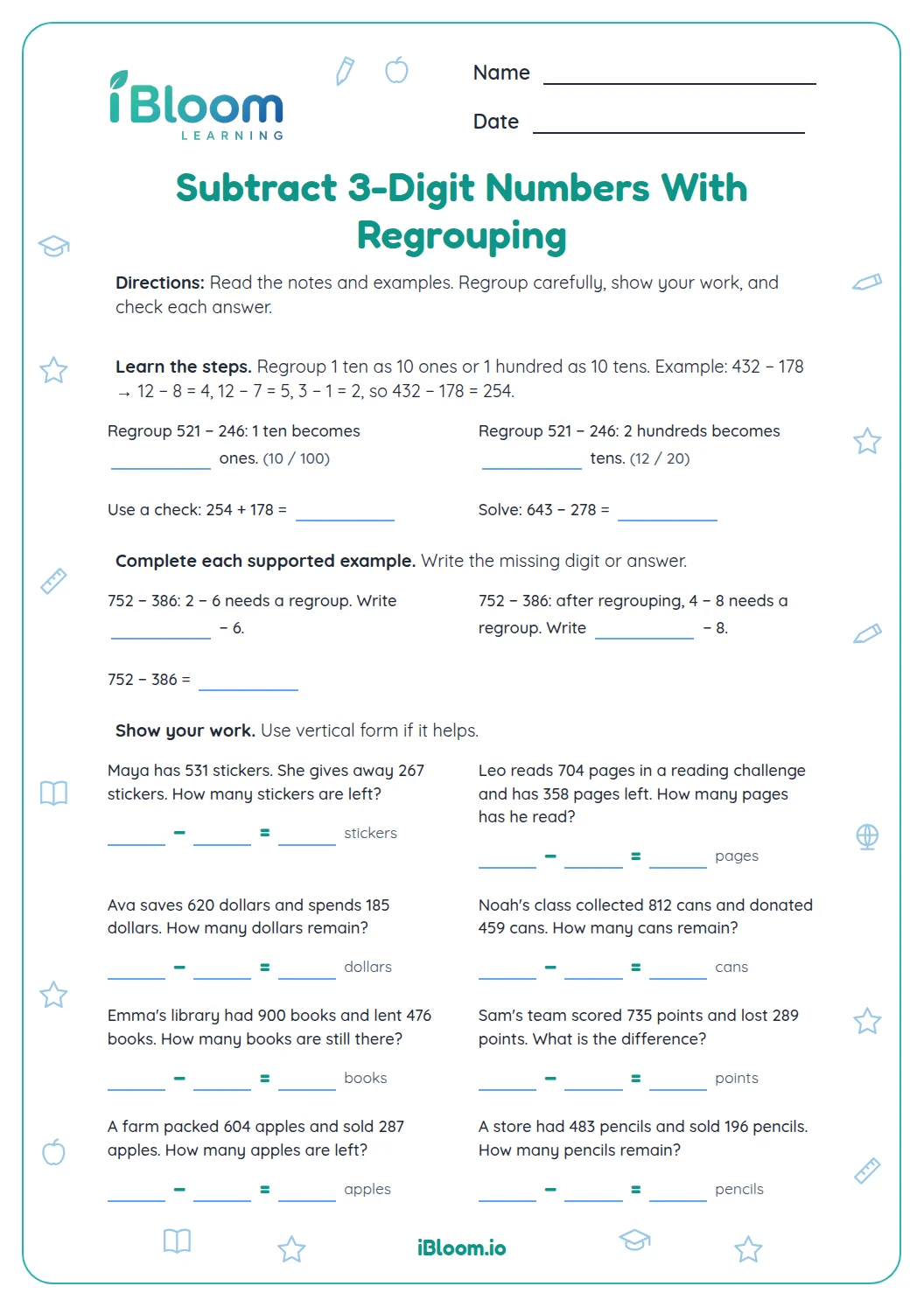
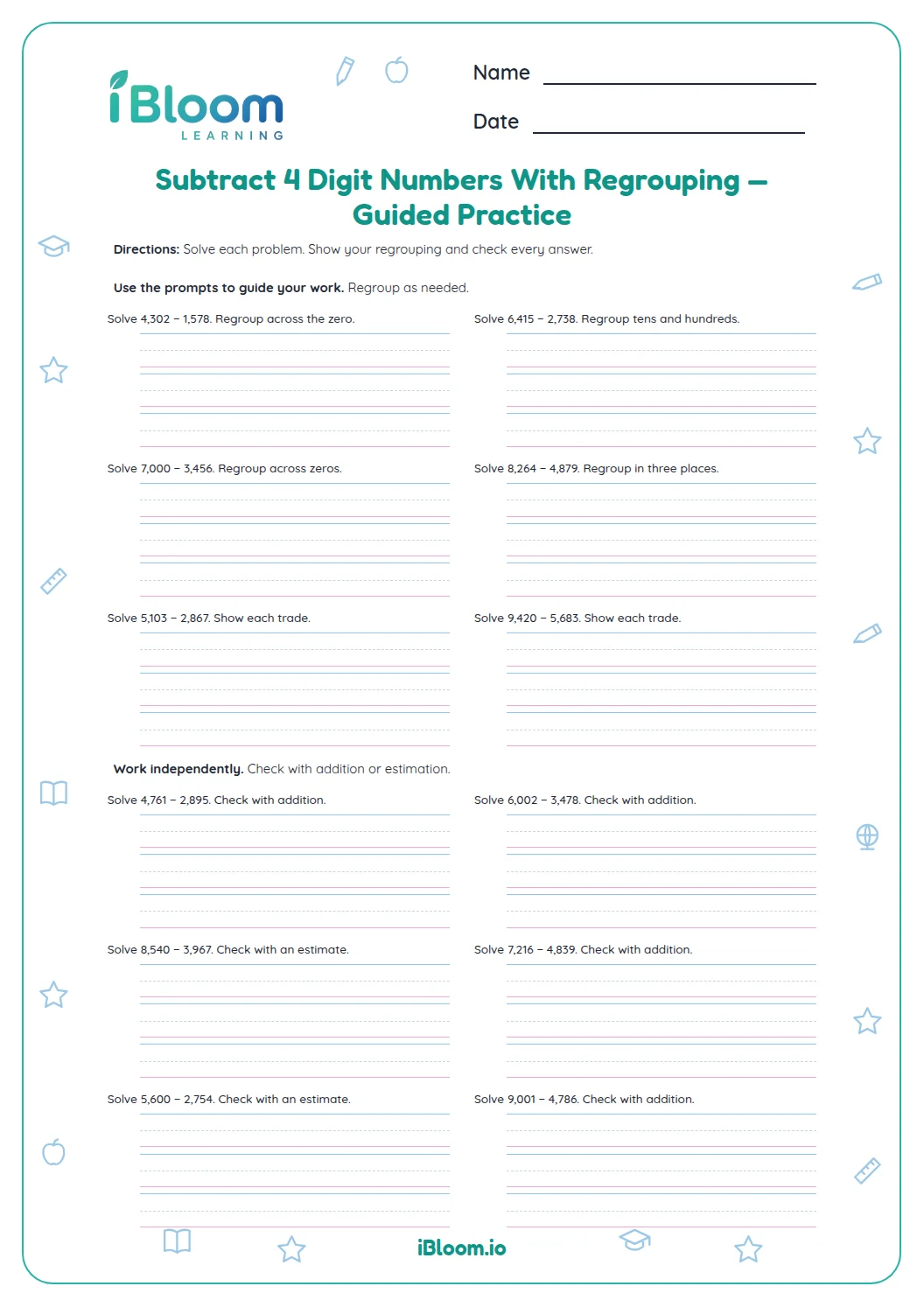
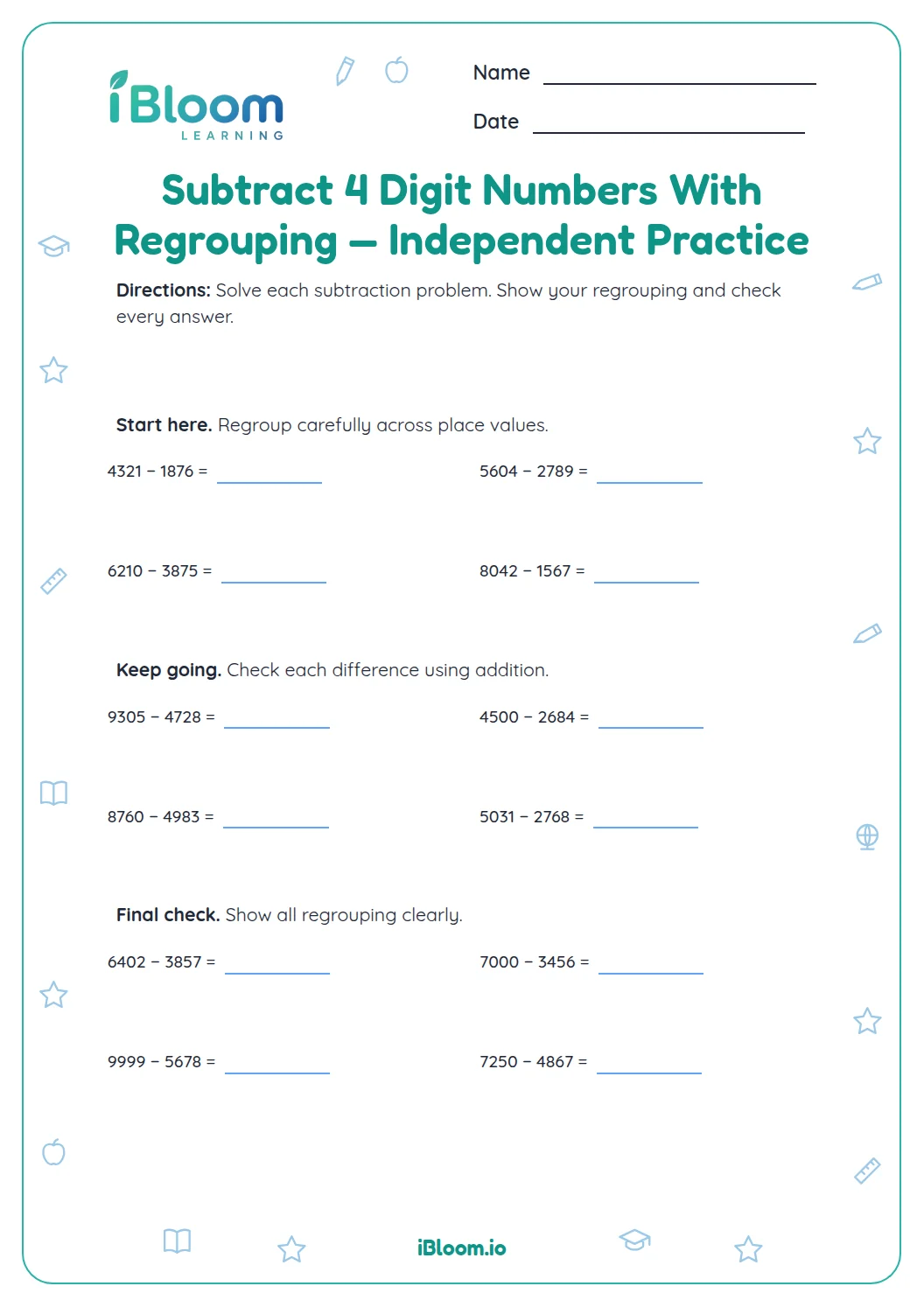
Line up the digits by place value. When a column has too few units to subtract, trade from the next place and keep the value equal. Starting with 1,000 can require trades across zero digits.
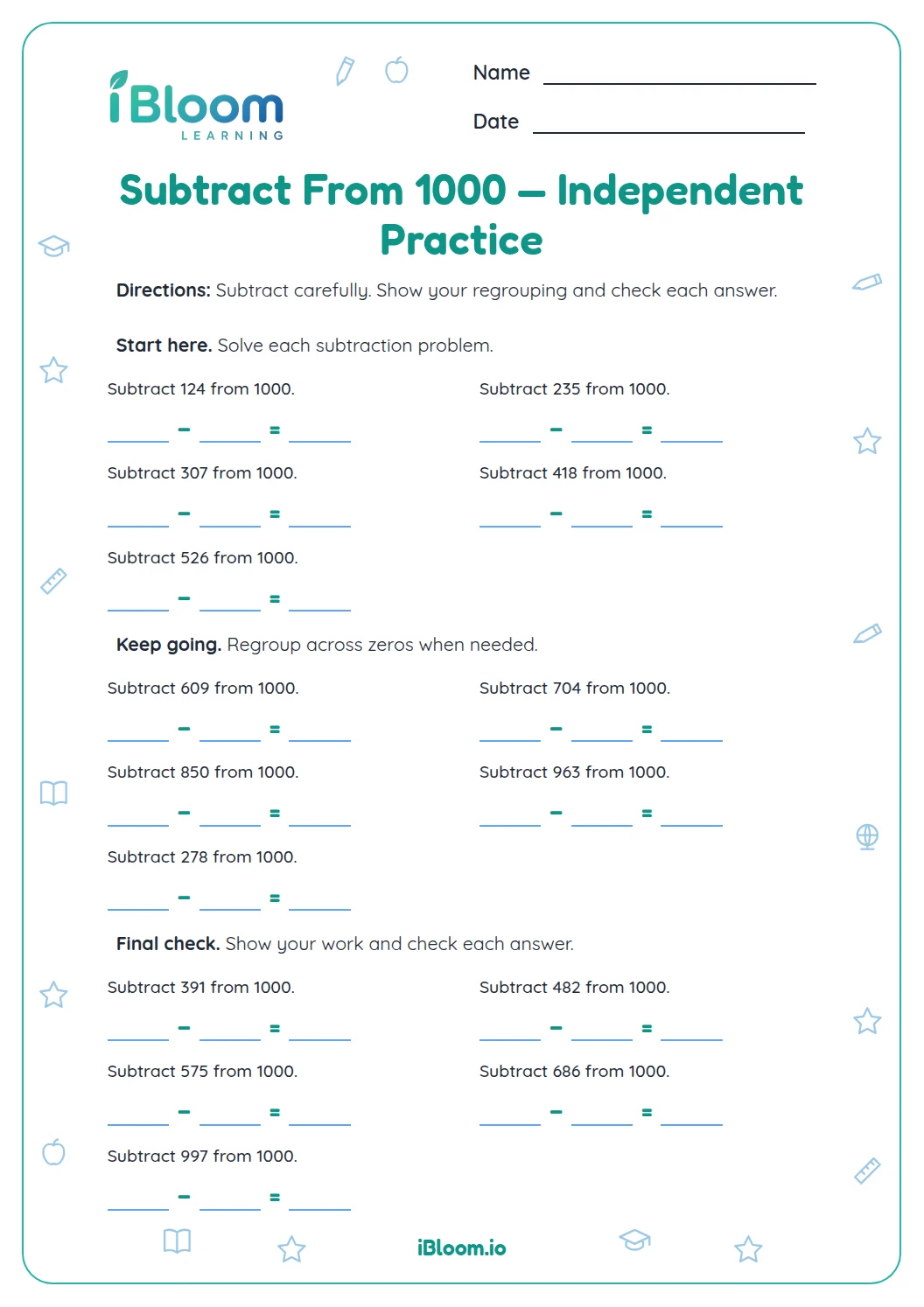
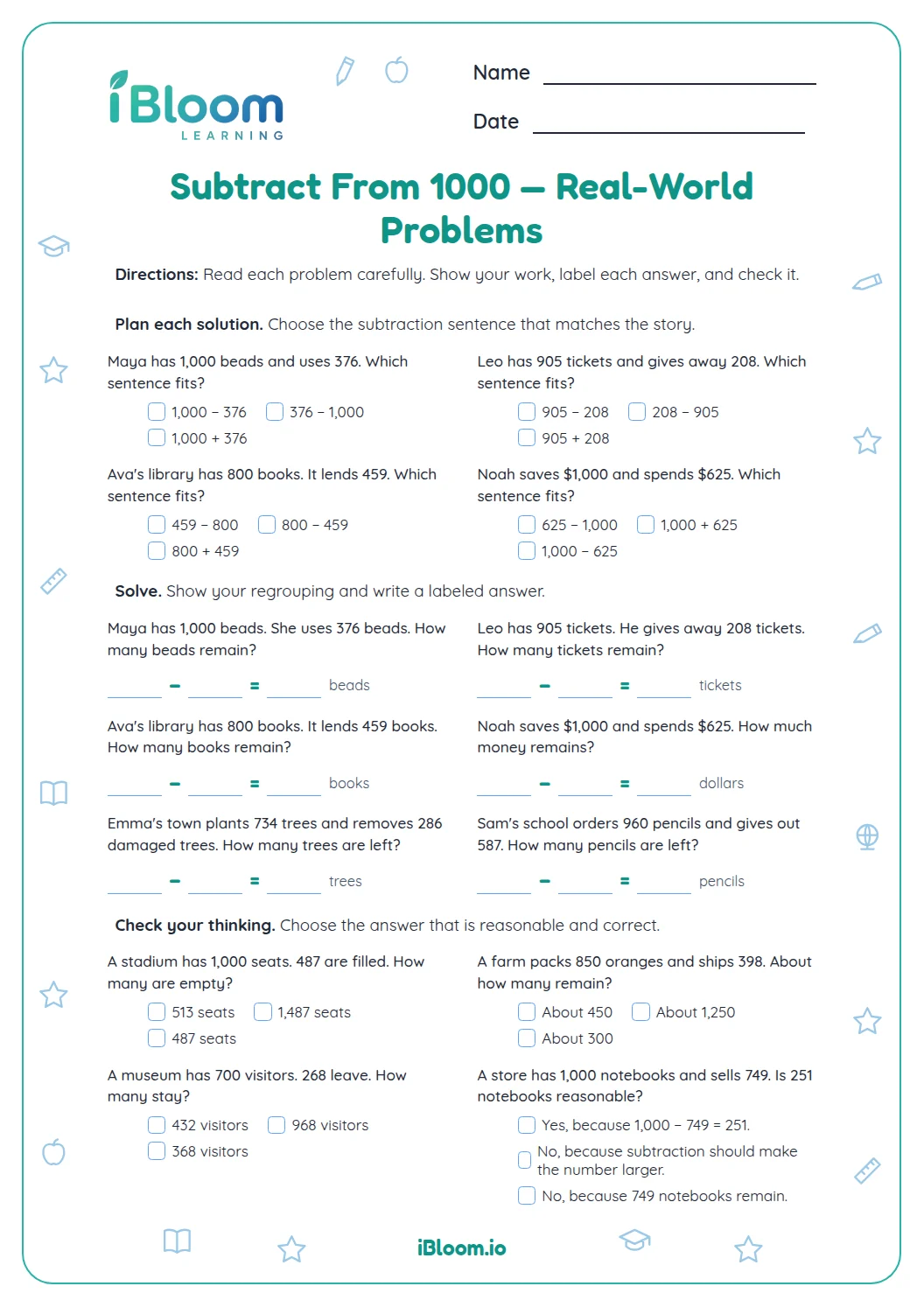
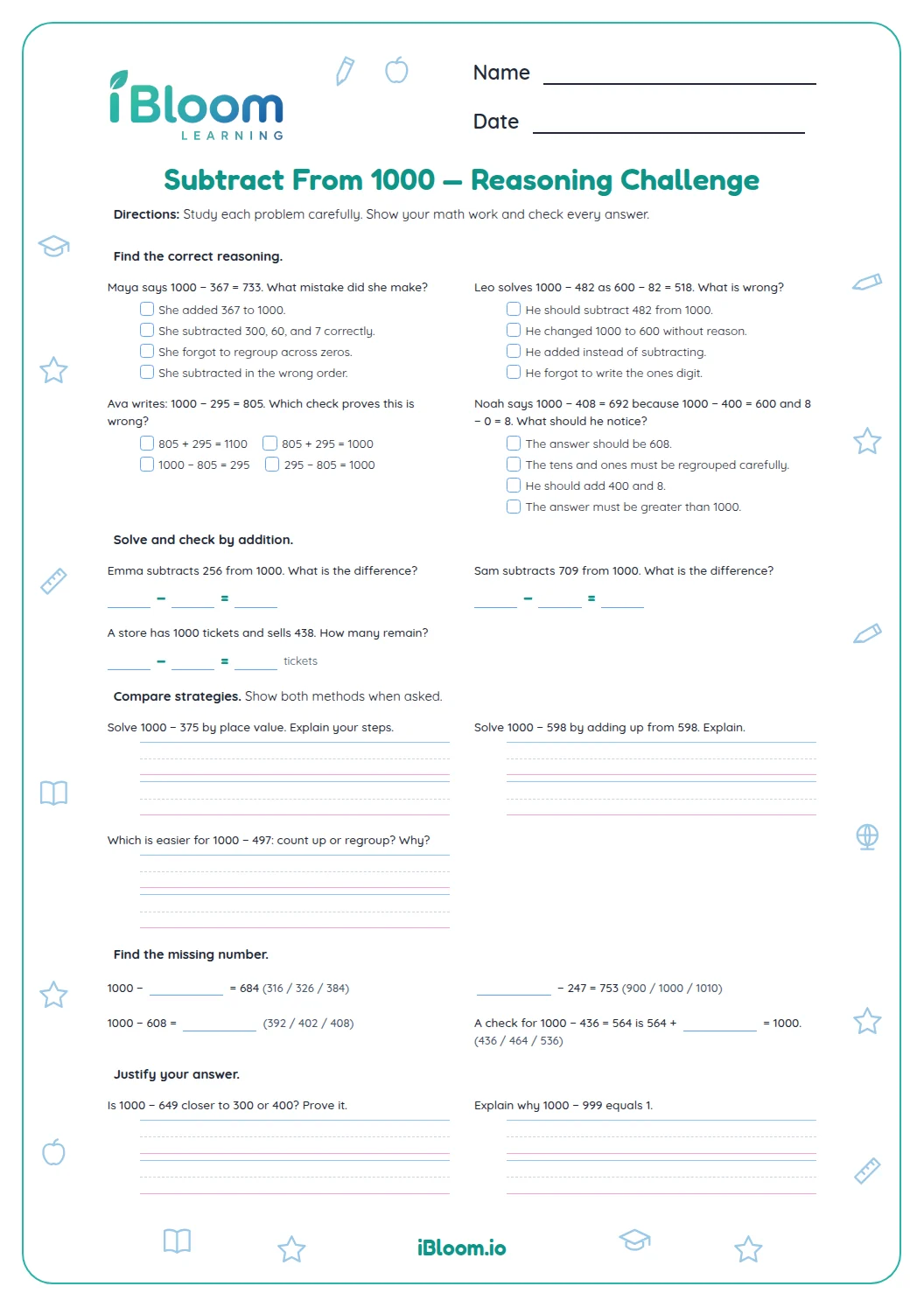
The worksheet includes direct differences, missing numbers, and two situations with 1,000 as the starting amount.
How can regrouping across zeroes work?
Trade one thousand for ten hundreds, then trade a hundred for ten tens and a ten for ten ones when needed. Subtract from right to left and check by addition.
- 11,000 − 263
- 2Regroup 1 thousand as 10 hundreds; trade as needed.
- 31,000 − 263 = 737
- 4Check: 737 + 263 = 1,000.
What kinds of subtraction are included?
Part A practices twelve subtraction differences. Part B completes four missing-number equations. Part C uses two short word problems, each beginning with 1,000.
How to use this worksheet
- 1Read the instruction for the current part before starting.
- 2Complete one question at a time and mark the clue or step that supports the answer.
- 3For a written response, use a complete sentence and include the important detail.
- 4Pause after each part to review any uncertain items.
- 5Check the separate key and explain one answer in your own words.
Common mistakes and quick fixes
The mistake
Answering from a single familiar word or detail without rereading the whole prompt.
The fix
Read the full sentence or situation again and point to the clue that supports the answer.
The mistake
Choosing an answer that is related to the topic but does not answer the question.
The fix
Restate the question in your own words before choosing or writing.
The mistake
Stopping after a first thought when the item asks for evidence or a reason.
The fix
Add the detail or step that makes the response clear.
Curriculum alignment
This worksheet practices the named grade-level skill through explicit questions and answer checking.
Fluently add and subtract multi-digit whole numbers using the standard algorithm.
On this sheet: Students subtract multi-digit whole numbers, including regrouping across zeros, and check results.
Show the official wordingHide the official wording
Fluently add and subtract multi-digit whole numbers using the standard algorithm.
What to practice next
Make more practice
Further reading
Questions parents and teachers ask
What skill does this subtracting from 1,000 worksheet practice?
When a place has too few units to subtract, regrouping moves value from a larger place. Subtracting from 1,000 can require trades across zeroes, so keeping the place values aligned helps. The examples include several three-digit subtrahends and story problems.
How many questions are on the printable?
There are 18 questions: 16 subtraction equations and two word problems. The equations include regrouping from 1,000 and missing values; the final problems ask how many items remain. Children can check each difference with addition, then confirm that the total matches the starting amount.
Is an answer key included?
Yes. The answer key shows the expected value for all 18 items. For each subtraction equation, add the difference to the subtrahend; the sum should equal the starting number. The word-problem answers keep the units named in their questions.
How long should this worksheet take?
Allow about 20 to 25 minutes to work through the calculations and check the answers. A child may need a little longer when regrouping across zeroes. Encourage a clear written setup and one inverse-operation check before moving to the next part.
How can I support a child who gets stuck?
Add the difference to the number that was subtracted. For example, 742 − 358 = 384 can be checked with 384 + 358 = 742. Estimating first also helps a child notice an answer that is far too large or small.