


About this worksheet
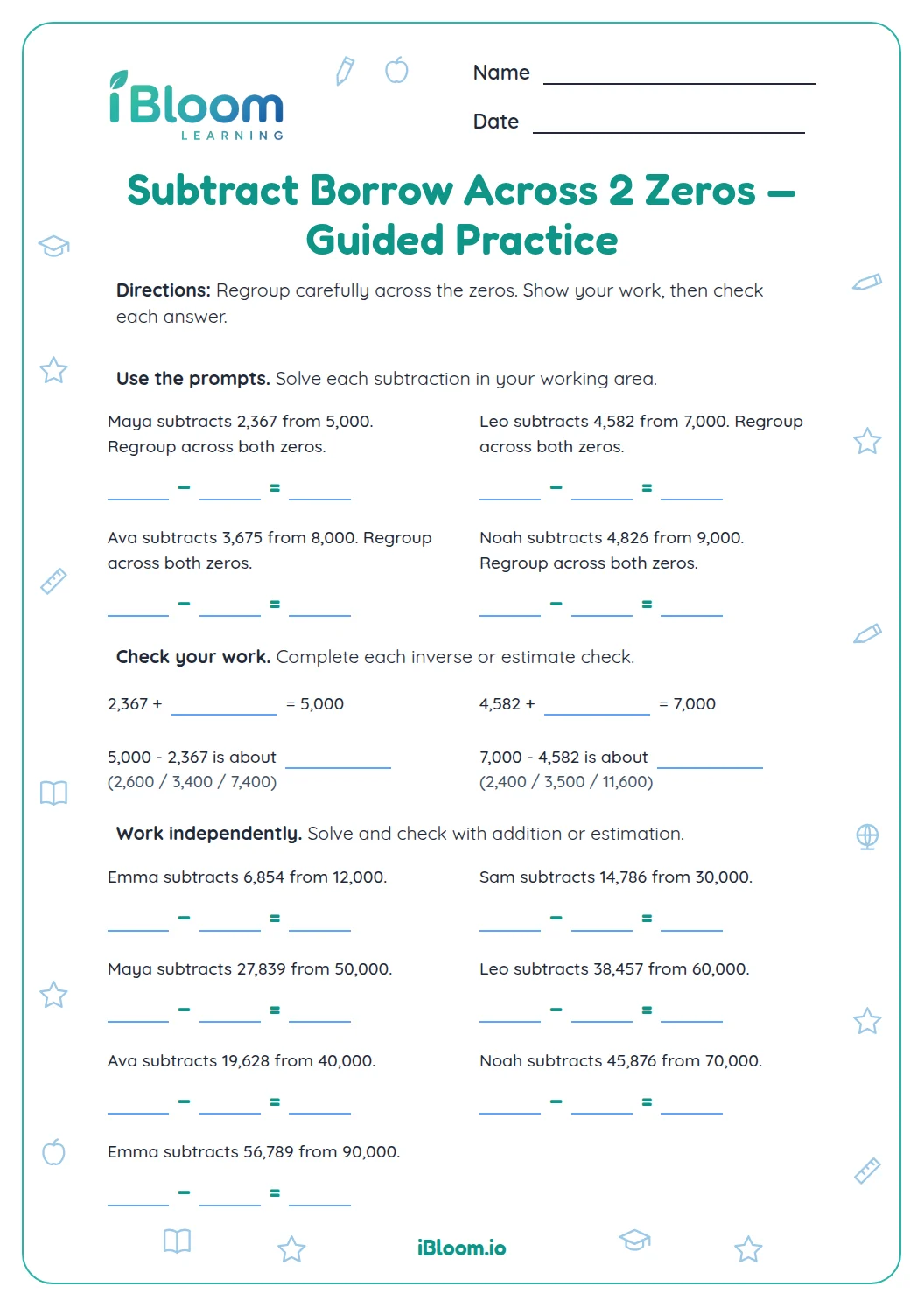
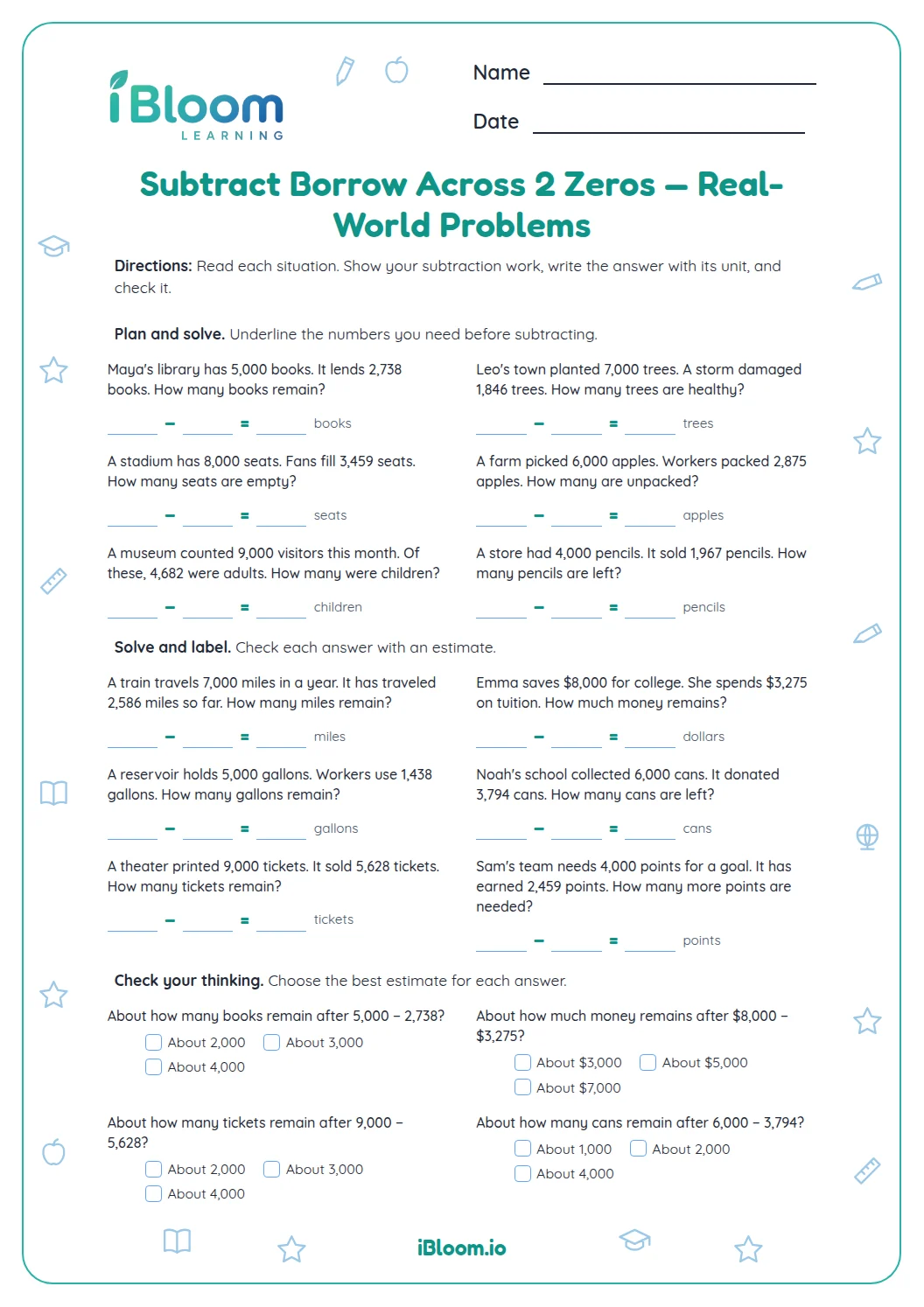
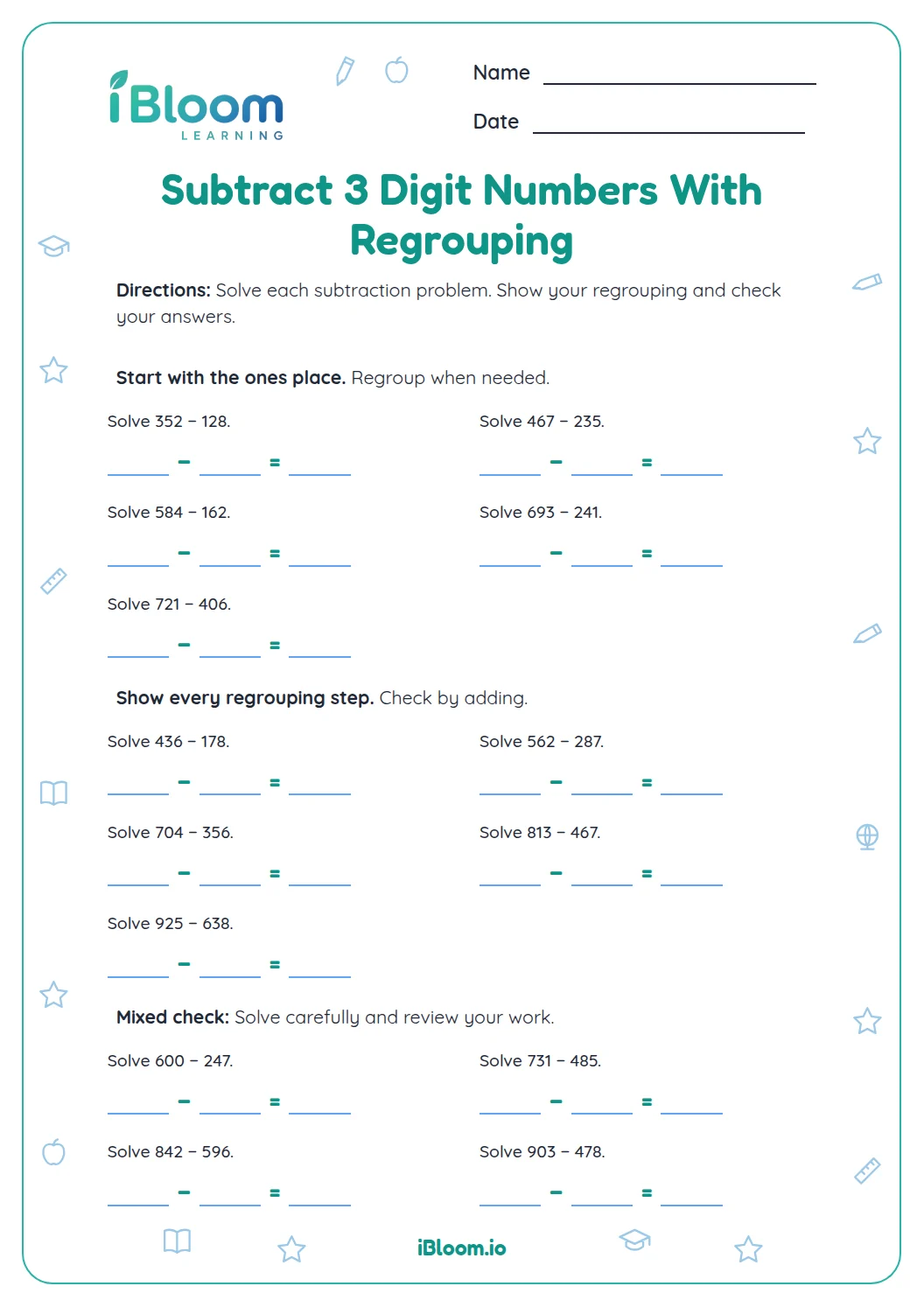
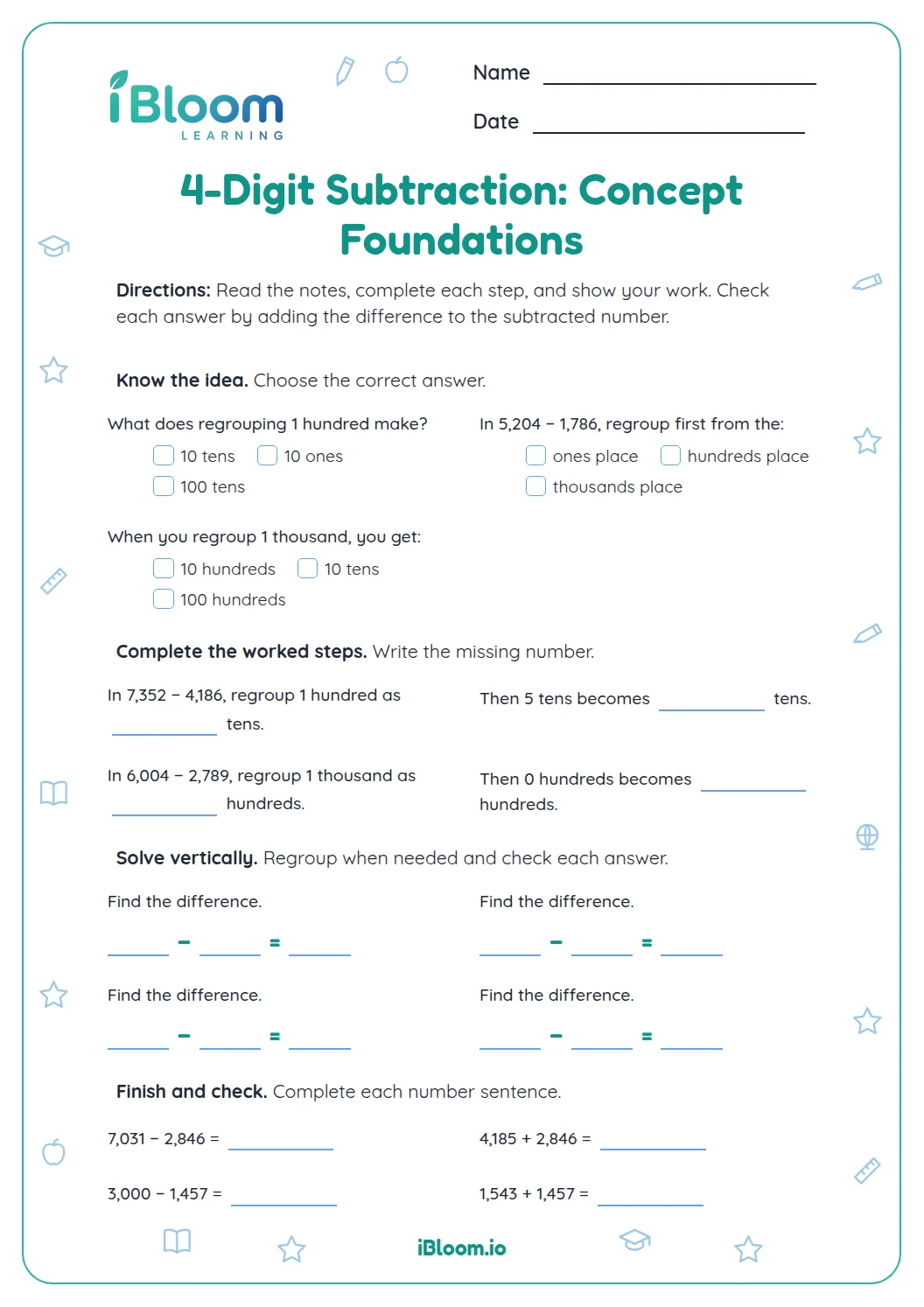
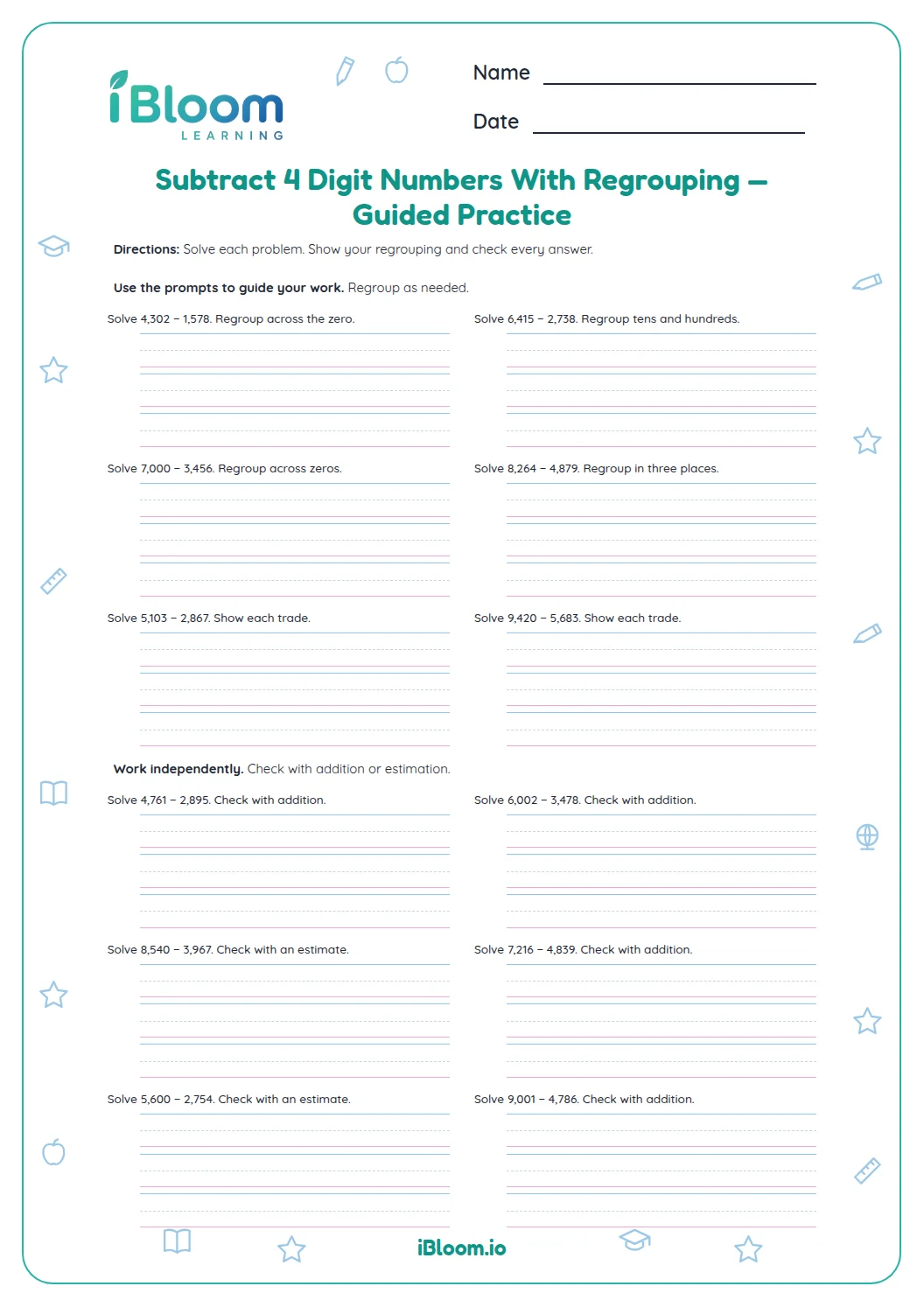
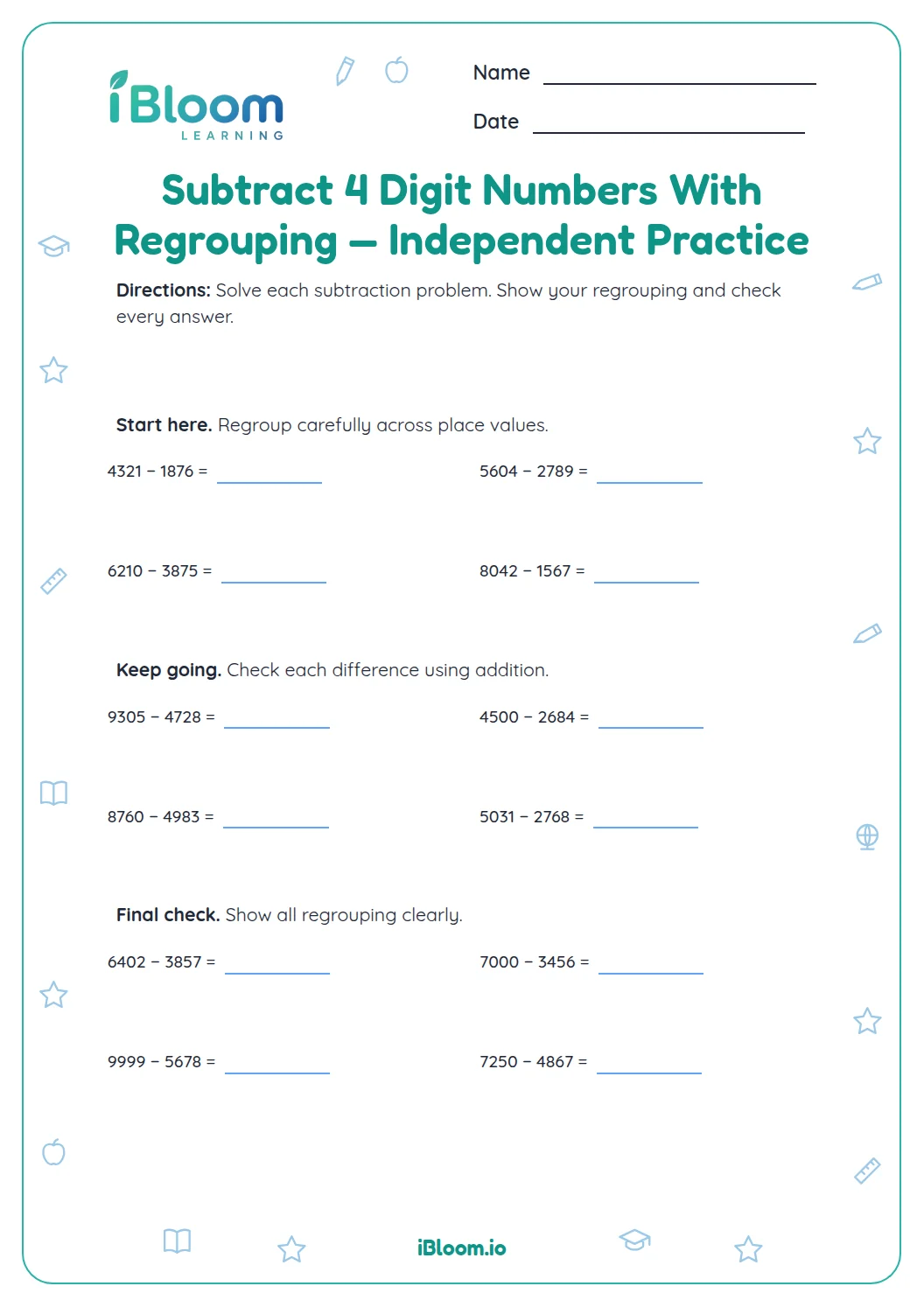
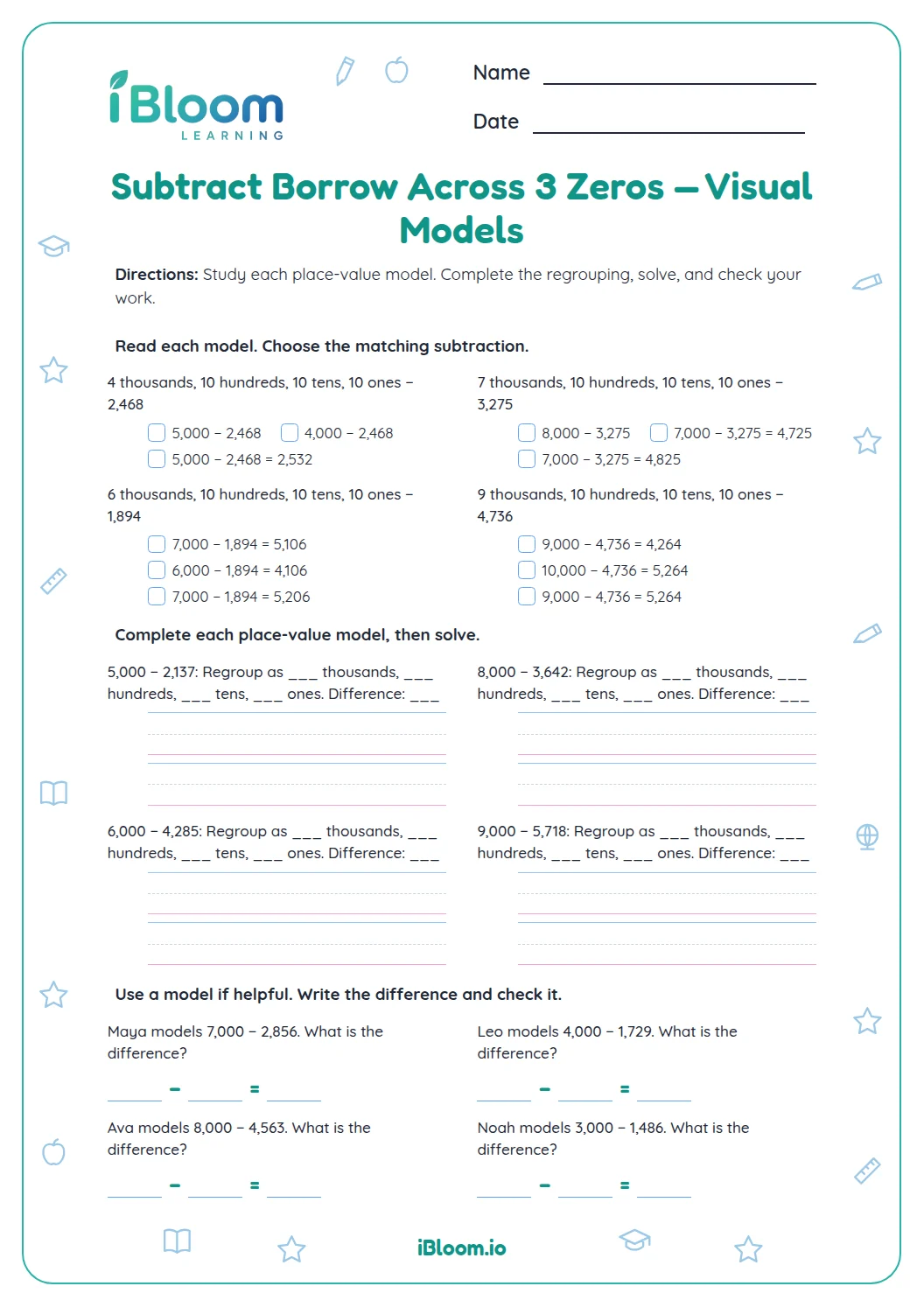
This Grade 4 worksheet gives children 16 problems subtracting across two zero places. First, they use base-ten models to choose a regrouping, then find missing subtrahends and solve subtraction problems from hundreds through thousands. The separate answer key shows the regrouped place values and differences.
Aligned to 4.NBT.B.4
How can you regroup across two zeros?
The model shows 500. Rename one hundred as ten tens, then trade one ten for ten ones: 500 becomes 4 hundreds, 9 tens, and 10 ones. This makes each column ready for 500 − 276.
- 1500 − 276
- 2500 = 4 hundreds, 9 tens, 10 ones
- 3500 − 276 = 224
How can a missing subtrahend be found?
If 500 − ___ = 276, find the amount that must be taken from 500 to leave 276. The missing number is 224 because 276 + 224 = 500.
How can addition check the difference?
Add the difference and the number subtracted. Their sum should return to the starting number. This check can reveal a missed regrouping or a place-value error.
How to use this worksheet
- 1Read the model and identify the number it represents.
- 2For questions 1–4, choose the regrouped hundreds, tens, and ones that allow subtraction.
- 3Find the missing subtrahend in questions 5–8 by adding the difference to it.
- 4Subtract from ones to hundreds in questions 9–16, regrouping across zeros as needed.
- 5Add each difference to its subtrahend to check the starting number.
Common mistakes and quick fixes
The mistake
Subtracting each column without regrouping
The fix
Trade from the next nonzero place and rename both places.
The mistake
Forgetting to reduce the place you borrowed from
The fix
Cross out the original digit and write the digit one less.
The mistake
Writing digits in the wrong place
The fix
Keep ones, tens, hundreds, and thousands in aligned columns.
Common Core alignment
This worksheet gives focused practice with the standard below.
Use the standard algorithm to subtract multi-digit whole numbers.
On this sheet: The practice uses the standard algorithm on multi-digit subtraction.
Show the official wordingHide the official wording
Fluently add and subtract multi-digit whole numbers using the standard algorithm.
What to practice next
Make more practice
Further reading
Questions parents and teachers ask
What does regrouping across two zeros mean?
It means trading from the next nonzero place across two zero places. In 500 − 276, rename 500 as 4 hundreds, 9 tens, and 10 ones. Then each place can be subtracted: 10 − 6 ones, 9 − 7 tens, and 4 − 2 hundreds.
How do the base-ten models help?
The first four drawings show the starting hundreds as base-ten blocks. Children choose a regrouped form that keeps the same value and makes the ones and tens available for subtraction. The later questions apply the same trading idea to written problems.
How many questions are included?
There are 16 questions in three parts: four model-based regrouping choices, four missing-subtrahend equations, and eight subtraction calculations. Problems range from hundreds to thousands, and the answer key lists the regrouped values and numerical differences. Each stage reinforces the same place-value trade.
How can I check a subtraction answer?
Add the difference to the amount subtracted. For example, 500 − 276 = 224 is checked by 224 + 276 = 500. If the sum misses the starting number, revisit the place where a hundred or ten was traded.
Is an answer key included?
Yes. The separate key gives the correct regrouping for each model, the missing subtrahends, and the differences. It can help an adult see whether a child made a place-value trade correctly as well as whether the final subtraction is accurate.