


About this worksheet
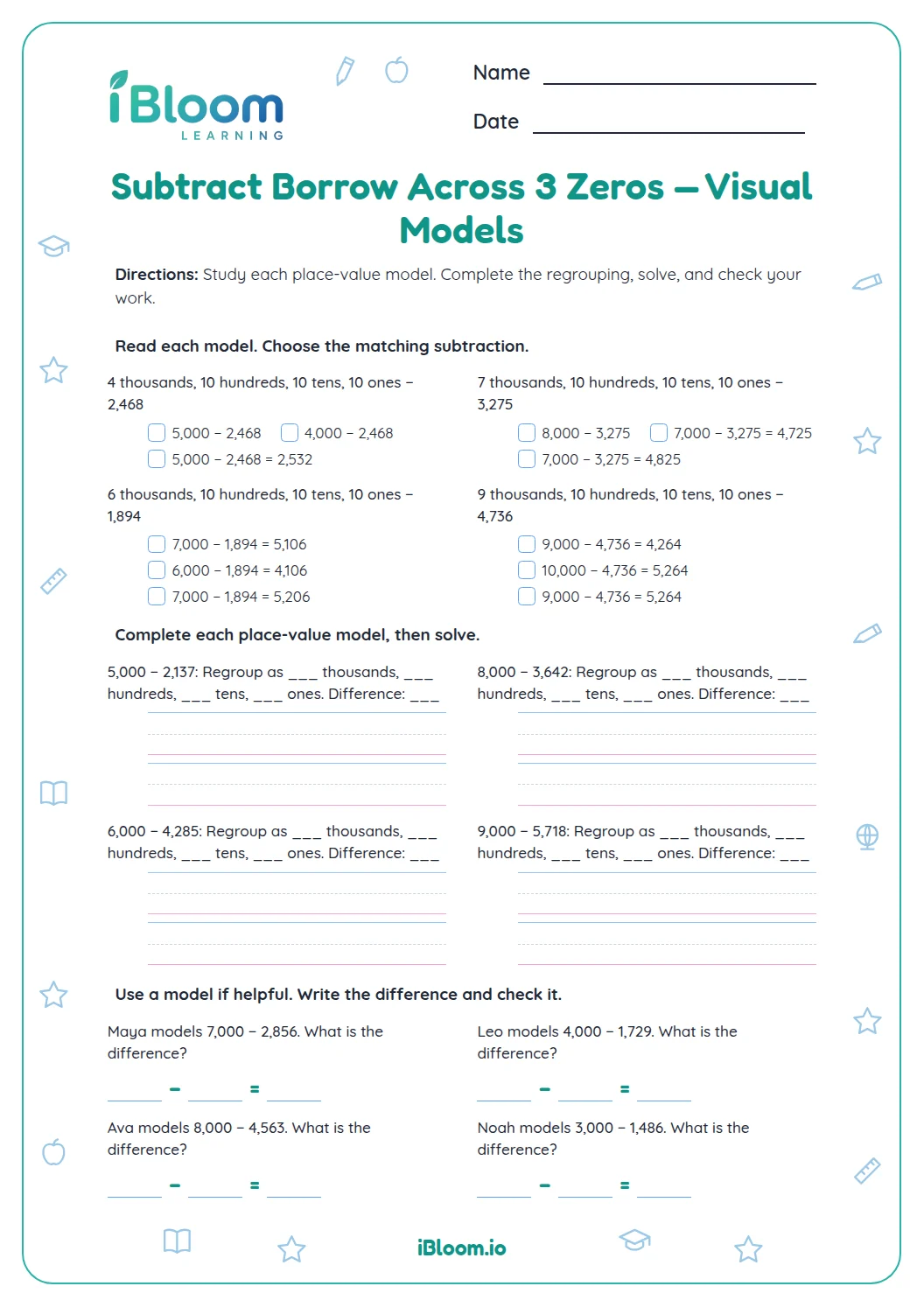
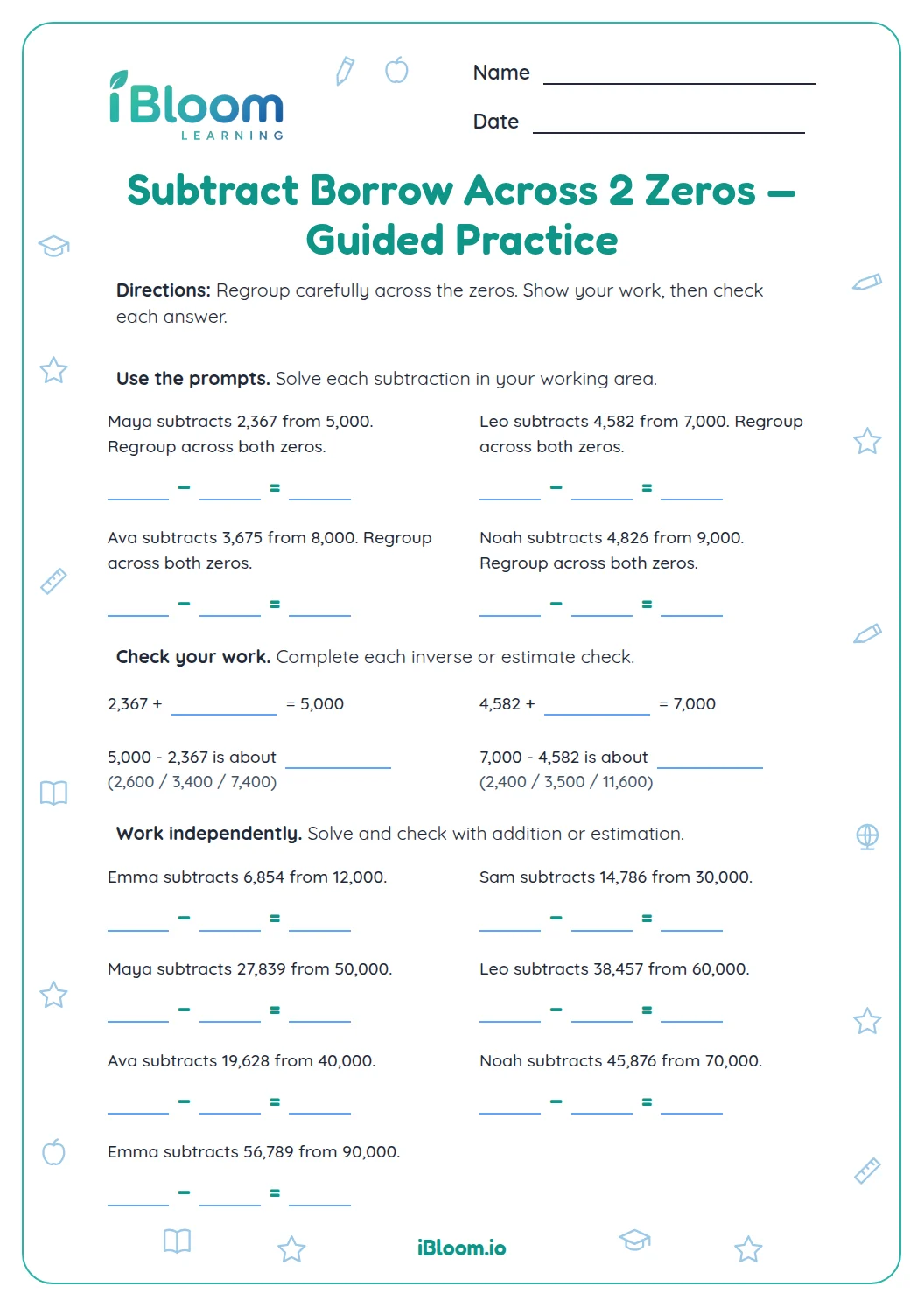
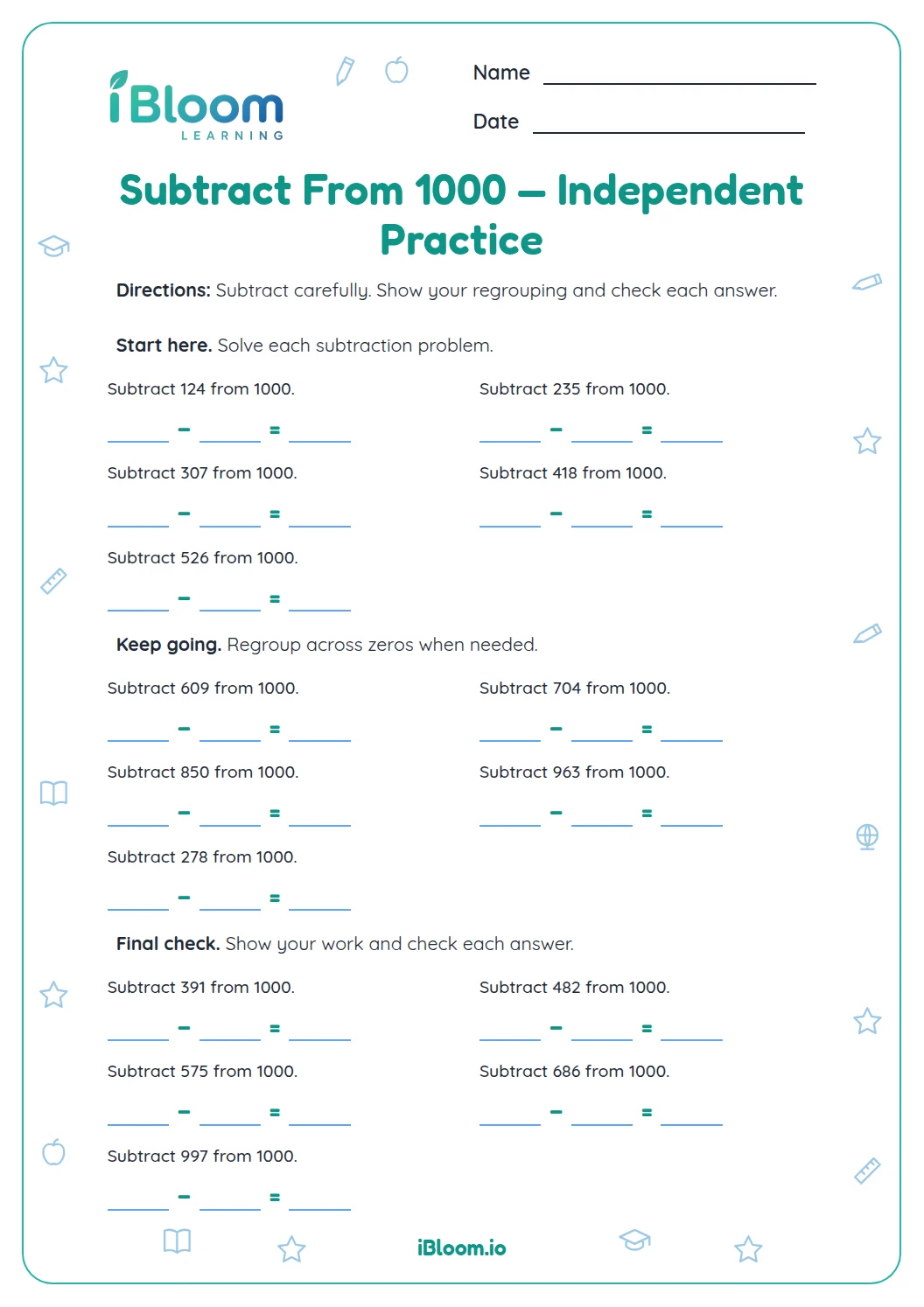
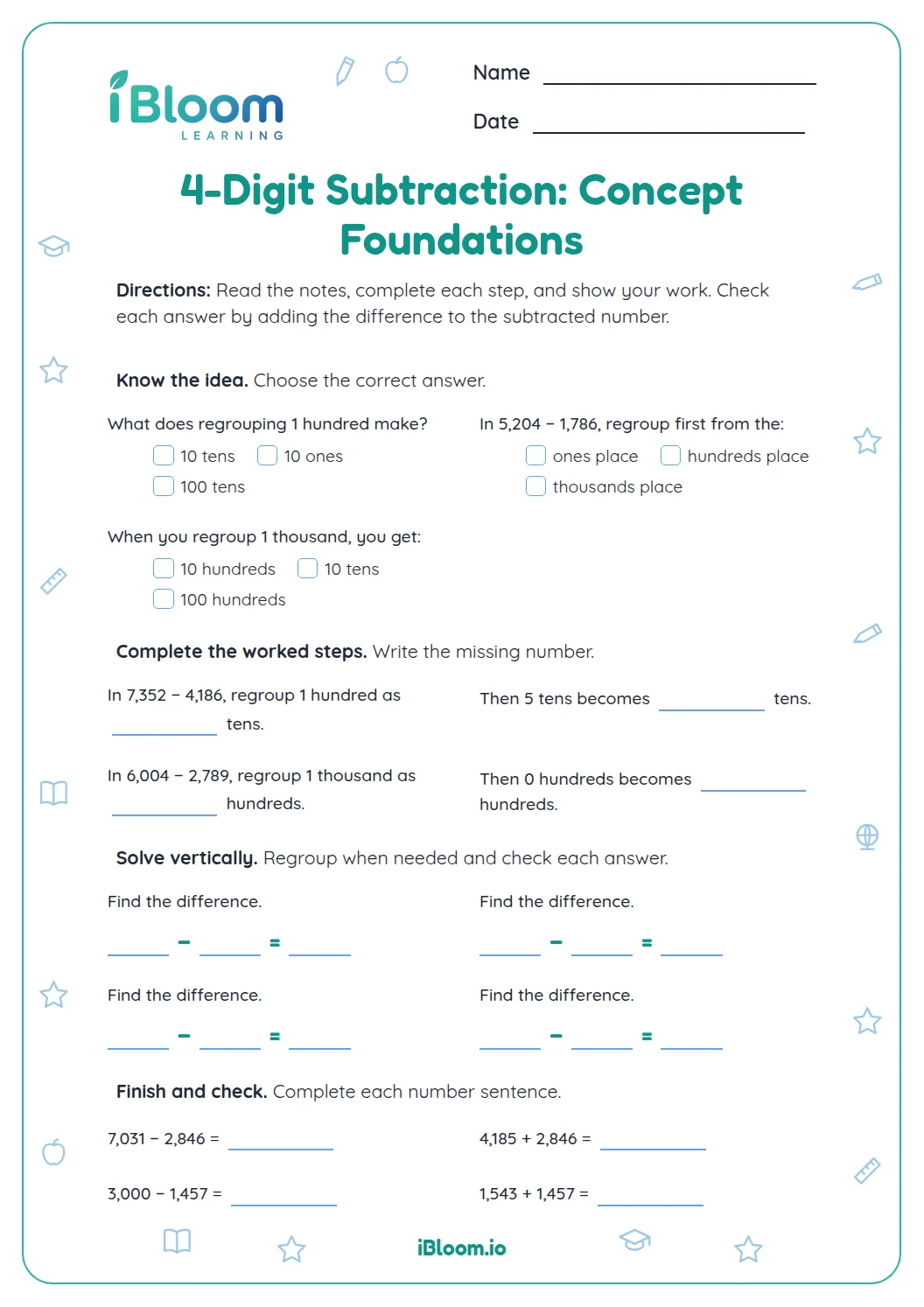
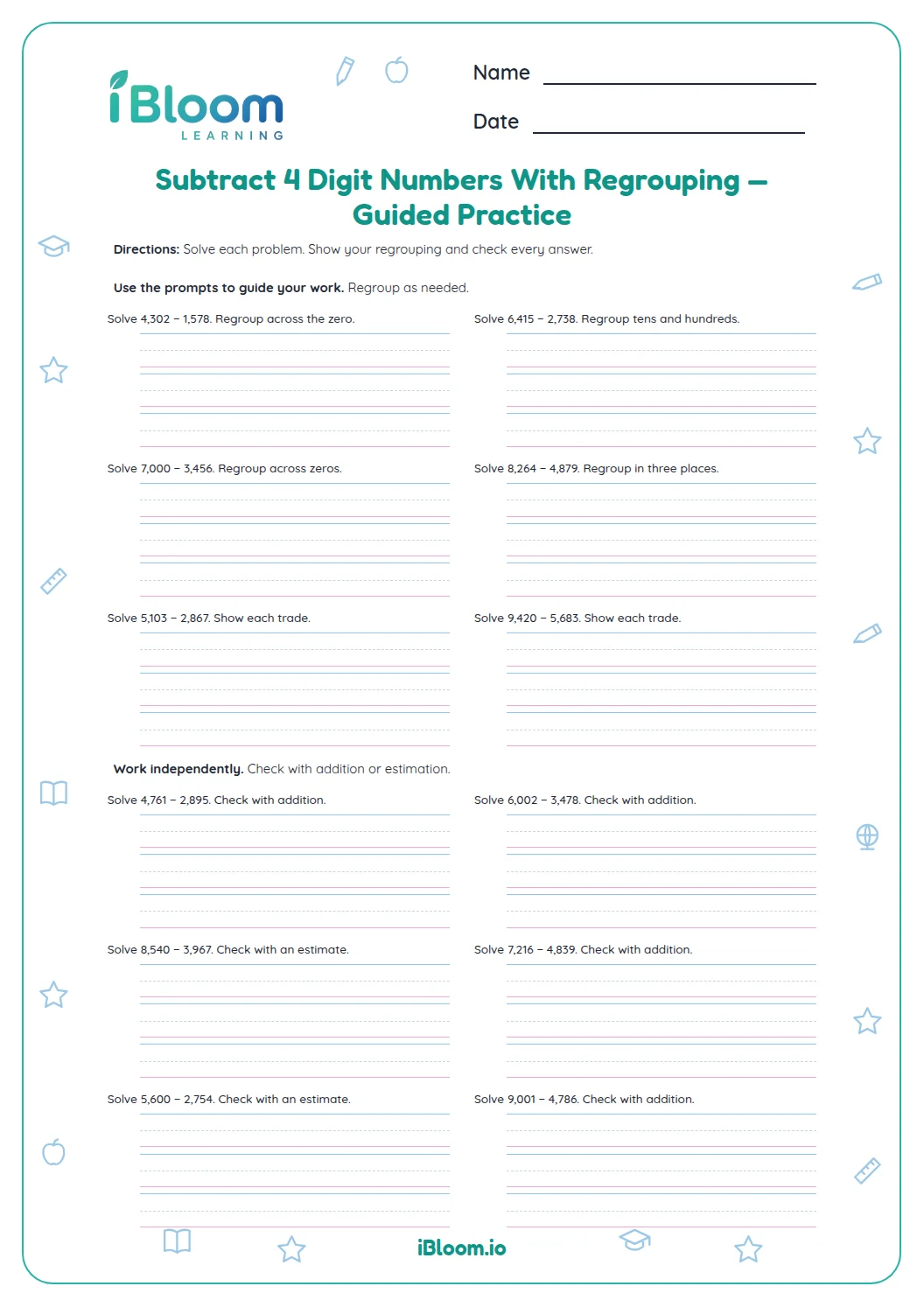
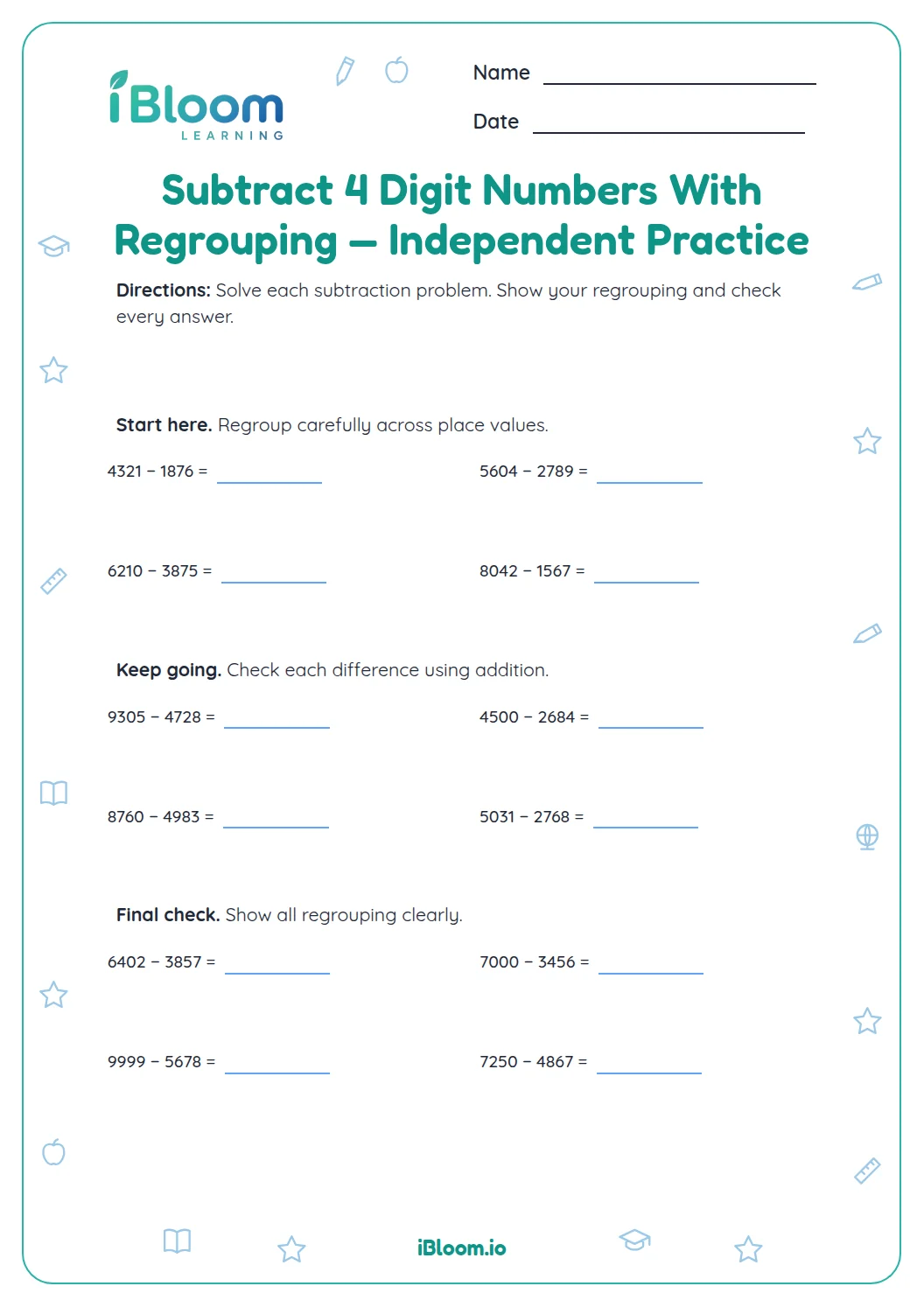
This Grade 4 printable gives students 16 subtraction problems with a thousands number or 10,000 as the minuend. Each problem requires regrouping across zero places, including cases that cross three zeros. The separate answer key lists all differences. Students can line up place values and show each regrouping step as they work.
Aligned to 4.NBT.B.4
How do you subtract across three zeros?
Regroup from the first nonzero place to the left, passing value through each zero until the ones place has enough to subtract. Keep the digits in their place-value columns as you rename the number.
- 14,000 − 1,765
- 2Regroup as 3 thousands, 9 hundreds, 9 tens, and 10 ones.
- 310 − 5 = 5; 9 − 6 = 3; 9 − 7 = 2; 3 − 1 = 2.
- 4Answer: 2,235
What do the three parts practice?
Part A starts with thousands minus four-digit numbers. Part B continues with regrouping through zeros, including a five-digit minuend. Part C provides a final set of differences to solve independently. All 16 items use subtraction.
How can students check a difference?
Add the difference to the number being subtracted. The sum should match the starting number. For example, check 4,000 − 1,765 by adding 2,235 + 1,765.
How to use this worksheet
- 1Line up each number by place value.
- 2Start regrouping at the first place where the top digit is too small.
- 3Pass value across zero places until the needed place can subtract.
- 4Subtract each column and record the difference.
- 5Add the difference to the subtrahend to check.
Common regrouping mistakes and quick fixes
The mistake
Taking a ten from a zero without regrouping from a nonzero place.
The fix
Move left until you reach a digit that can be renamed, then pass value through each zero.
The mistake
Forgetting that the donor place decreases after regrouping.
The fix
Write the renamed digits above the original columns before subtracting.
The mistake
Subtracting the smaller digit from the larger digit in every column.
The fix
Regroup when the top digit is smaller; then subtract top minus bottom.
Common Core alignment
This worksheet practices multi-digit subtraction using place-value regrouping.
Subtract multi-digit whole numbers using place value and the standard algorithm.
On this sheet: Every item subtracts a multi-digit whole number from a thousands number, regrouping across three zero places.
Show the official wordingHide the official wording
Fluently add and subtract multi-digit whole numbers using the standard algorithm.
What to practice next
Make more practice
Further reading
Questions parents and teachers ask
How do you subtract when the top number has zeros?
Regroup from a nonzero place to the left and pass value through each zero until the needed column has enough to subtract. Every problem practices this move. Keep the renamed digits visible above their columns as you work.
How many subtraction problems are included?
There are 16 problems in three parts on one worksheet page, followed by a separate answer key. They use thousands numbers and 10,000 as starting amounts, with four-digit subtrahends. Every item asks students to find a difference by regrouping.
What is the answer to 4,000 minus 1,765?
The difference is 2,235. Regroup 4,000 as 3 thousands, 9 hundreds, 9 tens, and 10 ones; then subtract 1,765 by place. Adding 2,235 and 1,765 returns 4,000 and checks the result carefully in addition. This check also reinforces the inverse relationship between addition and subtraction.
How can a student check each answer?
Add the difference to the number subtracted. The sum should equal the starting number. For example, 2,235 + 1,765 = 4,000, which checks the first problem and confirms that the regrouping produced the right difference for this example.
Does the worksheet include an answer key?
Yes. A separate key lists the difference for each of the 16 problems. Students can finish a part first, then use the key and addition to check their subtraction. The practice page fits on one sheet page for easy printing.