




About this worksheet
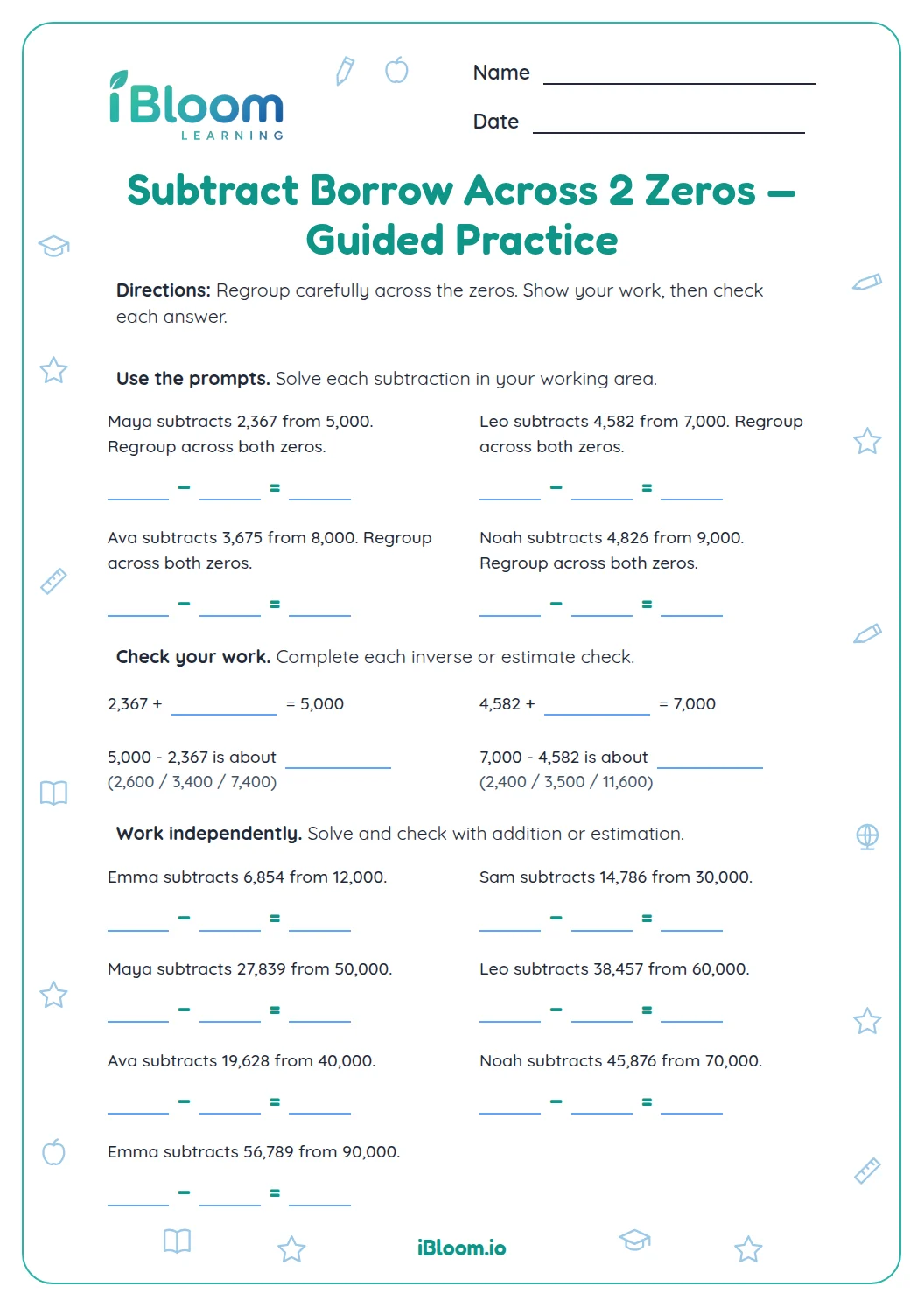
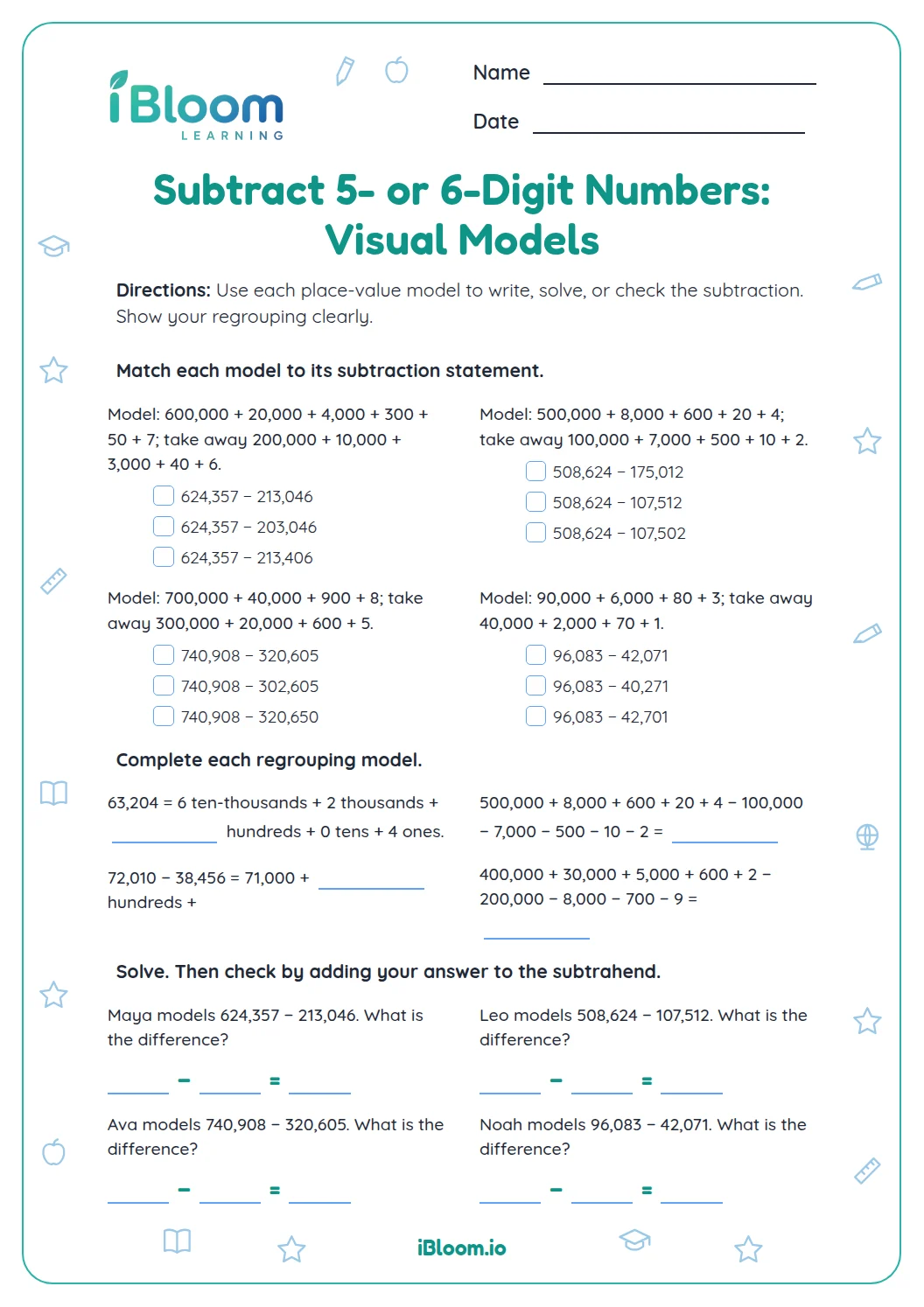
This free printable Grade 4 worksheet practices subtraction across zeros in 14 real-world problems and two answer checks. Students begin with whole thousands, such as 4,000 − 1,786, then apply the same regrouping method to five- and six-digit round numbers. Parts A and B have answer blanks; students use scratch paper to record their calculations. Part C asks students to estimate a difference and choose the reason an answer exceeds half the starting amount. The sheet practices the standard algorithm in CCSS 4.NBT.B.4. A separate key gives every result and both correct choices.
Aligned to 4.NBT.B.4
What happens to the zeros during regrouping?
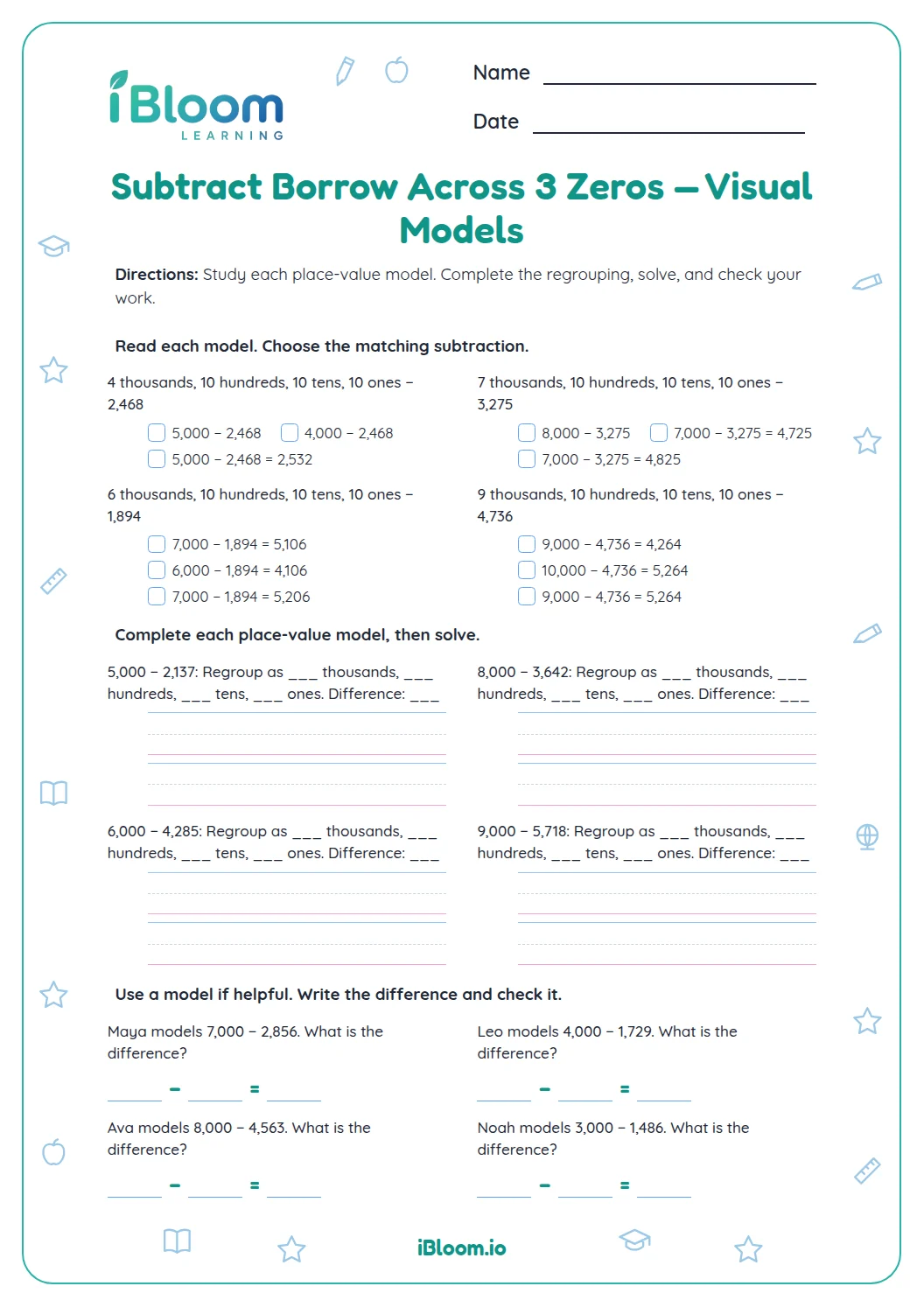
In 4,000 − 1,786, the ones column needs a trade, but both the tens and hundreds columns are zero. Trade one thousand for ten hundreds, one hundred for ten tens, and one ten for ten ones. The hundreds and tens each have nine left after passing a unit onward.
Write each changed value above its column. The last zero becomes ten; a zero column that passes a unit to the next place is left with nine. The renamed values must still total the starting number.
- 14,000 = 3,000 + 900 + 90 + 10
- 24,000 − 1,786 = 2,214 books
- 3Check: 2,214 + 1,786 = 4,000.
What changes as the problems get larger?
Part A has six four-digit starting amounts. Part B moves to four five-digit totals and four six-digit totals. Each problem requires a trade through a run of zeros, so students reuse the same place-value method.
The stories ask what remains, how two totals differ, or how much is still needed. Read the question before choosing the subtraction, then use the printed unit to check what the answer represents.
How can students check their differences?
Add the difference to the amount subtracted. For question 1, 2,214 + 1,786 = 4,000 checks the exact answer. An estimate checks its approximate size.
Question 15 rounds 23,468 to 20,000, giving an estimate of 30,000 for question 7. Question 16 uses a different check: Emma spends less than half of 100,000 dollars, so she must have more than half left.
How to use this worksheet
- 1Identify the starting total and the amount removed in question 1.
- 2Stack 4,000 above 1,786 on scratch paper, lining up matching place values.
- 3Record the trades through the zeros, then subtract from right to left.
- 4Repeat the regrouping process in Parts A and B, filling each answer blank.
- 5Choose the estimate and reason in Part C, then compare with the key.
Mistakes to notice and fix
The mistake
Leaving a middle column as 10 after passing a unit to the right.
The fix
Change that 10 to 9 when it gives one unit to the next column.
The mistake
Leaving 9 in the ones column after regrouping from a whole thousand.
The fix
The ones receive 10 and pass nothing onward. For 4,000, use 3 thousands, 9 hundreds, 9 tens, and 10 ones.
The mistake
Subtracting the smaller digit from the larger digit in each column.
The fix
Keep the order of the two numbers fixed. Rename the top number whenever its digit is too small.
Common Core alignment
Use the standard algorithm to subtract from whole thousands and larger round numbers.
On this sheet: Fourteen stories require multi-digit subtraction with regrouping through consecutive zeros.
Show the official wordingHide the official wording
Fluently add and subtract multi-digit whole numbers using the standard algorithm.
What to practice next
Make more practice
Further reading
Questions parents and teachers ask
What kinds of zero chains are on this sheet?
The sheet starts with numbers ending in three zeros, such as 4,000, and then uses larger round numbers such as 50,000 and 600,000. Every story requires regrouping through zeros. Students practice the same sequence of trades while the starting amounts grow from four to six digits.
What is the answer to the library problem?
The library has 2,214 books left after lending 1,786 of its 4,000 books. Rename 4,000 as 3 thousands, 9 hundreds, 9 tens, and 10 ones before subtracting. Adding the difference, 2,214, to the books lent, 1,786, returns the starting total of 4,000.
Will students need scratch paper?
Yes, keep scratch paper beside the worksheet for all fourteen story calculations. Each story provides an answer blank followed by its unit. Students should stack the two numbers, record each regrouping step, and subtract before copying the difference into the blank. Part C provides two multiple-choice checking questions.
What do the two checking questions ask students to do?
Question 15 asks for an estimate of 50,000 − 23,468 using rounding to the nearest ten thousand. Question 16 asks why spending 46,875 of 100,000 dollars leaves more than 50,000 dollars. Children choose an estimate and a reason that help check the size of those answers.
How can I help my child keep track of the trades?
Have your child cross out and replace each place value as soon as a trade happens. For 4,000, say that one thousand becomes ten hundreds, then pass one hundred onward. Finish the chain before subtracting, and add the renamed values to confirm they still total 4,000.