




About this worksheet
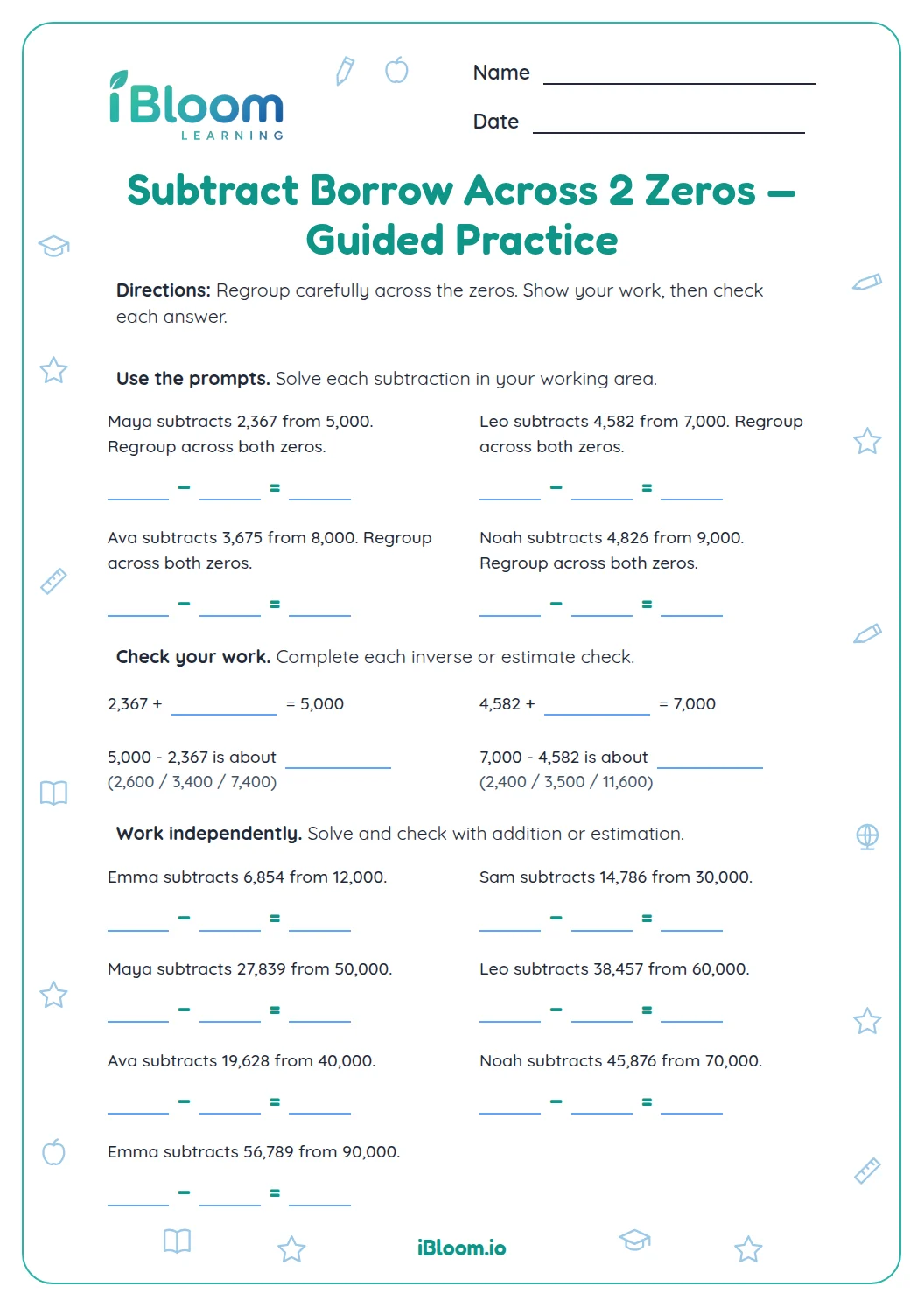
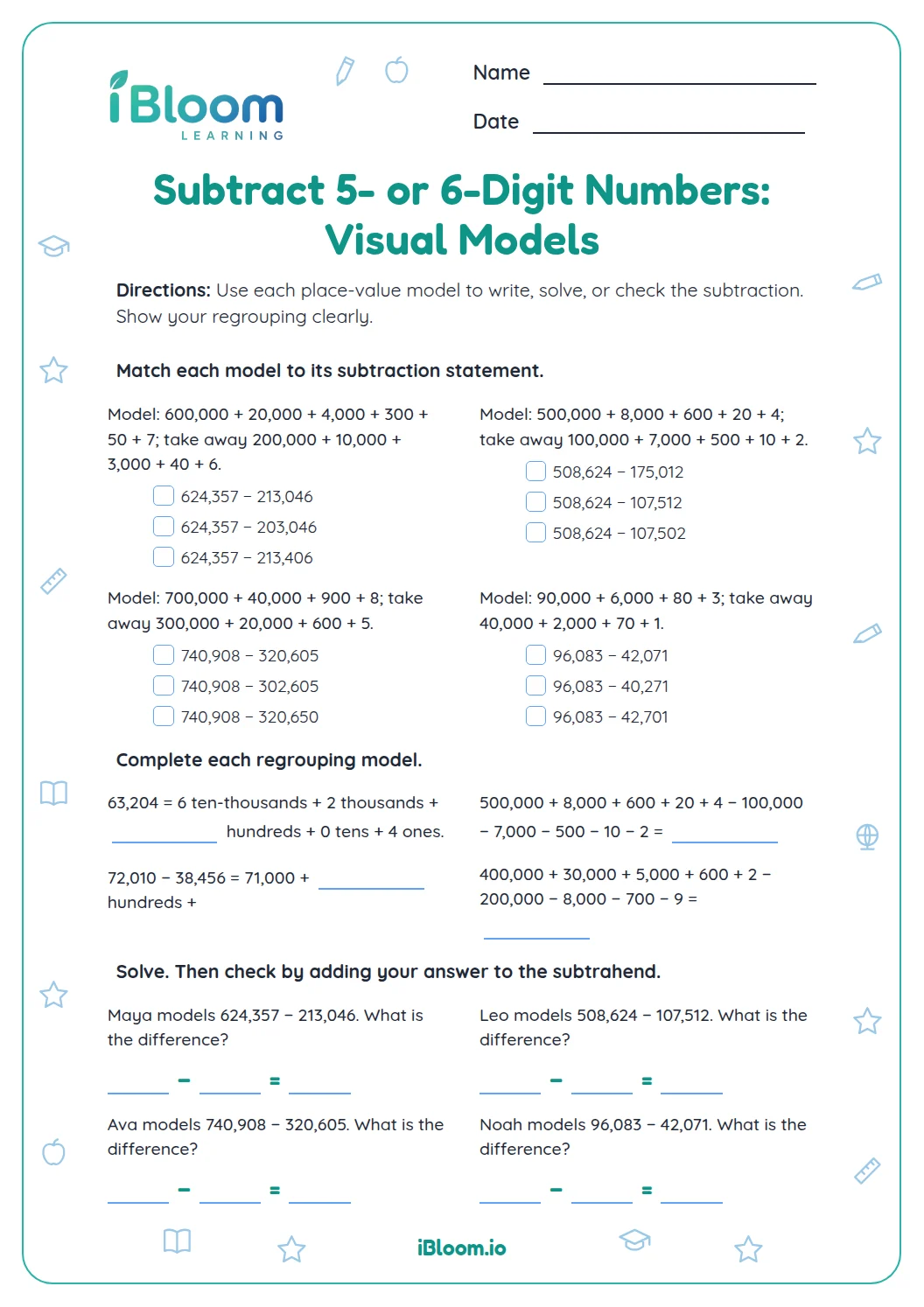
This printable practices multi-digit subtraction with the standard algorithm, including regrouping across zeros. Students begin with four-digit numbers, extend the method to larger values, solve two stories, and explain one regrouping step. The answer key includes the results and a sample explanation.
Aligned to 4.NBT.B.4
How do you subtract across zeros?
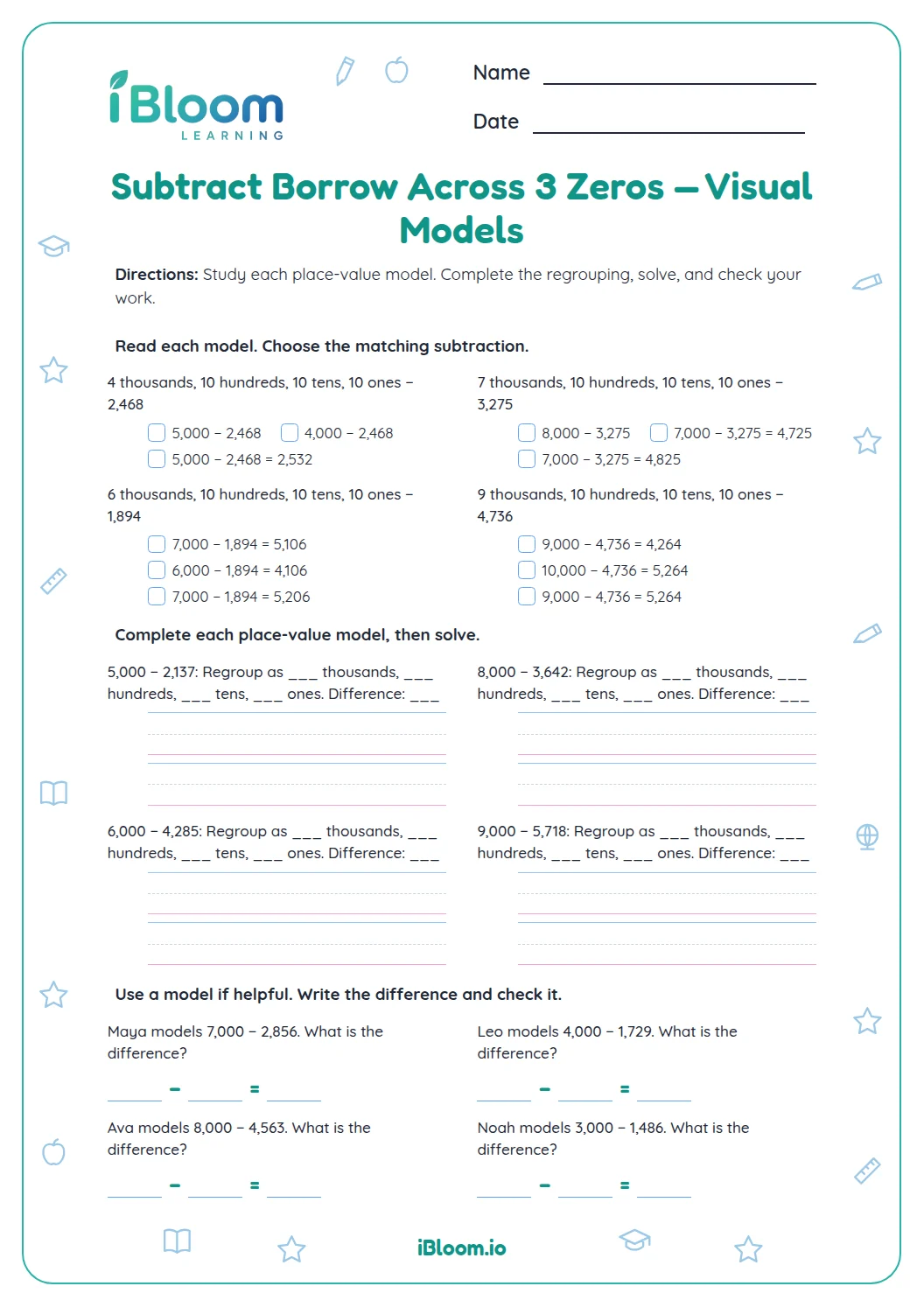
Regroup from the nearest nonzero place to the left, then carry that value through the zero places. In 5,000 − 2,647, the thousands are regrouped so the hundreds, tens, and ones can be subtracted.
- 15,000 − 2,647 = 2,353
- 2Check: 2,353 + 2,647 = 5,000
What stays the same with larger numbers?
The same standard algorithm applies to five-digit numbers. Work from right to left, regroup where needed, and keep each place aligned. The larger differences extend the zero-regrouping pattern from the first part.
How can you check a subtraction story?
Subtract the amount used or shipped from the starting amount, then add the difference back to check. For the museum story, 8,000 − 3,475 = 4,525 tickets; 4,525 + 3,475 returns to 8,000.
How to use the worksheet
- 1Read the whole prompt before writing an answer.
- 2Use the method named in the part direction.
- 3Keep work lined up or organize it on the response lines.
- 4Use the answer key after attempting the page and revisit any missed step.
Common slips to check
The mistake
Stopping a regroup at the first zero
The fix
Regroup through each zero place until the needed place has value.
The mistake
Subtracting digits without keeping place value
The fix
Line up ones, tens, hundreds, and thousands before computing.
The mistake
Leaving out the check
The fix
Add the difference to the amount subtracted and compare with the starting number.
Curriculum alignment
This worksheet practices a focused skill that supports grade-level learning.
Fluently subtract multi-digit whole numbers using regrouping and check with addition.
On this sheet: Fluently subtract multi-digit whole numbers using regrouping and check with addition.
Show the official wordingHide the official wording
Fluently add and subtract multi-digit whole numbers using the standard algorithm.
What to practice next
Make more practice
Further reading
Questions parents and teachers ask
What does borrowing across zeros mean?
When a place has zero, regroup from the nearest nonzero place to its left. In 5,000 − 2,647, the 5 thousands become 4 thousands, and the value is regrouped through the hundreds and tens so each place can be subtracted.
How can addition check a difference?
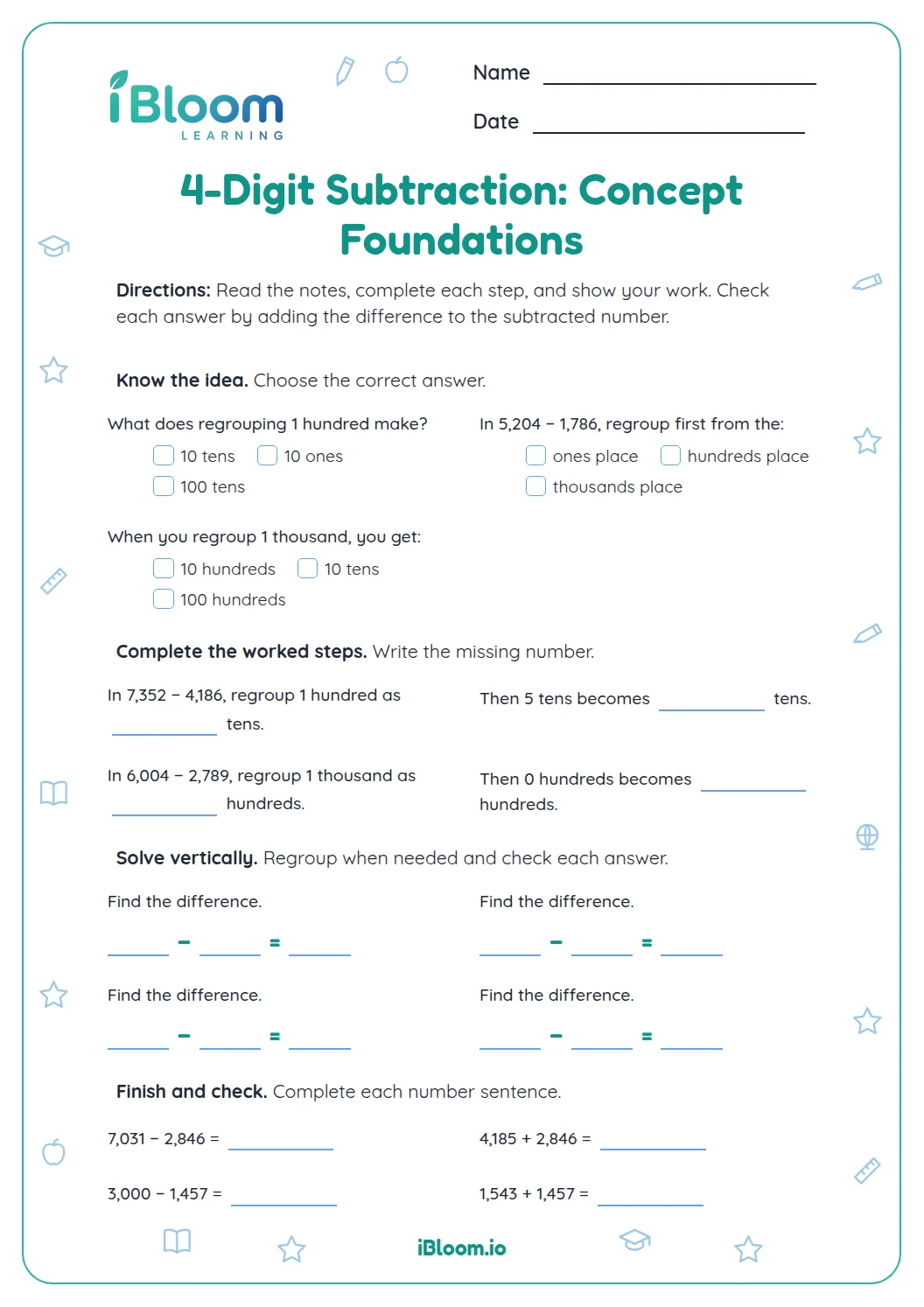
Add the difference to the number subtracted. For 7,000 − 2,468 = 4,532, check 4,532 + 2,468 = 7,000. If the sum does not return to the starting number, review the regrouping and subtraction. The examples keep the digits aligned by place.
Why does 5,000 − 1,892 not equal 4,892?
The hundreds and tens must be regrouped from the thousands before subtracting. Since 5,000 has no tens, hundreds, or ones, the value must pass through those places. The correct difference is 3,108. This is the same regrouping pattern practiced in Part A.
How many questions are included?
There are 14 questions in four parts over two worksheet pages: six four-digit differences, five larger differences, two subtraction stories, and one regrouping explanation. The separate key includes the differences and sample reasoning. The first problems use four-digit numbers with zeros.
What does “across three zeros” describe?
It describes regrouping in a number such as 5,000, where there are zeros in the hundreds, tens, and ones places. The first four-digit problems focus on this pattern, then the sheet extends the same regrouping to larger numbers. The examples include both four-digit and five-digit differences.