





About this worksheet
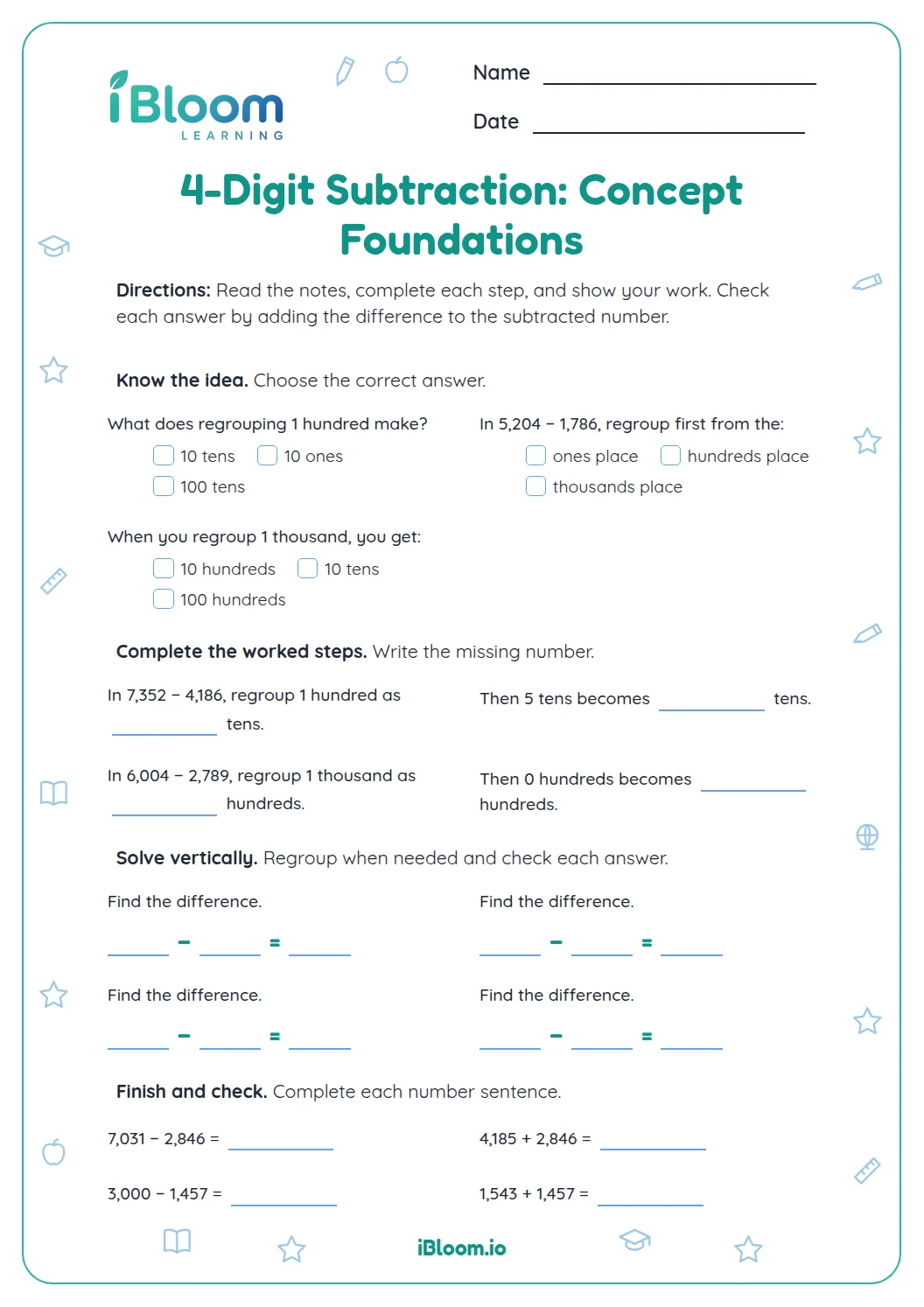
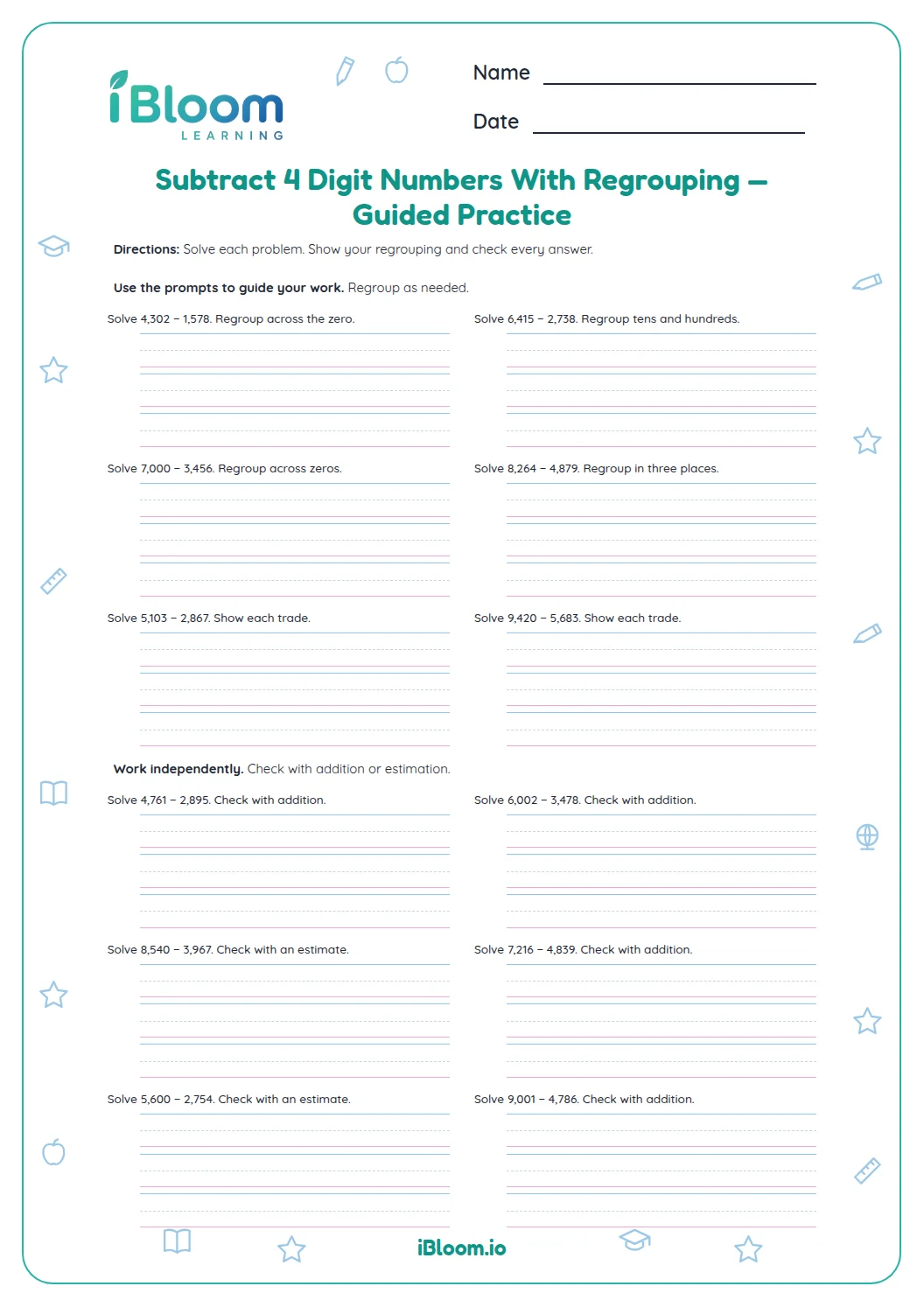
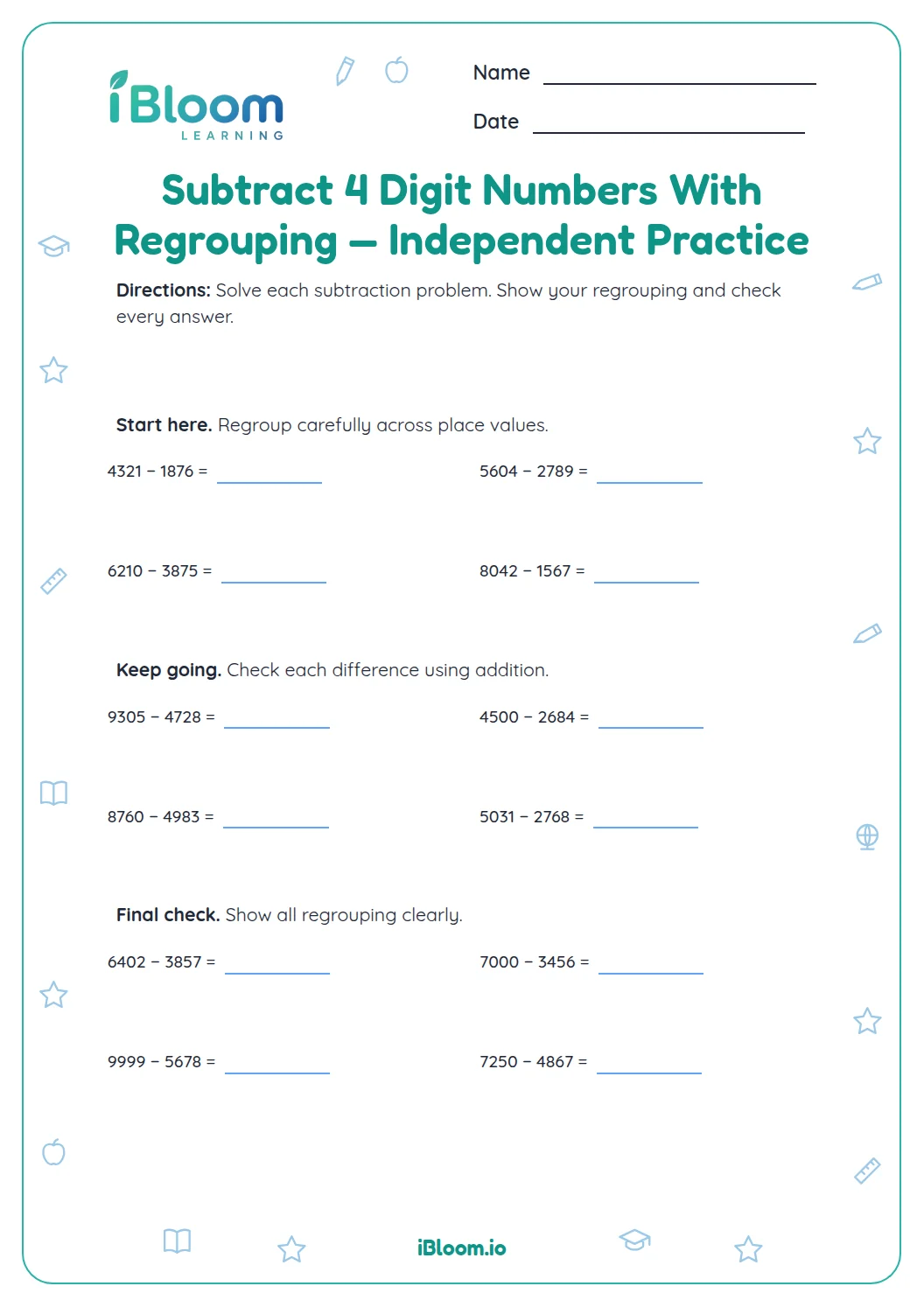
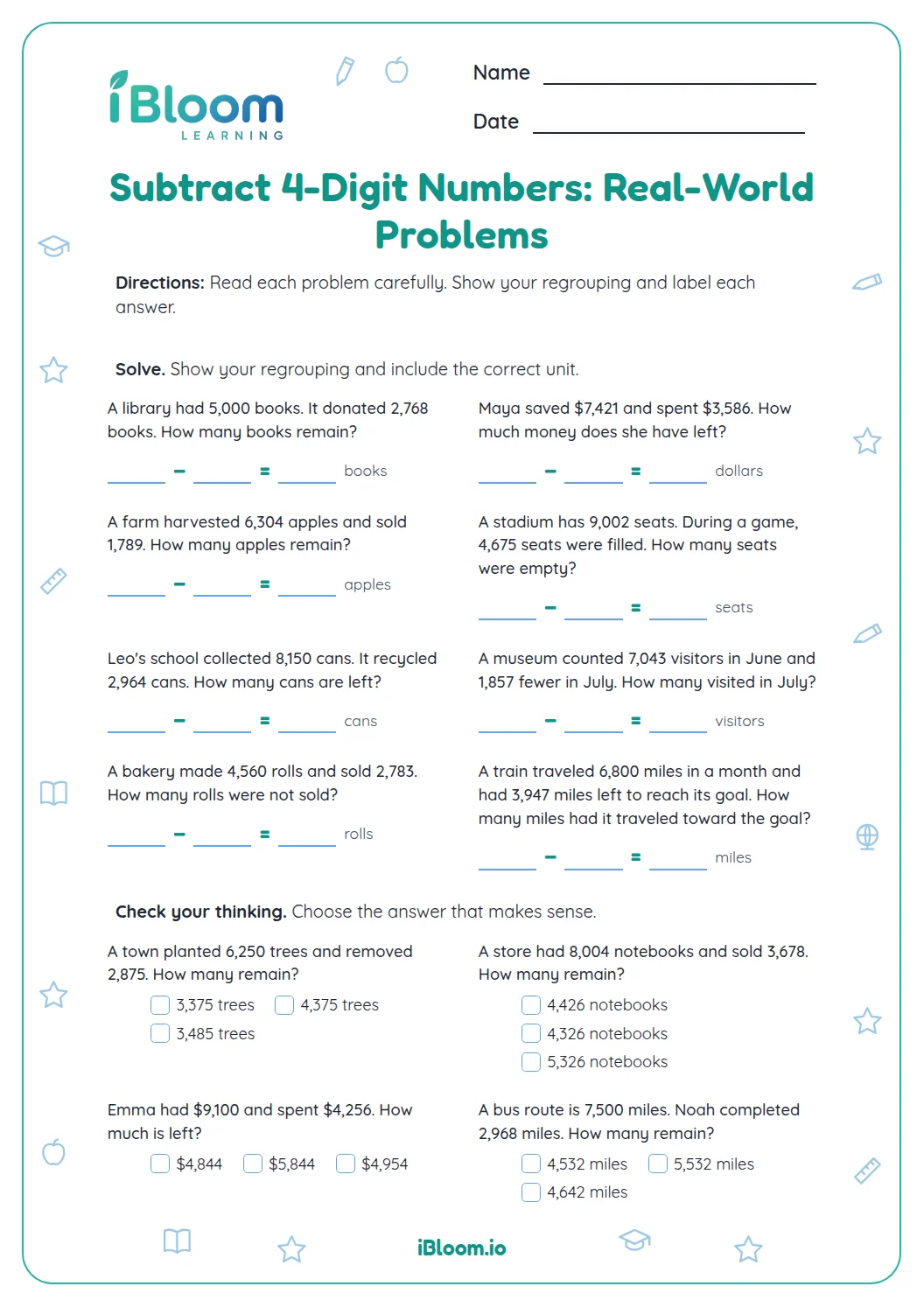
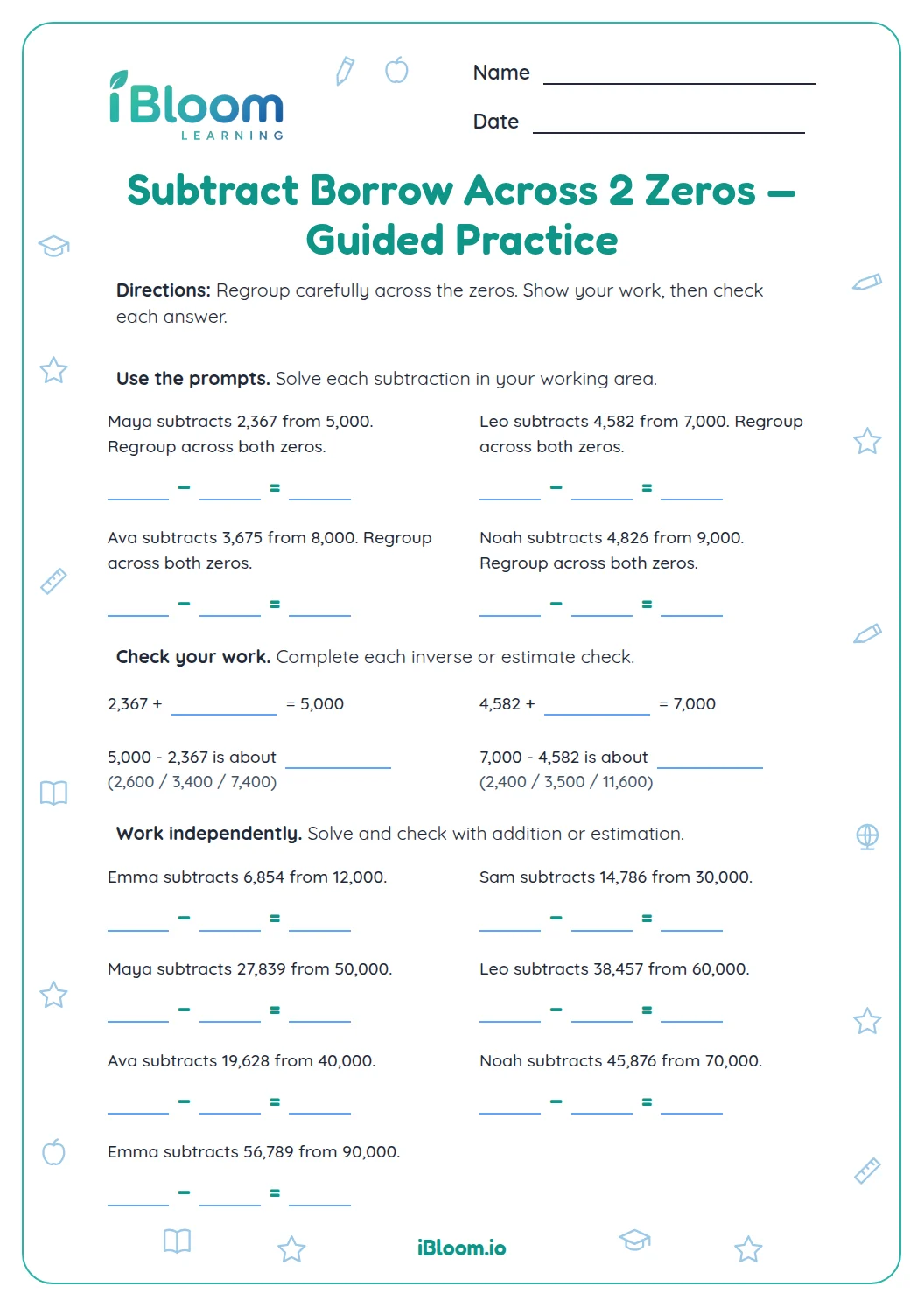
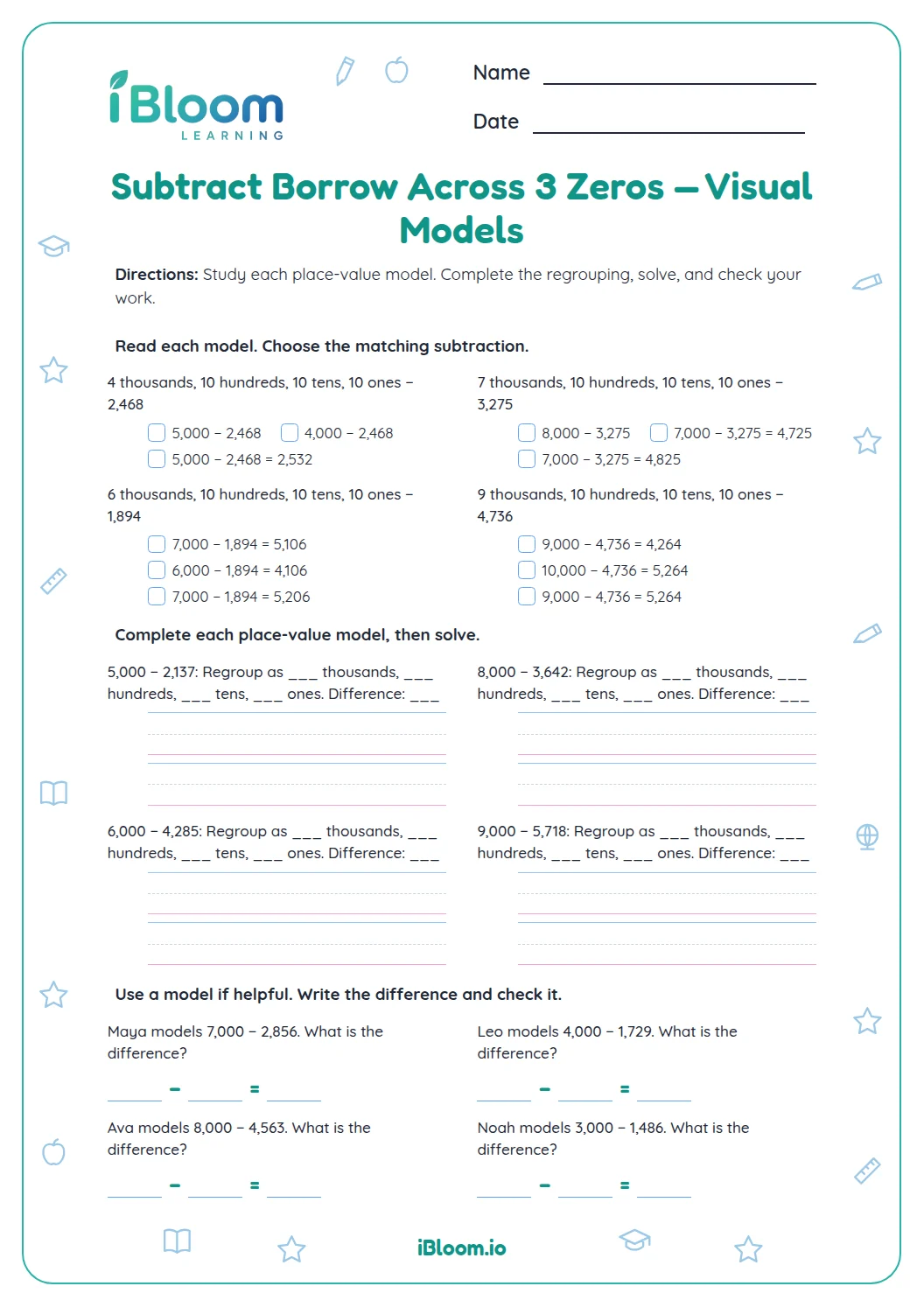
This free Grade 4 subtraction worksheet contains 16 four-digit subtraction problems with regrouping. Two number-bond models connect the whole, the amount taken away, and the missing difference; the remaining problems provide space for written regrouping. Students work across zeros and check selected differences by adding. The practice aligns with Common Core 4.NBT.B.4, which calls for fluent multi-digit addition and subtraction using the standard algorithm. A separate answer key lists every difference.
Aligned to 4.NBT.B.4
What is on the subtraction page?
There are 16 four-digit subtraction problems. Question 1 uses a number bond to connect the whole, the amount taken away, and the missing difference. Question 2 gives a place-value table with 6,014 renamed as 5 thousands, 9 hundreds, 10 tens, and 14 ones. The remaining problems provide room to work through regrouping and record a difference.
The set includes regrouping across zeros and across adjacent places. The answer key lists each difference.
- Questions 1–2: use a number bond and regrouped place-value table
- Questions 3–10: subtract with regrouping
- Questions 11–16: subtract and check by addition
How does regrouping work across place values?
Start at the ones place. If the top digit is too small, exchange one unit from the place to its left. Continue across the number when a zero appears. Keep the value the same: one ten becomes ten ones, one hundred becomes ten tens, and one thousand becomes ten hundreds.
- 1The table renames 6,014 as 5 thousands, 9 hundreds, 10 tens, and 14 ones.
- 2Subtract 2,789 by place: 5 − 2 thousands, 9 − 7 hundreds, 10 − 8 tens, and 14 − 9 ones.
- 3The difference is 3,225; check: 2,789 + 3,225 = 6,014.
What should students do when a place has zero?
In 6,014 − 2,789, there are not enough ones, and the tens place is also zero. Regroup from the hundreds after first exchanging one thousand into ten hundreds. This leaves 5 thousands, 9 hundreds, 10 tens, and 14 ones before subtracting by place.
How can addition check a subtraction answer?
Add the subtrahend and the difference. For question 12, the difference is 3,364; adding 1,849 gives 5,213, the starting number. If the sum does not return the minuend, review the regrouping in each column.
How to use this worksheet
- 1Start with the number-bond models and identify the whole and known part.
- 2For each equation, line up thousands, hundreds, tens, and ones.
- 3Regroup from left to right only when a place needs more units.
- 4Subtract one place at a time and keep the digits in their columns.
- 5Check a difference by adding it to the number subtracted.
Common mistakes and quick fixes
The mistake
Subtracting the smaller digit from the larger digit in each column.
The fix
Regroup when the top digit is too small; do not reverse the subtraction.
The mistake
Borrowing from a zero without regrouping through the next place.
The fix
Move left to a place with a unit, exchange it, then pass ten units right.
The mistake
Forgetting to reduce the place that gives up a unit.
The fix
Record each exchange before subtracting so the value stays balanced.
Common Core alignment
This worksheet practices the Grade 4 multi-digit subtraction calculation standard.
Subtract multi-digit whole numbers accurately with the standard algorithm.
On this sheet: All 16 problems subtract one four-digit whole number from another, with regrouping across place values.
Show the official wordingHide the official wording
Fluently add and subtract multi-digit whole numbers using the standard algorithm.
What to practice next
Make more practice
Further reading
Questions parents and teachers ask
Why does the worksheet use number bonds?
A number bond shows subtraction as a missing part: whole minus known part equals the other part. Questions 1 and 2 use this relationship for four-digit numbers. The later problems give more room for students to work through the standard subtraction algorithm.
What does regrouping mean?
Regrouping exchanges units without changing the number’s value. One thousand can be renamed as ten hundreds, one hundred as ten tens, and one ten as ten ones. The student then subtracts in each place using the renamed amounts. Keep each exchange recorded.
How can I help with subtraction across zeros?
Ask your child to move left until reaching a place with a unit to exchange, then record each change as the value moves right. In 6,014 − 2,789, the hundreds provide the exchange after the thousands are regrouped. The check by addition can confirm the result.
Should students show their work?
Yes. The equation work area gives room to line up the place values and record exchanges. Encourage students to write each subtraction column carefully, especially when regrouping passes through zero. The answer key is best used after the student has completed the calculation.
What is a quick way to check a difference?
Add the number subtracted to the difference. The sum should equal the starting number. For example, the check for 4,372 − 1,586 is 1,586 + 2,786 = 4,372. This checks the complete answer, though students should still review any written regrouping steps.