





About this worksheet
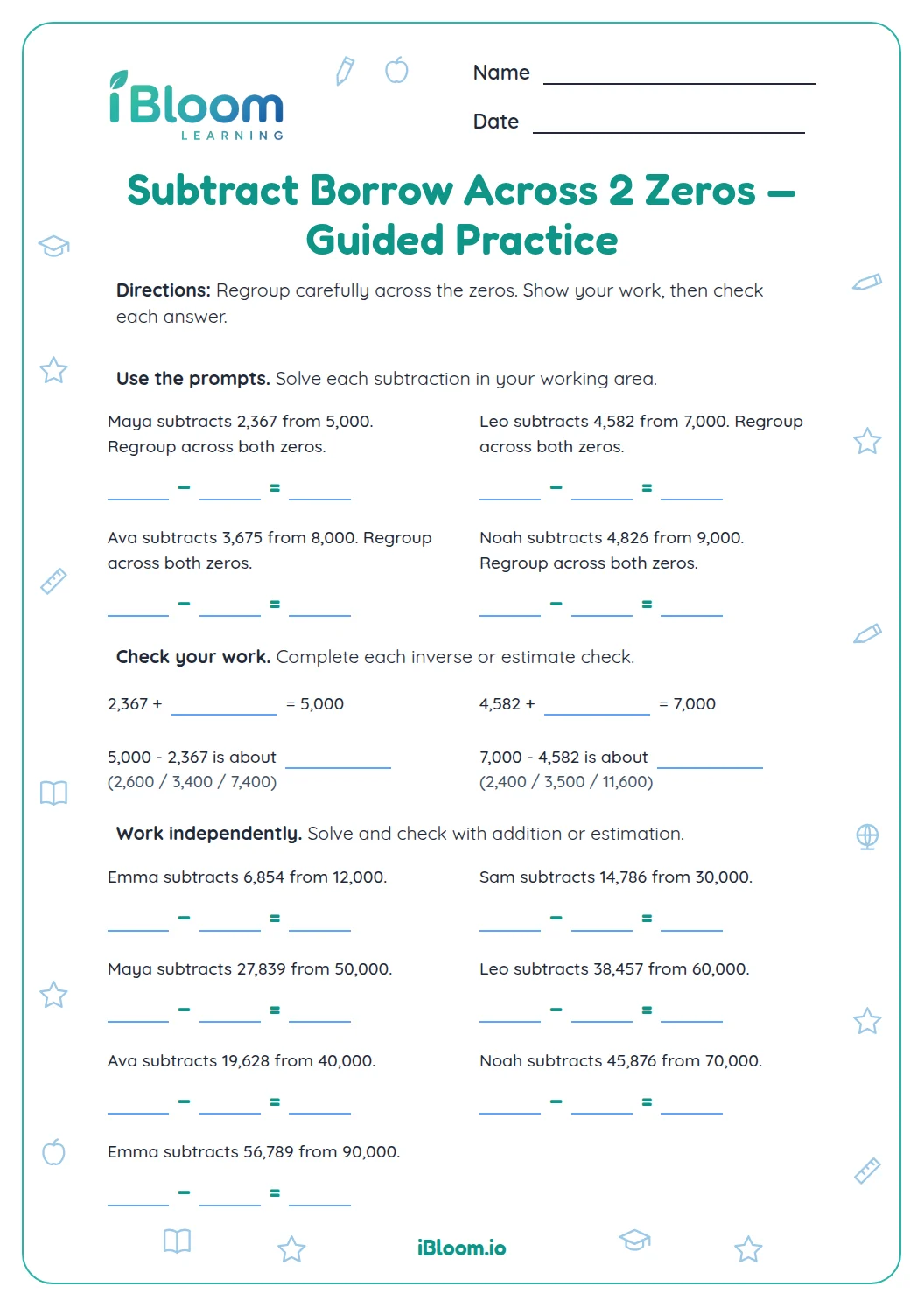
This Grade 4 independent-practice sheet focuses on subtracting four-digit numbers when the minuend has two consecutive zeros. Every problem requires regrouping across those zeroes, so students must trade from a nonzero place to reach the ones and tens places. There are 14 problems with room to show the standard algorithm and check each difference. The answer key follows the worksheet.
Aligned to 4.NBT.B.4
What does regrouping across two zeros look like?
Question 1 is 5,004 − 2,768. Since there are no tens or hundreds to trade from, regroup 1 thousand as 10 hundreds, then 1 hundred as 10 tens, and 1 ten as 10 ones. Subtract each place value to get 2,236, then check: 2,236 + 2,768 = 5,004.
Why does the regrouping move across places?
A zero has no units to trade. Regrouping must begin at the next place with a value available, then pass through each place until the ones column can be subtracted. Keeping the digits aligned makes each trade visible.
How can students check the difference?
Add the difference to the number being subtracted. For question 8, 8,004 − 3,598 = 4,406; adding 4,406 + 3,598 returns 8,004. If the sum differs from the minuend, revisit the regrouping marks and place-value columns.
How to use this worksheet
- 1Write the four-digit numbers in aligned place-value columns.
- 2Start regrouping at the first nonzero place to the left of the zeroes.
- 3Pass the trade through each zero place until the ones column has enough units.
- 4Subtract one column at a time and keep the regrouped values clear.
- 5Add the difference and subtrahend to check the minuend.
Common slips and fixes
The mistake
Trying to borrow from a zero column.
The fix
Move left to the first nonzero digit, regroup it, and pass one ten through each place.
The mistake
Forgetting that a digit changes after it is traded.
The fix
Write the new value above each column before subtracting.
The mistake
Checking by subtracting in the same order again.
The fix
Add the difference to the subtrahend and see whether the minuend returns.
Common Core alignment
Students use the standard algorithm to subtract multi-digit whole numbers.
Use the standard algorithm to subtract multi-digit whole numbers.
On this sheet: Every problem uses the standard algorithm to subtract four-digit numbers with regrouping across two zeros.
Show the official wordingHide the official wording
Fluently add and subtract multi-digit whole numbers using the standard algorithm.
What to practice next
Make more practice
Questions parents and teachers ask
How many problems are on this page?
There are 14 four-digit subtraction problems. Each minuend contains two consecutive zeros, so students have to regroup across the zero places. The worksheet provides space to show the standard algorithm, and a separate answer key lists each difference for checking.
What does “across two zeros” mean here?
Each problem has two neighboring zeroes in the number being subtracted from. Because those columns have no value to trade, students regroup from a nonzero place farther left and pass the trade through both zero columns before subtracting. Each problem is designed for that trade.
What is the answer to the first problem?
Question 1 is 5,004 − 2,768. Regroup through the hundreds and tens places so the ones column can be subtracted; the difference is 2,236. Add 2,236 and 2,768 to check that their sum returns to 5,004. This is the key’s listed difference.
Should students show regrouping marks?
Yes. The directions ask students to show regrouping and check the answer. Marking the changed place values above the columns helps track each trade through the zeroes and makes a missed regroup easier to spot. Students can label each new place value.
How should a student check a subtraction answer?
Add the difference to the number subtracted. The sum should equal the original four-digit number. For example, 4,406 + 3,598 = 8,004, confirming the answer to question 8 and showing that the difference is consistent. The worksheet asks for this addition check.