




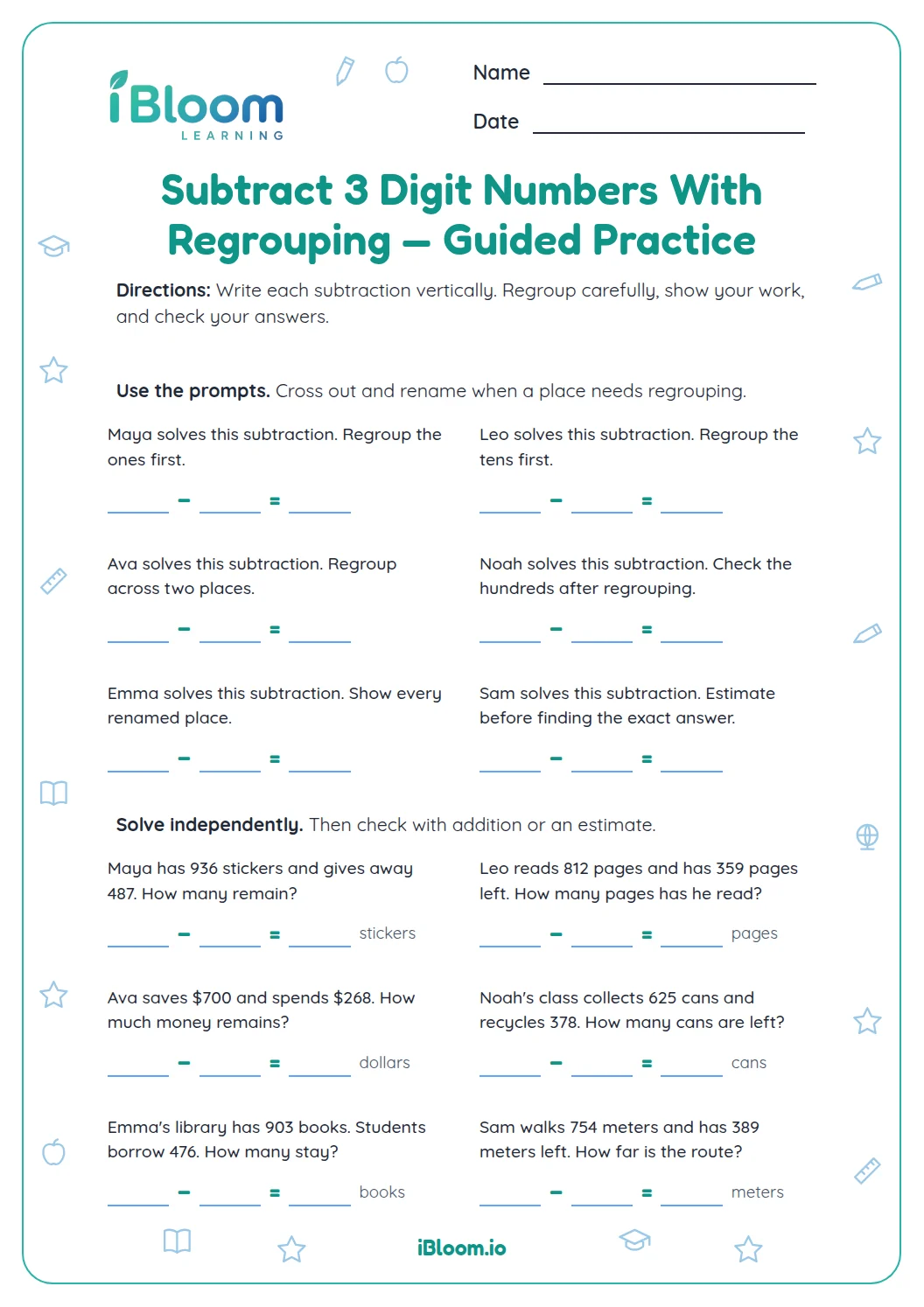
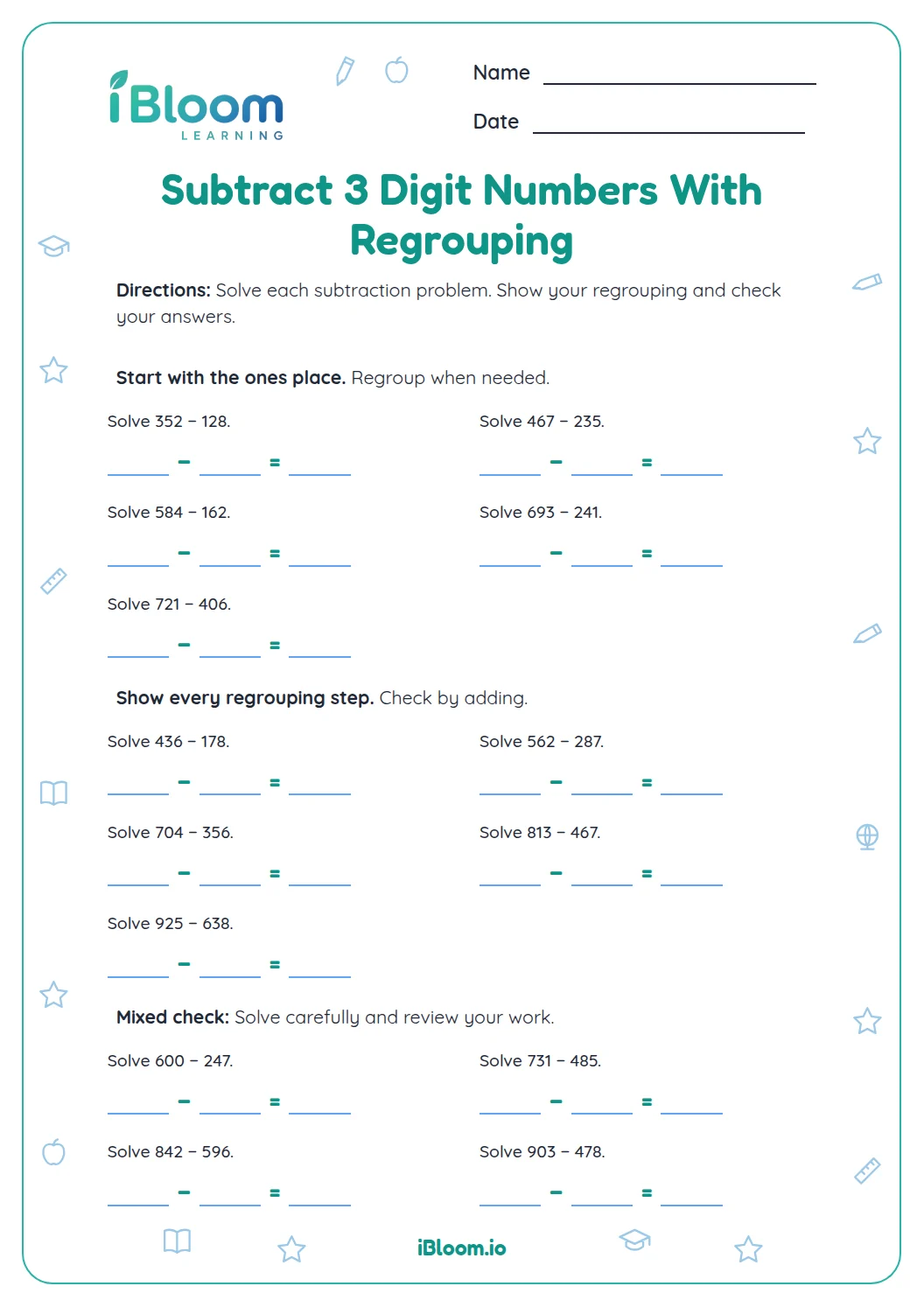
About this worksheet
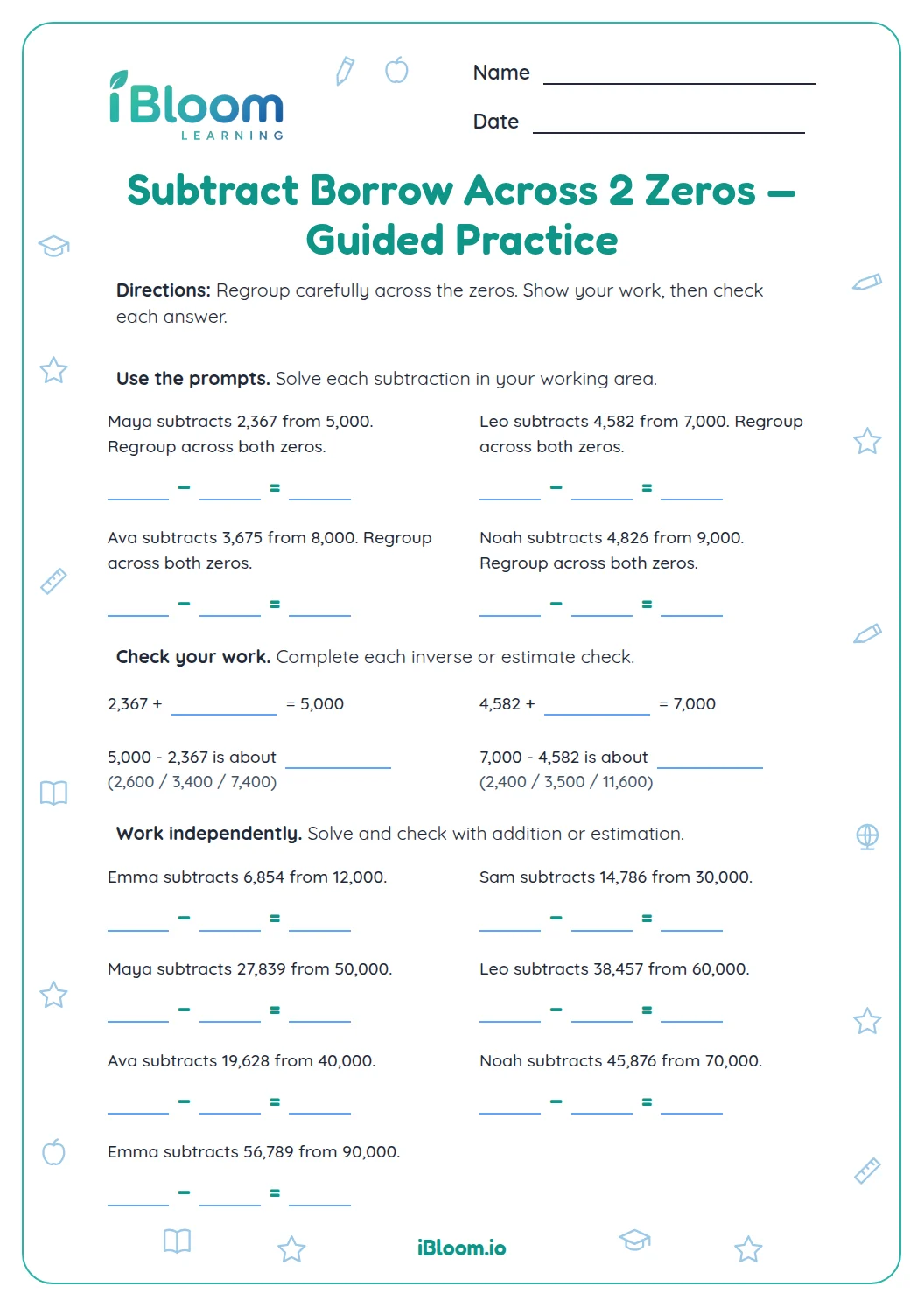
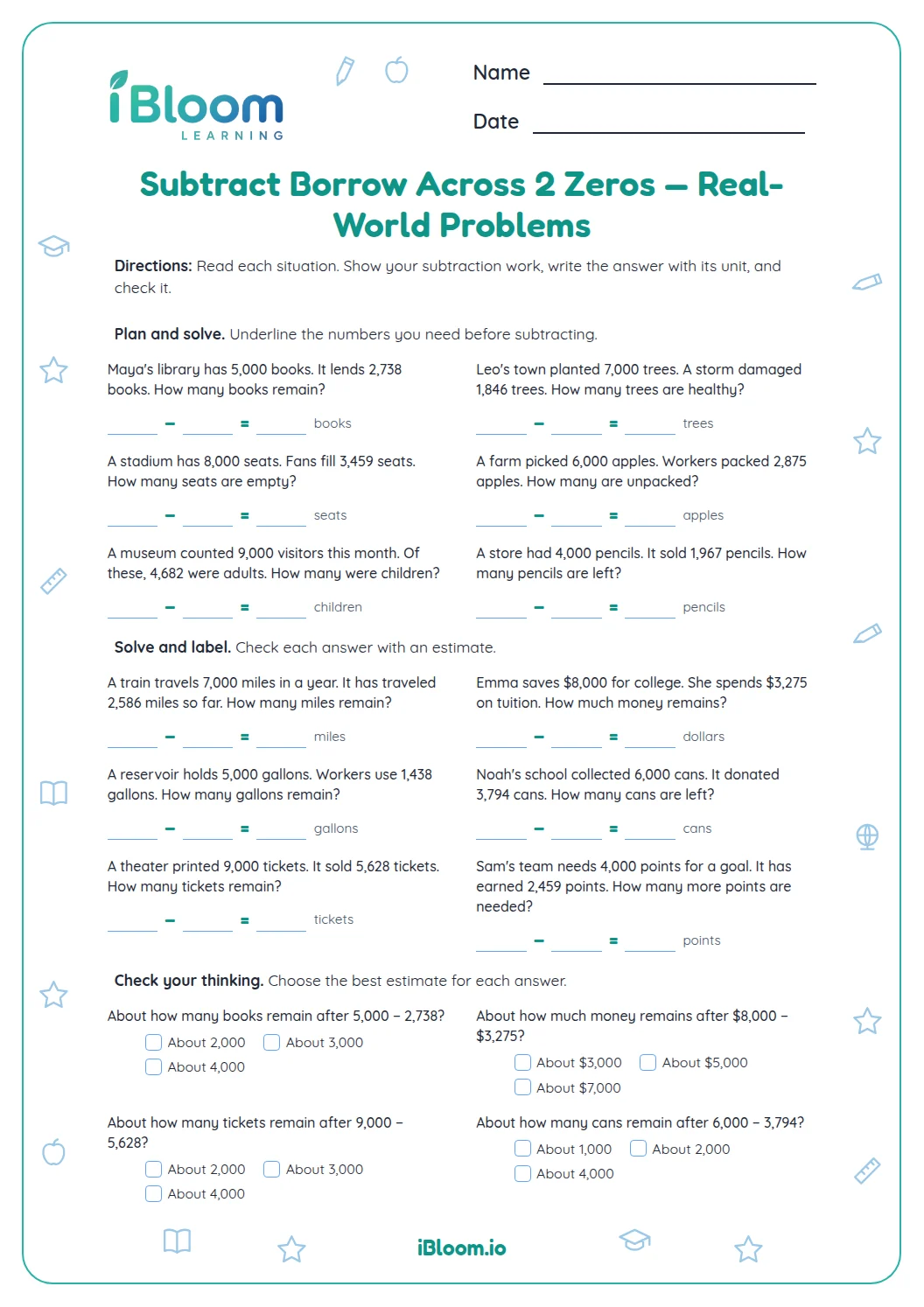
This free printable Grade 4 worksheet helps students subtract four-digit numbers when the top number has zeros in the hundreds and tens places. It starts with place-value questions about trading from the thousands, then gives difference problems, missing-number equations and two short stories. The work connects to CCSS 4.NBT.B.4: subtract multi-digit whole numbers using place-value strategies and the standard algorithm. A separate answer key is included for checking each response.
Aligned to 4.NBT.B.4
How does regrouping reach the ones place?
When subtracting from a number such as 7,000, there are no tens or hundreds available to trade directly. Trade 1 thousand for 10 hundreds. Then trade 1 hundred for 10 tens, and 1 ten for 10 ones. The number stays equal in value after every trade.
Question 1 uses 7,000 − 2,486. After regrouping, 7,000 is 6 thousands, 9 hundreds, 9 tens and 10 ones. Subtracting each place gives 4,514.
- 17,000 − 2,486
- 2Regroup 7,000 as 6 thousands, 9 hundreds, 9 tens and 10 ones.
- 3Subtract: 10 − 6 = 4; 9 − 8 = 1; 9 − 4 = 5; 6 − 2 = 4.
- 4Difference: 4,514
- 5Check: 4,514 + 2,486 = 7,000
What does the worksheet ask students to do?
The page moves from identifying the trades to carrying them out. Students solve six direct subtraction equations, then use addition or subtraction to fill in four missing numbers. The final two items connect the same calculation pattern to book and trail distances.
- Part A identifies regrouping and place-value trades.
- Part B finds differences in four-digit subtraction.
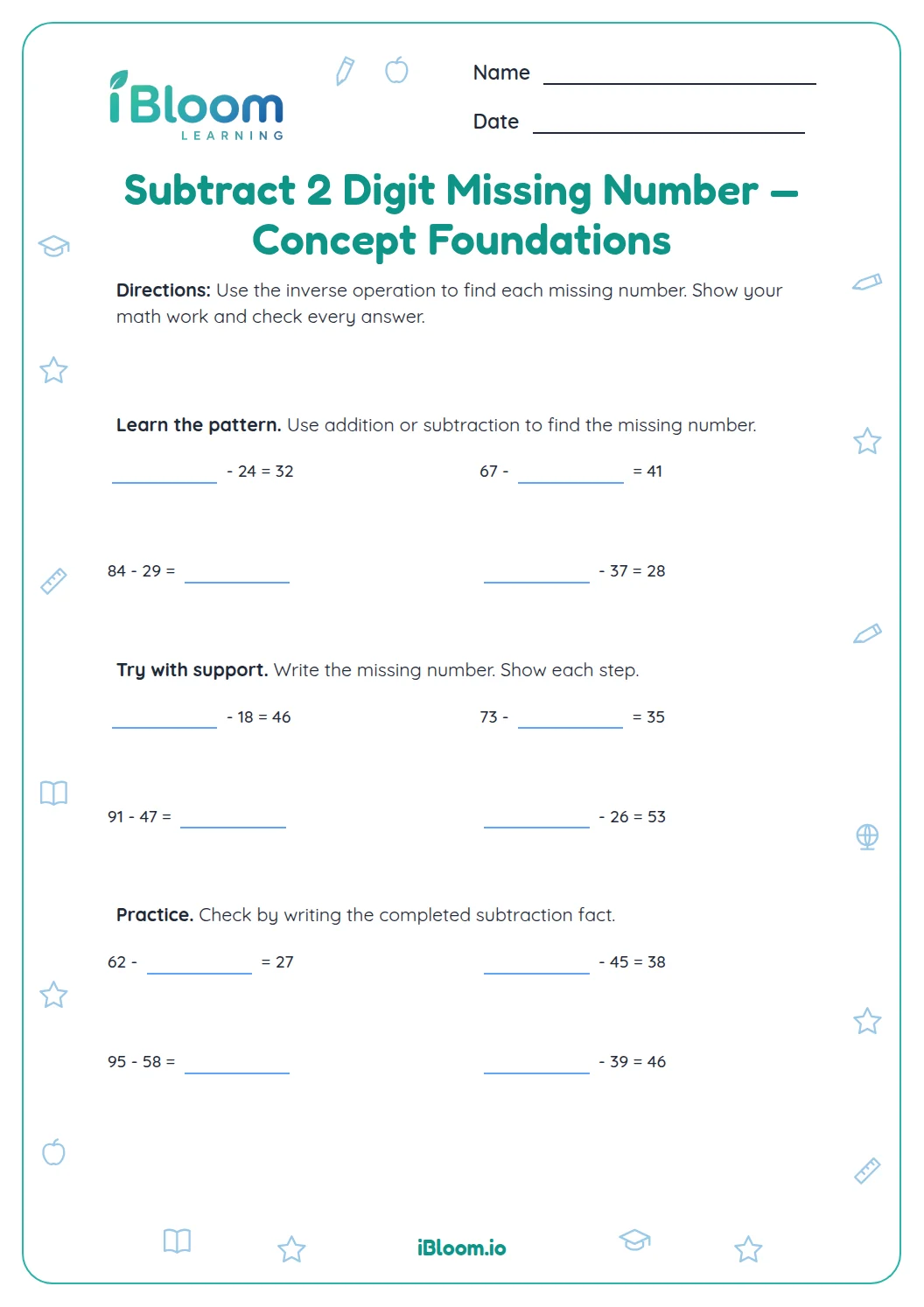
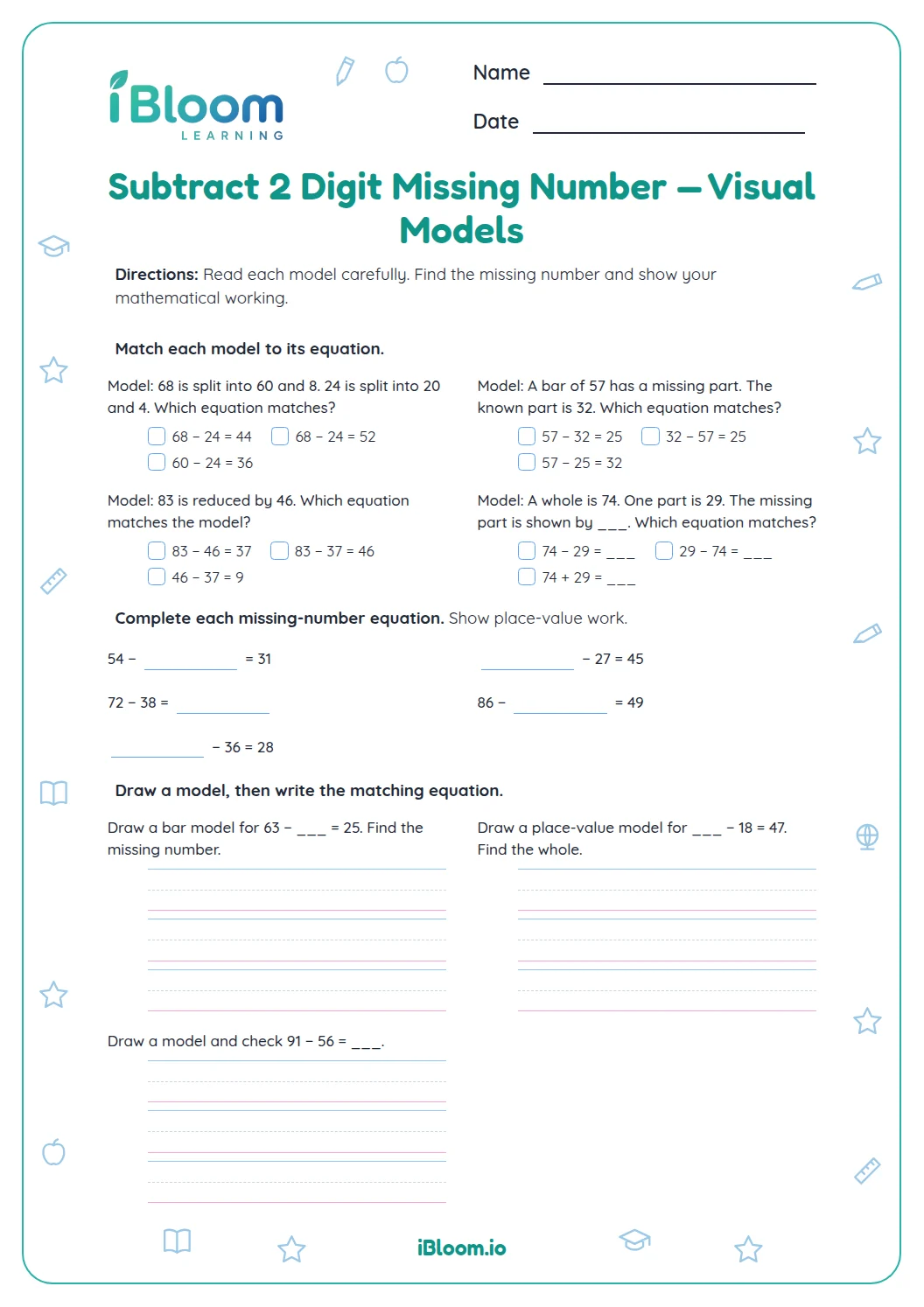
- Part C works backward from a missing number.
- Part D solves two short stories with equations.
How can students check a difference?
Addition reverses subtraction: add the difference to the amount taken away. For 6,000 − 2,457 = 3,543, check 3,543 + 2,457 = 6,000. If the sum is not the starting number, revisit the regrouping marks and place values.
How to work through the page
- 1Read the thousands, hundreds, tens and ones in the top number.
- 2Find the first nonzero place to the left of the zero places, then trade one place at a time to the right.
- 3Subtract the ones first, then tens, hundreds and thousands.
- 4For a missing-number equation, use the inverse operation to identify the unknown.
- 5Write an equation for each story before calculating.
- 6Check each difference by adding it to the number subtracted.
Common regrouping mistakes
The mistake
Trading one thousand for only one hundred.
The fix
A thousand is 10 hundreds, so write 10 in the hundreds place before trading one hundred onward.
The mistake
Forgetting to reduce the place that was traded from.
The fix
Cross out the original digit and write the amount left before recording the new group.
The mistake
Subtracting the smaller digit from the larger digit in every column.
The fix
Regroup so the top digit is large enough, then subtract top minus bottom in each place.
Common Core alignment
This worksheet practices multi-digit subtraction with place-value reasoning and the standard algorithm.
Subtract multi-digit whole numbers with place-value trades and the standard algorithm.
On this sheet: The difference and story problems subtract four-digit whole numbers, including regrouping across zero places.
Show the official wordingHide the official wording
Fluently add and subtract multi-digit whole numbers using the standard algorithm.
What to practice next
Make more practice
Further reading
Questions parents and teachers ask
Why does subtracting from 7,000 require several trades?
In 7,000, the hundreds, tens and ones places start at zero, so they cannot subtract 2,486 directly. Trade 1 thousand for 10 hundreds, then 1 hundred for 10 tens, and 1 ten for 10 ones. The value stays 7,000 throughout the trades.
What is 7,000 − 2,486?
It is 4,514. After regrouping, subtract 6 from 10 ones, 8 from 9 tens, 4 from 9 hundreds, and 2 from 6 thousands. Check the result by adding 4,514 and 2,486 to get 7,000. This confirms the trades kept the starting value.
How can my child check a subtraction answer?
Add the difference to the number that was subtracted. For example, if 6,000 − 2,457 is 3,543, calculate 3,543 + 2,457. The sum should return to 6,000; otherwise, check the trades and each column carefully. This quick check works for every problem.
How do you solve a missing-number subtraction?
Use the relationship between subtraction and addition. For ___ − 2,586 = 3,414, add 2,586 and 3,414 to find the starting number: 6,000. Substitute it into the equation to confirm that the difference is correct. This method works for the other missing-number items too.
Are the story problems different from the number sentences?
The stories use the same regrouping as the number sentences. One asks how many books remain after 2,684 of 5,000 are sent to another branch; the other asks how many meters remain after a group walks 4,375 meters of a 7,000-meter trail. The answer key includes units.
Is an answer key included?
Yes. The printable has a separate answer key with answers for all 16 questions. It can be used after students finish to check their regrouping, missing numbers and story problem equations, one item at a time. The key is printed separately for easy checking.