

About this worksheet
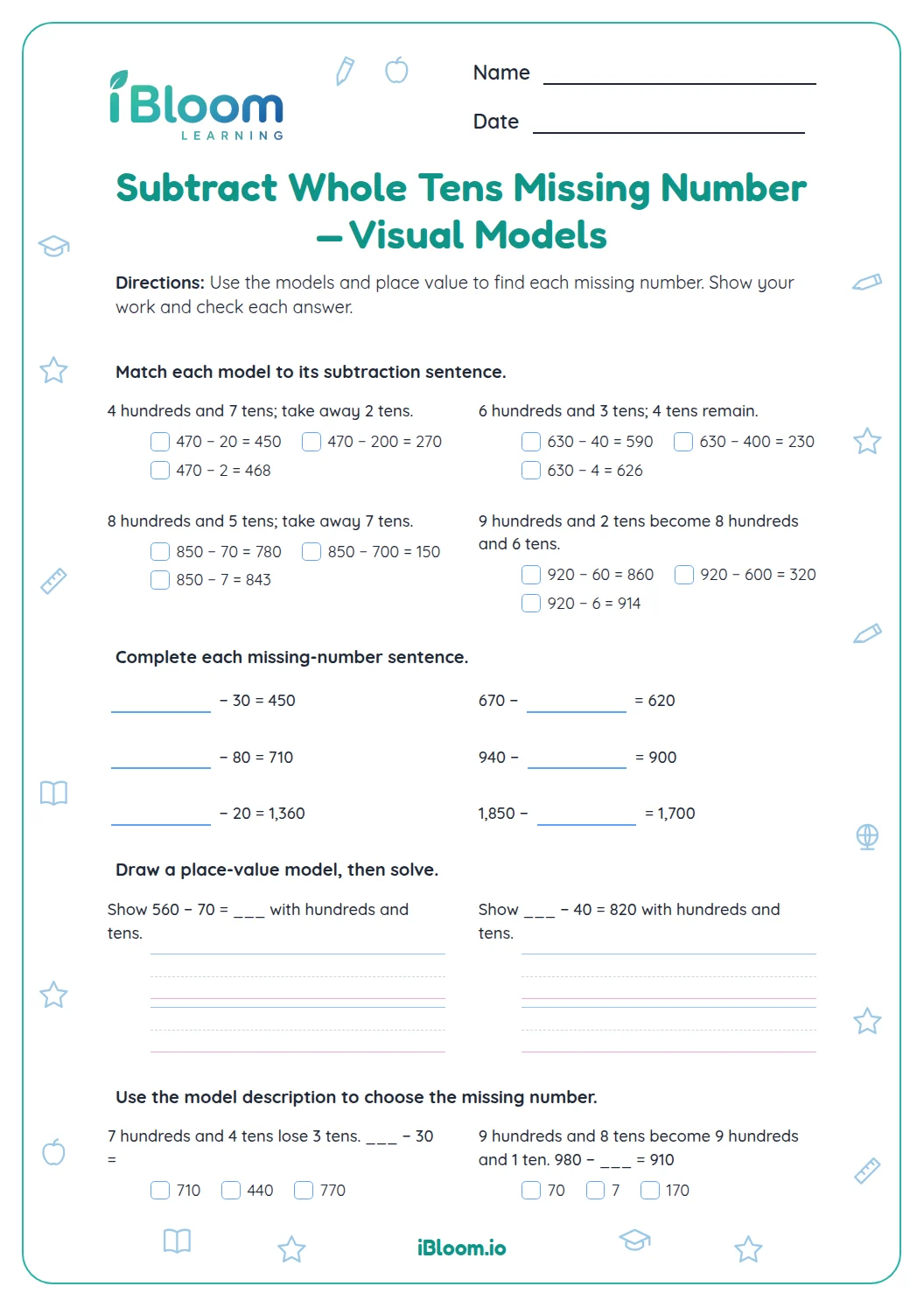
This free printable worksheet shows Grade 4 students why subtracting a whole number of tens, such as 371 − 50, is really just taking away tens. In Part A, children name the place that changes and spot a mistake. In Part B, they break a number apart, as in 562 − 40 = 500 + ___ + 2, then subtract, from 245 − 30 up to 752 − 90, where one hundred must be regrouped, and check one answer by adding. Part C has two word problems. It practices Common Core 3.NBT.A.2 and the regrouping step of 4.NBT.B.4, and a separate answer key gives every answer.
Aligned to 3.NBT.A.2 and 4.NBT.B.4
What does it mean to subtract whole tens?
A whole ten is a number like 20, 50 or 90: a number of tens and no ones. Subtracting 40 from 356 takes 4 tens away from the 5 tens in 356, so only the tens digit changes and the answer is 316. The 3 hundreds and the 6 ones are untouched.
Many Grade 4 students already know the steps of the written method but still treat 40 as the digits 4 and 0. Saying "4 tens" out loud keeps the place value in view and turns 371 − 50 into the simpler 7 tens − 5 tens.
How can students subtract tens without borrowing steps?
Ask them to rewrite the number in tens. 245 is 24 tens and 5 ones, and 30 is 3 tens. Then 24 tens − 3 tens = 21 tens, so 245 − 30 = 215. The ones digit simply comes along.
When there are not enough tens, one hundred is traded for 10 tens. In 752 − 90 there are 5 tens and 90 needs 9, so the 7 hundreds become 6 hundreds and the tens become 15. Then 15 tens − 9 tens = 6 tens, and the answer is 662. Part B questions 7, 11 and 12 practice exactly this move.
- 1752 − 90
- 2752 is 7 hundreds, 5 tens and 2 ones.
- 3Only 5 tens, so trade 1 hundred for 10 tens: 6 hundreds, 15 tens, 2 ones.
- 415 tens − 9 tens = 6 tens.
- 5Answer: 6 hundreds + 6 tens + 2 ones = 662
- 6Check: 662 + 90 = 752
What is on this worksheet?
Part A, "Think in tens," has three multiple-choice questions: which place changes in 356 − 40, which expression takes away 6 tens from 482, and which answer is right for Ben's 573 − 40 (he took 4 hundreds instead of 4 tens). Part B, "Break apart, then subtract," starts with four expanded-form sentences that ask for the missing tens.
Part B then has five subtractions that get harder, from 245 − 30, where nothing is regrouped, to 608 − 20 and 752 − 90, where a hundred is regrouped. It ends with a check by adding, 662 + ___ = 752. Part C has two word problems about library books and ticket sales.
- Part A: 3 multiple-choice questions on place value
- Part B: 4 break-apart sentences, 5 subtractions (the last 2 regroup) and 1 check by adding
- Part C: 2 word problems with working space
How to use this worksheet at home or in class
- 1Warm up out loud: ask "What is 5 tens minus 2 tens?" a few times, then try "What is 50 minus 20?" and notice they feel the same.
- 2Read question 1 together and have your child say which digit changes in 356 − 40 and why.
- 3Let your child do Part A and questions 4 to 7 alone. Ask them to explain Ben's mistake in question 3 in their own words.
- 4Work question 8 together, then have your child try questions 9 to 12, writing how many tens are left before the answer.
- 5Do the check in question 13. If 662 + ___ = 752 does not give 90, ask where the extra or missing hundred went.
- 6Mark with the answer key and redo any missed question using the tens-and-ones breakdown.
Common mistakes and quick fixes
The mistake
Subtracting the tens digit from the hundreds digit or the ones digit, as in Ben's 573 − 40 = 173 (he took 4 hundreds).
The fix
Say the number in tens first: "40 is 4 tens, so I take 4 tens from the 7 tens." Circle the tens digit before subtracting.
The mistake
Taking the 3 of 30 away from the ones, so 245 − 30 becomes 242.
The fix
Write 30 under 245 so the 0 sits under the 5. The ones column subtracts 0, so copy the 5 down unchanged, then work on the tens.
The mistake
Subtracting the smaller digit from the larger when the tens run short, such as 9 − 5 = 4 in 752 − 90, giving 742.
The fix
Trade one hundred for 10 tens. Write 6 hundreds and 15 tens above 752, then subtract 15 − 9 = 6 tens, which gives 662.
Common Core alignment
Most US states use the Common Core standards or a close state version. This sheet practices the place-value reasoning behind multi-digit subtraction, and its numbers stay within 1,000.
Subtract within 1,000 using place value: take tens from tens, trading a hundred when needed.
On this sheet: Every problem is within 1,000 and is solved by place value; question 13 checks a subtraction by adding.
Show the official wordingHide the official wording
Fluently add and subtract within 1000 using strategies and algorithms based on place value, properties of operations, and/or the relationship between addition and subtraction.
Subtract multi-digit numbers on paper, regrouping a hundred into tens when needed.
On this sheet: Questions 7, 11, 12, 14 and 15 need the regrouping step of the written method, here with whole tens only.
Show the official wordingHide the official wording
Fluently add and subtract multi-digit whole numbers using the standard algorithm.
What to practice next
Make more practice
Further reading
Questions parents and teachers ask
What is subtracting whole tens?
It means subtracting a number such as 20, 50 or 90, which has tens and no ones. For 371 − 50, you take 5 tens from 7 tens, so the tens digit becomes 2 and the rest stays the same: 321. Thinking in tens keeps the hundreds and ones from changing by mistake.
Why does the ones digit stay the same?
A whole ten has 0 ones, so there are no ones to take away. In 493 − 80 the 3 ones are not touched, and the 80 only affects the tens and sometimes the hundreds. The answer 413 still ends in 3. Students can confirm it by adding 80 back.
What are the answers to the regrouping questions?
Questions 7, 11 and 12 regroup a hundred. 815 − 50 = 765, so the missing tens in question 7 is 60. Also 608 − 20 = 588 and 752 − 90 = 662. In each one the tens digit is smaller than the number of tens being taken away, so a hundred becomes 10 tens.
Is this worksheet too easy for Grade 4?
It is a foundation sheet, so some students will move fast through Part A and the break-apart questions. The later subtractions and the word problems add regrouping, which trips up many fourth graders. If your child finishes without help, move on to the regrouping and borrow-across-zeros worksheets linked on this page.
How does the check-by-adding question help?
Addition undoes subtraction, so adding the tens back should give the starting number. In question 13, 662 + 90 = 752 proves that 752 − 90 = 662. A student who gets a different total knows to look again at the tens or the regrouped hundred before moving on.
How long will this take and is there an answer key?
Most students need about 15 minutes. If your child works in tens aloud, plan for a few minutes more. The answer key is a separate two-page copy of the worksheet with all 15 answers filled in, including the units for the two word problems.