


About this worksheet
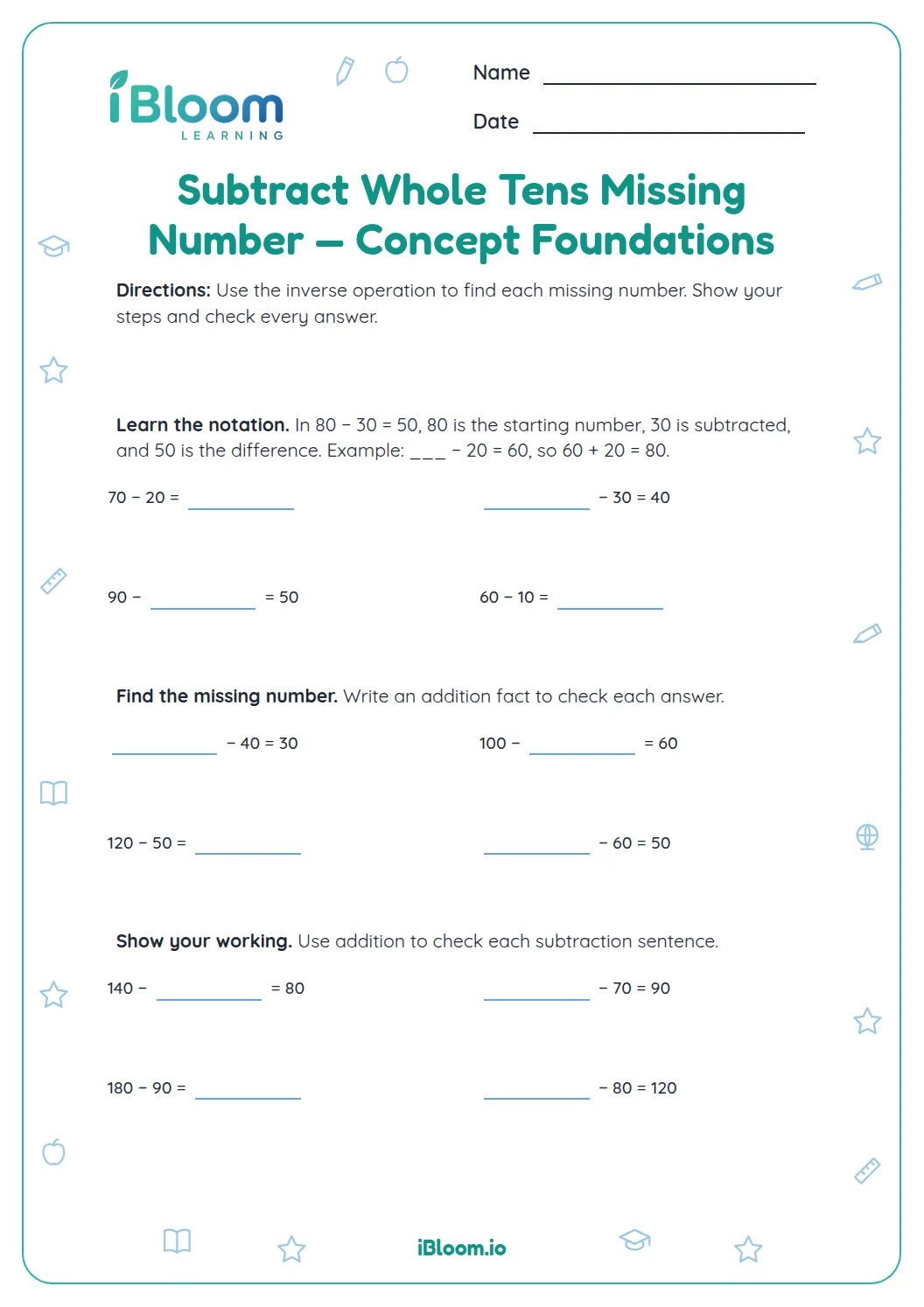
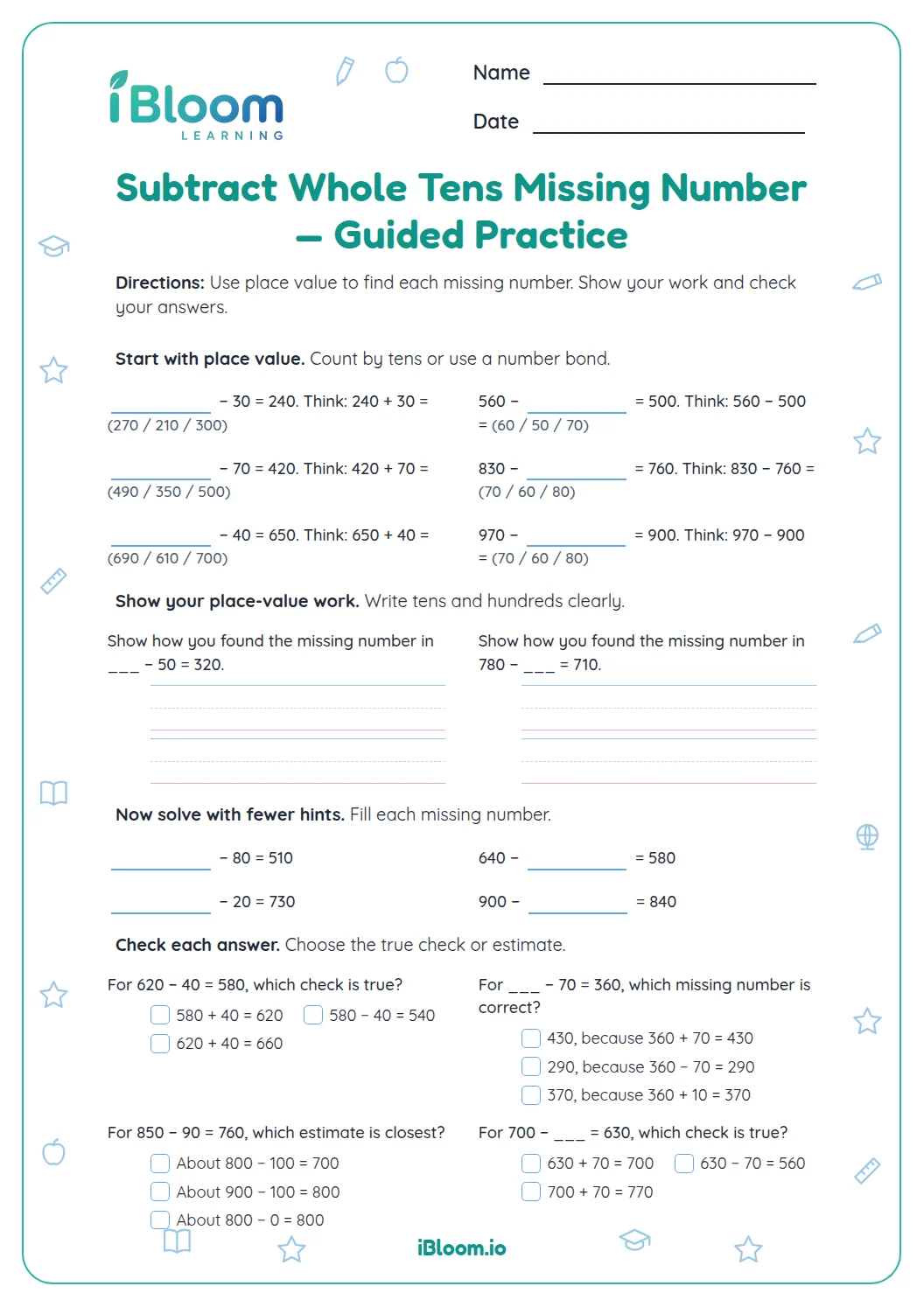
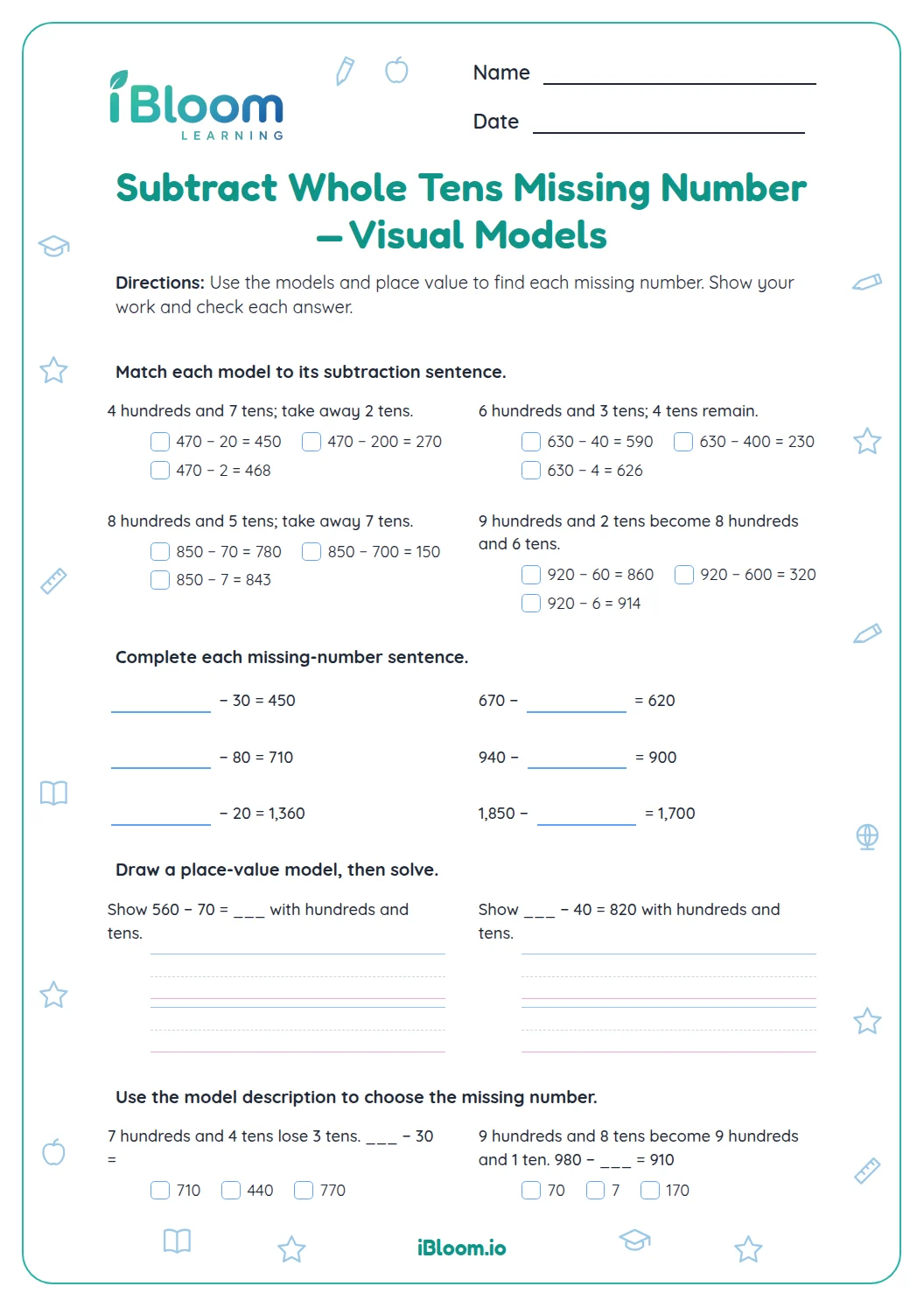
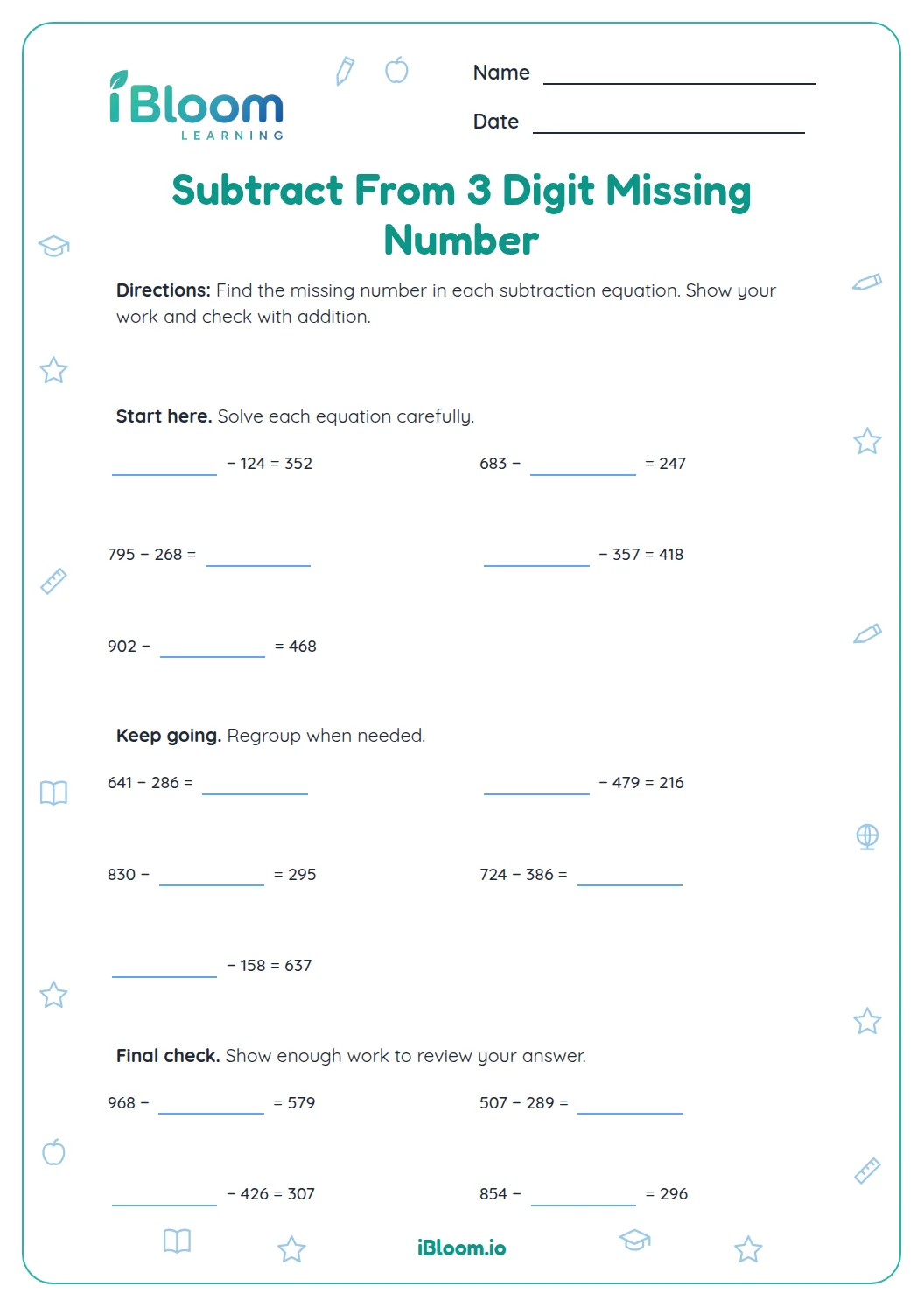
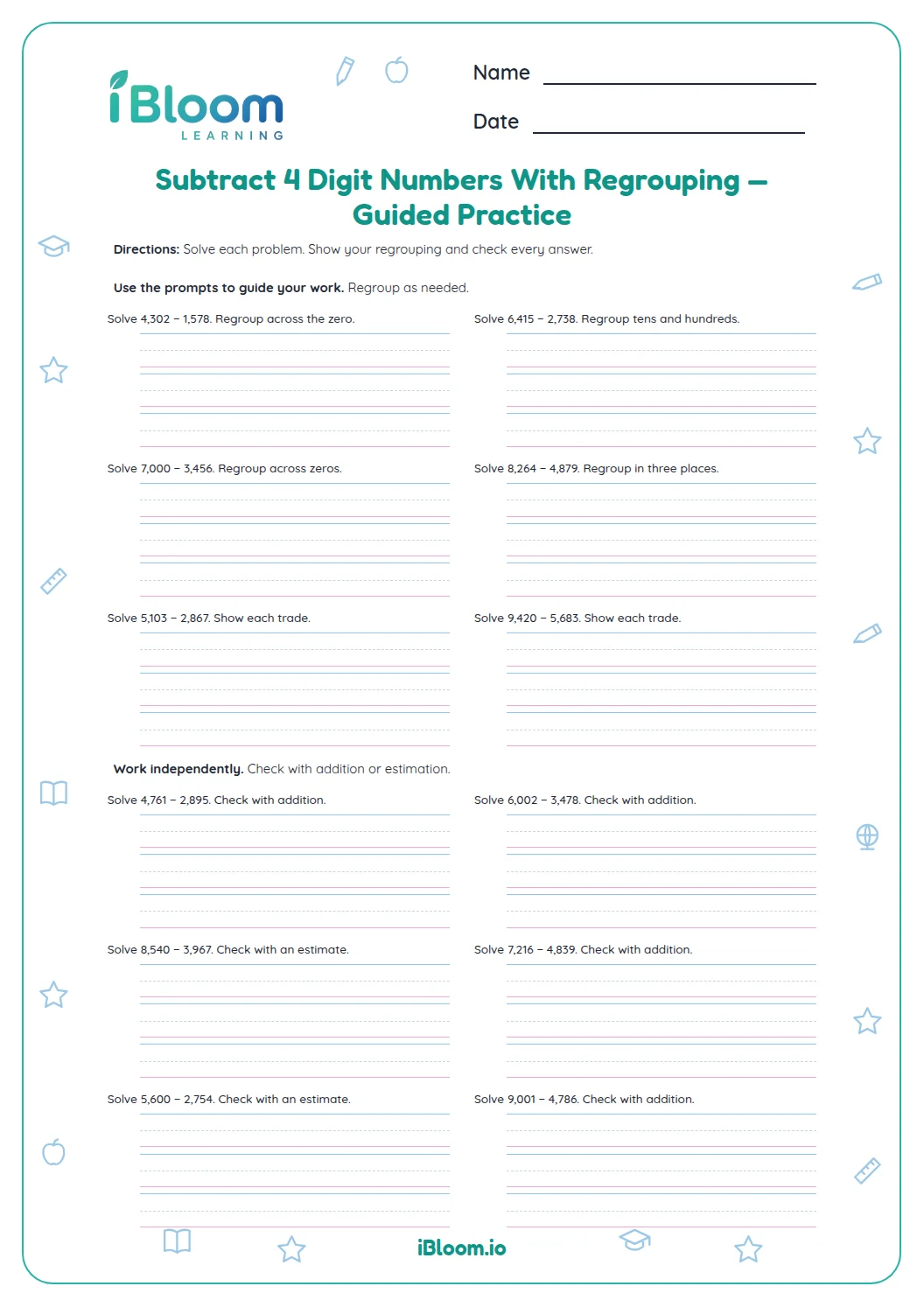
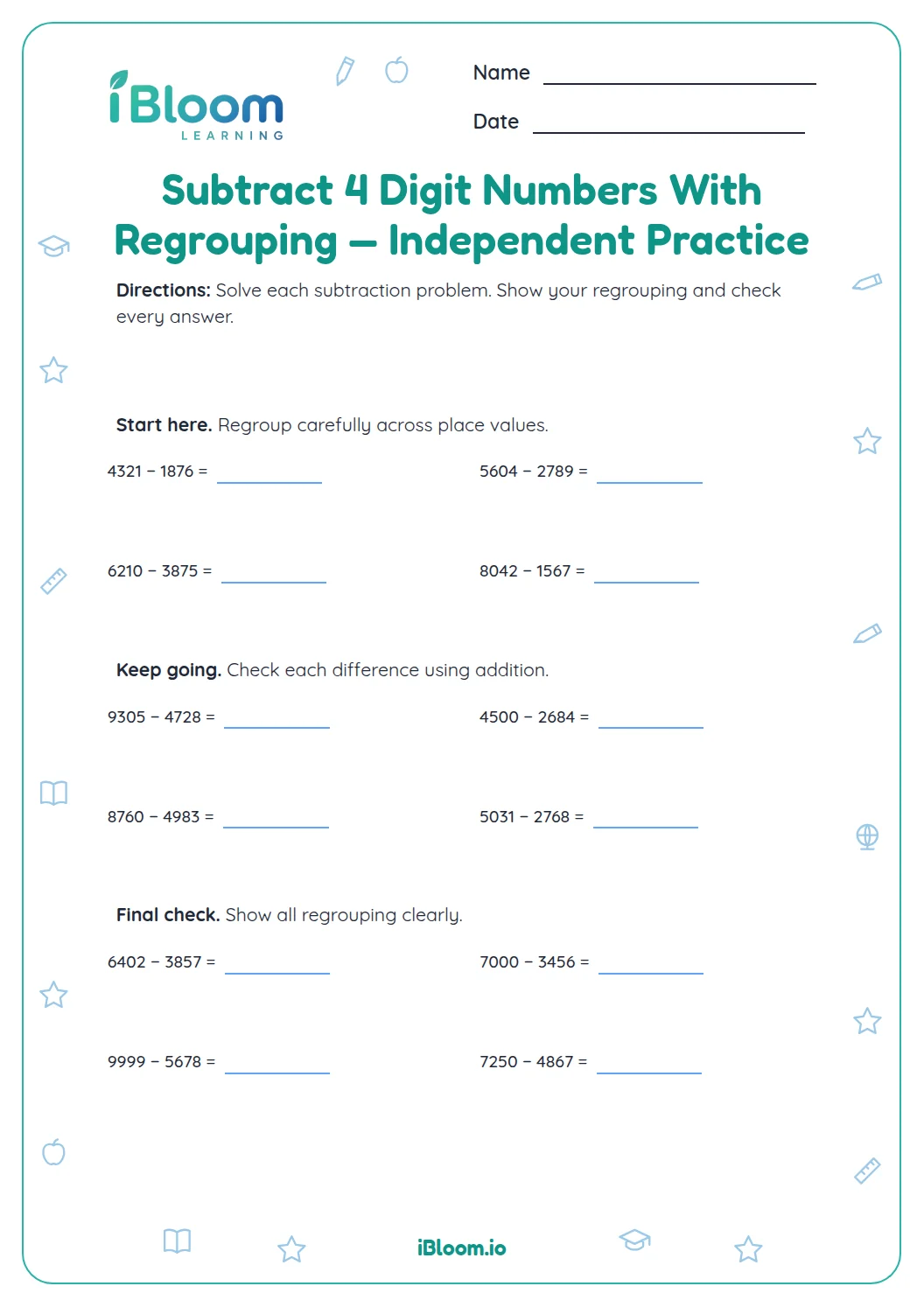
This free printable Grade 4 worksheet gives children subtraction sentences with one number missing, such as 740 − ___ = 390 or ___ − 280 = 460, where every number is a whole ten. It is independent practice: there is no model to follow, so children decide whether to add or subtract, regroup when they need to, and check each answer. Fourteen number sentences move from 3-digit numbers to 1,000 and 2,000, and two short stories finish the page. It supports Common Core 4.NBT.B.4, and a separate answer key gives every answer.
Aligned to 4.NBT.B.4
What does a missing number in a subtraction sentence mean?
Every subtraction sentence has three numbers: the whole you start with (the minuend), the amount you take away (the subtrahend), and what is left (the difference). Usually the blank sits after the equals sign. In a missing-number sentence it can sit in front instead, so children have to think about how the three numbers relate.
That is why these sentences are worth practicing. A child who only reads "subtract the second number from the first" will stumble on ___ − 40 = 270, where the blank is the starting number. Seeing that the three parts are connected, and that addition undoes subtraction, is what makes the sentence solvable.
Why use whole tens, and how do you solve them?
When every number ends in 0, children can think in tens instead of ones. 740 is 74 tens, 390 is 39 tens, and the missing number is 74 tens − 39 tens = 35 tens, or 350. The regrouping step is the same one used in any multi-digit subtraction, but the zeros keep the focus on place value.
If the blank is the starting number, flip to addition. In ___ − 280 = 460, the starting number is the difference plus what was taken away: 460 + 280 = 740.
- 1Question 5: 740 − ___ = 390
- 2The blank is the amount taken away, so subtract: 740 − 390 = 350.
- 3Check: 390 + 350 = 740. ✓
- 4Question 6: ___ − 280 = 460
- 5The blank is the starting number, so add: 460 + 280 = 740.
- 6Check: 740 − 280 = 460. ✓
What is on this worksheet?
Part A, "Find the missing part," has four sentences with 3-digit numbers and no regrouping, where the blank moves around: 560 − ___ = 320, ___ − 40 = 270, 860 − 340 = ___ and ___ − 150 = 430. Part B, "Regroup a hundred," uses numbers like 740 − ___ = 390 and 620 − 470 = ___, where a hundred must be renamed as ten tens.
Part C, "Bigger numbers," reaches 1,000 and 2,000, including 1,000 − ___ = 640, 2,000 − ___ = 1,260 and 1,700 − ___ = 870, which ask children to regroup across several places. Part D has two stories with space for a number sentence and working: books sold at a library sale, and the cost of a bike.
- Part A: 4 sentences, 3-digit numbers, blank in different places
- Part B: 4 sentences that need regrouping
- Part C: 6 sentences up to 1,000 and 2,000
- Part D: 2 word problems with working space
How can children check their own answers?
Because this is independent practice, the check matters as much as the answer. For a missing amount taken away, add it to the difference and look for the starting number. For a missing starting number, subtract the amount taken away from it and look for the difference.
Children who get into the habit of checking catch most slips on their own, and the answer key then confirms rather than corrects. If a check fails, they redo the step instead of guessing which number is wrong.
How to use this worksheet at home or in class
- 1Warm up with one oral sentence, such as 50 − ___ = 20, and ask which operation finds the missing number.
- 2Let your child read the Part A directions and start alone. The sheet is built for independent work.
- 3Ask for a quick check after every answer: add or subtract the other way and compare with the sentence.
- 4In Part B and C, point out that 740 is 74 tens when a regrouping step feels tricky.
- 5For the stories in Part D, have your child write a number sentence with a blank before solving.
- 6Use the answer key last. For a miss, ask your child to explain which part of the sentence the blank stands for.
Common mistakes and quick fixes
The mistake
Subtracting in the wrong direction when the blank is the starting number, for example writing 460 − 280 = 180 for ___ − 280 = 460.
The fix
Ask whether the answer should be larger or smaller than 460. The starting number must be larger, so add: 460 + 280 = 740.
The mistake
Subtracting the smaller digit from the larger in each place, so 740 − 350 is worked as 410 instead of 390.
The fix
Rewrite the hundreds as tens. 74 tens − 35 tens = 39 tens, and 39 tens is 390. Always ask whether the tens place needs regrouping first.
The mistake
Losing track of the zeros in 1,000 and 2,000, such as 1,000 − 360 = 740.
The fix
Think of 1,000 as 100 tens and subtract in tens: 100 tens − 36 tens = 64 tens, which is 640. Check by adding 360 + 640.
Common Core alignment
Most US states use the Common Core math standards or a close state version, so this sheet fits Grade 4 subtraction in most classrooms.
Subtract (and add to check) multi-digit whole numbers with the standard algorithm, regrouping where needed.
On this sheet: Every question needs multi-digit subtraction or an addition check, with regrouping across tens, hundreds and thousands.
Show the official wordingHide the official wording
Fluently add and subtract multi-digit whole numbers using the standard algorithm.
What to practice next
Make more practice
Further reading
Questions parents and teachers ask
What do the blanks mean in these subtraction sentences?
The blank is a number your child must find. It can be the amount taken away, the answer, or the number you start with. In 560 − ___ = 320 the blank is the amount taken away, so the child works out 560 − 320 and finds 240.
When should my child add instead of subtract?
Add when the blank is the starting number, as in ___ − 280 = 460. The starting number is what is left plus what was taken away, so the child adds 460 + 280 to get 740. Subtract when the blank is the answer or the amount taken away.
Why does every number on the sheet end in zero?
Whole tens let children focus on regrouping and place value without a distracting ones digit. They can think in tens, such as 74 tens − 39 tens, and still use the standard algorithm. Once that is secure, the linked sheets add numbers with nonzero ones digits.
What are the answers to the two word problems?
The library sold 590 books, because 1,450 − 590 = 860, and the bike cost $460, because 740 − 460 = 280. Children can write the number sentence 1,450 − ___ = 860 first, then solve. The answer key shows both alongside the other 14 answers.
Can my child use a calculator or an addition check?
Skip the calculator, since the goal is fluency with the standard algorithm, but do encourage an addition check. Adding the answer back to the amount taken away should return the starting number. It takes seconds and helps children catch slips in regrouping on their own.
Is there an answer key, and how long does the sheet take?
Yes, the answer key is a separate file showing all 16 answers, including the story problems. Most Grade 4 children finish in about 20 minutes. Allow a little longer for the stories in Part D and for children who check every answer by adding back.