

About this worksheet
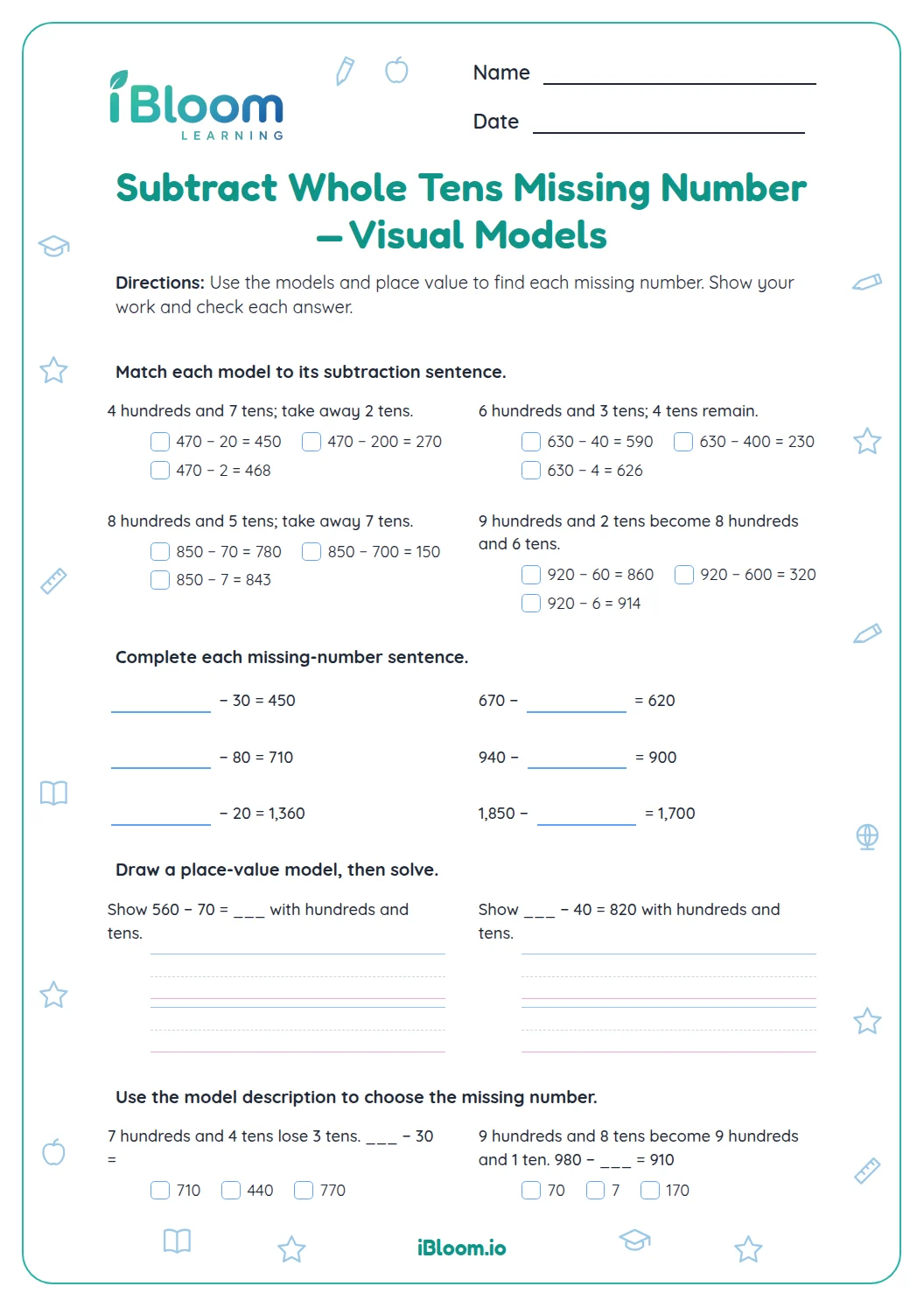
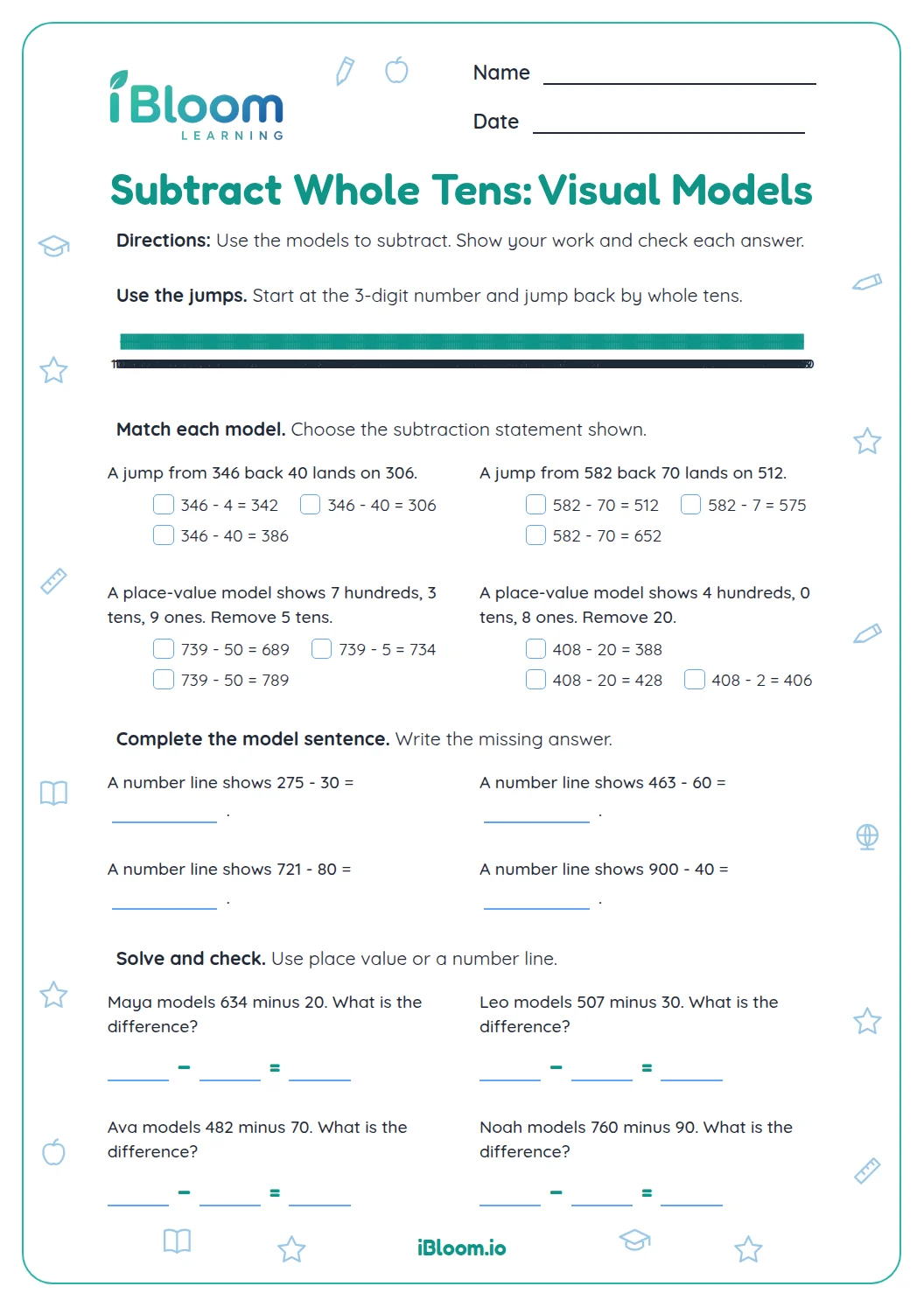
This Grade 4 worksheet combines number-line models and equations to practice subtracting whole tens from three-digit numbers. Students count backward by tens in the first eight problems, then find six more differences. The answer key shows each result.
How do the number lines model subtraction?
The first eight problems use number lines divided into equal jumps of ten. Begin at the starting number and count backward by the number of tens in the prompt.
The final six problems use equations to apply the same place-value reasoning. All 14 questions avoid crossing a hundred.
- Part A: count back by tens on number lines
- Part B: solve six subtraction equations
- Check by adding the tens back
- Answer key included
How can students check a difference?
A subtraction can be checked by adding the amount taken away to the difference. If the sum returns to the starting number, the answer is consistent.
- 1Start at 347 and jump back 2 tens.
- 2347 − 20 = 327
- 3Check: 327 + 20 = 347.
How can students check their work?
For a number-line item, count the jumps and compare the landing value with the equation you would write. For the remaining equations, add the tens back to check the starting number.
How to use this worksheet
- 1Read the starting number and the number of tens to subtract.
- 2Begin at the starting number on the number line.
- 3Count backward one equal jump for each ten.
- 4Write the number where you land.
- 5Add the tens back to check your difference.
Common subtraction slips
The mistake
Treating 40 as 4 instead of four tens.
The fix
Count four jumps of ten when subtracting 40.
The mistake
Counting forward from the starting number.
The fix
Subtraction means move left on the number line, toward smaller numbers.
The mistake
Changing the ones digit when subtracting whole tens.
The fix
Each jump changes the number by ten, so the ones digit stays the same.
The mistake
Using a different number of jumps from the tens in the prompt.
The fix
Match one backward jump to each ten being subtracted.
What to practice next
Make more practice
Questions parents and teachers ask
What does one jump on a number line represent?
One jump represents ten. The prompt tells students how many tens to subtract, so they count backward by that many equal jumps from the starting number. The number line makes the change in tens visible in each of the first eight questions.
Do any problems cross a hundred?
No. Each problem is chosen so the tens can be subtracted without crossing a hundred. This lets students focus on counting back by tens while keeping the hundreds and ones in view. The last six items use equations for the same kind of subtraction.
How can students check their answers?
Add the subtracted amount back to the difference. For example, 327 + 20 returns to 347. If the sum matches the starting number in the question, the subtraction is checked. The answer key shows each expected difference for comparison.
Why does the ones digit stay the same?
The amount being subtracted is a whole number of tens, so it has zero ones. Each line jump changes the tens value by ten and leaves the ones place unchanged in these problems. Students can verify this by comparing the start and end values.
How many number-line problems are included?
There are eight number-line subtraction problems and six additional equations, for 14 questions total. The worksheet and answer key each span three pages. Every item asks students to subtract a whole-tens amount from a three-digit number and find the difference.