

About this worksheet
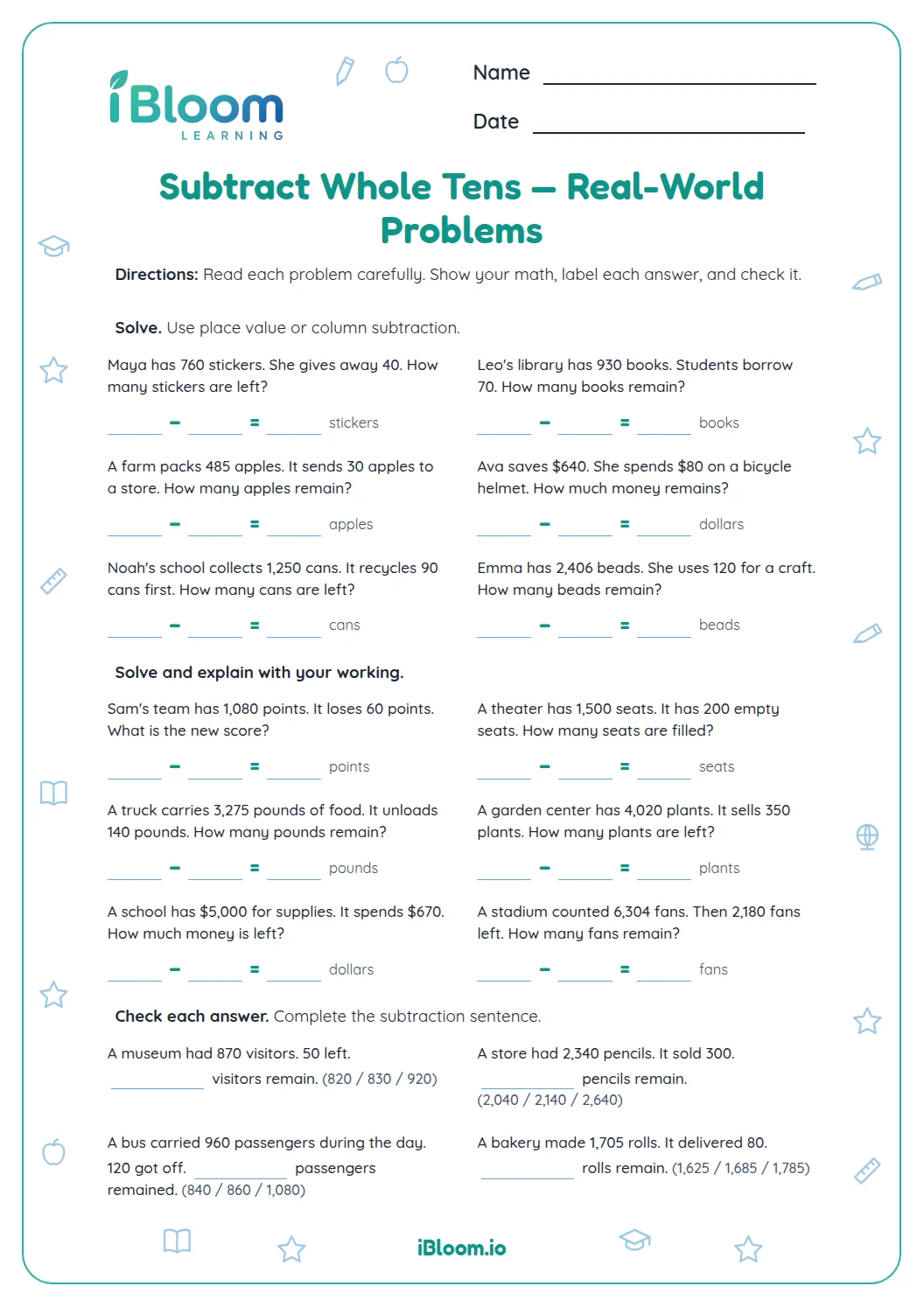
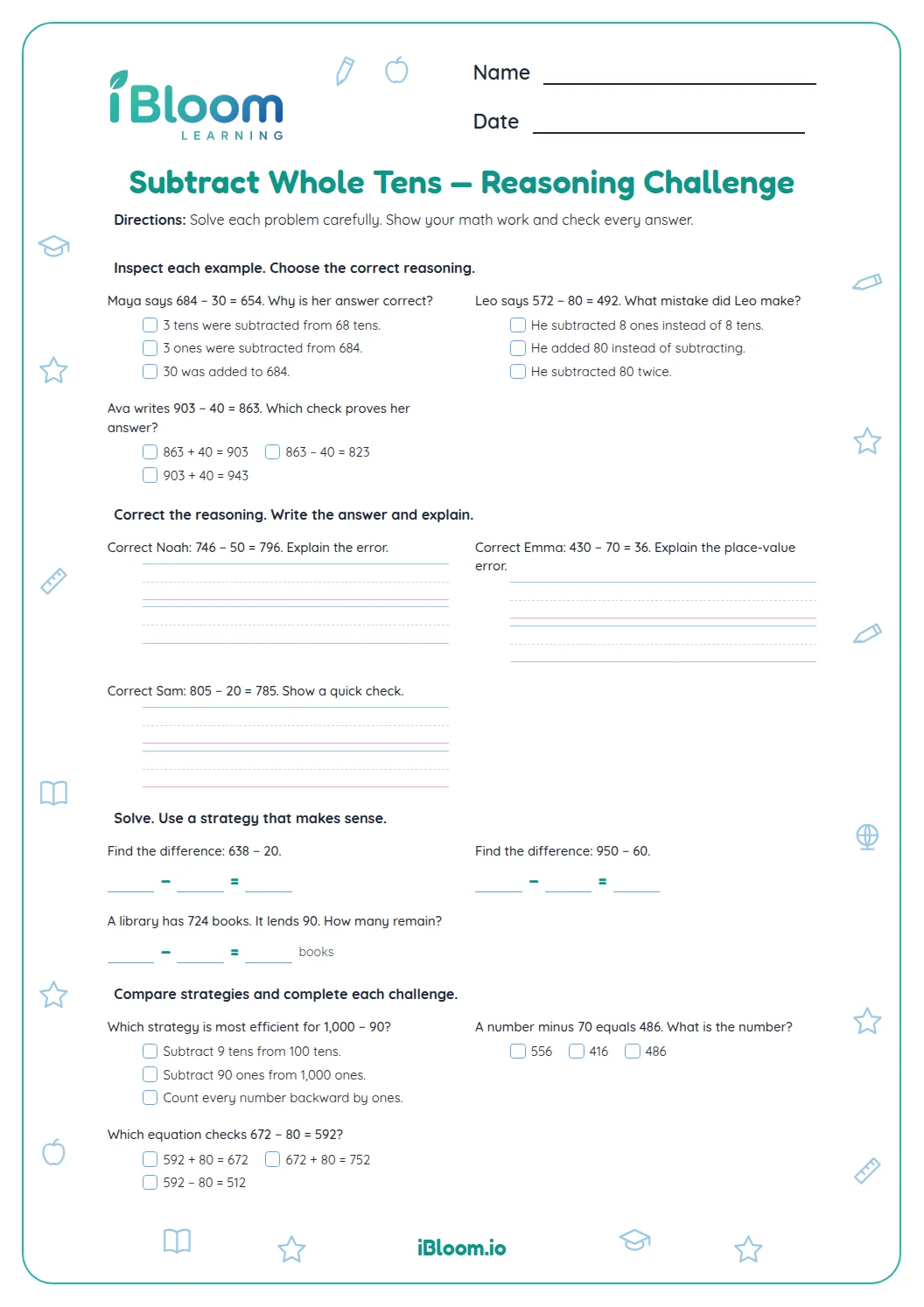
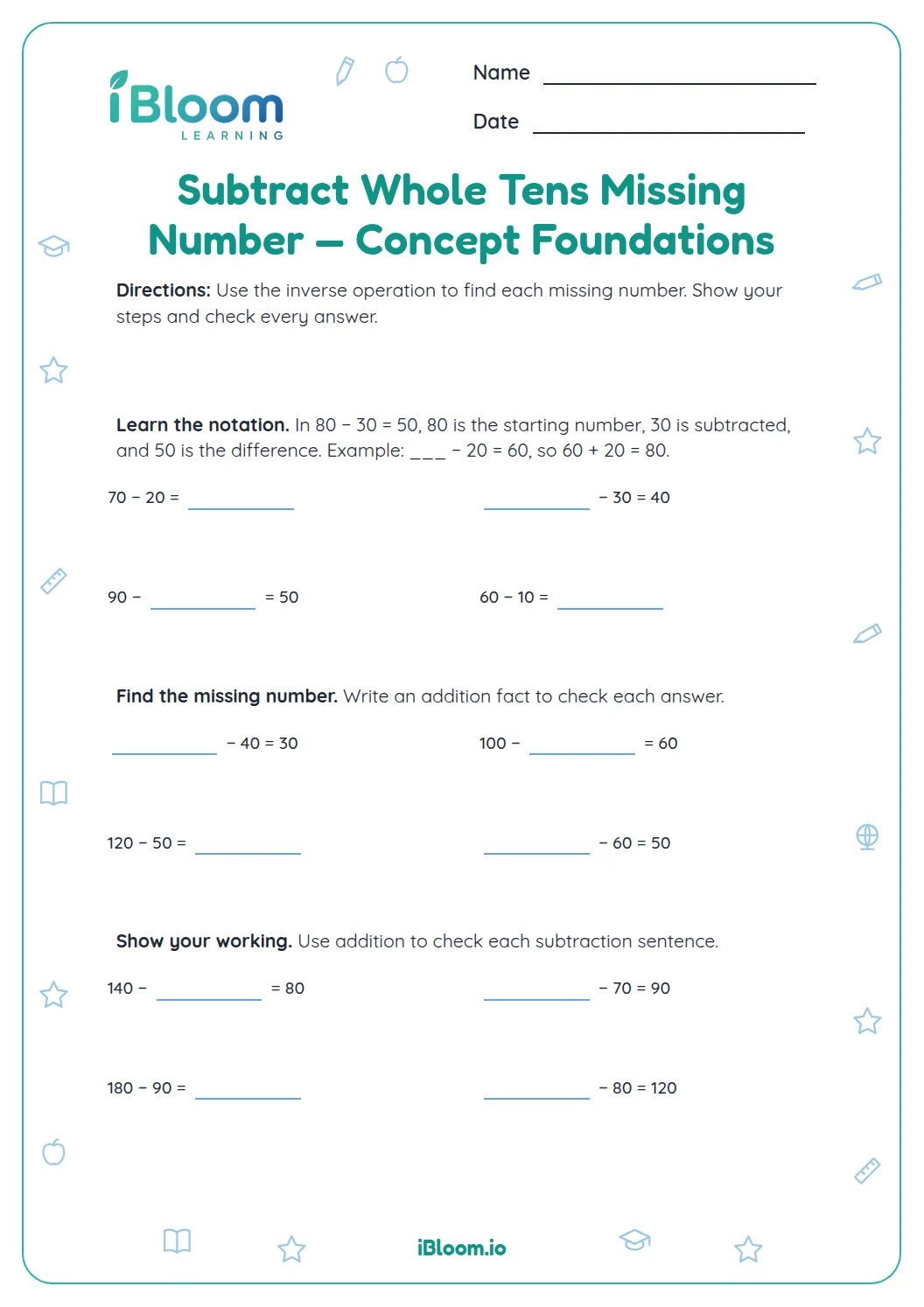
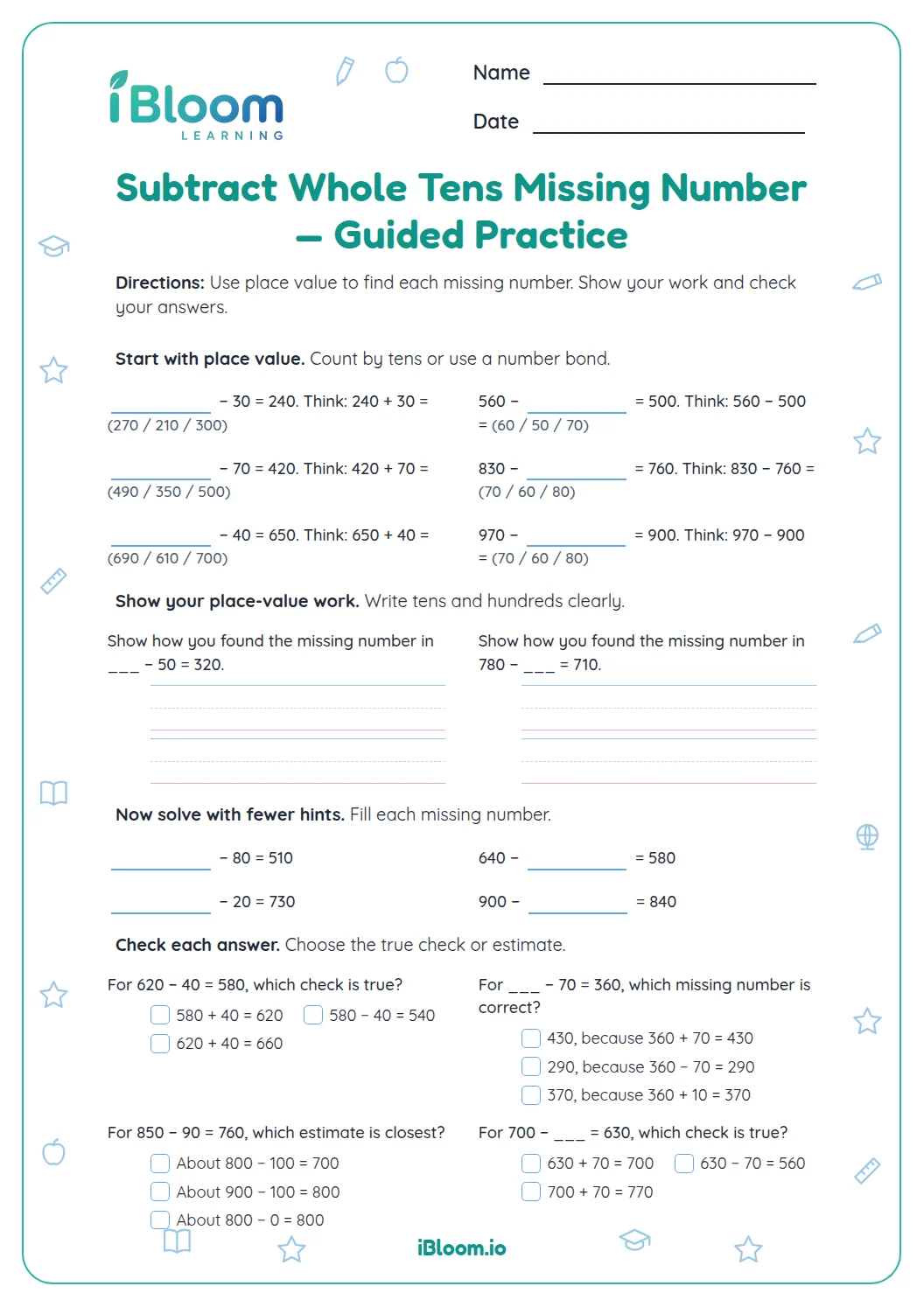
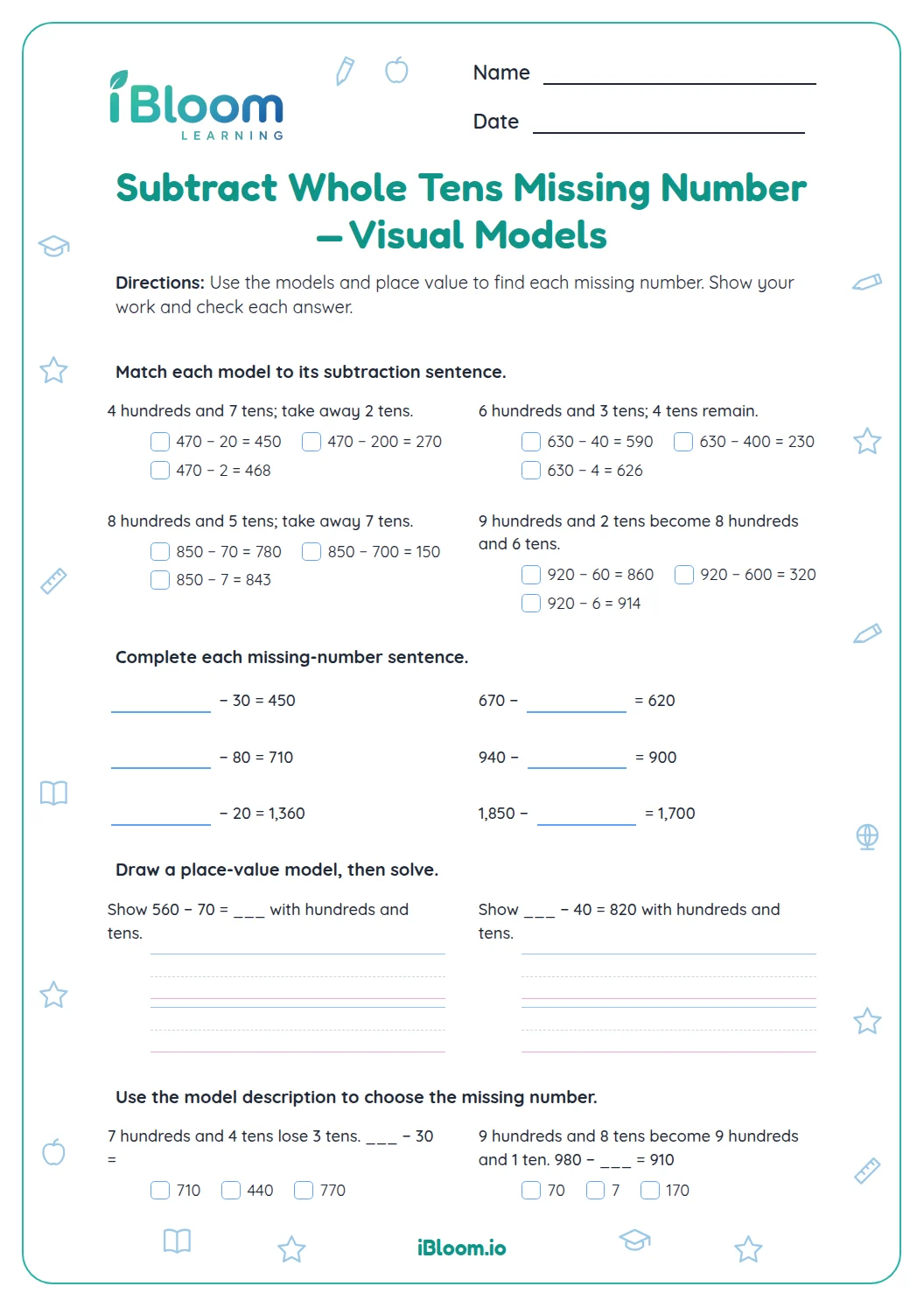
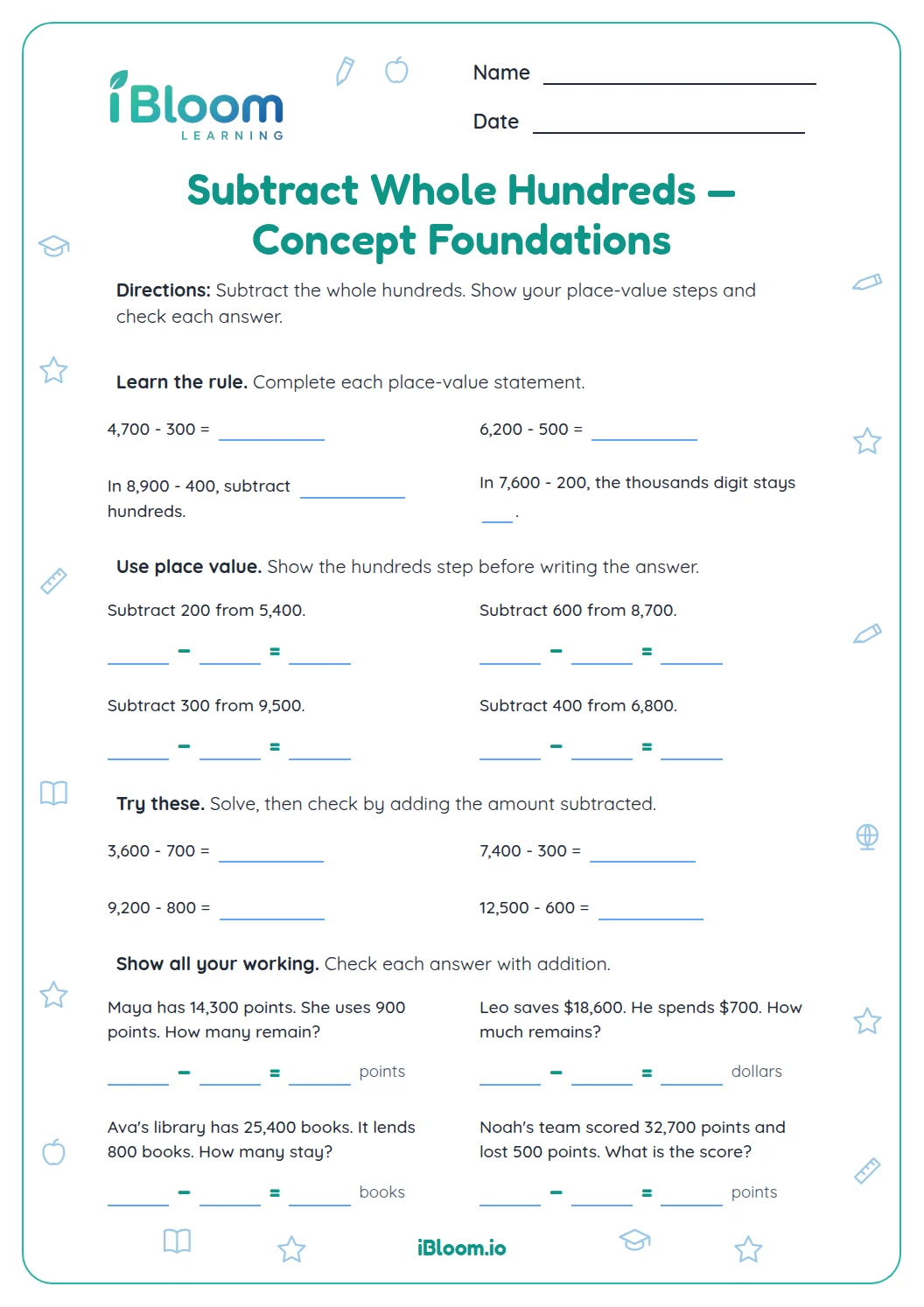
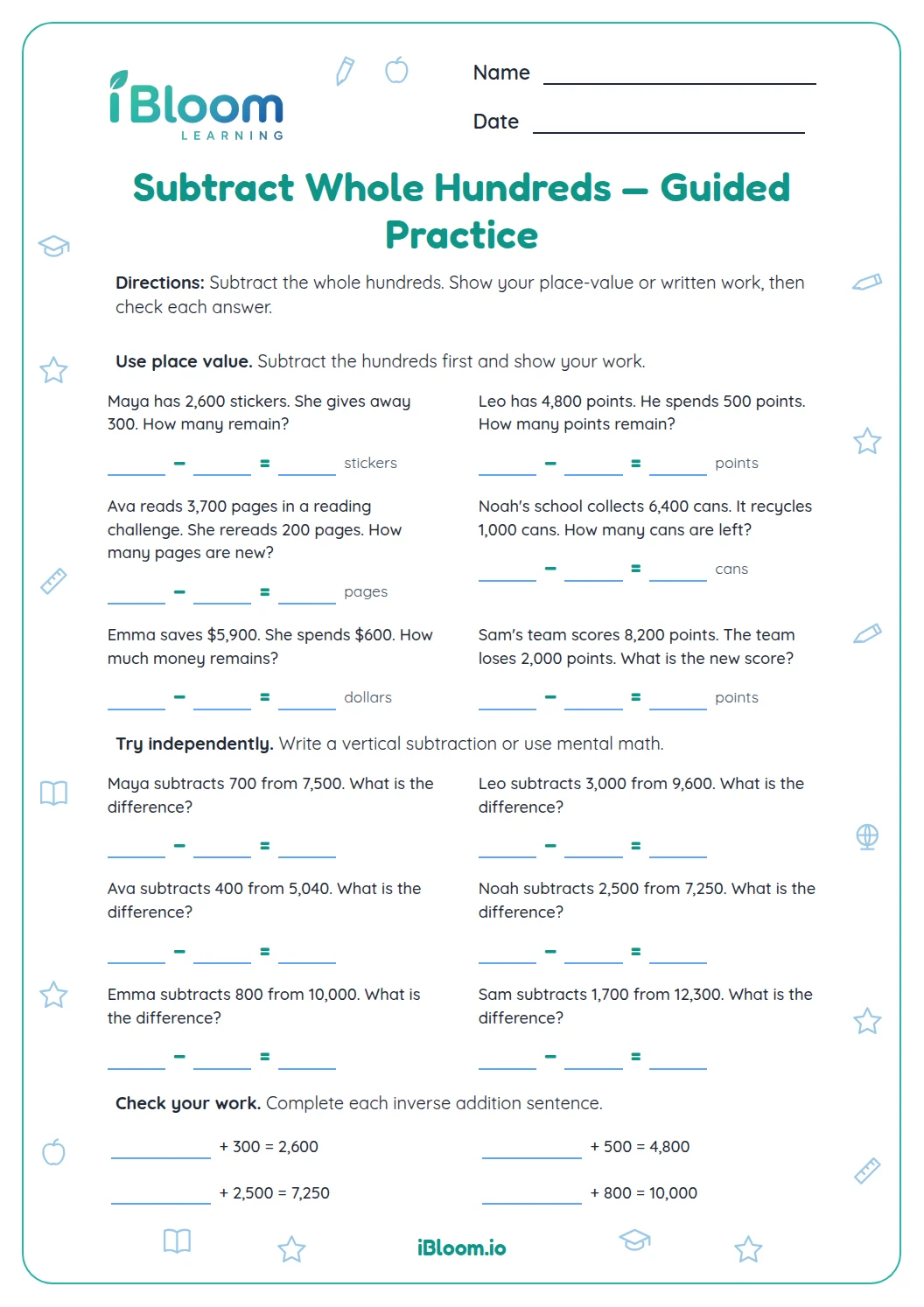
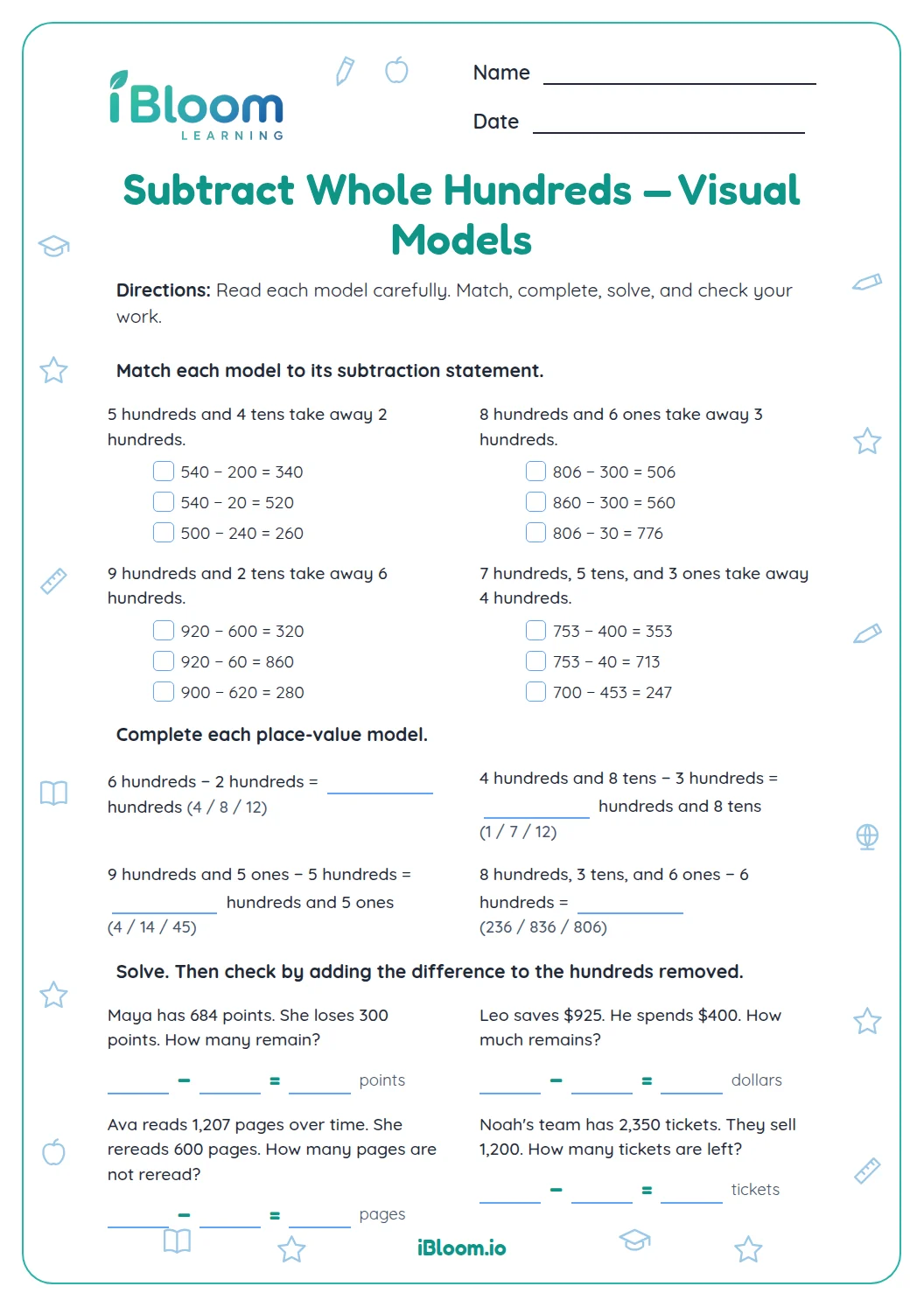
This free printable worksheet gives Grade 4 students guided practice at subtracting whole tens, such as 86 − 30, 243 − 90 and 1,250 − 80. Part A walks through the idea of counting tens first. Part B moves to numbers where the tens run out and the hundreds have to change, including 700 − 30. Part C asks for missing numbers, and Part D has three word problems with working space. It practices Common Core 4.NBT.B.4 and builds on 3.NBT.A.2. A separate answer key is included.
Aligned to 4.NBT.B.4 and 3.NBT.A.2
How do you subtract whole tens in your head?
A whole ten is a number like 30, 60 or 90. When you subtract one, only the tens (and sometimes the hundreds) change, so the ones digit stays put. In 86 − 30, the 6 ones are untouched, and 8 tens − 3 tens = 5 tens, giving 56.
That is why it helps to name numbers by their tens. 142 is 14 tens and 2 ones. Subtract 6 tens and you have 8 tens and 2 ones, which is 82. The same thinking works for 1,250 − 80, where 125 tens − 8 tens = 117 tens, or 1,170.
- 1142 − 60
- 2142 is 14 tens and 2 ones
- 314 tens − 6 tens = 8 tens
- 48 tens and 2 ones = 82
- 5Check: 82 + 60 = 142
What happens when the tens run out?
In 243 − 90, the tens place shows only 4 tens, so you cannot take away 9 tens from it. Children who think in tens do not get stuck: 243 is 24 tens and 3 ones, and 24 tens − 9 tens = 15 tens. Fifteen tens and 3 ones is 153. A hundred has been broken into ten tens along the way, without any crossing out.
Part B is built around this move. Question 10, 700 − 30, trips up the most children because there are no tens or ones to start from. Seven hundreds is 70 tens, and 70 tens − 3 tens = 67 tens, which is 670. Counting tens is faster and safer than borrowing across the zeros.
What is on this worksheet?
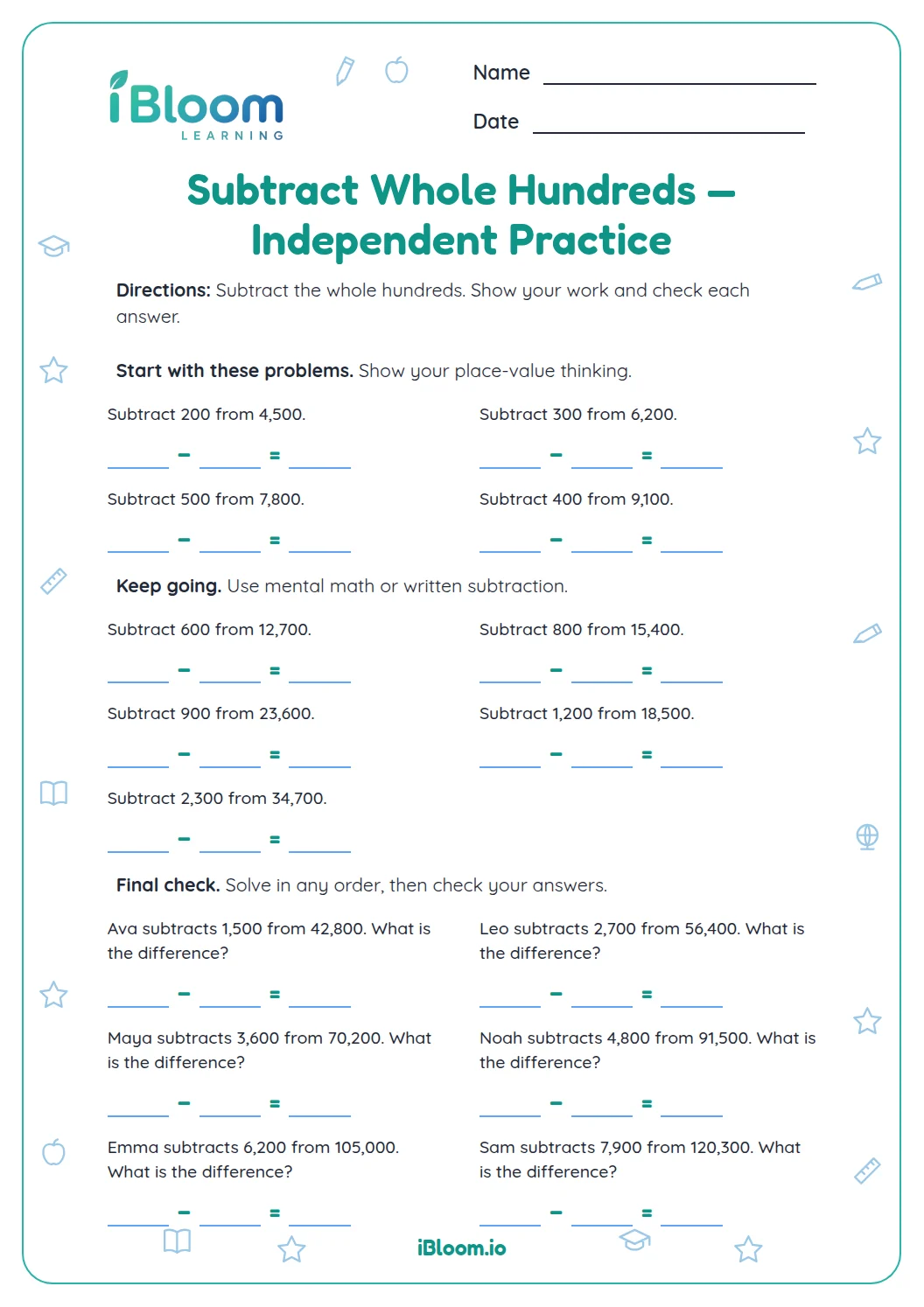
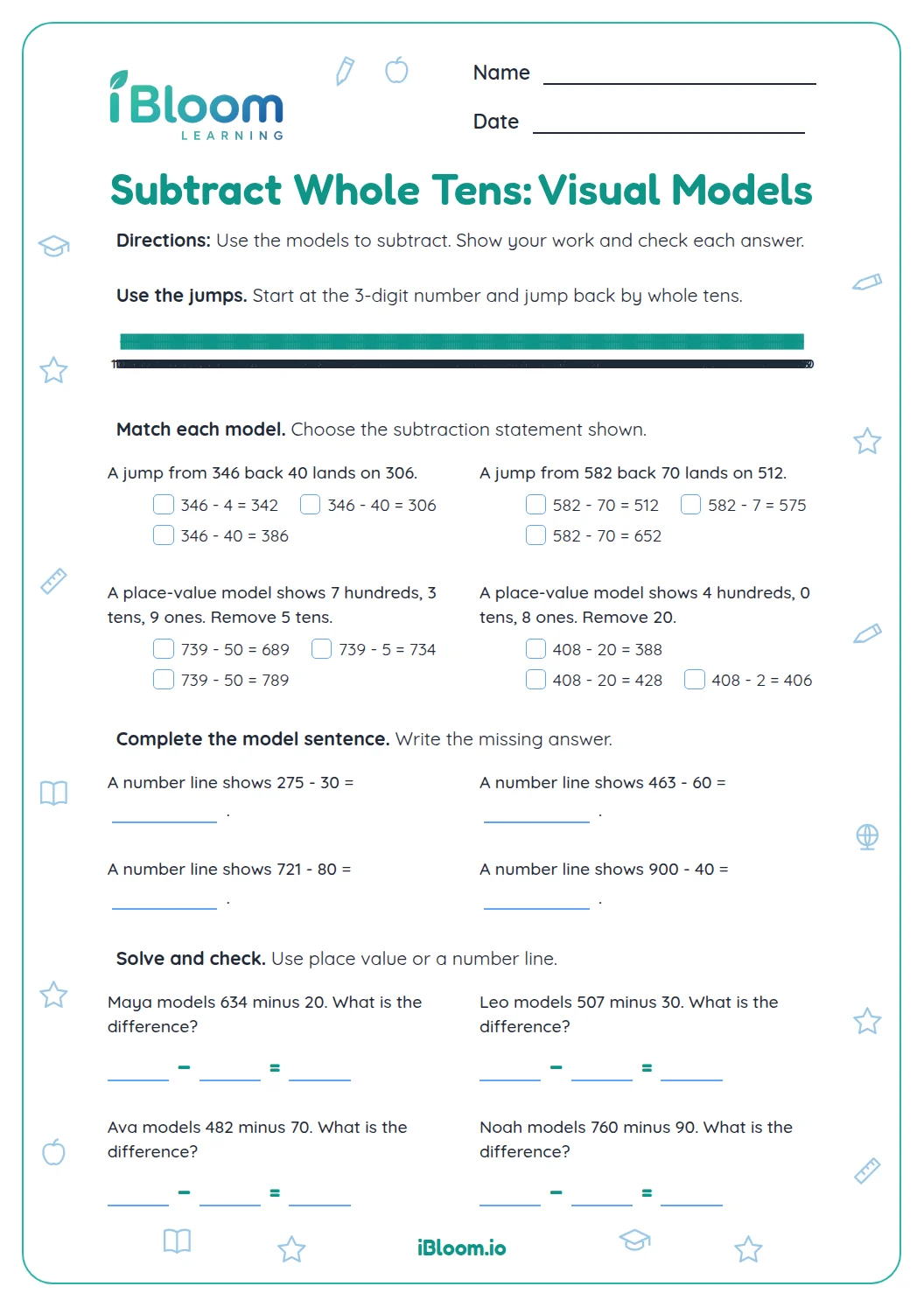
Eighteen questions in four parts, over two pages. The numbers start at two digits and end at four, and every subtracted number is a whole ten from 30 to 90.
Part A is the guided part: questions 1 and 3 ask only for the number of tens, and questions 2, 4 and 5 ask for the full answer. Part B has six subtractions where the hundreds change. Part C asks for the missing number, in a subtrahend or a starting number. Part D has three word problems, the last with two subtractions.
- Part A, Think in tens: 5 questions, 2 of them counting tens only
- Part B, Past the hundred: 6 questions from 128 − 40 to 1,250 − 80
- Part C, Missing numbers: 4 questions such as ___ − 60 = 72
- Part D, Word problems: 3 stories with space to write a number sentence
- Answer key on separate pages
How can students check a subtraction answer?
Add the answer back to the number that was subtracted. If 243 − 90 = 153, then 153 + 90 should equal 243. Adding whole tens is easy to do mentally, so the check is quick.
The same idea finds missing numbers in Part C. For ___ − 30 = 54, add 54 + 30 to get the starting number, 84. This is the relationship between addition and subtraction that 3.NBT.A.2 asks children to use.
How to use this worksheet at home or in class
- 1Warm up with a number line or place-value chart. Ask: "What is 5 tens minus 2 tens?" Then try 50 − 20.
- 2Do questions 1 to 4 together. Say "tens" out loud each time, and have your child write the tens count before the answer.
- 3Let your child finish Part A, then check the ones digit: it should match the starting number.
- 4In Part B, ask what happens when the tens are not enough. Have your child try question 7 (243 − 90) by counting tens.
- 5Work Part C by adding. Ask: "What would I add to the answer to get back to the start?"
- 6For Part D, ask for a number sentence before any working, then mark the sheet with the answer key and redo any miss with place-value blocks or a drawing.
Common mistakes and quick fixes
The mistake
Subtracting from the ones digit, writing 86 − 30 = 83 because 6 − 3 = 3.
The fix
Say the numbers in tens: 8 tens − 3 tens. Point out that the ones digit never changes when a whole ten is subtracted, so the answer must end in 6.
The mistake
Turning the digits around when the tens run out, as in 243 − 90 = 253 because 9 − 4 = 5.
The fix
Rename the number in tens: 243 is 24 tens and 3 ones. Then 24 tens − 9 tens = 15 tens, and 15 tens and 3 ones is 153. Check by adding 153 + 90 = 243.
The mistake
Writing 730 for 700 − 30 by taking the smaller digit from the larger, because 0 − 3 “can’t be done.”
The fix
Think of 700 as 70 tens. Then 70 tens − 3 tens = 67 tens, which is 670. The answer must be less than 700, and 670 + 30 = 700 confirms it.
Common Core alignment
Most US states use the Common Core standards or a close state version. This sheet practices the Grade 4 subtraction standard and the Grade 3 place-value strategies below.
Subtract multi-digit numbers accurately; here the numbers are 2 to 4 digits and you take away whole tens.
On this sheet: Every subtraction uses 2-, 3- or 4-digit numbers, including the two-step word problem; it is solved by tens, not columns.
Show the official wordingHide the official wording
Fluently add and subtract multi-digit whole numbers using the standard algorithm.
Subtract within 1,000 by thinking in tens and hundreds, and check by adding back.
On this sheet: Counting tens and the addition check in Part C are the place-value and inverse strategies this standard names.
Show the official wordingHide the official wording
Fluently add and subtract within 1000 using strategies and algorithms based on place value, properties of operations, and/or the relationship between addition and subtraction.
What to practice next
Make more practice
Further reading
Questions parents and teachers ask
What does subtracting whole tens mean?
It means subtracting a number made of tens only, like 30, 60 or 90, from a larger number. Because a whole ten has no ones, the ones digit of the answer is the same as the ones digit you started with. In 86 − 30 = 56, the 6 stays and the tens go from 8 to 5.
Why does the sheet ask for the number of tens first?
Counting tens shows what really changes when you subtract a whole ten. In question 3, 142 is 14 tens and 2 ones, so 14 tens − 6 tens = 8 tens. Question 4 then asks for the full answer, 82. Once children see this, the hundreds changing in Part B stops being a surprise.
Why is 700 − 30 harder than 86 − 30?
In 700 − 30 there are no tens to take from, so children must think of the 7 hundreds as 70 tens. Then 70 tens − 3 tens = 67 tens, or 670. In 86 − 30 the 8 tens are already there, so the tens digit simply drops from 8 to 5.
Is this sheet right for Grade 3 students too?
Mostly for Grade 4. Grade 3 children subtract within 1,000 using place value, so Parts A to C, apart from question 11, are within reach. Question 11 (1,250 − 80), question 17 and the two-step question 18 are better kept for Grade 4. The Grade 3 standard, 3.NBT.A.2, is the foundation.
Should children use the standard algorithm or mental math here?
Either. Whole tens are quick to do mentally, so the sheet leans on counting tens. Standard 4.NBT.B.4 asks for the written algorithm, so after this sheet, ask your child to set up one problem in columns and show that both ways give the same answer. Compare 243 − 90 each way.
How long does it take, and is there an answer key?
Yes, the answer key is on separate pages and shows every answer, including units for the word problems. Most Grade 4 students finish in about 20 minutes. Part A moves quickly, and the three word problems take the most time because children write a number sentence before solving them.