

About this worksheet
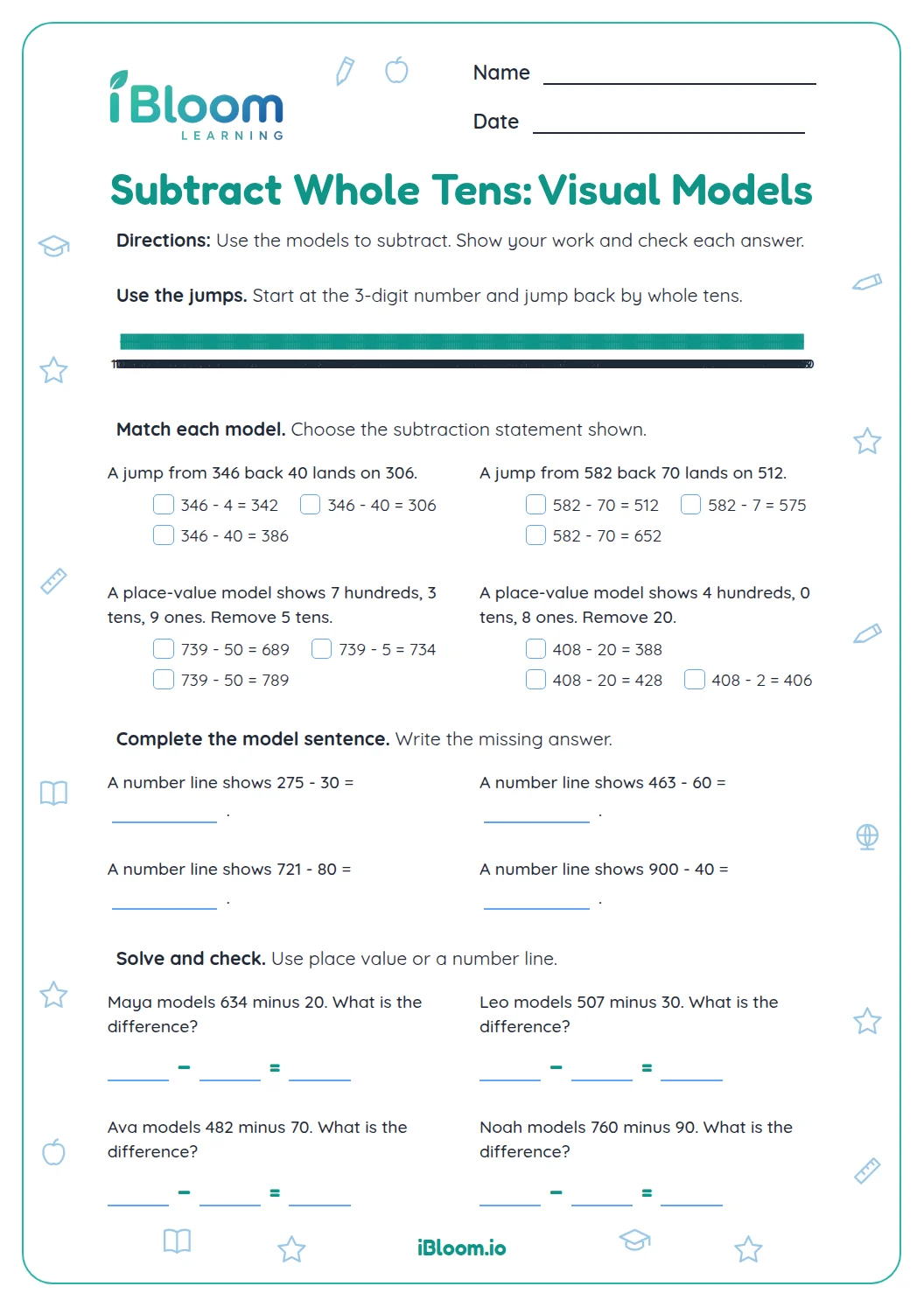
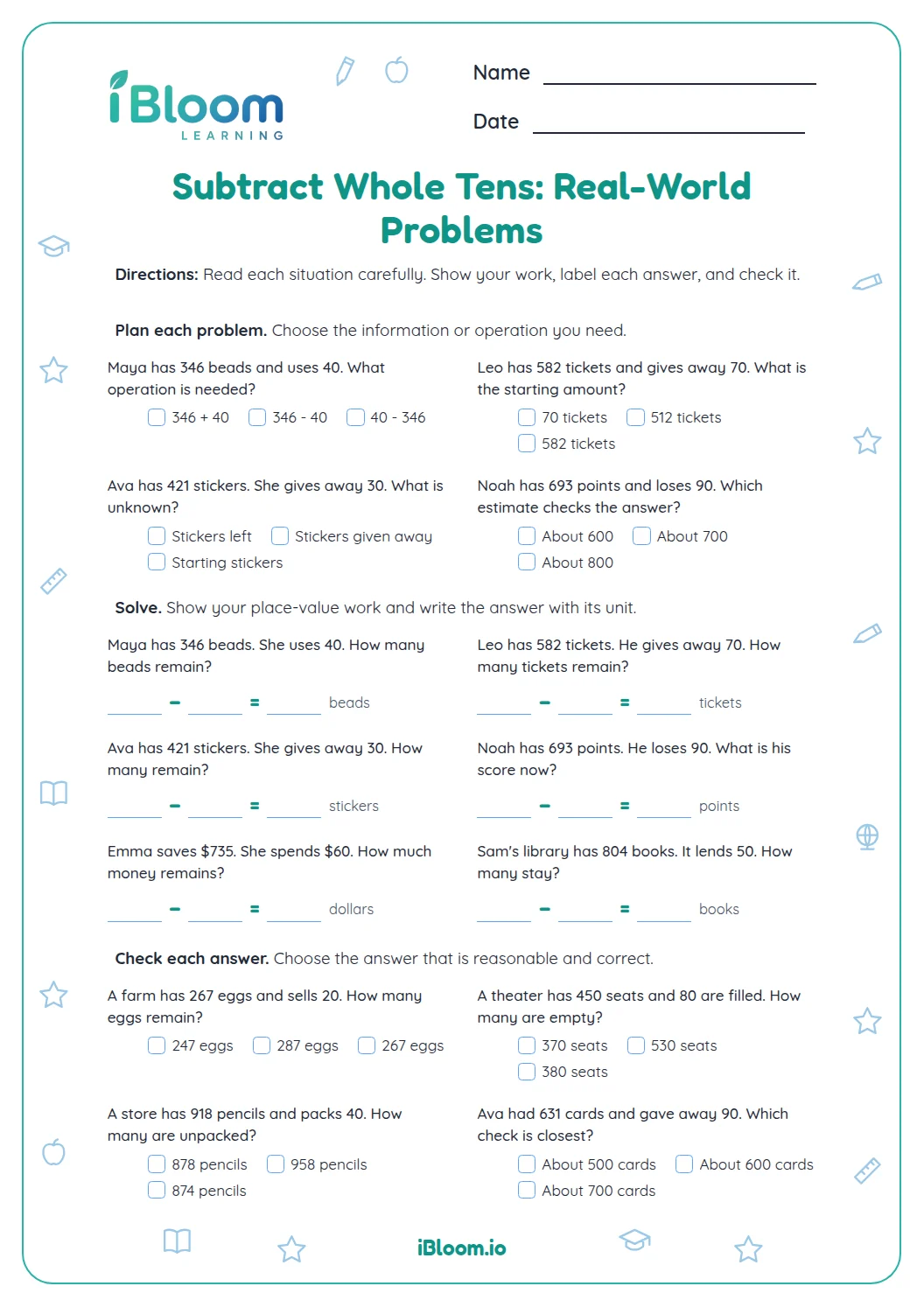
This free Grade 4 independent practice sheet focuses on subtracting a two-digit multiple of ten from a three-digit number. Students solve 16 problems in three sets: subtracting when the tens digit is large enough, subtracting across a zero, and finding a missing multiple of ten. Each answer can be checked by adding the subtrahend back to the difference. A separate answer key is provided.
Aligned to 4.NBT.B.4
What changes when you subtract whole tens?
A whole-ten subtrahend has zero ones, so the ones digit stays the same. In 486 − 30, subtract 3 tens from 8 tens: 456. The hundreds and ones remain as they were.
Question 1 is 486 − 30. The 8 tens become 5 tens, so the answer is 456.
- 1486 − 30
- 28 tens − 3 tens = 5 tens
- 3Answer: 456
How do you subtract when the tens digit is too small?
If the tens digit is smaller than the tens being taken away, regroup 1 hundred as 10 tens. For 624 − 40, rename 6 hundreds 2 tens as 5 hundreds 12 tens. Then subtract 4 tens to get 584.
How can you find the missing tens?
Use the difference to work backward. In 736 − ___ = 686, the difference from 736 to 686 is 50, so the blank is 50. Add 686 + 50 to check that it returns to 736.
How is practice organized?
Questions 1–5 subtract whole tens, with regrouping needed in questions 3 and 4. Questions 6–11 mix examples that do and do not require regrouping. Questions 12–16 ask for the missing multiple of ten.
How to use this worksheet
- 1Line up hundreds, tens, and ones mentally or on scratch paper.
- 2Subtract the tens; regroup one hundred as 10 tens when the tens digit is too small.
- 3For a small tens digit, trade one hundred for 10 tens before subtracting.
- 4For a missing number, compare the start and the difference.
- 5Add each subtrahend to its answer to check.
Mistakes to watch for
The mistake
Subtracting the tens digit as ones
The fix
The 4 in 40 means four tens, or 40. Keep the number in the tens place.
The mistake
Changing the ones digit
The fix
Subtracting a multiple of ten leaves the ones digit unchanged.
The mistake
Forgetting to regroup a hundred
The fix
Rename one hundred as 10 tens, then subtract the required tens and keep the remaining hundreds.
Common Core alignment
The problems use place value and the standard subtraction algorithm.
Students subtract multiples of ten from three-digit numbers and check differences.
On this sheet: The worksheet gives repeated three-digit subtraction practice.
Show the official wordingHide the official wording
Fluently add and subtract multi-digit whole numbers using the standard algorithm.
What to practice next
Make more practice
Further reading
Questions parents and teachers ask
Why does the ones digit stay the same?
The subtrahend is a multiple of ten, so it has zero ones. No ones are removed. For example, 486 − 30 keeps the 6 ones and changes the tens from 8 to 5. Have the student name the tens being subtracted and check by adding the difference back.
When should a student regroup?
Regroup when the tens digit in the minuend is smaller than the tens being subtracted. Trade one hundred for 10 tens, then subtract in the tens place. The ones digit remains unchanged. Have the student name the tens being subtracted and check by adding the difference back.
How can missing tens be checked?
Add the missing tens to the stated difference. The sum should equal the starting number. In 736 − ___ = 686, the blank is 50 because 686 + 50 = 736. Have the student name the tens being subtracted and check by adding the difference back.
How many problems are on the page?
The sheet has 16 problems: 11 ask for a difference and five ask for a missing multiple of ten. The problems are grouped by whether regrouping is needed. Have the student name the tens being subtracted and check by adding the difference back.
Does this worksheet include an answer key?
Yes. A separate key lists each difference and each missing tens value. Students can also verify answers with addition, which reverses the subtraction in every problem. Have the student name the tens being subtracted and check by adding the difference back.