



About this worksheet
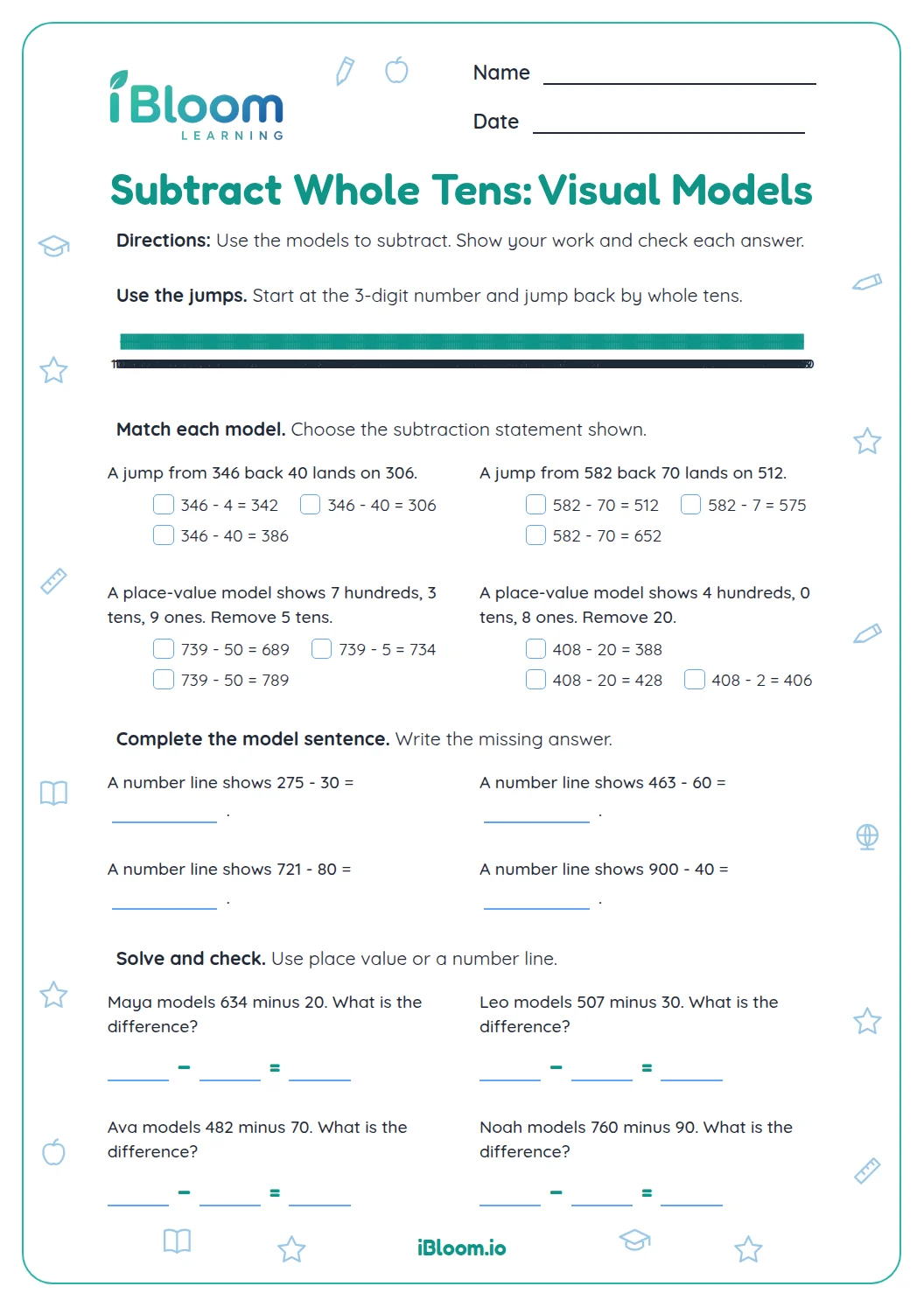
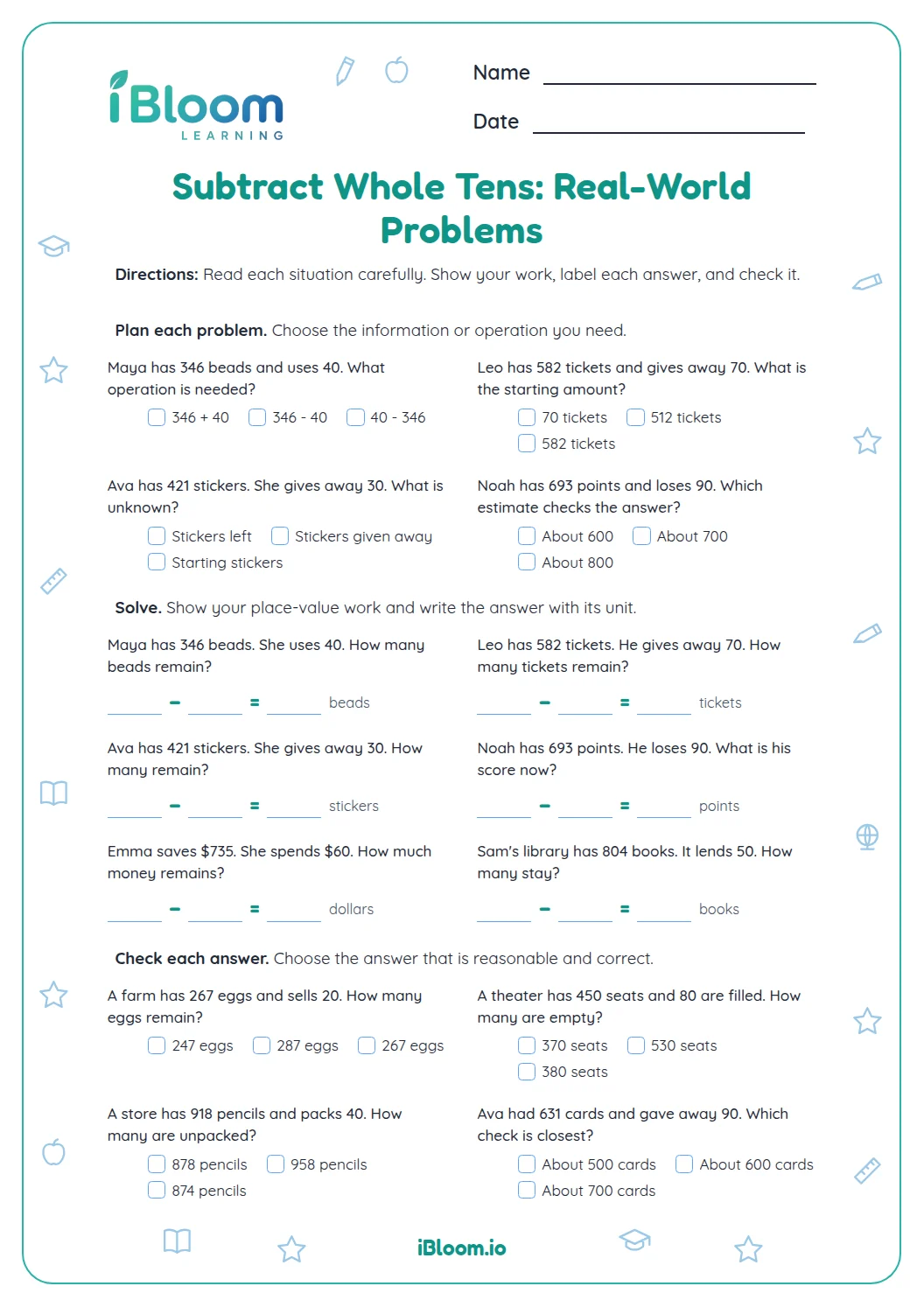
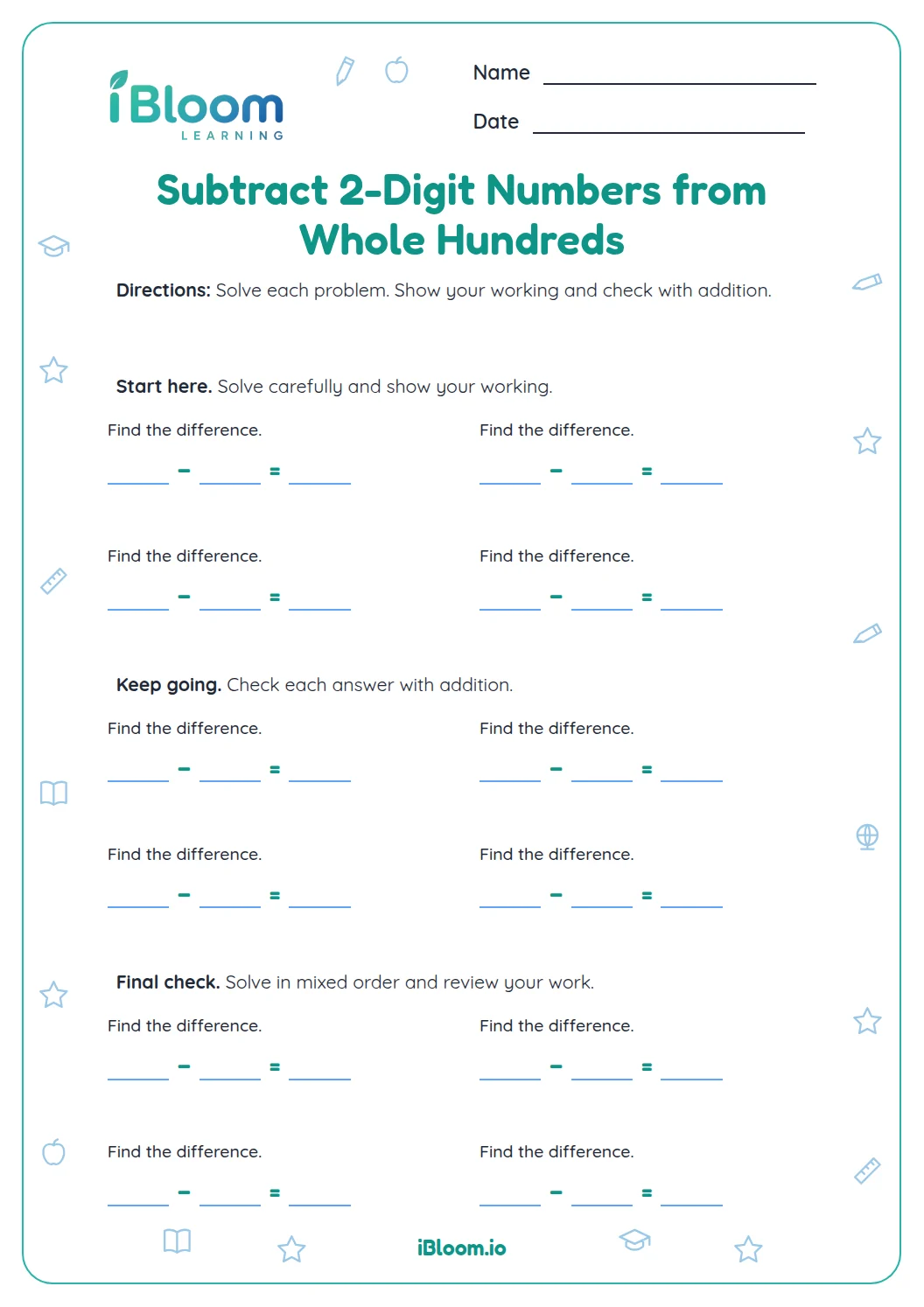
This Grade 4 worksheet focuses on subtracting two-digit whole tens from three-digit numbers. Fourteen questions move from direct calculations to a missing number, comparisons, an addition check, and place-value explanations. Each subtrahend is a multiple of ten, so learners can track how the tens digit changes while the hundreds and ones digits stay fixed.
Aligned to 4.NBT.B.4
What changes when you subtract 20?
Twenty is 2 tens. Subtract 2 from the tens digit and keep the hundreds and ones digits in view. For 436 − 20, 3 tens becomes 1 ten, so the result is 416.
- 1436 − 20 = ___
- 2436 has 3 tens; subtract 2 tens.
- 3436 − 20 = 416.
How do the reasoning questions build?
Part A starts with direct subtraction, then asks you to compare two differences, check with addition, and name the place that changes.
How can addition check subtraction?
For 506 − 70 = 436, the check is 436 + 70 = 506. Since adding 70 back returns to 506, the subtraction is consistent.
How to use this worksheet
- 1Read the subtrahend as a number of tens.
- 2Subtract those tens from the tens digit.
- 3Keep the hundreds and ones places aligned.
- 4For a missing number, compare the starting and ending values.
- 5Check subtraction by adding the subtrahend back.
Mistakes to watch for
The mistake
Subtracting the tens digit as ones.
The fix
Think of 40 as 4 tens, not 4 ones.
The mistake
Changing the hundreds or ones digit without a reason.
The fix
Check which place the whole-ten subtrahend affects.
The mistake
Choosing the larger subtrahend as the larger difference.
The fix
Subtract both amounts; the larger amount subtracted leaves the smaller result.
Common Core alignment
This worksheet practices the listed Common Core skill.
Subtract whole tens from three-digit numbers and explain the place-value change.
On this sheet: The questions directly practice this skill.
Show the official wordingHide the official wording
Fluently add and subtract multi-digit whole numbers using the standard algorithm.
What to practice next
Make more practice
Further reading
Questions parents and teachers ask
What does “whole tens” mean on this sheet?
Each subtrahend is a multiple of ten, such as 20, 40, or 90. Read it as a number of tens and compare that amount with the tens in the three-digit number. Use the stated numbers to explain the place-value step, then check the result with the key.
Why does subtracting 40 change the tens digit?
Forty is 4 tens. When subtracting it from a three-digit number, subtract 4 from the tens place; keep the hundreds and ones places aligned. For example, 735 − 40 = 695. Use the stated numbers to explain the place-value step, then check the result with the key.
How do learners check a subtraction answer?
Add the subtrahend back to the proposed difference. For 506 − 70 = 436, the check is 436 + 70 = 506. If the sum differs from the starting number, revisit the tens subtraction. Use the stated numbers to explain the place-value step, then check the result with the key.
How many reasoning questions are on the sheet?
The worksheet contains 14 questions over two practice pages, with a separate two-page key. The items include calculations, comparisons, a missing subtrahend, a real-world quantity, and explanations about place value. Use the stated numbers to explain the place-value step, then check the result with the key.
Can learners work independently?
A learner who understands three-digit place value can work through the calculations and comparisons independently. The explanation items may benefit from an adult asking, “Which place changed?” before the learner writes a response. Use the stated numbers to explain the place-value step, then check the result with the key.