
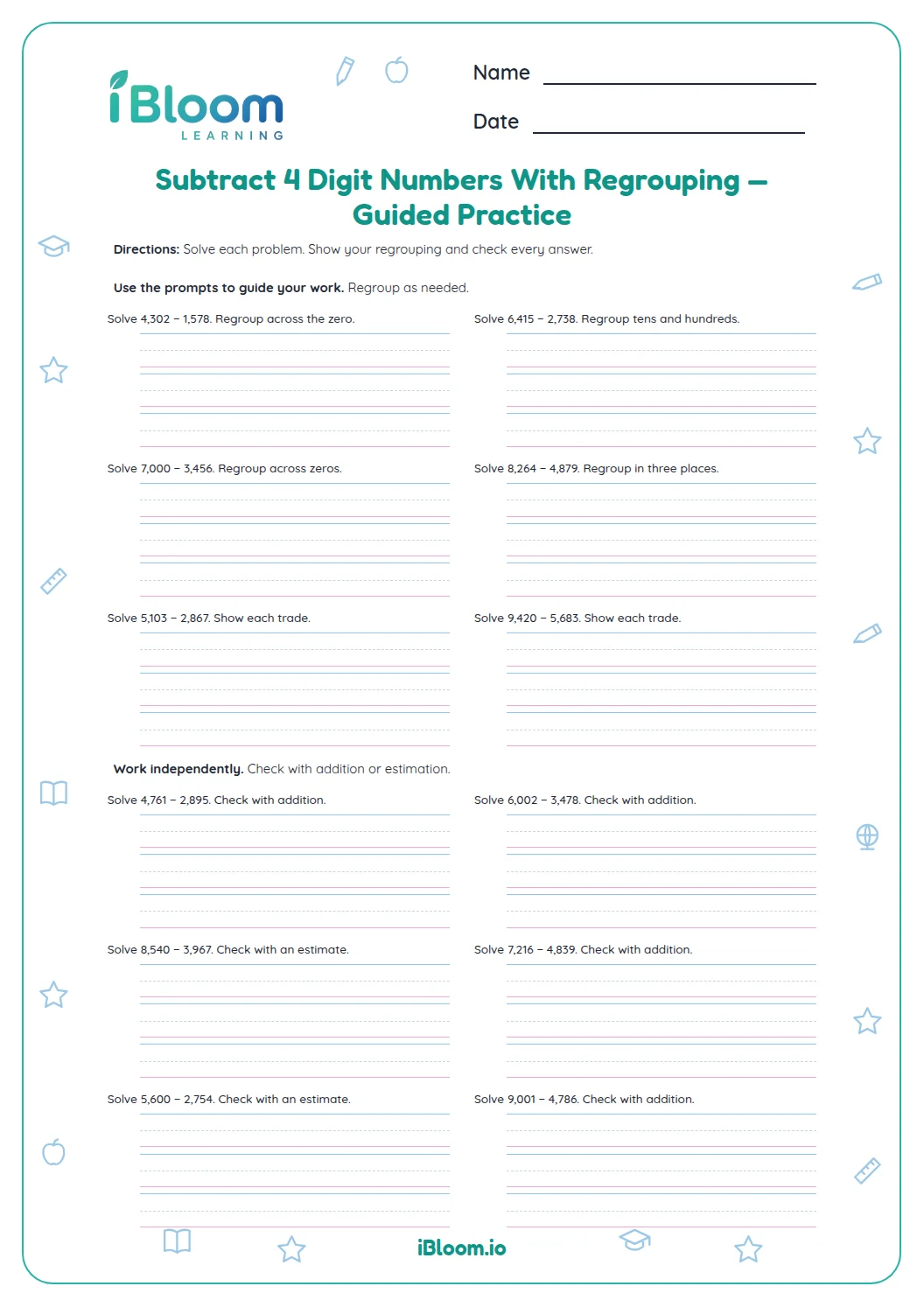
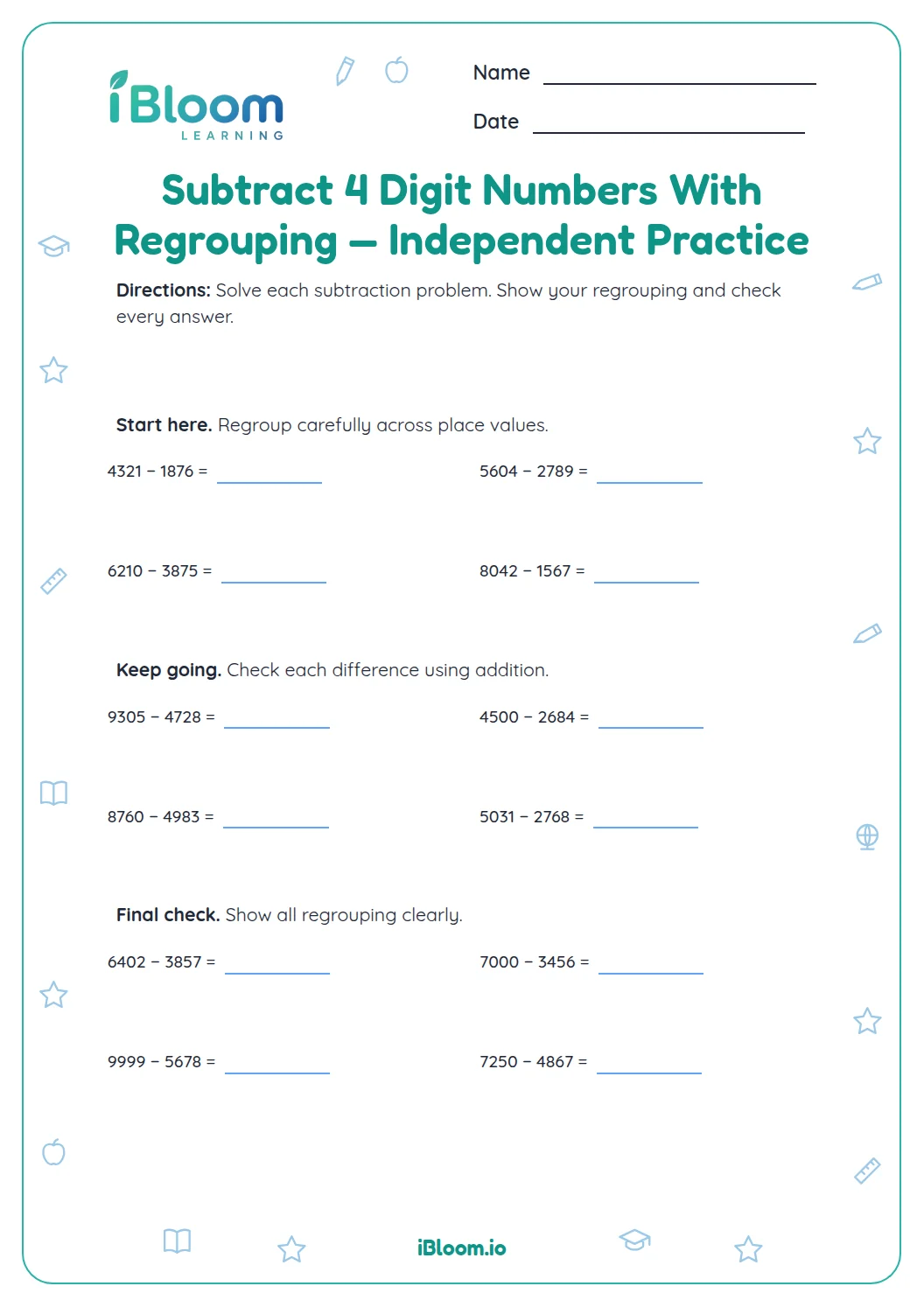
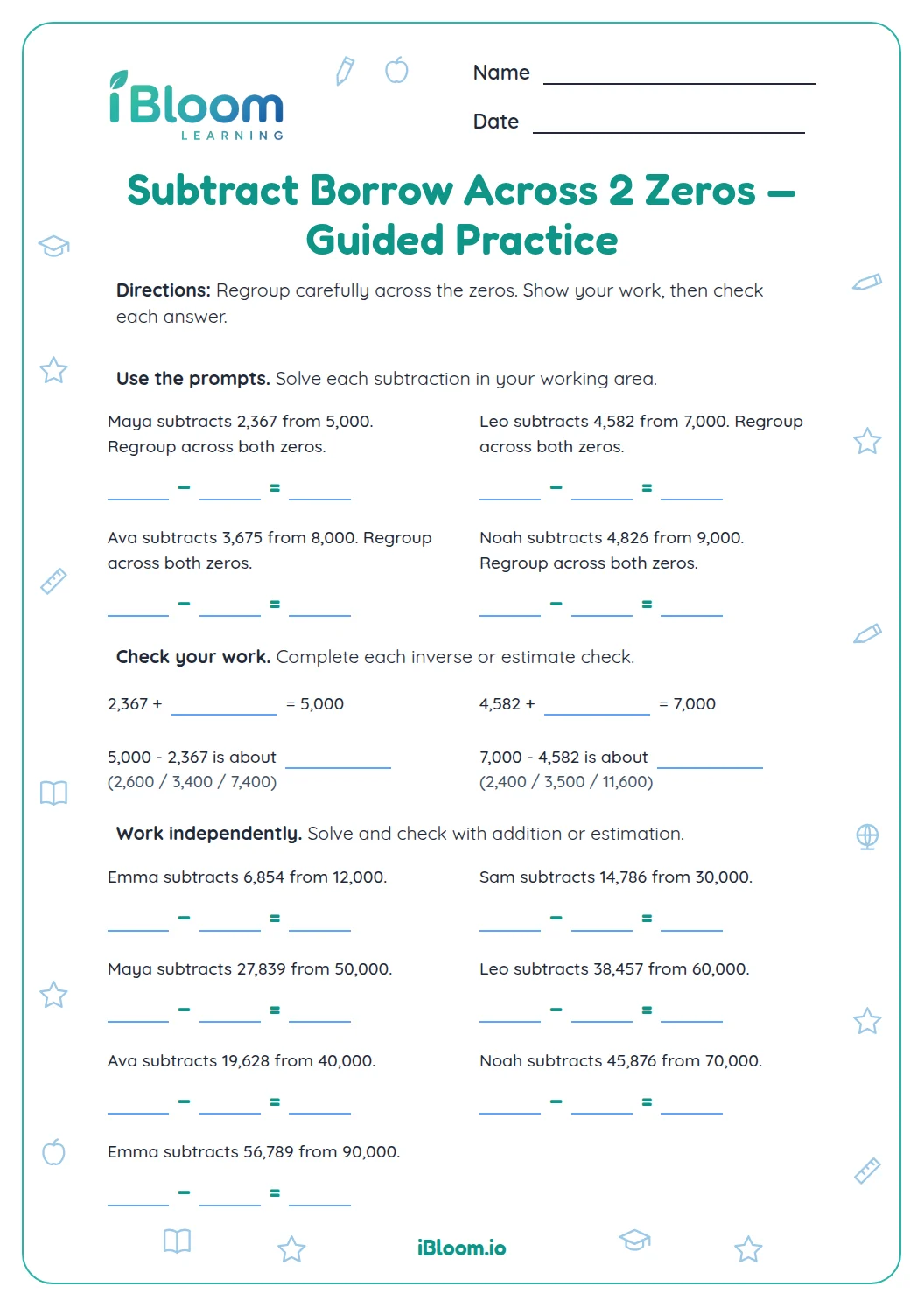
About this worksheet
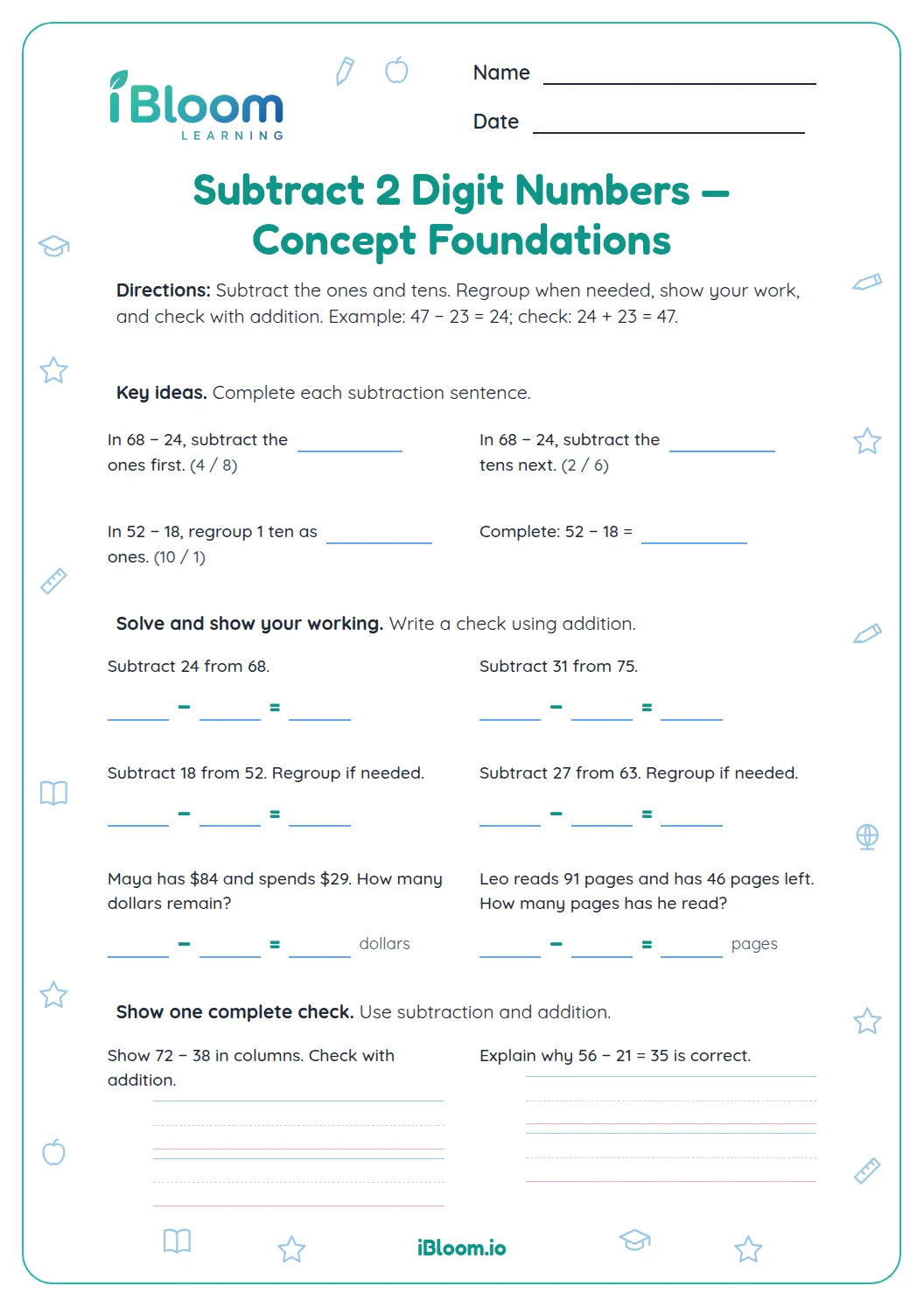
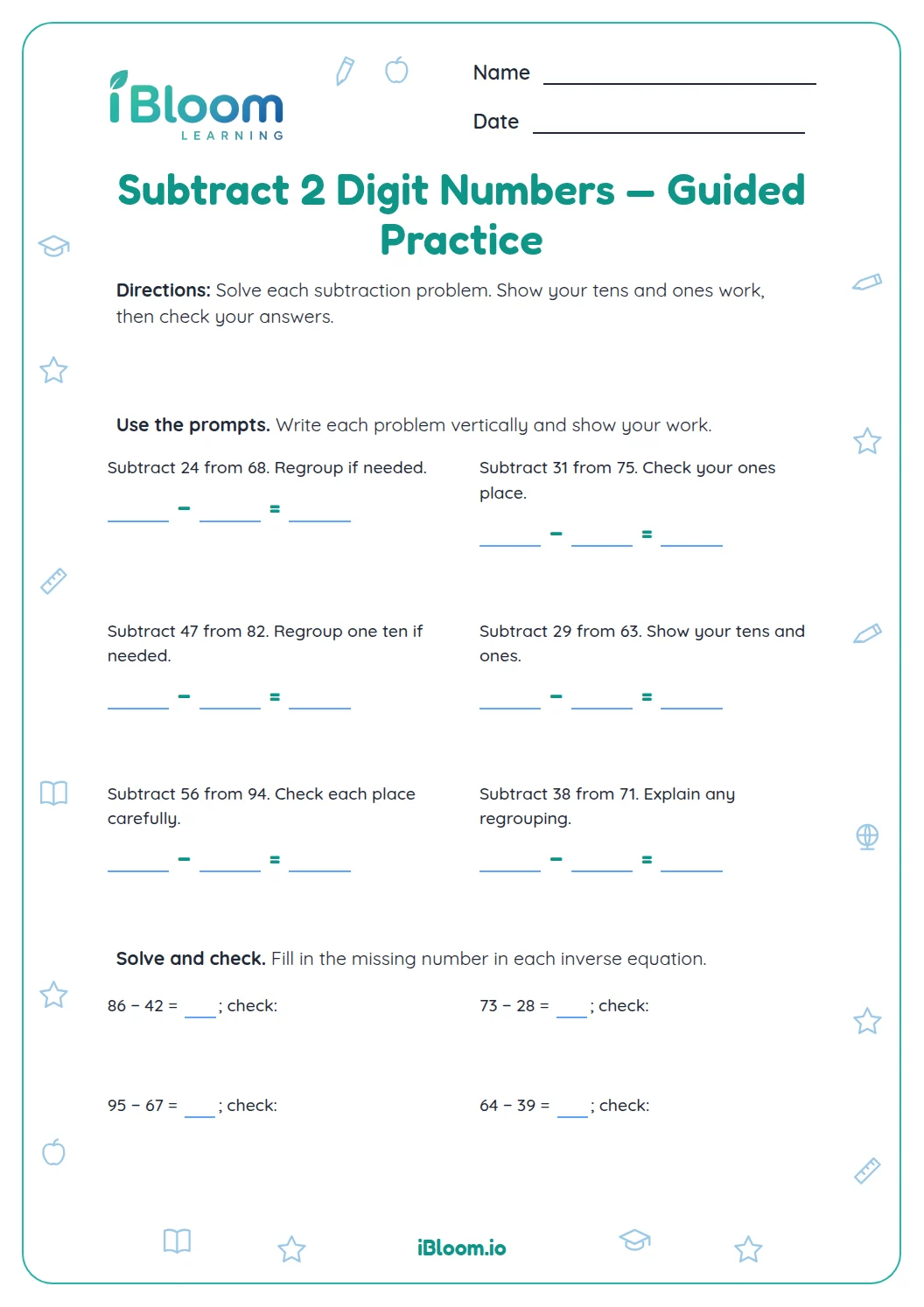
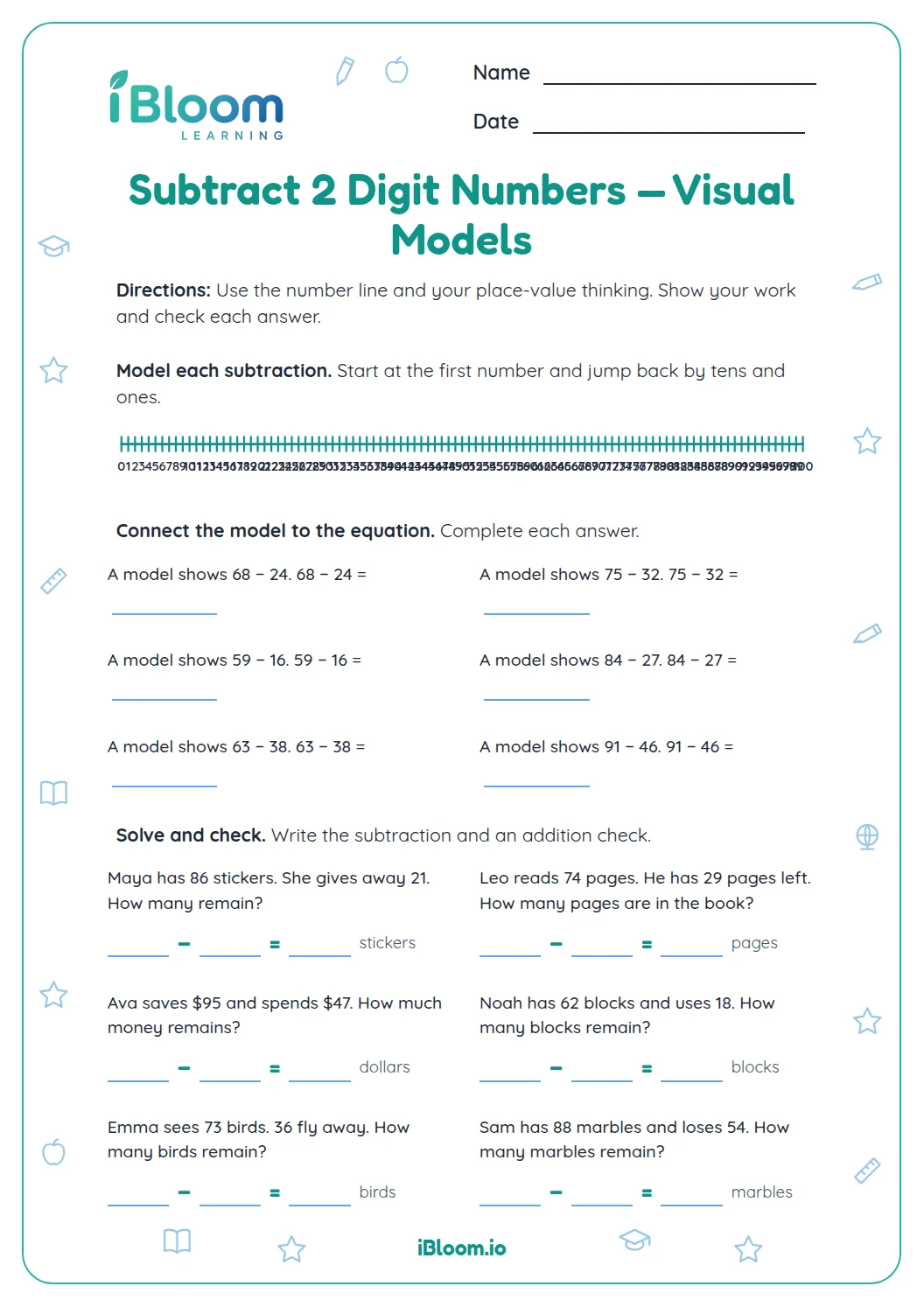
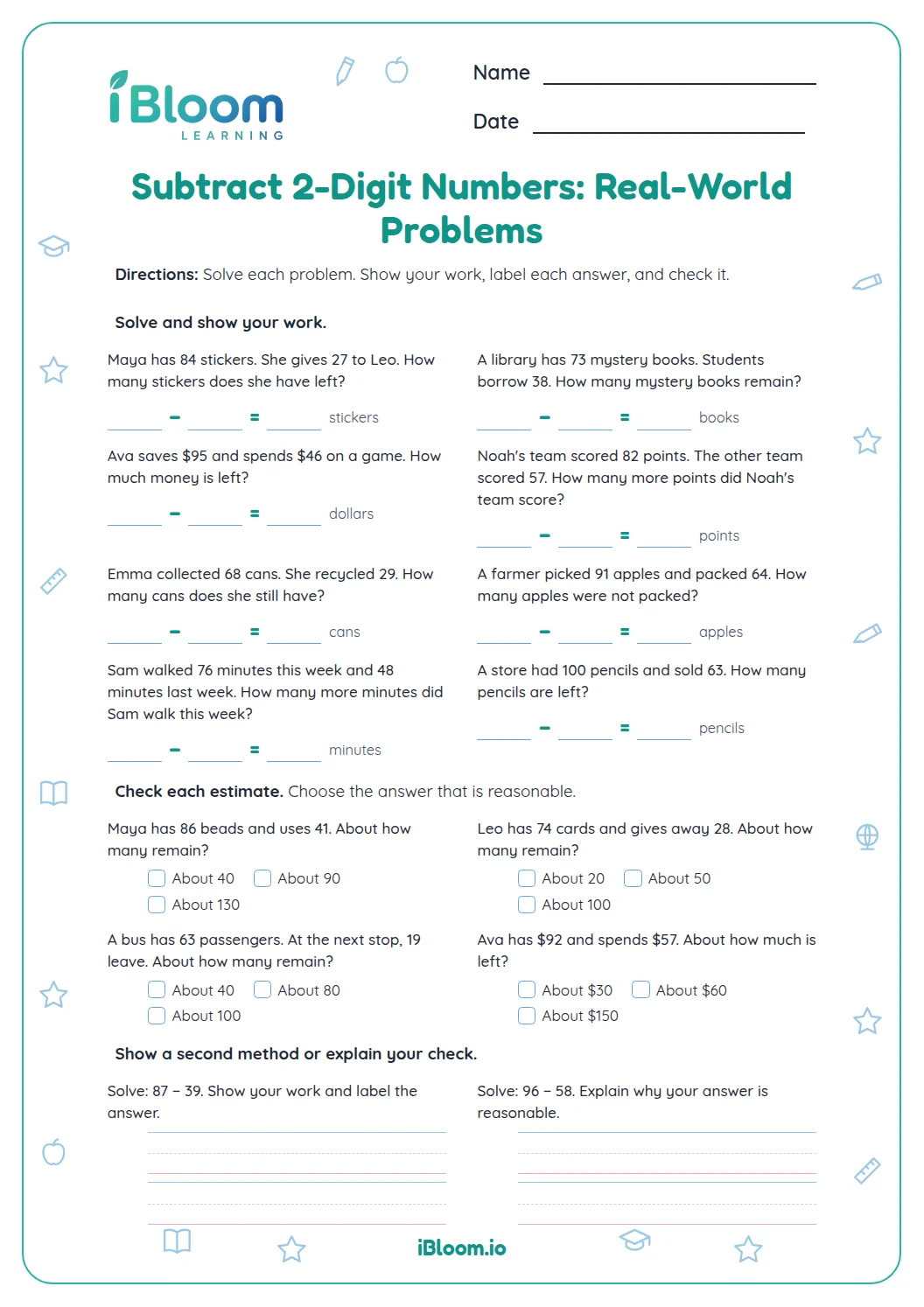
This free printable worksheet gives Grade 4 students independent practice with subtracting two-digit numbers using the standard algorithm. Part A has six problems with no trading. Part B has six where the ones digit is too small and a ten must be traded. Part C asks for missing numbers and spots two classmates' mistakes, and Part D has three word problems with room to write a number sentence. It supports Common Core 4.NBT.B.4 and the Grade 2 work it builds on, 2.NBT.B.5. The answer key is on its own pages, with every answer filled in.
Aligned to 4.NBT.B.4 and 2.NBT.B.5
What is on this worksheet?
The sheet moves from easier to harder in four parts. Part A is six problems like 87 − 35 where each top digit is at least as big as the one below it, so students practice lining up tens and ones. Part B is six problems like 63 − 47 where the ones digit on top is smaller, including 90 − 58 and 40 − 17 with a zero in the ones place.
Part C turns the question around. Two problems hide a number, such as ___ − 27 = 45, and two ask students to find the right answer when Leo or Ava made a mistake. Part D has three word problems about library books, pages and stickers. The last one has two subtractions in a row.
- Part A: 6 subtractions with no trading
- Part B: 6 subtractions that need a traded ten
- Part C: 2 missing numbers and 2 mistakes to fix
- Part D: 3 word problems, one with two steps
How does trading a ten work in 2-digit subtraction?
Take 63 − 47. The ones digit 3 is smaller than 7, so students cannot subtract 7 ones yet. They trade 1 ten for 10 ones: 63 is now 5 tens and 13 ones. Then 13 − 7 = 6 ones and 5 − 4 = 1 ten, so the answer is 16.
Grade 4 students often did this in Grade 2 with blocks. Now the goal is to do it on paper without losing track of the crossed-out tens digit, and to confirm the answer by adding it back.
- 163 − 47 = ___
- 2Ones: 3 is less than 7, so trade 1 ten for 10 ones.
- 363 becomes 5 tens and 13 ones.
- 413 ones − 7 ones = 6 ones
- 55 tens − 4 tens = 1 ten
- 6Answer: 16
- 7Check: 16 + 47 = 63
How do students find a missing number in subtraction?
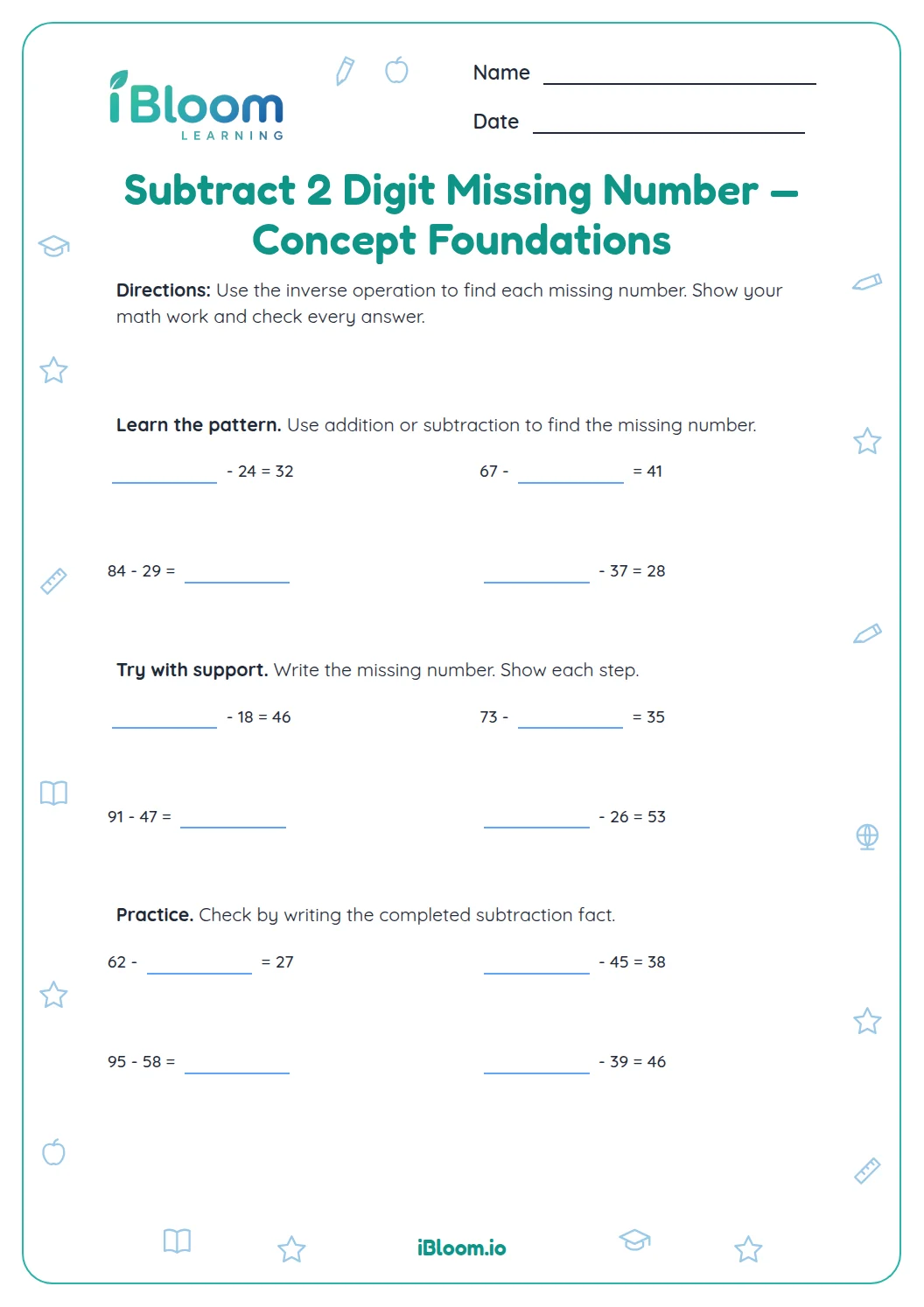
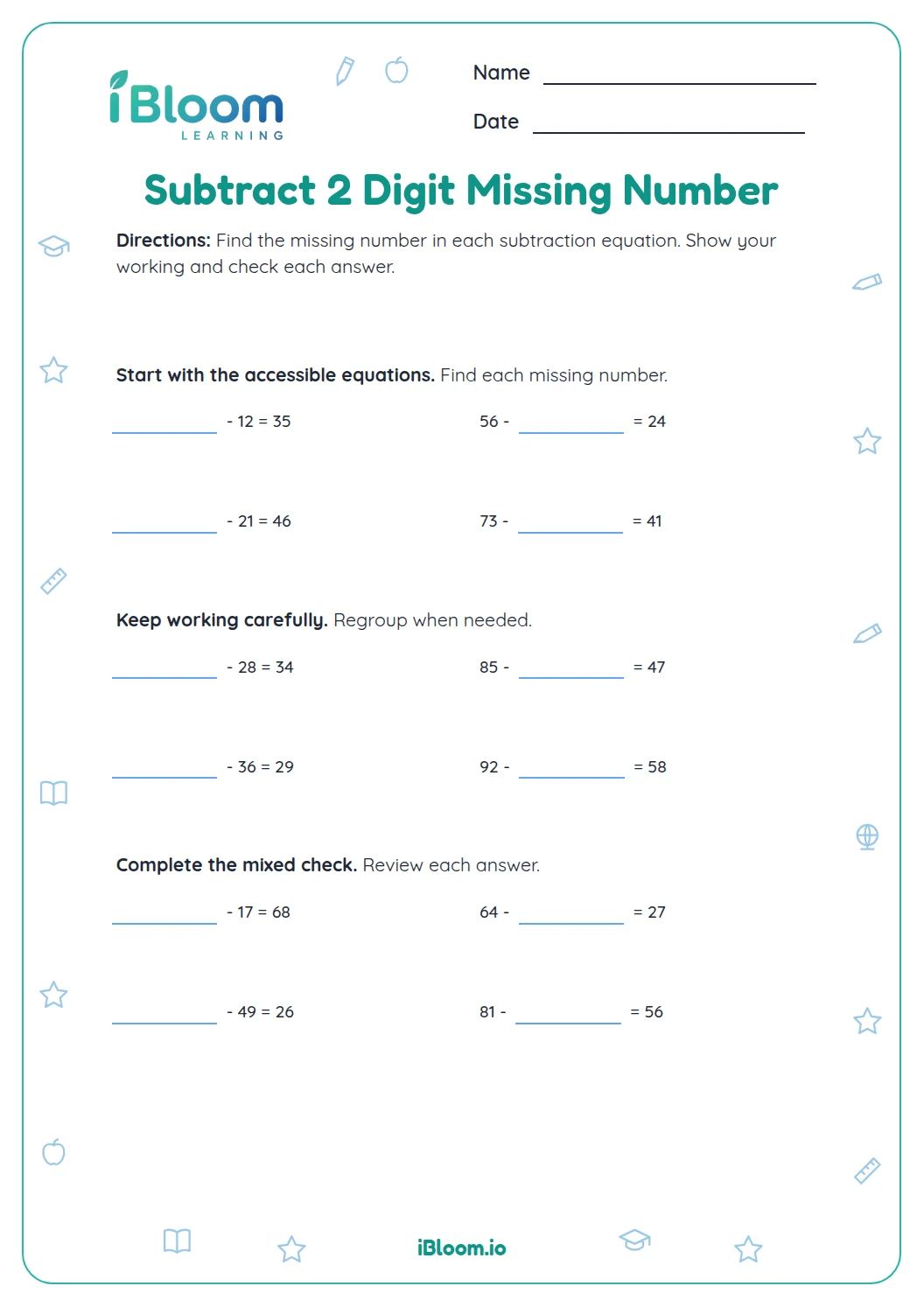
Subtraction and addition undo each other, so a missing number can be found by working backward. For ___ − 27 = 45, the starting number is what you get when you add back what was taken away: 45 + 27 = 72. For 63 − ___ = 28, the missing number is the difference between 63 and 28, which is 35.
Part C uses this idea twice. The same fact family also gives students a way to check every answer on the sheet, which is why the directions ask them to add to check.
Why does the sheet ask students to find a mistake?
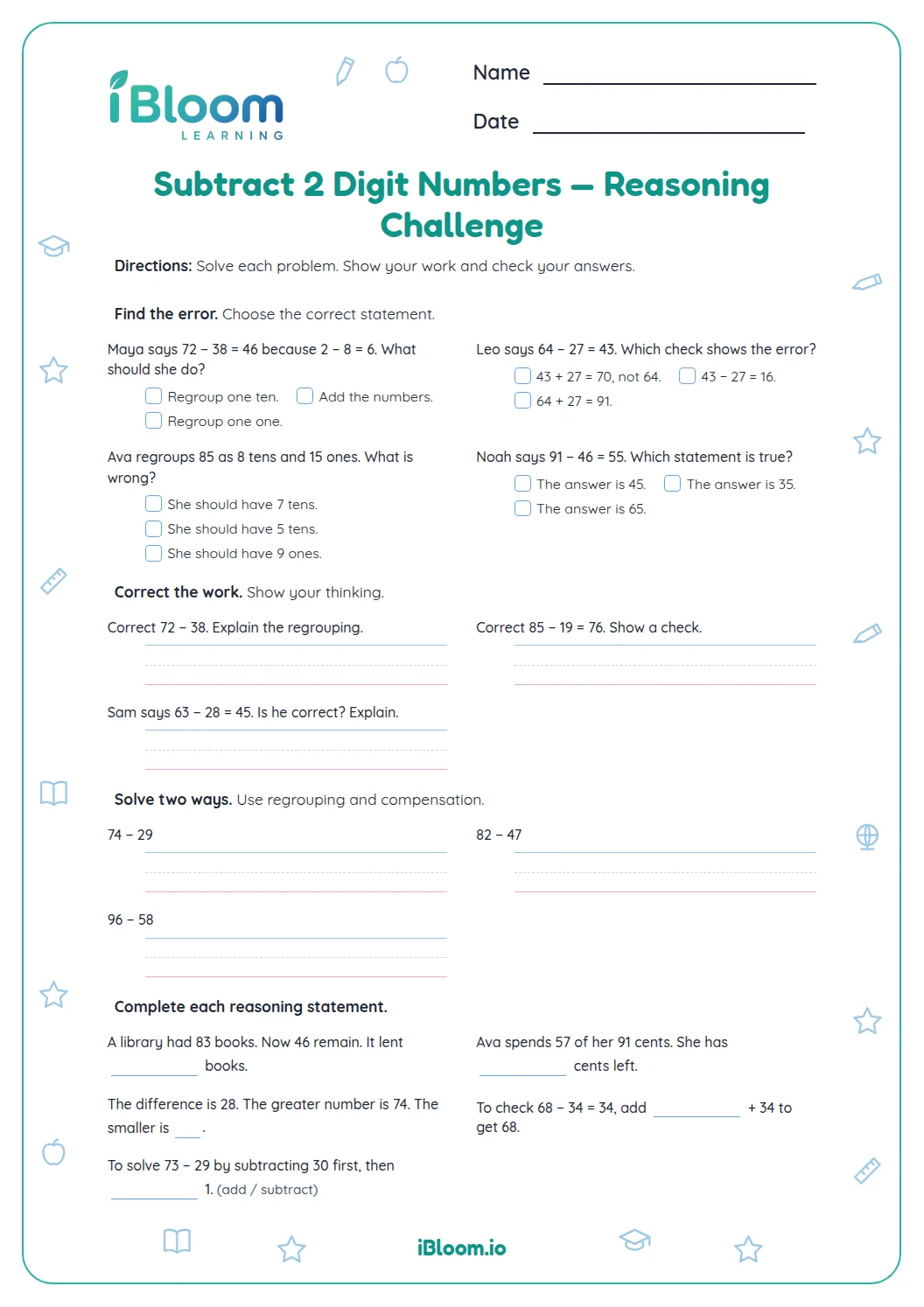
Leo wrote 62 − 38 = 36. He subtracted the smaller digit from the larger in each column (8 − 2 = 6 and 6 − 3 = 3), so he never traded a ten. Ava's 83 − 47 = 44 has the same slip. It is the most common two-digit subtraction error, so spotting it in someone else's work helps students catch it in their own.
Students write the correct answer. If they get the wrong answer again, ask them to add it back to the number being subtracted and see whether they get the starting number.
How to use this worksheet at home or in class
- 1Do the first problem in each part together, saying each step aloud before your child writes anything.
- 2Let your child work Part A alone. These need no trading, so you can see whether place value is secure.
- 3In Part B, ask your child to circle the ones digit that is too small before trading, then cross out and rewrite the tens digit.
- 4In Part C, ask your child to say the matching addition sentence before solving a missing number.
- 5For Part D, have your child write a number sentence in the space, solve it, and add the unit (books, pages, stickers).
- 6Check with the answer key, then ask your child to add back every answer that was marked wrong.
Common mistakes and quick fixes
The mistake
Subtracting the smaller digit from the larger in each column, so 62 − 38 becomes 36.
The fix
Ask which number is on top. The top digit never moves down: if 2 is less than 8, trade a ten first, then do 12 − 8.
The mistake
Trading a ten but forgetting to lower the tens digit, so 81 − 24 becomes 67 instead of 57.
The fix
Have your child cross out the 8, write a small 7 above it, and write a small 1 beside the 1 to show 11 ones. Then subtract.
The mistake
Getting stuck on 90 − 58 and 40 − 17 because the ones digit is 0.
The fix
Show 90 as 8 tens and 10 ones. Zero ones is the same as needing a trade, so the steps are the same as for 63 − 47.
Common Core alignment
Most US states use the Common Core Operations and Number standards or something close, so this sheet fits Grade 4 fluency work in most classrooms.
Subtract with the standard algorithm, trading a ten when needed (here with 2-digit numbers).
On this sheet: Main standard for the skill. The sheet practices the subtract-and-trade steps of the standard algorithm.
Show the official wordingHide the official wording
Fluently add and subtract multi-digit whole numbers using the standard algorithm.
Subtract within 100 quickly and accurately, and check with addition.
On this sheet: The numbers on the sheet are all within 100, so this is the content students are fluent with before moving to larger numbers.
Show the official wordingHide the official wording
Fluently add and subtract within 100 using strategies based on place value, properties of operations, and/or the relationship between addition and subtraction.
What to practice next
Make more practice
Further reading
Questions parents and teachers ask
Is two-digit subtraction too easy for Grade 4?
For many students it is a quick review, but it is a good check on fluency. If a student is slow or makes trading mistakes here, larger numbers will be harder. Use this sheet as a warm-up, for catch-up practice or to confirm skills before moving on to 3-digit and 4-digit subtraction.
Which problems on the sheet need regrouping?
Every problem in Part B needs a trade: 63 − 47, 81 − 24, 90 − 58, 74 − 66, 40 − 17 and 95 − 78. Part A has no trading. Part C includes ___ − 27 = 45, which uses addition, and the two mistake problems, 62 − 38 and 83 − 47, both need a trade.
What are the answers to Part B?
The six answers are 16, 57, 32, 8, 23 and 17. For example, 74 − 66 = 8 because 14 − 6 = 8 and 6 − 6 = 0 tens. The answer key is on its own pages and shows all nineteen answers, including the units for the word problems.
Why does the sheet ask students to add to check?
Adding the answer back to the number subtracted should give the starting number, so addition is a built-in answer checker. For 63 − 47 = 16, check 16 + 47 = 63. Students who check as they go catch trading slips, and the habit also helps with missing-number problems.
How do students solve the sticker problem in Part D?
It has two steps. Nia had 95 stickers and gave away 28, so 95 − 28 = 67 are left. Then she gave away 19 more, so 67 − 19 = 48. The answer is 48 stickers. Students can also add 28 + 19 = 47 first and subtract once: 95 − 47 = 48.
How long does this worksheet take?
Most Grade 4 students need about 15 minutes. Part A moves quickly, Part B takes a little longer because of the trading, and the word problems need space to write. Students who find trading hard may need an extra five minutes, or you can split the sheet over two sessions.