



About this worksheet
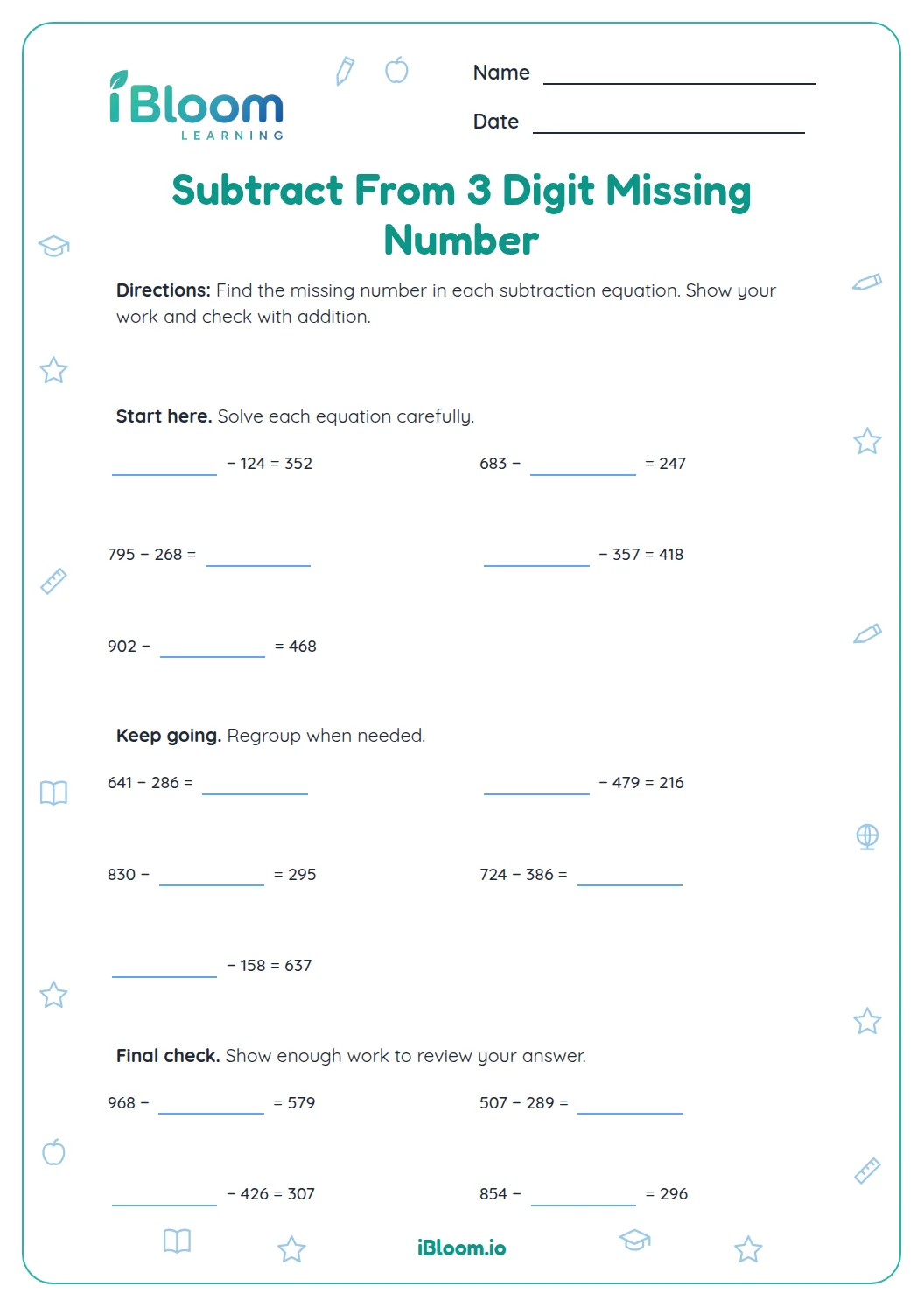
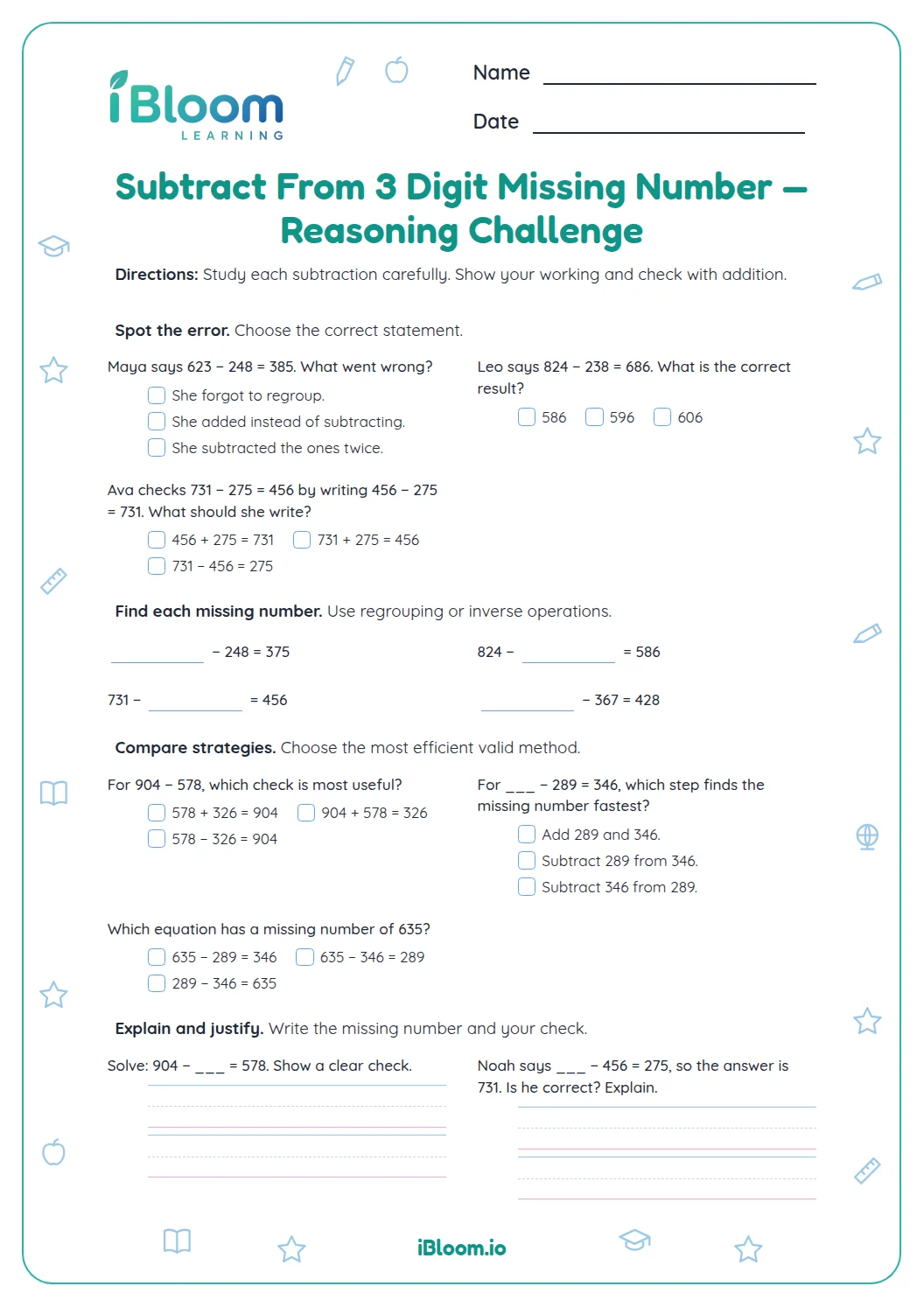
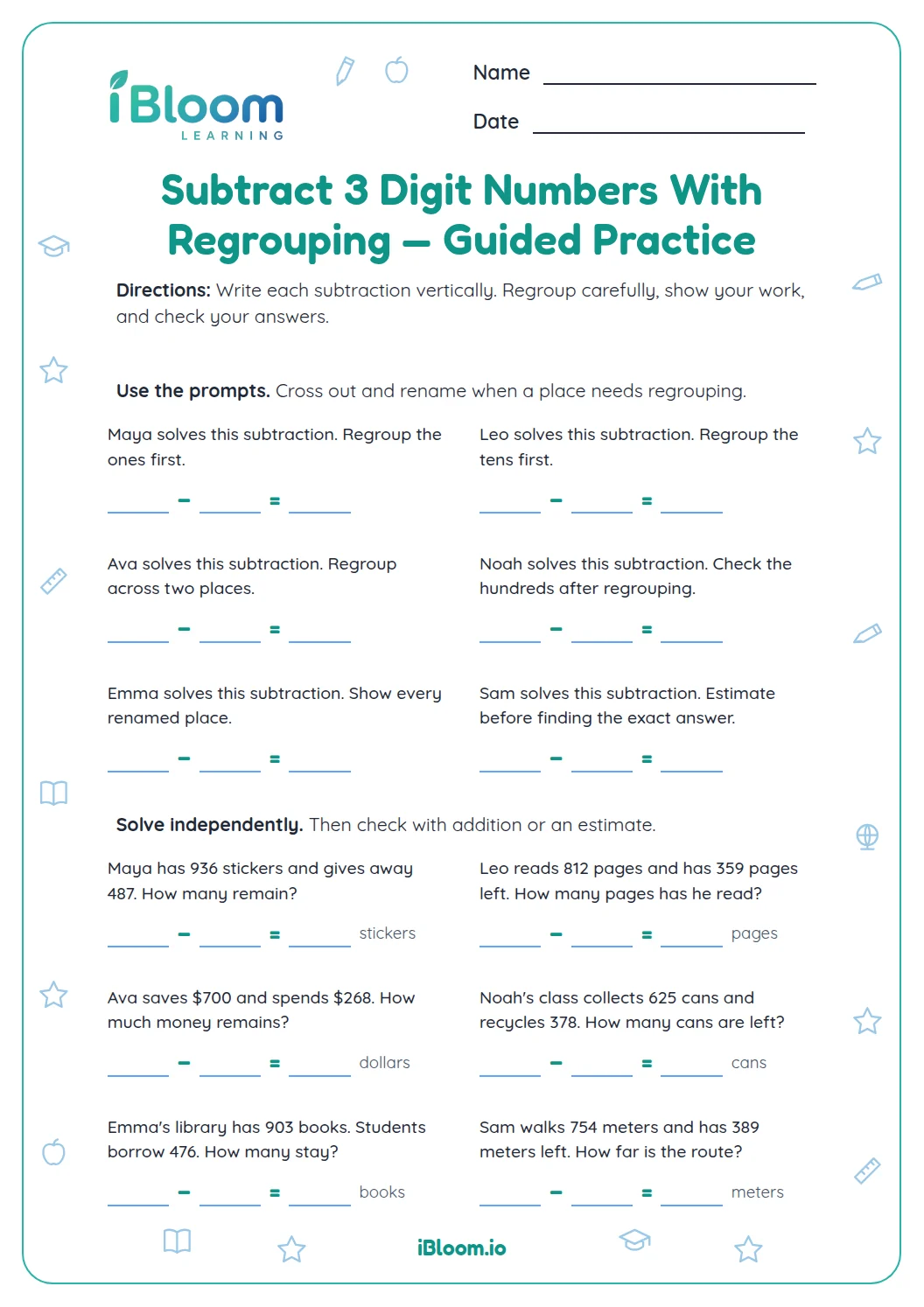
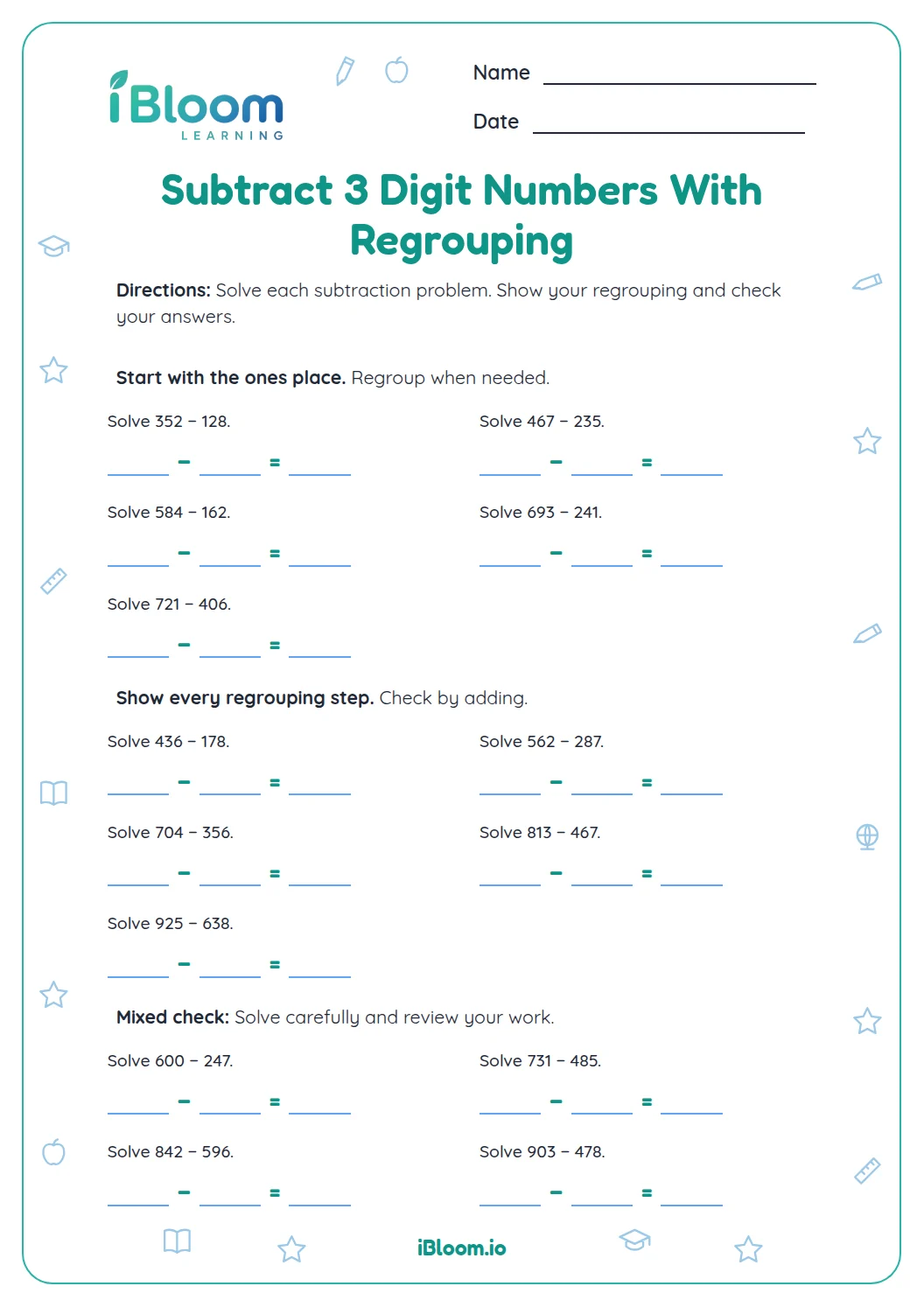
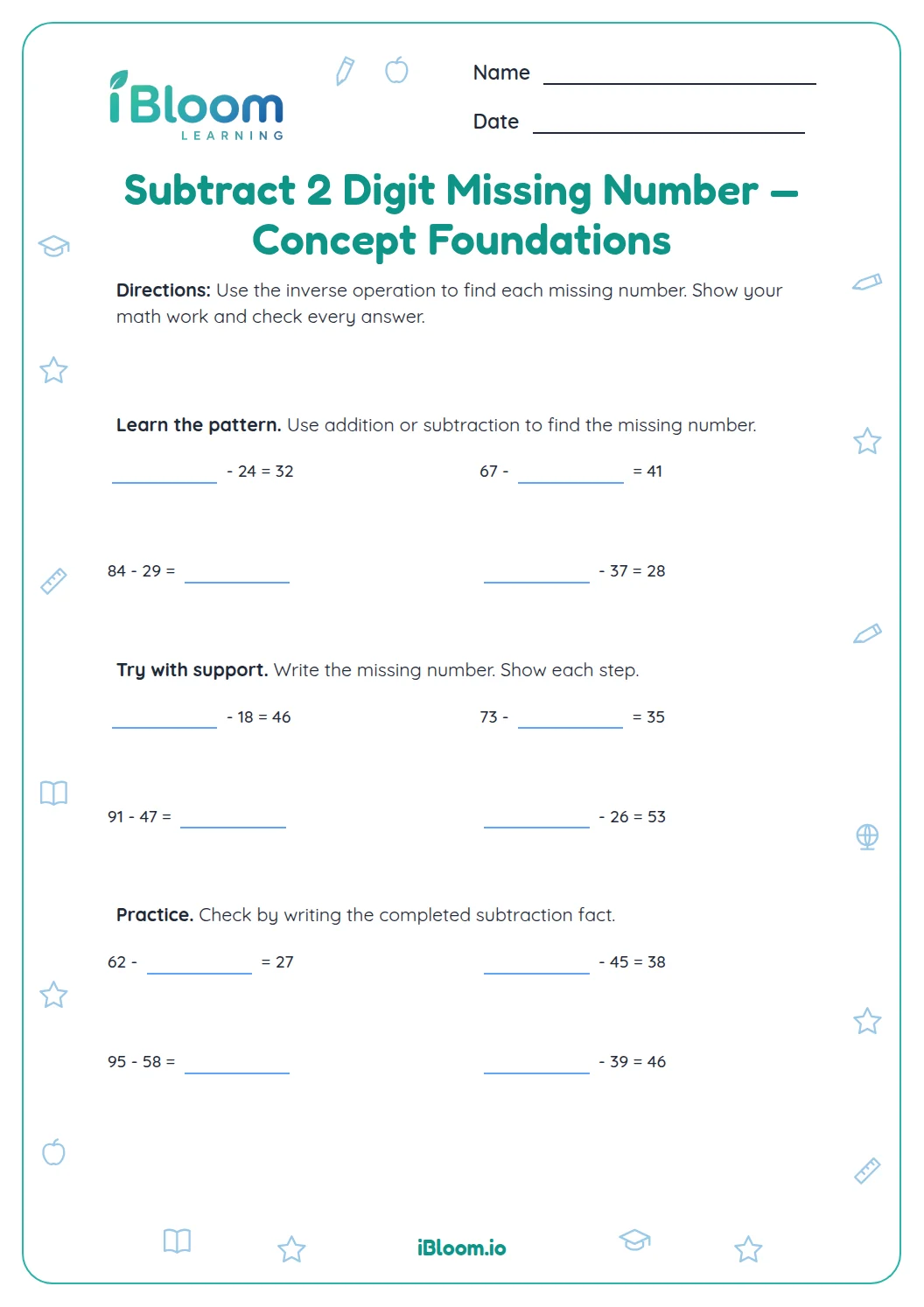
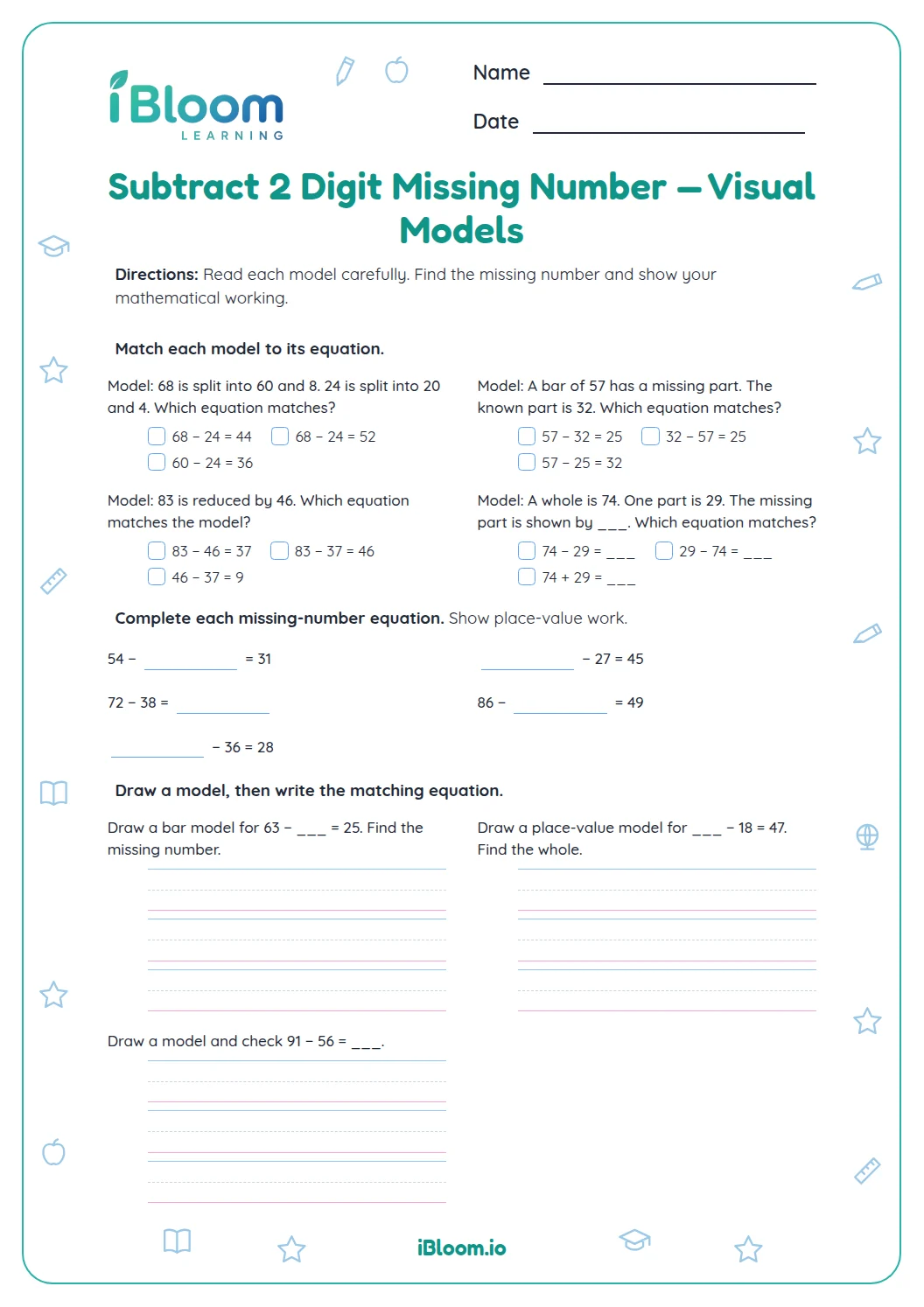
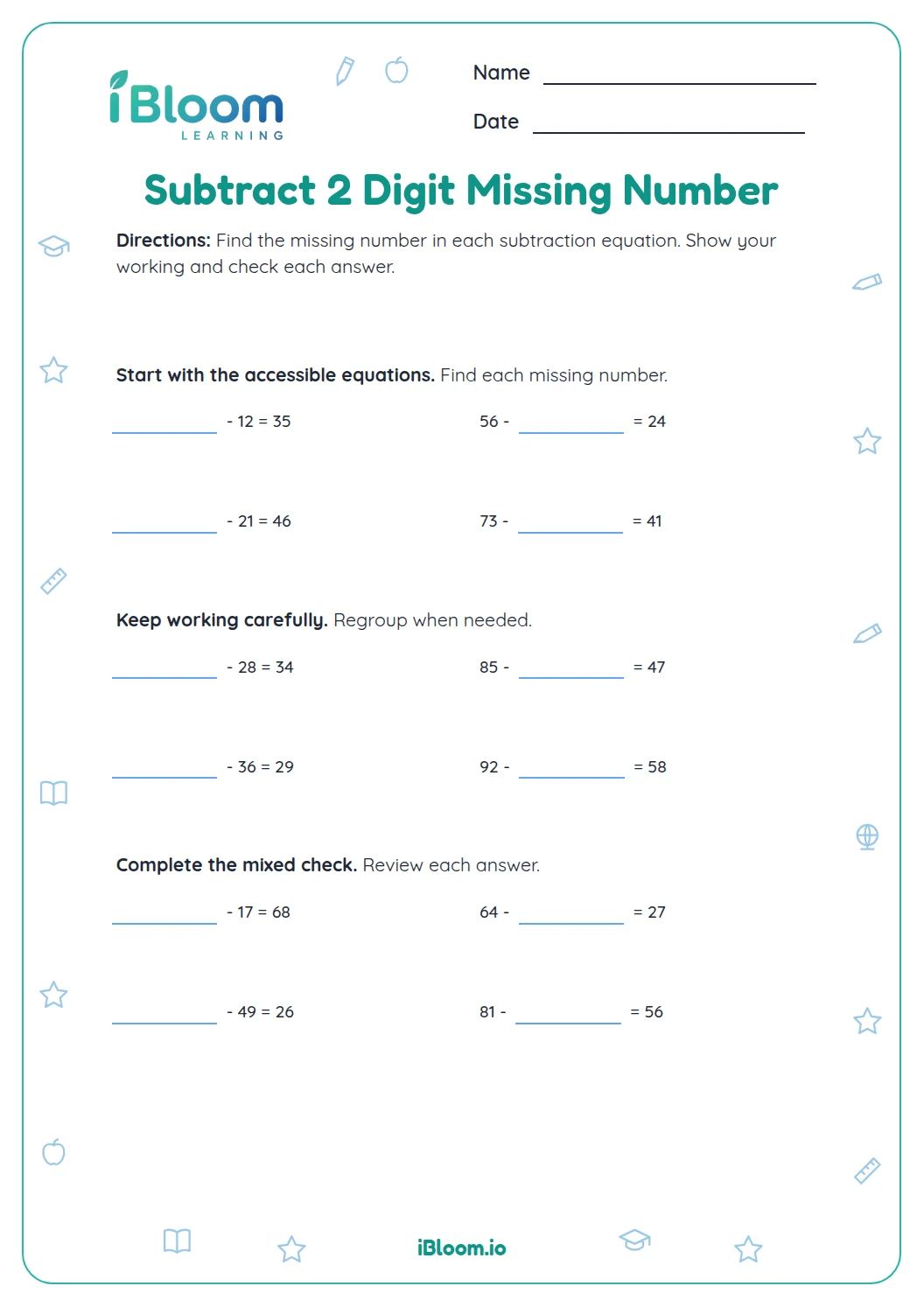
This Grade 4 worksheet practices three-digit subtraction with an unknown in two positions: first the difference, then the subtrahend. Four problems include base-ten drawings of the starting number; the other items build independent equation practice. The 14-question key lists each missing value. Students can use place value and regrouping, then check with addition.
Aligned to 4.NBT.B.4
What does this worksheet include?
The 14 questions are split into two parts. First find seven missing differences; then find seven missing subtrahends.
A missing difference is the result. A missing subtrahend is the amount taken away, so pay attention to which position contains the blank.
- 14 questions
- Two ordered practice parts
- Separate answer key
How can students work through an example?
For 321 − ___ = 213, compare 321 and 213: the difference between them is 108, so 321 − 108 = 213.
- 1321 − ___ = 213
- 2The missing subtrahend is 108 because 321 − 108 = 213.
How can students check their work?
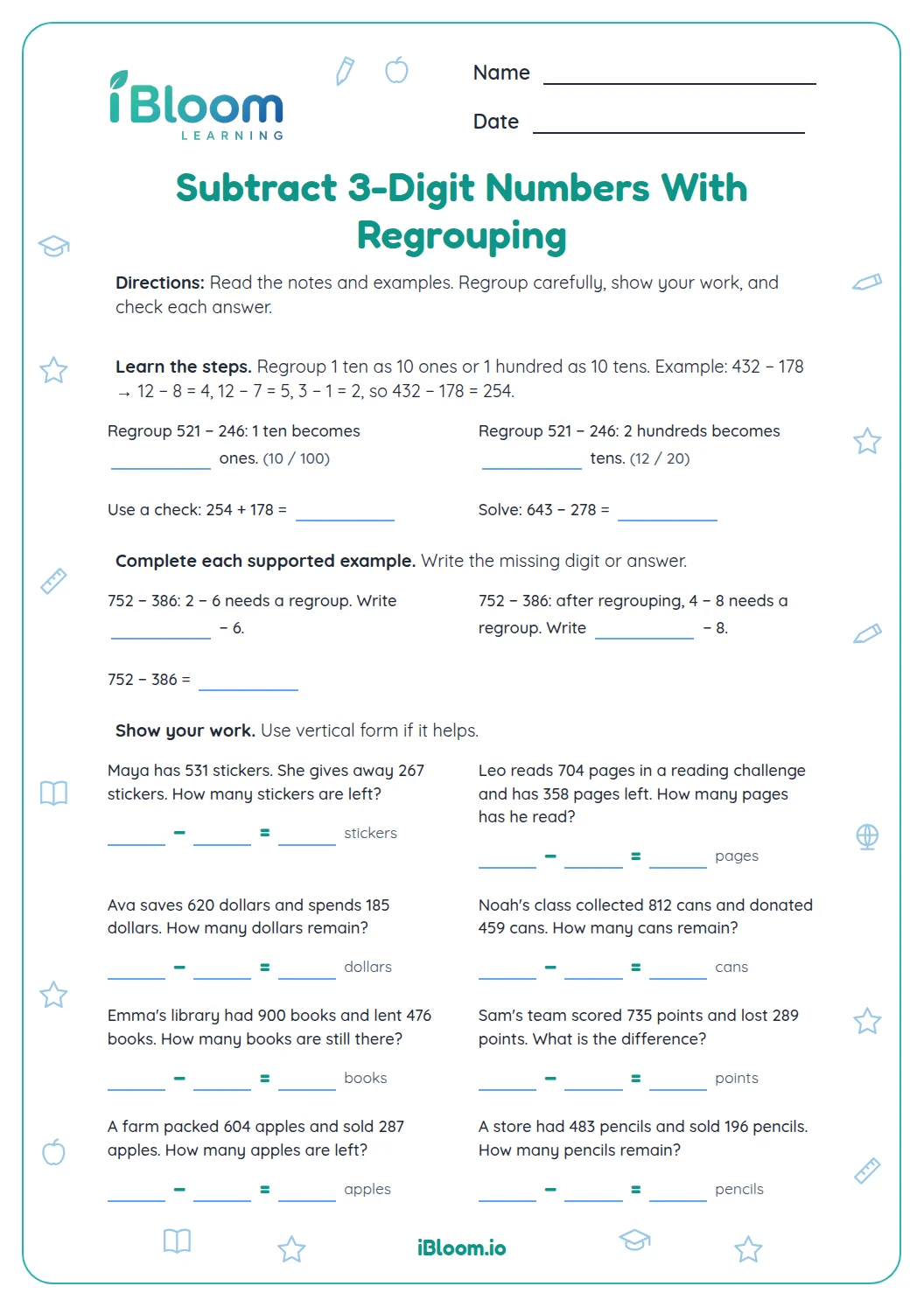
Four questions show base-ten drawings of their starting numbers. Regroup by place value as needed, then use addition to check each result.
How can practice build accuracy?
Use the answer key after attempting the questions. For any missed item, redo the comparison, place-value step, sentence clue, or equation check that applies.
How to use this worksheet
- 1Read which number is missing: the difference or the subtrahend.
- 2For a missing difference, subtract the subtrahend from the starting number.
- 3For a missing subtrahend, find the difference between the starting number and result.
- 4Regroup across place values when a digit is too small.
- 5Check subtraction with addition.
Common mistakes and quick fixes
The mistake
Subtracting the smaller digit from the larger in every column.
The fix
Regroup when the top digit is smaller.
The mistake
Treating the missing subtrahend like a missing difference.
The fix
Use the equation position to choose the operation.
The mistake
Skipping the check.
The fix
Add the difference and subtrahend to recover the starting number.
Use place value and subtraction to find an unknown number in a three-digit equation.
On this sheet: Use place value and subtraction to find an unknown number in a three-digit equation.
Show the official wordingHide the official wording
Fluently add and subtract multi-digit whole numbers using the standard algorithm.
What to practice next
Make more practice
Further reading
Questions parents and teachers ask
What is a missing subtrahend?
The subtrahend is the number being taken away. In 321 − ___ = 213, the missing subtrahend is 108 because 321 − 108 equals 213. The second part of the worksheet focuses on finding this unknown number. Check by adding 108 and 213.
What does the first part ask students to find?
The first seven questions have a missing difference, the result of a subtraction equation. Students subtract the given three-digit subtrahend from the starting number. Four of those questions also show a base-ten drawing of the starting number. Regrouping may be needed.
How many visual models are included?
Four questions include base-ten drawings that represent the starting three-digit number. Students can use the hundreds, tens, and ones shown to think through place value. The remaining ten questions provide equations for independent practice. Each drawing matches its starting number.
How can a subtraction answer be checked?
Use addition to check. Add the subtrahend to the difference; the sum should equal the starting number. For a missing subtrahend, add the found value to the given difference and check that it returns the starting number. This works for both parts.
How many questions are on the sheet?
There are 14 questions in two parts. The first seven ask for missing differences, and the next seven ask for missing subtrahends. The answer key gives the missing value for every equation. Four questions include a base-ten drawing. The separate key lets students review the result after completing the question independently.