



About this worksheet
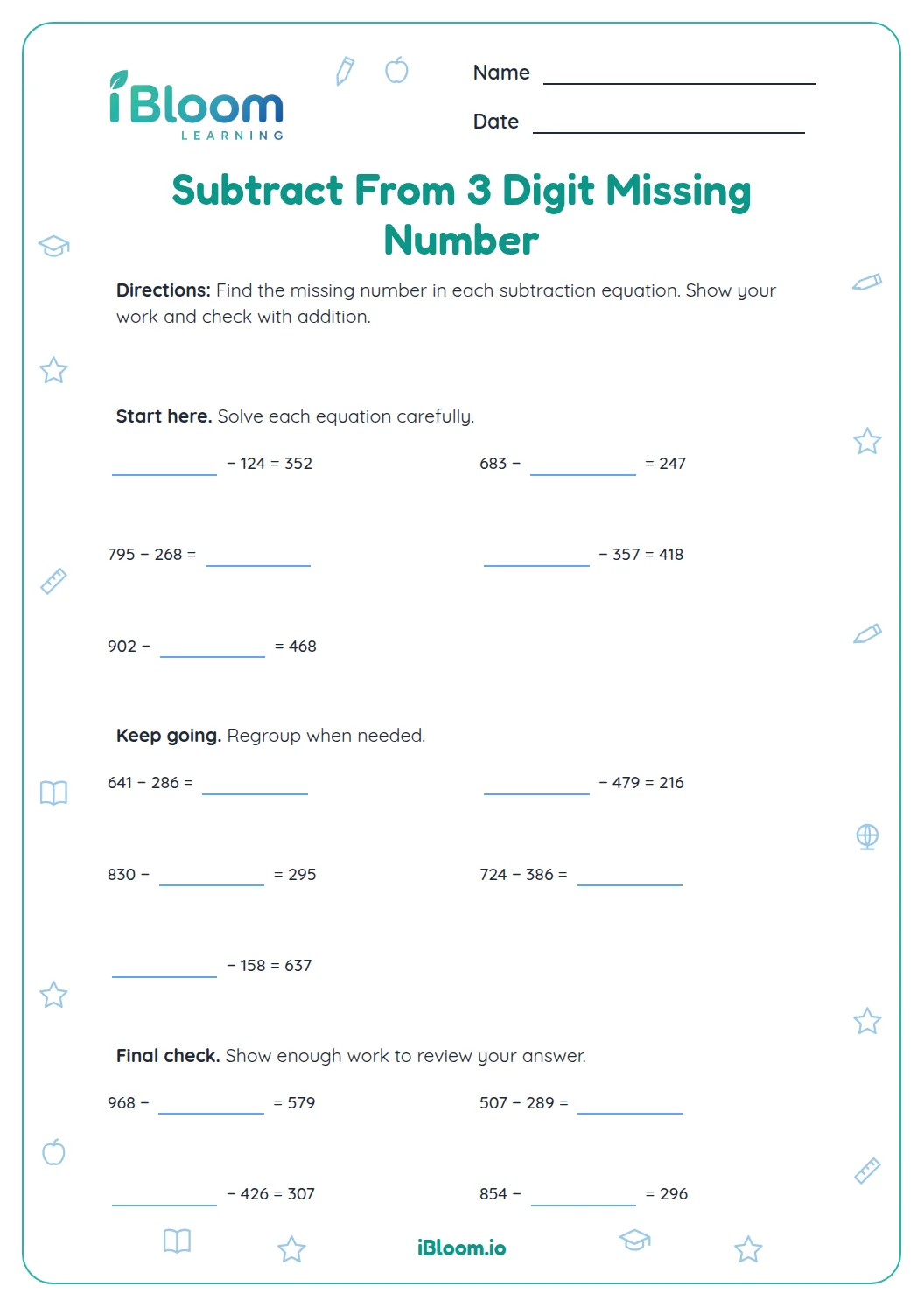
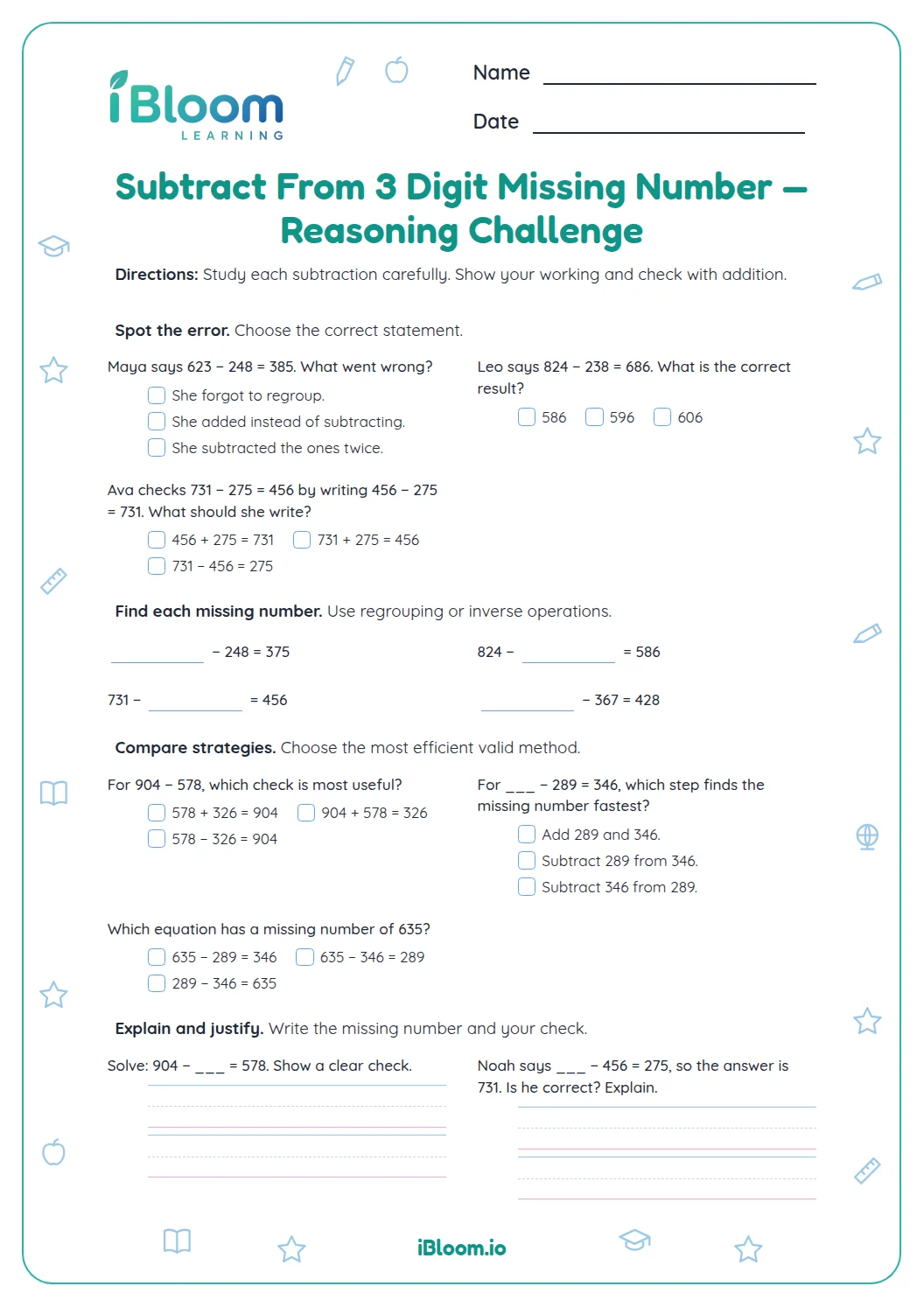
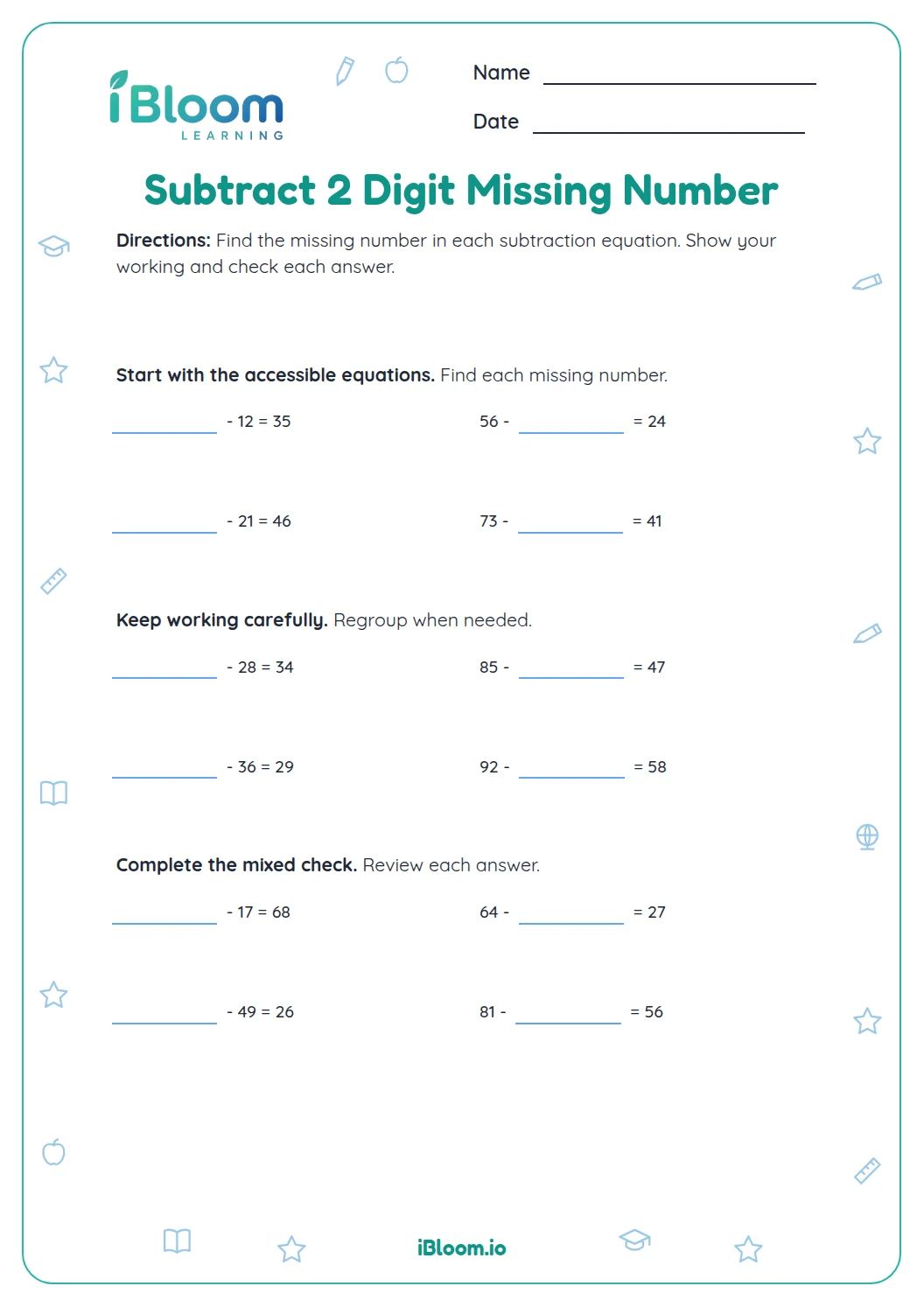
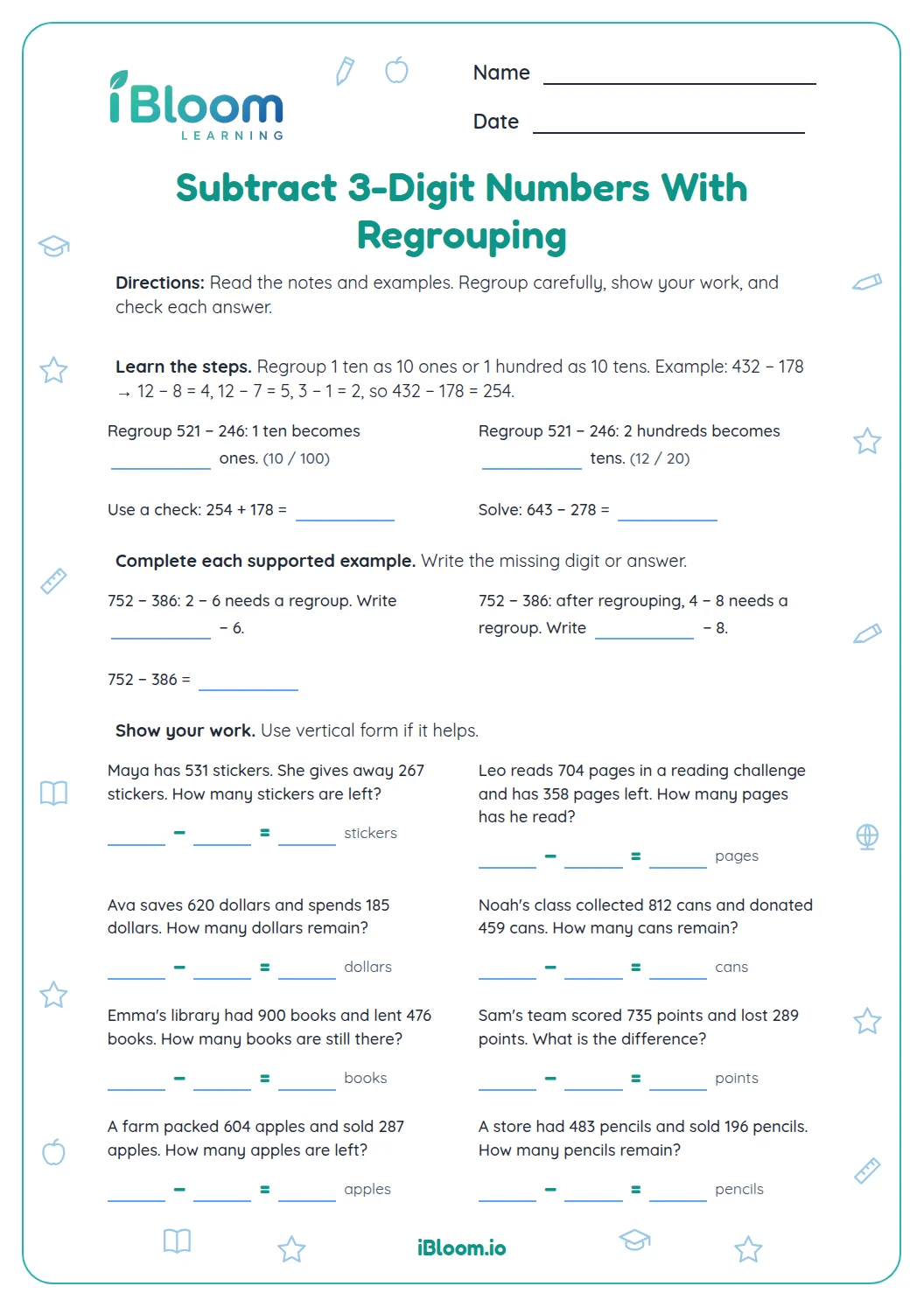
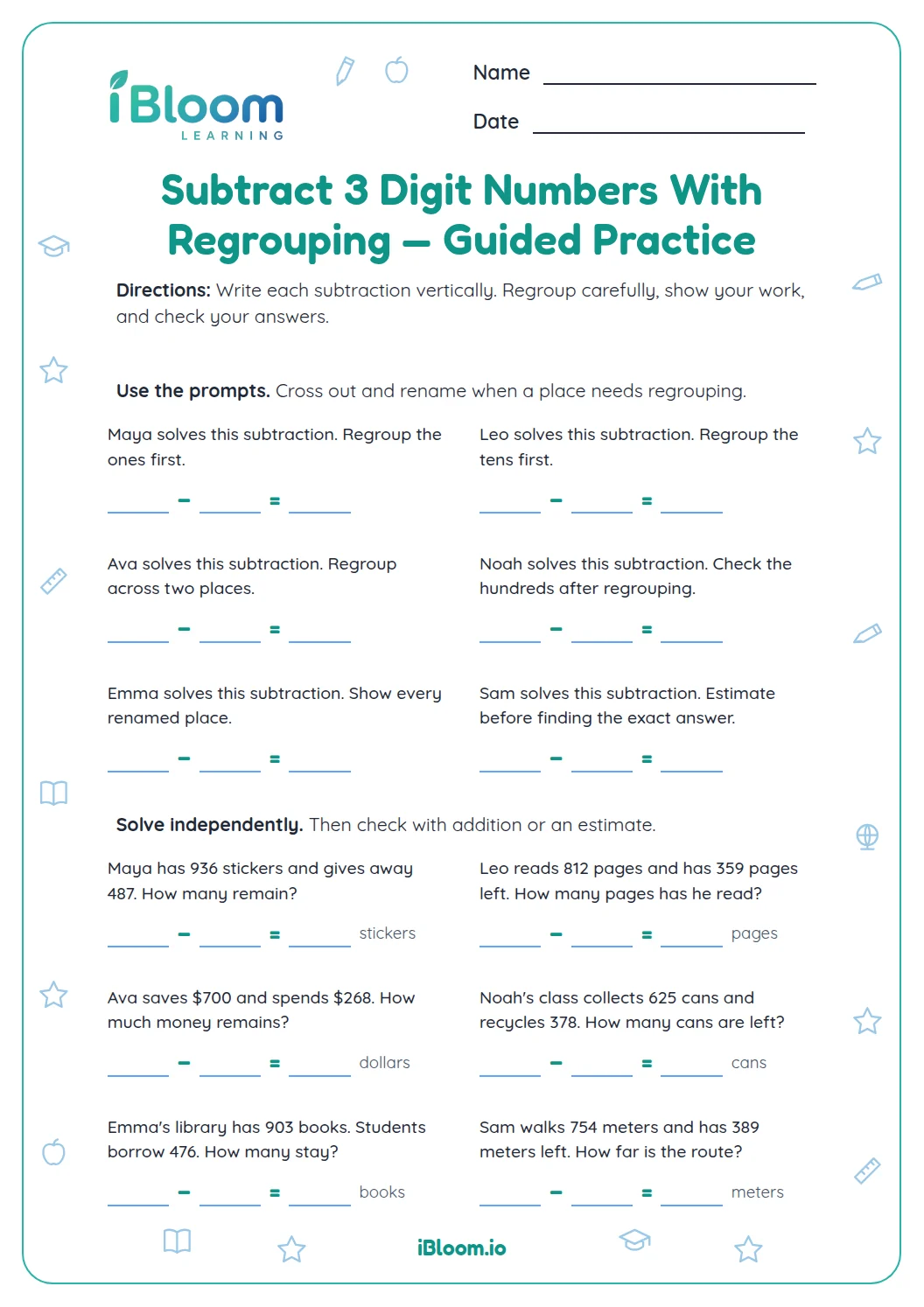
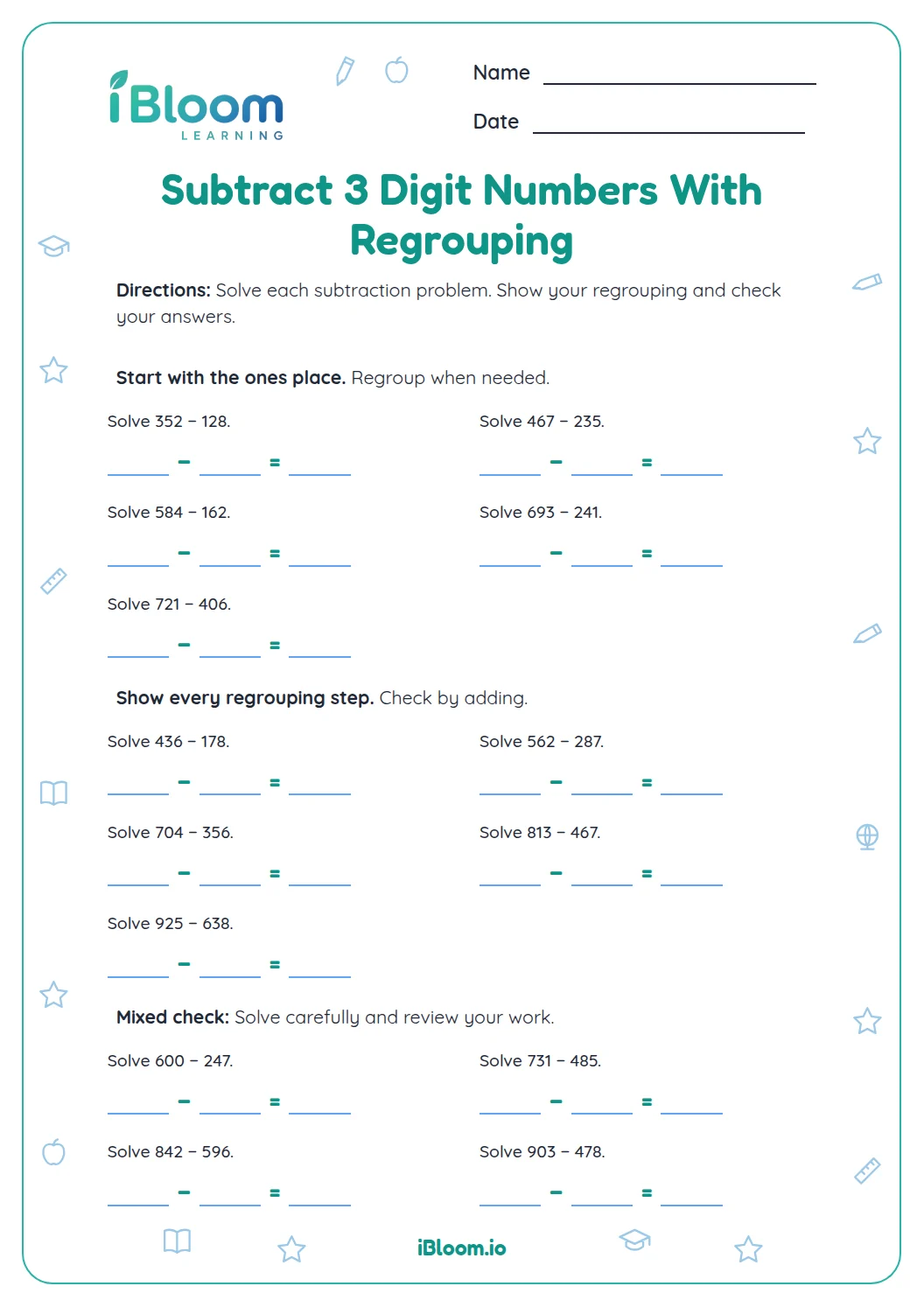
This Grade 4 printable gives students practice finding an unknown number in three-digit subtraction situations. The first part uses number sentences to show missing subtrahends and minuends; the second places the same relationships in familiar settings such as a library, garden center, and bus route. Students write or complete an equation, calculate, and label the answer with the right unit. The sheet has 14 questions and a separate answer key.
Aligned to 4.NBT.B.4
What can a blank mean in subtraction?
The blank can stand for the amount taken away, the starting amount, or the amount left. Read the position of the blank before calculating. For 624 − ___ = 287, the blank is the amount subtracted. For ___ − 356 = 418, it is the starting amount.
- 1___ − 356 = 418
- 2356 + 418 = 774, so the missing starting number is 774.
How do you choose an equation for a story?
Identify what the situation starts with, what changes, and what remains. The library began with an unknown number of books, 286 were checked out, and 417 remained. That relationship is start − 286 = 417.
How can addition check a subtraction answer?
Add the amount removed to the amount left. For the library story, 286 + 417 = 703. The total is the starting number, so 703 − 286 = 417 checks the answer. Keep the unit from the story in the final response.
How to use this worksheet
- 1Mark whether the blank is the start, the amount removed, or the result.
- 2Write an equation for each story before doing the arithmetic.
- 3Subtract with place value, regrouping when needed.
- 4Use addition to check an unknown start or amount removed.
- 5Write the unit with each story answer and compare with the key.
Common mistakes and quick fixes
The mistake
Subtracting 356 from 418 to solve ___ − 356 = 418.
The fix
The starting number is larger than the amount removed. Add 356 + 418 to recover the missing start: 774.
The mistake
Treating “how many did it sell?” as the amount remaining.
The fix
Name the known start and known remainder first. For 825 seedlings and 368 remaining, find the sold amount with 825 − 368.
The mistake
Writing a number without its unit in a story answer.
The fix
Carry the unit from the question, such as books, seats, or meters, so the answer describes the quantity.
Common Core alignment
The questions use multi-digit subtraction in number sentences and everyday situations.
Subtract multi-digit whole numbers fluently using the standard algorithm.
On this sheet: Students solve three-digit subtraction situations, including finding an unknown part.
Show the official wordingHide the official wording
Fluently add and subtract multi-digit whole numbers using the standard algorithm.
What to practice next
Make more practice
Further reading
Questions parents and teachers ask
What is a missing minuend?
The minuend is the number being subtracted from, or the starting number in a subtraction sentence. In ___ − 356 = 418, the missing minuend is 774 because 774 − 356 = 418. Addition recovers it by adding the subtrahend and difference, then subtraction checks it.
How do I find a missing subtrahend?
A subtrahend is the amount taken away. In 624 − ___ = 287, subtract the difference from the starting amount: 624 − 287 = 337. Check by putting 337 back into the sentence: 624 − 337 = 287. Both sides match.
Why do the word problems use subtraction?
Each story compares a starting total with an amount removed or an amount remaining. Naming those quantities helps show whether the blank is the start, the part taken away, or the result. The equation captures that relationship before the arithmetic begins.
Why should students write an equation first?
An equation shows how the known quantities and the unknown fit together. For the checked-out library books, start − 286 = 417. That setup makes it clear the number sought is the original amount, so students can use 286 + 417. The quantities have the same unit.
How can an answer be checked?
Use the inverse operation. Add the amount taken away to the amount remaining and compare the sum with the starting amount. For a missing result, subtract the result from the start to recover the amount removed. This check also catches regrouping errors.
Should answers include units?
Yes. A numerical answer becomes clearer when it includes the quantity named in the story, such as 703 books or 335 meters. The number-sentence section has no unit, while the real-world section gives a unit in each prompt. That keeps the answer tied to the situation.