




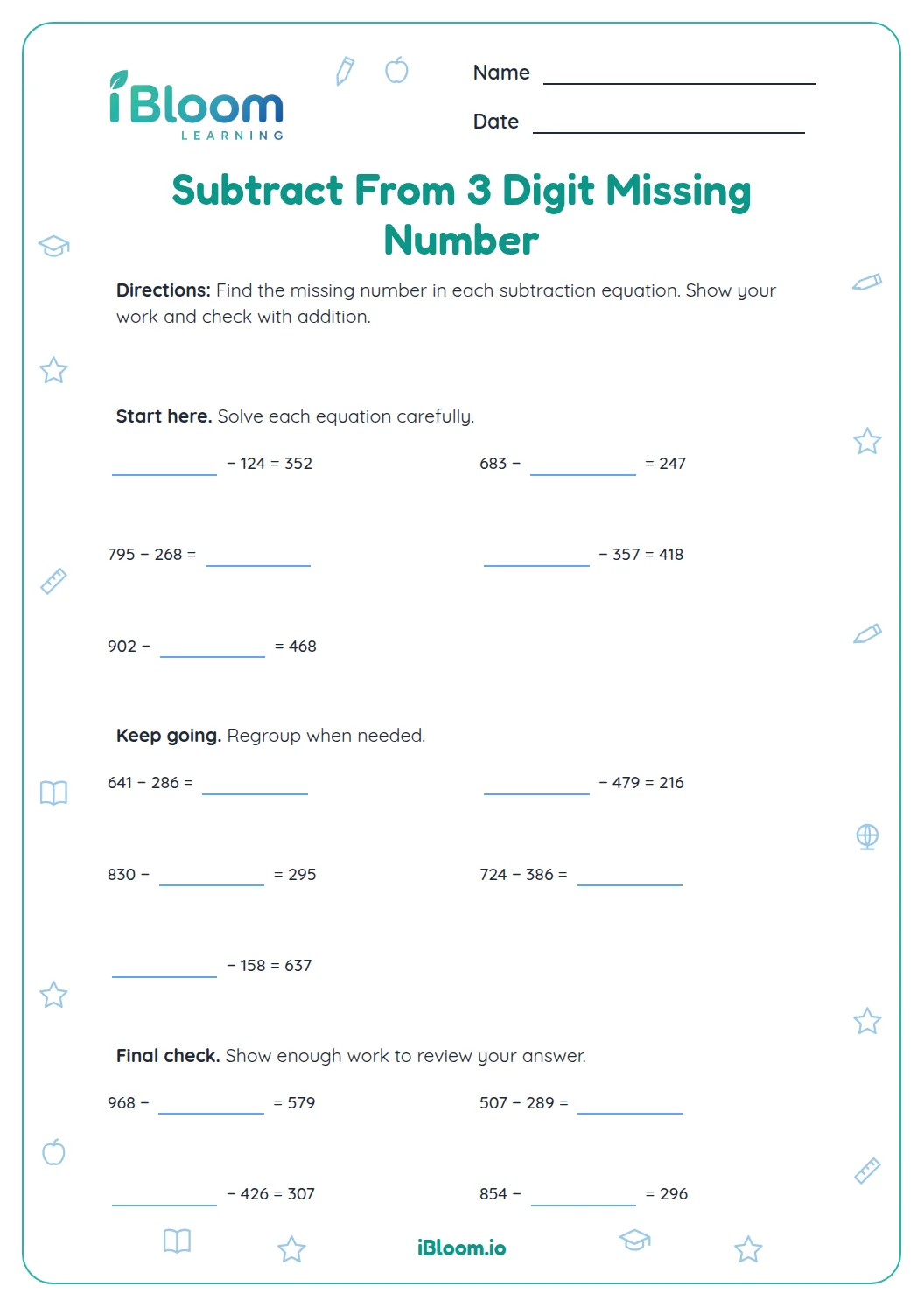
About this worksheet
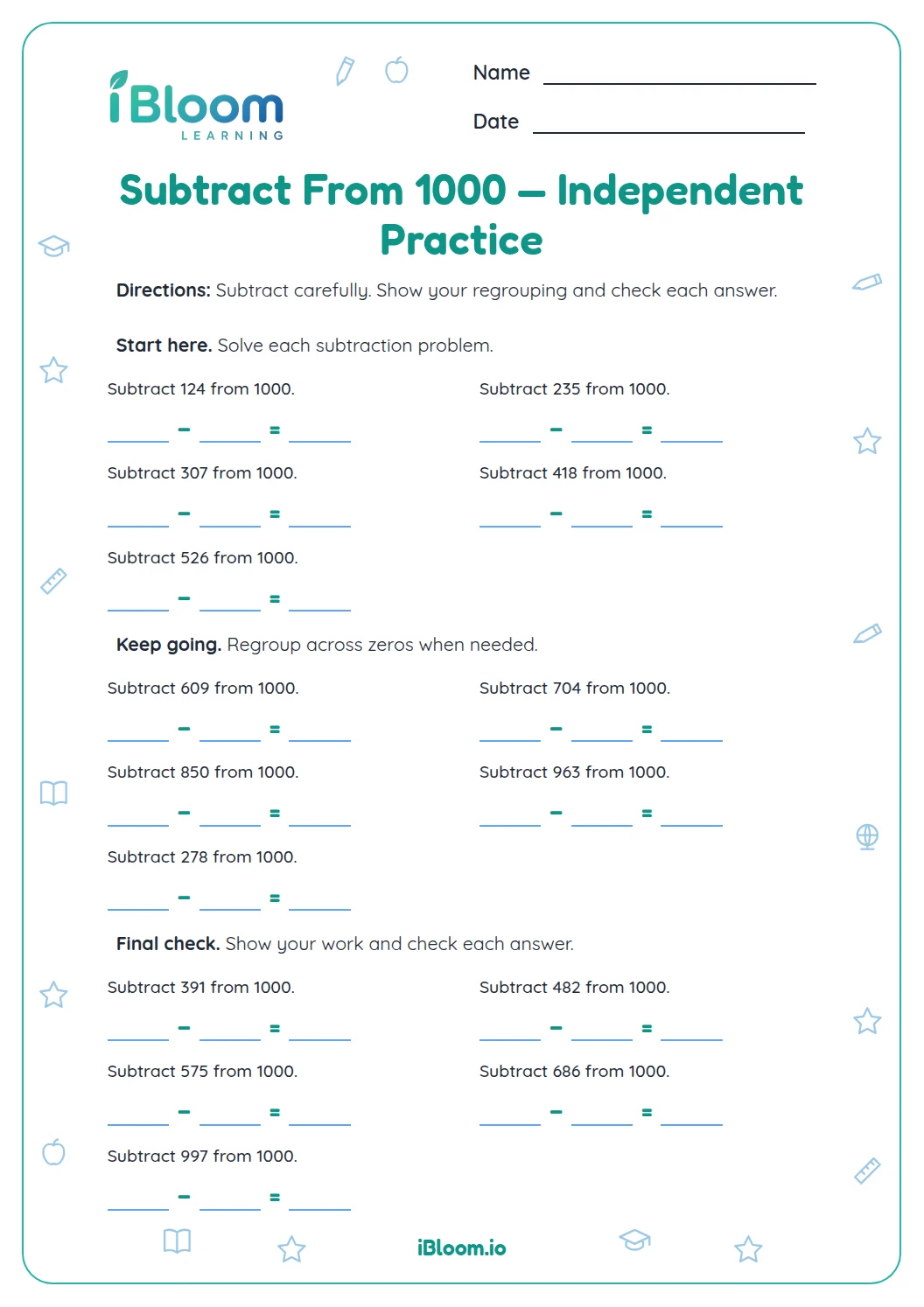
When subtracting from 1,000, regroup across the zeros. Think of 1,000 as 9 hundreds, 9 tens, and 10 ones. Then subtract by place: for 1,000 − 247, subtract 7 from 10, 4 from 9, and 2 from 9 to get 753. Add the answer back to check.
Aligned to 4.NBT.B.4
How do you regroup 1,000 across zeros?
For 1,000 − 247, rename 1,000 as 9 hundreds, 9 tens, and 10 ones. Subtract each place to get 753, then check that 753 + 247 = 1,000.
- 11,000 − 247
- 2Rename as 9 hundreds, 9 tens, 10 ones
- 310 − 7 = 3; 9 − 4 = 5; 9 − 2 = 7
- 4Difference: 753
- 5Check: 753 + 247 = 1,000
How does practice build the regrouping process?
Part A includes direct subtraction and missing-number sentences. Each problem starts from 1,000, so students can focus on how regrouping changes the hundreds, tens, and ones.
How can students check a subtraction answer?
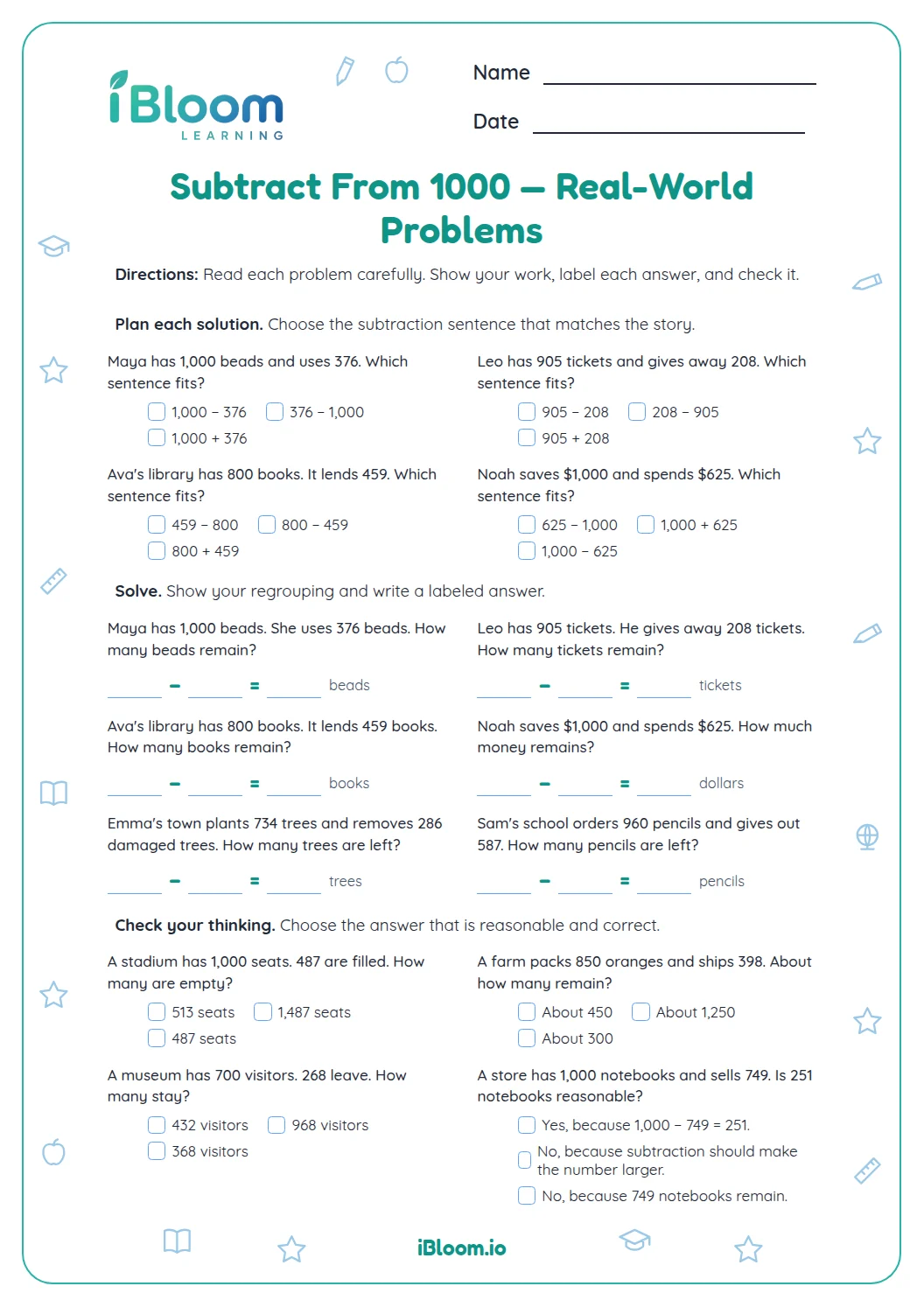
Add the difference to the subtrahend; the sum should be 1,000. In Part B, students also subtract amounts in stories and label the remaining bookmarks, seats, or flyers.
How to use this worksheet
- 1Write 1,000 above the number being subtracted.
- 2Regroup across zeros so each place has enough to subtract.
- 3Subtract ones, tens, and hundreds.
- 4Check by adding the difference and subtrahend.
- 5For a story, state the remaining quantity with its unit.
Common mistakes and quick fixes
The mistake
Subtracting each digit from zero without regrouping.
The fix
Rename 1,000 as 9 hundreds, 9 tens, and 10 ones first.
The mistake
Forgetting a zero in the difference, as in 1,000 − 908.
The fix
Subtract by place value: 10 − 8 = 2 ones, 9 − 0 = 9 tens, and 9 − 9 = 0 hundreds, so 92.
The mistake
Checking by adding the wrong numbers.
The fix
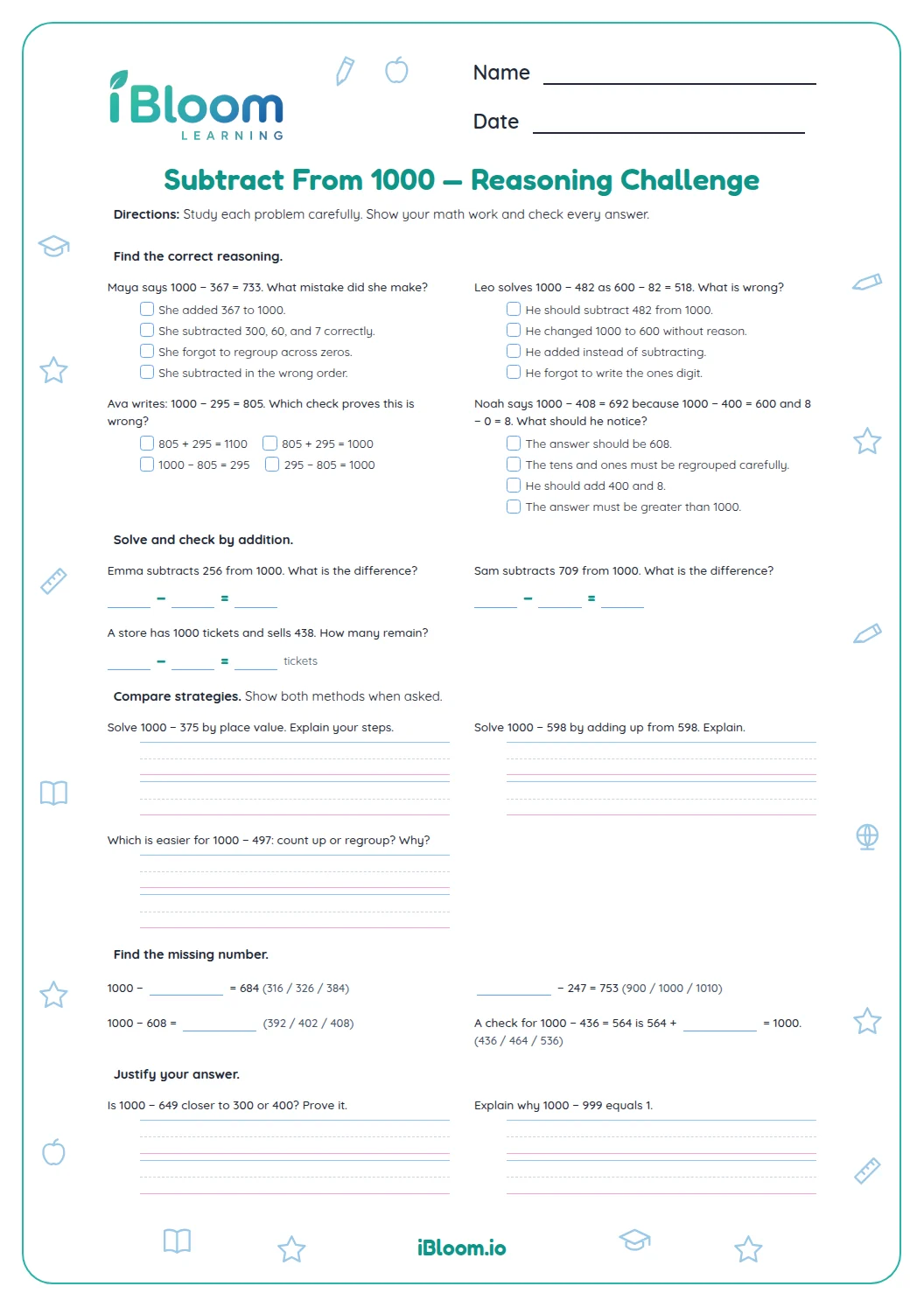
Add the difference to the subtrahend; the sum should be 1,000.
Curriculum alignment
This worksheet practices the named skill through models, short responses, and independent application.
Fluently add and subtract multi-digit whole numbers using the standard algorithm.
On this sheet: Students subtract three-digit amounts from 1,000 and use place-value regrouping across zeros.
Show the official wordingHide the official wording
Fluently add and subtract multi-digit whole numbers using the standard algorithm.
What to practice next
Make more practice
Questions parents and teachers ask
How do you subtract a number from 1,000?
Regroup across the zeros so each place has enough to subtract. For 1,000 − 247, rename 1,000 as 9 hundreds, 9 tens, and 10 ones. Subtract by place to get 753. The place-value steps help students keep track of each regrouped amount.
Why does regrouping from 1,000 take several steps?
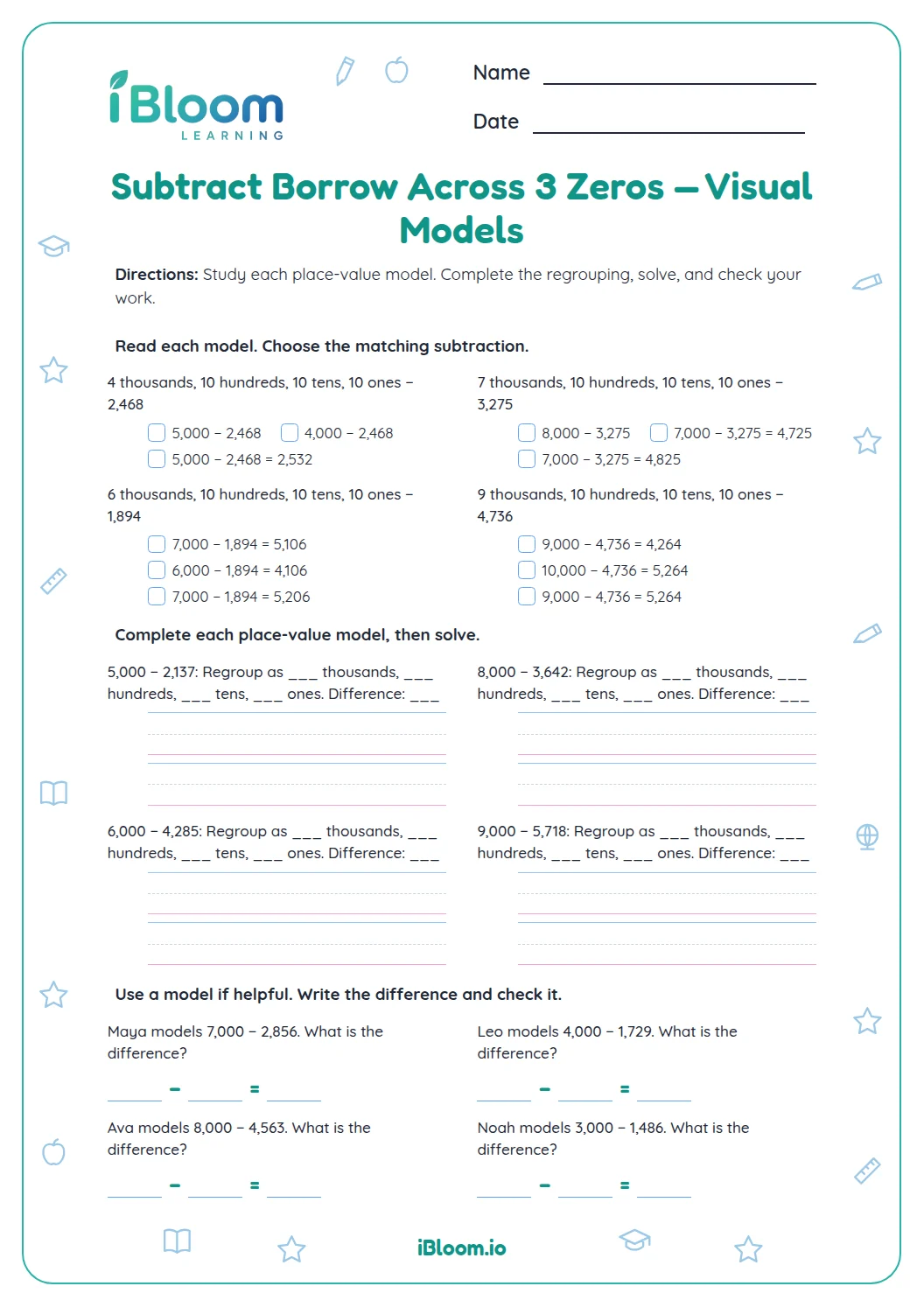
There are no tens or ones in 1,000 to trade directly. Regroup one thousand as 10 hundreds, then trade one hundred for 10 tens and one ten for 10 ones. The result is 9 hundreds, 9 tens, and 10 ones.
What is 1,000 − 908?
It is 92. After regrouping, subtract 8 from 10 ones to get 2, 0 tens from 9 tens to get 9 tens, and 9 hundreds from 9 hundreds to get 0 hundreds. The place-value steps help students keep track of each regrouped amount.
How can students check a subtraction answer?
Add the difference and the number subtracted. For 1,000 − 247 = 753, check 753 + 247 = 1,000. The original starting amount should be the sum. The place-value steps help students keep track of each regrouped amount. The answer key makes it easy to confirm the check as well as the difference.
What do the story problems ask students to find?
Each story gives a total of 1,000 and an amount used, occupied, or given away. Subtract the amount that is no longer part of the total, then answer with the matching unit, such as bookmarks, seats, or flyers. The place-value steps help students keep track of each regrouped amount.
Is there a separate answer key?
Yes. The answer key gives the differences, missing values, story totals, and correct checks. Students can first solve the worksheet independently, then use the key to verify the regrouping and addition checks. The place-value steps help students keep track of each regrouped amount.