

About this worksheet
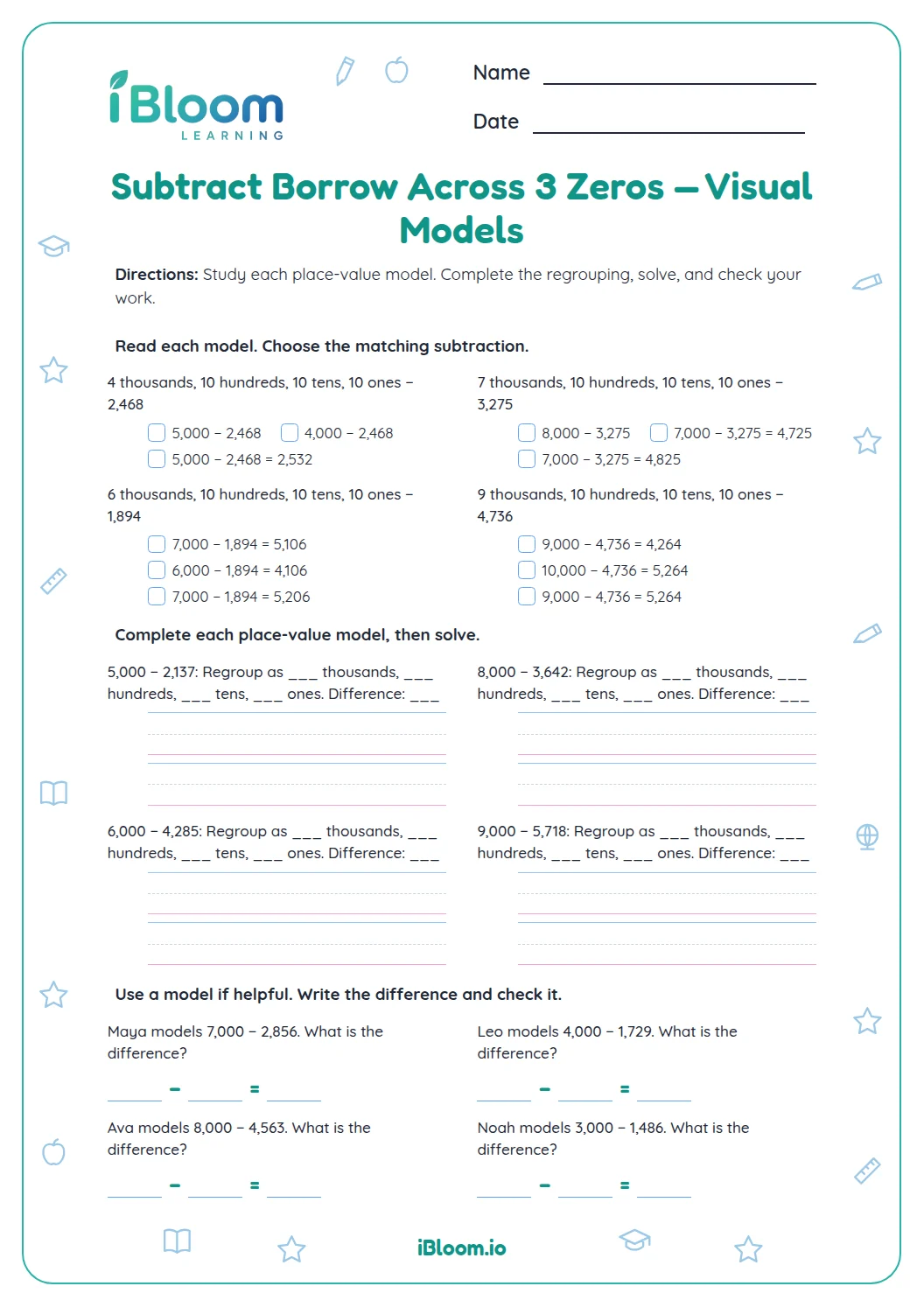
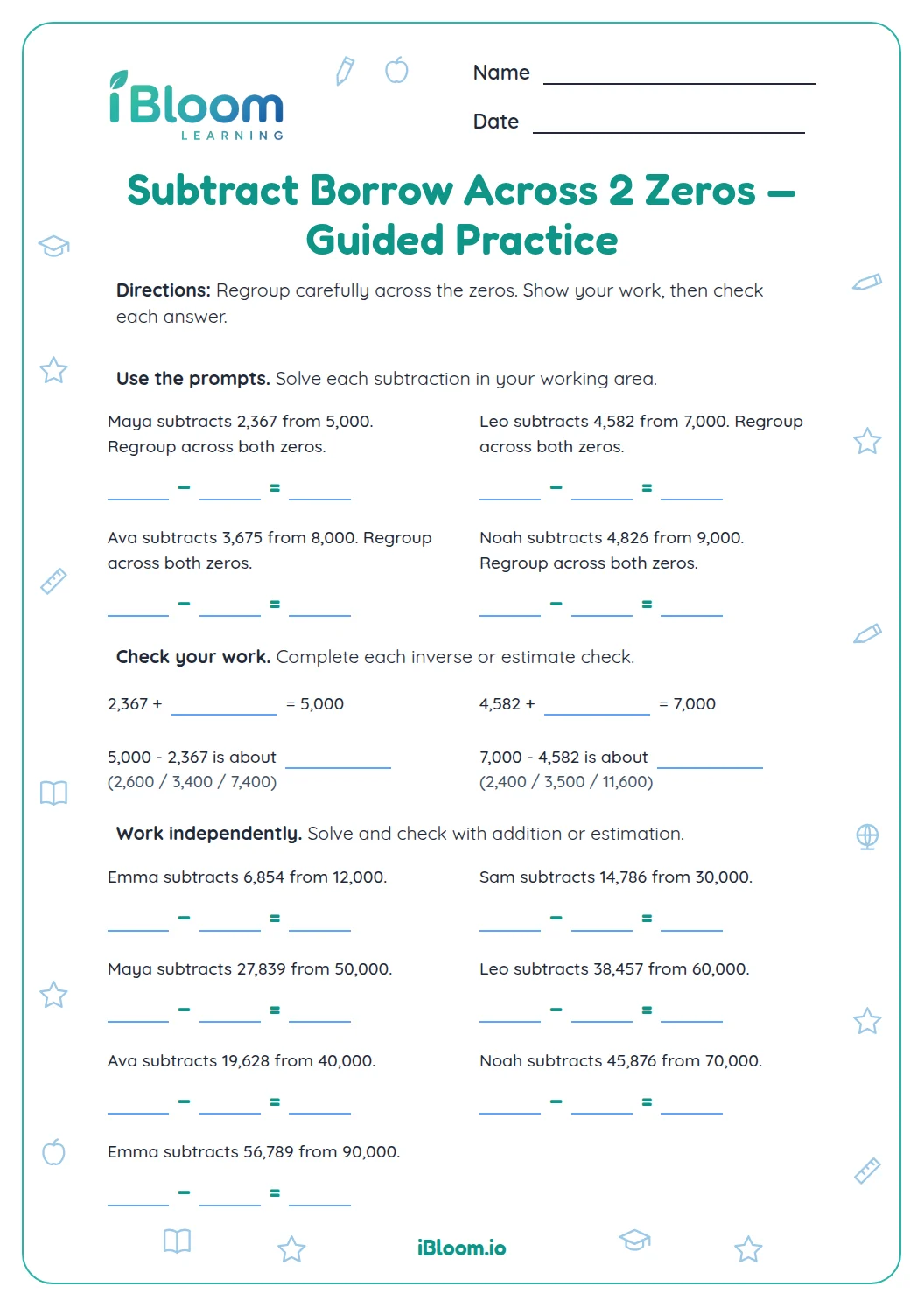
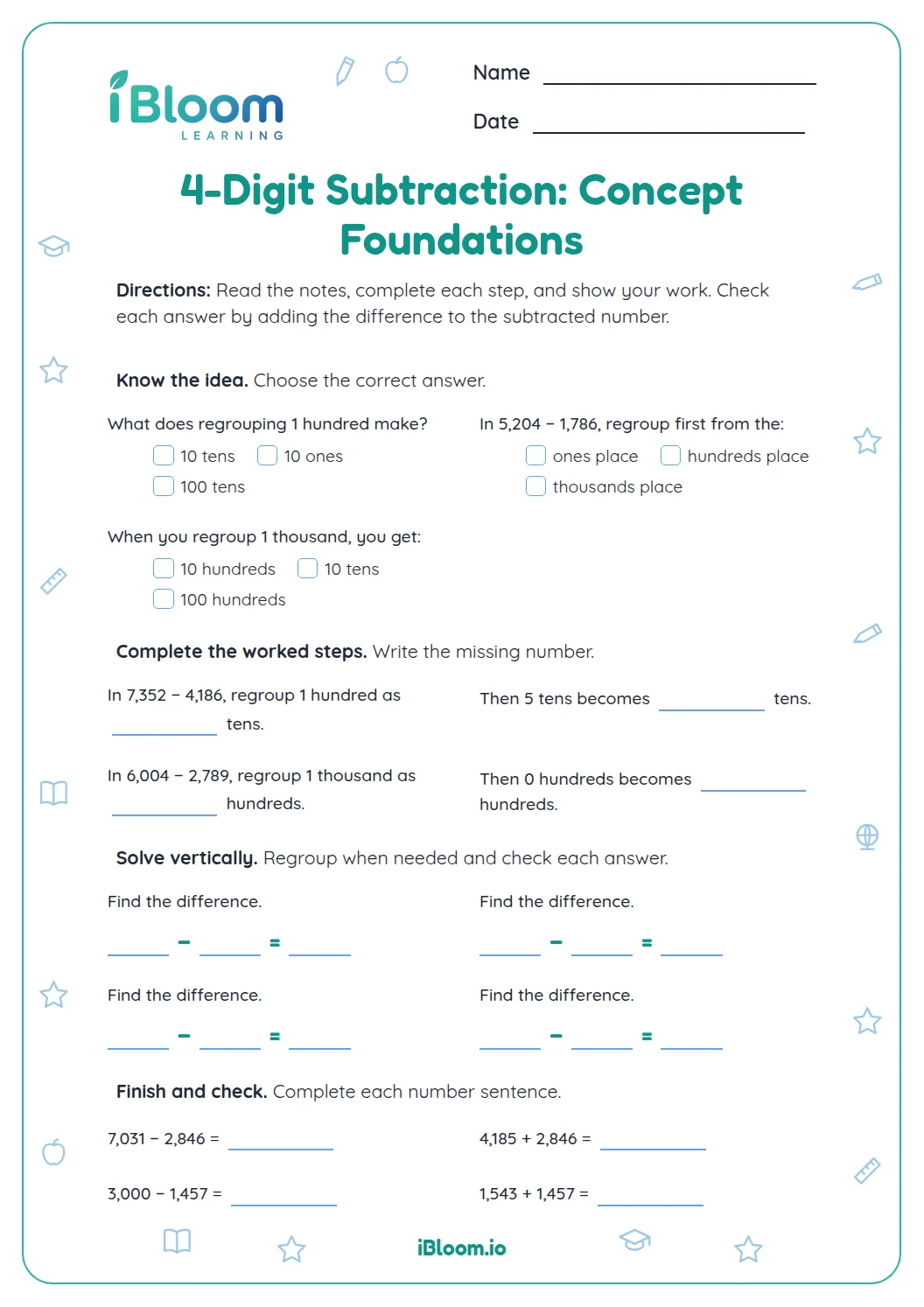
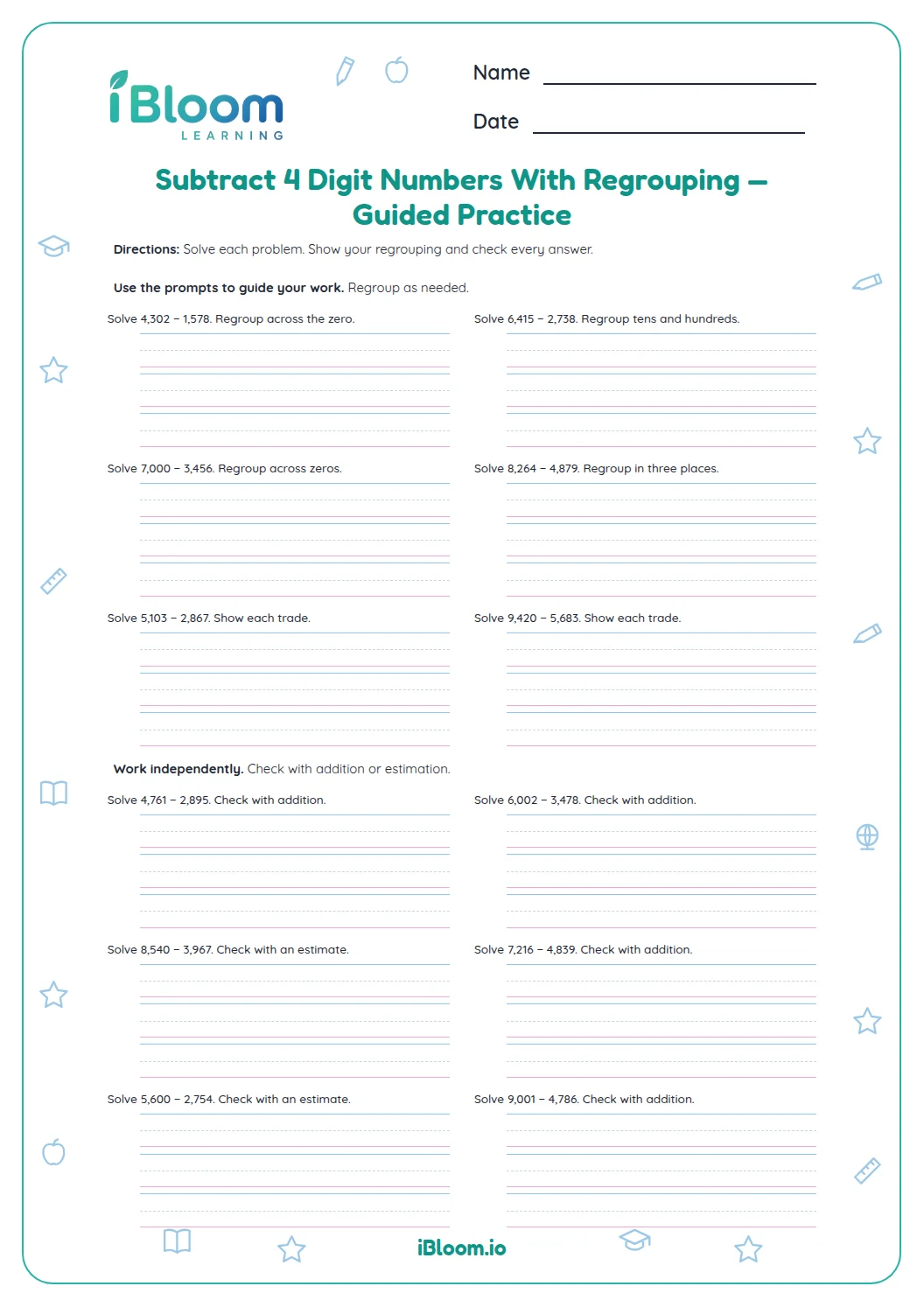
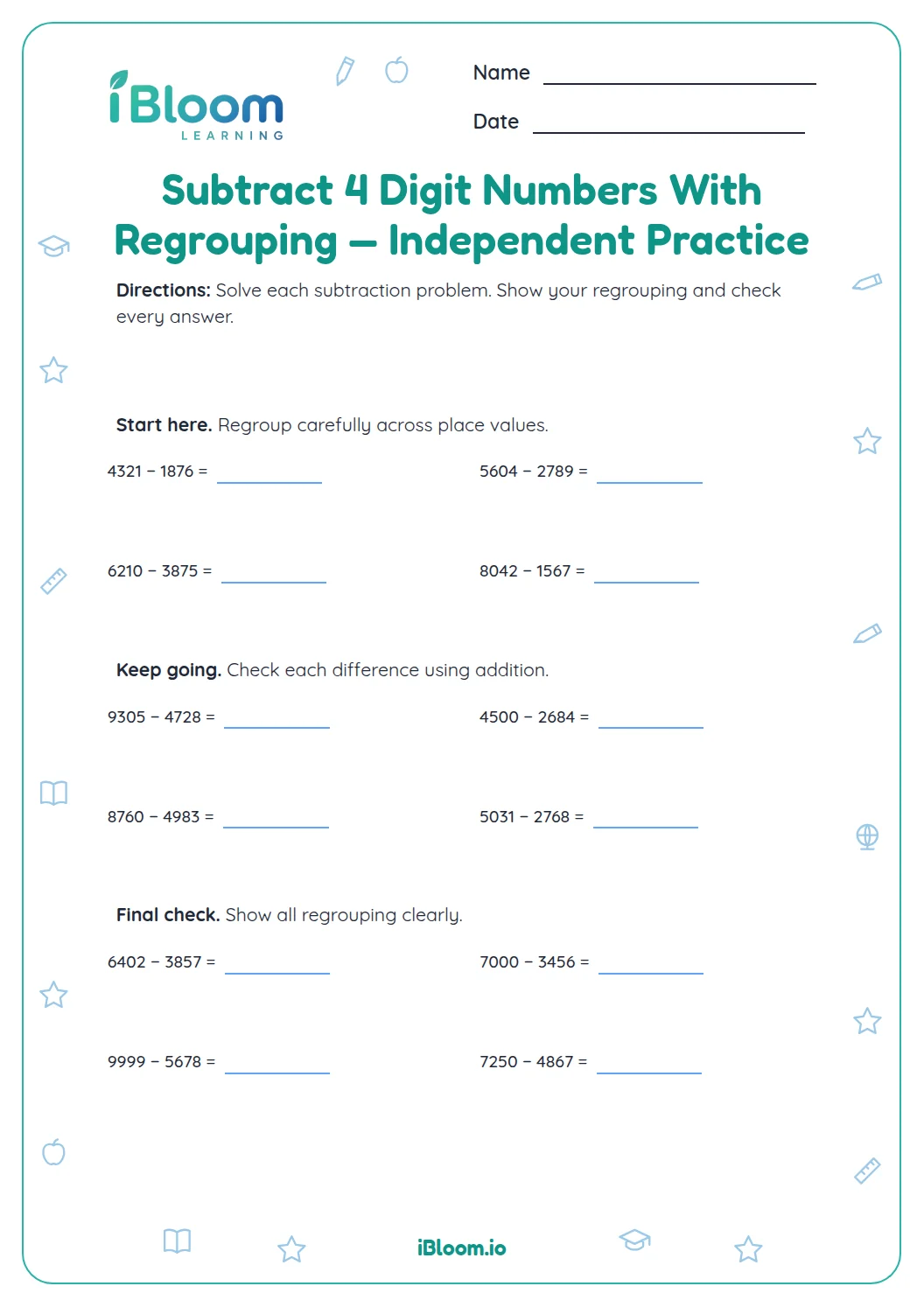
This free Grade 4 worksheet builds a careful method for subtracting when a multi-digit minuend contains zeros. Students regroup from a nonzero place value across zero digits, then subtract in columns. The 16 questions include computation, word problems, and an error check, with answers on a separate key page. The work aligns with Common Core 4.NBT.B.4, which calls for fluency with multi-digit addition and subtraction using the standard algorithm.
Aligned to 4.NBT.B.4
How does regrouping cross zero places?
In 5,000 − 2,347, there are no tens or hundreds to subtract from at first. Exchange one thousand for ten hundreds, then exchange one hundred for ten tens, then one ten for ten ones.
- 15,000 − 2,347
- 2Regroup the 5 thousands as 4 thousands, 9 hundreds, 9 tens, and 10 ones.
- 3Subtract: 2,653.
What should you do after regrouping?
Subtract each column from right to left. Keep the regrouped digits visible so you do not subtract from the original zeros.
How can addition check the answer?
Add the difference and the number subtracted. If the sum equals the starting number, the subtraction is consistent.
How to use this worksheet
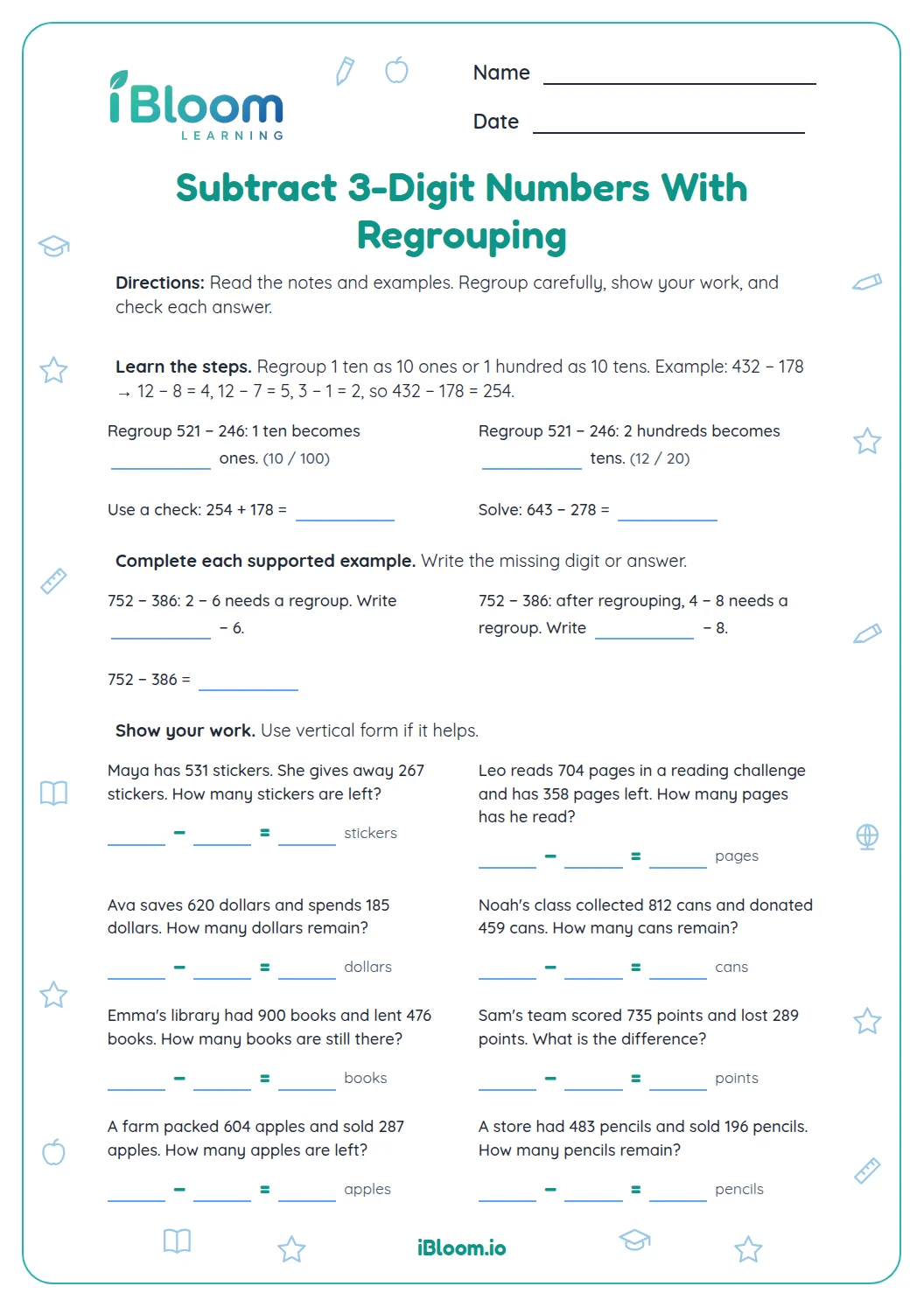
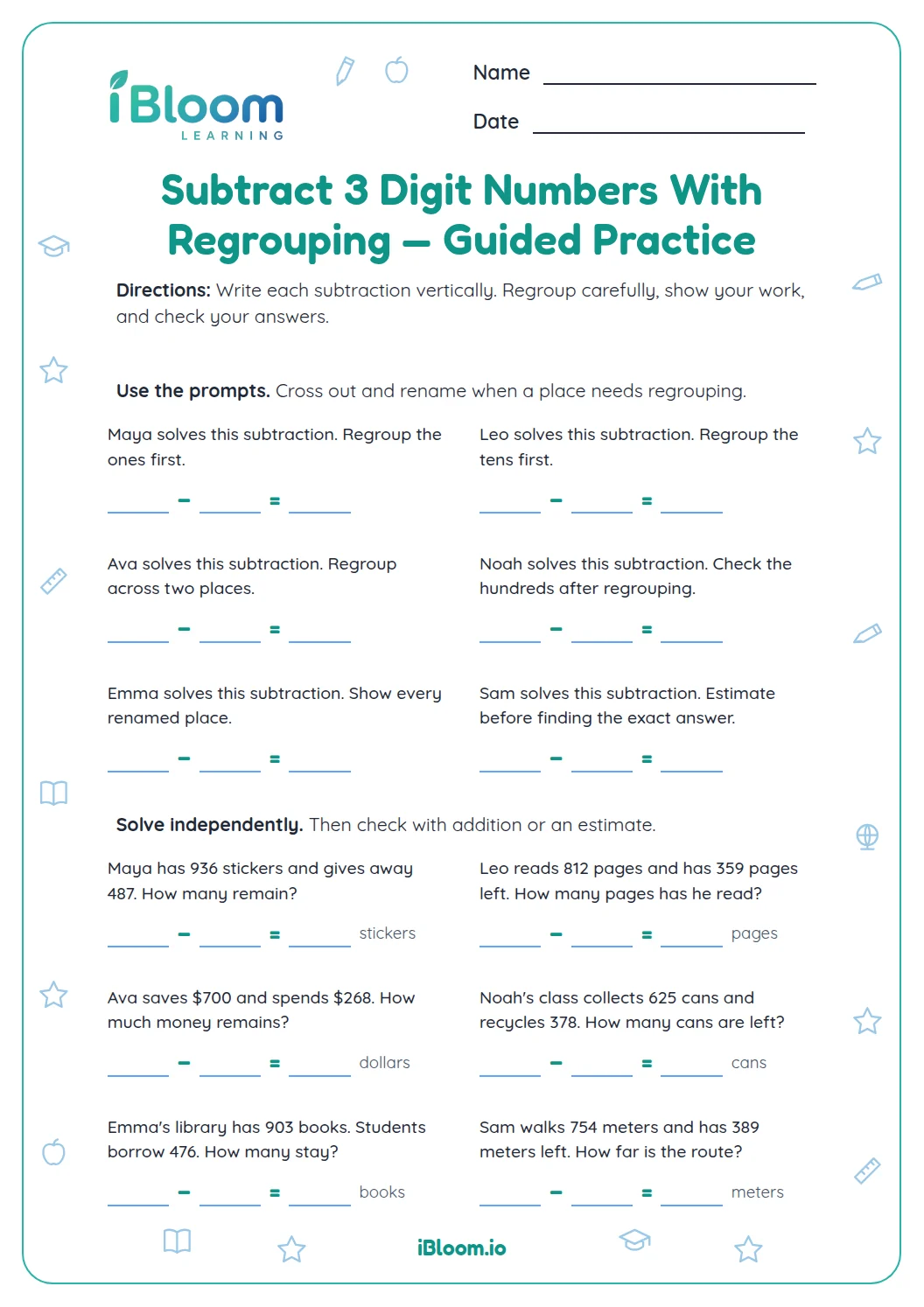
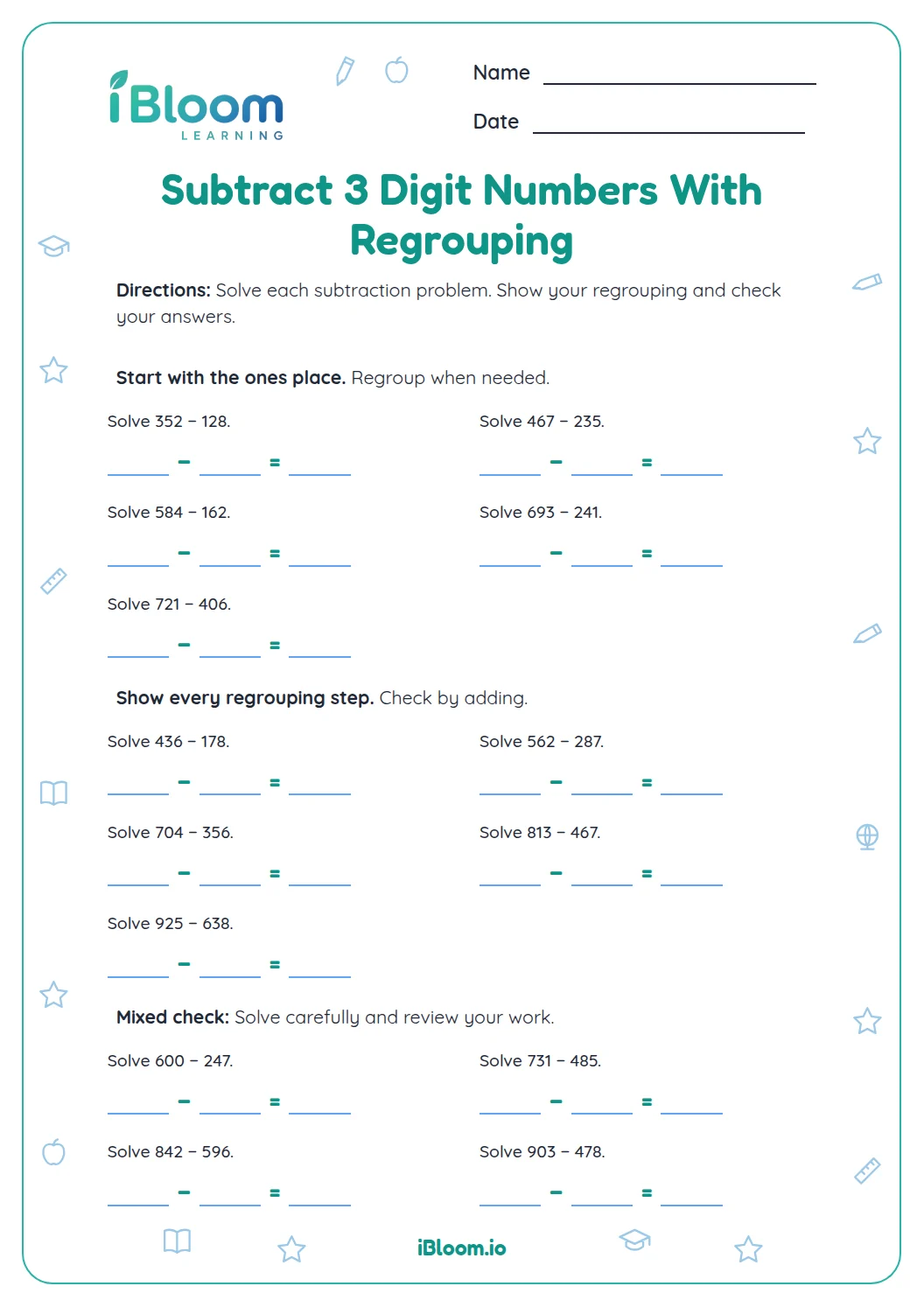
- 1Write the larger number above the smaller number, aligning place values.
- 2Start in the ones column and compare the digits.
- 3When needed, exchange from the nearest nonzero column to the left.
- 4Update every digit crossed by the exchange.
- 5Subtract each column and check by addition.
Common mistakes and quick fixes
The mistake
Borrowing one ten directly through two zeros without changing the intervening places.
The fix
Show each exchange: a thousand becomes 10 hundreds, then a hundred becomes 10 tens.
The mistake
Leaving a zero unchanged after regrouping through its place.
The fix
Cross out and rewrite every place value involved in the exchange.
The mistake
Subtracting the smaller digit from the larger digit in every column regardless of position.
The fix
Regroup first so the top digit is at least as large as the bottom digit in that column.
Common Core alignment
The problems practice the standard subtraction algorithm with multi-digit whole numbers.
Subtract multi-digit whole numbers with regrouping across zero places.
On this sheet: Students use the standard subtraction algorithm with multi-digit numbers and regrouping across zeros.
Show the official wordingHide the official wording
Fluently add and subtract multi-digit whole numbers using the standard algorithm.
What to practice next
Make more practice
Further reading
Questions parents and teachers ask
Why is subtracting across zeros tricky?
A zero place has no unit to subtract, so regrouping has to begin in a place farther left. The value then passes across the zero places one exchange at a time. Questions 5 through 12 practice this pattern with different starting numbers.
What is the answer to 5,000 minus 2,347?
The difference is 2,653. Regroup 5 thousands as 4 thousands, 9 hundreds, 9 tens, and 10 ones. Then subtract each column. The answer key lists the result and the other worksheet answers. Students can use this result as a model for the other problems with three zeros.
How can I check a subtraction answer?
Add the difference to the number subtracted. For 5,000 − 2,347 = 2,653, add 2,653 + 2,347. The total is 5,000, matching the starting number, so the equation checks. This check works for any subtraction problem with whole numbers. That makes addition a practical inverse operation for checking the work.
Does this sheet include word problems?
Yes. Three questions use bookmarks, trail distance, or boxes to place subtraction in a context. Encourage students to write the unit when the question includes one, then check that the answer is smaller than the starting amount. Each story gives the starting amount and the amount taken away.
What if the student gets stuck at a zero?
Have them look left for the nearest place with a digit greater than zero. Exchange from that place and rewrite each place value passed on the way to the needed column. A place-value chart or quick sketch can help make each exchange visible.