
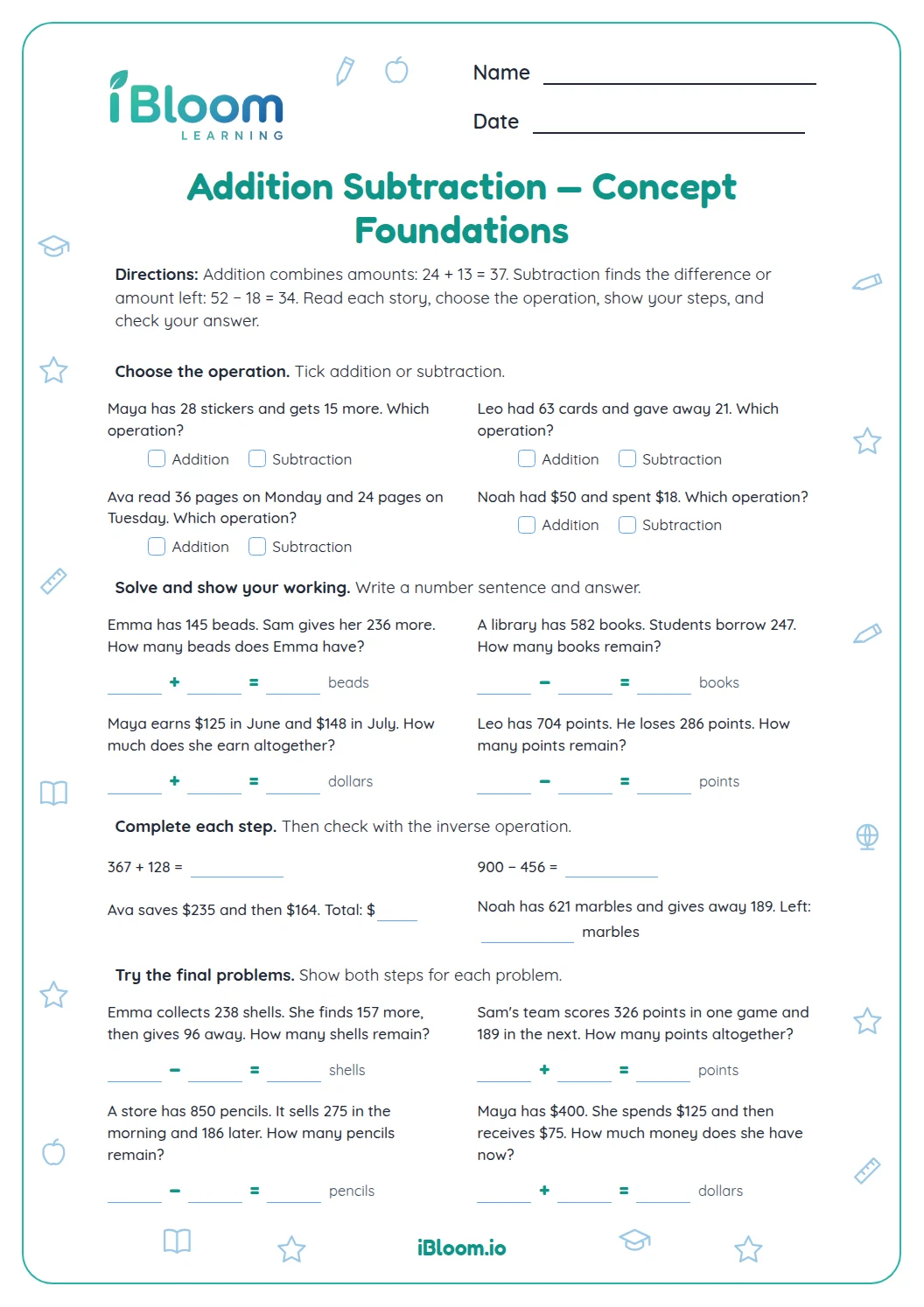
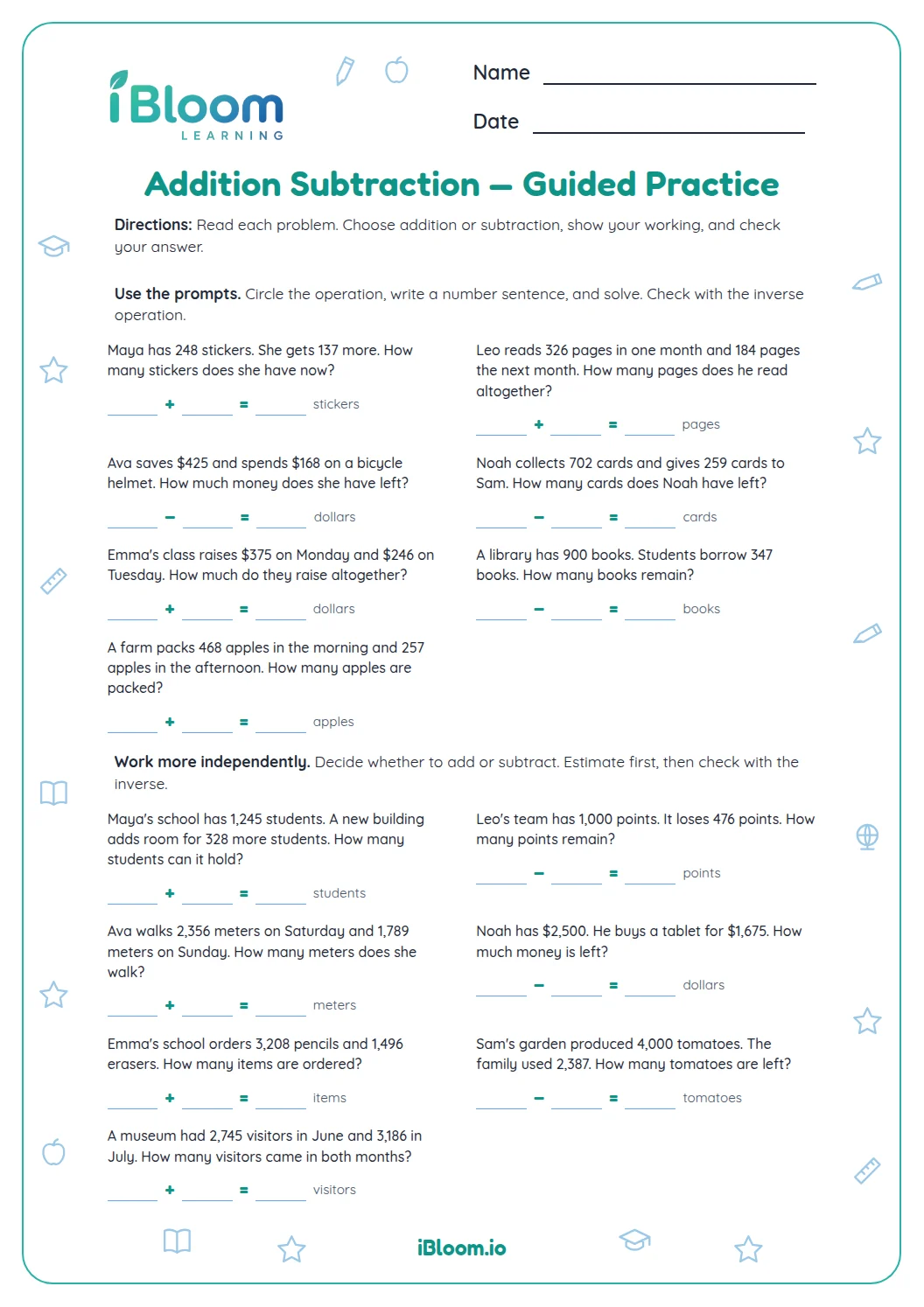
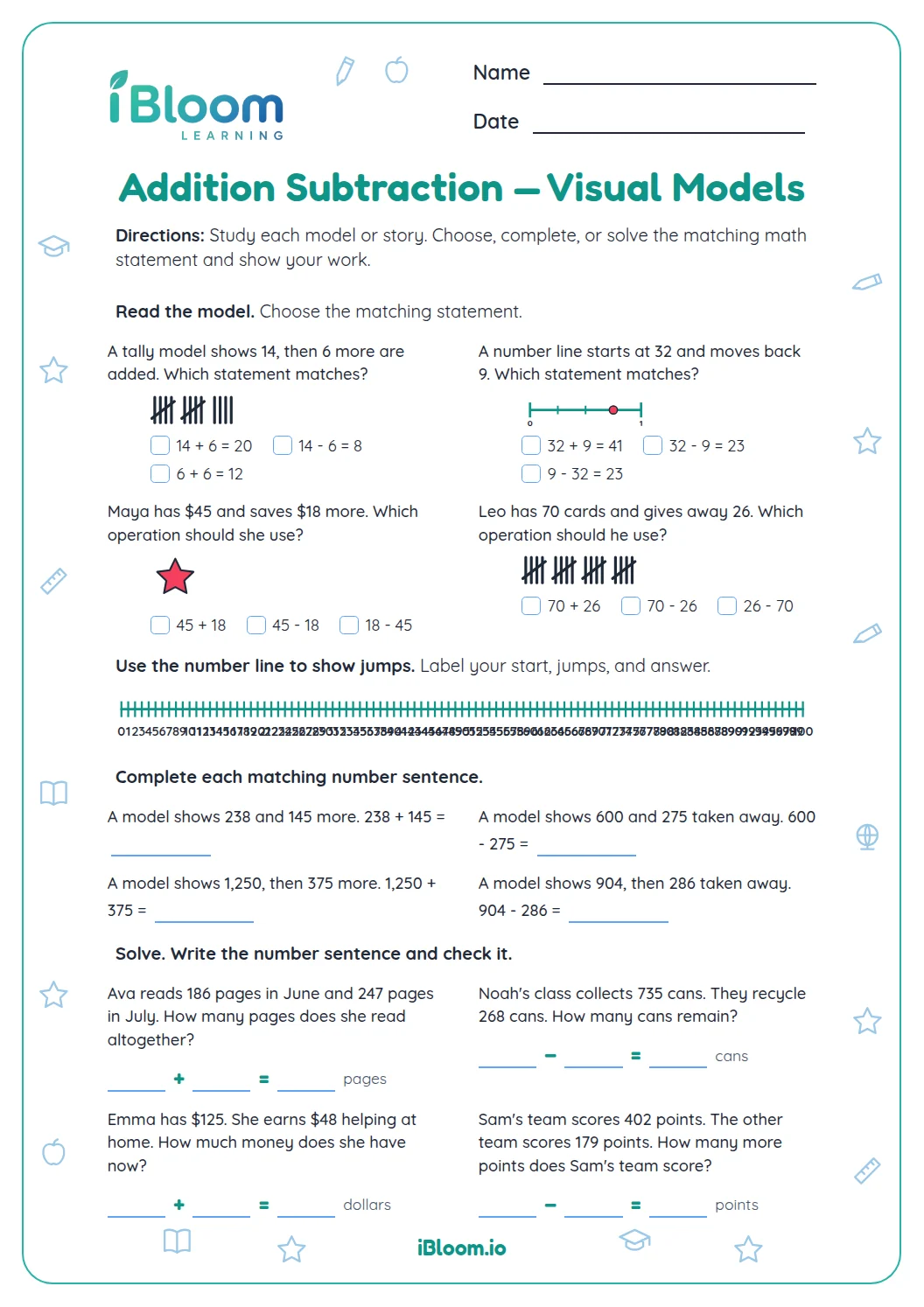
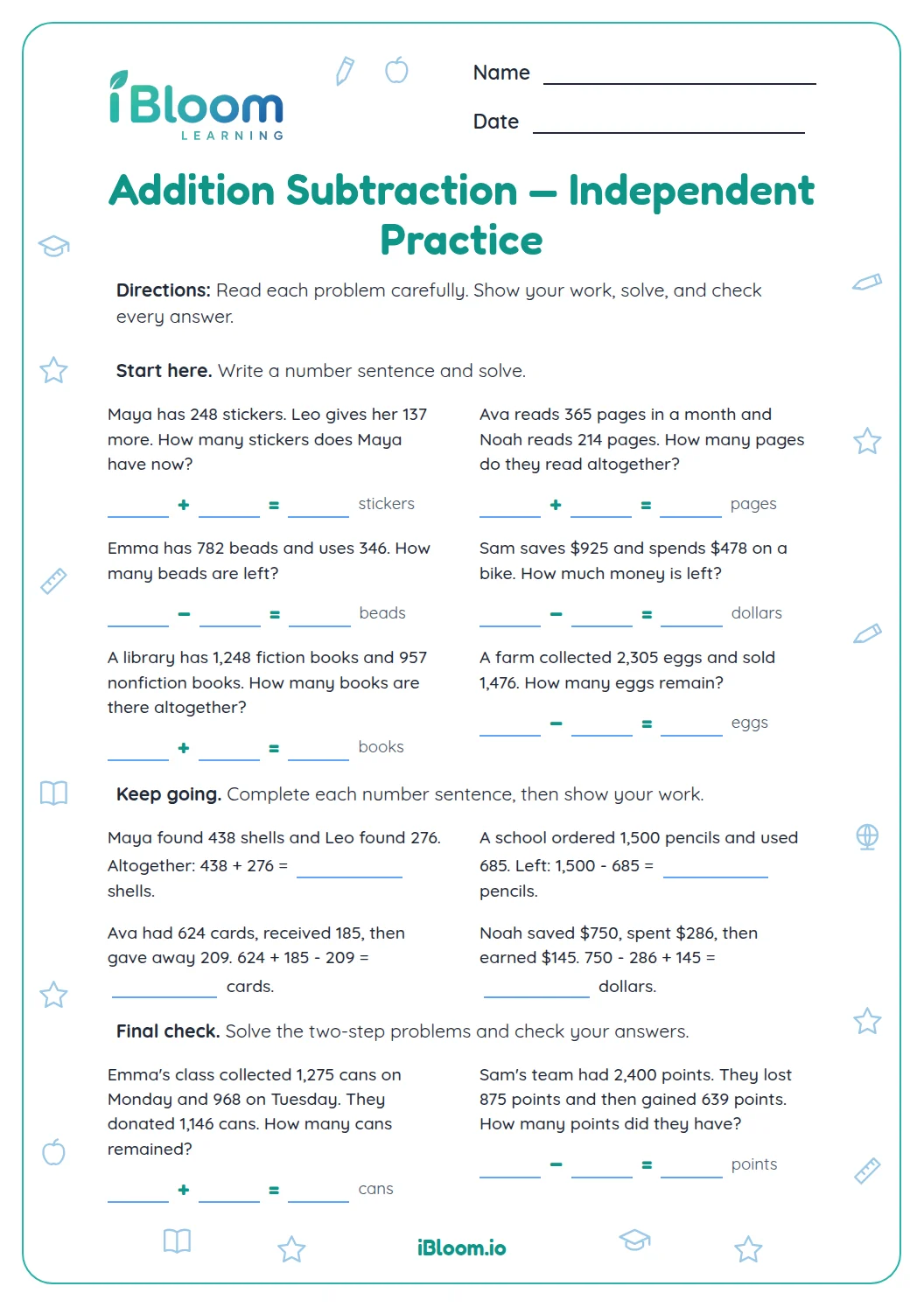
About this worksheet
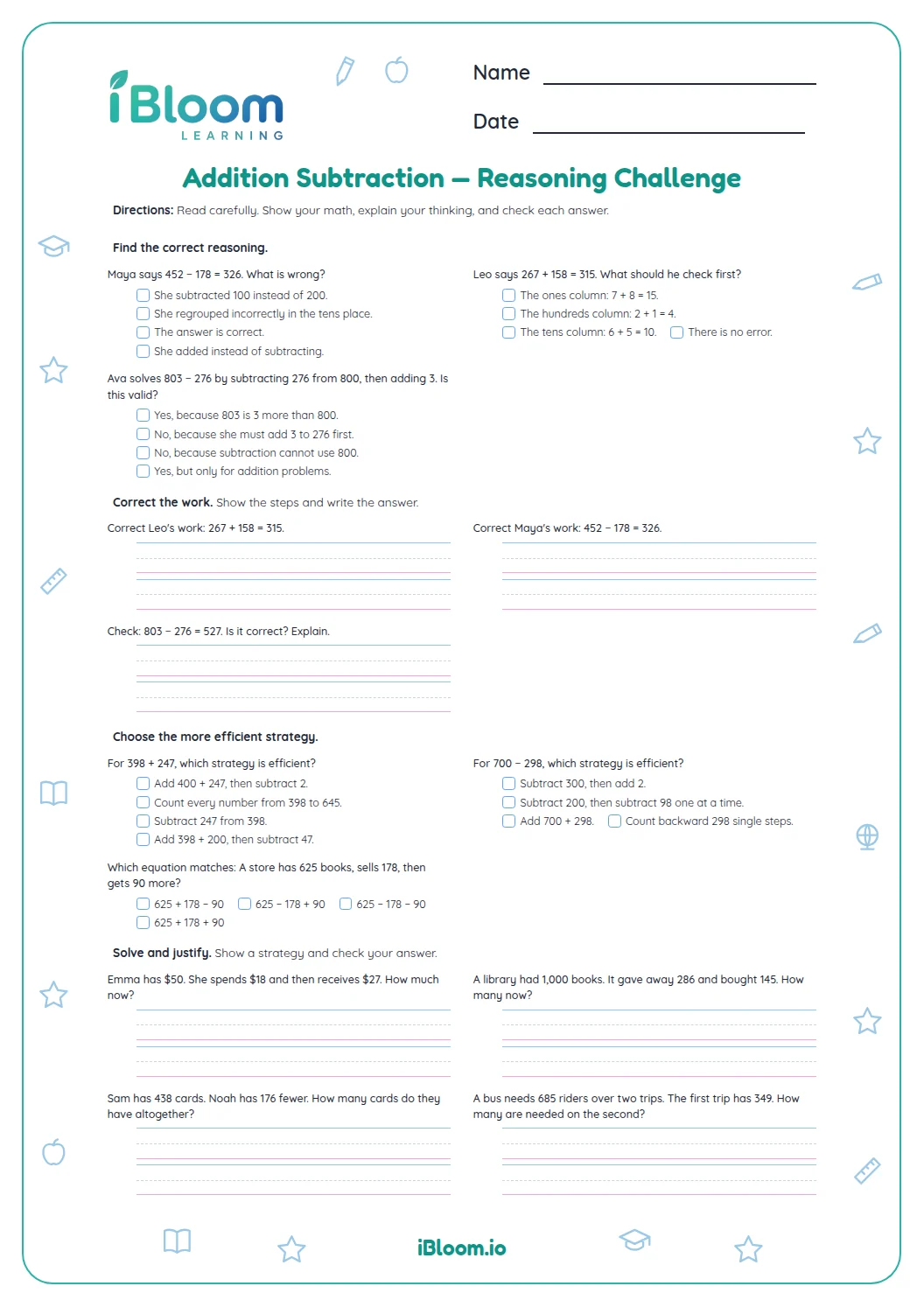
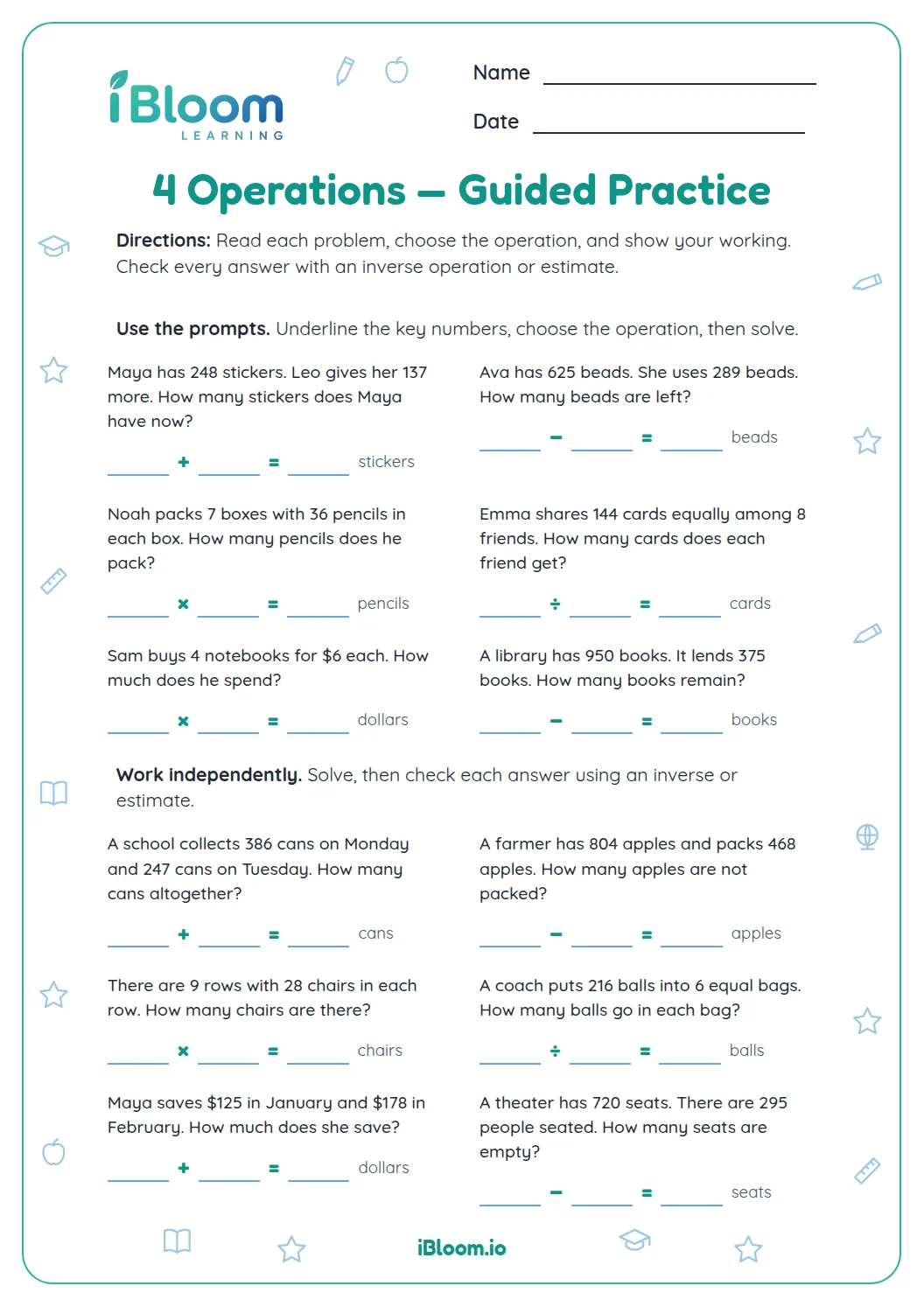
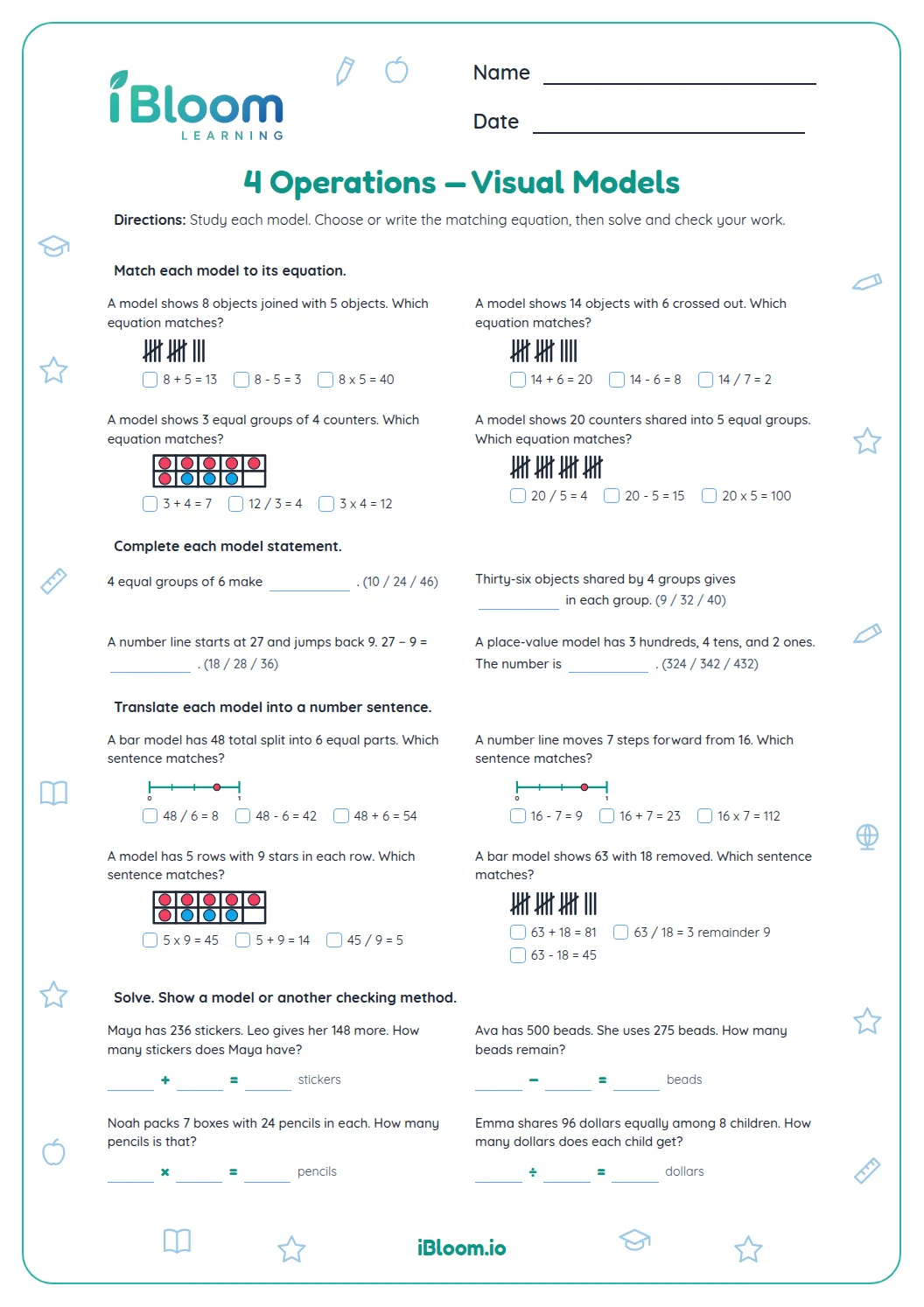
This Grade 4 printable has 14 real-world addition and subtraction problems in two parts. Students solve multi-digit totals, differences, and two-step stories, then label each answer. It practices CCSS 4.NBT.B.4: adding and subtracting multi-digit whole numbers.
Aligned to 4.NBT.B.4
How do you choose an operation?
Addition combines quantities to find a total. Subtraction finds what remains or compares an amount with a goal. In each story, name the unknown first, then decide which operation connects the known amounts to it.
For the library story, the question asks for the combined number of books: 2,486 + 1,759 = 4,245 books. Regroup the ones and tens, then estimate to check that the total is reasonable.
How do two-step stories work?
Use the result of the first action in the next calculation. In the bottle story, first add 3,250 + 1,875 to find the delivery total. Then subtract 2,496 sold: 5,125 − 2,496 = 2,629 bottles remain.
Label the final number with the unit named in the question. A label makes clear whether the answer counts books, meters, or bottles.
Solve a story problem
- 1Read the final question and name the unknown quantity.
- 2Choose addition or subtraction based on how the quantities relate.
- 3Write an equation and calculate carefully, regrouping when needed.
- 4For a two-step story, use the first result in the next equation.
- 5Add a label and estimate or use the inverse operation to check.
Common mix-ups
The mistake
Subtracting the smaller number just because the story mentions “more.”
The fix
Ask whether the question wants a combined total or a difference. “How many more are needed?” compares the goal with the amount already collected.
The mistake
Stopping after combining deliveries in a two-step problem.
The fix
Reread the final question. If it asks what remains after sales, subtract the sales too.
The mistake
Using the total traveled as the second day’s distance.
The fix
Subtract the first day’s miles from the two-day total to find the remaining distance.
Common Core alignment
These problems practice Grade 4 whole-number addition and subtraction in meaningful situations.
Fluently add and subtract multi-digit whole numbers.
On this sheet: Students add and subtract numbers through the thousands in one- and two-step contexts.
Show the official wordingHide the official wording
Fluently add and subtract multi-digit whole numbers using the standard algorithm.
What to practice next
Make more practice
Further reading
Questions parents and teachers ask
How do I decide whether to add or subtract?
Ask what the unknown represents. Add when the story asks for a combined total. Subtract when it asks what remains or how far apart two amounts are. For example, the book drive question compares the goal with the number already collected, so subtract the collected books from the goal.
How can I solve a two-step problem?
Write and solve an equation for the first action, then use that result in a second equation. In the bottle story, add the two deliveries before subtracting the bottles sold. Keep the intermediate total visible so you do not subtract from just one delivery.
Why should I include a label?
A label tells what the answer counts, such as books, meters, or seats. It helps you check that the unit matches the question and that you used the right quantities. For instance, the library answer is 4,245 books, not just 4,245.
How can I check subtraction?
Use addition to undo the subtraction. If 2,468 tickets were sold from 5,200, add the tickets sold to the tickets remaining. The sum should be 5,200. An estimate can also show whether the difference is in a sensible range.
What does “how many more” mean in the book drive story?
The story asks how many books are needed to reach a goal. Compare the goal of 8,000 with the 3,685 already collected, then find the difference. This gives 4,315 additional books. The phrase signals a comparison because the question asks for the gap between two amounts.