


About this worksheet
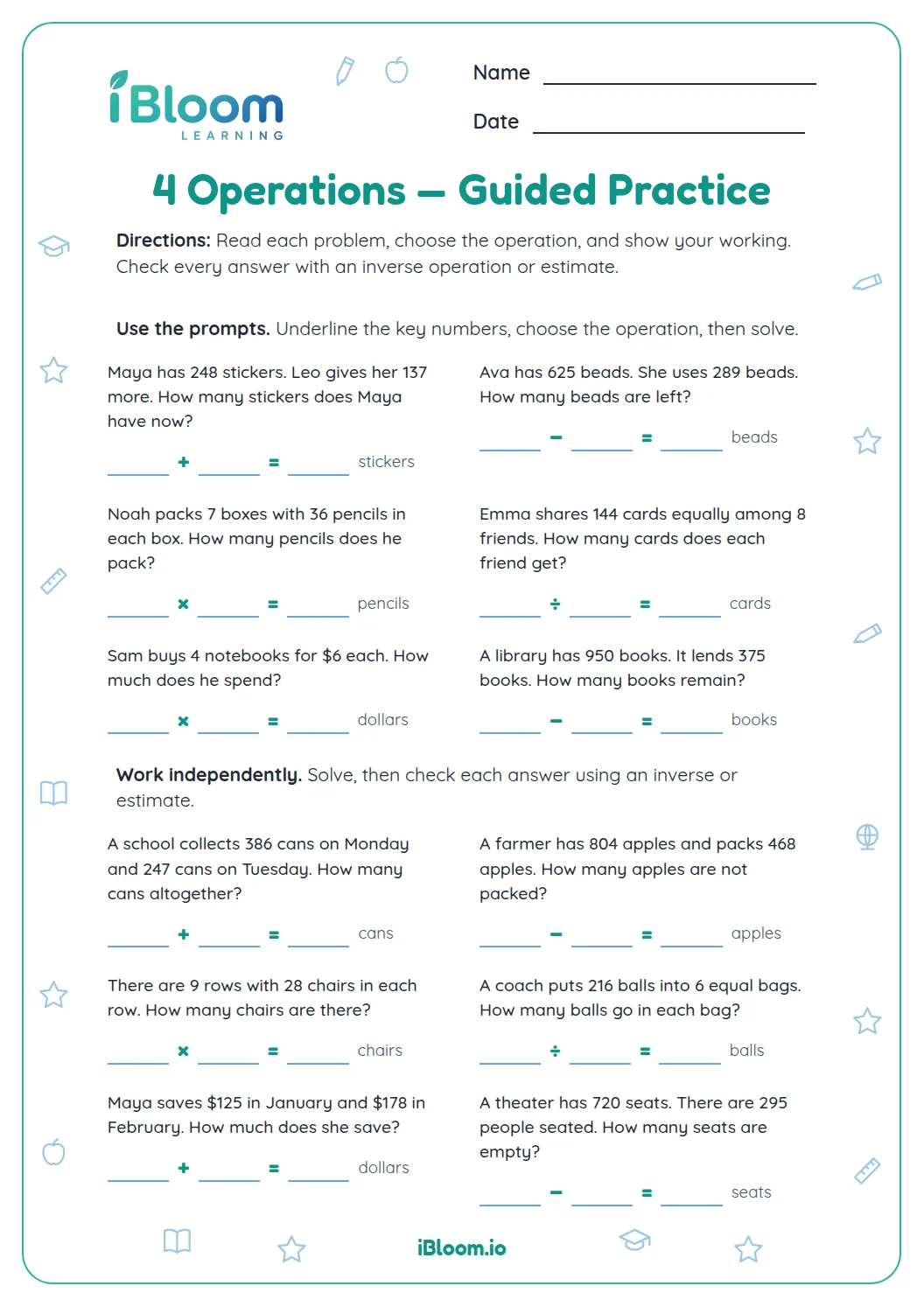
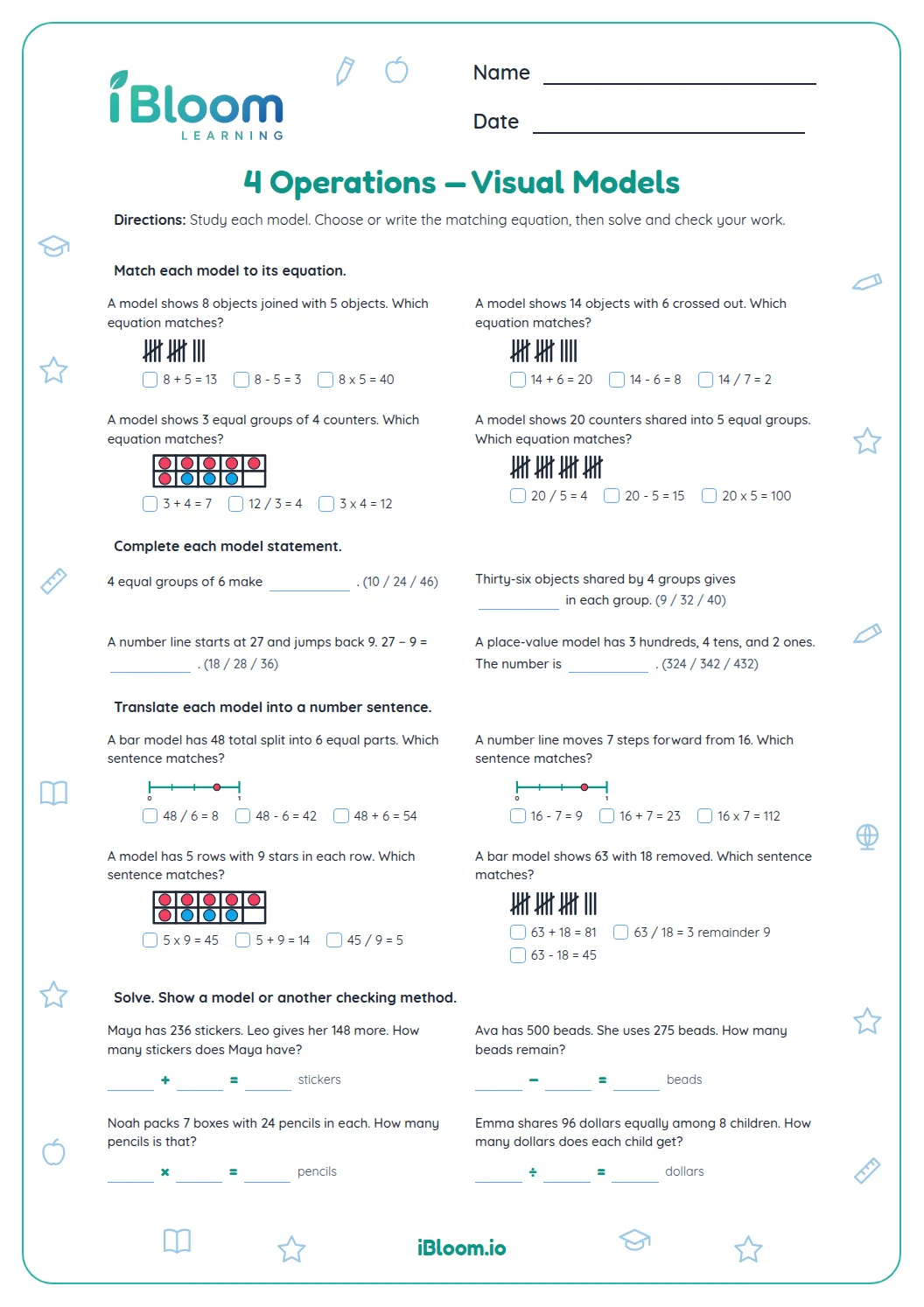
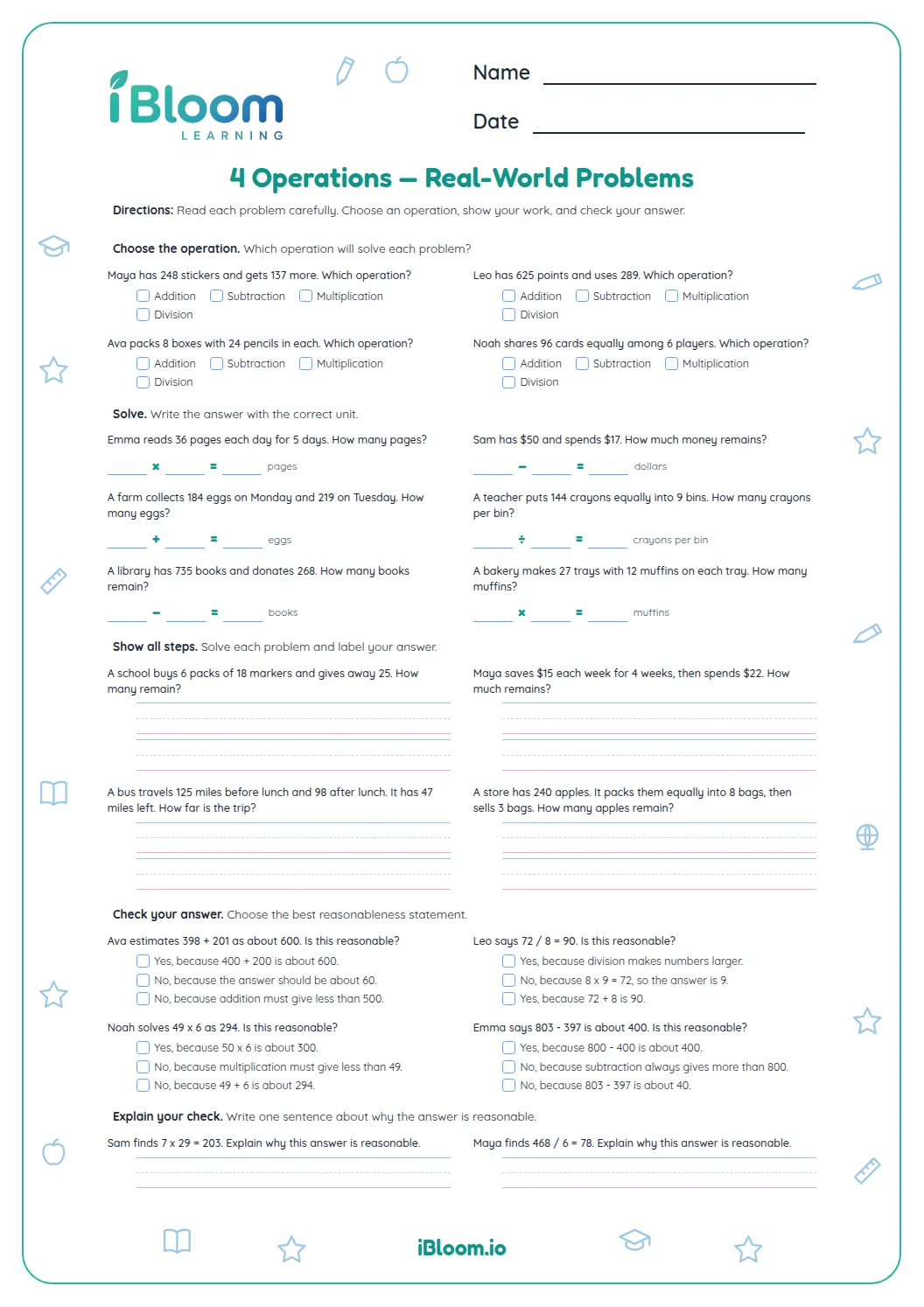
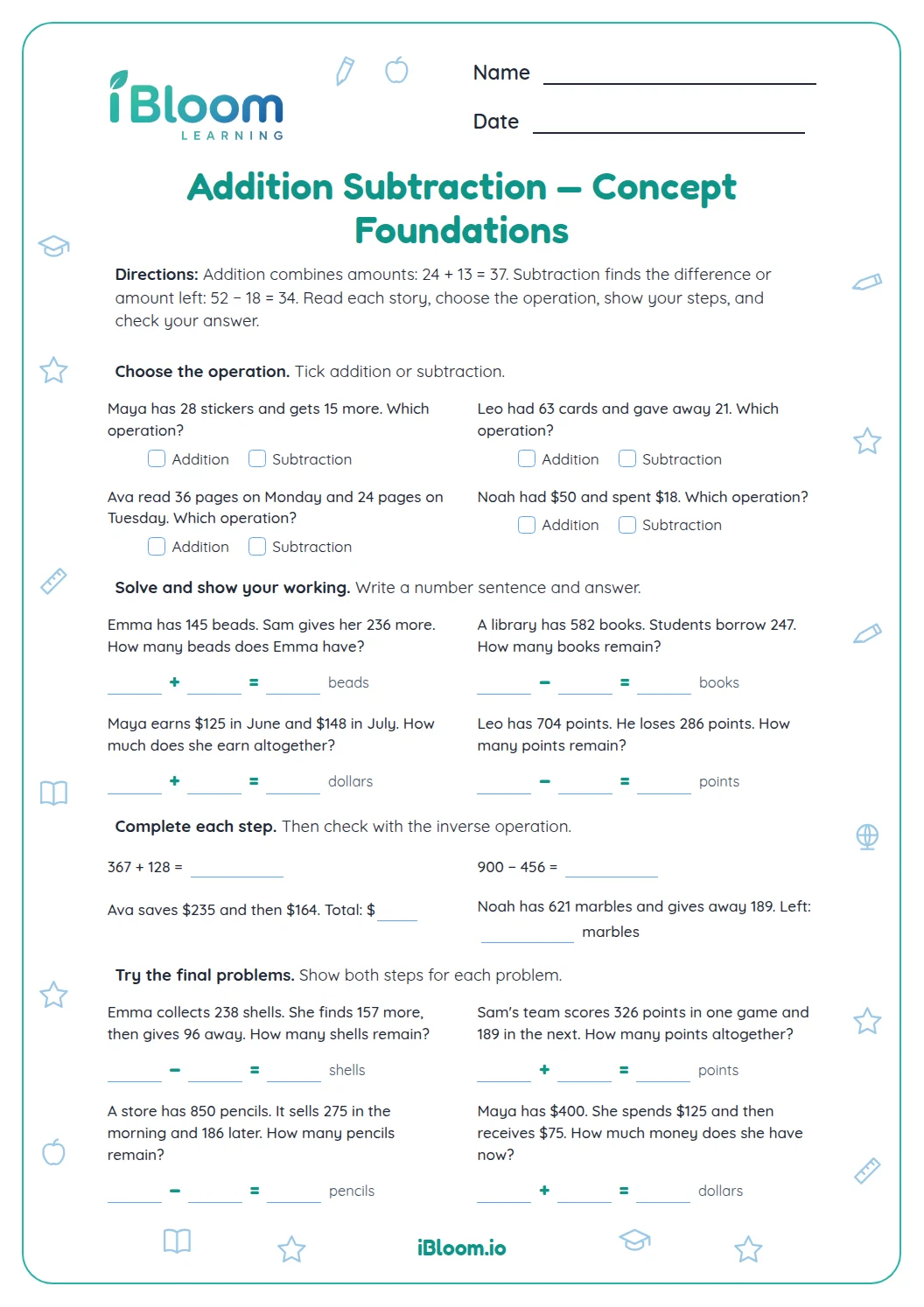
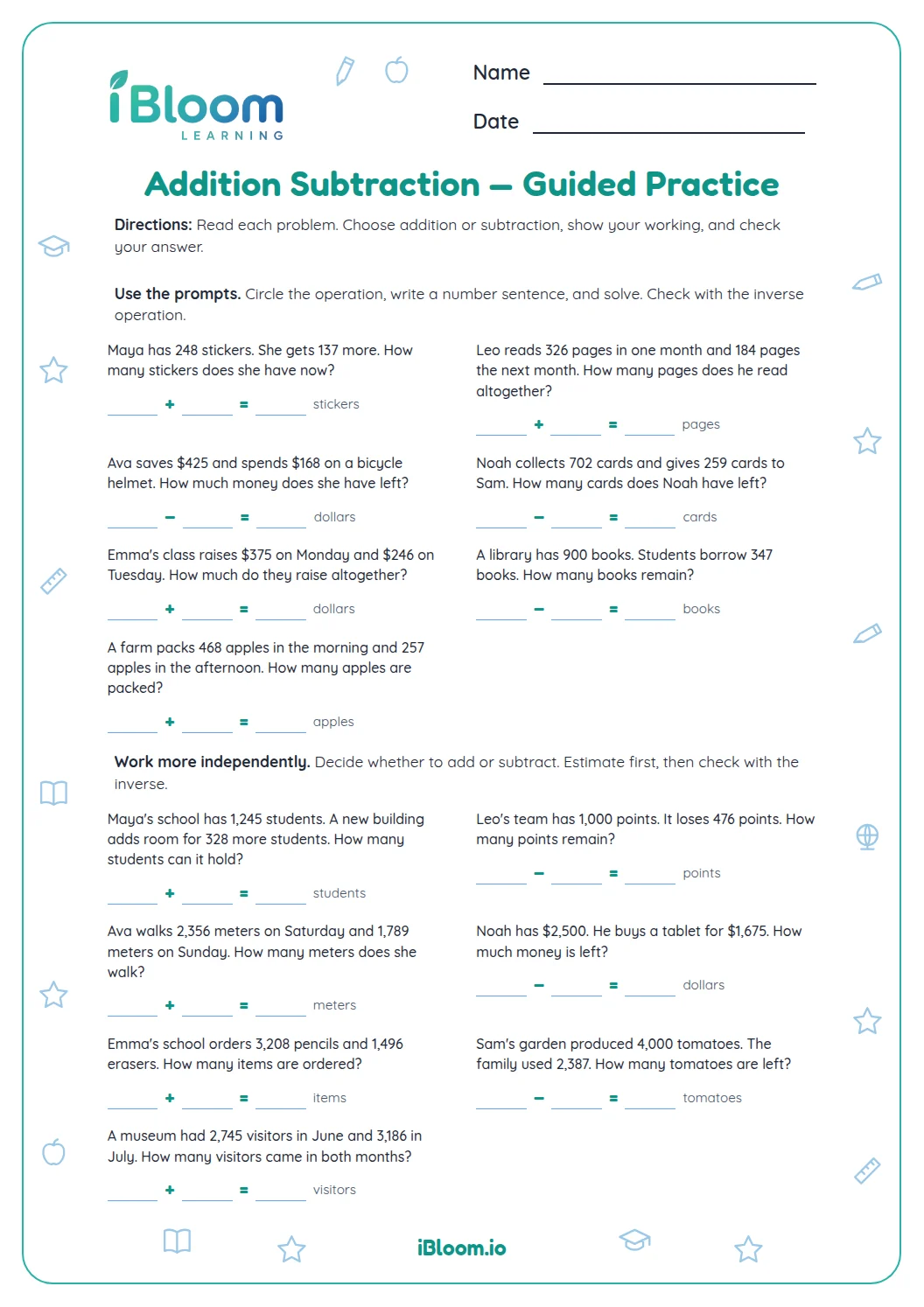
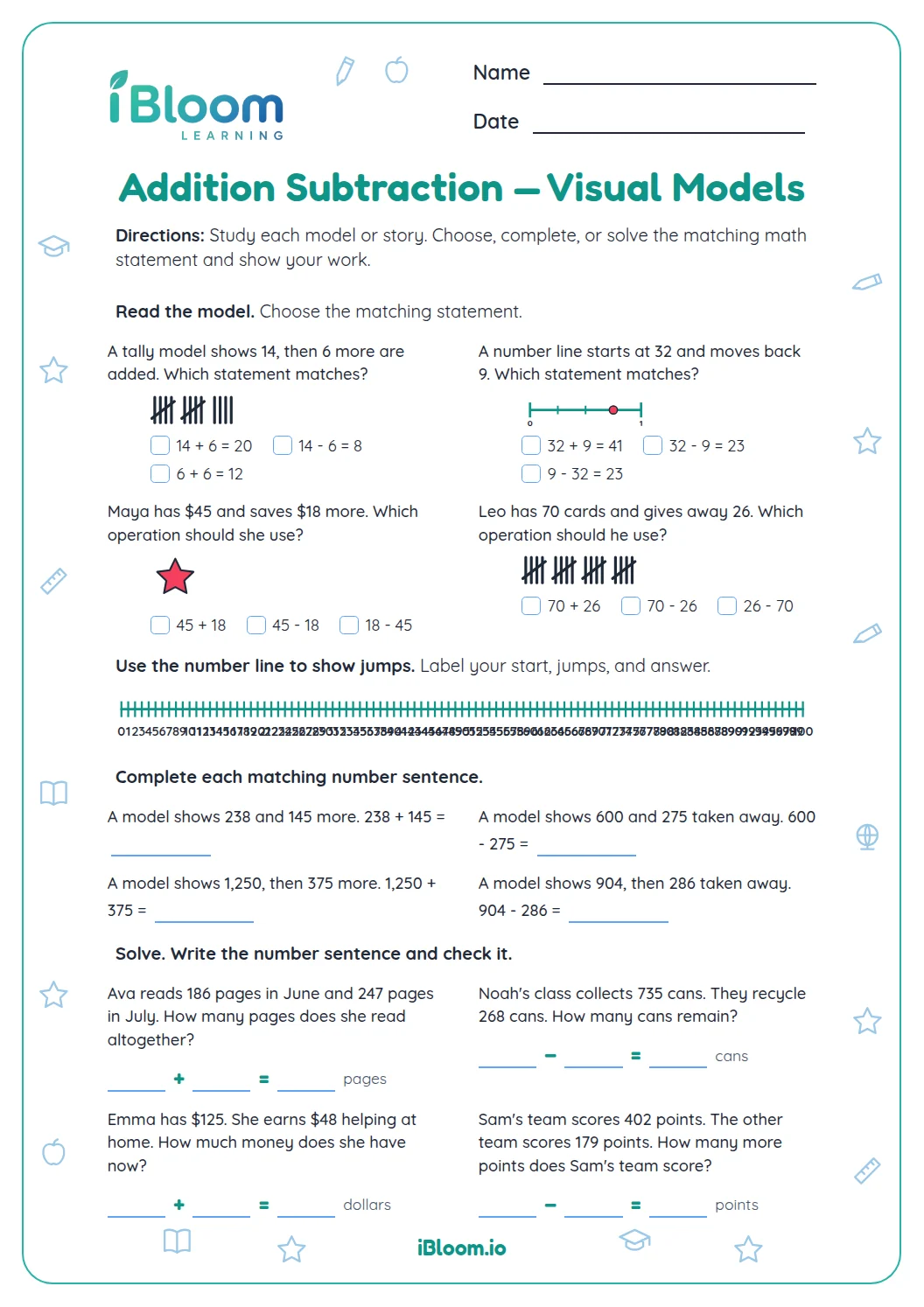
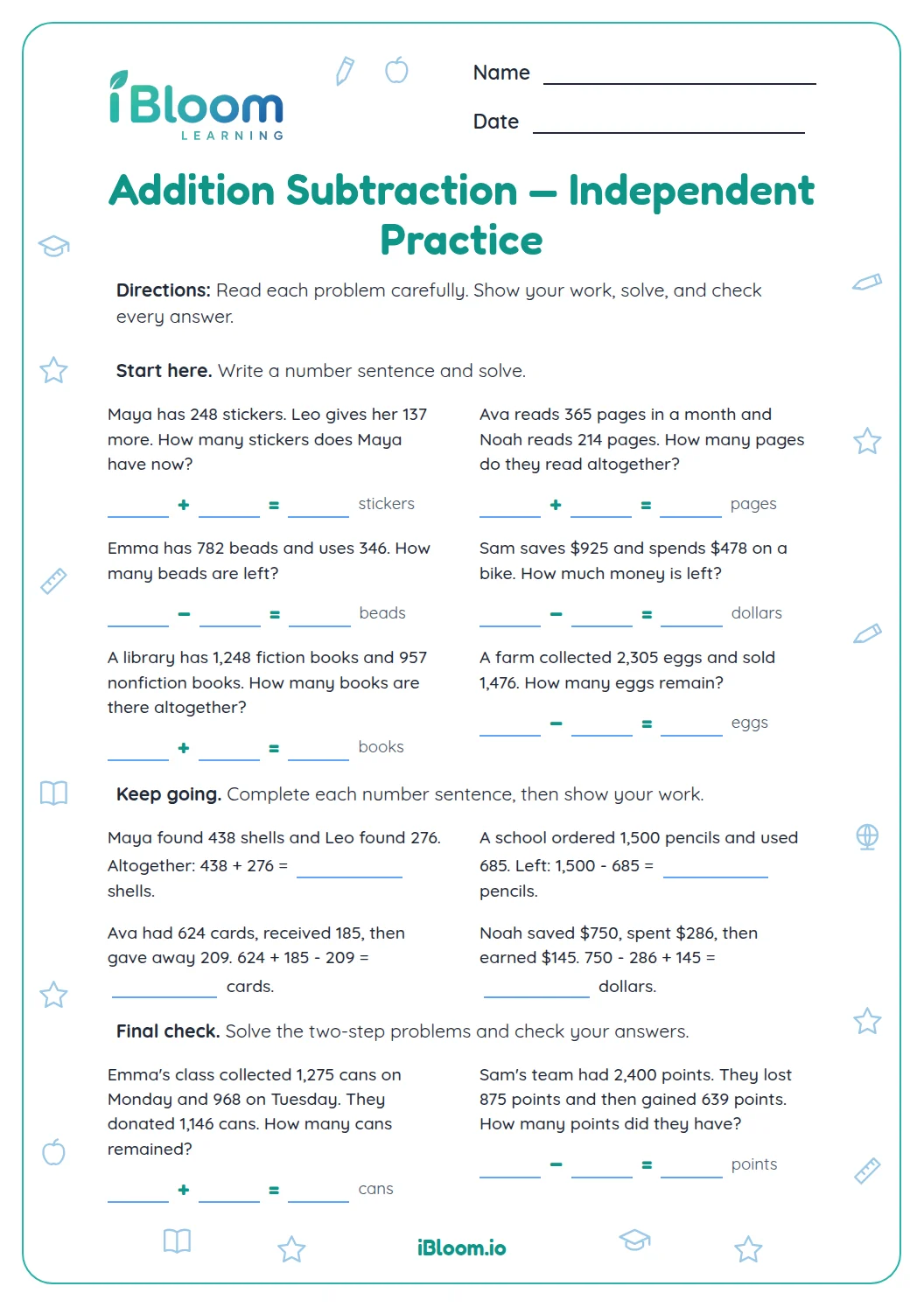
This free printable Grade 4 worksheet gives students 14 word problems that use addition, subtraction, multiplication, and division. Problems include equal groups, sharing, money, multi-step stories, and interpreting a remainder. Students write equations, show their work, and label answers with units when needed. It practices CCSS 4.OA.A.3 by representing and solving multi-step whole-number problems and checking whether answers make sense. A separate answer key lists a concise answer for each problem.
Aligned to 4.OA.A.3
How do you choose an operation?
Look for what happens to the quantities. Joining amounts or finding a difference often calls for addition or subtraction. Equal groups point to multiplication; sharing equally points to division. Some stories need one operation after another.
- 1Four notebooks cost 4 × $3 = $12.
- 2$12 + $5 = $17 total.
- 3$20 − $17 = $3 change.
How do you keep a two-step problem organized?
Write a short equation for each step and keep the units attached to the answer. In question 2, first find the seedlings planted: 8 × 24 = 192. Then subtract 37, so 192 − 37 = 155 seedlings remain.
How can you check a word-problem answer?
Reread the question and compare the size of your answer with the story. Question 12 asks for markers at each table, so dividing the total among 7 tables makes sense; an answer larger than the original total would signal an error.
More Grade 4 four-operation word problems at home or in class
- 1Read the final question first and name the quantity you need to find.
- 2Underline the numbers and the relationships described in the story.
- 3Write one equation for each step, keeping the order clear.
- 4Calculate and include a unit such as miles, dollars, or boxes.
- 5Estimate or use the inverse operation to see whether the result is reasonable.
Common mistakes and quick fixes
The mistake
Choosing an operation from a single clue word without reading the whole story.
The fix
Describe what happens to the quantities in your own words before selecting an operation.
The mistake
Doing the steps in the wrong order in a multi-step story.
The fix
Find the intermediate amount first, then use it in the step that answers the question.
The mistake
Leaving off the unit or ignoring what a remainder means.
The fix
Finish by answering the exact question in a short sentence with the correct unit.
Curriculum alignment
Represent and solve multistep whole-number stories, then check the answer.
On this sheet: The worksheet directly practices this skill in its questions.
Show the official wordingHide the official wording
Solve multistep word problems posed with whole numbers and having whole-number answers using the four operations, including problems in which remainders must be interpreted. Represent these problems using equations with a letter standing for the unknown quantity. Assess the reasonableness of answers using mental computation and estimation strategies including rounding.
What to practice next
Make more practice
Further reading
Questions parents and teachers ask
How many problems are on the worksheet?
There are 14 word problems across three parts. They include addition, subtraction, multiplication, division, and multi-step situations involving money, groups, distance, and supplies. Each problem provides room to write equations and show calculations, and the separate answer key lists the result with its unit.
Does every problem use all four operations?
No single story needs all four operations. Across the full page, students choose among addition, subtraction, multiplication, and division; several problems combine two or more operations. This lets children practice matching the operation to the relationship in the story rather than following a fixed pattern.
How should my child handle a remainder?
Read what is being counted and what the question asks. For instance, if a quantity is packed into equal groups, a leftover may be reported separately or may mean one more group is needed. Question 6 divides exactly, while students can use the same interpretation habit in other word problems.
Should students write equations or just answers?
The directions ask students to write an equation and show their work. Recording the steps makes it easier to see how the story connects to the calculation and helps a child find an error when checking with the key.
What does the answer key include?
The key provides a short final answer for all 14 questions, including units such as books, miles, dollars, or items. For multi-step questions, adults can ask the student to explain the intermediate calculation as well as compare the final result.
How long does this worksheet take?
Plan for about 30 minutes, depending on how much written work students show. It can also be completed over two sittings: finish the first two parts, check those answers, then return to the multi-step and mixed-operation stories. Ask the student to explain one operation choice aloud.