


About this worksheet
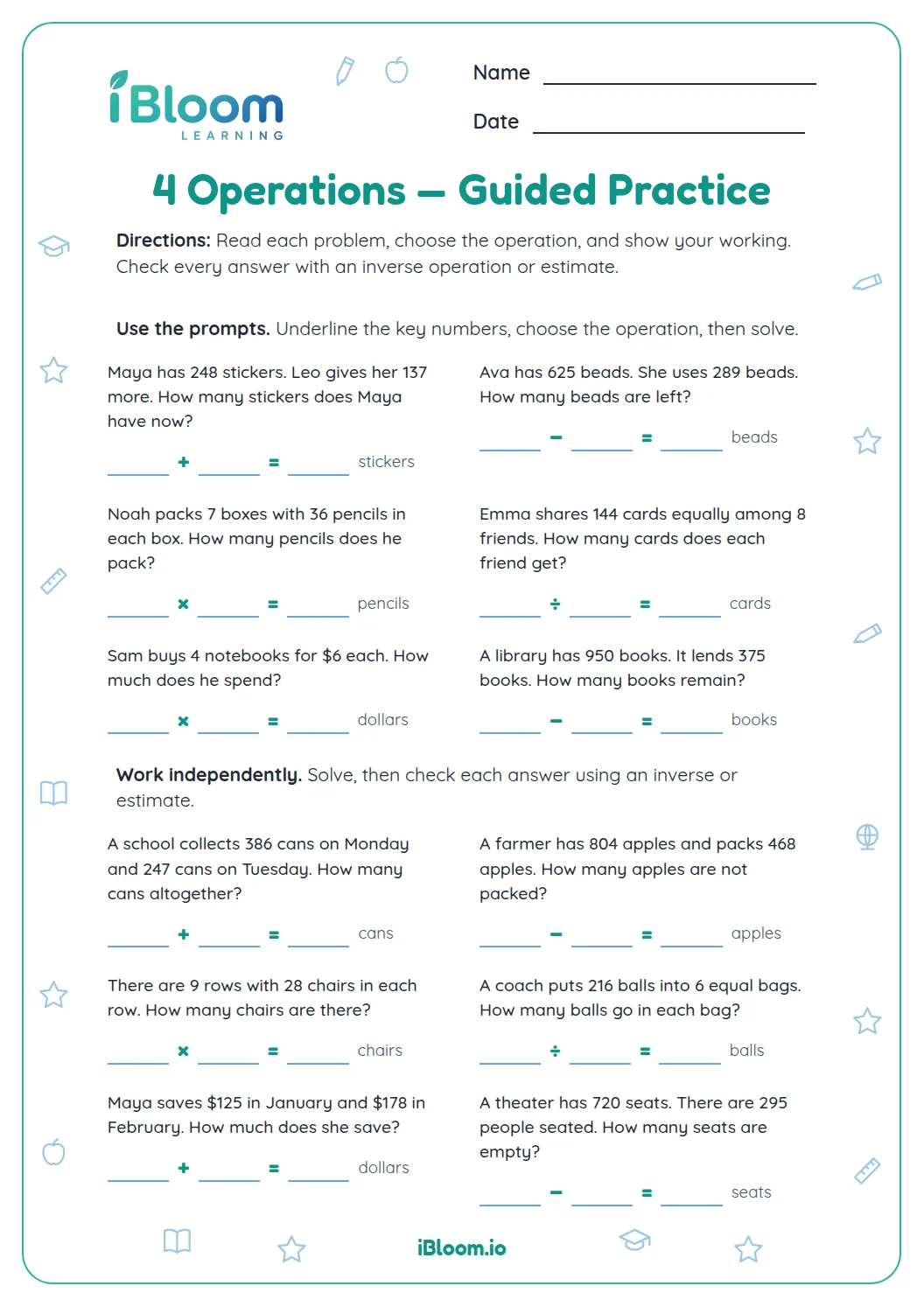
This Grade 4 worksheet gives students 14 multistep word problems using addition, subtraction, multiplication, and division. The stories involve equal groups, sharing, purchases, and packing. Students write equations, solve, and include units; the separate answer key gives the results. It practices CCSS 4.OA.A.3.
Aligned to 4.OA.A.3
How do you turn a story into steps?
Find the starting amount and the change. If a story describes equal groups, multiply to find the total; if some are removed, subtract afterward. For question 1, four boxes of 18 crayons make 72, and 72 − 27 = 45 crayons remain.
- 14 boxes × 18 crayons = 72 crayons
- 272 − 27 = 45 crayons
- 3Answer: 45 crayons
When should you multiply or divide?
Multiply when equal groups are combined. Divide when a total is shared equally or packed into equal groups. In question 4, 148 students need buses that each hold 40; 3 buses hold only 120, so 4 buses are needed.
How can you check the result?
Estimate before solving, then ask whether the answer matches the question and its unit. A number of buses must be a whole number of buses, and money left after a purchase should be less than the starting amount.
How to use this worksheet
- 1Underline the question and write what unit the answer needs.
- 2Mark equal groups, amounts added, or amounts taken away.
- 3Write an equation for each step before calculating.
- 4For sharing or packing, check whether a remainder changes the result.
- 5Estimate and compare your answer with the story.
Common mistakes and quick fixes
The mistake
Using only the last number in the story.
The fix
List the quantities and decide how they connect before calculating.
The mistake
Dividing when the groups are unequal or multiplying when sharing.
The fix
Ask whether the story combines equal groups or splits a total evenly.
The mistake
Giving a number without its unit.
The fix
Finish with crayons, dollars, bags, seats, or the unit named in the question.
Common Core alignment
This worksheet gives focused practice with the standard below.
Represent and solve multistep whole-number story problems with the four operations.
On this sheet: Each story requires choosing operations and solving a multistep problem.
Show the official wordingHide the official wording
Solve multistep word problems posed with whole numbers and having whole-number answers using the four operations, including problems in which remainders must be interpreted. Represent these problems using equations with a letter standing for the unknown quantity. Assess the reasonableness of answers using mental computation and estimation strategies including rounding.
What to practice next
Make more practice
Further reading
Questions parents and teachers ask
How can I help my child choose an operation in a word problem?
Have your child name what is known and what the question asks before choosing an operation. Then write one equation per step and check that the answer fits the story. This sheet has 14 multistep stories and a separate answer key with units.
Is an answer key included?
Yes. The separate answer key includes responses for all 14 questions, including sample responses where wording may vary. Review it after the learner has tried each part, then revisit any item that needs another strategy. The key gives a unit with each result, which makes it easier to check that the operation sequence answers the story question.
How many questions are on the sheet?
There are 14 word problems in two parts: six in “Plan and solve” and eight in “Use multiple steps.” They include addition, subtraction, multiplication, division, and combinations of operations. A separate answer key lists each result with its unit.
How can we use this for practice at home?
Read one story together and name what the answer should measure before calculating. For question 1, multiply 4 boxes by 18 crayons, then subtract 27; the result is 45 crayons. The worksheet has 14 stories and an answer key for checking each unit.
What should I do when an answer is incorrect?
Check whether each operation matches a relationship in the story, then estimate the result. For question 4, three buses hold only 120 students, so 148 students need four buses. The key gives 4 buses, which is a whole number and enough seats.