
About this worksheet
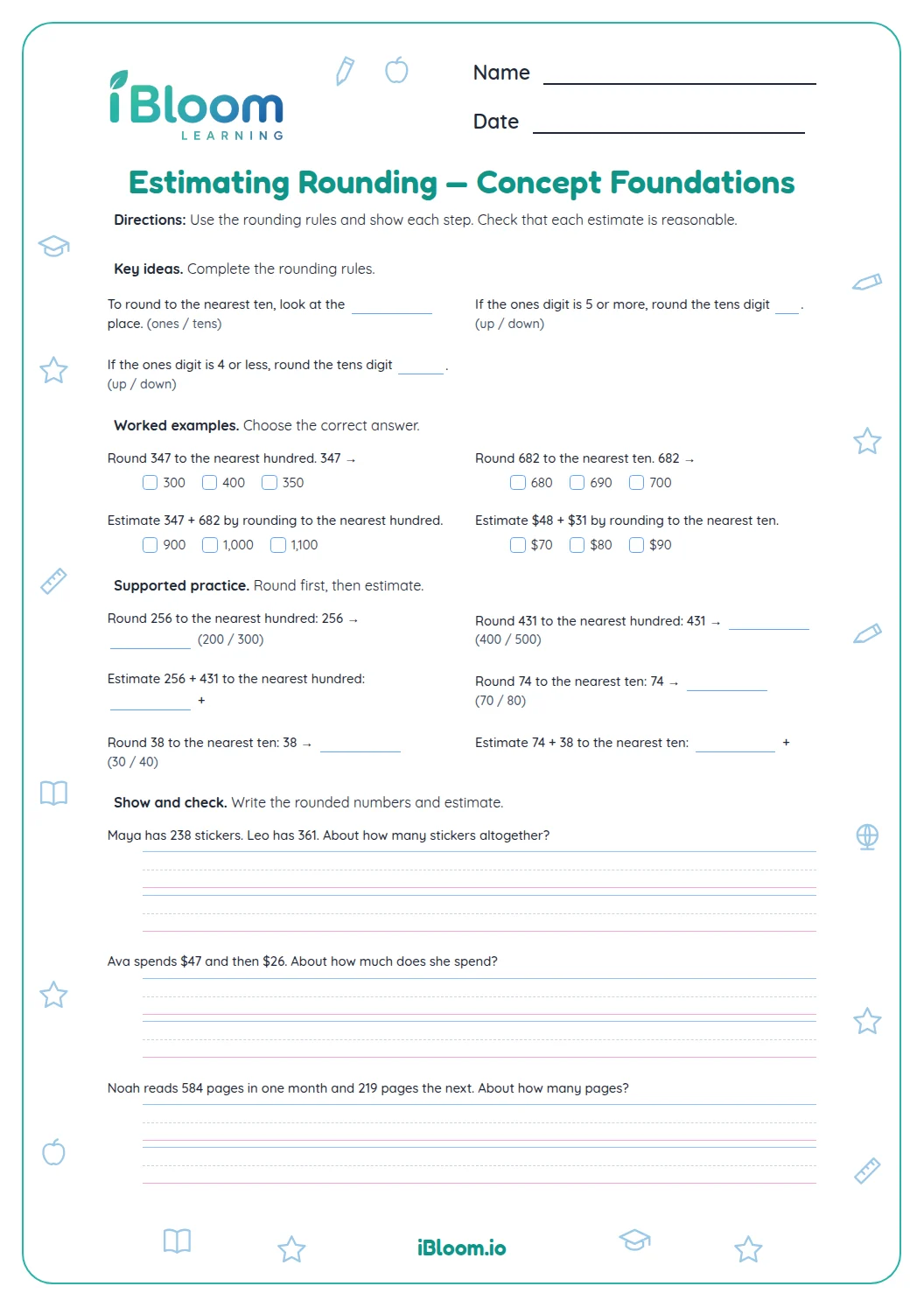
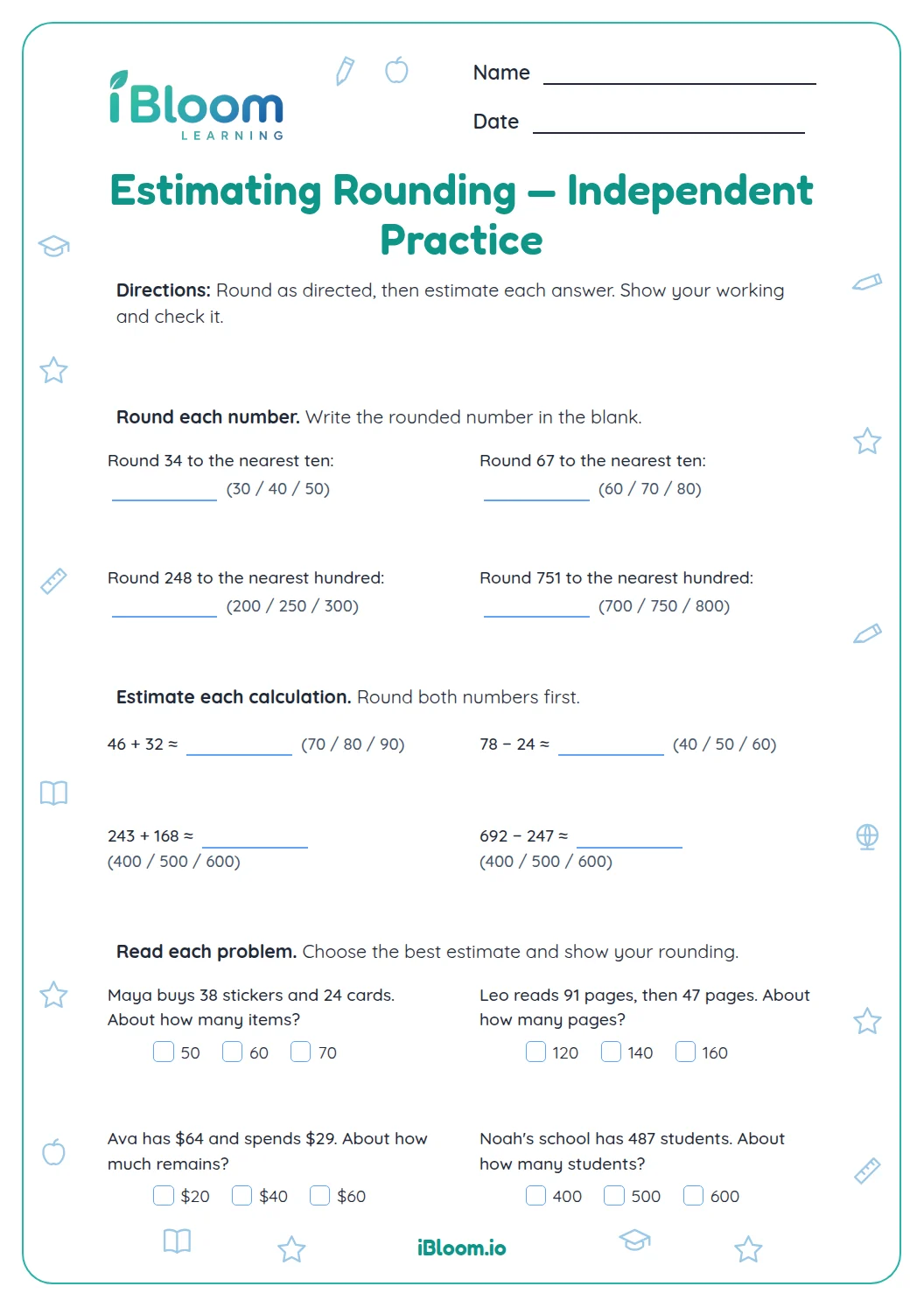
This free printable Grade 4 worksheet connects place-value rounding with estimates in everyday word problems. Part A has four questions that round one quantity to the nearest ten, hundred or thousand. Part B has two guided addition stories, and Part C has two stories to solve independently. Part D adds four checks using estimates or inverse operations. Every rounding place is stated explicitly. The twelve questions practice Common Core 4.NBT.A.3 and come with a separate answer key.
Aligned to 4.NBT.A.3
What rounding routine does this worksheet teach?
First identify the place named in the question. Look at the digit immediately to its right: zero through four keeps the rounding digit the same; five through nine increases it by one. Replace the digits to the right of the rounding place with zeros.
Use the rounded quantities for the calculation. If the story asks how many altogether, add. If it asks how many remain or how many more, subtract. Label the result as an estimate using about.
How does the first guided problem work?
Question 5 starts with 248 books on one cart and 326 on another. It supplies 248 rounded to the nearest hundred as 200. Students round 326 to 300 and add those values to estimate the combined number of books.
- 1248 rounds to 200; 326 rounds to 300.
- 2200 + 300 = 500
- 3The estimate is about 500 books.
- 4Both starting quantities were rounded to the nearest hundred.
How does the support change across the parts?
Part A isolates rounding, including halfway values and a number that rounds to 10,000. Part B gives the first rounded quantity in each story and asks students to add. Part C asks students to round both quantities and choose addition or subtraction. Part D uses estimates and inverse operations to check calculations.
Ask students to write the two rounded numbers before calculating. This makes it possible to see whether an incorrect estimate came from rounding, choosing an operation or calculating with the rounded values.
An estimate can expose a large error, but a nearby result still needs checking. Question 9 uses an estimate of 500 to choose between 574 and 5,740. Questions 11 and 12 then check exact calculations by reversing the operation.
How to use this worksheet
- 1Read the place named in each Part A question and mark that digit.
- 2Use the next digit to decide whether the number rounds up or down.
- 3Work question 5 together, using the supplied 200 and finding 300.
- 4Finish Part B by rounding the second quantity before adding.
- 5In Part C, write both rounded values and an equation in the working space.
- 6Use estimates and inverse operations for Part D, then check every result with the key.
Mistakes to notice and fix
The mistake
Rounding the exact total instead of rounding each quantity first.
The fix
Follow the stated order: round both quantities, then combine them.
The mistake
Looking at the ones digit when rounding to the nearest hundred.
The fix
Use the tens digit, which is immediately to the right of the hundreds place.
The mistake
Leaving the rounding digit unchanged when the next digit is 5.
The fix
Round halfway values up: 6,500 becomes 7,000 to the nearest thousand.
Common Core alignment
Round whole-number quantities to tens, hundreds or thousands before estimating.
On this sheet: Students round quantities at a named place and use rounded values to estimate totals and differences.
Show the official wordingHide the official wording
Use place value understanding to round multi-digit whole numbers to any place.
What to practice next
Make more practice
Further reading
Questions parents and teachers ask
Which rounding places are practiced?
The worksheet uses the nearest ten, hundred and thousand. Each rounding question names the place so students know which digit to examine. Part A practices individual quantities, Parts B and C estimate totals or differences in stories, and Part D checks answers with estimates or inverse operations.
Should students round before or after calculating?
They should round each starting quantity before calculating. That order is part of the directions for these problems. In question 5, 248 becomes 200 and 326 becomes 300, so the estimate is about 500 books. Calculating the exact total and then rounding can produce a different result.
What help is provided in the guided problems?
Each Part B problem gives the first rounded value and tells students to add. Students round the second quantity and write the estimate in the blank. Part C then asks them to round both quantities and choose addition or subtraction, with a working grid for each problem.
How are halfway values rounded on this sheet?
Halfway values round up to the next multiple of the named place. For example, 6,500 rounds to 7,000 to the nearest thousand, and 9,950 rounds to 10,000 to the nearest hundred. Use the neighboring multiples to show that each starting number lies exactly between them.
Can two different estimates both make sense?
Different rounding places can give different useful estimates, but this sheet specifies the place for each problem. Check the answer using that instruction and round every starting quantity first. If a child offers another estimate, discuss the method, then return to the place named in the question.