
About this worksheet
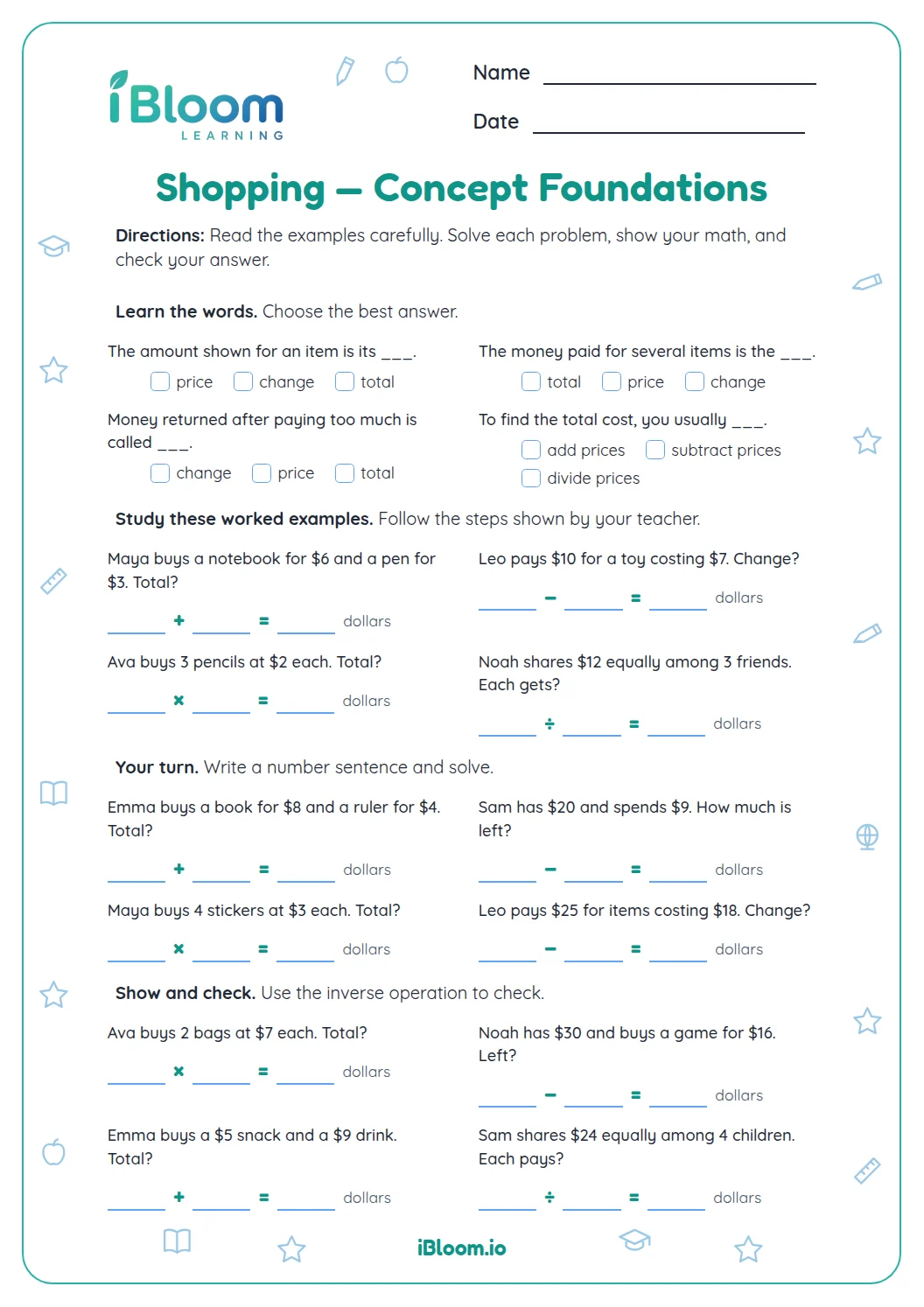
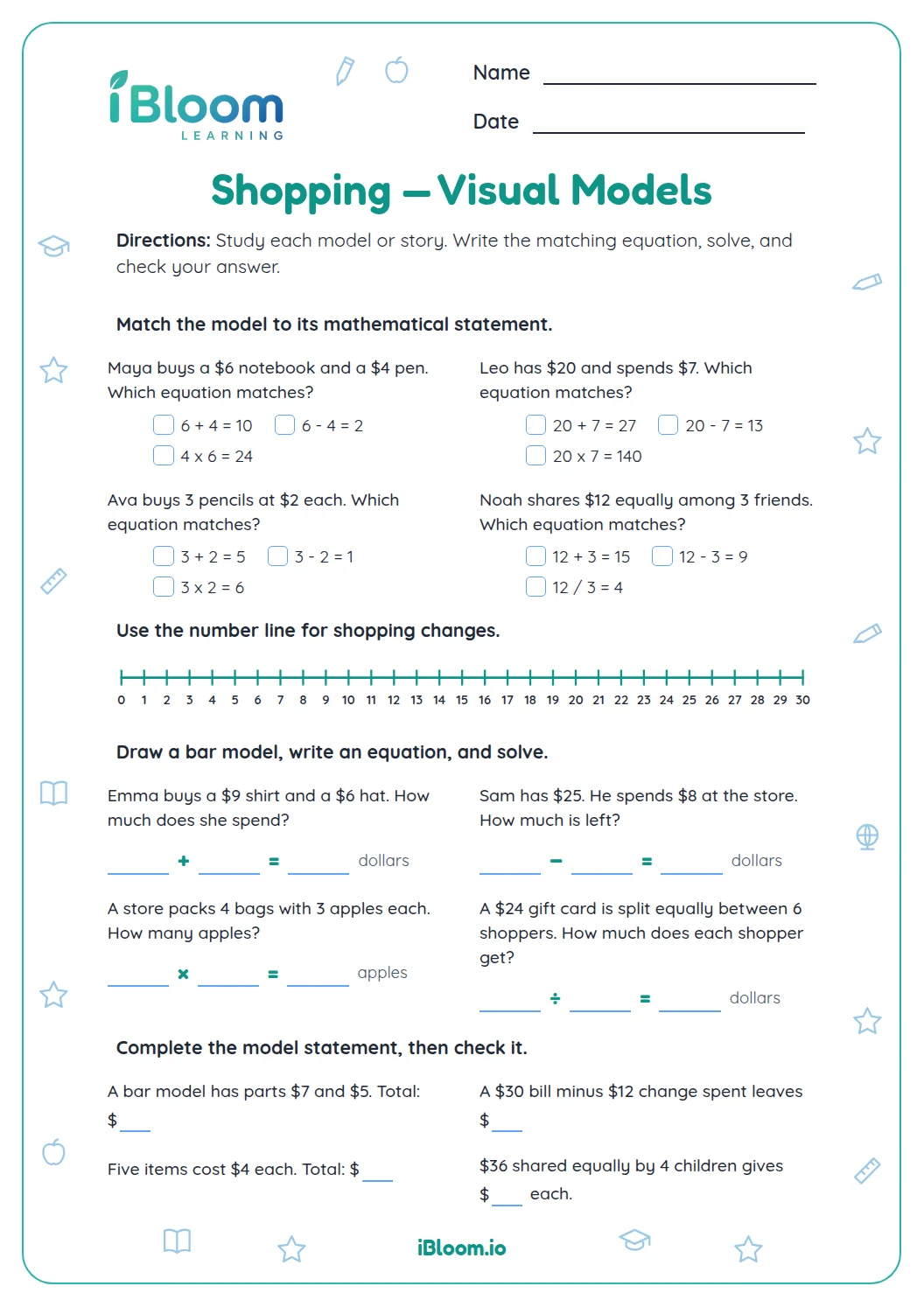
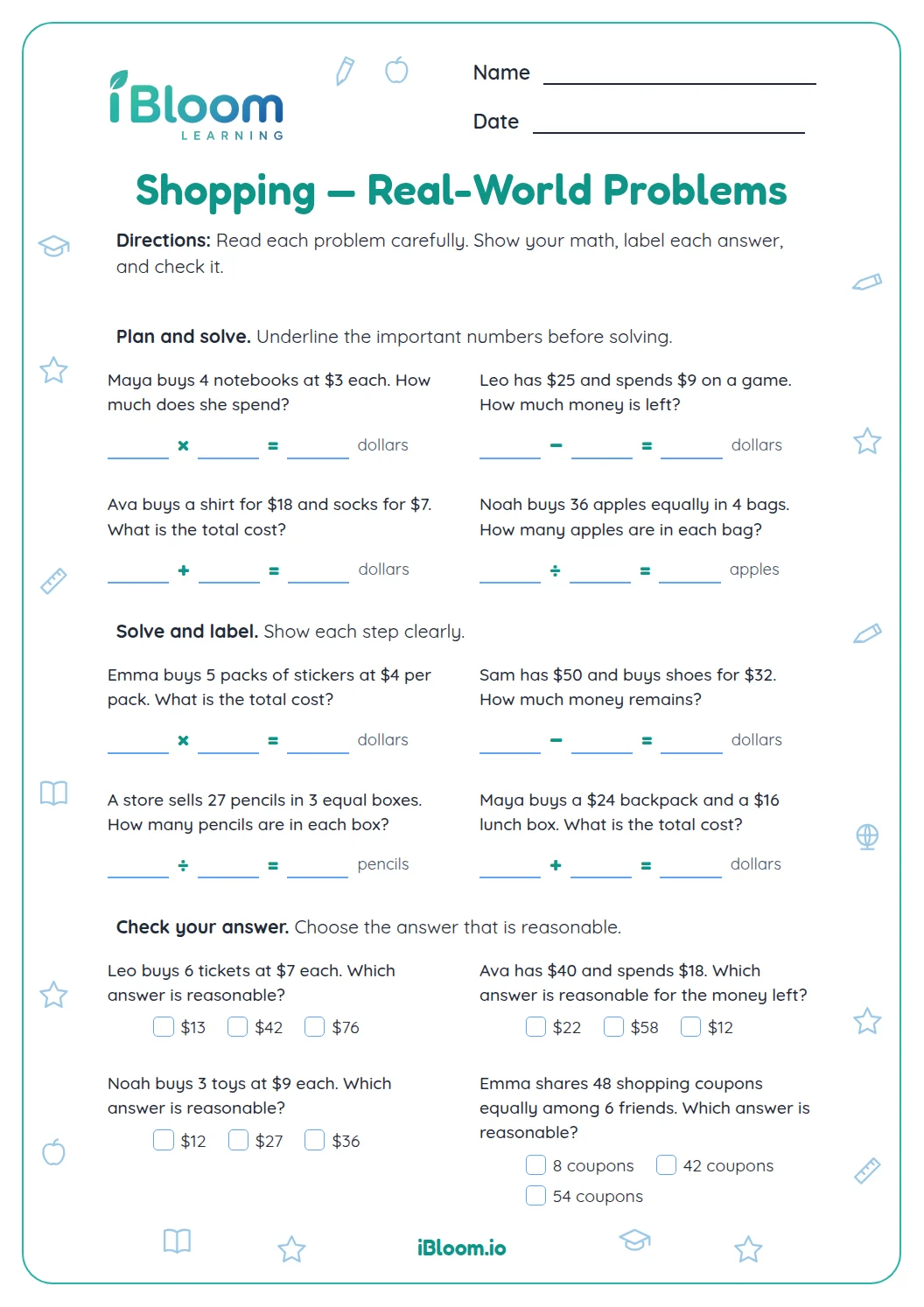
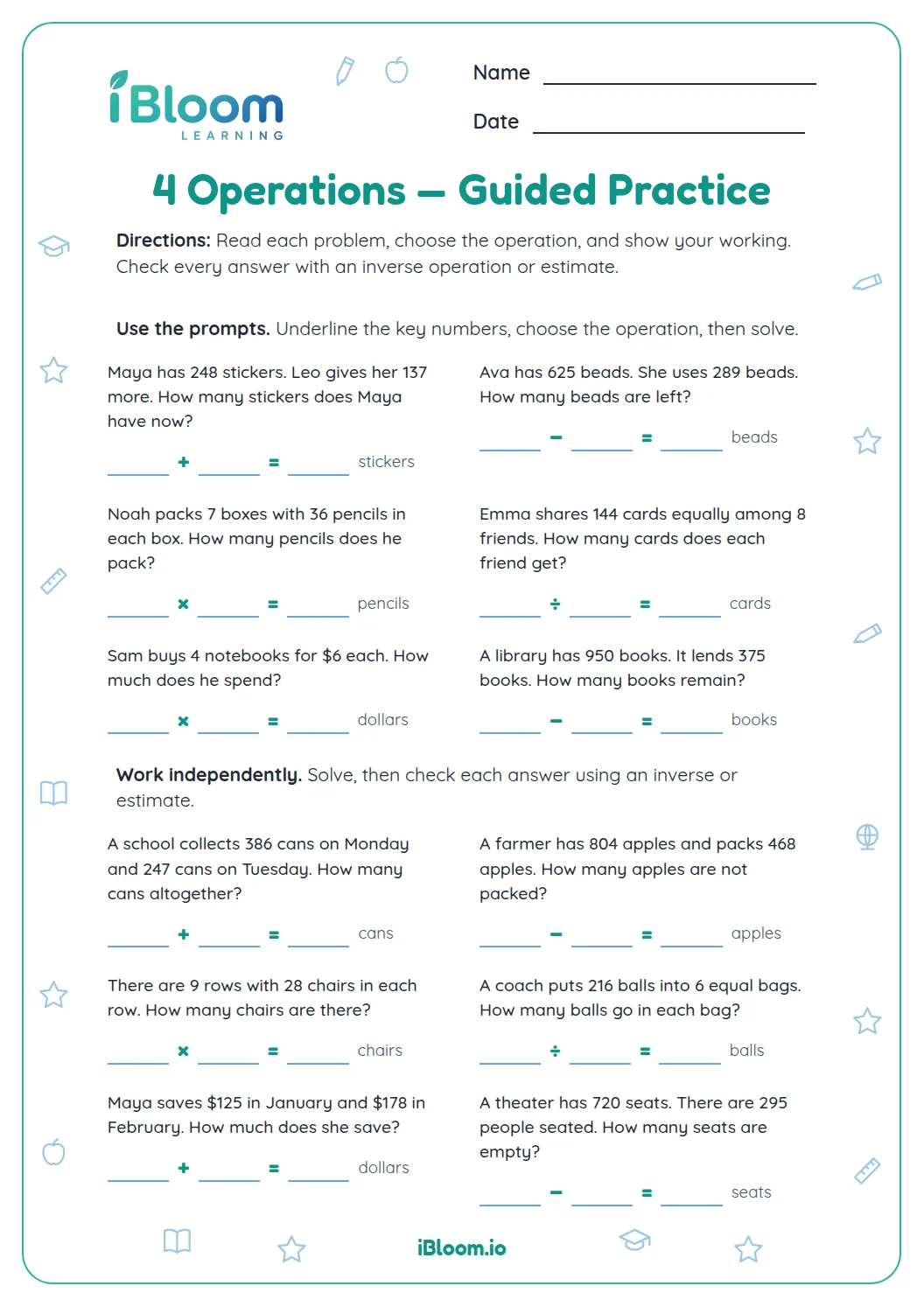
This printable gives Grade 4 learners independent practice solving shopping problems with familiar prices. The 16 questions ask students to add item costs, compare prices, find change, multiply equal costs, divide a shared total, and solve two-step situations. Each problem leaves room for an equation and a solution, so students can show how the numbers in the story connect. It practices multi-step problem solving with whole-number operations and money contexts.
Aligned to 4.OA.A.3
What information matters in a shopping problem?
Read for the item prices, how many items are bought, and what the question asks you to find. Some stories ask for a total; others ask for the difference between prices or how much remains after a purchase.
How does an equation organize the story?
For a group of identical items, multiply the number of items by the price of one item. Keep the dollar sign with the answer.
- 1Problem: Four pencils cost $2 each. What is the total cost?
- 2Equation: 4 × $2 = $8
- 3Answer: $8
How can students check the answer?
Estimate the size of the result and include the dollar sign when the question asks for a cost or amount of money. A change amount should be smaller than the amount paid, and a shared cost should multiply back to the total.
A routine for each problem
- 1Underline the prices and quantities in the story.
- 2Restate what the question asks you to find.
- 3Choose addition, subtraction, multiplication, or division.
- 4Write an equation and solve it.
- 5Check that the answer is reasonable and add a dollar sign for money.
Common errors and fixes
The mistake
Adding prices when the question asks how much more one item costs.
The fix
Compare the prices by subtracting the smaller price from the larger one.
The mistake
Finding only one purchase cost in a two-step problem.
The fix
Reread the story and complete both actions before writing the final amount.
The mistake
Forgetting the money unit in the final answer.
The fix
Include a dollar sign when answering a cost, change, or remaining-money question.
Common Core alignment
This worksheet gives children direct practice with the stated grade-level skill.
Solve multistep problems using the four operations and whole-dollar amounts.
On this sheet: Students choose operations and solve shopping problems with whole-number amounts.
Show the official wordingHide the official wording
Solve multistep word problems posed with whole numbers and having whole-number answers using the four operations, including problems in which remainders must be interpreted. Represent these problems using equations with a letter standing for the unknown quantity. Assess the reasonableness of answers using mental computation and estimation strategies including rounding.
What to practice next
Make more practice
Further reading
Questions parents and teachers ask
What kinds of shopping situations are included?
The problems include adding prices, finding change, multiplying a unit price, dividing a shared cost, and solving two-step shopping situations. All amounts are whole dollars. The answer key gives a short equation and answer for each problem, so children can check both the operation and result.
Should students show their equations?
Yes. Writing an equation makes it easier to see which quantities belong together and gives students a way to check their reasoning. The answer key lists the final answers; students can compare their equations with the relationships in each story.
How do I help when a student chooses the wrong operation?
Ask the student to say what the unknown amount represents. “How much more?” asks for a difference, while “how much altogether?” asks for a total. In a two-step story, have the student name what must be found first.
How many problems are on the worksheet?
There are 16 shopping word problems across three worksheet pages, followed by three answer-key pages. Items include costs, change, equal shares, comparisons, discounts, and two-step totals, with whole-dollar amounts throughout. Each item has room to write an equation and solve.
Should every answer include a dollar sign?
Use a dollar sign when the answer is an amount of money, such as a total cost, change, or money left. If a question asks only for a number of dollars per person, showing the dollar sign still makes the unit clear.