
About this worksheet
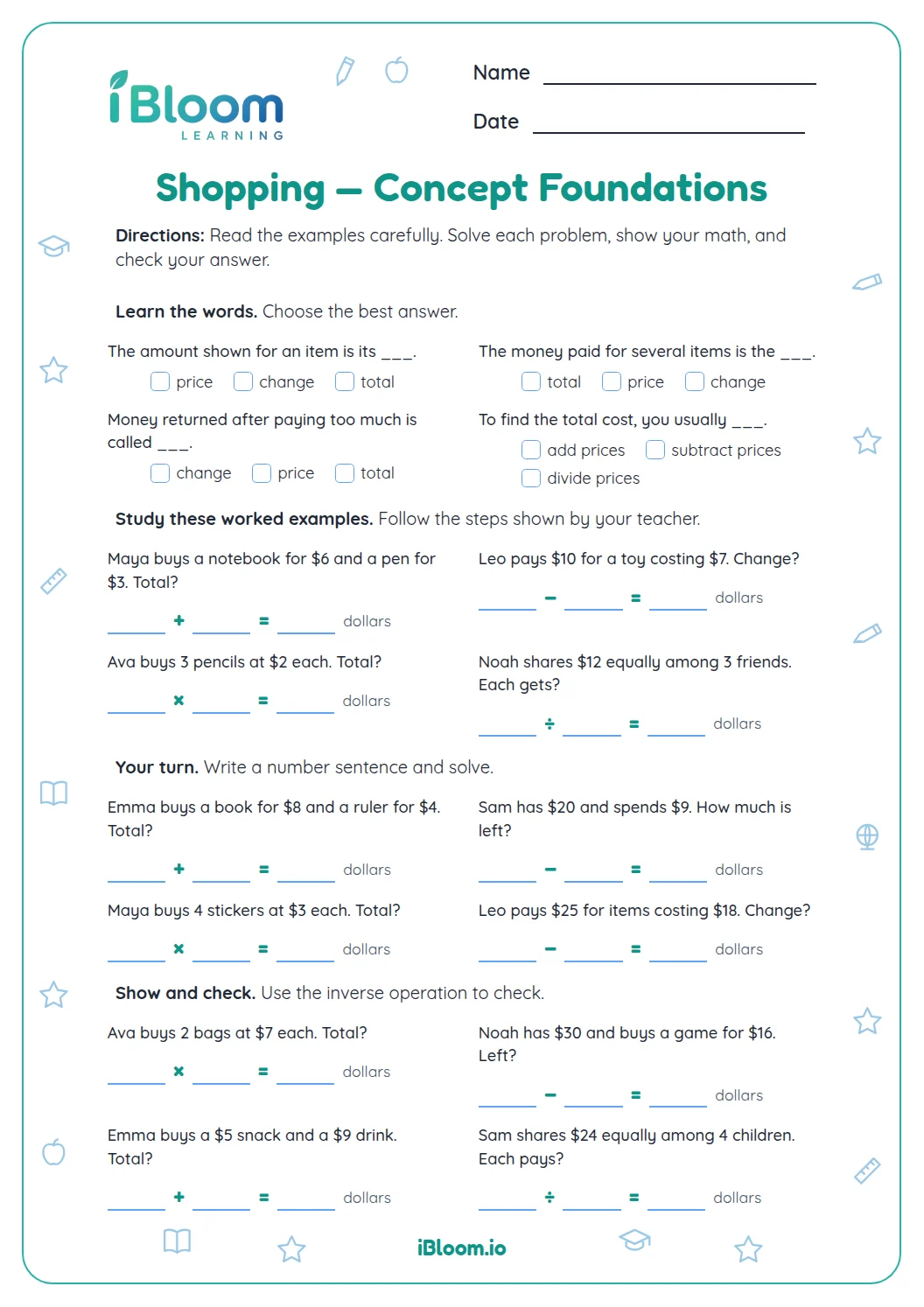
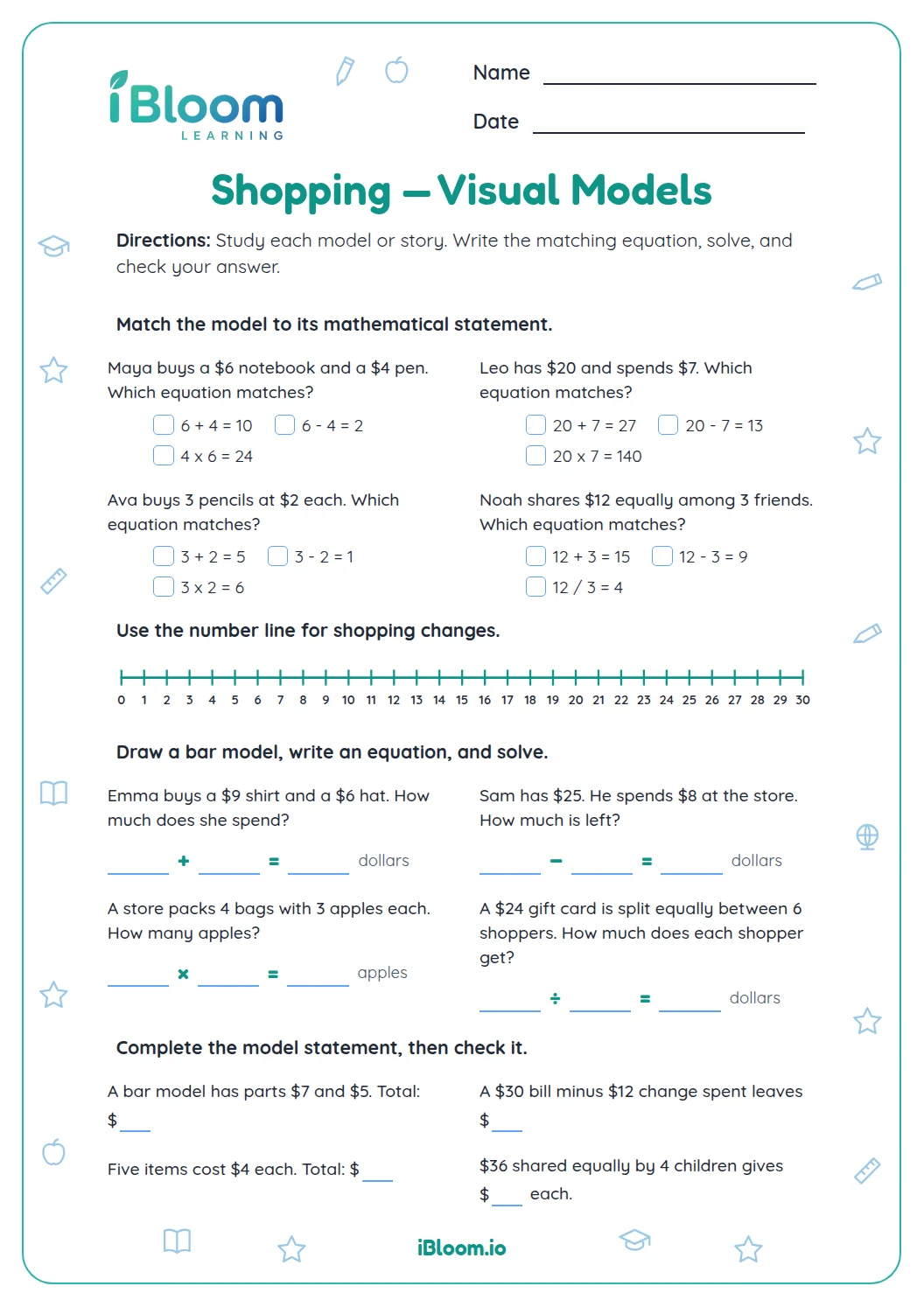
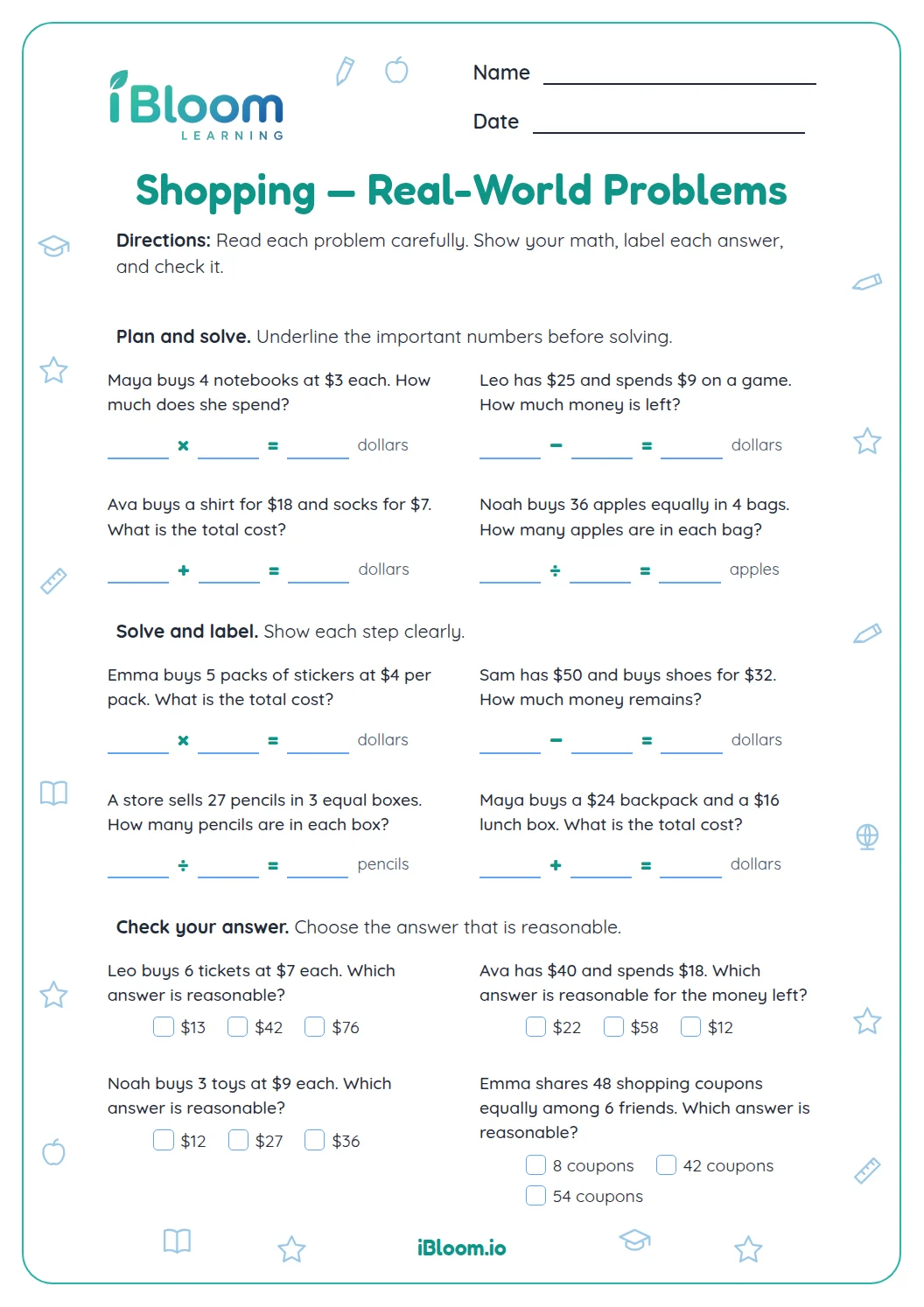
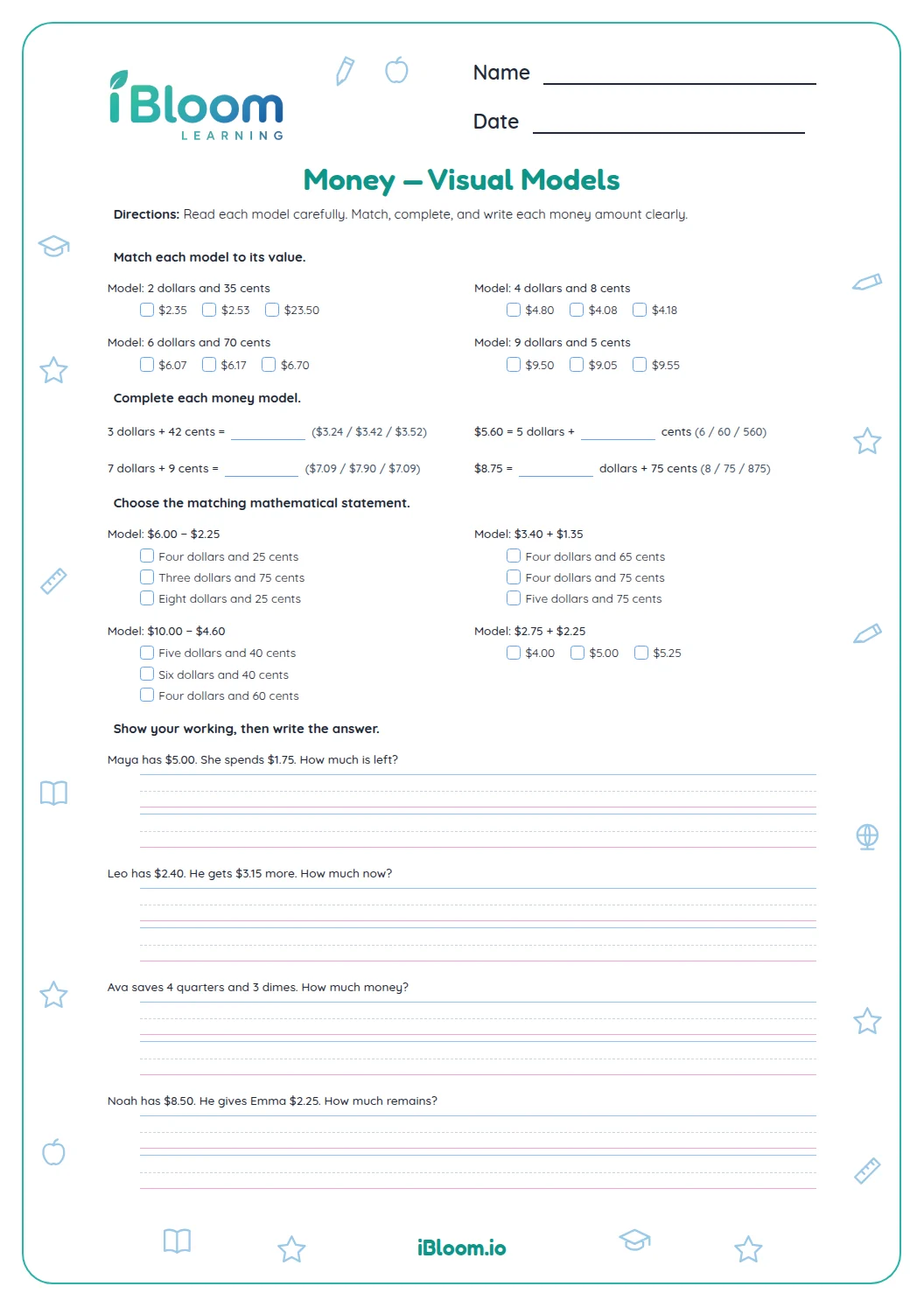
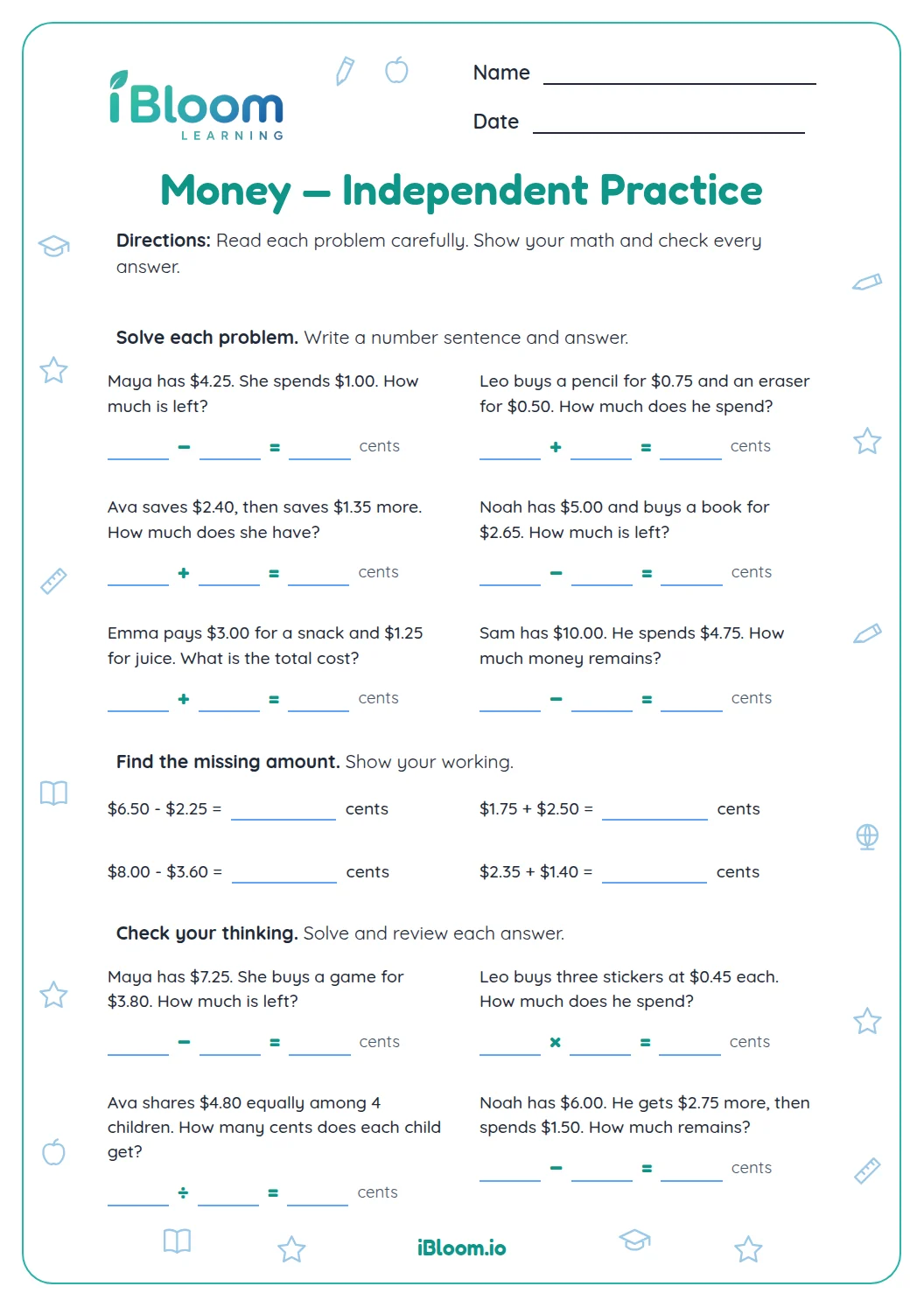
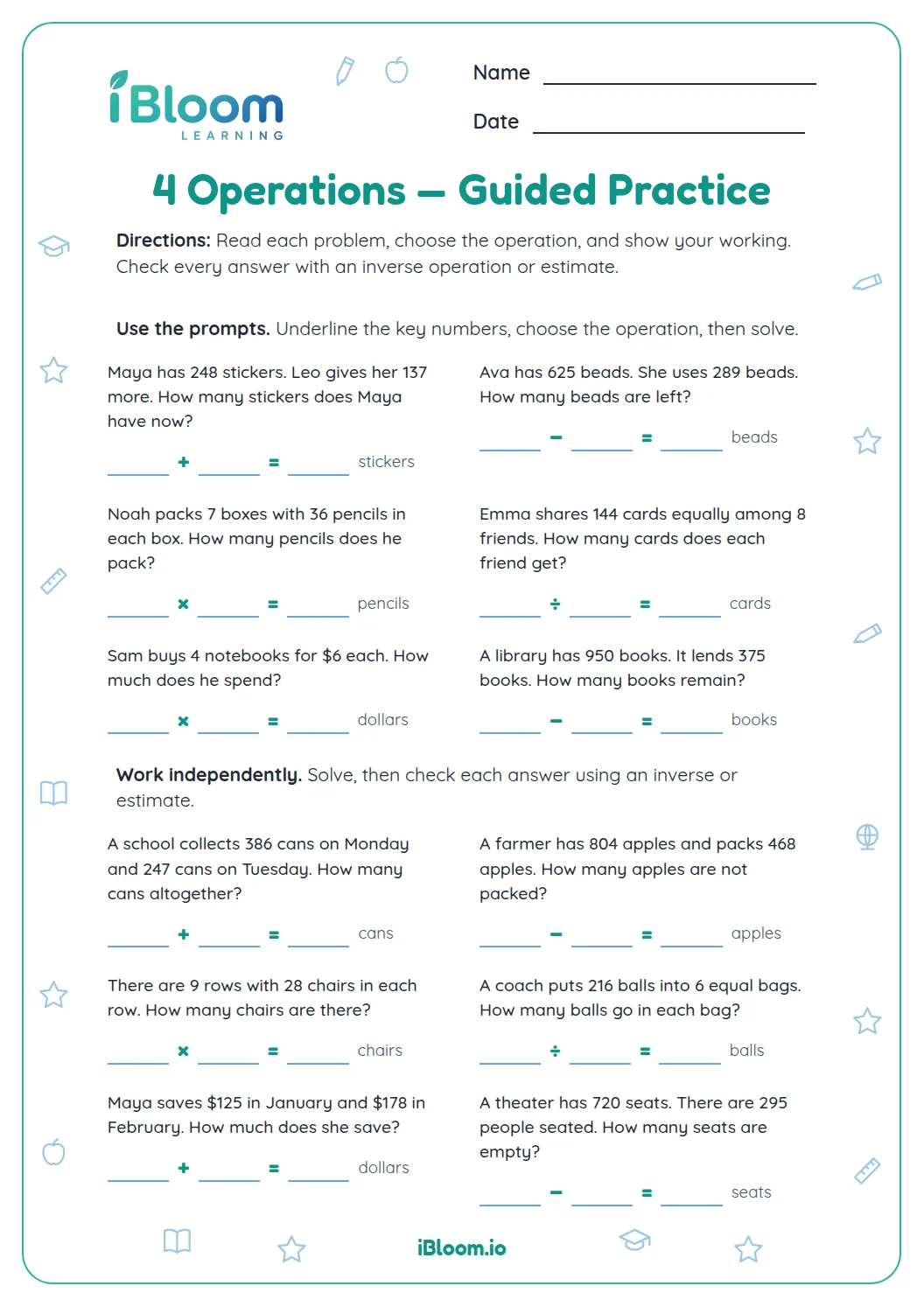
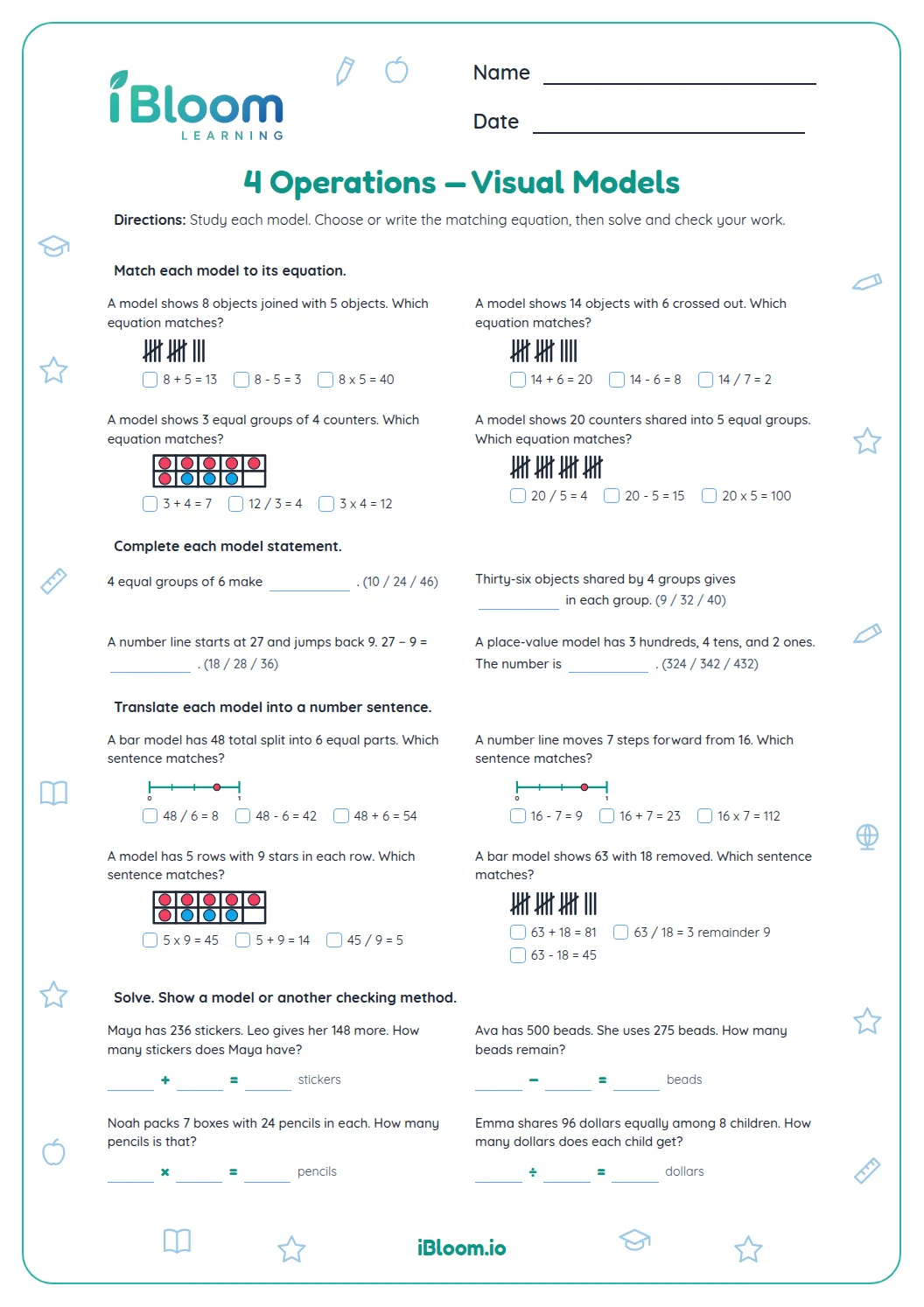
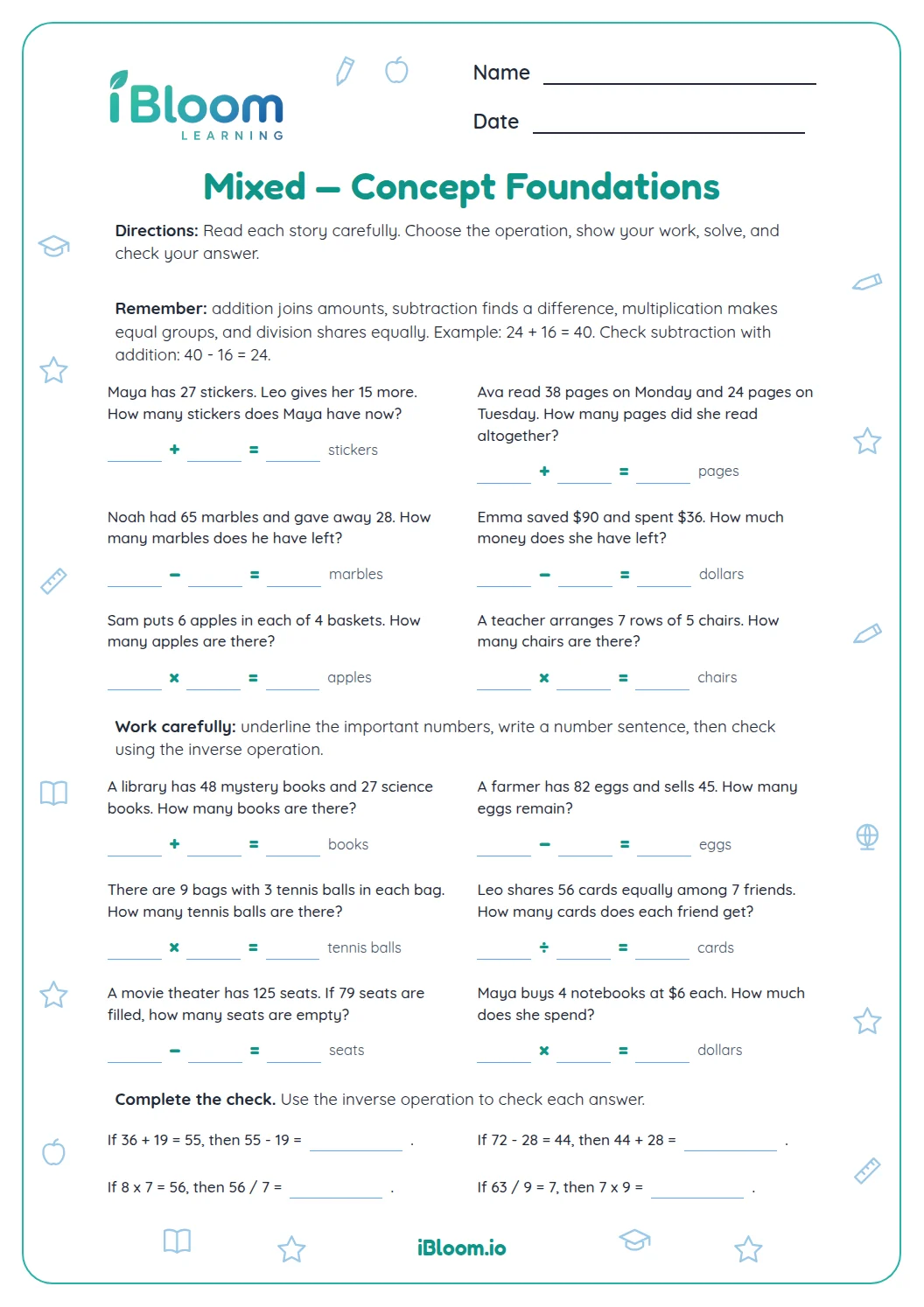
This Grade 4 shopping worksheet asks students to reason about prices, change, equal groups and quantities. Fourteen multiple-choice questions ask for calculations, equations that model stories, an interpretation of a division remainder and a check of whether an estimate is reasonable. Students can solve on scratch paper before choosing. The answer key lists the correct choices. The page practices Common Core 4.OA.A.3.
Aligned to 4.OA.A.3
How do you turn a shopping story into an equation?
Use scratch paper to record the quantities and operation or operations before selecting an answer. Question 1 asks for the cost of two groups of items: find each group’s cost, then add them.
- 16 notebooks at $3 each: 6 × 3 = $18
- 24 folders at $2 each: 4 × 2 = $8
- 3Add the group costs: $18 + $8 = $26.
How can an equation show the story?
Some choices show equations rather than final quantities. Check that the equation uses the numbers in the story and the operations the question requires. Other questions ask you to calculate a total, an equal share or an amount remaining.
How do you check an estimate?
For the can question, divide 74 by 8 and interpret the remainder: each shelf gets 9 cans, with 2 left over. For the final question, compare Eli’s expected change with the exact result after three $28 games are paid for with $100.
- 174 ÷ 8 = 9 remainder 2
- 2Each shelf gets 9 cans, with 2 cans left over.
How to use this worksheet
- 1Read the whole story and identify what the question asks.
- 2Write down the quantities and choose an operation or sequence of operations.
- 3Solve on scratch paper, then compare your result with the choices.
- 4Include dollars or item units in your thinking, and interpret any remainder.
- 5Estimate or calculate again to decide whether the result is reasonable.
Common mistakes and quick fixes
The mistake
Adding the price of one item only once when several are bought.
The fix
Multiply the number of items by the price for one item first.
The mistake
Subtracting when the story asks for equal groups.
The fix
If a total is split into equal groups, divide.
The mistake
Leaving off the unit or money sign.
The fix
Finish with dollars, a count of items, or another unit named by the question.
Common Core alignment
This page practices the listed Common Core skill through its worksheet questions.
Solve multistep whole-number word problems using the four operations.
On this sheet:
Show the official wordingHide the official wording
Solve multistep word problems posed with whole numbers and having whole-number answers using the four operations, including problems in which remainders must be interpreted. Represent these problems using equations with a letter standing for the unknown quantity. Assess the reasonableness of answers using mental computation and estimation strategies including rounding.
What to practice next
Make more practice
Further reading
Questions parents and teachers ask
Can students show their work on this shopping sheet?
The worksheet uses multiple-choice questions, so students mark an answer or an equation on the page. They can still write calculations on scratch paper before choosing. Encourage them to record the operation or operations that match each story and then check the result against the choices.
Do all questions involve money?
No. Several questions use prices, totals or change, while others ask about pencils, crayons, stickers, cans, toys or bags. Students practice choosing operations across shopping situations, and include dollars or item units when the answer calls for them. The questions mix one-step and multi-step reasoning.
How does question 1 combine operations?
Question 1 asks for the cost of six notebooks at $3 each and four folders at $2 each. Find each group’s cost, then add them: 6 × $3 = $18 and 4 × $2 = $8, so the total is $26. Students may write these steps on scratch paper.
How should students interpret the remainder in question 10?
Question 10 shares 74 cans equally among 8 shelves. Each shelf gets 9 cans, because 8 × 9 = 72, and 2 cans remain. The answer key includes both the number of cans on a shelf and the leftover cans, which gives meaning to the division remainder.
How can students check whether an estimate is reasonable?
Compare the estimate with an exact calculation or with a nearby rounded amount. For question 14, three games at $28 cost $84, leaving $16 from $100. An expectation of $25 change is too high, so the estimate is not reasonable. Students choose the statement that explains the check.