
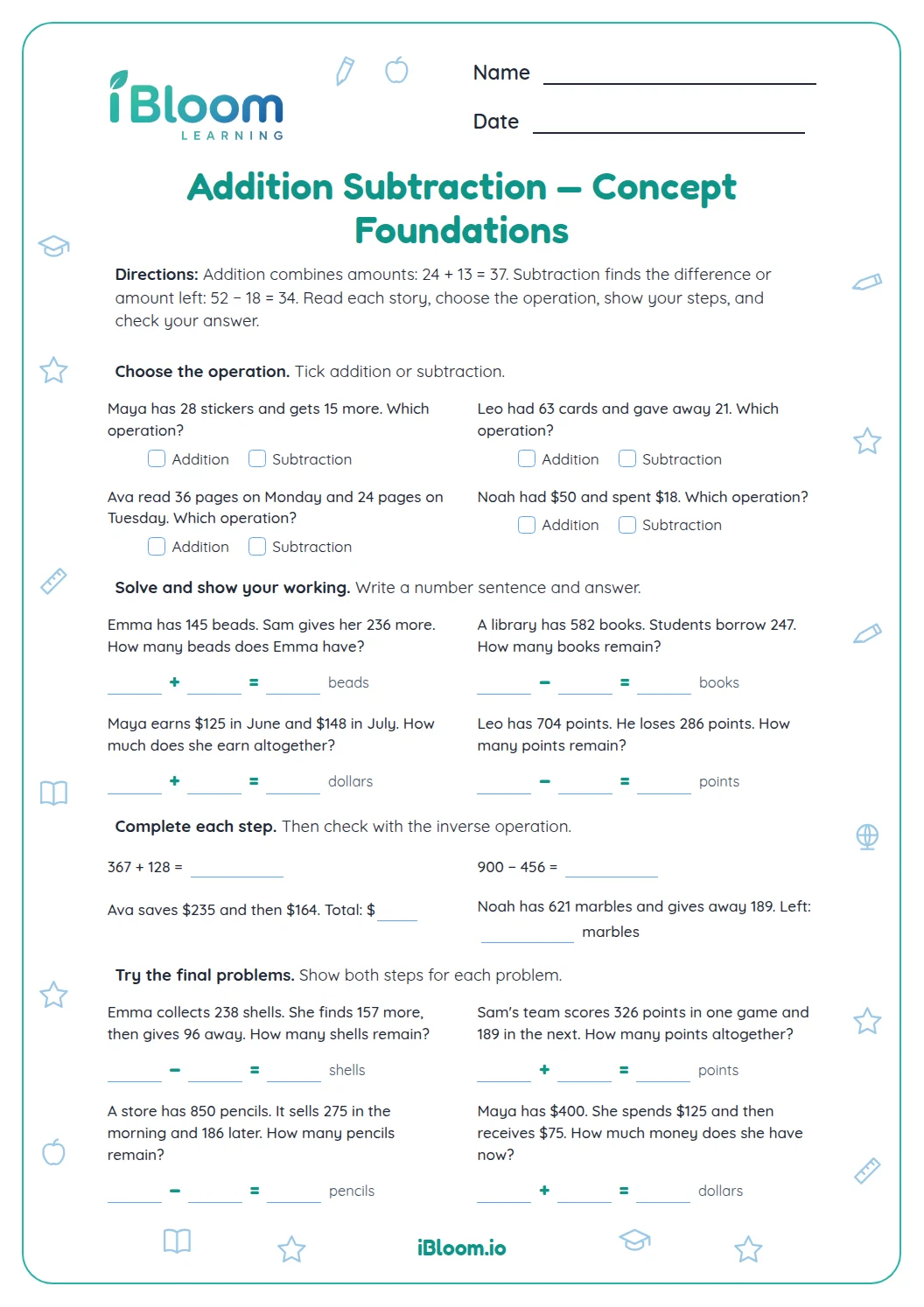
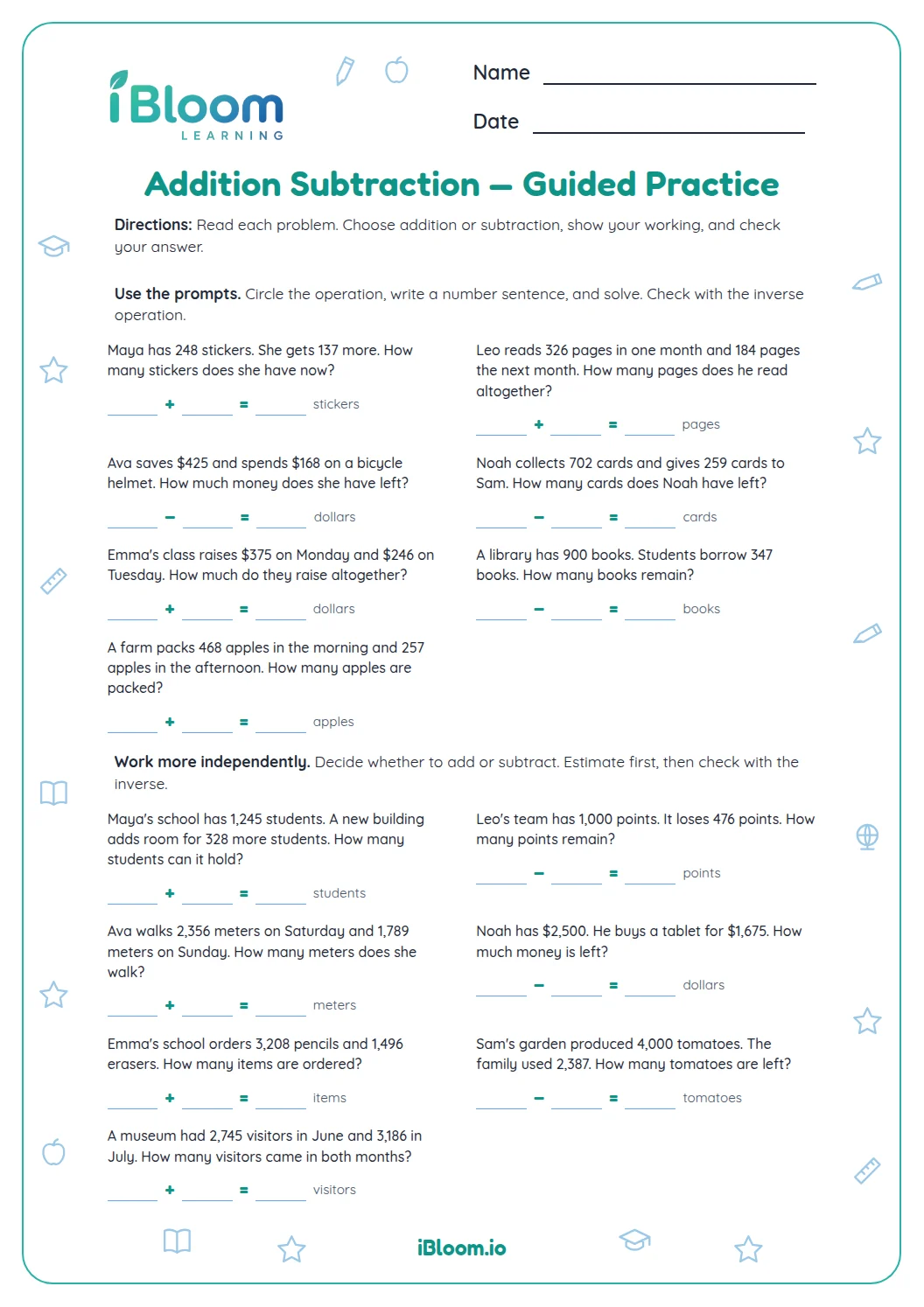
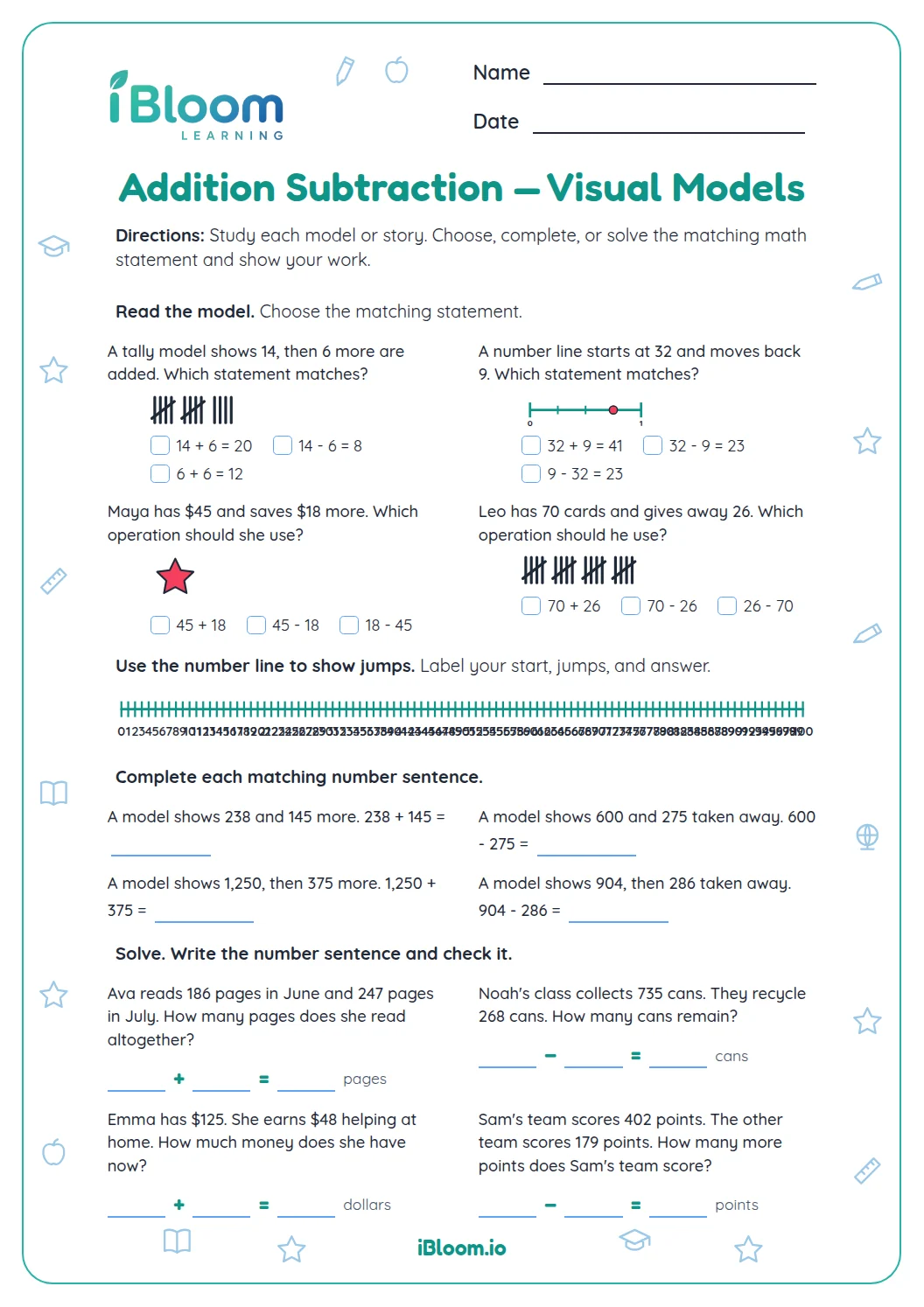
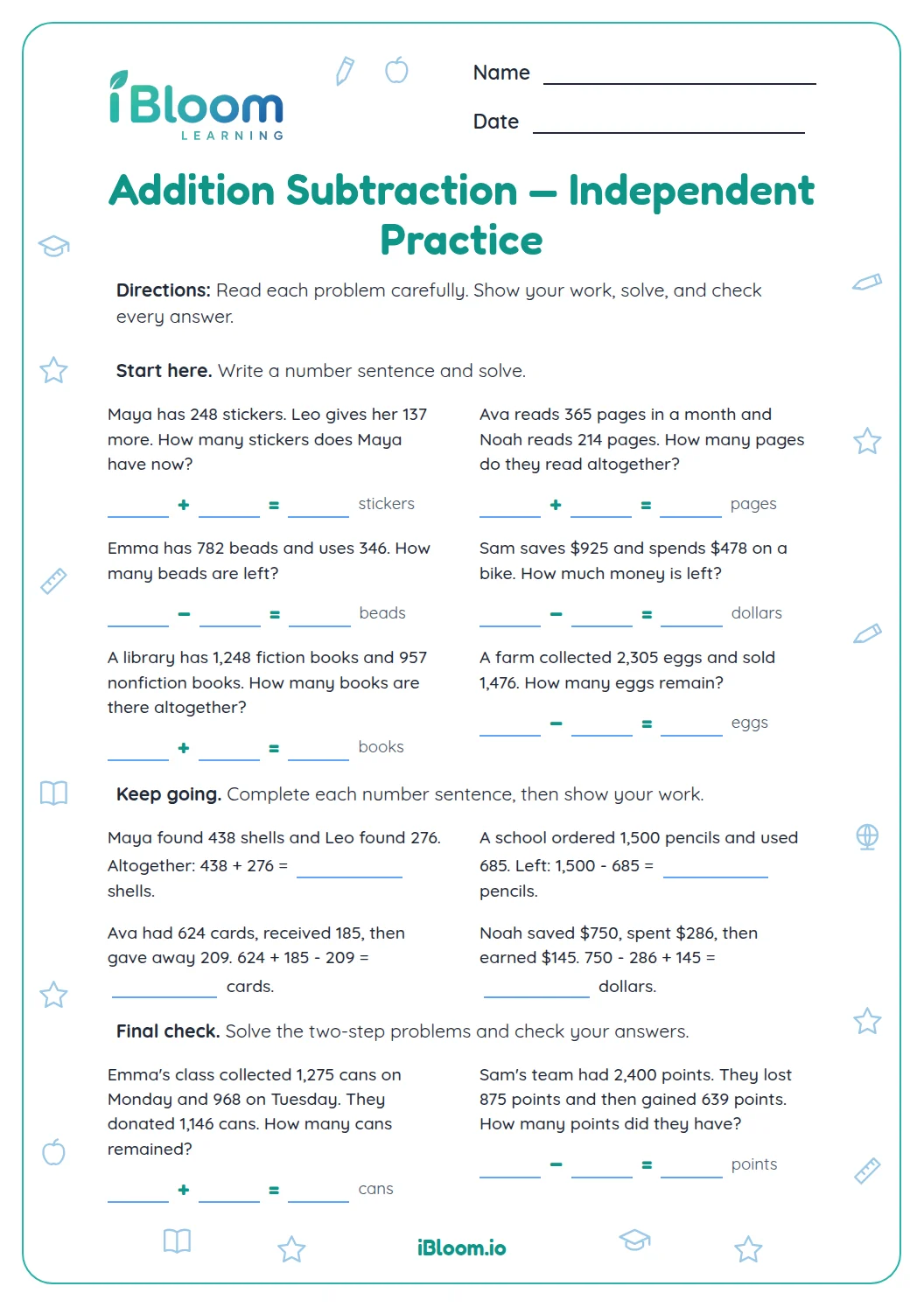


About this worksheet
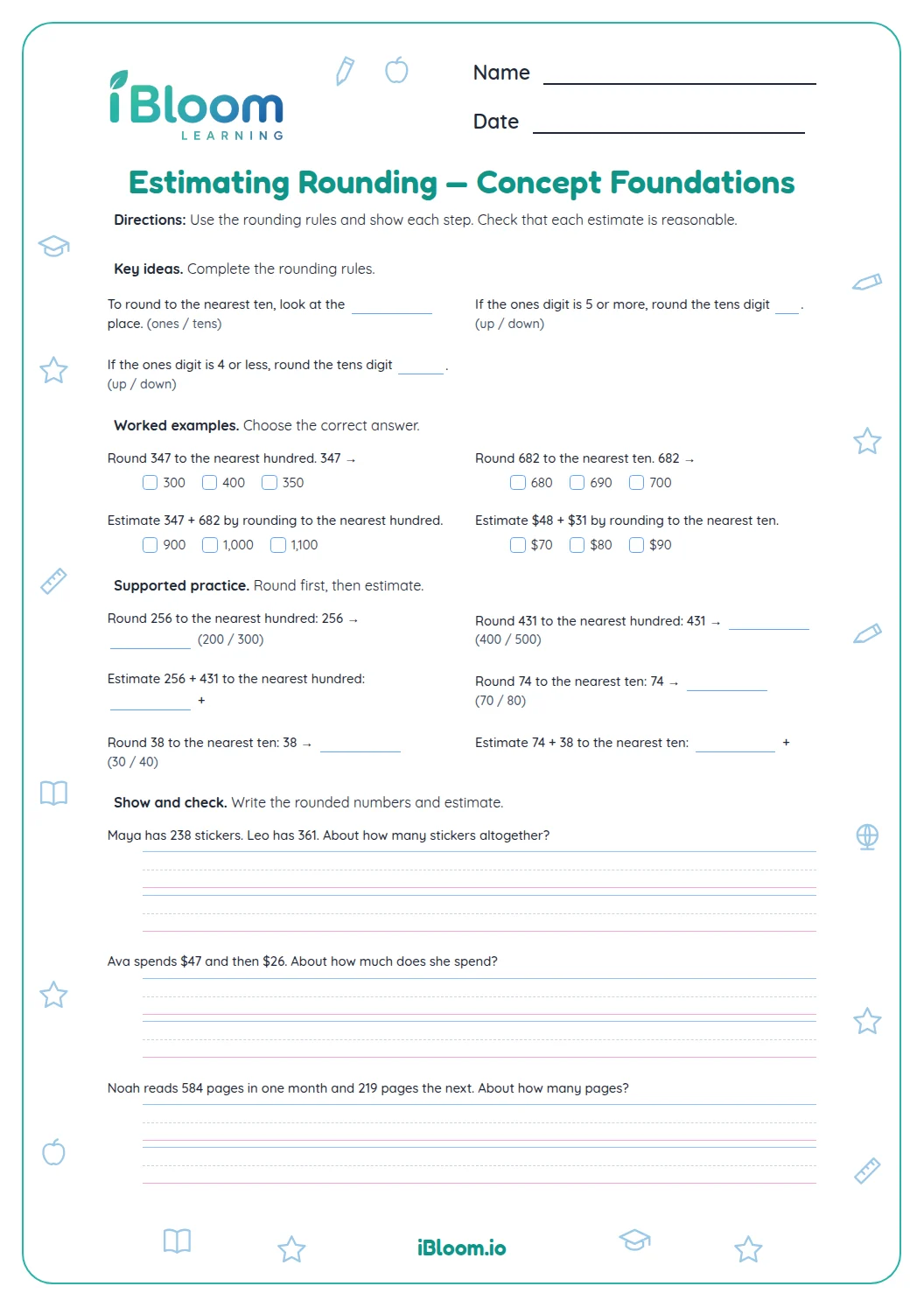
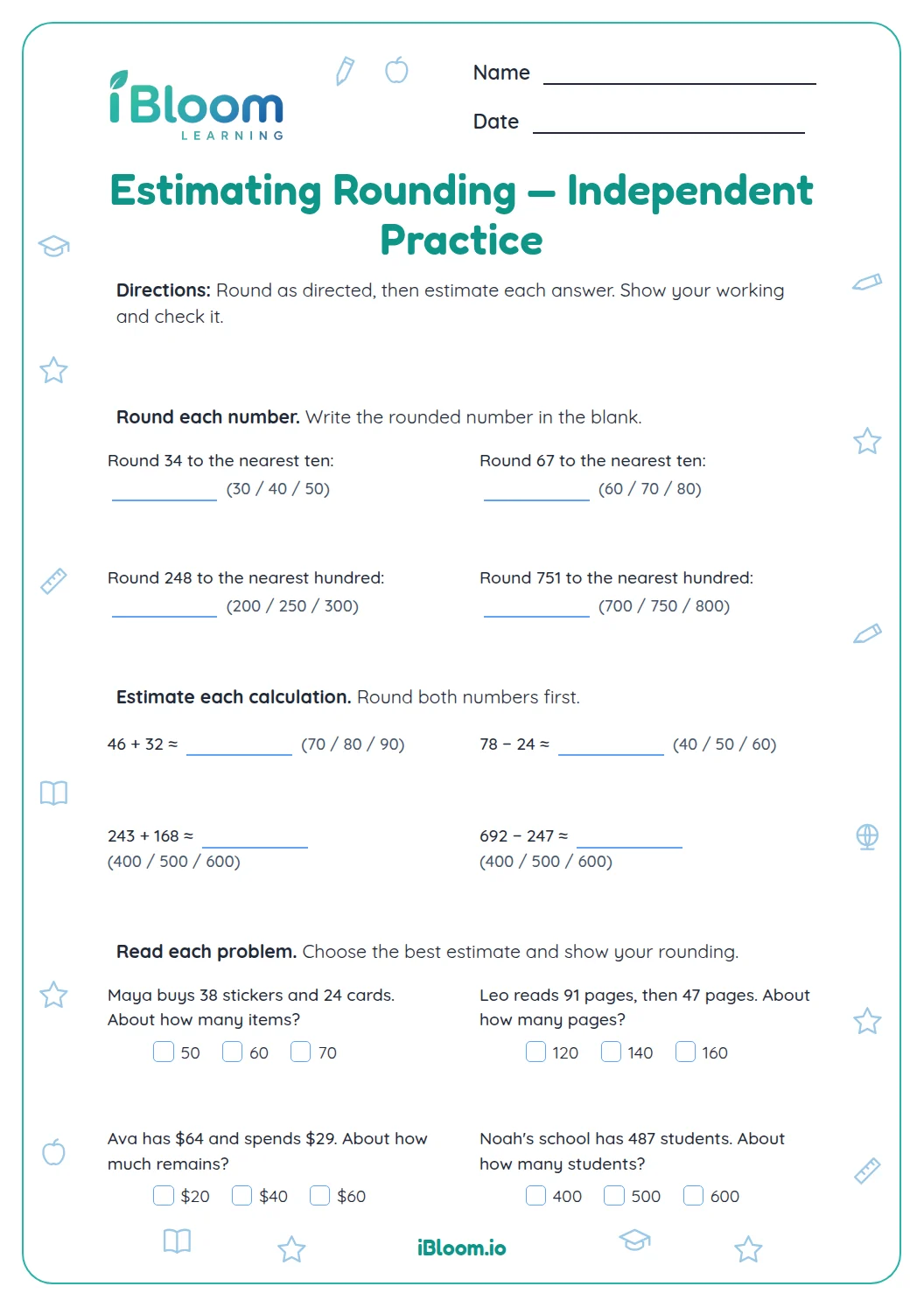
This Grade 4 worksheet gives students 15 concise questions about rounding whole numbers and using rounded values to estimate sums. It begins with rounding to tens, hundreds, and thousands, then moves to addition estimates and reasonableness checks. The work practices CCSS 4.NBT.A.3: using place-value understanding to round multi-digit whole numbers to any place. A separate answer key supports quick checking.
Aligned to 4.NBT.A.3
How do you round to a named place?
Find the place named in the question, then check the digit immediately to its right. If that digit is 5 or greater, increase the named-place digit by one; otherwise, keep it. Replace the digits to its right with zeros.
- 1Round 347 to the nearest ten.
- 2The ones digit is 7, so 347 rounds up to 350.
How do rounded addends make an estimate?
Round each addend to the requested place, then add the rounded numbers. In question 5, 1,486 rounds to 1,500 and 527 rounds to 500, so the estimated sum is 2,000. The estimate is close to the exact total, 2,013.
How can you check whether an estimate is reasonable?
Compare the estimate with rounded addends and with the size of the exact calculation. If 398 + 205 is rounded to hundreds, the addends become 400 and 200, so 600 is a reasonable estimate.
How to use the worksheet
- 1Read the place named in each rounding question.
- 2Check the digit immediately to the right of that place.
- 3Round each addend separately in estimate questions.
- 4Add the rounded values and compare the result with the choices.
- 5Use the key to check each answer and revisit the rounding step if needed.
Rounding slips and quick fixes
The mistake
Rounding from the digit in the named place.
The fix
Look one place to its right to decide whether to round up.
The mistake
Rounding only one addend in an estimate.
The fix
Round both addends to the requested place before adding.
The mistake
Reporting an exact sum when asked to estimate.
The fix
Use the rounded values and label the result as an estimate.
Common Core alignment
This practice connects to the listed Common Core skill.
Round multi-digit whole numbers to the requested place before estimating sums.
On this sheet: Students round whole numbers to named places and use rounded values in estimates.
Show the official wordingHide the official wording
Use place value understanding to round multi-digit whole numbers to any place.
What to practice next
Make more practice
Further reading
Questions parents and teachers ask
How many questions are on the worksheet?
There are 15 multiple-choice questions in three parts. Students first round numbers, then estimate sums, and finally judge whether estimates are reasonable. The separate answer key lists one correct choice for every question. The items use whole numbers and named place values.
How does rounding help estimate a sum?
Rounding makes each addend easier to work with. For example, 1,486 rounds to 1,500 and 527 rounds to 500 to the nearest hundred, giving an estimate of 2,000. The exact sum is 2,013, so the estimate is close.
What does “nearest hundred” mean?
Find the hundreds digit and check the tens digit. A tens digit of 5 or more sends the hundreds digit up one; a smaller digit leaves it as it is. Then replace the tens and ones digits with zeros.
Does the answer key show the rounded addends?
The key gives the correct choice for each item. Ask the student to say the rounded addends aloud before checking a sum; that makes it easier to spot whether a missed step was the rounding or the addition.
How long should students spend on this page?
About 15 minutes is a useful starting estimate for 15 short questions. Give extra time if the student is explaining why an estimate is reasonable or reviewing how a digit affects rounding. The questions use tens, hundreds, and thousands.