






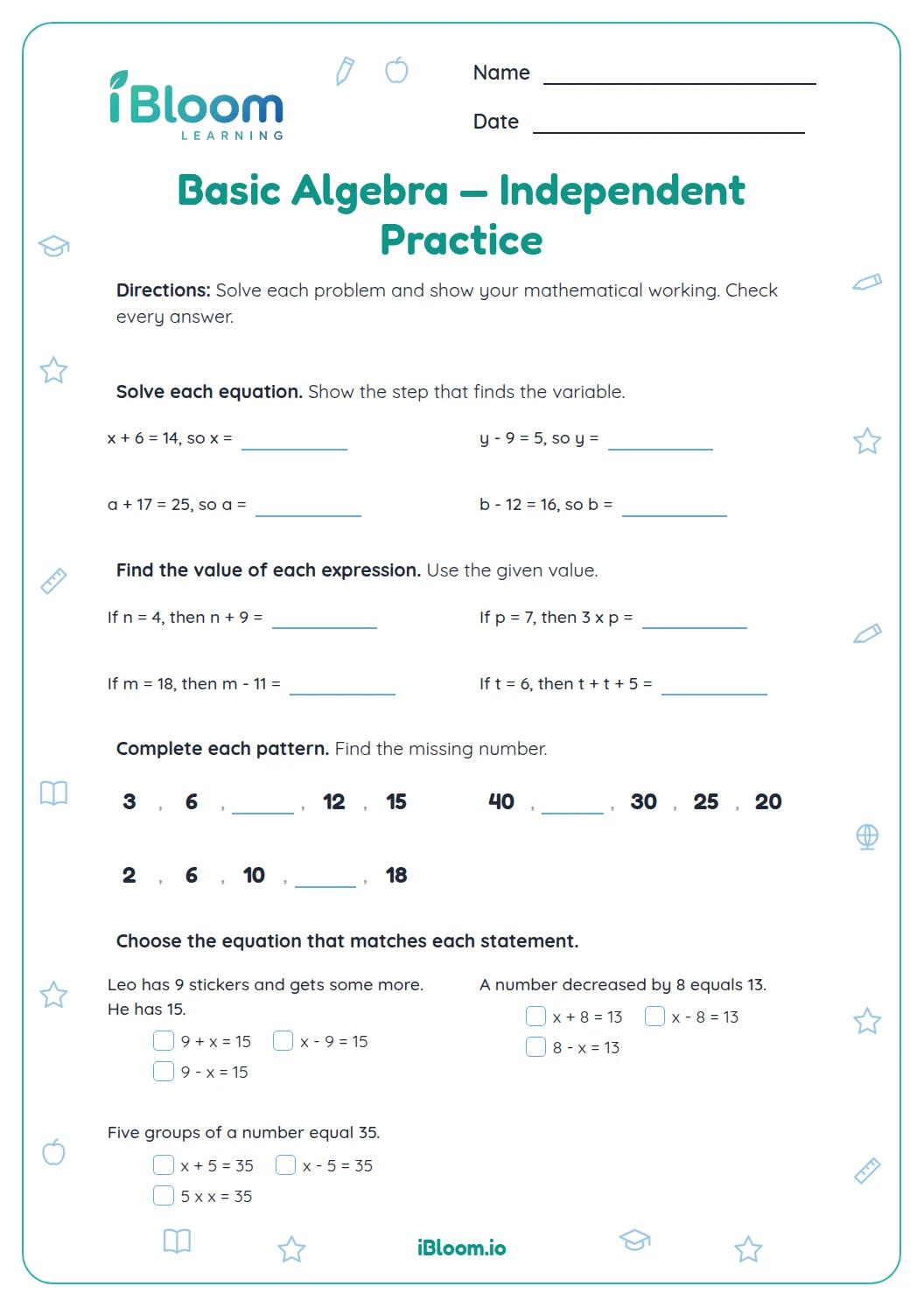
About this worksheet
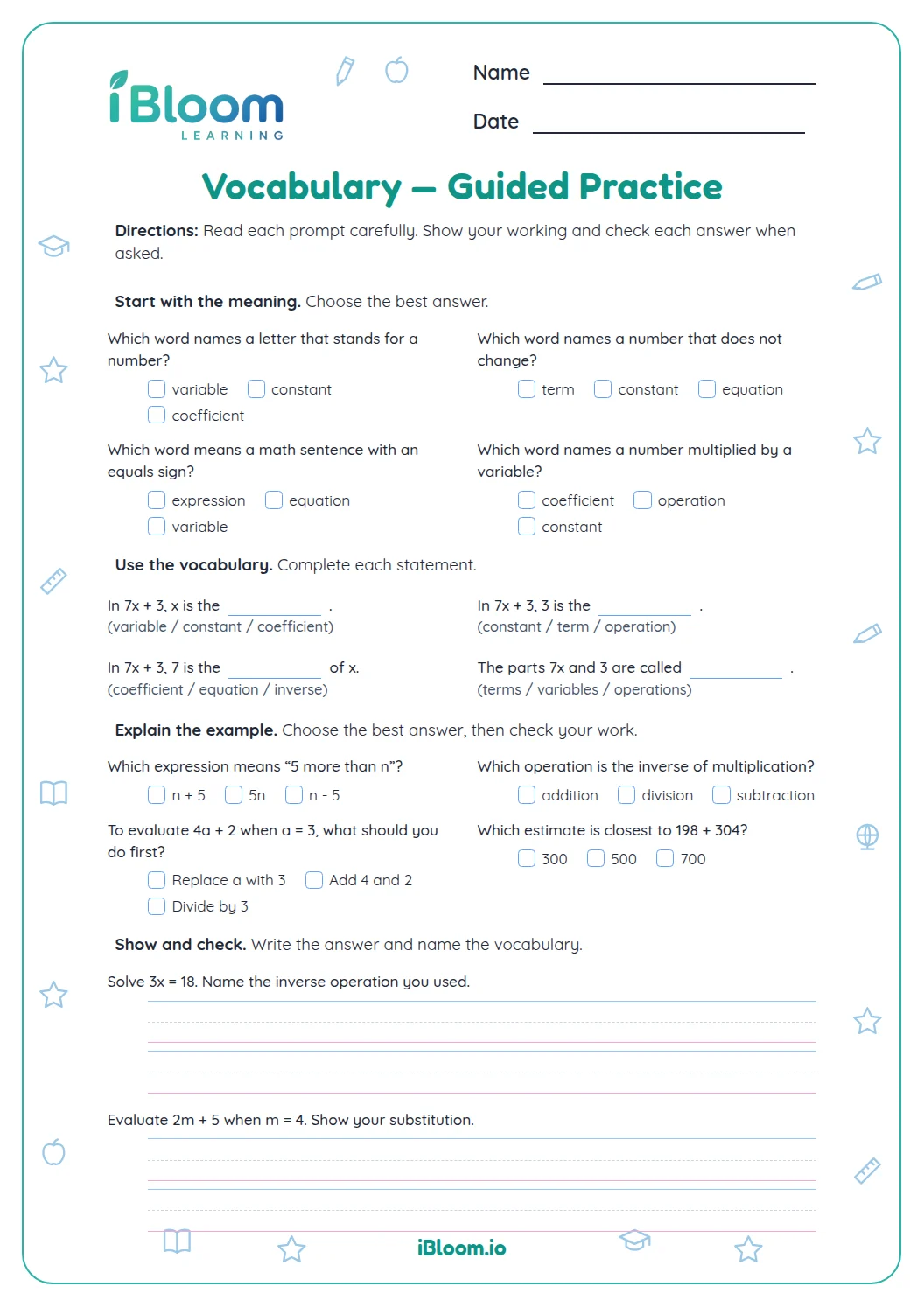
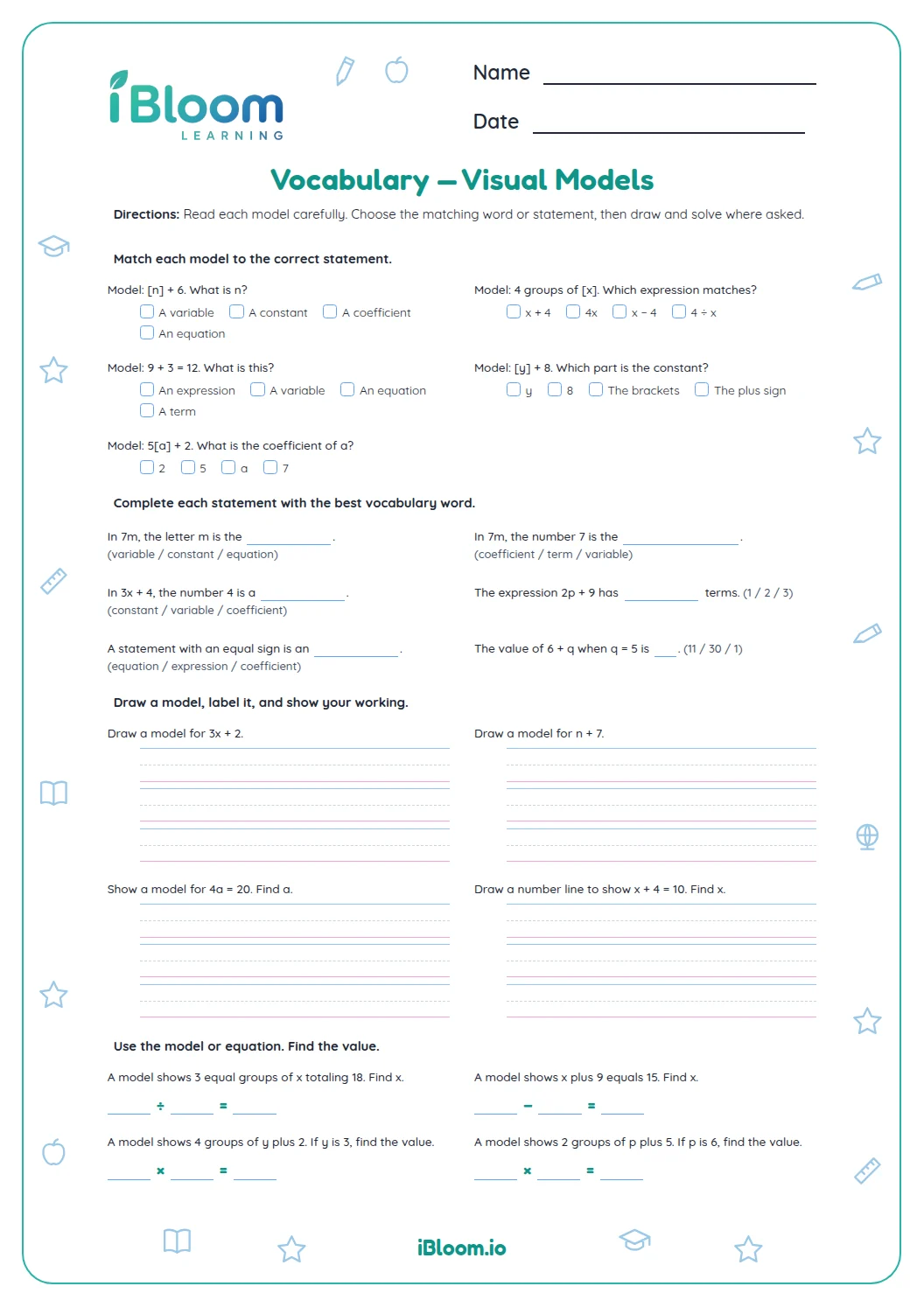
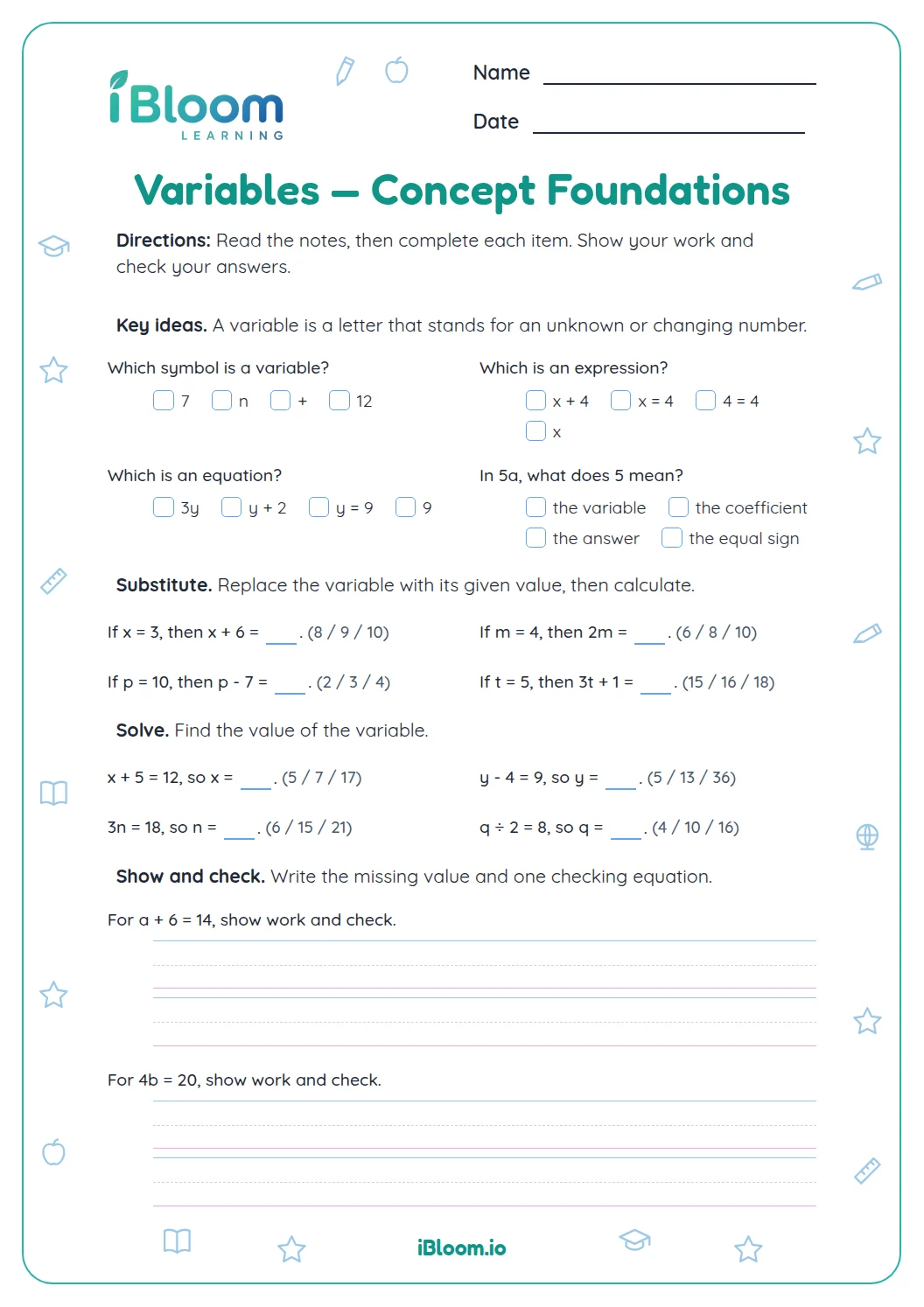
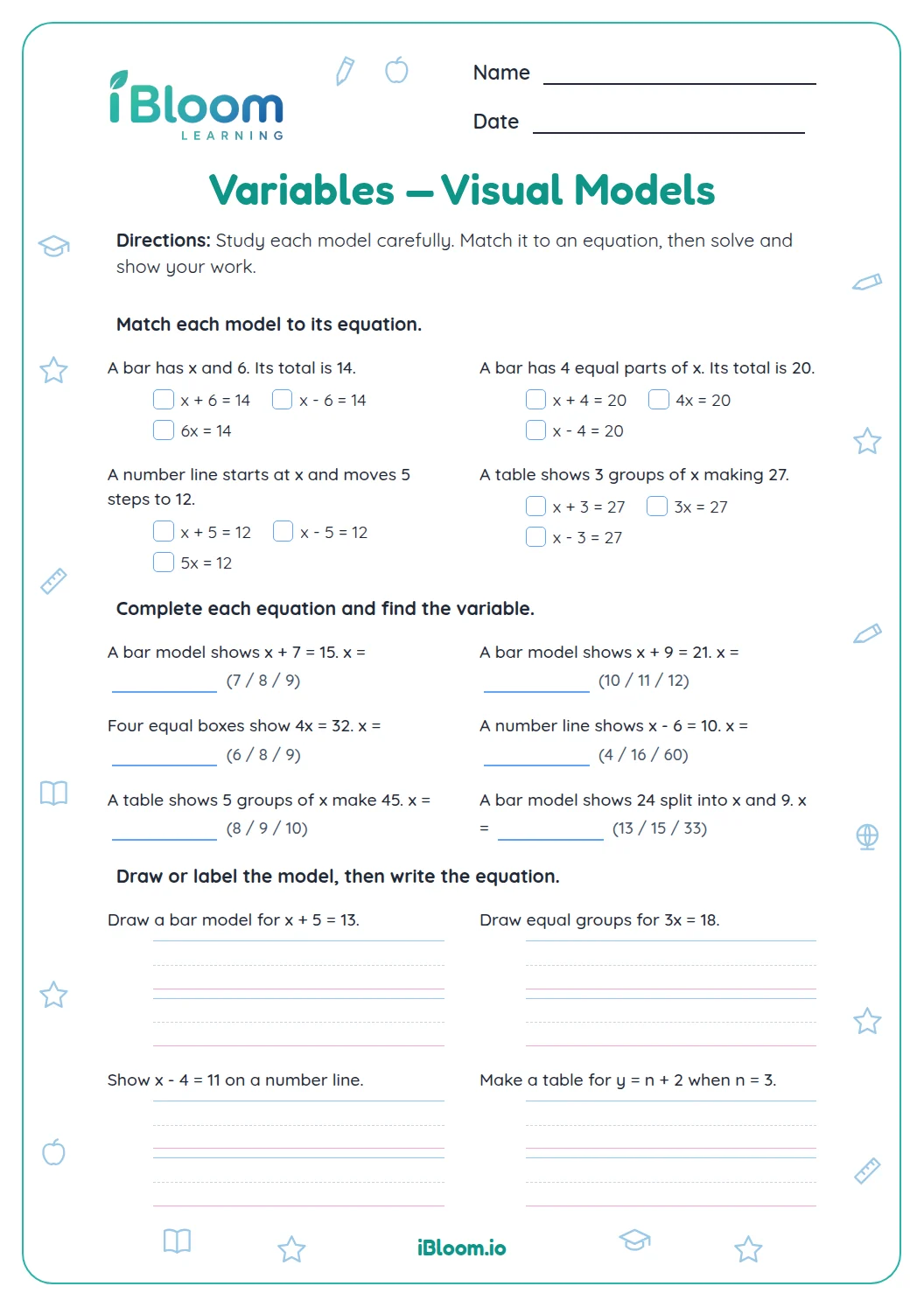
This free Grade 5 algebra vocabulary worksheet gives students 14 independent practice questions. Part A reviews operation words and the distinction between an expression, an equation and a variable. Part B asks students to read expressions by their structure, and Part C turns verbal calculations into symbols. Students use sum, difference, product and quotient in meaningful examples rather than copying definitions. The work supports Common Core 5.OA.A.2 through interpreting numerical expressions and writing calculations as expressions. A separate answer key includes the vocabulary choices and expressions.
Aligned to 5.OA.A.2
What do sum, difference, product and quotient mean?
Sum names the result of addition; difference names the result of subtraction; product names the result of multiplication; quotient names the result of division. These words also describe how to build expressions.
Part A places these terms beside examples of expressions and equations. An expression such as 7 + 5 represents a value. An equation such as 9 − 4 = 5 states that two sides have equal values. A variable is a letter that represents a number.
How do vocabulary words reveal grouping?
Listen for the whole quantity named by a phrase. “The difference of 9 and 4” is one quantity, written 9 − 4. “Twice” tells us to multiply that entire difference by 2.
Question 10 asks for a relationship without calculating either value. The outside factor 3 tells us that 3 × (6 + 2) is three times as large as 6 + 2.
- 1Twice the difference of 9 and 4
- 2The difference: 9 − 4
- 3Twice that entire quantity: 2 × (9 − 4)
- 4Choose the expression with the difference grouped together.
How should students write the final four answers?
Students write expressions using the operation signs and numbers from each prompt. Keep the stated number order so it is easy to compare the written expression with the words.
For question 13, “add 5 and 9, then multiply the sum by 2” becomes (5 + 9) × 2. The parentheses keep the sum together. For question 14, (10 − 3) + 8 records the stated steps; 10 − 3 + 8 follows the same order.
How to use this worksheet
- 1Complete Part A independently, connecting each operation name with its sign.
- 2Check whether each example includes an equals sign when distinguishing equations from expressions.
- 3Read the whole phrase in Part B before looking at the choices.
- 4In Part C, write the named calculation and group any sum or difference that must stay together.
- 5Compare with the key and explain the grouping in questions 9 and 13.
Mistakes to check and how to fix them
The mistake
Calling 7 + 5 an equation.
The fix
Look for an equals sign stating that two sides have equal values. This example is an expression.
The mistake
Writing 2 × 9 − 4 for twice the difference of 9 and 4.
The fix
Group the entire difference: 2 × (9 − 4).
The mistake
Writing 3 + (6 + 2) for three times the sum.
The fix
Times means multiplication. Use 3 × (6 + 2); adding 3 describes a different relationship.
Common Core alignment
Read and write numerical expressions using operation words and grouping.
On this sheet: Parts B and C ask students to interpret and write expressions without calculating their values.
Show the official wordingHide the official wording
Write simple expressions that record calculations with numbers, and interpret numerical expressions without evaluating them. For example, express the calculation “add 8 and 7, then multiply by 2” as 2 × (8 + 7). Recognize that 3 × (18932 + 921) is three times as large as 18932 + 921, without having to calculate the indicated sum or product.
What to practice next
Make more practice
Further reading
Questions parents and teachers ask
Which vocabulary words does the worksheet practice?
The worksheet practices sum, difference, product, quotient, expression, equation and variable. It also uses phrases such as twice and three times as large. Students first choose words and examples, then apply operation language to read and write expressions, including expressions with a grouped sum or difference.
Should students calculate the values in Part B?
No, students can answer Part B by reading the structure of each expression. For example, the factor 3 in 3 × (6 + 2) tells them that the expression is three times as large as 6 + 2. The task is to describe the relationship using the operation language.
Why does twice the difference need parentheses?
Parentheses show that the entire difference is multiplied by 2. In question 9, 2 × (9 − 4) matches the words. Without the parentheses, 2 × 9 − 4 doubles only 9 before subtracting 4. Reading the phrase as “twice that difference” helps students hear the group.
Are alternate expressions accepted in Part C?
Accept an expression that follows the stated calculation and number order. In question 14, both (10 − 3) + 8 and 10 − 3 + 8 record subtracting 3 from 10 and then adding 8. Question 13 needs the sum grouped so that multiplication applies to both addends together.
How can I review a confused operation word?
Pair the word with a familiar calculation and say both aloud. For product, use 7 × 4 and say “the product of seven and four.” Then ask the student to find product in Part A and write its expression in Part C. Reusing one example connects the definition to the symbols.