







About this worksheet
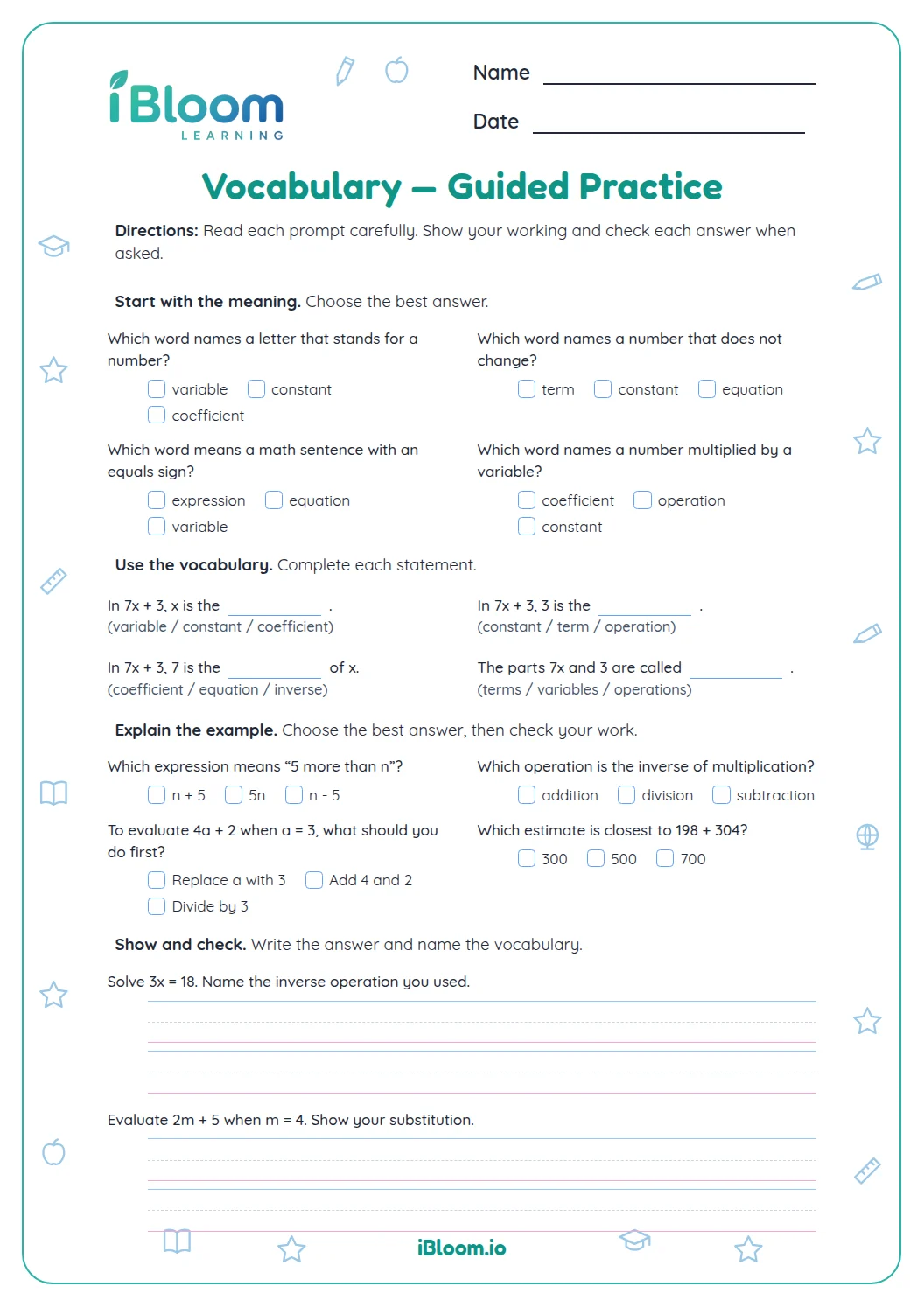
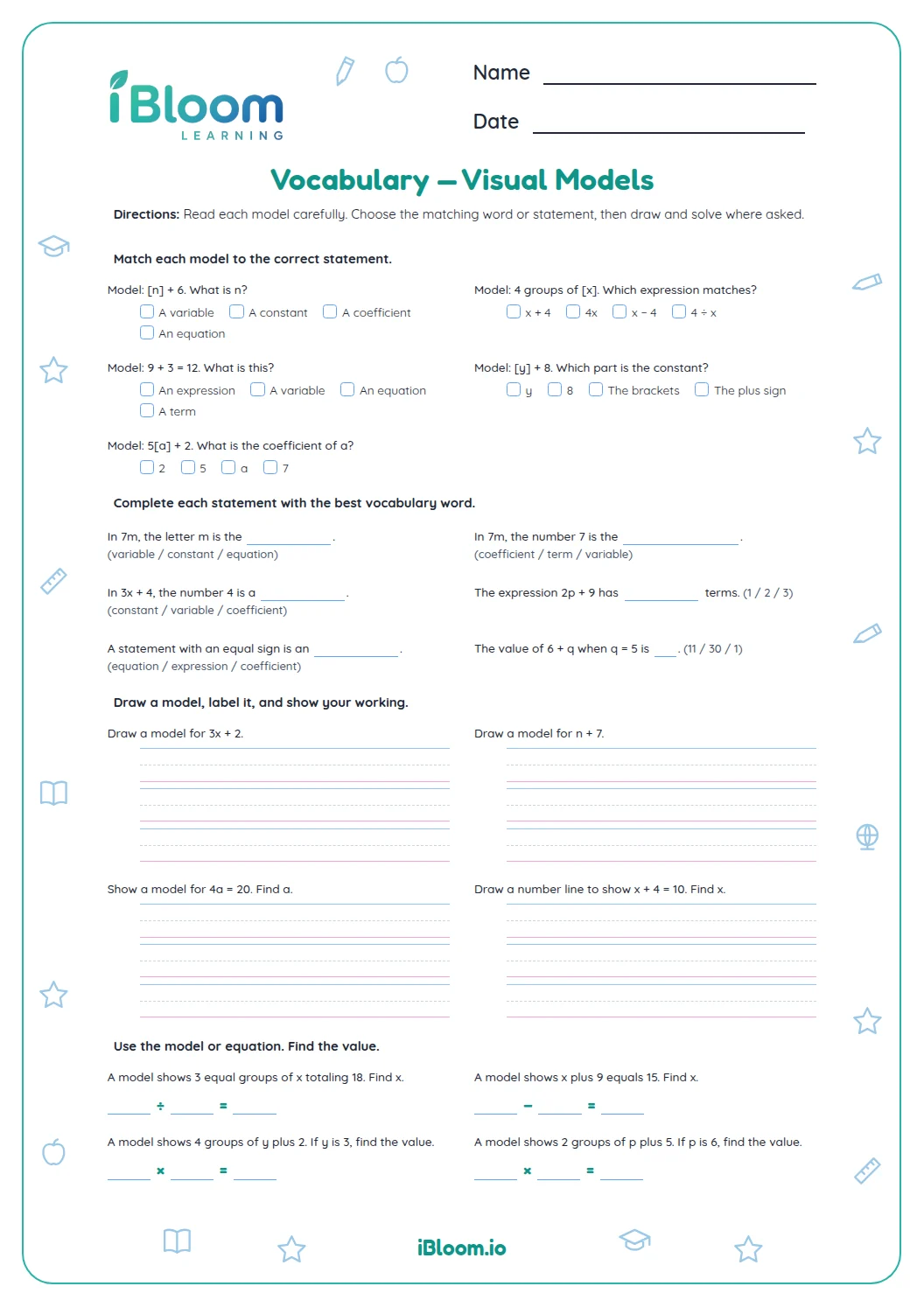
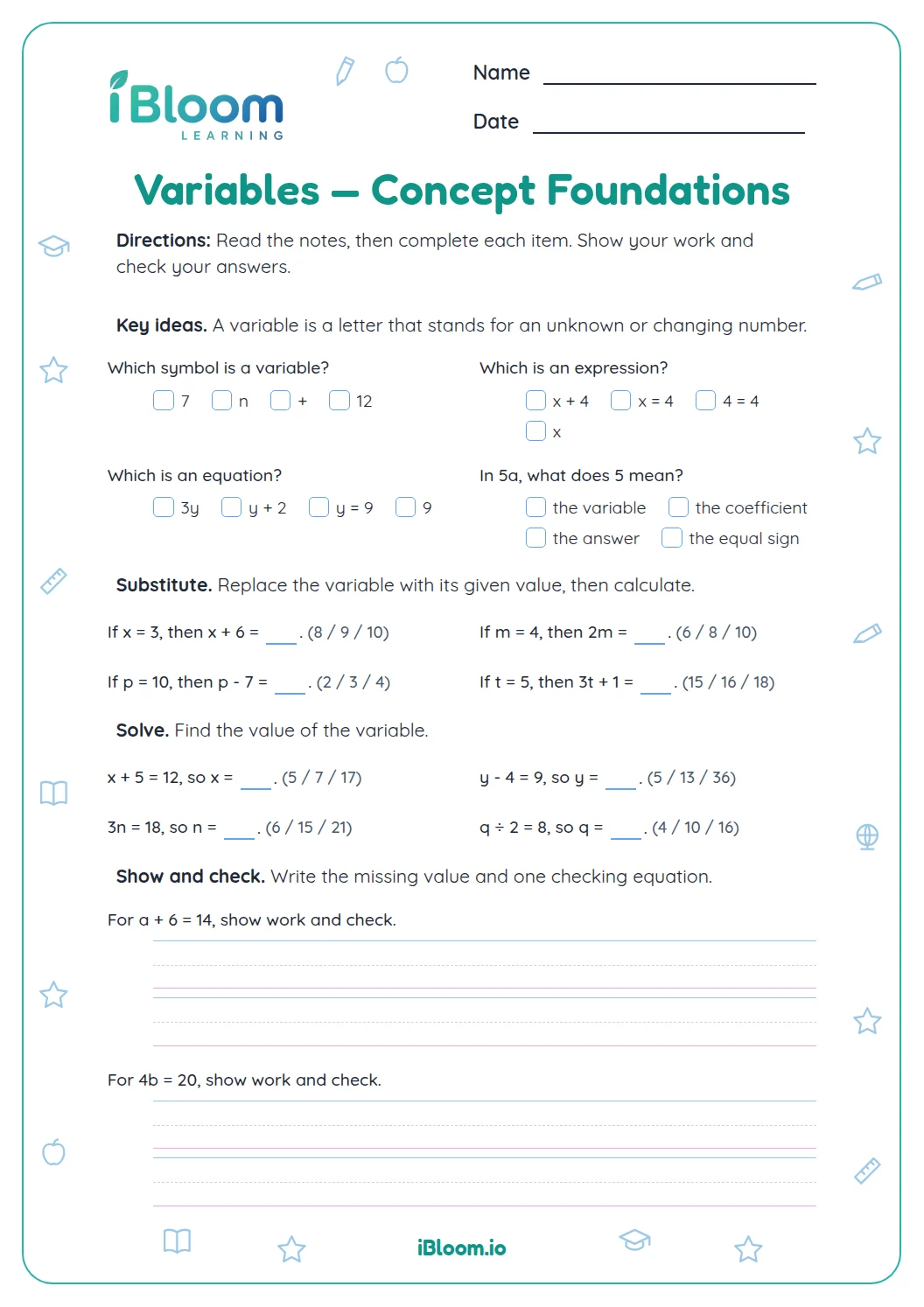
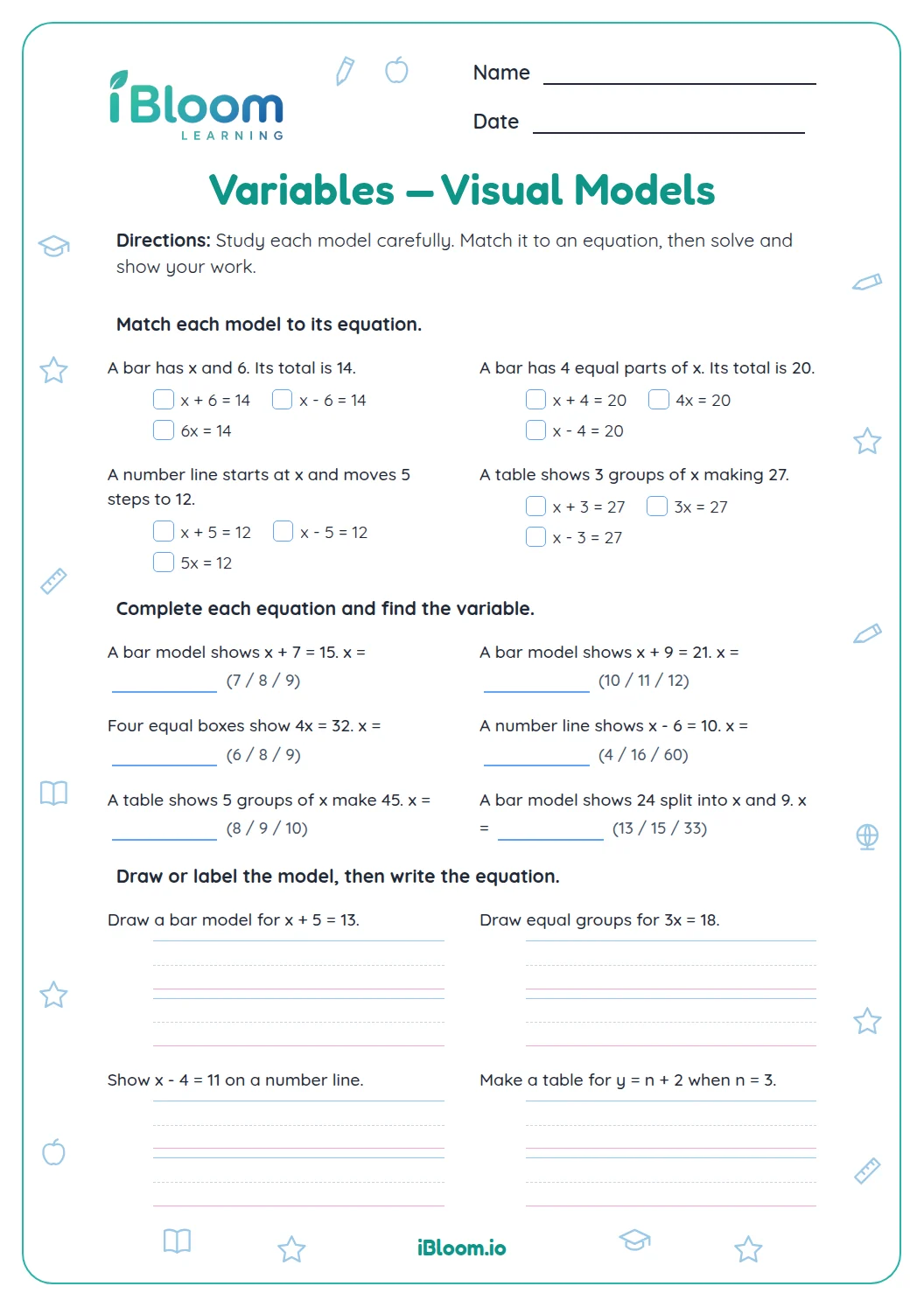
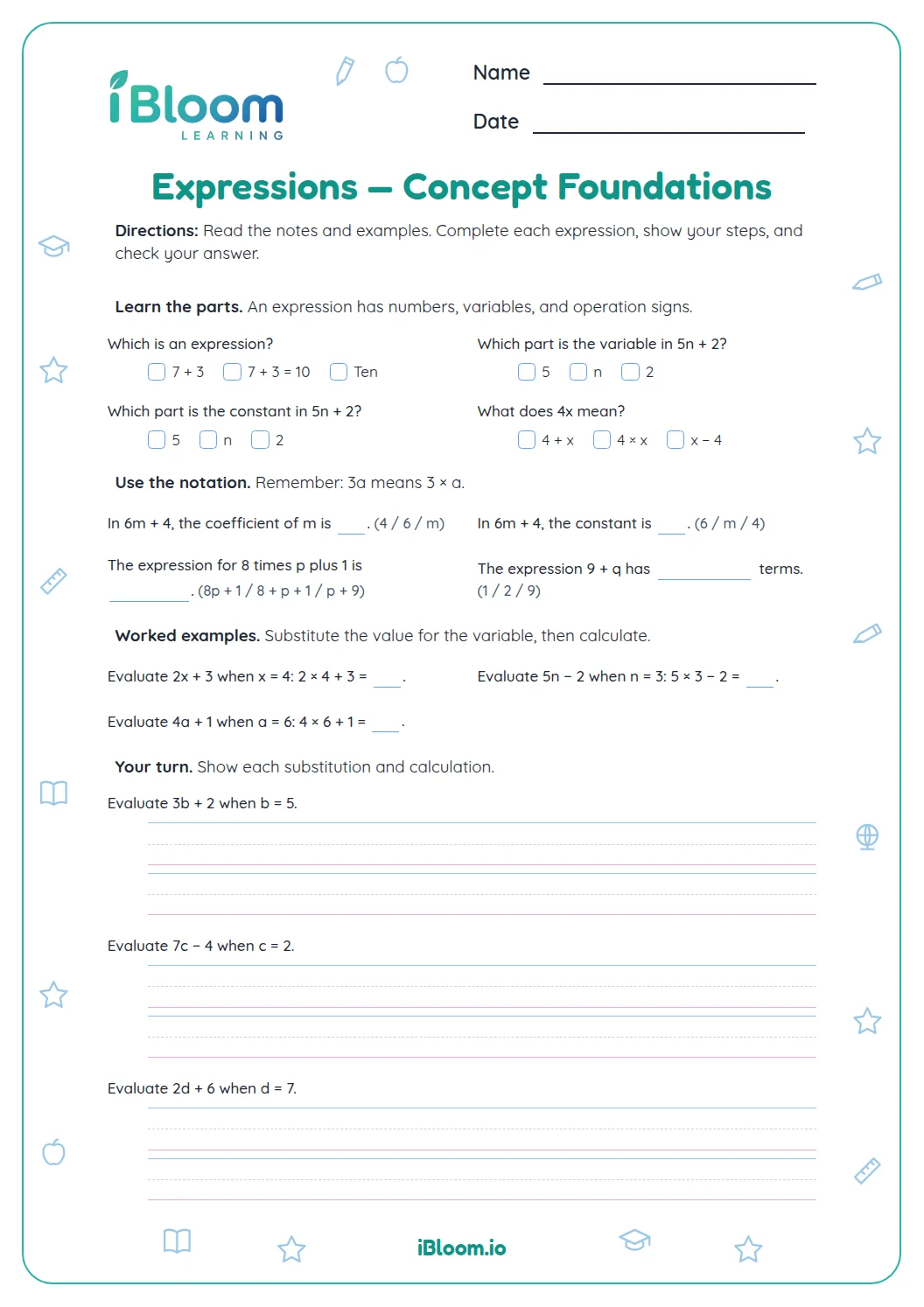
This printable Grade 5 algebra vocabulary worksheet introduces the language used to describe expressions and equations. Learners name variables, coefficients, constants and terms, distinguish an equation from an expression, and translate a short phrase. It includes 15 questions and a separate answer key. The numerical expression work connects to CCSS 6.EE.A.2.
Aligned to 6.EE.A.2
What are the parts of an algebraic expression?
A variable is a letter that stands for a number. A coefficient multiplies a variable, and a constant is a number without a variable. Terms are separated by plus or minus signs. An equation includes an equal sign connecting two expressions.
- 16x + 4
- 26 multiplies x, so 6 is the coefficient.
- 3x is the variable.
- 44 stands alone, so it is the constant.
- 5The expression has two terms: 6x and 4.
What will children practice?
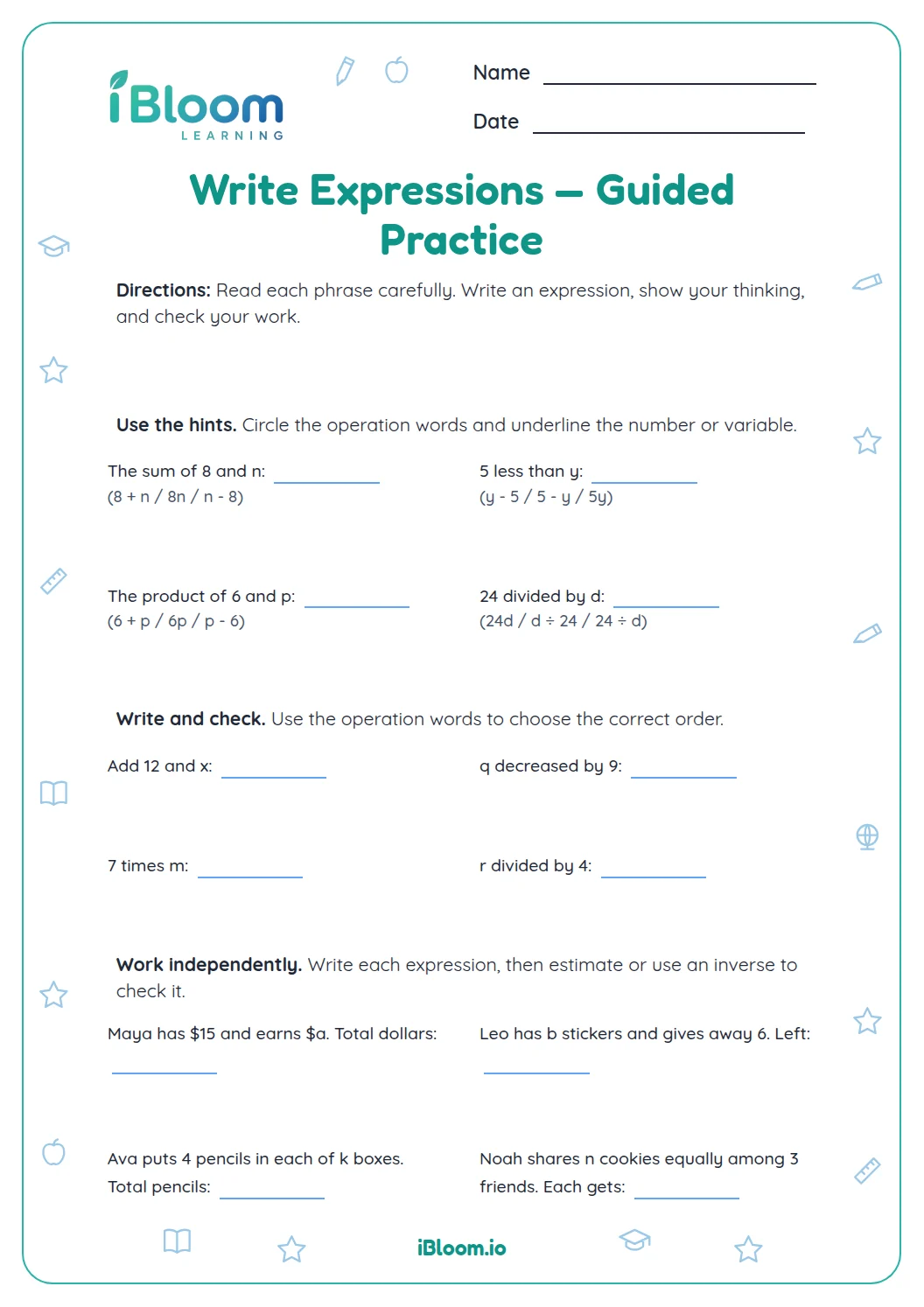
The 15 items move from naming variables, coefficients, constants, and terms to distinguishing expressions from equations. Learners also translate two phrases into expressions and identify an implied coefficient of 1. A separate two-page key provides answers and a sample response.
How can an adult support the practice?
Ask the learner to explain the place or operation that matters before calculating. Use the answer key to check the result and the reasoning.
How to use this worksheet
- 1Read the full expression before naming a part.
- 2Look for the letter that stands for a number.
- 3Find the number multiplying that letter for the coefficient.
- 4A number by itself is a constant.
- 5Look for an equal sign to decide if the statement is an equation.
Mistakes to watch for
The mistake
Calling every number a coefficient.
The fix
A coefficient multiplies a variable; a standalone number is a constant.
The mistake
Calling a variable an equation.
The fix
A letter is a variable; an equation needs an equal sign.
The mistake
Counting symbols instead of terms.
The fix
Terms are separated by plus and minus signs; 6x is one term.
Common Core alignment
This worksheet introduces the vocabulary used to read expressions with letters.
Read algebraic expressions with letters standing for numbers.
On this sheet: Learners read expressions with variables, identify their parts and translate a phrase into an expression.
Show the official wordingHide the official wording
Write, read, and evaluate expressions in which letters stand for numbers.
What to practice next
Make more practice
Further reading
Questions parents and teachers ask
What is a variable?
A variable is a letter that represents a number. In 6x + 4, x is the variable. The worksheet asks learners to identify variables in both expressions and equations, then use a variable in two short verbal phrases. Naming the letter helps distinguish it from the number multiplying it.
What is a coefficient?
A coefficient is the number multiplying a variable. In 6x, the coefficient is 6. If no number is written, as in z, the coefficient is 1. Questions 2, 7, and 14 practice both the written and implied coefficient. The value 1 is understood even when it is not printed.
What is a constant?
A constant is a number that stands alone rather than multiplying a variable. In 6x + 4, the constant is 4. In 5k + 1, it is 1. Look for a number that forms its own term instead of the factor attached to a letter.
How can I tell an expression from an equation?
An equation contains an equal sign and states that two quantities are equal. An expression combines numbers, variables, and operations without an equal sign. For example, 7 + c is an expression, while 4r = 20 is an equation. Questions 6, 11, and 15 check this distinction.
What does “term” mean?
A term is a part of an expression separated by plus or minus signs. In 2x + 3 + y − 8, the terms are 2x, 3, y, and −8. Question 9 asks learners to count the four terms; the minus sign belongs with the final term.