

About this worksheet
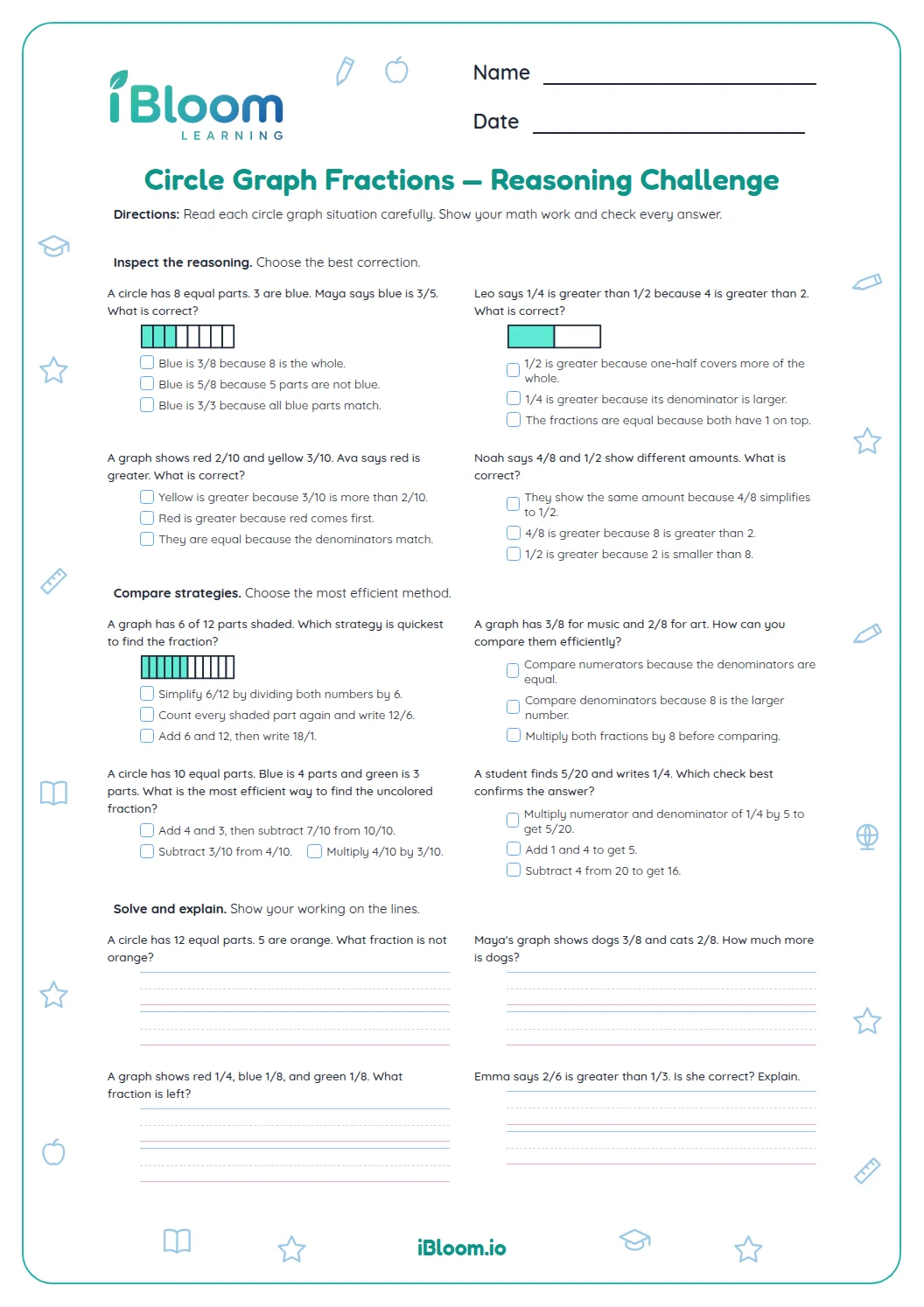
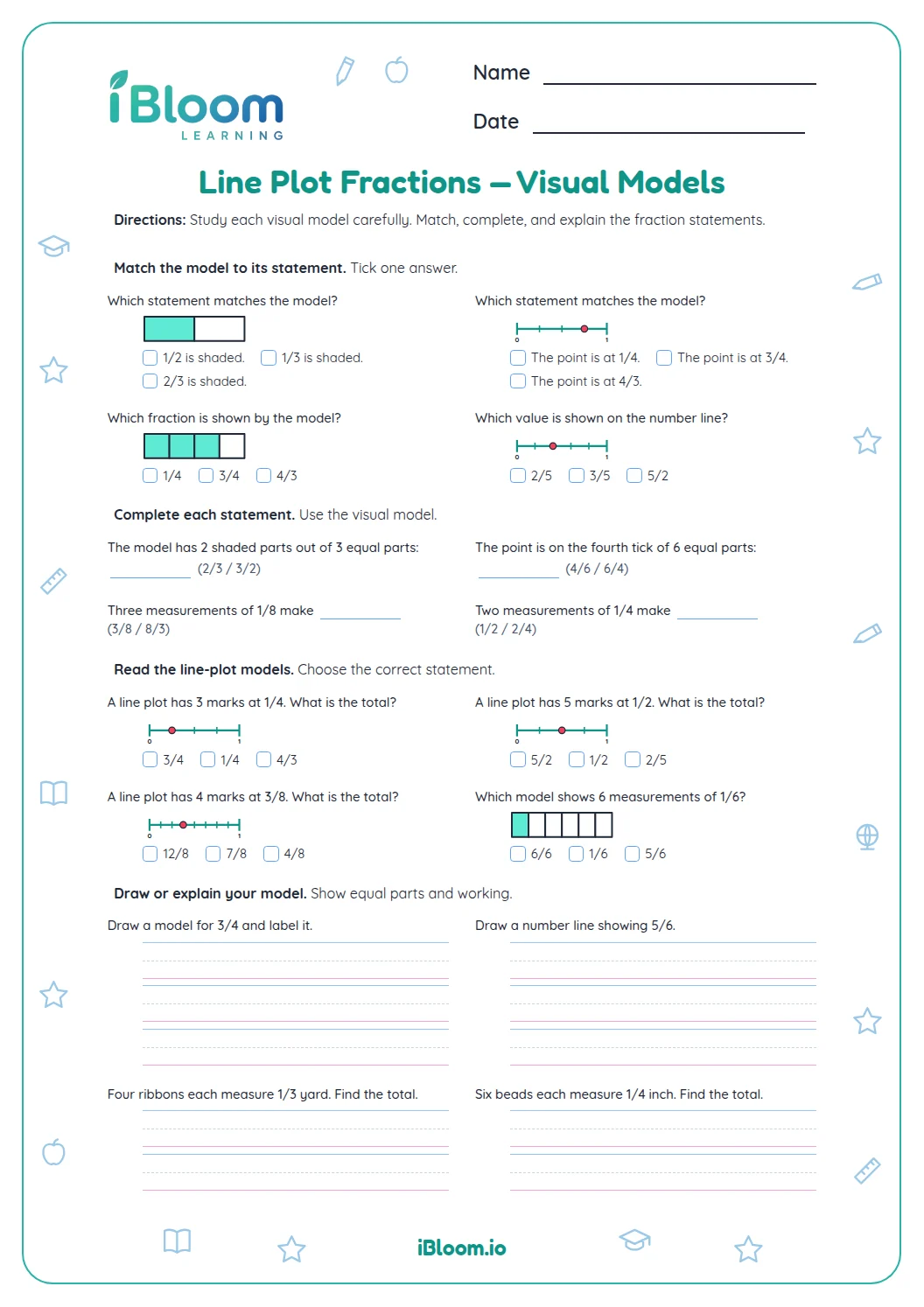
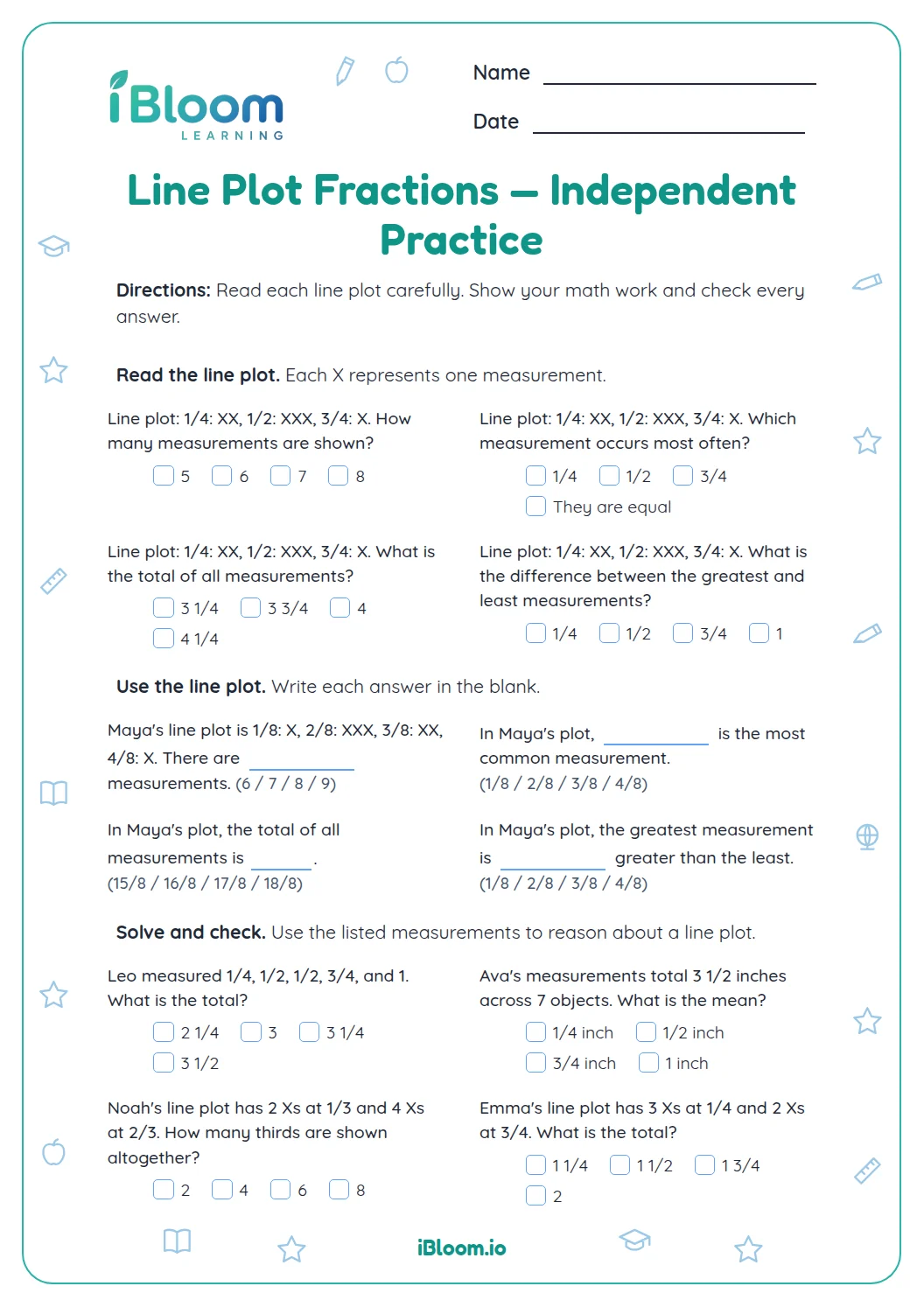
Fourteen questions use equal-part circle models and survey fractions to find, compare, and interpret parts of a whole. The separate answer key supports checking after the learner has tried each question.
Aligned to 5.NF.B.4.a
How do equal parts show a fraction?
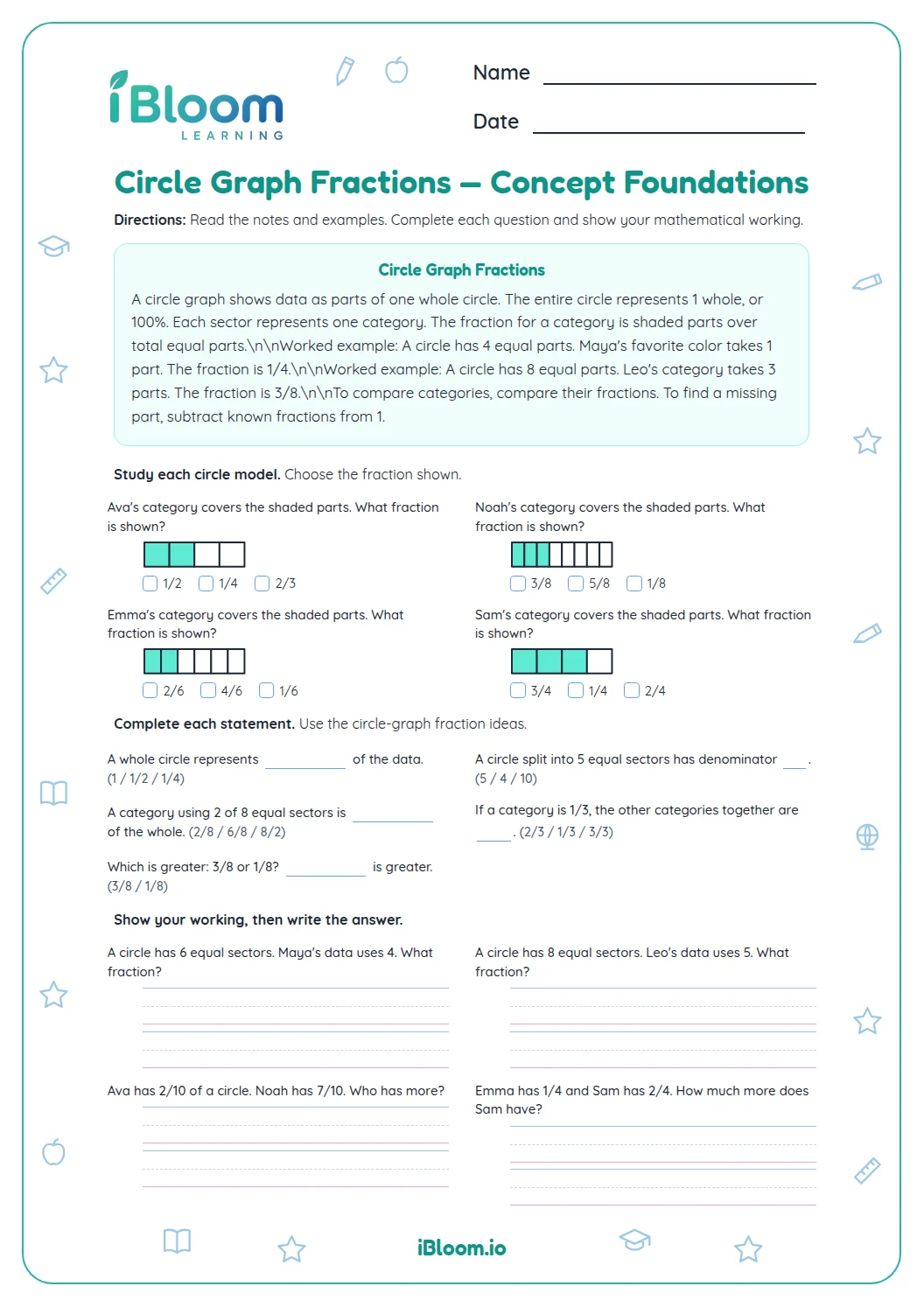
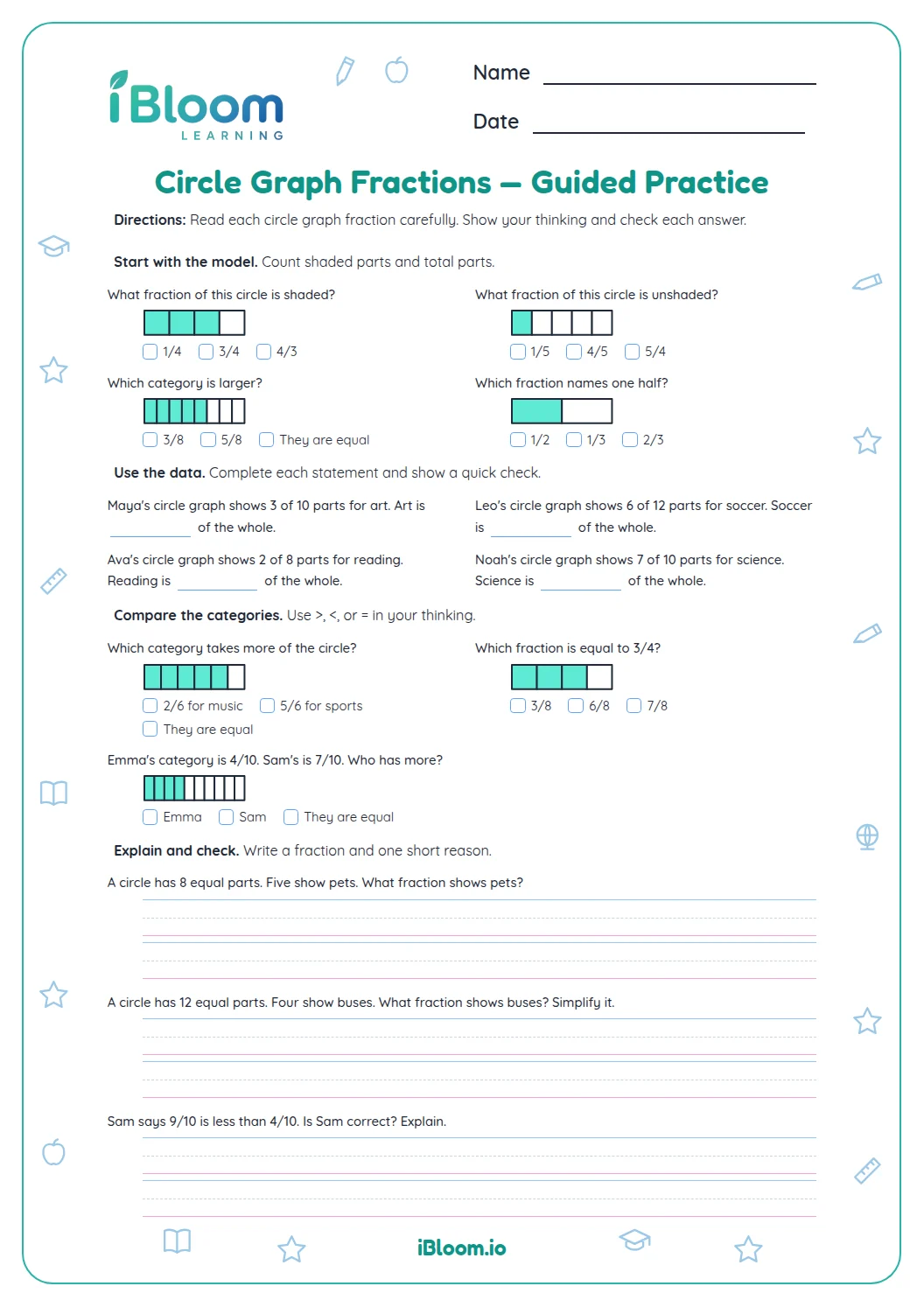
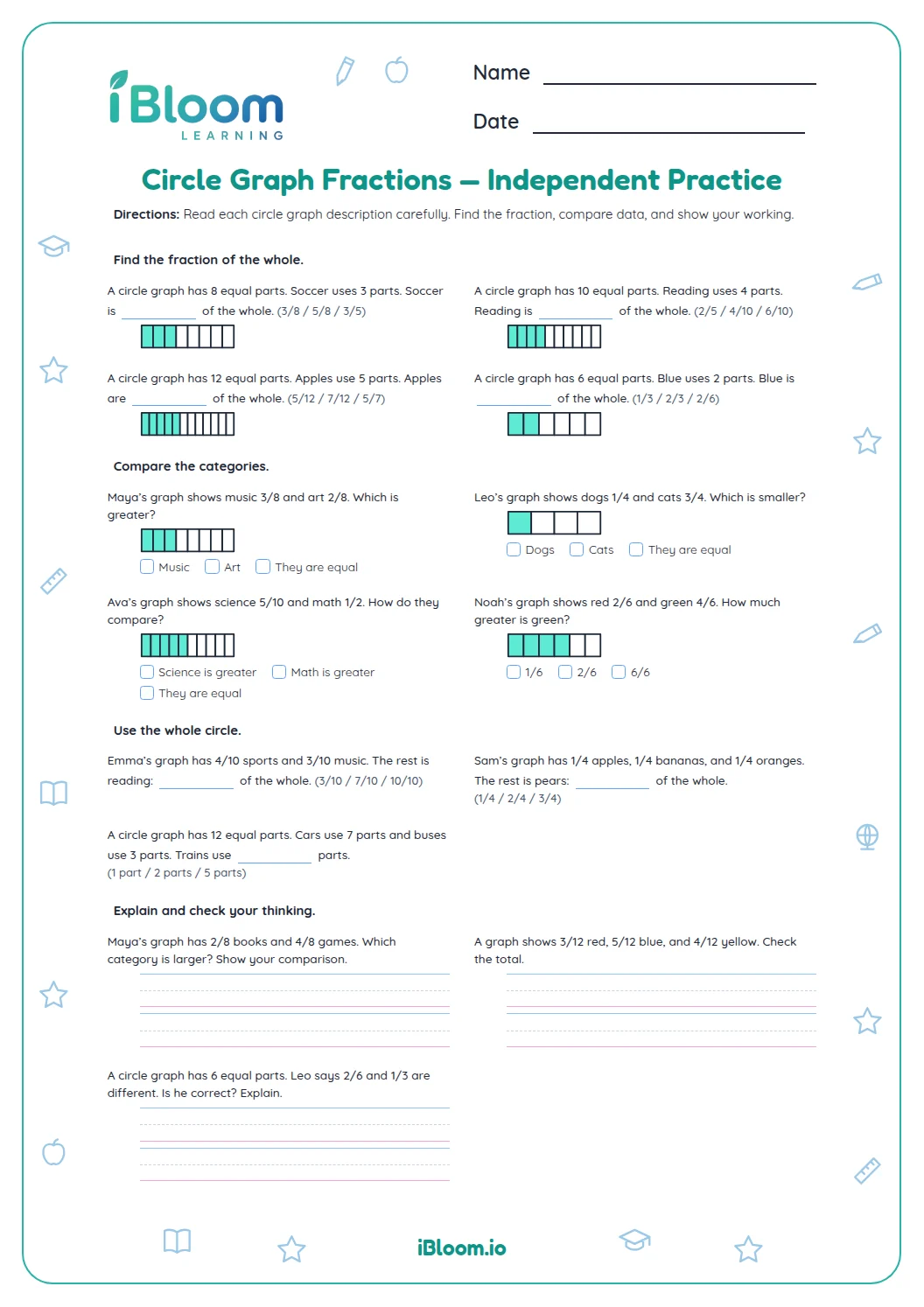
A fraction names equal parts of one whole. In question 1, 3 of 8 equal circle parts are shaded, so the fraction is 3/8.
How do survey fractions describe votes?
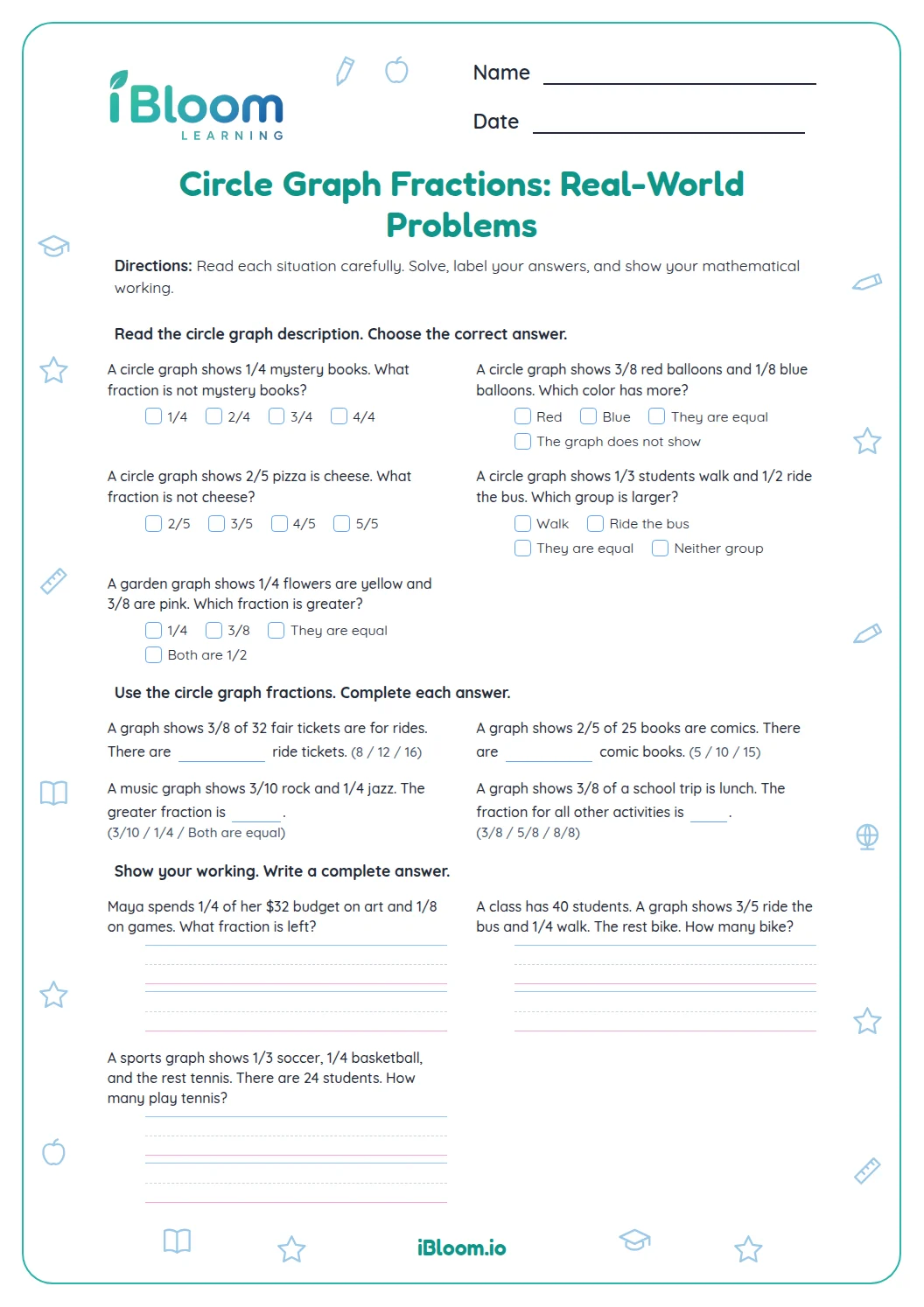
Use the whole number of votes as the total, then identify the fraction for a category. In question 8, 3/8 of 32 is 12: divide 32 by 8, then multiply by 3.
How can you check a circle graph?
Category fractions together make 1 whole. In question 13, 1/4 + 1/2 leaves 1/4 for books.
How to use this worksheet
- 1Count all equal parts for the denominator.
- 2Count the shaded or named parts for the numerator.
- 3For a fraction of votes, divide by the denominator and multiply by the numerator.
- 4Check that all category fractions account for the whole.
Common mistakes and quick fixes
The mistake
Switching the numerator and denominator.
The fix
Write the named or shaded parts first, then all equal parts.
The mistake
Stopping after finding one part of a vote total.
The fix
For 3/8 of 32, find 32 ÷ 8, then multiply that result by 3.
The mistake
Leaving a category out of the circle graph total.
The fix
Add the category fractions and check that they total 1.
Common Core alignment
This worksheet practices the standard below through its questions.
Use equal parts to find a fraction of a whole-number vote total.
On this sheet:
Show the official wordingHide the official wording
Interpret the product ( a / b ) × q as a parts of a partition of q into b equal parts; equivalently, as the result of a sequence of operations a × q ÷ b . For example, use a visual fraction model to show (2/3) × 4 = 8/3, and create a story context for this equation. Do the same with (2/3) × (4/5) = 8/15. (In general, (a/b) × (c/d) = (ac)/(bd).
What to practice next
Make more practice
Further reading
Questions parents and teachers ask
How does a circle graph show a fraction?
The full circle represents one whole group. Equal slices stand for equal shares, and each category’s fraction names its slices over all slices. In question 1, three of eight equal parts are shaded, so the fraction is three eighths. This same equal-parts idea helps connect a visual model to survey results.
How do I find 3/8 of 32 votes?
Divide the total, 32, by the denominator, 8, to find the size of one equal group. That gives 4 votes per group. Then multiply by the numerator, 3, to find 12 votes. Question 8 uses this method, and you can check by adding three groups of four.
Why should category fractions add to 1?
All categories in a complete survey account for the whole group, which is represented by 1. In question 13, music is one fourth and sports is one half. Together they make three fourths, so the remaining one fourth belongs to books. Adding every category checks the total.
Is an answer key included?
Yes. A separate key gives answers to all 14 questions. It includes the shaded fractions, the vote calculations, and the category fractions, so an adult can check both the result and the equal-groups method after the learner completes the sheet.