
About this worksheet
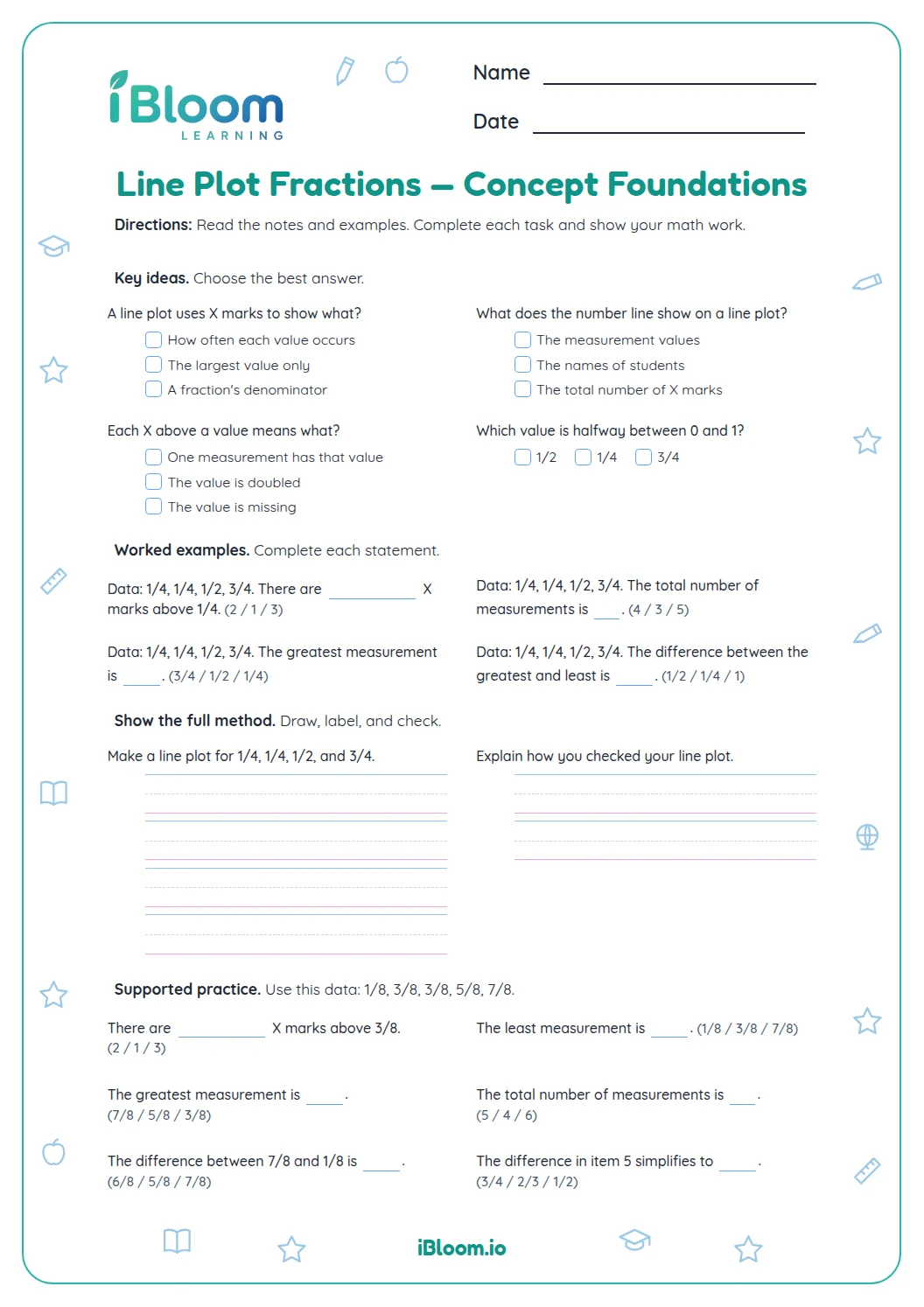
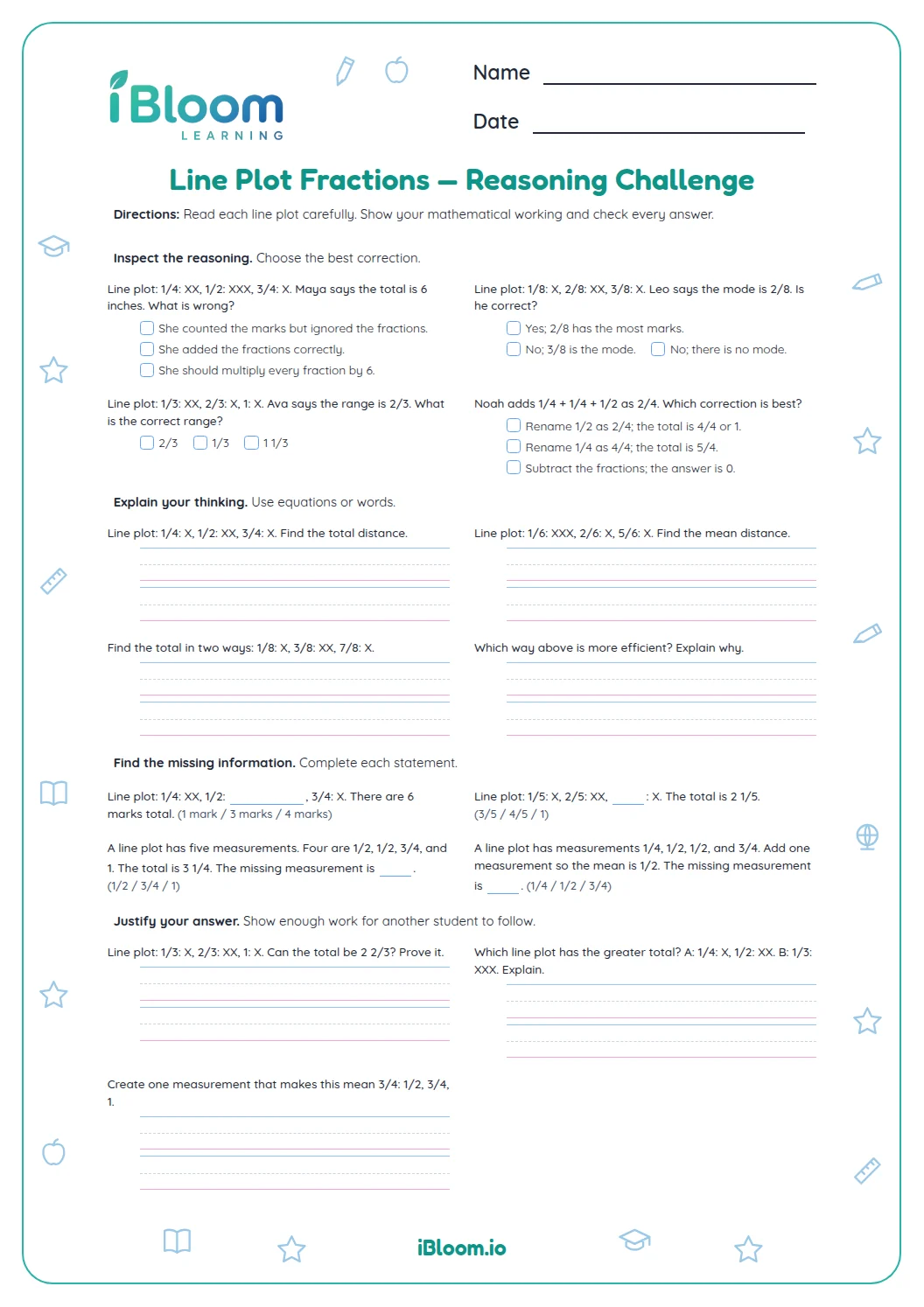
This free printable worksheet gives Grade 5 students guided practice with line plots of measurements in fractions of a unit (1/8, 1/4, 1/2 and 3/4). Part A asks children to read the data: how many, which is most common, how many are longer or shorter. Part B adds the measurements to find two totals. Part C finds a difference and shares two totals equally, the beaker example named in Common Core 5.MD.B.2. Part D asks children to fix two wrong totals. Each line plot is described in words, so children sketch the plot first. A separate answer key covers all 11 questions.
Aligned to 5.MD.B.2 and 5.NF.A.2
What is a line plot with fractions?
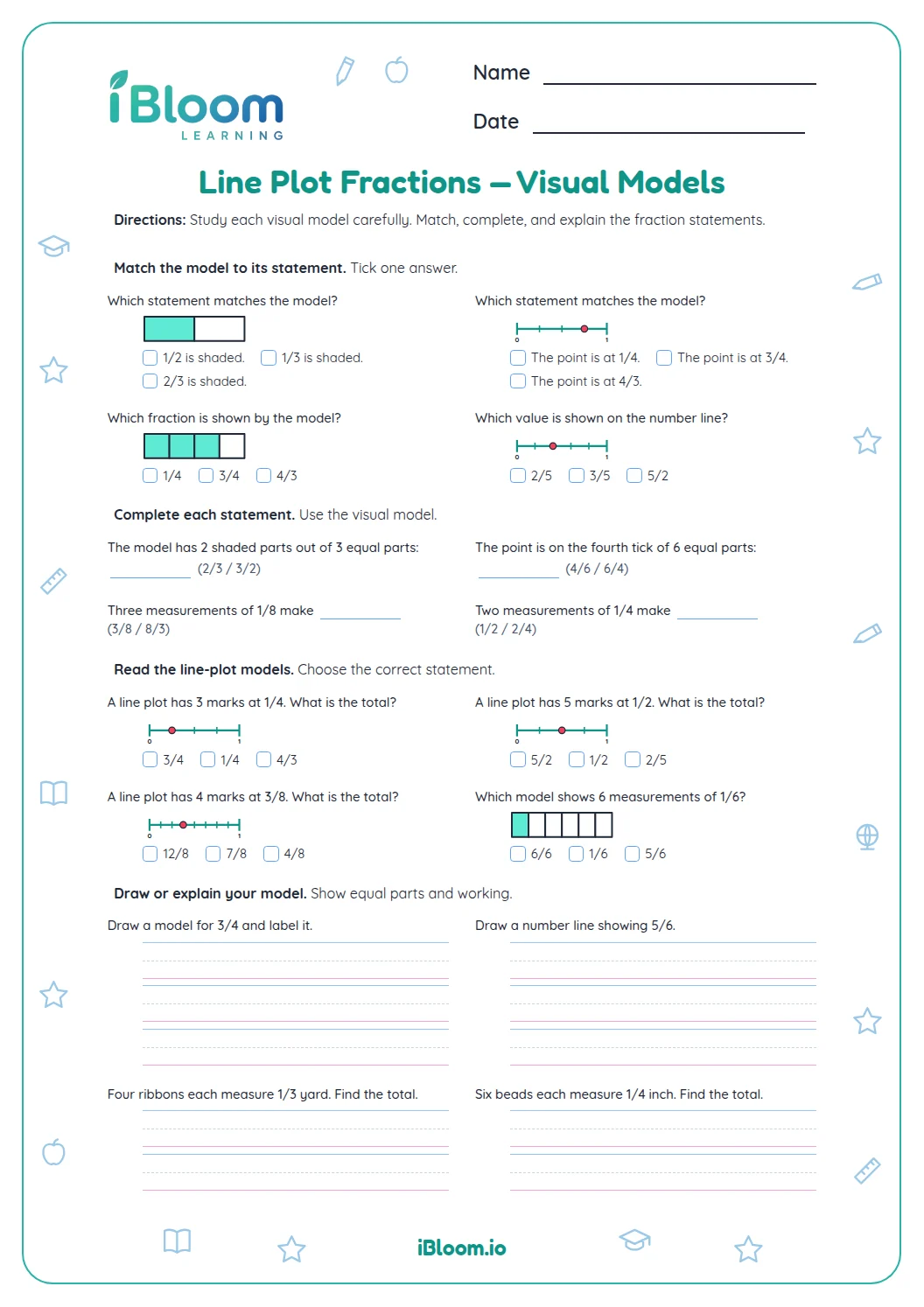
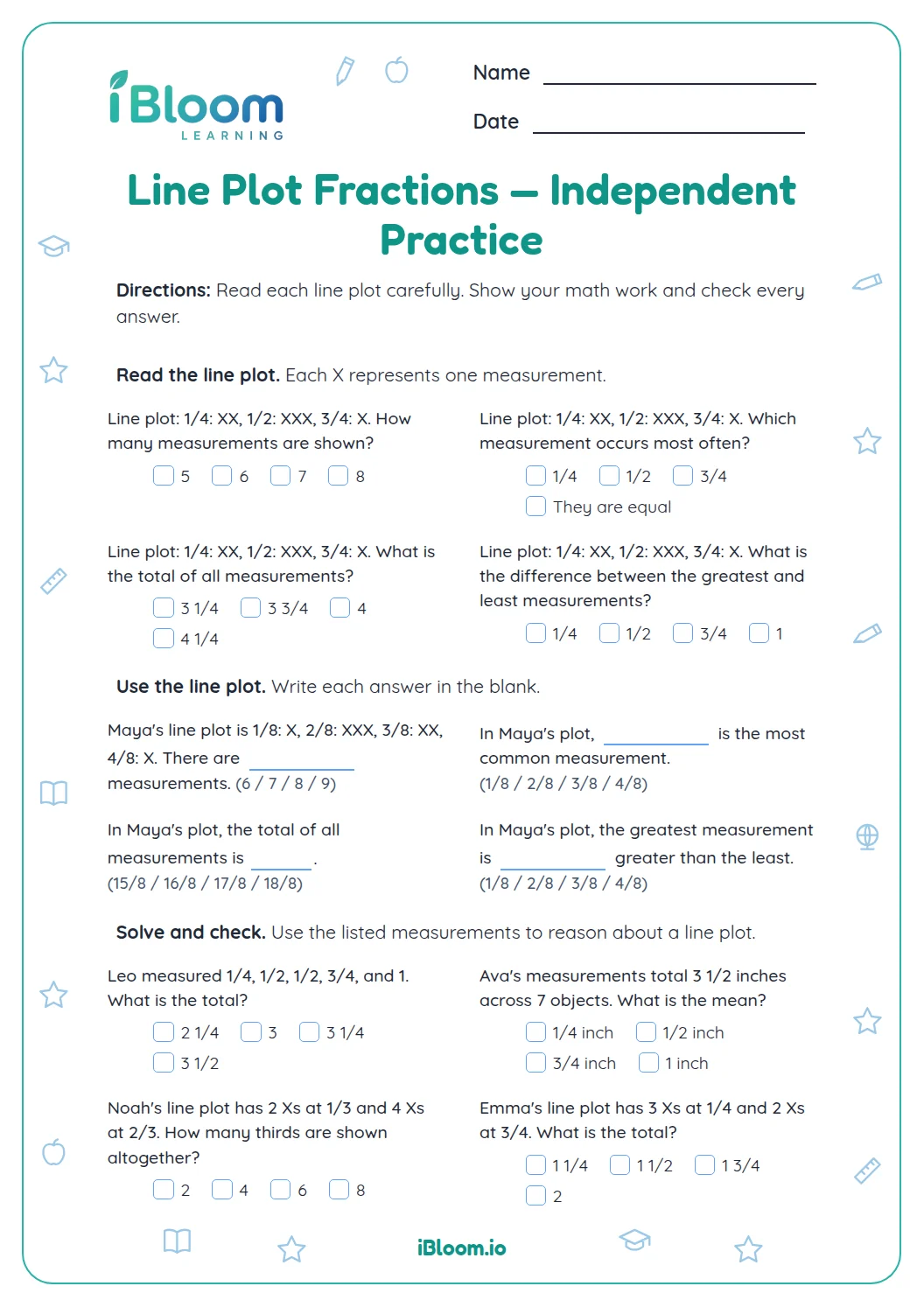
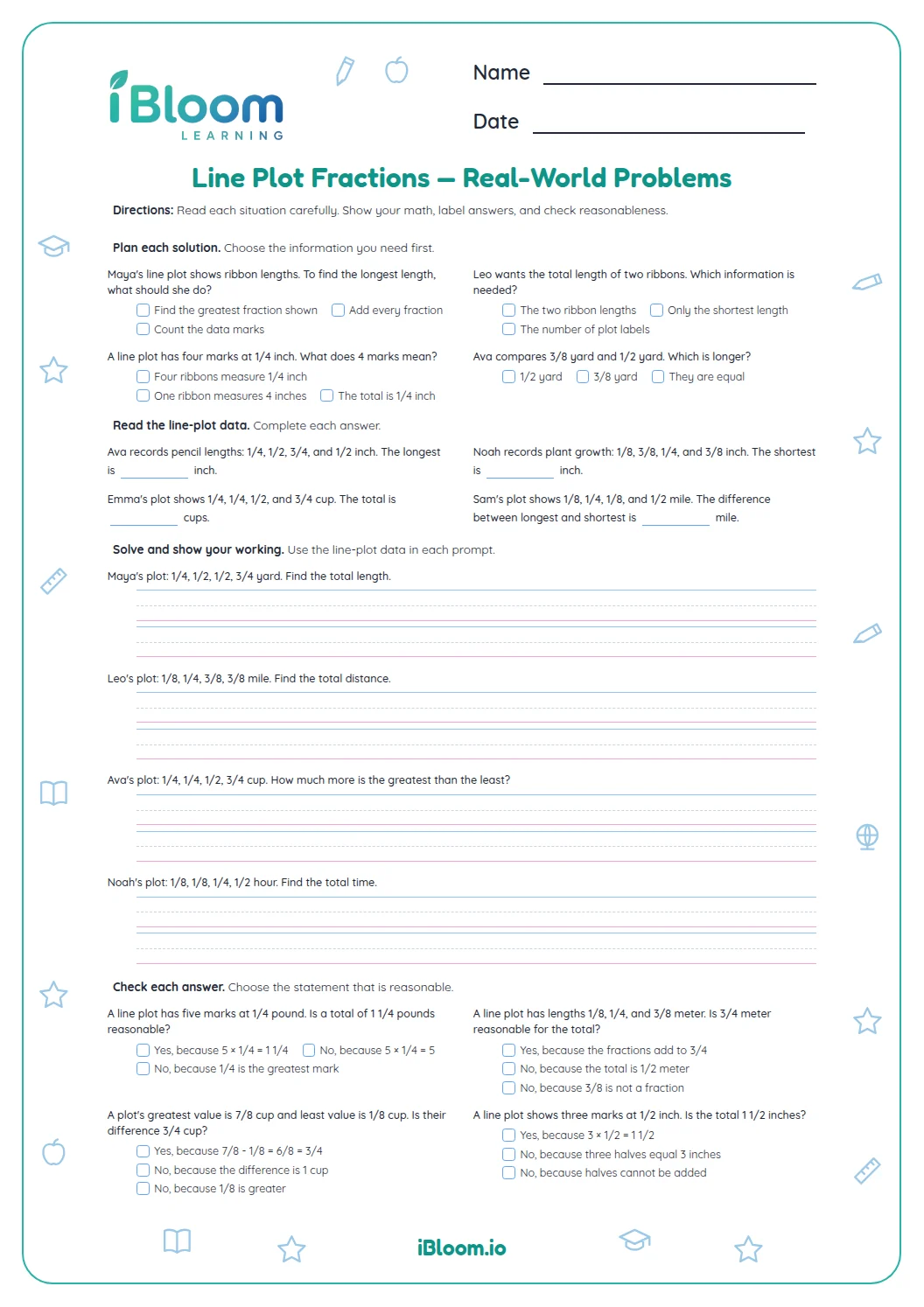
A line plot shows data on a number line. Each X above a number stands for one measurement of that size. In Grade 5, the numbers are fractions of a unit, such as 1/4 yard or 3/4 inch, so the plot answers questions like how long all the ribbons are together or which length is most common.
On this sheet each plot is described in words, for example "2 Xs above 1/4, 3 Xs above 1/2 and 1 X above 3/4." Sketching the number line and drawing the Xs on scrap paper is a good first step for any question that feels confusing.
How do you find the total of the data on a line plot?
Every X is one measurement, so a stack of Xs is repeated addition. Three Xs above 1/2 make 3 × 1/2 = 3/2, or 1 1/2. Do that for each number, then add the results. Working from the smallest size to the largest keeps the steps tidy.
Questions 5 and 6 are totals, and question 7 is a difference instead: Noah's longest stub is 1 1/2 inches and his shortest is 3/4 inch, so the difference is 1 1/2 − 3/4 = 3/4 inch.
- 1Maya's ribbons: 2 Xs above 1/4, 3 Xs above 1/2, 1 X above 3/4.
- 22 × 1/4 = 2/4 = 1/2
- 33 × 1/2 = 3/2 = 1 1/2
- 41 × 3/4 = 3/4
- 5Total: 1/2 + 1 1/2 + 3/4 = 2 + 3/4 = 2 3/4
- 6Answer: 2 3/4 yd
What does it mean to share the data equally?
Common Core 5.MD.B.2 describes pouring the liquid from several identical beakers together and then sharing it equally among them again. The answer is the total divided by the number of containers. Question 8 uses glasses of water: the total is 1/4 + 1/2 + 1/2 + 3/4 = 2 cups, and 2 cups shared by 4 glasses is 1/2 cup each. Question 9 does the same with six beakers measured in eighths and quarters.
Children are using a first idea of the mean here, even though the word is not on the page. The last two questions check reasoning: question 10 asks what is wrong with saying that 3 Xs above 1/2 foot total 3/6 foot, and question 11 catches the habit of adding tops and bottoms (3/8 + 1/2 is not 4/10).
What is on this worksheet?
Eleven questions in four parts over three pages. The contexts change (ribbons, plants, jumps, pencils, water and beakers) so children practice reading data, not memorizing one plot.
- Part A: 4 multiple-choice questions that read the plot (how many, most common, longer than, shorter than)
- Part B: 2 totals with working space (ribbons in yards, jumps in feet)
- Part C: 3 fill-ins, a difference and two equal shares
- Part D: 2 wrong totals to correct (3/6 foot and 4/10 yard)
- Fractions used: 1/8, 1/4, 3/8, 1/2, 3/4 and mixed numbers like 2 1/4 and 3 1/2
How to use this worksheet at home or in class
- 1Warm up with a quick sketch: draw a number line from 0 to 1 marked in quarters and put 3 Xs above 1/2.
- 2Do question 1 together. Have your child draw the plot from the description before counting the Xs.
- 3Let your child finish Part A, then check the counts with the answer key before starting Part B.
- 4In Parts B and C, write a multiplication for each stack first (2 × 1/4), then add or subtract. Ask for a unit on every answer.
- 5For questions 8 and 9, find the total before dividing. Ask, "Does the equal share make sense? It should be between the smallest and largest measurement."
- 6Finish with Part D. Have your child explain what Mia and Jon each did wrong, and how they could have spotted that the total was too small.
Common mistakes and quick fixes
The mistake
Adding the fractions on the number line and forgetting to count the Xs, for example finding 1/4 + 1/2 + 3/4 for question 5 instead of using 2, 3 and 1 Xs.
The fix
Remind your child that each X is one measurement. Write 2 × 1/4, 3 × 1/2 and 1 × 3/4 before adding.
The mistake
Multiplying the denominator as well as the numerator, as Mia does in question 10 (3 × 1/2 = 3/6), or adding tops and bottoms, as Jon does in question 11 (3/8 + 1/2 = 4/10).
The fix
Three halves is 3/2. Keep the denominator when multiplying by a whole number, and rename to a common denominator before adding: 3/8 + 4/8 = 7/8.
The mistake
Dividing the total by the number of different measurements instead of the number of containers. In question 8, a child divides by 3 because there are three different amounts.
The fix
Ask, "How many glasses are there?" It is 4 glasses, so divide by 4. Count every X, not only every number.
Common Core alignment
Most US states use the Common Core Math standards or a close state version. This sheet follows the Grade 5 line plot standard and the fraction operations it relies on.
Use fraction operations on line plot data, including sharing a total equally.
On this sheet: Every question uses data from a line plot with fractional measurements, and questions 8 and 9 are the equal-sharing problem from the standard.
Show the official wordingHide the official wording
Make a line plot to display a data set of measurements in fractions of a unit (1/2, 1/4, 1/8). Use operations on fractions for this grade to solve problems involving information presented in line plots. For example, given different measurements of liquid in identical beakers, find the amount of liquid each beaker would contain if the total amount in all the beakers were redistributed equally.
Add and subtract fractions in word problems and check that the answer makes sense.
On this sheet: Questions 5 to 7 add and subtract halves, quarters and mixed numbers, and question 11 asks children to spot an unreasonable sum like 3/8 + 1/2 = 4/10.
Show the official wordingHide the official wording
Solve word problems involving addition and subtraction of fractions referring to the same whole, including cases of unlike denominators, e.g., by using visual fraction models or equations to represent the problem. Use benchmark fractions and number sense of fractions to estimate mentally and assess the reasonableness of answers. For example, recognize an incorrect result 2/5 + 1/2 = 3/7, by observing that 3/7 < 1/2.
What to practice next
Make more practice
Further reading
Questions parents and teachers ask
What is a line plot with fractions in Grade 5?
It is a number line that shows measurements as Xs, where the measurements are fractions of a unit such as 1/4, 1/2 and 3/4. Each X above a number is one measurement of that size. Students read the plot and use fraction operations to find totals, differences and equal shares.
How do I find the total of a line plot?
Multiply each measurement by the number of Xs above it, then add the products. For 3 Xs above 1/2, the product is 3 × 1/2 = 1 1/2. On this sheet, question 5 totals 2 3/4 yards and question 6 totals 13 feet. Check by counting the Xs, and make sure each answer has its unit.
What are the answers to the equal-share and error questions?
Question 8 is 1/2 cup, since four glasses hold 2 cups in all. Question 9 is 1/4 liter: six beakers hold 1 1/2 liters. Question 10 is 1 1/2 feet, because 3 × 1/2 = 3/2, not 3/6. Question 11 is 7/8 yard, because 3/8 + 4/8 = 7/8, not 4/10.
Why are the line plots described in words, not drawn?
This worksheet prints text and number problems, so each line plot is described in words, such as 2 Xs above 1/4. Children can draw the number line and Xs themselves. Drawing the plot first makes the data visible and is a good habit that matches the standard.
What does it mean to share a total equally?
It means finding the total of all the measurements and dividing it by how many containers or items there are. In question 8, four glasses hold 2 cups together, so each holds 1/2 cup once they are evened out. This fair-share idea is the same one children use whenever they even out a set of measurements.
Do students need common denominators for this sheet?
Yes, for several questions. Question 5 adds 1/2, 1 1/2 and 3/4, which needs fourths, question 7 subtracts 3/4 from 1 1/2, and question 11 needs eighths. Students who find this hard can rename each fraction first, such as 1/2 as 2/4 or 4/8, and then add or subtract.