
About this worksheet
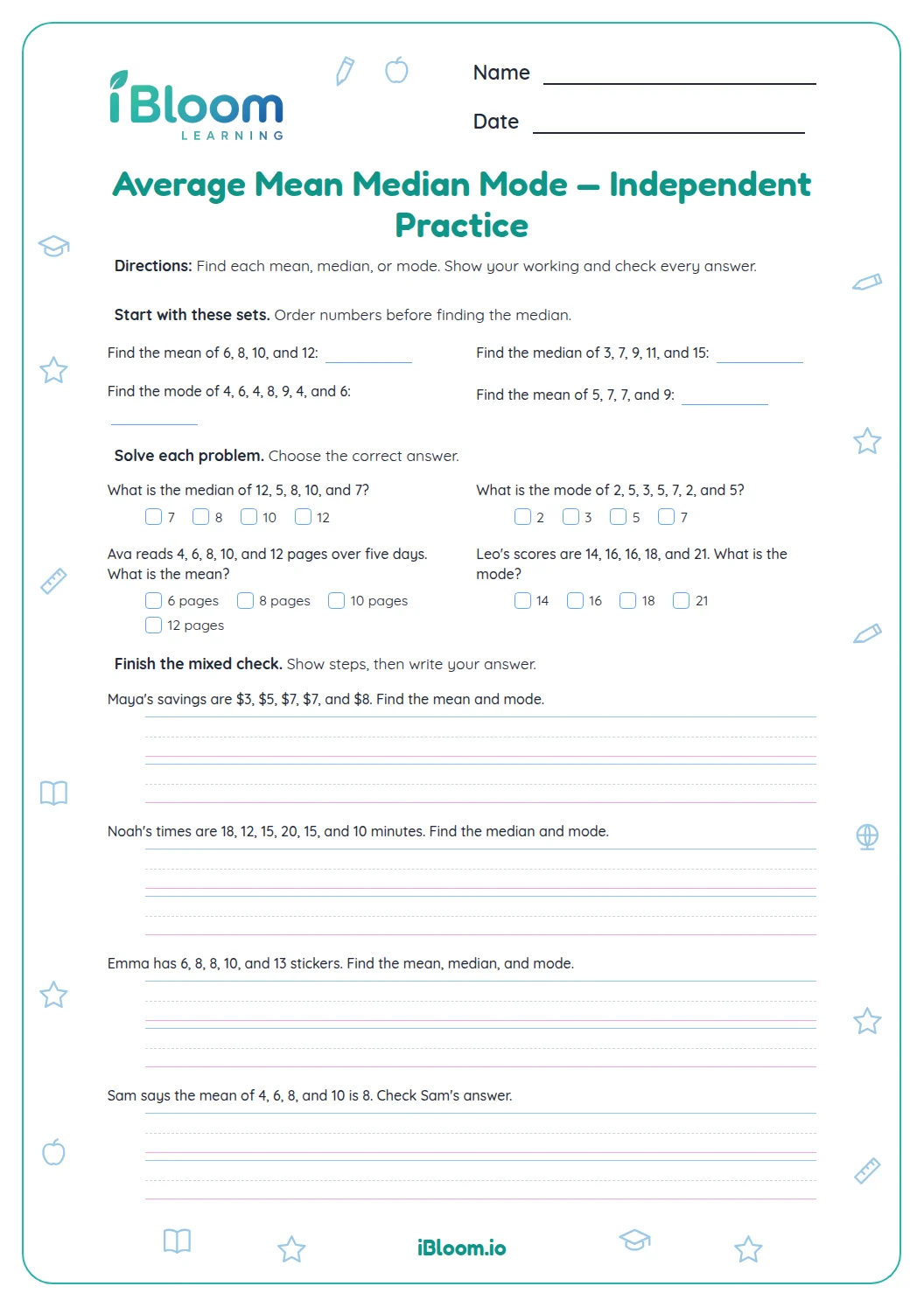
This free printable worksheet teaches the idea behind the mean, the fair-share value of a data set, before any formula is memorized. Grade 5 children say what the mean tells you, choose the rule that finds it, divide to get the mean of three to five whole numbers, solve two short stories, and work backward from a mean to a total or a missing number. It practices Common Core 6.SP.A.3, describing a whole data set with one number found by sharing the total equally. A separate answer key is included.
Aligned to 6.SP.A.3
What is the mean, and what does it tell you?
The mean is the amount each value in a data set would be if they were all made equal. Picture three plates holding 2, 4 and 9 cookies. Move cookies around until every plate has the same number and each plate has 5. That 5 is the mean.
Starting from fair share, not from a rule, helps children see why we add and then divide: adding gathers everything into one pile, and dividing shares that pile out evenly.
- 1Plates hold 2, 4 and 9 cookies.
- 2Total: 2 + 4 + 9 = 15
- 3Count: 3 plates
- 4Share evenly: 15 ÷ 3 = 5
- 5Answer: 5 cookies on each plate
How do you find the mean step by step?
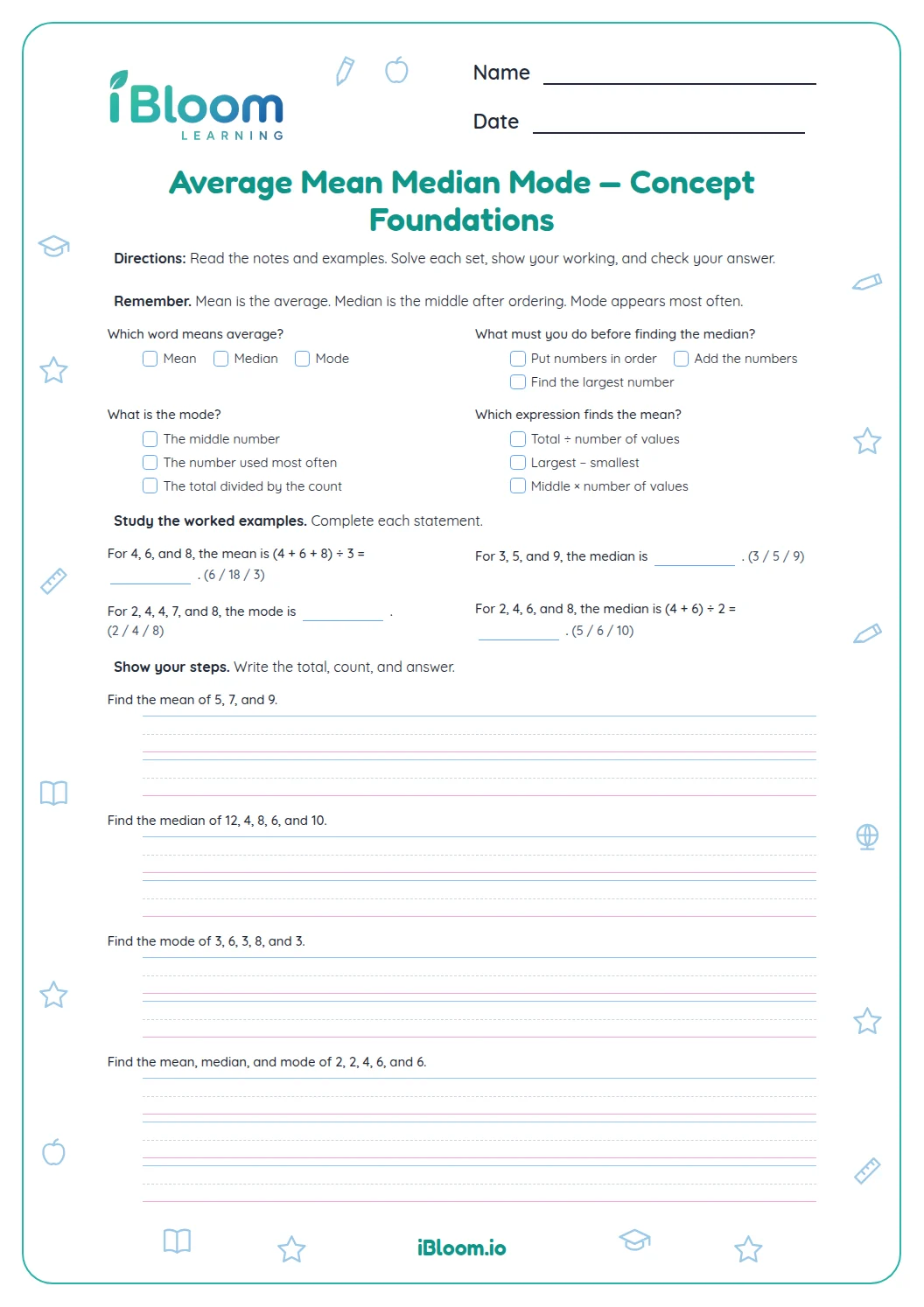
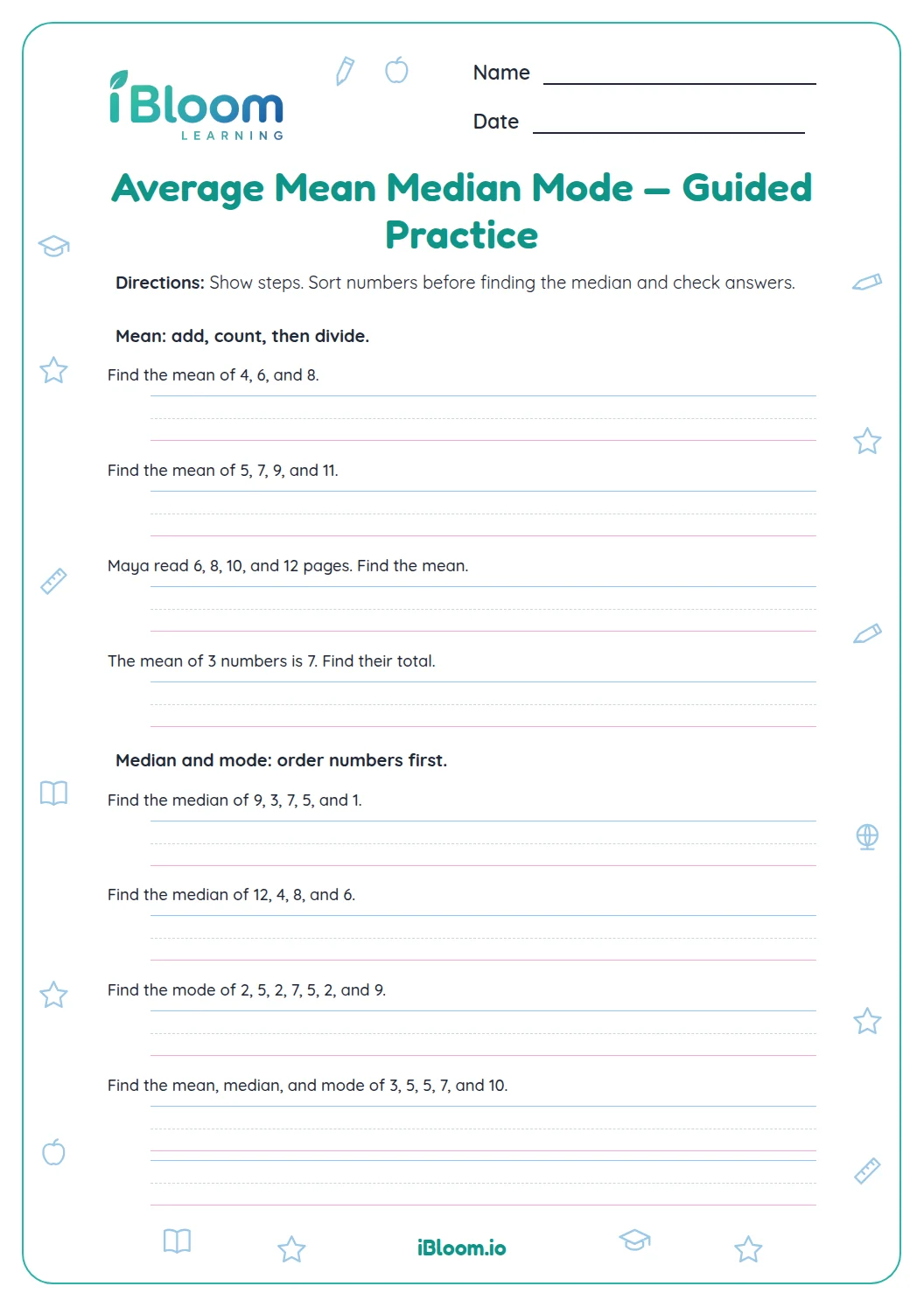
Add the values to find the total, count how many values there are, then divide the total by the count. Part A names the rule, total ÷ count, before children use it. Part B then gives the whole calculation with the numbers in place, for example (3 + 5 + 7 + 9) ÷ 4 = 6, so children focus on getting the addition and the division right.
Counting the values matters. In (6 + 9 + 12 + 5 + 8) ÷ 5 there are five values, so the total of 40 is divided by 5 and not by 4.
How do you work backward from a mean?
If the mean and the count are known, the total is the mean times the count. The mean of 4 numbers is 12, so their total is 4 × 12 = 48. If some values are also known, subtract them from the total to find the missing one.
Question 9 gives a mean of 7 for three numbers, with 5 and 6 known. The total must be 3 × 7 = 21, and 21 − 5 − 6 leaves 10. This direction is harder, so the sheet saves it for the end of Part B, after four forward calculations.
What is on this worksheet?
Four parts, from the idea to the reasoning. All data sets use whole numbers, and every mean is a whole number, so children can concentrate on the method.
- Part A: 3 multiple-choice questions: what the mean is, the rule, and which set has a mean of 10
- Part B: 4 number sentences, such as (4 + 6 + 8) ÷ 3 = ___, and 2 missing-value questions
- Part C: 2 stories with working space: pages read and cookies shared
- Part D: 1 written check of Tia's claim that the mean is the middle number
- Data sets with 3, 4 or 5 values, all whole numbers
How to use this worksheet at home or in class
- 1Warm up with real objects: put 2, 4 and 9 coins or crackers in three cups and ask how to make the cups equal.
- 2Do Part A together and say the rule out loud: total ÷ count. Ask why the mean is the fair share.
- 3Let your child work through Part B, writing the total on the side before dividing.
- 4In Part C, have your child write a number sentence before calculating, as in 24 ÷ 4 for the pages story.
- 5For Part D, ask your child to explain question 12 aloud: add 6, 8 and 13, divide by 3, and say why the middle number is not the mean here.
- 6Check with the answer key. For any miss, ask whether the total or the count was wrong.
Common mistakes and quick fixes
The mistake
Dividing by the wrong count, such as dividing 40 by 4 when there are 5 values.
The fix
Put a small tick under each value before dividing. The count is the number of ticks, not the number of plus signs, which is always one fewer.
The mistake
Mixing up the mean with the middle number or the most common number.
The fix
Use three cues: the mean is the fair share (add, then share), the median is the middle value, the mode is the most common value. Question 12 shows why they differ: the middle of 6, 8 and 13 is 8, but the mean is 9.
The mistake
Stopping at the total, so answering 21 for the mean of 5, 7 and 9 instead of 7.
The fix
Ask whether the answer sits between the smallest and largest values. A mean of 21 cannot come from numbers no bigger than 9.
Common Core alignment
This sheet practices the standard below on the mean, using whole-number division.
See the mean as one number that stands for a whole data set, found by sharing the total equally.
On this sheet: Main standard: the sheet teaches the mean as one number that stands for the whole data set (fair share).
Show the official wordingHide the official wording
Recognize that a measure of center for a numerical data set summarizes all of its values with a single number, while a measure of variation describes how its values vary with a single number.
What to practice next
Make more practice
Further reading
Questions parents and teachers ask
What is the mean in math for a fifth grader?
The mean is the fair-share value of a set of numbers: add them and divide by how many there are. In question 10, four friends read 3, 5, 6 and 10 pages, 24 pages in all. Shared evenly among four readers, that is 6 pages each, so the mean is 6 pages.
What should children know before finding the mean?
They should be able to add several whole numbers and divide the total by how many values there are. Every mean on this sheet is a whole number, so the division comes out evenly. The stories in Part C then show why the mean is a fair share of the total.
Why do you divide by the number of values?
Adding combines all the values into one total. Dividing by the number of values splits that total into equal shares, one per value, which is what each value would be if they were all equal. For 3, 5, 7 and 9, the total of 24 shared four ways is 6.
What are the answers to Part B?
The four number sentences have answers 6, 6, 13 and 8, and the two missing values are 48 and 10. For the last sentence, 6 + 9 + 12 + 5 + 8 = 40, and 40 ÷ 5 = 8. The answer key shows every answer on the sheet, including a model explanation for question 12.
Can the mean be a number that is not in the data set?
Yes. The mean of 1 and 2 is 1.5, which is not in the set. The same can happen with whole numbers, like 2, 4 and 9, whose mean is 5. On this sheet, every mean is a whole number to keep the focus on the method, but many data sets have decimal means.
How long does it take, and is there an answer key?
Most children need about 20 minutes, a little longer if working on the stories carefully. The answer key is on its own pages and lists the correct answer for every question, with a model reply for question 12. Parts A and B make a good short first session, with Parts C and D later.