

About this worksheet
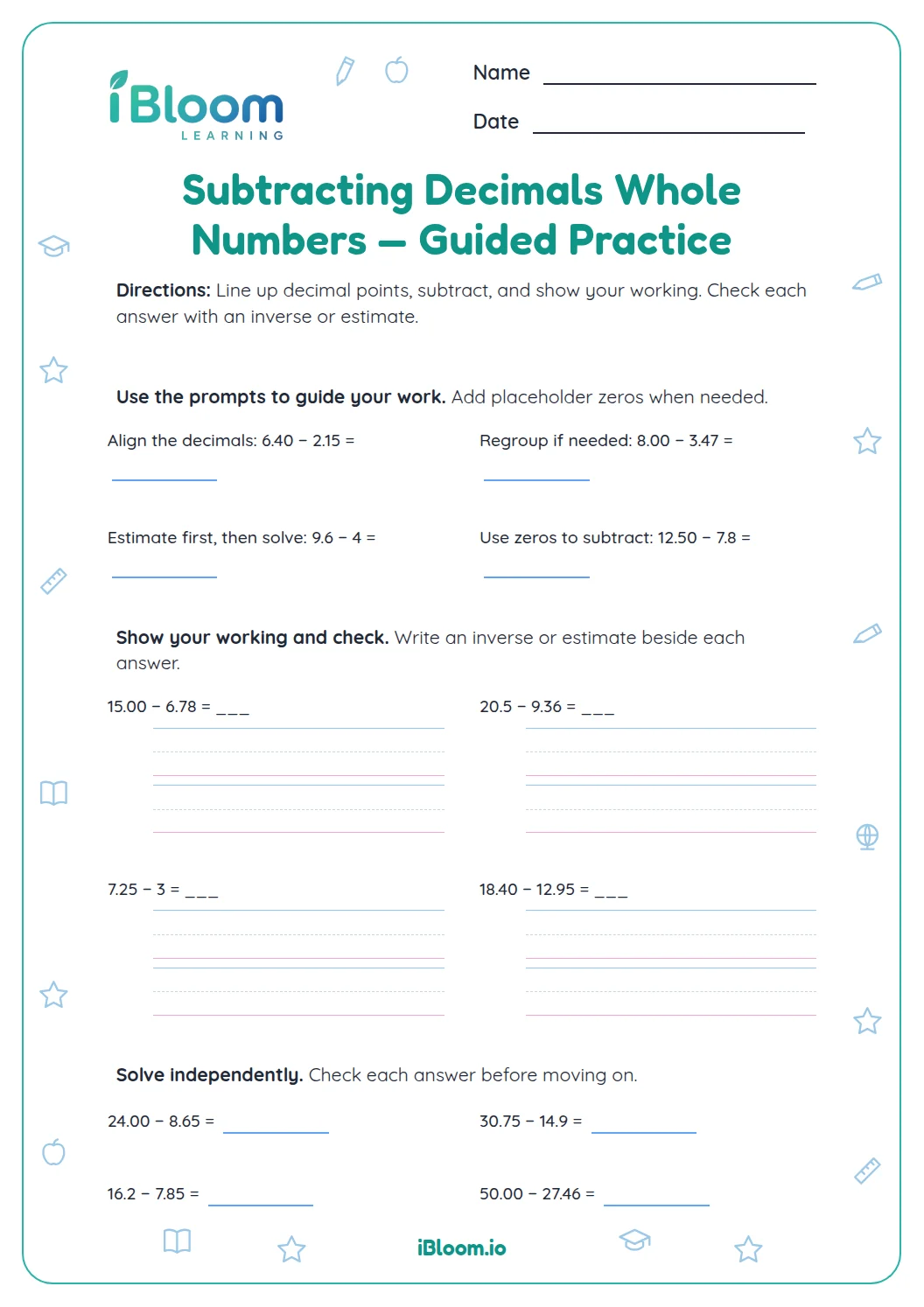
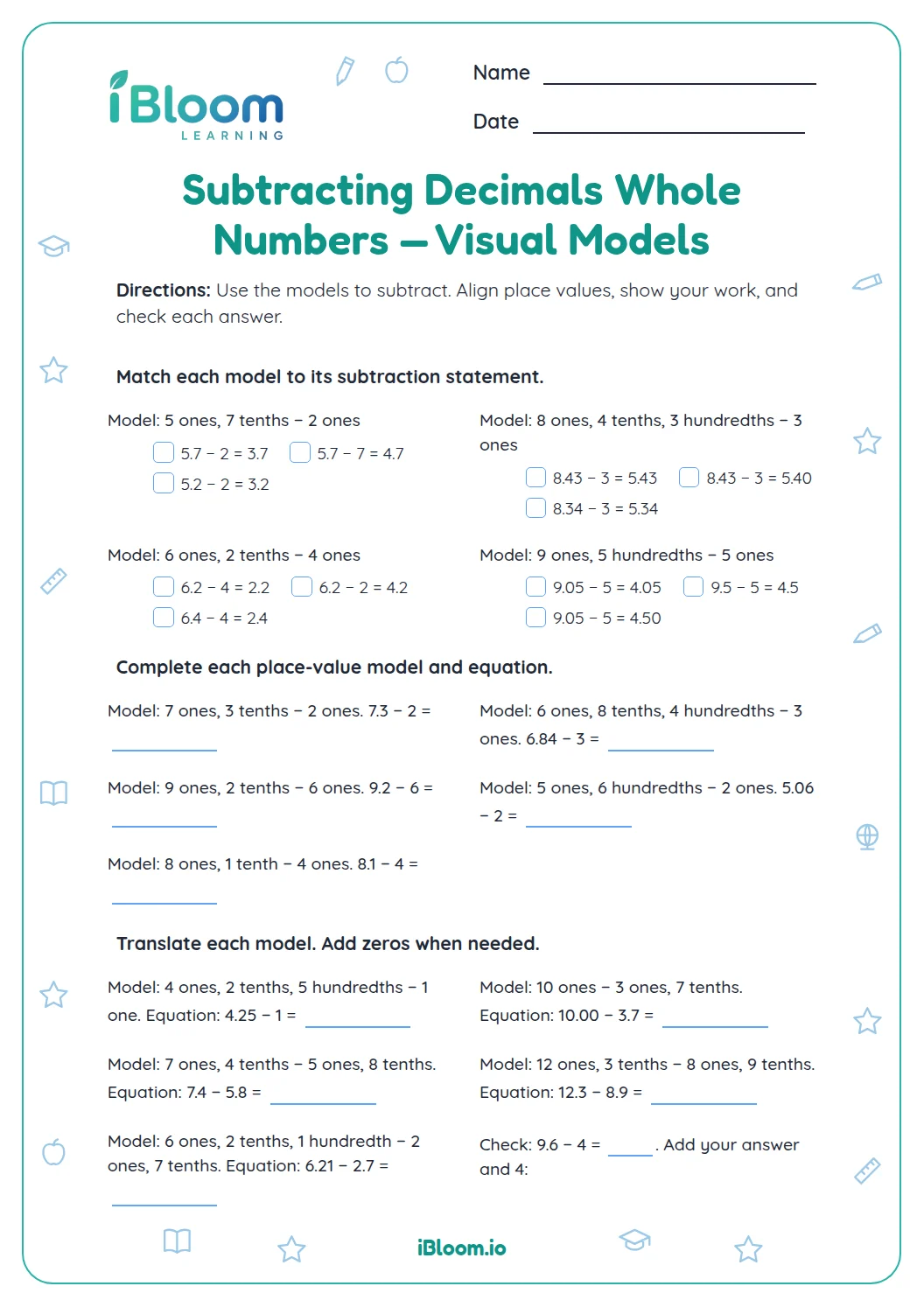
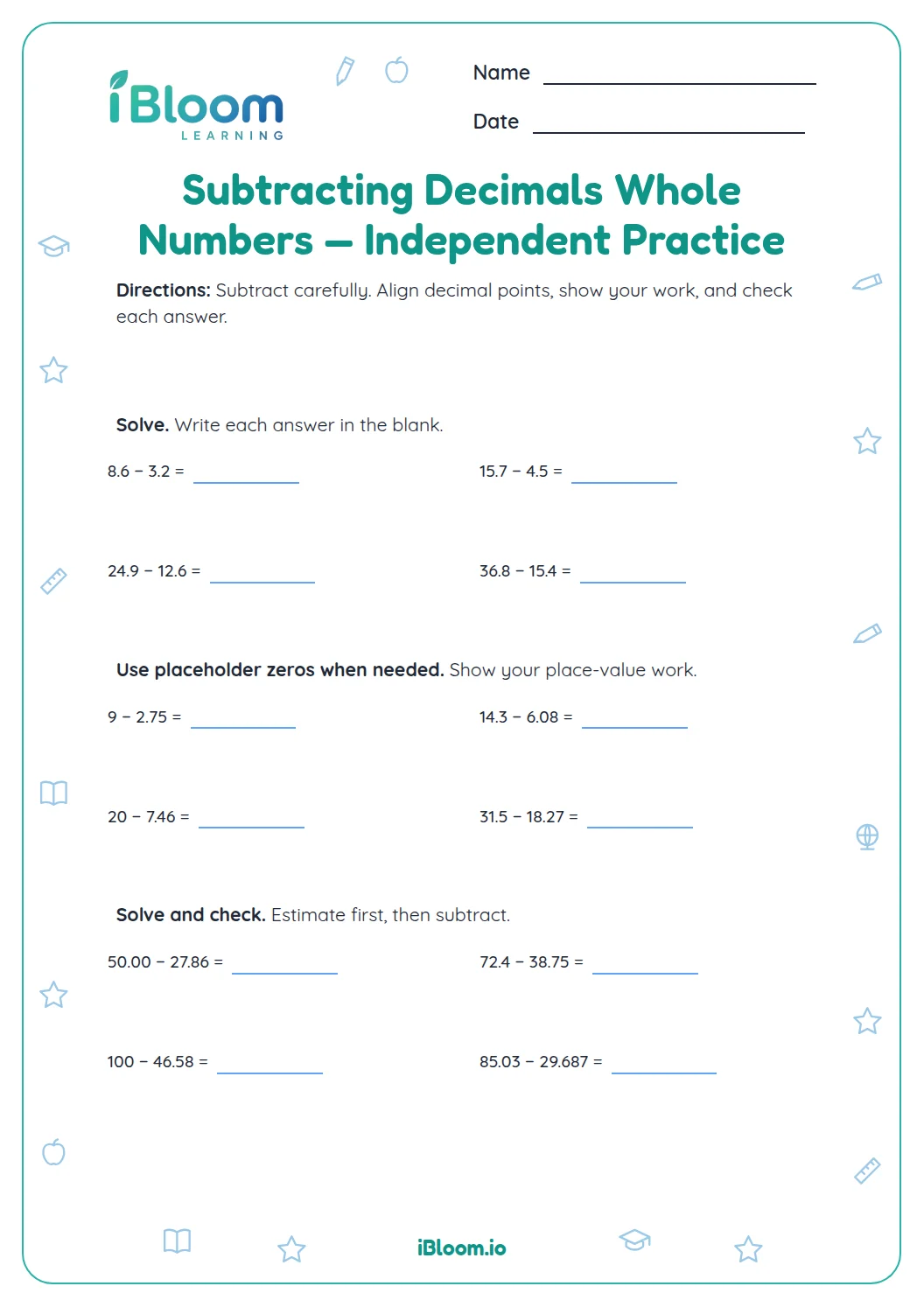
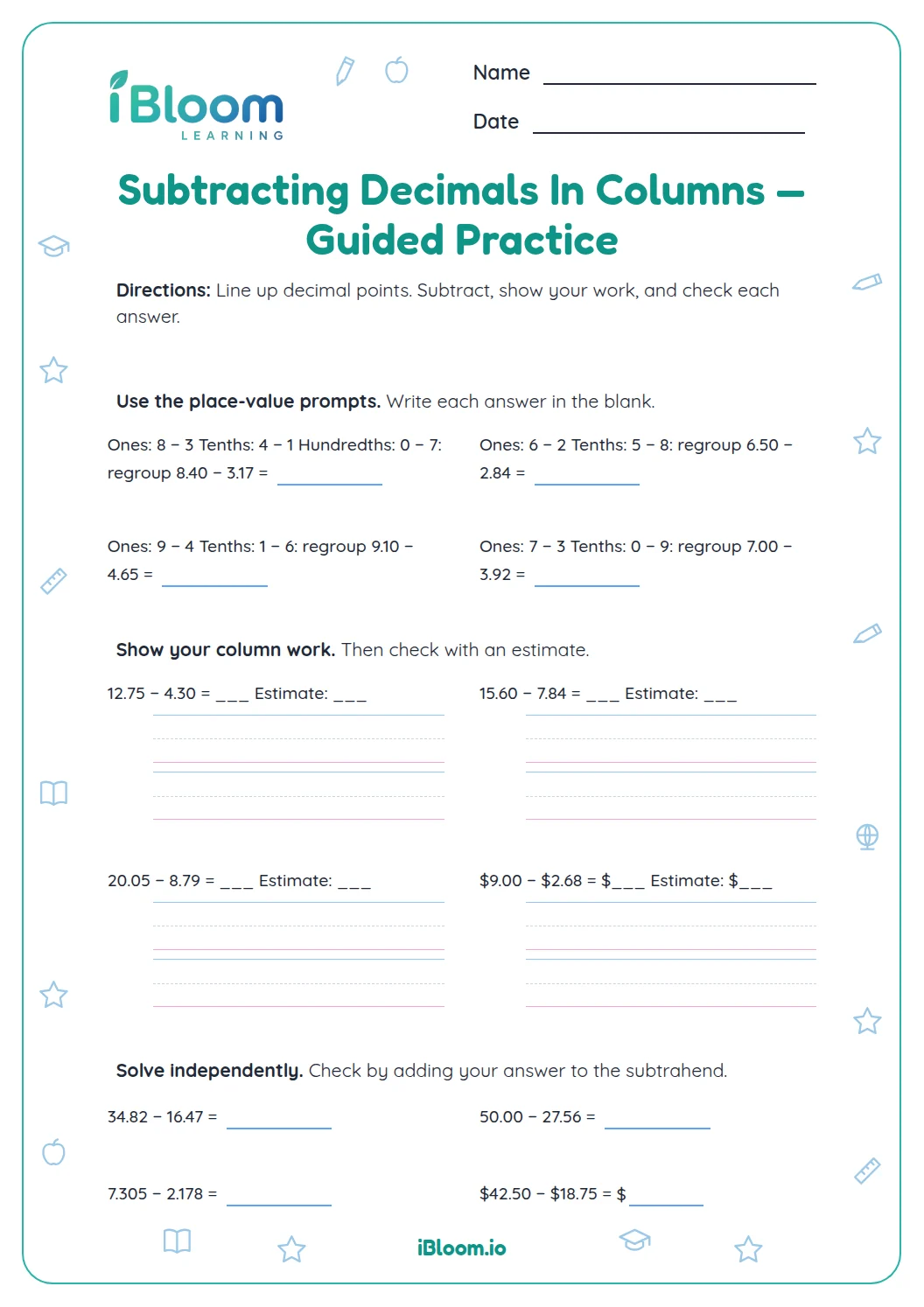
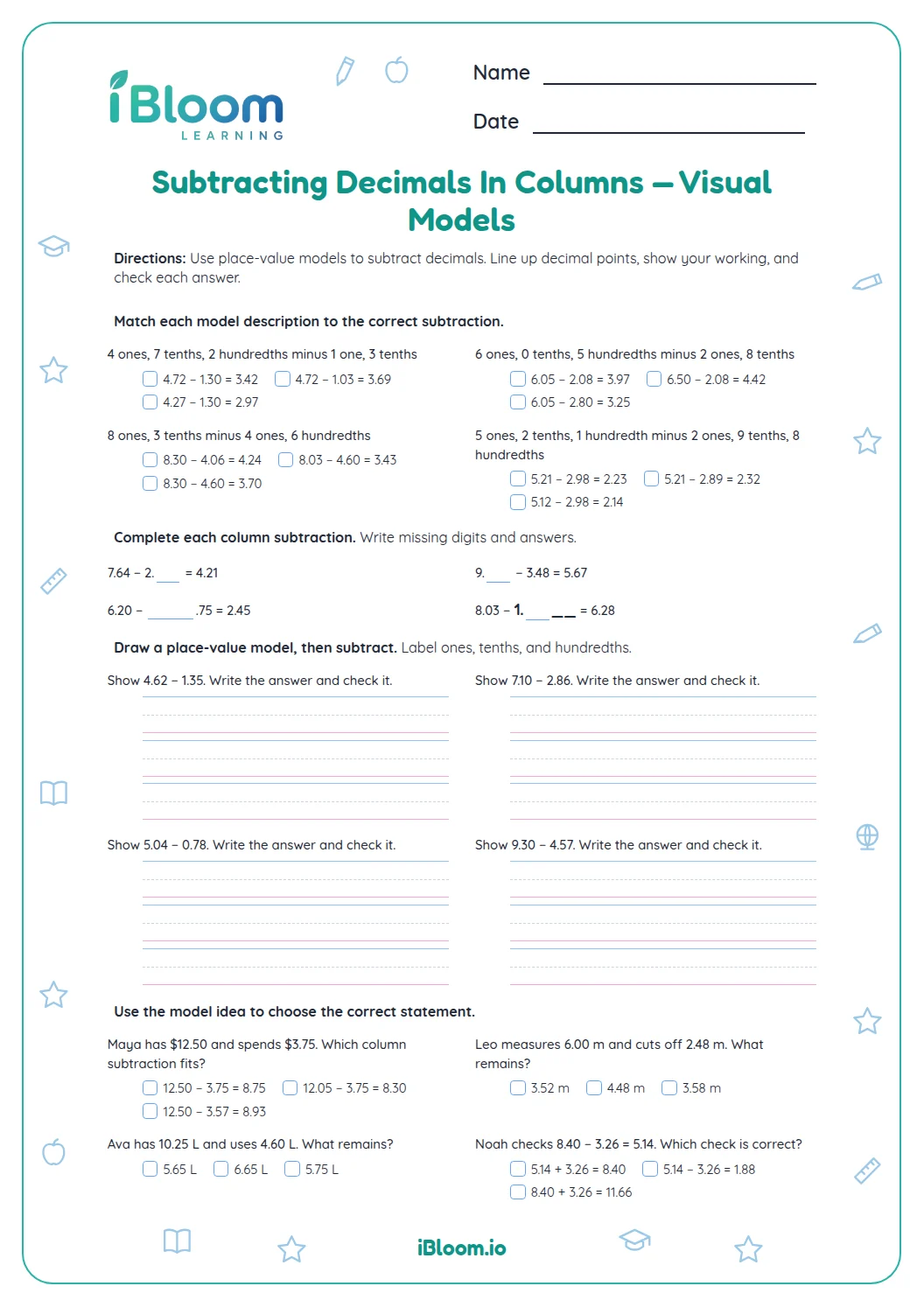
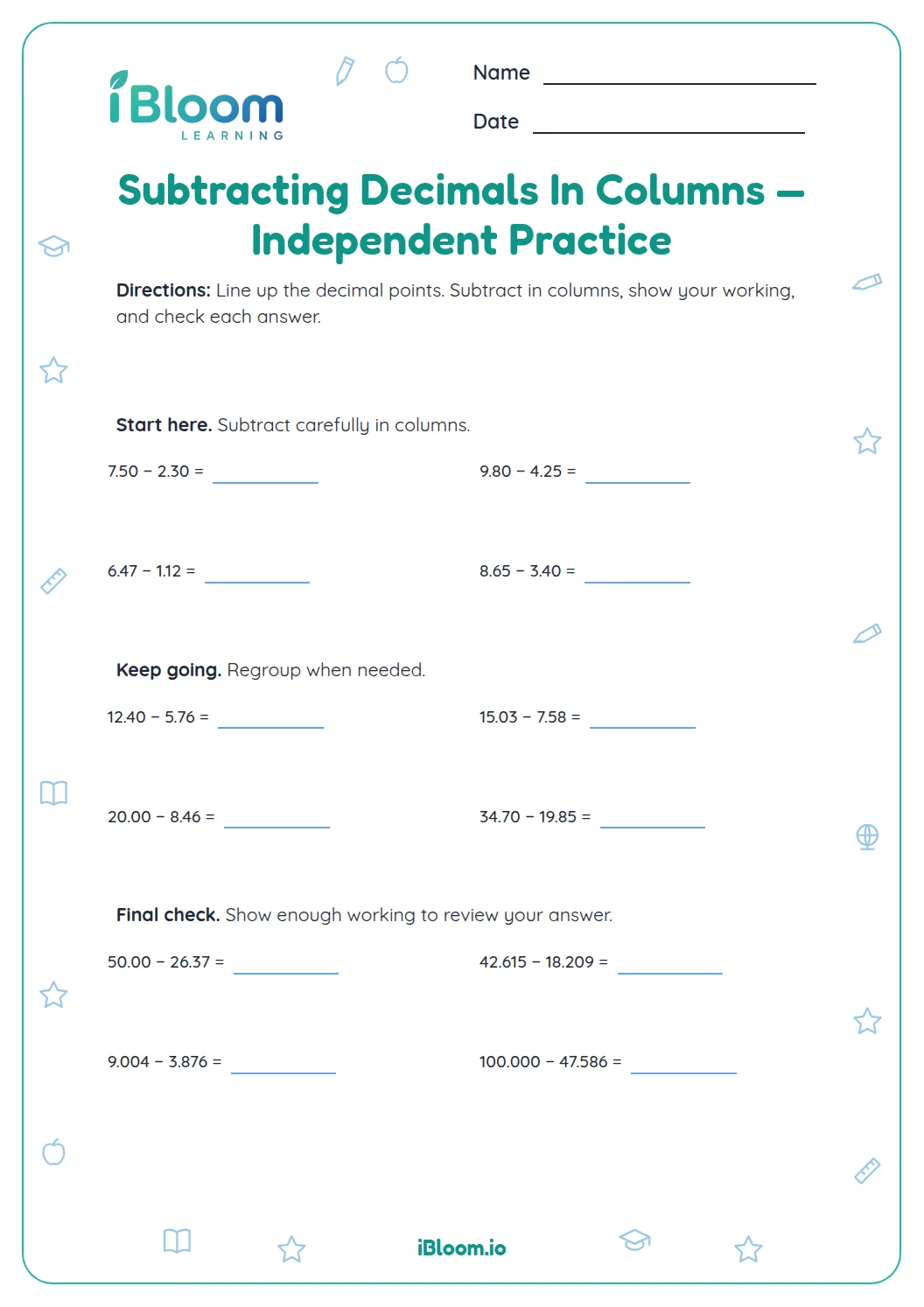
This Grade 5 printable turns decimal subtraction into everyday situations involving lengths, amounts, scores, and supplies. Students write a subtraction equation, align place values, and label each difference with the unit in the problem. Sixteen questions progress from single subtractions to a two-step situation. The tasks practice Common Core 5.NBT.B.7, which includes subtracting decimals to hundredths using place-value strategies and written methods.
Aligned to 5.NBT.B.7
How do I turn each situation into subtraction?
Find the original amount and the amount taken away, spent, poured, or traveled. Write the larger starting amount first, then subtract the change.
- 112.50 miles − 4.75 miles = 7.75 miles
- 2The difference is 7.75 miles.
Why line up decimal points?
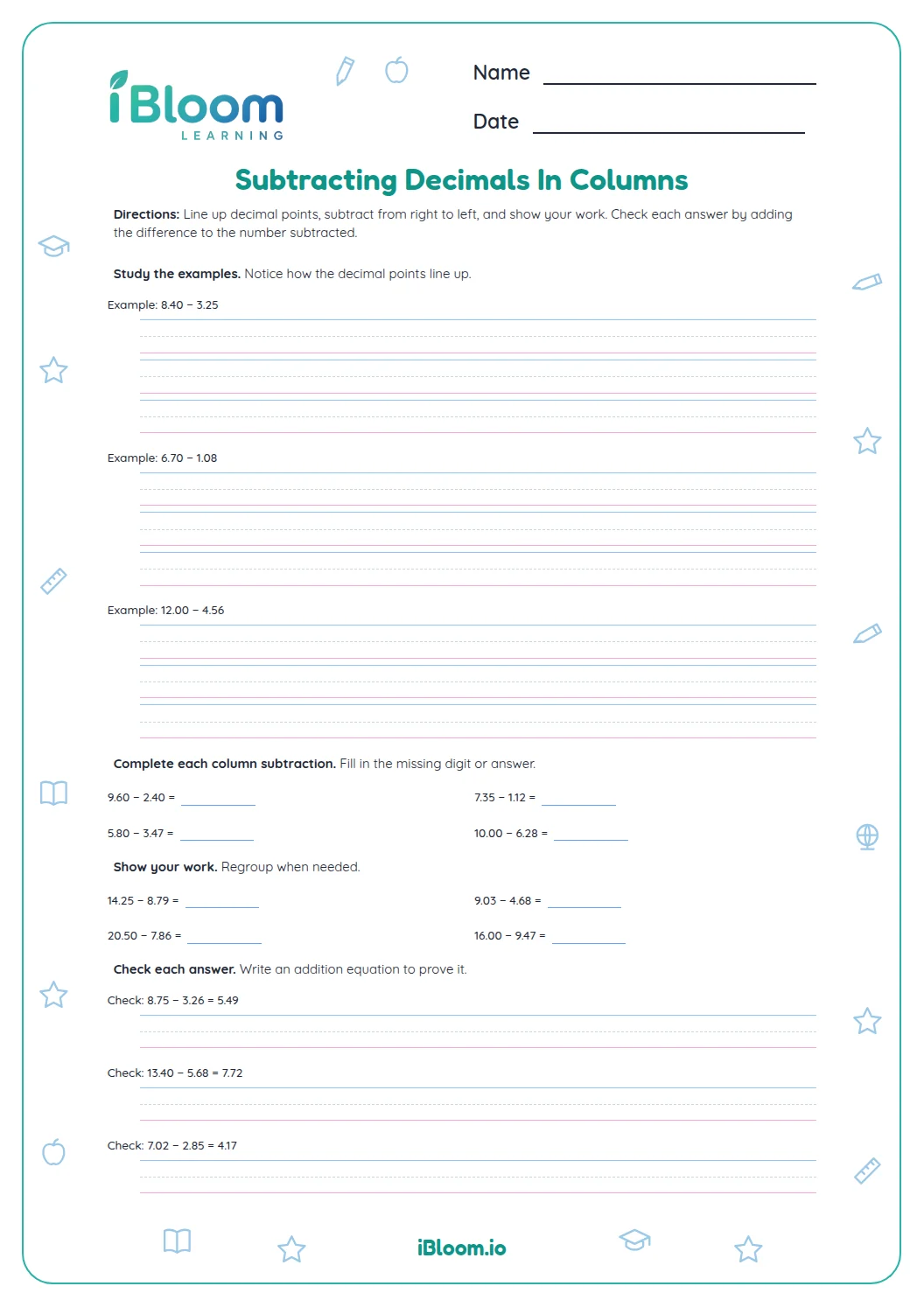
Aligned decimal points keep ones, tenths, and hundredths in their correct columns. Add a zero when needed so both numbers have the same number of decimal places.
How should I label the answer?
Carry the situation’s unit into the answer: miles, liters, feet, or pounds. In the two-step problem, subtract both amounts used from the original quantity.
How to use this worksheet
- 1Underline the starting amount and the amount removed.
- 2Write the subtraction equation before calculating.
- 3Align the decimal points and add a placeholder zero if useful.
- 4Subtract hundredths, tenths, and whole-number places carefully.
- 5Check whether the result is reasonable and include the unit.
Common mistakes and quick fixes
The mistake
Subtracting the smaller digit from the larger in every column without regrouping.
The fix
Regroup across place values when a top digit is too small, just as with whole-number subtraction.
The mistake
Misaligning a decimal point.
The fix
Write both numbers with decimal points in one vertical line before subtracting.
The mistake
Leaving the unit off the result.
The fix
Copy the unit from the question into the final answer.
Common Core alignment
This printable practices the listed Common Core skills through short, grade-level tasks.
Subtract decimals to hundredths in practical situations.
On this sheet: Every problem subtracts decimals to hundredths in a real context.
Show the official wordingHide the official wording
Add, subtract, multiply, and divide decimals to hundredths, using concrete models or drawings and strategies based on place value, properties of operations, and/or the relationship between addition and subtraction; relate the strategy to a written method and explain the reasoning used.
What to practice next
Make more practice
Further reading
Questions parents and teachers ask
How many problems are included?
The worksheet has 16 real-world subtraction problems on the worksheet. Each asks for a subtraction equation and a labeled difference, and the answer key gives a concise result with the matching unit. Check the result by adding the amount removed back to the difference; it should equal the starting amount.
What decimal places appear?
Amounts use tenths and hundredths, with some whole-number amounts written with trailing zeros. Students should line up decimal points and can add a zero to make place values easier to compare. Check the result by adding the amount removed back to the difference; it should equal the starting amount.
Should students show their equations?
Yes. Each problem provides working space for an equation and calculation. Writing the equation helps connect the story to subtraction before students compute the decimal difference. Check the result by adding the amount removed back to the difference; it should equal the starting amount.
Why does the answer include a unit?
The unit tells what the difference measures. A length problem ends in miles, feet, or meters; a capacity problem ends in liters or gallons. Copying the unit makes the answer complete. Check the result by adding the amount removed back to the difference; it should equal the starting amount.
How can students check a difference?
Add the amount removed back to the difference. The sum should equal the starting amount. Students can also estimate with whole numbers to see whether their result is a reasonable size. Check the result by adding the amount removed back to the difference; it should equal the starting amount.