



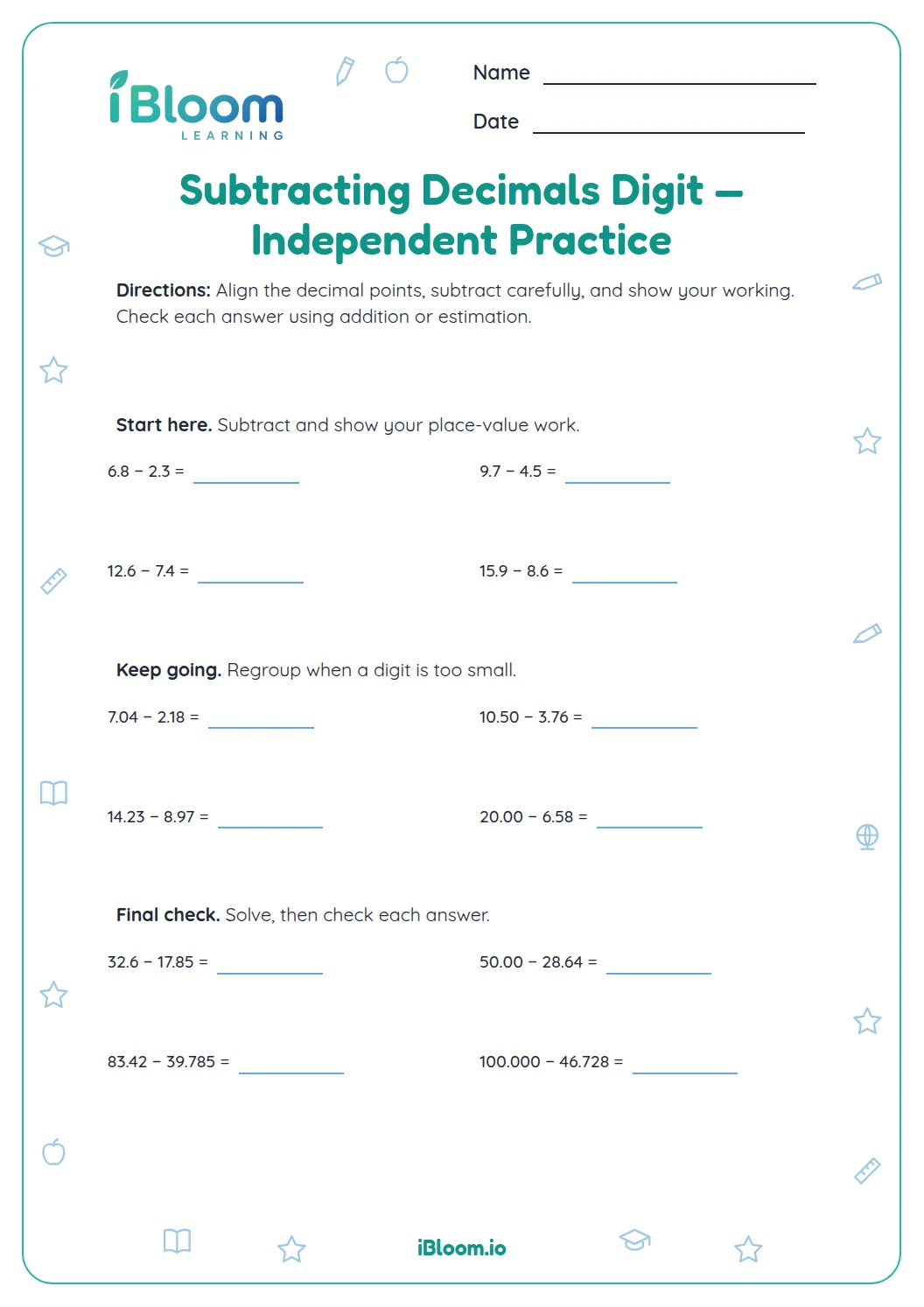
About this worksheet
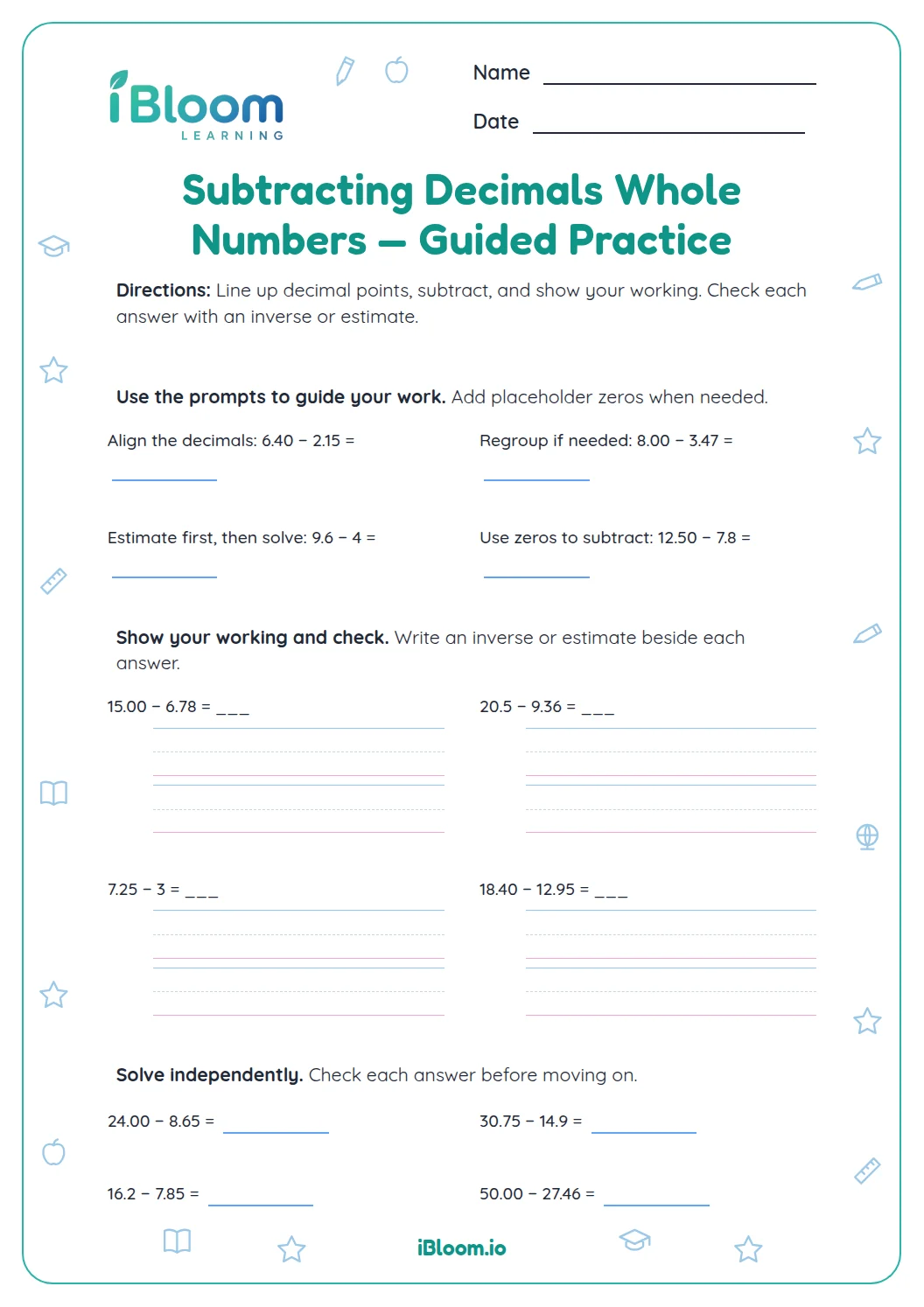
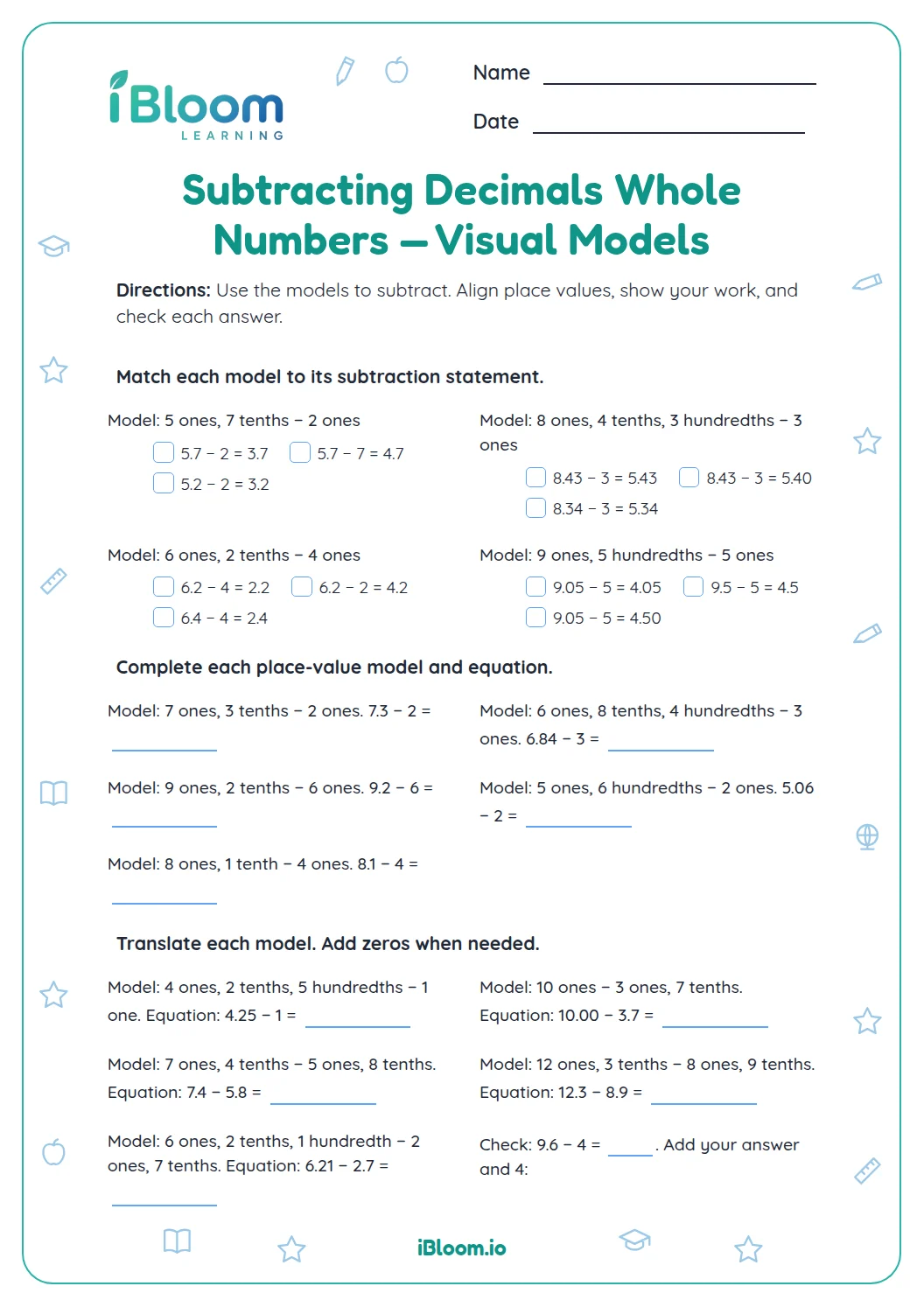
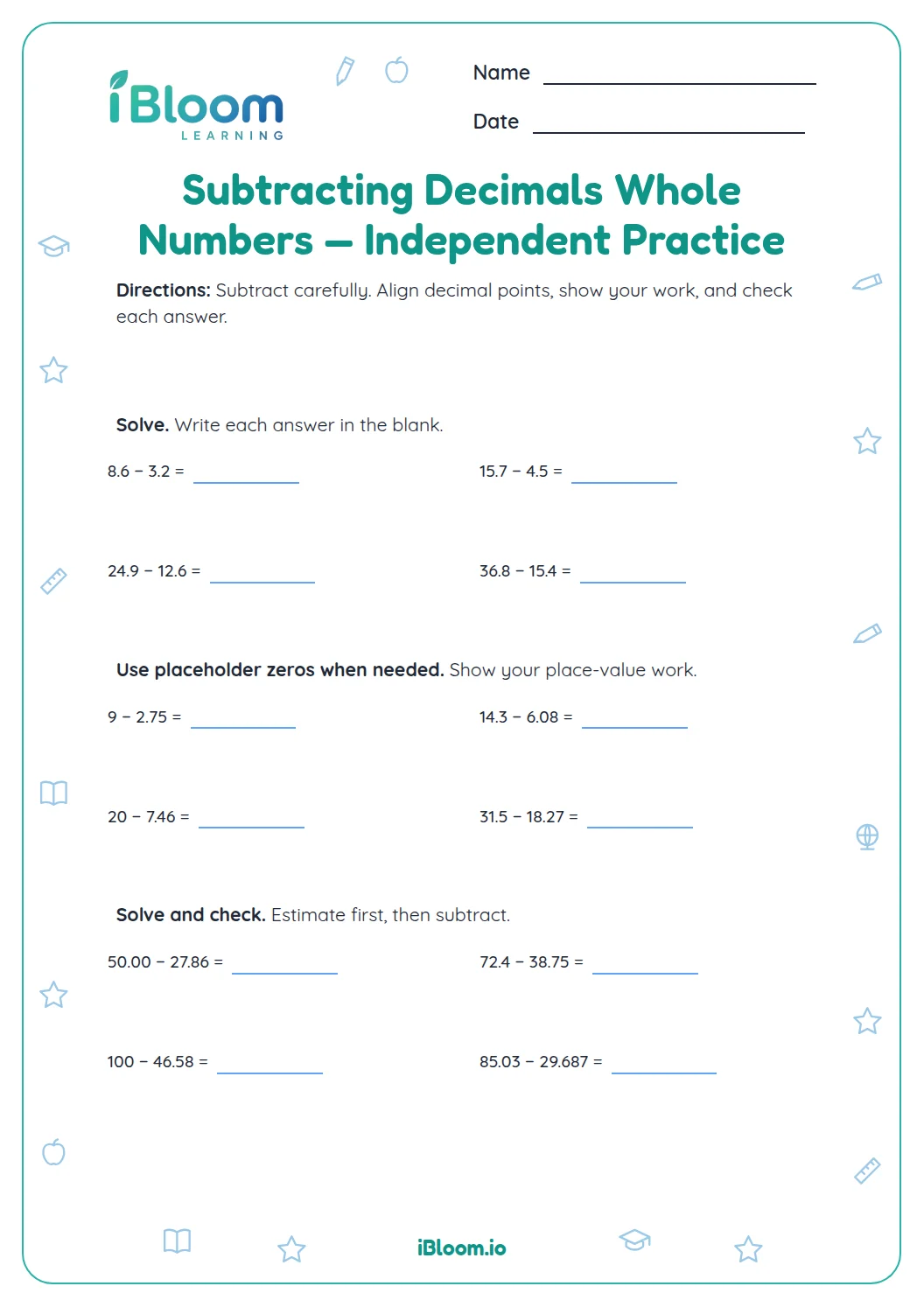
This Grade 5 worksheet builds the place-value habits needed to subtract decimals accurately. Students choose correct setups, add placeholder zeros when needed, solve decimal differences and apply subtraction in short measurement situations. The numbers include tenths and hundredths, with regrouping in several problems. Practice supports Common Core 5.NBT.B.7.
Aligned to 5.NBT.B.7
What is on this worksheet?
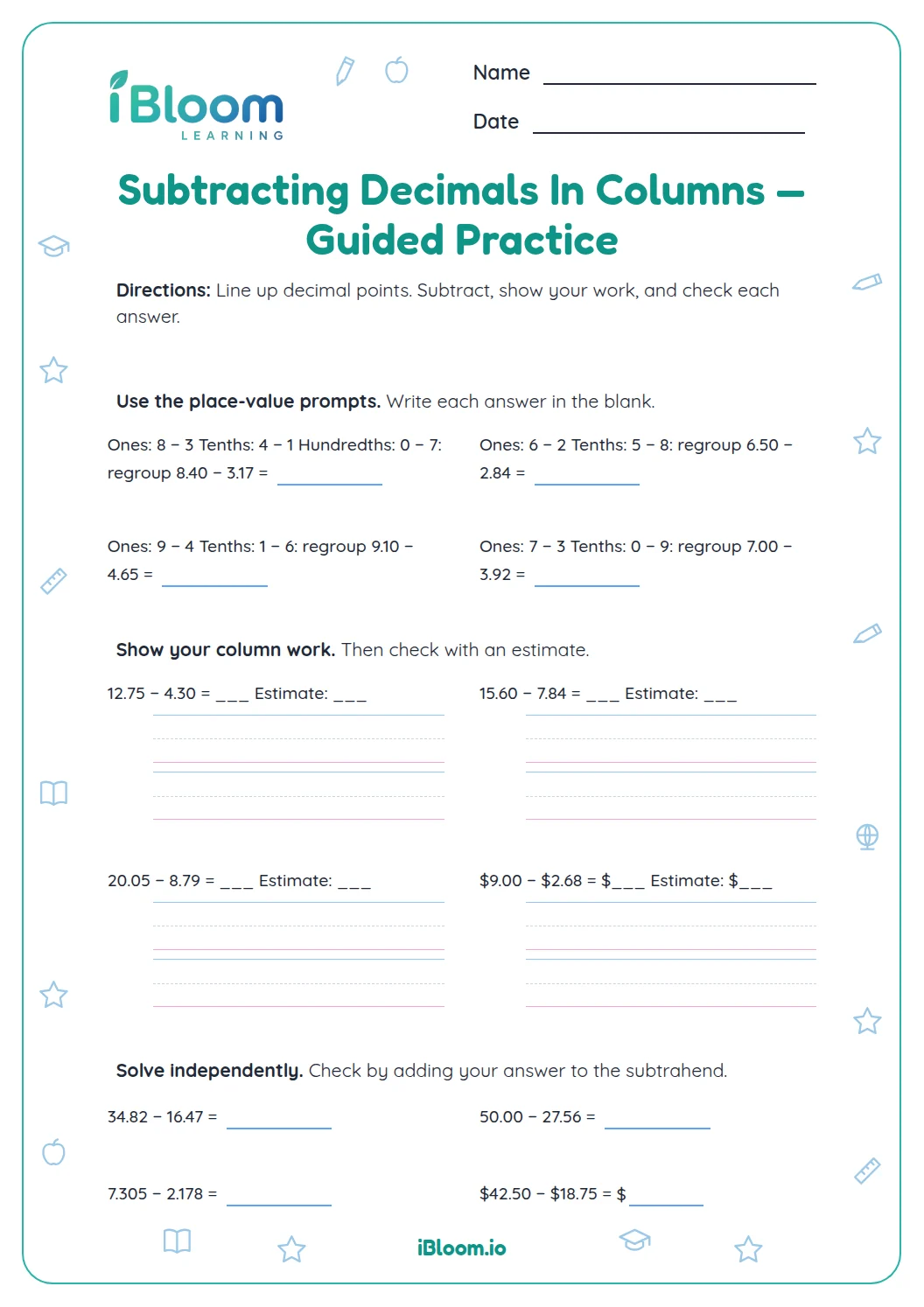
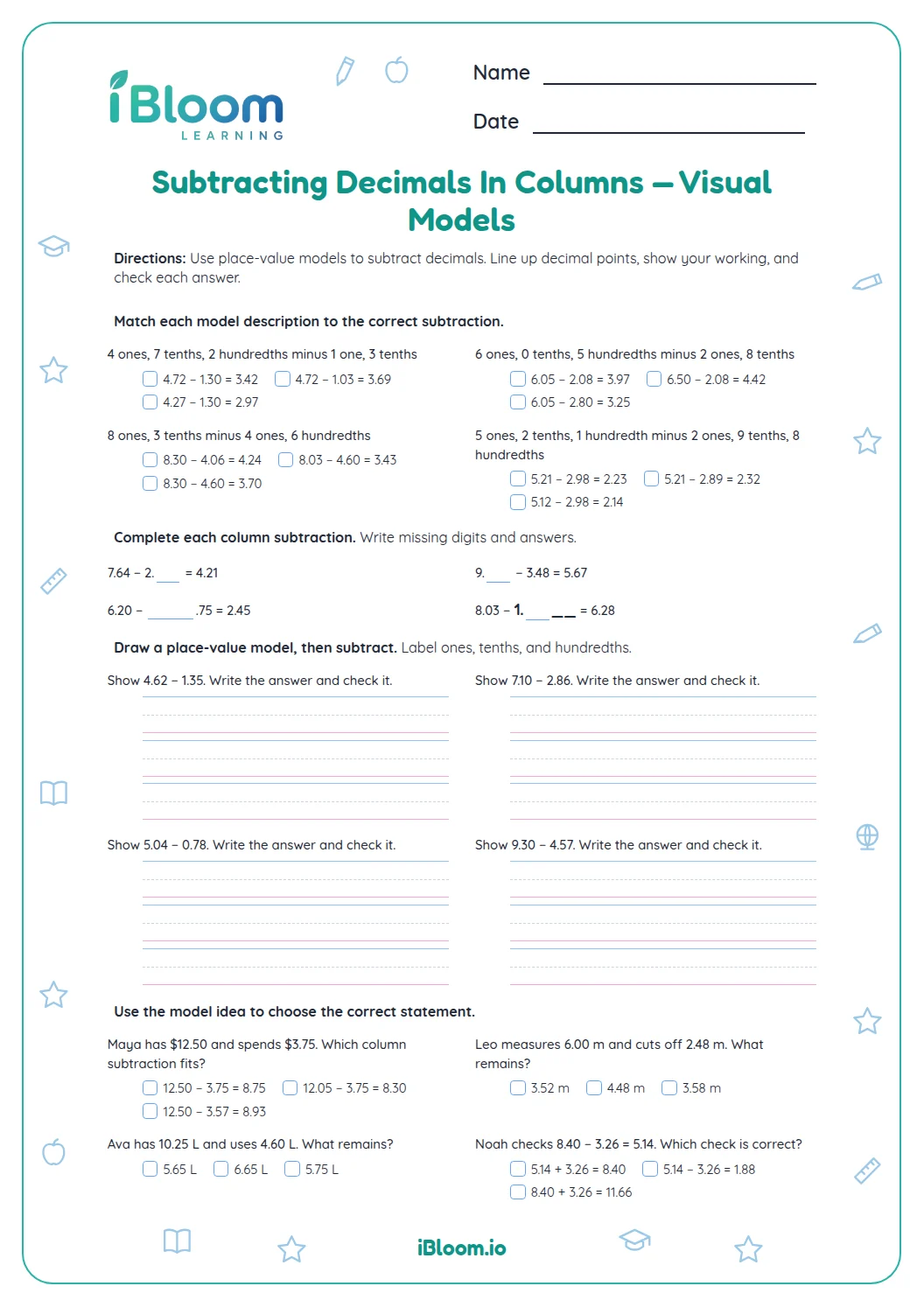
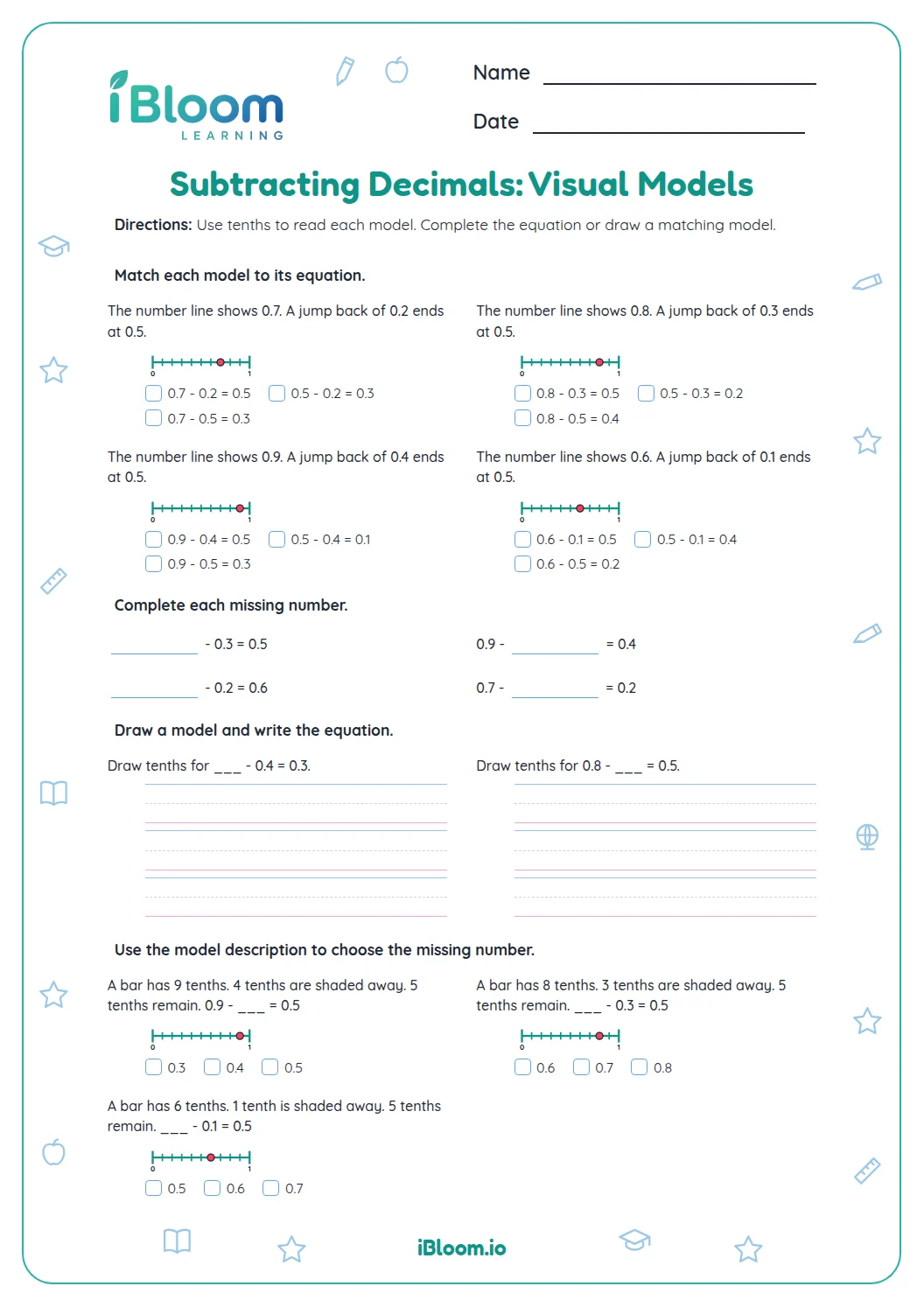
Questions 1–5 review decimal alignment and equivalent forms, including writing 7 as 7.00. Questions 6–13 give direct subtraction practice with tenths and hundredths.
Questions 14–15 apply subtraction to measurement problems. Question 16 asks students to explain a place-value check.
- Part A: line up place values and reason about equivalent forms (questions 1–5)
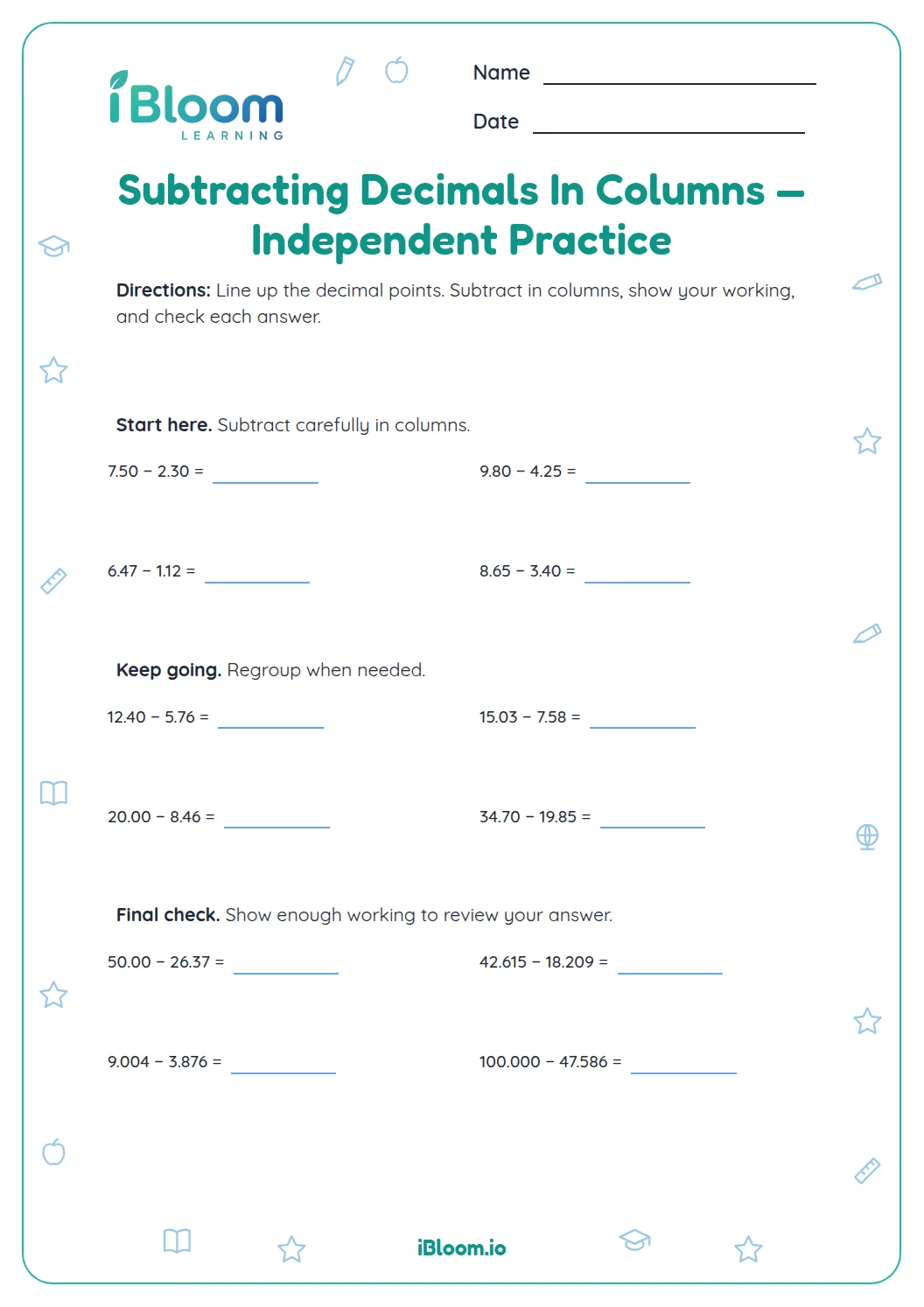
- Part B: subtract decimals with and without regrouping (questions 6–13)
- Part C: solve two measurement problems (questions 14–15)
- Part D: explain a place-value check (question 16)
Why do decimal points line up?
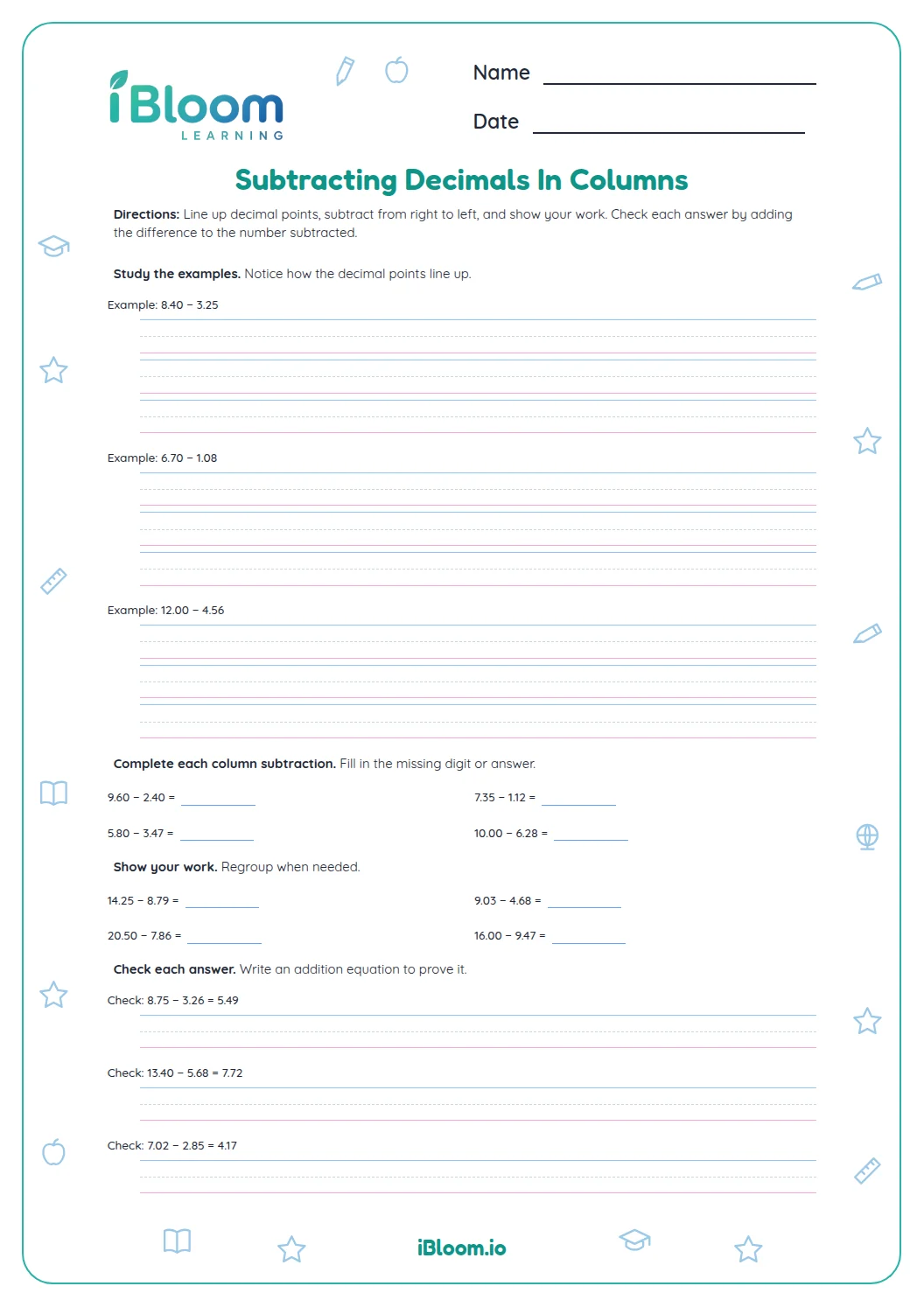
Digits in the same column represent the same place value. Lining up the decimal points places ones under ones, tenths under tenths and hundredths under hundredths.
A whole number can be written with a decimal point and zeros, such as 7.00. Those zeros do not change the value, but they make the columns easier to see.
- 1 6.20
- 2− 3.45
- 3Write the decimal points in one column before subtracting.
How can you check a subtraction answer?
Addition reverses subtraction. Add the difference to the number that was taken away; the result should match the starting number.
For 10.00 − 6.48 = 3.52, check with 6.48 + 3.52 = 10.00.
- 1Difference: 3.52
- 2Number subtracted: 6.48
- 3Check: 6.48 + 3.52 = 10.00
How to use this worksheet
- 1Read the direction under each part before answering.
- 2Work through the questions in order and use the space to show thinking.
- 3Use the separate answer key to review answers; talk through any response that needs more than one idea.
- 4Estimate the difference first, then add the result back to check it.
Common mistakes and quick fixes
The mistake
Subtracting digits in different place-value columns.
The fix
Line up decimal points and add placeholder zeros before subtracting.
The mistake
Forgetting to place the decimal point in the answer.
The fix
Bring the decimal point straight down from the aligned problem.
The mistake
Adding digits from mismatched place-value columns.
The fix
Line up decimal points and add placeholder zeros before subtracting.
Common Core alignment
This page gives Grade 5 practice with subtracting decimals and whole numbers. The cited Common Core standard describes the skill practiced here.
Use place value and written methods to operate with decimals to hundredths.
On this sheet: Students add, subtract, multiply and divide decimals to hundredths using concrete models or drawings and strategies based on place value, properties of operations and the relationship between addition and subtraction.
Show the official wordingHide the official wording
Add, subtract, multiply, and divide decimals to hundredths, using concrete models or drawings and strategies based on place value, properties of operations, and/or the relationship between addition and subtraction; relate the strategy to a written method and explain the reasoning used.
What to practice next
Make more practice
Further reading
Questions parents and teachers ask
Why can I add zeros to a decimal before subtracting?
A zero at the end of a decimal does not change its value. For example, 6.2 and 6.20 are equal. Writing 6.20 can make the tenths and hundredths columns easier to see when subtracting from a number with two decimal places.
What should I do when the top digit is smaller?
Regroup from the next place value, just as you do in whole-number subtraction. Keep the decimal points aligned as you work, and remember that regrouping one whole gives ten tenths or one tenth gives ten hundredths. Borrowing changes the digits but preserves the value.
How can I check a decimal subtraction answer?
Add the difference to the number that was subtracted. The sum should equal the starting number. You can also estimate before calculating: a reasonable answer should be close to the difference between the rounded numbers. Estimation can reveal a misplaced decimal point quickly.
Why do decimal points need to line up?
Each digit belongs to a place value such as ones, tenths or hundredths. Lining up decimal points puts matching places in the same column. This lets the usual subtraction algorithm work without mixing tenths with hundredths. These place-value names describe the columns after the decimal point.
How can I check a decimal subtraction answer?
Add the difference to the number that was subtracted. The sum should equal the starting number. You can also estimate by rounding the values before subtracting; a result far from the estimate may point to a misplaced decimal point or a regrouping error.