





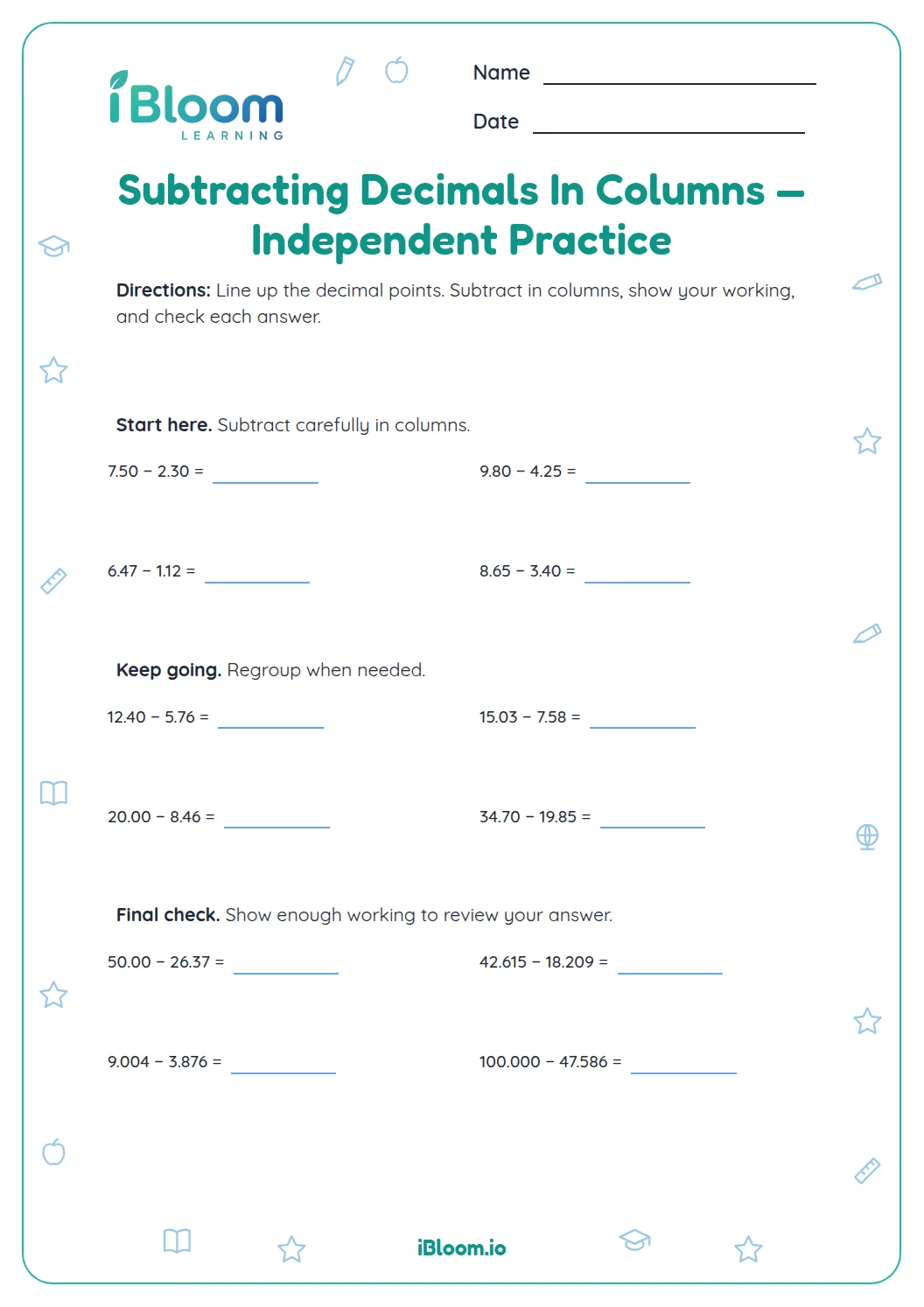
About this worksheet
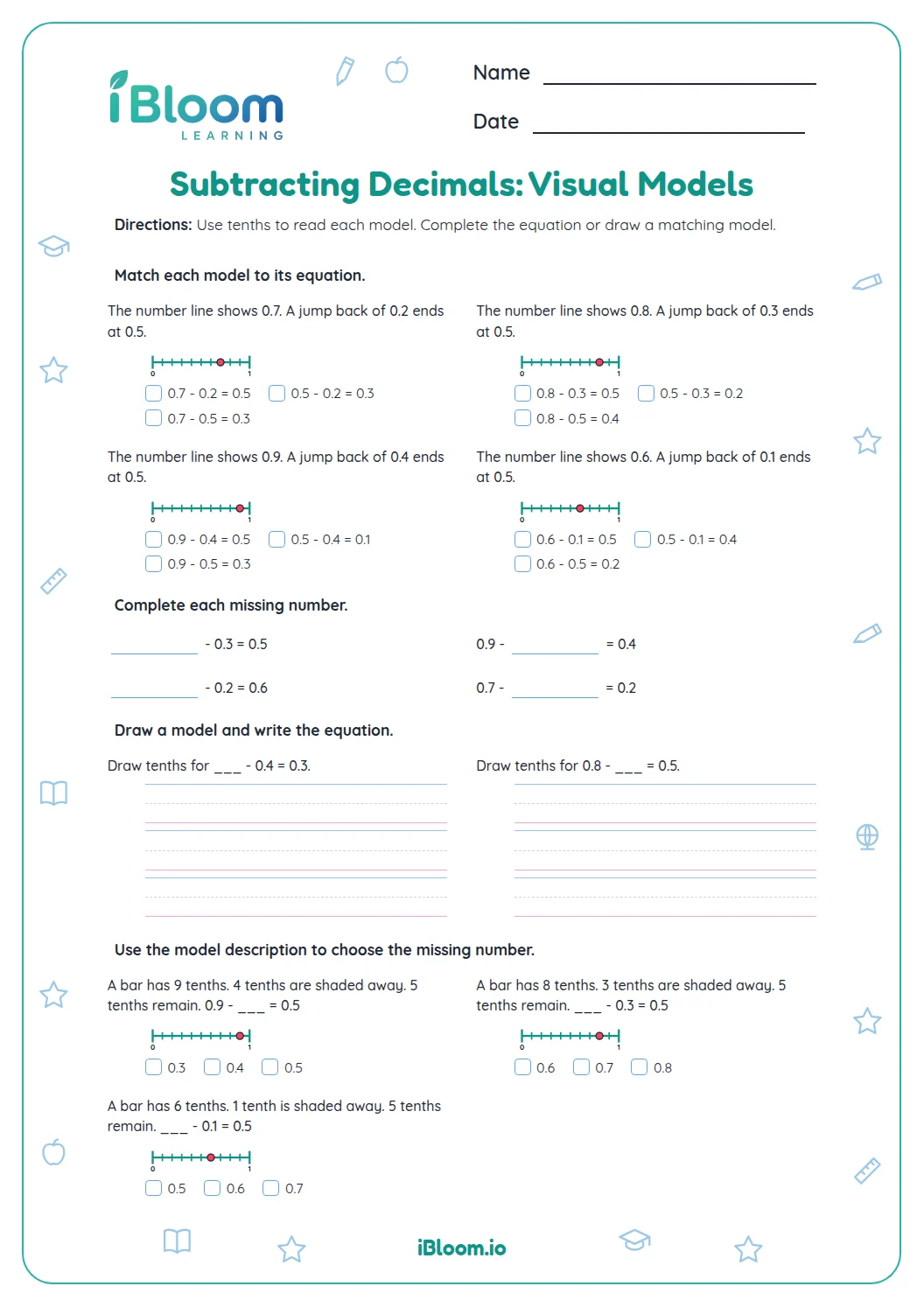
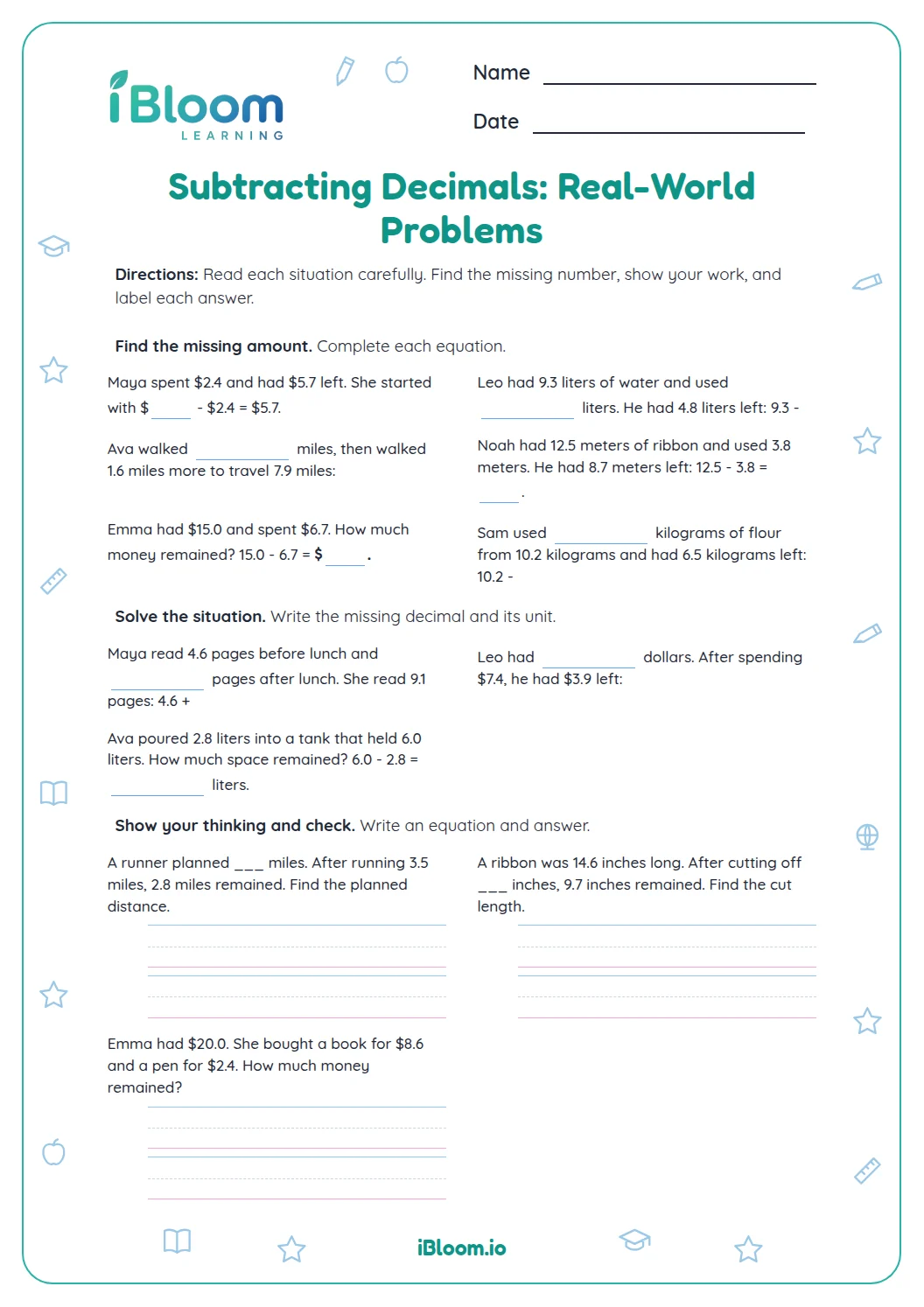
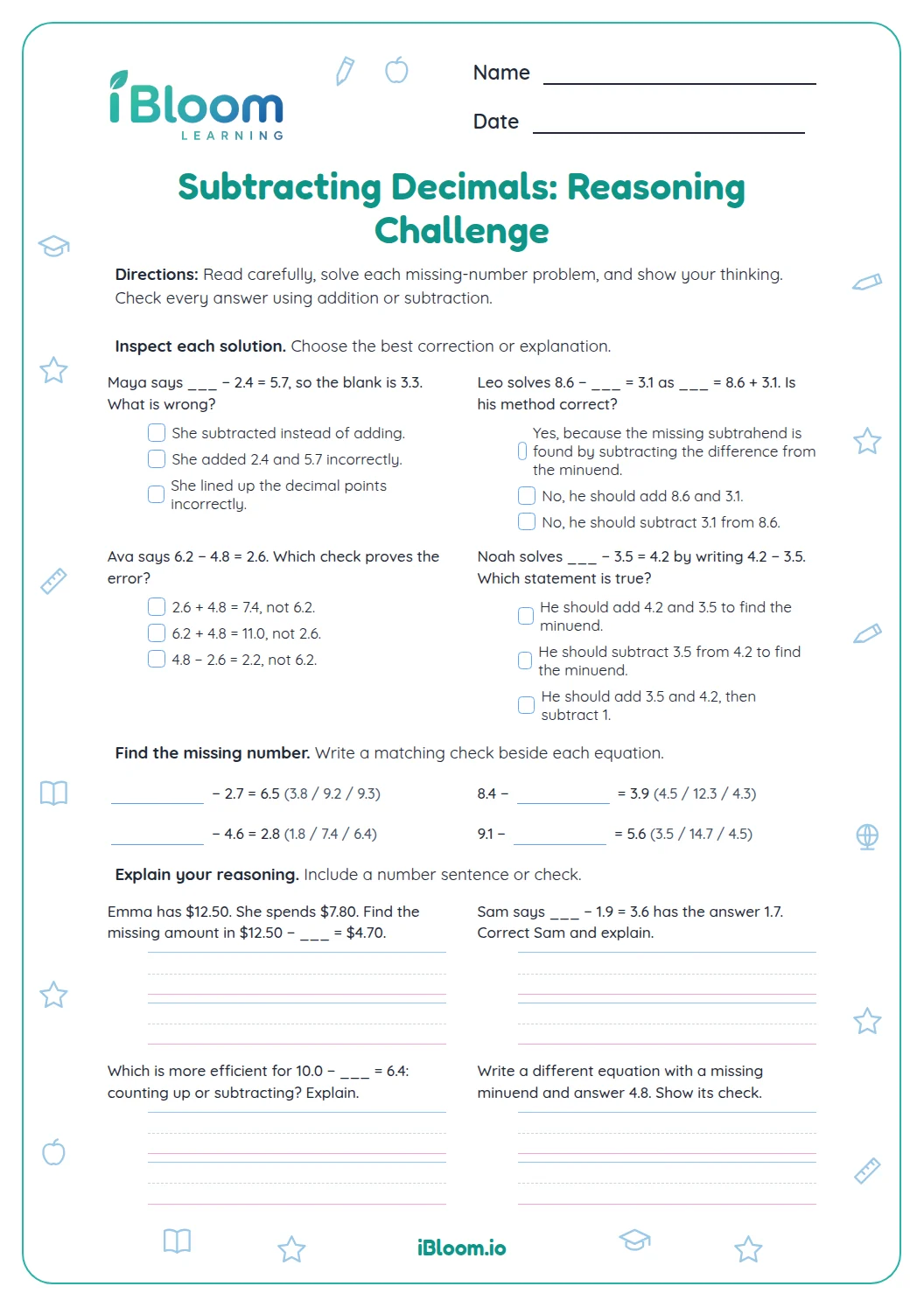
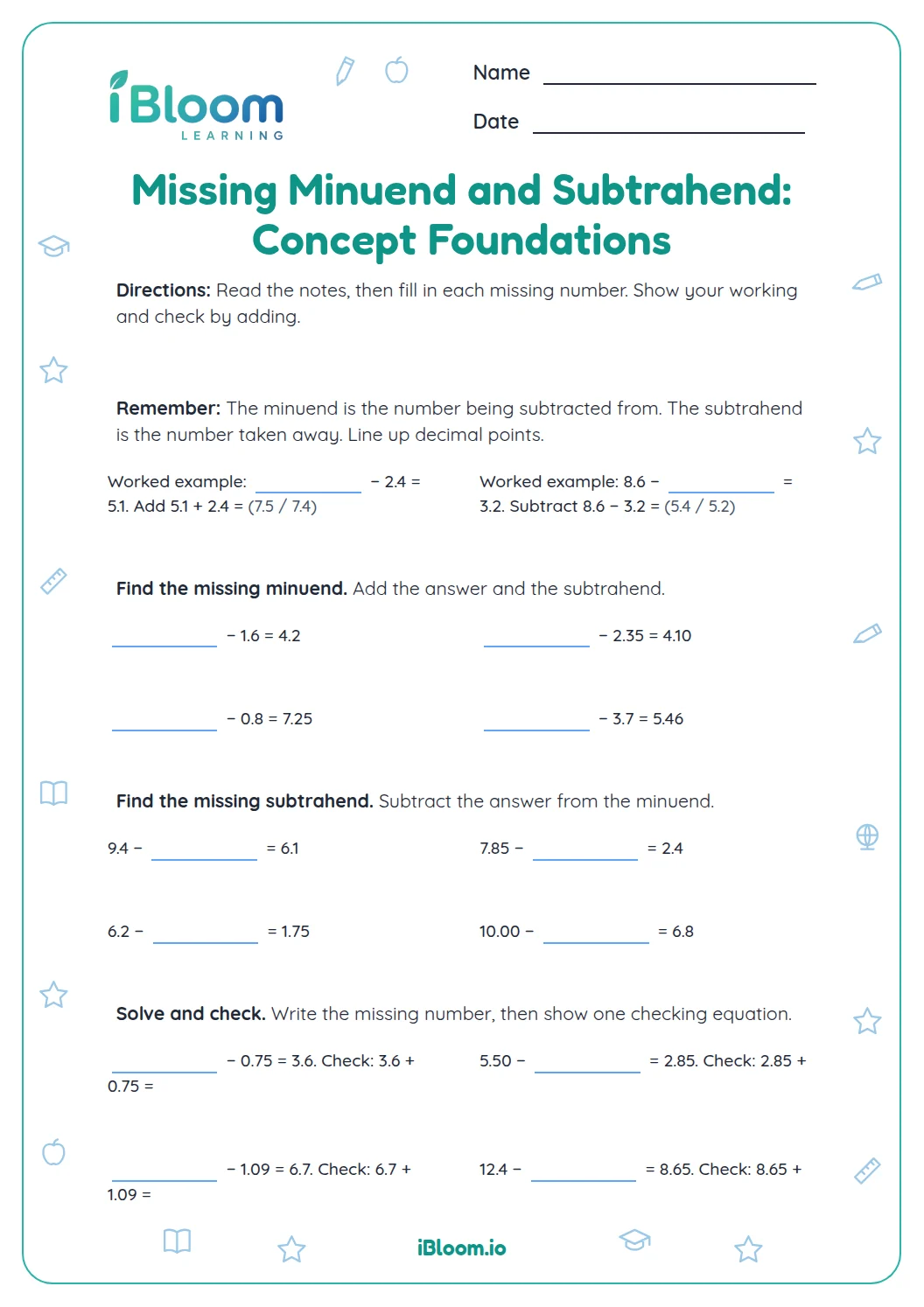
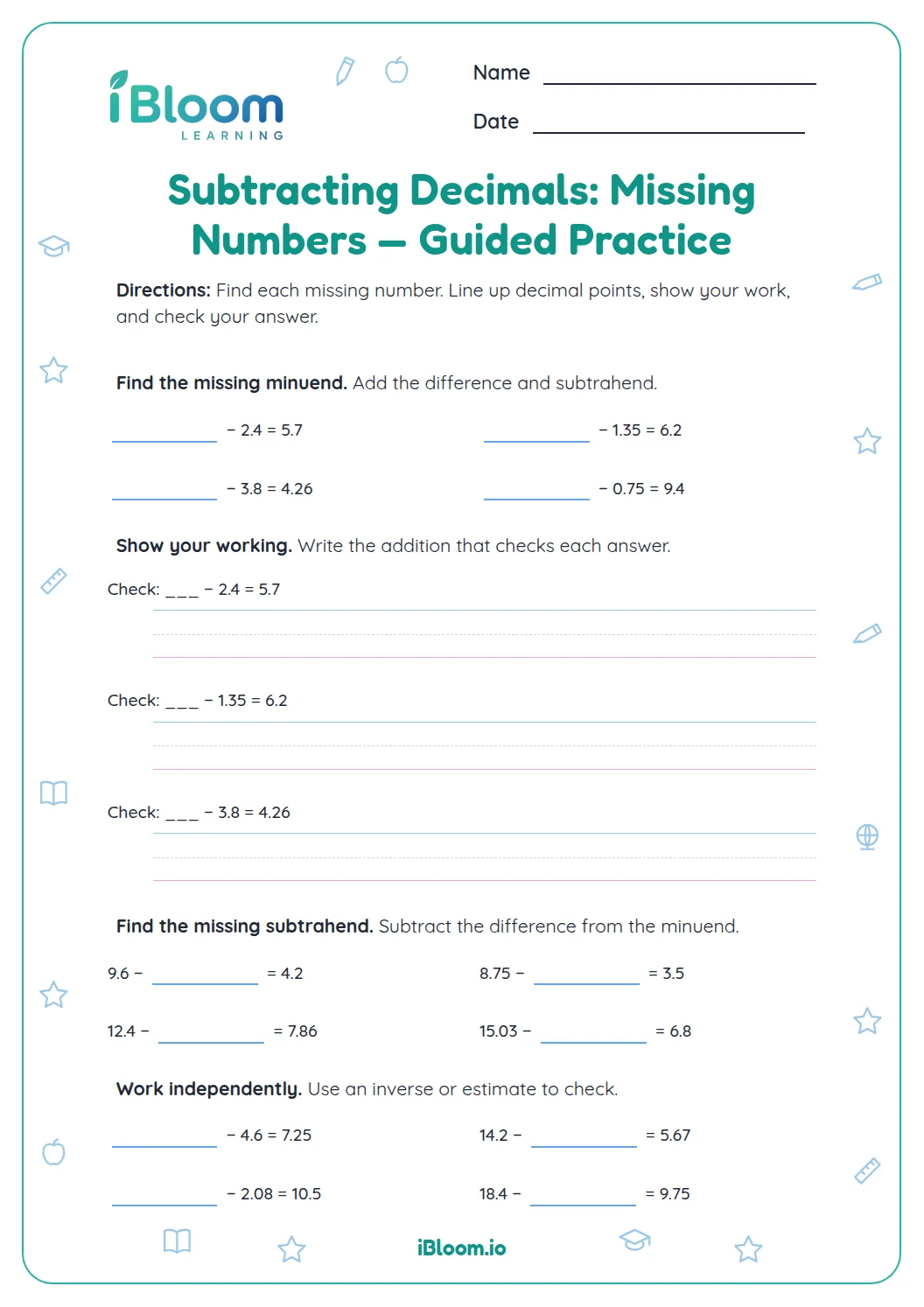
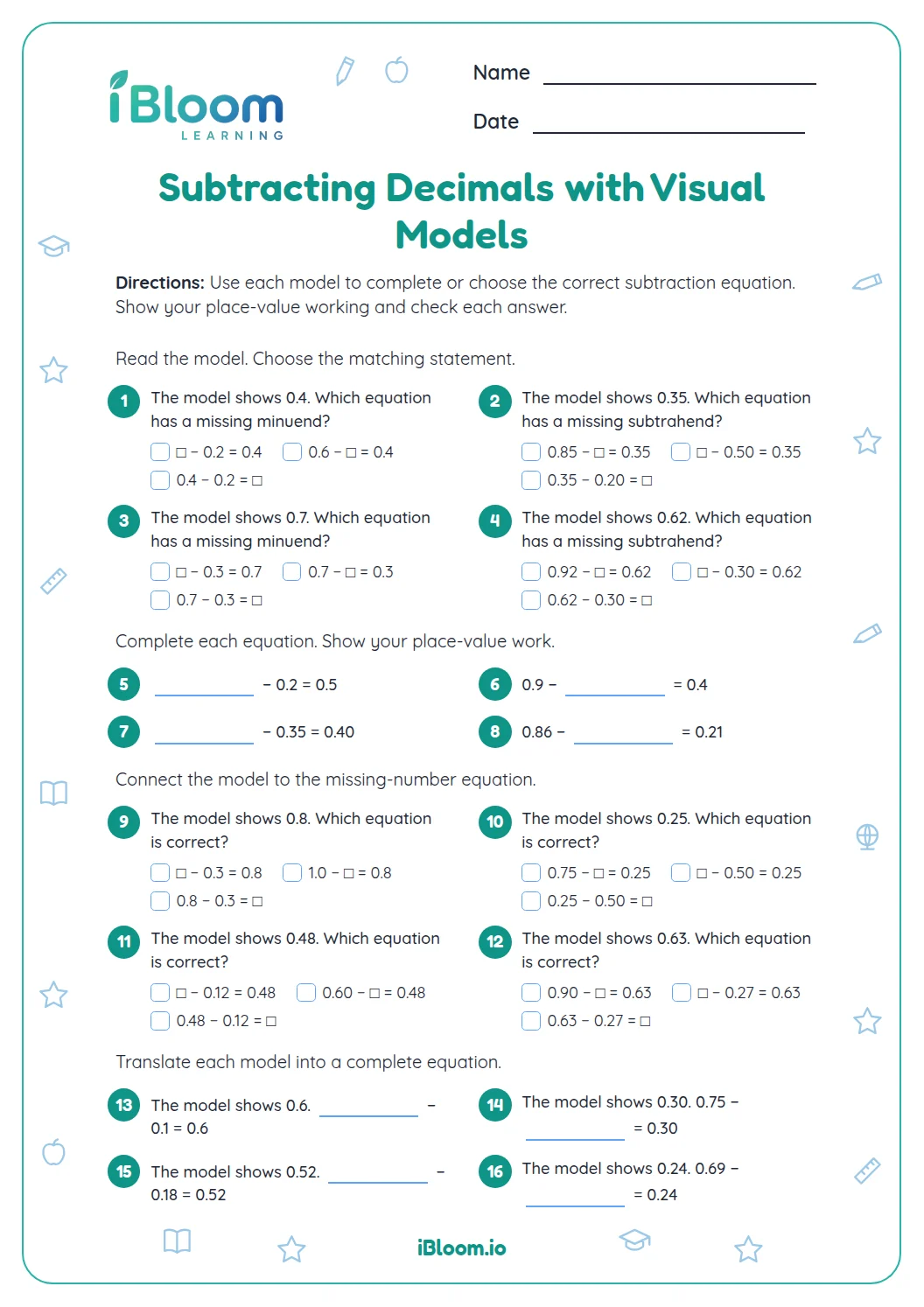
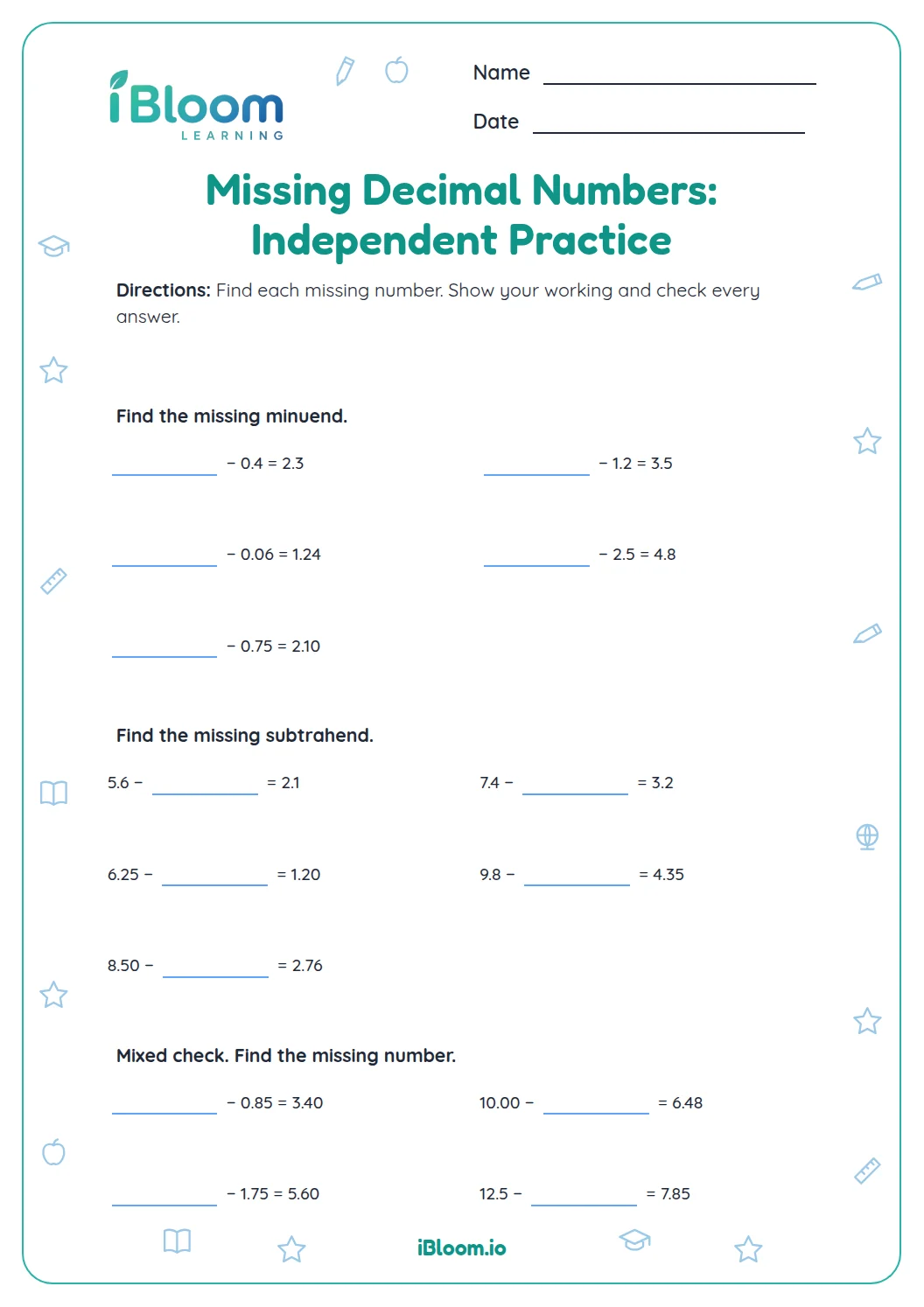
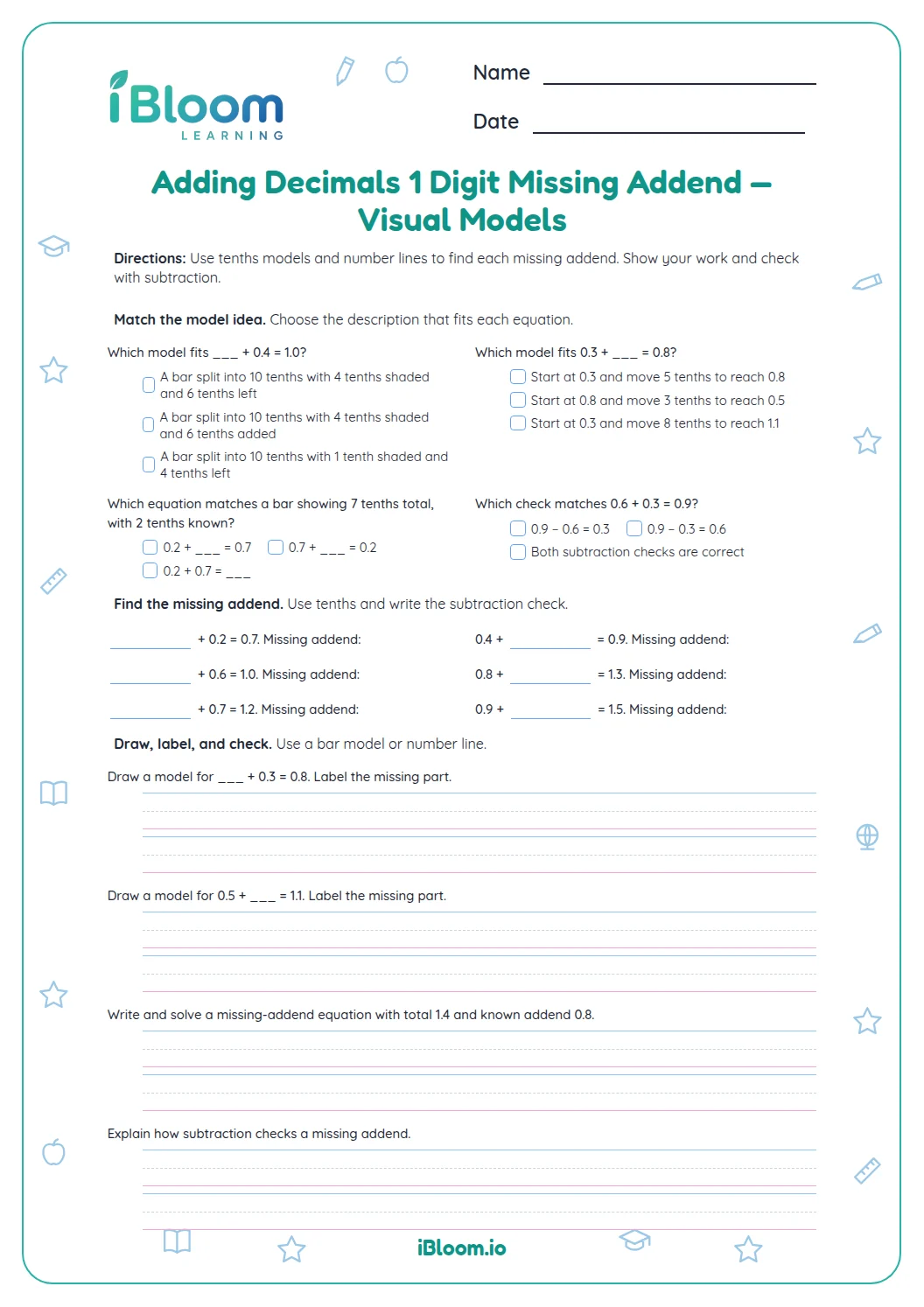
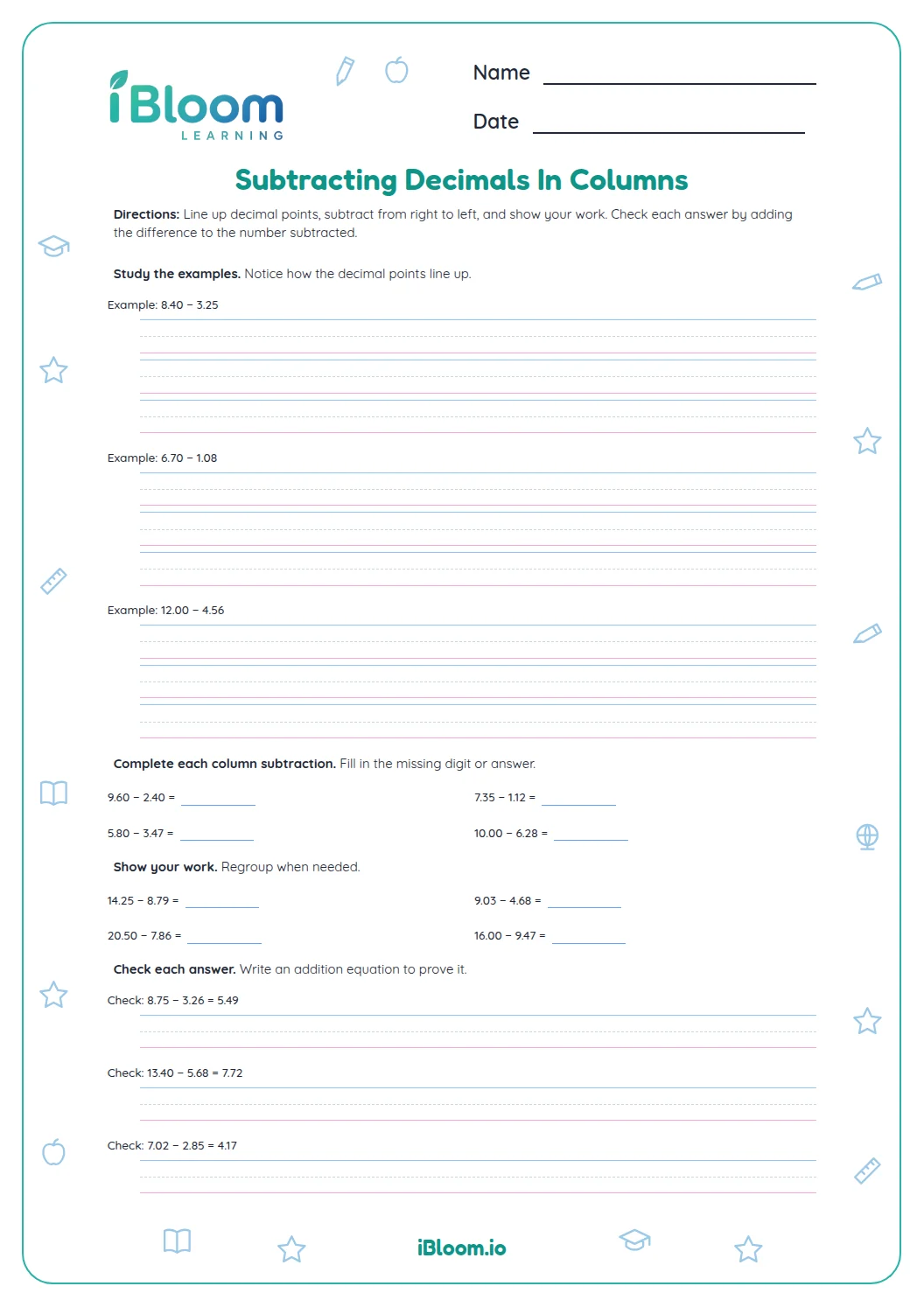
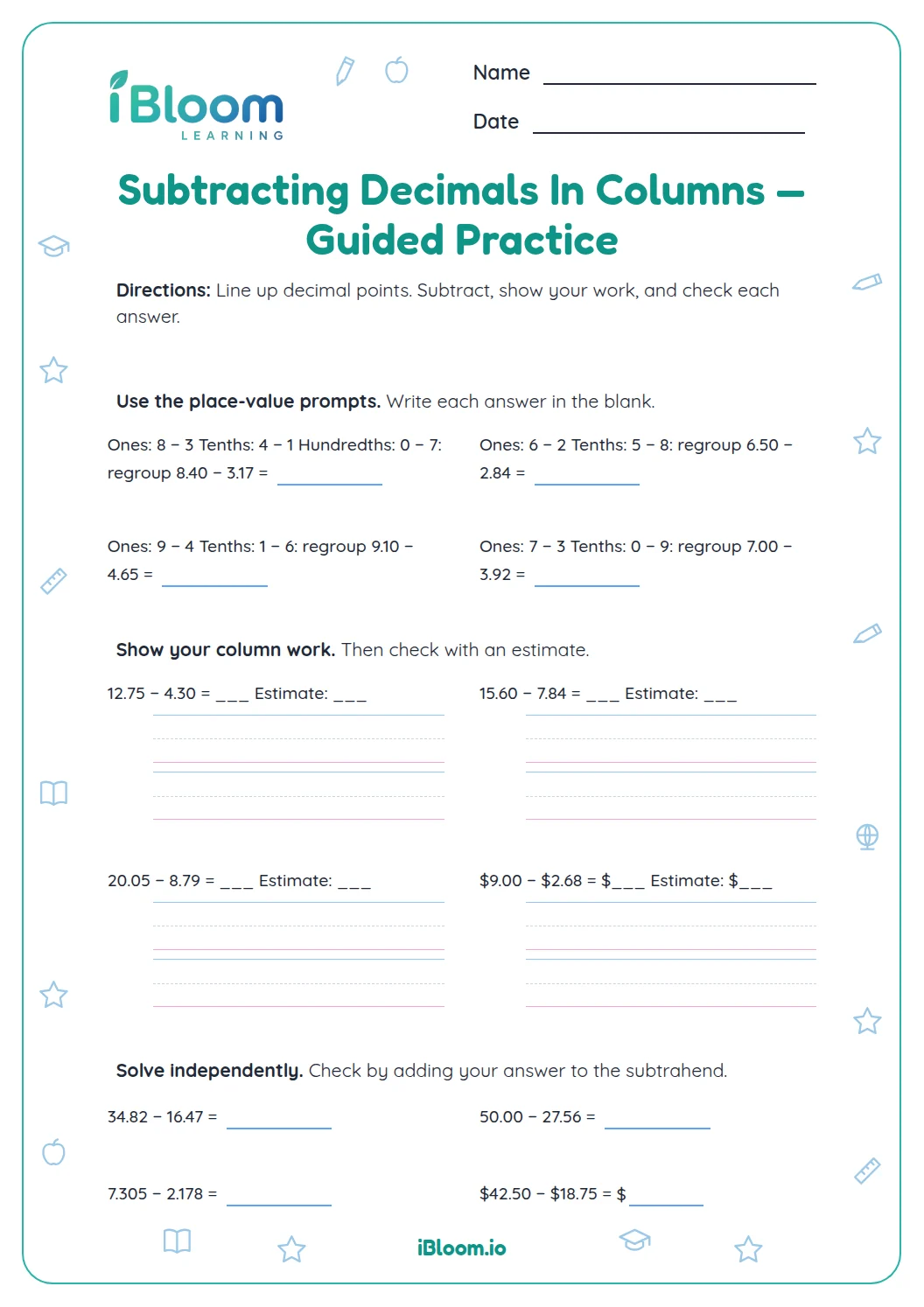
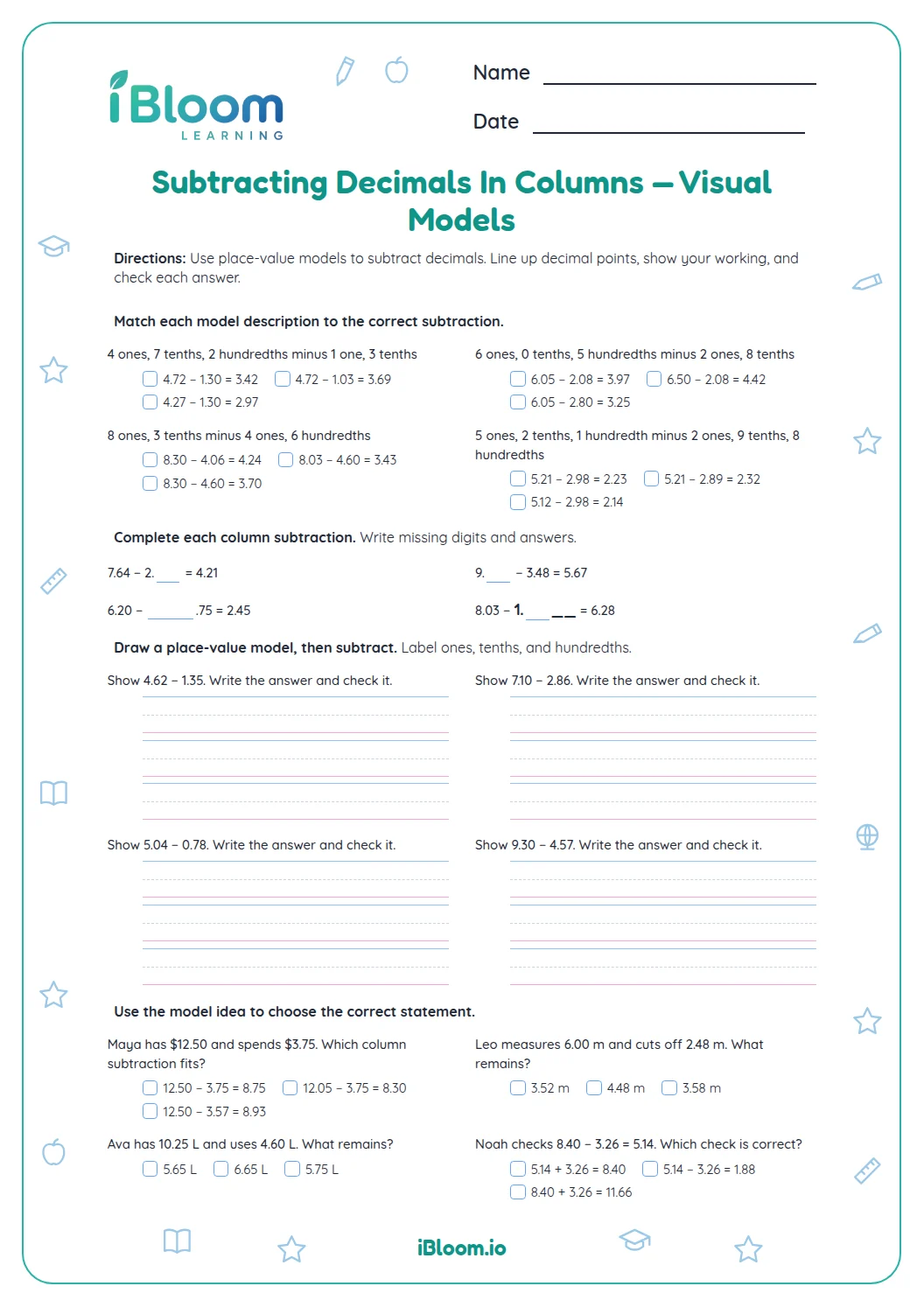
This free Grade 5 decimals worksheet focuses on subtraction equations with one missing number. In Part A, the first number is missing, so students add the difference to the number subtracted to recover the starting amount. In Part B, the subtrahend is missing, so students subtract the difference from the starting amount. All values are decimals to tenths, and the answer key lets students check each equation.
Aligned to 5.NBT.B.7
How do you find a missing minuend?
The minuend is the number from which another number is subtracted. In ___ − 1.2 = 2.3, the missing start must be large enough that taking away 1.2 leaves 2.3. Add the difference and subtrahend: 2.3 + 1.2 = 3.5.
Check by substitution: 3.5 − 1.2 = 2.3.
How do you find a missing subtrahend?
In 6.7 − ___ = 2.5, the starting amount and the difference are known. The amount taken away is 6.7 − 2.5 = 4.2. Substitution confirms it: 6.7 − 4.2 = 2.5.
Align decimal points when subtracting, and use a zero as a placeholder if needed.
What kinds of equations are on the sheet?
Part A has eight missing-minuend equations. Part B has eight missing-subtrahend equations. Every number is given to tenths, so the focus stays on choosing the inverse operation and keeping the decimal place aligned.
How to use this worksheet
- 1Read the equation and identify whether the first or second number is missing.
- 2For a missing minuend, add the subtrahend and difference.
- 3For a missing subtrahend, subtract the difference from the minuend.
- 4Line up decimal points and calculate to the tenths place.
- 5Put the missing value back into the equation to check it.
Common mistakes and quick fixes
The mistake
Adding the two known numbers when the subtrahend is missing.
The fix
For a missing subtrahend, subtract the difference from the minuend.
The mistake
Subtracting the difference from the subtrahend when the minuend is missing.
The fix
Add the subtrahend and difference to rebuild the starting amount.
The mistake
Misaligning tenths digits.
The fix
Write each decimal point directly under the other before calculating.
Common Core alignment
Students use place-value strategies and the relationship between addition and subtraction.
Use place value and addition–subtraction relationships to solve decimal subtraction equations.
On this sheet:
Show the official wordingHide the official wording
Add, subtract, multiply, and divide decimals to hundredths, using concrete models or drawings and strategies based on place value, properties of operations, and/or the relationship between addition and subtraction; relate the strategy to a written method and explain the reasoning used.
What to practice next
Make more practice
Further reading
Questions parents and teachers ask
What is a missing minuend?
The minuend is the first number in a subtraction equation, the amount that another number is taken from. In ___ − 1.2 = 2.3, students add 1.2 and 2.3 to find the missing starting amount, 3.5. Substitute the value into the original equation; the subtraction should reproduce the stated difference exactly.
How do you find a missing subtrahend?
Subtract the difference from the starting amount. For example, in 6.7 − ___ = 2.5, calculate 6.7 − 2.5 = 4.2. Then check that 6.7 − 4.2 equals 2.5. Substitute the value into the original equation; the subtraction should reproduce the stated difference exactly.
How many problems are included?
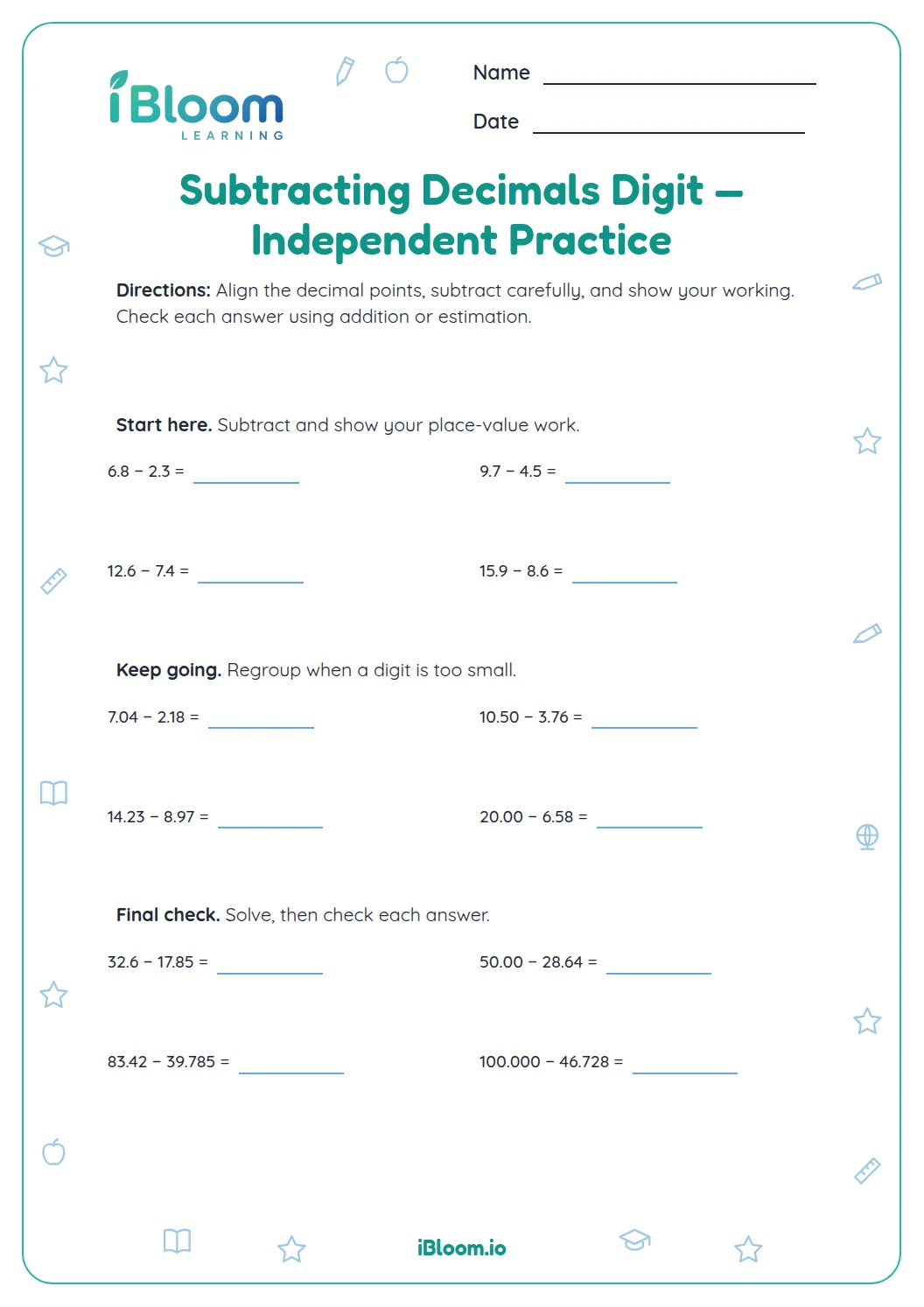
There are 16 fill-in equations across two worksheet pages. The first eight have a missing minuend, and the next eight have a missing subtrahend. An answer key follows the worksheet. Substitute the value into the original equation; the subtraction should reproduce the stated difference exactly.
What decimal places appear in the problems?
Each number is written to the tenths place, with one digit after the decimal point. Students still need to align decimal points carefully, especially when a subtraction requires regrouping. Substitute the value into the original equation; the subtraction should reproduce the stated difference exactly.
How can I check a missing-number answer?
Replace the blank with the proposed answer and compute the subtraction. If the result matches the number after the equals sign, the missing value is correct. For instance, check 3.5 − 1.2 = 2.3. Substitute the value into the original equation; the subtraction should reproduce the stated difference exactly.